
Home » 2016 (Page 14)
Yearly Archives: 2016
RIP for BMI — New Research Proves It’s Worthless for Employee Wellness Programs
Looks like a lot of you employees should be getting your employers to refund your penalties for not losing weight…or retroactively award you your incentives…read on. One way or the other, it’s time to end corporate fat-shaming.
Here is yet another in the unending stream of reasons to be certain all those Koop-award-winning savings claims and just about every other announced wellness savings figure are fabricated: they are all based partially or totally on Body Mass Index (BMI) reductions among active motivated participants — but BMI turns out to be a worthless indicator of health status. (We’ve already pointed out that the whole concept of measuring anything on “active motivated participants” is garbage anyway, as Aetna recently proved by accidentally telling the truth.)
How worthless? A study due out in the International Journal of Obesity says 75-million Americans are misclassified, meaning their BMI doesn’t match their true underlying health status. (As an aside, this scoop comes from this morning’s STAT News, the new must-read healthcare daily.) Many people with high BMIs are healthy, while many people with low BMIs are high-risk. Shocking! Who knew?
Naturally (cue the smirk on our faces), we did. As recently as in last month’s expose of The Vitality Group‘s squirrely outcomes claims, we pointed out that BMI is a 200-year-old construct based on faulty reasoning to begin with — and noted it has been challenged on multiple bases for years. We were also the first to observe that BMIs don’t correlate with a company’s financial success. And our series: “The Belly of the Beast” chronicled one vendor’s misunderstanding of BMIs as well, though I understand they are improving quite a bit now and we wish them the best and look forward to telling you about their improvements.
The implications of this new research are staggering:
- Companies need to refund penalties, and also award incentives retroactively, to people who were unfairly denied their money because wellness vendors don’t know how to measure outcomes;
- The “subject matter experts” who wrote the HERO Report need to retract basically their whole ball of wax, since it obsesses with BMI — and they need to apologize to me for inaccurately calling my claims “inaccurate” when they are specifically and relentlessly urging readers to do the wrong thing;
- Wellness vendors need to learn a thing or two about wellness, for a change.
- And guess who’s 3.27-to-1 ROI was based on studies obsessing with BMI? Kate Baicker, that’s who. Despite multiple hedges and walk-backs, she has yet to issue a formal retraction of her puff-piece on wellness economics. This gives her a good excuse.
Of course, in wellness, “the implications are staggering” means: “business as usual,” and they won’t do a thing to address these new findings.
The EEOC can’t ignore this. How can they give employers more leeway — as they now intend to do — to fine employees based on a variable they now know to be wrong?
Quizzify 1, Wellness Vendors 0
Those of you who use Quizzify don’t have to fret, by the way. The correct answers to the Quizzify question: “What is a BMI?” already include:
- “A crude measure comparing your height and weight,”
- “Can be very misleading if you in otherwise good condition,” and
- “Is good to know but not to obsess with.”
(For those of you keeping score at home, Quizzify’s incorrect answer is: “It stands for ‘Bowel Movement Intensity,’ and indicates how much effort you required in order to stay regular.”)
Even so, we will be adjusting the answers going forward to take into account this new research, starting next week. We expect the wellness ignorati will follow suit in a few years — once they stop advocating lowfat diets, PSA tests, and annual mammograms. The good news is that they generally no longer recommend bloodletting.
Share this:

Read Their Lips: An Apology to HERO Is Long Overdue
You may remember our series on the HERO Outcomes Guidelines Report. We had observed that their own numbers showed wellness loses money. Specifically, they showed a program costing $18/person/year or $1.50 PMPM:

Gross savings were pegged at $0.99 PMPM:

Silly ol’ me reasoned that if a program costs $0.51 more per month than it saves, that annual net losses would exceed $6.00. Of course, that’s before counting all the other costs that the HERO Guidebook listed (pp 10-11) but conveniently overlooked in their actual cost calculation:

Silly ol’ me also assumed these cost and savings figures had been approved by the 60 “subject matter experts” who reached “consensus” in this report, consensus being a word that appears 16 times. The report itself required “two years and countless hours of collaboration.” (p. 3)
Hopefully you can see how I might have been inadvertently misled into thinking the report actually did represent expert consensus, reached after two years and countless hours of collaboration.
I’ve since learned that the nice people at HERO are very upset with me for falsely assuming that the information in their report represents the information in their report.
They call my lapse of integrity “outrageous.” This adjective was contained in a letter read but not sent to me by a member of the HERO Board. (At the risk of blowing his cover, this is a guy known for his integrity.) Staywell’s Paul Terry, whose own escapades have been well-chronicled on The Health Care Blog, had apparently circulated this letter around a while back on behalf of HERO.
Specifically, Terry stated it was “outrageous” that I had failed to mention that this money-losing scenario in the HERO Report was just one example of a wellness outcome. For some unknown reason, HERO elected to illustrate the financial benefits of wellness with an example that loses money. That would be like a tobacco company illustrating the health benefits of smoking with this example:

Piling on, Ron Goetzel also disavowed the HERO report’s figures during our debate, stating that his numbers are “wildly different” from the ones in the report he co-authored.
Apology and Atonement
I apologize.
To atone, I will substitute Ron’s recommended “wildly different” wellness budget of $150 per employee per year for the report’s $18 PEPY. Then let’s adjust the $0.99 PEPM savings in reduced wellness-sensitive medical event (WSME) spending for the natural decline in WSMEs that occurred over the same period, according to Truven. Truven is Ron’s employer and hence is presumably the source of Ron’s “wildly different” figures for WSMEs.

If you can’t read Truven’s numbers above, they show a decline in WSMEs in the working-age insured population between 2009 and 2012 of 23%. This actually greater than the 17% (3.14 down to 2.62 “potentially preventable hospitalizations” per 1000) decline in the HERO example over the same period:

But we’ll give HERO the benefit of the doubt and say doing wellness reduced wellness-sensitive events as much as not doing wellness would have reduced them.
That actually is the “benefit of the doubt” because a review of all the Truven data compiled for the government shows that indeed WSMEs have consistently trended more favorably in the non-exposed populations than in the”privately insured” population below (in green), much of which was exposed to wellness.
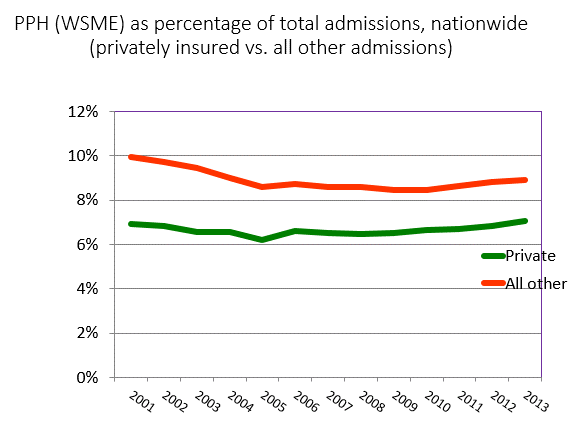
Adjusting for the benefit-of-the-doubt secular decline in WSMEs wipes out gross savings — even without counting all the following claims costs that HERO says should actually increase:

Or maybe those cost increases also only happen in this one rogue example in this one rogue chapter. And maybe this one rogue chapter (Chapter 1) just contains a terrible, horrible, no good, very bad example that somehow accidentally found its way into the HERO Guidelines Report even though none of the 60 subject matter experts believe it. Or maybe two years wasn’t enough time for these experts to review it, though my review required only five minutes. Perhaps that’s because when I read, I don’t move my lips.
So…
Per HERO’s and Ron’s request, I’ll replace their original estimate of $6 in annual losses PEPY with Ron’s new net loss estimate of $150 PEPY. And that’s without the multitudinous added costs that they also listed but never counted.
All in, my original estimate was off by almost two decimal points. However, I take responsibility only for the magnitude of the error, not for the delay in correcting it. If HERO had told me last year to substitute these real figures for their rogue example, I would have corrected the figures posthaste.
And my lips would have morphed into a great big smile.
Share this:

Goofus and Gallant Meet Viverae and Quizzify
Goofus and Gallant is a Highlights for Children feature contrasting different behaviors. Example:


Viverae’s and Quizzify’s guarantees lend themselves to this type of comparison. Honestly, we don’t even know if Viverae still offer theirs. Nonetheless, through the years a number of people have sent it to us and asked for our help interpreting it. (That’s a polite phrasing of what the emails said, and of course we are nothing if not polite.) It provides an excellent opportunity to learn how to read a guarantee with a discerning eye, and we thank Viverae for offering it and hope they too are able to gain some insights from our analysis of it.
Here is Viverae’s guarantee, which we will review clause by clause:

Goofus: Viverae’s Clause #1 doesn’t allow any leeway in program design.
Gallant: Quizzify offers the guarantee even if you want to tweak the program design.
Goofus: Viverae’s Clause #2 is an EEOC violation. You can’t “require” employees to do biometric screens. The program wouldn’t be voluntary. You might as well just send a memo to your employees with the phone number of the EEOC and tell them to sue you.
Gallant: Quizzify guarantees no EEOC lawsuits, and actually indemnifies against them.
Goofus: Viverae’s Clause #3 would seem fairly self-evident–except that in wellness, as the example at the end of this posting* shows, some wellness vendors don’t know there are 12 months in a year.
Gallant: Quizzify assumes its customers know that a year has 12 months in it, so this clause isn’t part of our guarantee.
Goofus: Viverae’s Clause #4 requires you to not only sign up for 3 years to get this 20% guarantee in the third year only, but also to waive your rights to early termination. So basically they are saying: “If you sign up for 3 years with no ‘out’ clause, we might possibly give you a guarantee worth 6.67%/year on average, assuming we measure validly.”
Gallant: Quizzify’s price list offers customers discounts exceeding 6.7% a year for multiyear contracts anyway, even before any guarantee, and allows not-for-cause termination for a small upcharge.
Gallant: Quizzify’s guarantee is 100% in all years, not 20% in year 3.
Goofus: Viverae’s Clause #5 requires a minimum number of 1000 employees, making it off-limits to more than 98% of America’s employers.
Gallant: Quizzify offers a straight 100% satisfaction guarantee if the number of eligible employees is too small to measure savings objectively.
Goofus: Viverae’s employee incentive/penalty requirement in Clause #6 is the “maximum allowed by law.”
Gallant: Quizzify requires a minimum incentive of only $100. We believe that the program should be attractive enough that you don’t need to force employees to participate.
Goofus: Viverae’s Clause #7 requires all carriers and PBMs for all years to turn over all employee-identifiable claims files. Since Viverae is not HIPAA-compliant, that creates a HIPAA issue. (In all fairness to Viverae, most wellness vendors are not HIPAA-compliant. Quizzify is the exception. Quizzify doesn’t collect or store private health information, so HIPAA doesn’t apply.)
It also means Viverae determines how much money Viverae saved, with no oversight.
Gallant: Quizzify allows the customer or its consultant to complete its simple claims extraction algorithm and determine savings, or Quizzify can do it for them. Its claims extraction algorithm is the industry standard required by the Intel-GE Care Innovations Validation Institute.
Speaking of the Validation Institute, Goofus’s guarantee is not validated by them.
Quizzify’s is.

Postscript:
Gallant reminds readers that both he and Goofus are trademarks of Highlights for Children so don’t even think about using these characters without attribution.
Goofus sprinkles Gallant’s DNA at crime scenes.
*Avivia “three-year” study of drug adherence:

If you like this example, you’ll love This Is Your Brain on Wellness
Share this:

Johnson & Johnson Proposes a “Fat Tax” on Businesses
This J&J/Goetzel/Vitality proposal is a Fat Tax, pure and simple. If they are right about shareholders caring how many overweight people a company employs (and they aren’t), it is a tax on overweight employees, each one costing the company a slight amount of its market value. If they are wrong, this represents a pure transfer of wealth from corporate America and their employees to companies like Johnson & Johnson and Vitality.
Read the full posting here. Comment and share it.
By the way, these wellness people don’t understand math any more than they understand wellness. One of their premises for the Fat Tax is that over 14 years, companies with wellness programs outperformed the market. Besides failing to use sector indexes as benchmarks, they don’t understand the way compounding works. Suppose the average market performance is set to 0%. If all your stocks perform at a market level, your return will be 0%. However, if half of them increase 10% a year and the other half decrease 10% a year, you’ll be way ahead of the averages because each year the 10% increases are applied to an increasingly larger figure, and the 10% decreases are applied to an increasing smaller figure. And if you look at their portfolio, it’s disproportionately weighted to the healthcare sector, which boomed over the period, and the financial services sector, which dramatically contracted. Towards the end of the period, the performance of Citigroup etc. didn’t matter any more.
This is true even if you set the market performance to a figure other than 0%. It’s just clearer this way.
Share this:
Overweight? Johnson & Johnson’s Dream Is Your Worst Nightmare
Every time I think wellness promoters can’t possibly match their previous shock-and-awe levels of egregious statements and proposals, they come through with another one. This post is from the employee’s viewpoint. To see it from the employer’s viewpoint, view the posting on the Proposed Johnson & Johnson Fat Tax. That company wants corporate America to pay them to count the number of overweight employees a corporation has.
PS Obviously we don’t have any money to oppose this with, so please share it on social media.
Suppose there were: (1) a widely held but false perception that gays had lower productivity and higher healthcare costs than straights; (2) false literature that companies with gay conversion programs outperformed the stock market; and (3) a proposal that companies disclose to shareholders the percentage of gays they employ.
Obviously, many corporate CEOs would stop hiring gays, de facto require gay conversion among current employees, and fire gays who failed the program, in order to maximize stock price and hence their own net worth.
Preposterous? Of course, but if Johnson & Johnson (J&J), Vitality Group and a few pharmaceutical companies get their way, this exact same scenario will befall overweight employees. Indeed, two-thirds of this dystopian scenario is already in place:
- Despite proof to the contrary, the popular misperception is that working-age thin people have higher productivity and spend less on healthcare than working-age overweight people;
- To help bring weight discrimination into the boardroom, some wellness apologists — led by Ron Goetzel, of course — published a facile and misleading study in a third-tier journal (that had already admitted poor peer review practices) showing companies with wellness programs (the obesity equivalent of gay conversion in ineffectiveness, and almost as likely to harm participants) outperformed the stock market. The opposite is actually true, if one uses sector indexes as benchmarks. (This is the correct methodology with small numbers of companies concentrated in a few industries. And it’s the correct result given the fact that conventional “pry, poke and prod” wellness loses money, period.)
To complete this trifecta of weight discrimination, all that remains is to convince publicly traded corporations to disclose the weight of their employees…and that’s exactly what this cabal — led by J&J and Vitality — proposed at Davos. (They also want companies to disclose their stress levels. I have no idea how one measures stress. The one company that tried measuring stress, Keas, failed both miserably–and, this being the wellness industry, hilariously.)
Weight measures used by companies are also facile and misleading. Typically — as with Vitality Group, an outspoken advocate of this proposed regulation — they use the Body Mass Index, or BMI. The BMI was invented by a mathematician 200 years ago, using a simplistic formula that he could never really justify…and yet has been the de facto standard for measuring overweight ever since. It’s misleading along many dimensions. Further, it now turns out that the whole workplace BMI obsession might be pointless, as people with normal BMIs are at higher risk than people with high BMIs, if their weight is distributed badly. Most recently, it’s been shown to be just plain wrong, doing a horrible disservice to overweight people and, in some workplaces, costing them money,
While I can’t explain why PepsiCo would be signing on other than for corporate image reasons, the agendas of J&J and Vitality are quite clear: disclosing weight to shareholders would encourage publicly traded companies to use “pry, poke and prod” workplace wellness services, which they coincidentally happen to provide. (The drug companies involved, such as Novo Nordisk, stand to benefit from selling more drugs.)
Unintended Ironies: A Hallmark of Wellness
Ironically, though, during that same Davos meeting, Vitality also candidly admitted that their wellness services don’t work even in the best-case scenario of their own employees. That admission undermines the entire fiction that this scheme would somehow benefit the employees being fat-shamed.
Here is another irony. (One hallmark of the wellness industry is its obliviousness to its own many ironies.) This industry thrives on being totally unregulated — uniquely in healthcare, wellness companies and individuals face no licensing, education, training, oversight or certification requirements. Consequently they can and do get away with whatever they want. And yet now they want every other company to make more disclosures in regulated filings, for no purpose other than enhancing their own bottom lines.
Still another irony: The prime schemer behind this initiative, David Yach of Vitality, assured STATNews that existing laws would prevent employees from bring fired due to weight. But “existing laws” don’t prevent anything in wellness now. A federal court says it’s fine to deny insurance to employees for failing to participate in wellness. And despite flouting federal health guidelines with impunity, no wellness vendor has ever been prosecuted for doing things to employees that would get doctors sent to jail. And as Health Fitness Corporation learned, you can lie to states as much as you want about anything — including saving the lives of cancer victims who don’t have cancer — and not be prosecuted. Indeed, no wellness company or program has ever been successfully prosecuted or sued for anything under “existing laws.”
The Inevitable Result: Institutionalized Weight Discrimination
Many things in life have unforeseeable consequences. However, the consequence here is perfectly foreseeable: If you are overweight or especially if you are obese, you should be able to keep your current job if your company likes your work. But your chances of getting hired anew by a publicly traded company — if you are competing for the job with an almost-but-not-quite-equally qualified thin person — would nosedive.
I rarely editorialize in this blog, because I don’t have to — facts are the wellness industry’s worst nightmare. (See the Vitality example above. I don’t need to come out and say they’re clueless. I merely highlight the data they themselves helpfully provided to make that conclusion self-evident.) However, I’ll make an exception here: I find it appalling that J&J, Vitality, and Novo Nordisk advocate subjecting huge numbers of employees to institutionalized discrimination and to programs that they admit don’t work, simply to make a few bucks.
Share this:
Vitality’s Glass House: Their Own Wellness Program Fails Their Own Employees
By now our mantra is well-known amongst the Welligentsia: “In wellness, you don’t have to challenge the data to invalidate it. You merely have to read the data. It will invalidate itself.”
Today’s example: Vitality Group. They have already been profiled here, as one of the approximately eleventy zillion wellness vendors who don’t understand wellness. Their customer, McKesson, was also profiled for showing massive savings despite the apparent failure of their wellness program to make a nontrivial impact on smoking or weight or anything else. Even Employee Benefit News piled on that one.
However, if there is anyplace wellness should work, it’s at a wellness vendor, right? After all, it’s a closed system. There is huge bias among the investigators, the subjects of the experiment self-select to go work at a wellness vendor, and presumably they have a state-of-the-art program. So if Vitality showed positive results at its own workplace, no one would put any stock in them.
But what if they show negative results? What if a wellness vendor can’t even make wellness work for its own employees despite all the biases, self-selection and program excellence?
In today’s STATNews, Vitality admitted its own inability to both “do wellness” on its own employees and to measure the results of their own programs on their own employees. According to the article itself, the percentage of employees who are eating badly increased 2 percentage points. This is ironic given that they eat at least one meal a day at work. So much for “serve healthier food in the company cafeteria,” one of our fallback recommendations that seemed like it couldn’t miss. Even a wellness company can’t pull it off. (In all fairness, though, I have eaten at Healthways’ cafeteria. The food is fabulous and healthy…and they grow a little of it themselves out back.)
But wait…there’s more.
The weight of employees climbed as well. Employees with high BMIs rose from 58% to 60%. OK, so employees got fatter. Big deal. We’ve proven no correlation between weight and financial savings, and we have also urged employers to stop embarrassing employees because of their weight. Vitality does the opposite — weight-cycling, which is probably unhealthy. They promote a biggest-loser program called the “10-Ton Challenge” to see which department can lose the most weight.
What makes this a classic wellness story is that “employees lost a collective 210 inches from their waist circumference.” How can BMIs be rising at the same time waistlines are shrinking? Perhaps everyone is popping steroids, so their weight is being redistributed? Or maybe BMI is, as many people have said for years, the wrong measure? Or maybe they are not counting employees who gain weight, a la ShapeUp?
Whatever it is, in classic wellness vendor fashion and as our mantra predicts, Vitality has now proven exactly the opposite of what it intended to prove, which is that their own program doesn’t work in their own company. Their “collective” weight-loss claims self-invalidate due to a fundamental, massive, inconsistency in their own reported findings that, in classic wellness vendor fashion, they didn’t explain — either because they didn’t notice or figured we wouldn’t notice.
But we did.
Share this:
A Triathlete’s Perspective on Workplace Wellness
We frequently get complaints from “average” employees about wellness, and our most popular Huffpost was about the fat-shaming aspects of wellness programs that obsess with BMIs. (Weight discrimination under the guise of weight control is one of the hallmarks of wellness, of course.)
But what about triathletes? What about people for whom those wellness incentives are a complete windfall? They can collect money for what they do anyway, sort of like when you buy something at a store and don’t learn it was on sale until you check out. Obviously, as the beneficiaries of these programs’ largesse (at the expense of other employees indirectly, of course), fitness buffs should embrace wellness, like –to quote wellness apologist Larry Chapman — “a beloved pet.”
Sure, if that pet is the Hound of the Baskervilles.

(Note to the literal-minded. This isn’t actually the Hound of the Baskervilles, who declined to sit for a photo session. This isn’t even a dog, as far as we know.)
I’d encourage you to read this critique of Virgin Pulse’s program in its entirety. You’ll have to scroll down through the blog post (not too fast–you’ll miss the review of Quizzify) to Comment #3, but it’s worth a full read to capture the essence beyond these excerpts.
First, Virgin Pulse — here’s a shocker — can’t do math. Because of their innumeracy (also one of the hallmarks of wellness), Virgin is accomplishing exactly the opposite of what wellness is supposed to do:
When I ran 5 miles in 50 minutes, at a 10-min/mile pace, I got more points for having >45 min of active minutes, but when I actually ran it faster, say, 8-min/mile pace which gave me a 40 min time, I only got >30 min activity, and fewer points, despite performing a much harder task. Nothing like being punished for being successful.
And Virgin Pulse apparently can’t do wellness either (yet another hallmark of the wellness industry):
Those of us who lift weights and do things that do not have “steps” but require greater physical acumen are greatly disadvantaged. Sadly, most government programs place a higher priority on “aerobic” activity rather than strength training. This “cardio = fitness” mentality is about is about 30 years behind the times.
She of course is completely correct about this on multiple dimensions. Virgin Pulse’s information is way out of date, outdated information being — you guessed it — yet another hallmark of the wellness industry. Among other things, giving “points” for cardio but not strength will increase back pain and other musculoskeletal problems–which account for a vastly higher share of employer health spending than the 1-in-800 incidence of heart attacks–in two different ways:
- Strength exercises are now shown to be the best way to prevent and control back pain;
- Obsessing with “steps” increases the likelihood of falls, sprains, and repetitive motion injuries.
At the risk of “burying the lead,” here is another thing Virgin managed to do:
It can also be annoying to be reminded constantly to get my mammogram. I am a breast cancer survivor and have had a double mastectomy. No mammograms for me. How insensitive of you!
After several paragraphs of other observations about the intrusiveness (still another hallmark of the wellness industry, in this case including monitoring employee sleep), she concludes:
The entire program is childish and silly. Another “social media” forum for people to get imaginary medals or stupid stuff while [Virgin] surreptitiously inserts little “healthy” reminders that may or may not be considered current health information. [Editors note: the majority of Virgin’s “1440 habit-building interactions per member per year” are either self-evident and cliched, outdated, wrong, unrelated to wellness, or controversial.]
I’m sure there are better ways to promote corporate fitness that are not insulting to the intelligence of adults. As a personal trainer and health coach, I’d be happy to give you a few ideas.
Here’s one idea: require wellness vendors to know the first thing about wellness.
Share this:

Healthcare can be hazardous to your health: My narrow escape from the “treatment trap.”
In the immortal words of the great philosopher Michael Corleone: “I keep trying to get out, but I keep getting pulled back in.”
That describes healthcare too. One thing leads to another, and you end up in the “treatment trap.” This is my own personal tale of (narrowly avoided) massive overtreatment woe. This incident bothered me for a long time…and ultimately was the inspiration for Quizzify. I thought, if this could happen to me, it could happen to anybody.
Some variation of this has happened to me not once, but many times. If I got all the scans that doctors have advised me to get, I’d be glowing by now. In the oh-I-know-it-sounds-crazy-but-it-just-might-work department, I do have a solution to help reduce the number of CT scans in this country, which is: Stop calling them scans.
You see, the word “scan” by itself is quintessentially non-threatening. For instance, after you “scan the horizon,” the horizon is none the worse off for wear. Most people approach medical scans with the same nonchalance. Most patients are not cautioned in advance about the radiation (100 to 1000 times that of an x-ray) and sometimes the referring physician doesn’t bother to mention the IV with the dye in it. If a doctor says, “I’d like to order a CT scan for you,” most people say “fine.” Or, at worst, “What’s the cost?” (Many people even demand one before the doctor proposes it.)
However, if the doctor says: “I’d like to order an intravenous dye-assisted radiation scan for you,” people might start asking the questions they should have been asking in the first place.
Please see Ann’s comment below. She makes the excellent point that often the doctor is not the instigator of these scans. The patient is. I’ll let her take it from here…
Share this:
New Report Raises the Bar for Cluelessness in Wellness
This is Part 2 of the $895 IBISWorld Wellness Industry Report review. Here is Part 1.
What do you get for your $895? To begin with, some of the most creative facts we’ve ever seen, delivered in some of the most creative sentence structures we’ve ever seen, Yet, tempting as it may be, we’re going to completely ignore head-scratchers like:
Wellness firms may offer employers stress management courses and sessions that offer music therapy, aromatherapy, Tai Chi, and post disaster stress reduction through coaching.
Government-funded initiatives that promote wellness to cut costs related to chronic ailments (e.g., obesity and diabetes) has further exacerbated many businesses movement toward purchasing corporate wellness services.
And my favorite:
The industry provides wellness programs to businesses across the United States, including small, medium and large businesses in the private sector and businesses in the public sector.
“Businesses in the public sector”? I knew that many of our legislators are for sale but I didn’t realize they had incorporated.
I’ve read this next one several times and still can’t figure out what they are saying, other than they don’t realize (1) that health screenings and biometric tests are basically the same thing; (2) that it is impossible to take someone’s blood pressure without including both the systolic and diastolic readings; (3) and that prior to publication they should have had this material reviewed by a smart person:

Ok, we’re done completely ignoring these head-scratchers now.
Misinformation
Instead we will focus on the fact that most of what they report is simply wrong, like: “There is increasing acceptance of the value of programs offered by this industry.” For example, they claim that the ROI for corporate wellness, according to RAND, is $3.80 per dollar invested. I would have to exhaust America’s entire strategic reserve of electrons in order to point out everything wrong with that figure. Besides its general ludicrousness, there is the slight problem that RAND itself says exactly the opposite:

How could they be so clueless, even by the standards of wellness? Even though this is a wellness industry report, and most wellness companies don’t touch disease management, they mistook the RAND ROI for disease management as the ROI for wellness. Despite RAND being cited more than 100 times, nowhere did they bother to mention that RAND says wellness loses money. Hello? What did you expect for a measly $895? (In all fairness, if you look hard enough, at one point they say RAND says that “lifestyle management” saves a “mere $6.0 [sic]” per employee per month.)
So basically the fact that wellness loses money–which at this point even the Health Enhancement Research Organization itself acknowledges–is completely missing.
There are also a huge number of statements that make no sense when placed side by side. So “wages comprise 3-4% of industry revenue,” making wellness possibly the least labor-intensive industry in the country. Yet, several pages later, IBISWorld decides that “the industry is labor-intensive.”
The Largest Wellness Companies?
You’d think for $895 they could at least identify the largest independent wellness companies. No such luck. They anoint ComPsych as the largest. I personally had never even heard of them, and what employee is going to give personal health information to a company named ComPsych? IBISWorld got one thing right — ComPsych does at least offer wellness — if you squint hard enough:

The other two they name are ValueOptions, now Beacon Health Options, and Ceridian. Not sure where they came up with the idea that those are the largest. Neither is even in the wellness screening business. They might as well have named Dunder Mifflin or Vandelay Industries.
Share this:

Question: How is Wellness the Opposite of King Midas and Gold?
Answer: Everyone who touches wellness turns to stupid.
Speaking of which, we are going to do a two-part review of the IBISWorld report Corporate Wellness Services in the US. The difference between the worthless information in this report and all the other worthless information on wellness economics is that this worthless information will set you back maybe $895.
The first statistic you learn — and you don’t even have to buy the report to “learn” this statistic because it’s right on their home page — is IBISWorld says this $7-billion industry employees a whopping 3,120 people.

To give you an idea of how wildly low that jobs figure is, I myself have more than 3,120 Linkedin friends in the wellness industry. And that’s despite the fact that no one in wellness likes me.
Just Healthways alone, a company that is deemed too trivial to even mention in this report (they’re in good company — I am ignored as well), employs 2700 people. I guess the consulting firm’s Young Turks (including Sarah Turk) lack access to a calculator. Otherwise they might have wondered how wellness could be one of the most profitable industries in the world: sales per employee are roughly $2.3-million, more than twice that of Goldman Sachs.
And that misinformation is featured right on their website. If anyone sues to get their purchase price back, IBISWorld’s best defense could be: “You knew it was wrong before you bought it.”
Report Highlights
We know employees aren’t getting paid seven figures to poke us with needles. Likewise, there is no significant capital involved in wellness, so with $2.3-million/employee in sales, these companies must be insanely profitable, right? Maybe that home page display is a tease to get potential industry entrants to buy the entire report in order to learn how they can get a piece of this action.
And yet…
After you buy the report, you learn the whole thing was a setup — profits are precisely $434.6-million, or only 6% of sales. (Precise or not, this figure is made up, since no wellness company is going to disclose its profits.) So where is all the employer’s money going, if not to wages, profit or depreciation (0.6% of revenues, they say)? Apparently, IBISWorld has a plug category for “purchases.” I guess their computer program uses this category for whatever is left over after fabricating the other figures:

What is in the category “purchases”? Mostly software and lab equipment, they say. I guess with only 0.6% of revenues going to depreciation, somehow these massive capital expenditures don’t get depreciated, perhaps because what most HRA/screening vendors do is worthless to begin with.
They are also confusing capital expenditures, which are never listed in a bar chart of “expenses” because they aren’t an expense, with purchased services, which are. It’s understandable that these people don’t understand wellness economics — most wellness vendors and consultants don’t understand wellness economics. However, for $895, a customer purchasing a financial report should be able to assume the report-writer understands financial reporting. (Several pages later, by the way, they put capital expenditures themselves at 0.6% of revenues.)
Here is the list of what they classify as “purchases”:
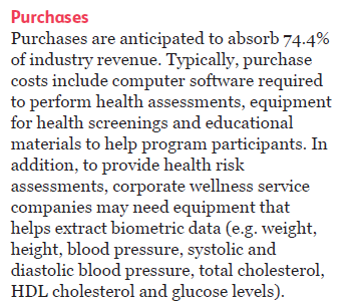
Notice anything else about this paragraph, besides making no accounting sense? It makes no wellness sense. They seem to have somehow confused biometric screening with health risk assessments (HRAs): “To provide health risk assessments, corporate wellness service companies may need equipment that helps extract biometric data.”
Leaving no stone unturned, the biometric data include not just “blood pressure” but also “systolic and diastolic blood pressure.” IBIS, hate to tell you this but even the dumbest wellness vendor knows you need both those values to create a reading. Otherwise it would be like the George Carlin sportscaster routine: “And here’s a partial score from a game in progress: New York Knicks 46.”
Perhaps IBISWorld assumes that the $895 price tag itself convinces buyers that they must know what they’re talking about. And yet, as we’ll see in the next installment, in addition to confusing screening and capital expenditures with operating expenses, they also don’t understand the difference between wellness and disease management.

 They Said What?