
Home » 2016 (Page 5)
Yearly Archives: 2016
The back story of the scathing STATNews smackdown of Wellsteps and Goetzel
This posting is for folks who found us via award-winning journalist Sharon Begley’s “Wellness Award Goes to Workplace Where Many Health Measures Got Worse.” (Note that no one has ever challenged any of her two dozen awards.)
In the event that you are new to the Wellsteps./Boise School District debacle, here is the back story, very quickly.
- Wellsteps lied about savings.
- I predicted the combination of lying, incompetence and cronyism would win them a Koop Award.
- Wellsteps said: It’s fun to get fat. It’s fun to be lazy.“
- Wellsteps showed a complete failure to understand wellness.
And so, inevitably…
Wellsteps won a Koop Award. Ron Goetzel and Seth Serxner have never let their friends down in the past, so why should integrity, competence and facts stand in the way this time?
Share this:

Are you smarter than a Koop Award Committee member? Take this quiz to find out
Last week we asked if you were smarter than a wellness vendor. (SPOILER ALERT: you are — assuming you can read this posting without moving your lips.) I suggested taking the Interactive Health IQ test, just to be sure.
Now, see if you are smarter than a Koop Committee member. They all reviewed this Wellsteps application and decided it was award-worthy.*
Do you agree that this application is award-worthy? If not, see how many self-invalidators you can find. I don’t mean “challenges” to the data. I mean self-immolations. Remember the mantra: “In wellness you don’t have to challenge the data to invalidate it. You merely have to read the data. It will invalidate itself.”
After you’ve finished, review the answers to see what you got right and what you missed. You may have read it before since it’s been getting lots of views for six weeks, but I’ve added several observations since the original posting.
You may even find things I missed, so let me know. The reason is that — aside from possibly the first Sunday in November — there aren’t enough hours in a day to identify everything that Koop Committee members “overlook” in their friends’ applications.
If this type of analysis interests you, I might recommend applying for Critical Outcomes Report Analysis certification. This program is run by the Validation Institute, the gold standard in all things analytical regarding population health and employee health. (Disclosure: while I am not an employee, they occasionally subcontract to me.)
There is nothing highly technical in the answer posting. In order to make it possible for a Koop Committee member to understand and hence decide to rescind the award, I used only fifth-grade math, simple declarative sentences, short words, and lots of pictures.
*Speaking of disclosures that don’t appear in the award application, the Wellsteps CEO also served on the awards committee itself until very recently. Indeed, until so very recently that he still says he is on it.
Share this:

The latest on Nebraska: Ron Goetzel covers up his cover up.
To our new readers, while 2016 marked the first instance in which a Koop Award was ever bestowed upon a company that harmed employees, 2016 wasn’t the first Koop Award ever to go to a company whose own data showed they fabricated results. Below is a history of one of the Koop Award’s Greatest Hits.
For those of you who haven’t been following the saga of the Nebraska state employee wellness program, here is a crash course, aka “Lies, Damn Lies, and the Nebraska State Wellness Program.” If you have been following it, you can skip to the end for the latest installment, Mr. Goetzel’s cover-up of his cover-up.
By way of background, this program is called “wellnessoptions” (imagine e.e. cummings-meets-poking employees with needles-meets-a sticky spacebar). They used to say the Holy Roman Empire was neither Holy nor Roman nor an Empire. Likewise, wellnessoptions is neither optional, if you want a decent deal on healthcare, nor wellness. Instead of wellness, it features a hyperdiagnostic anti-employee jihad in which Health Fitness Corporation (HFC) diagnoses employees but does nothing about the diagnosis except take credit for it.
TIMELINE — PART ONE: HFC’S TROUSERS COMBUSTED
September 24, 2012, 2:00 PM
I read Health Fitness Corporation announcement that its customer, the state of Nebraska, won Ron Goetzel’s C. Everett Koop Award for program excellence.
September 24, 2012, 2:01 PM
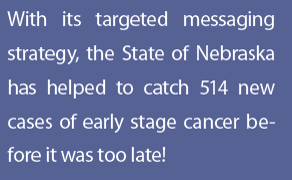
I recognize that the cancer outcomes were obviously made up. Until then, I hadn’t been following the Koop award closely enough to realize that making up outcomes was apparently one of the award criteria, as I later came to learn.
October 2012
I read the full write-up on the program and realize that not only were most of the other outcomes made up, but they had actually lied about saving the lives of cancer victims. If you screen a few thousand people for colon cancer, you don’t find 514 cases of cancer, and you certainly don’t save their lives, as HFC was claiming. And you absolutely don’t save money, as they were also claiming. All this is even more true when you waive age-related guidelines and let anyone get screened, and encourage overscreening by sending out 140,000 letters to state employees graced with the picture of a beautiful young model way too young to be getting a colonoscopy.
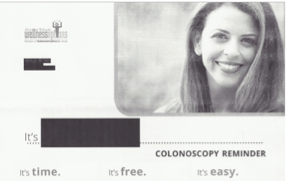
How this invalid nonsense ever got by all the eagle-eyed Koop Committee members would be a mystery, except that HFC is a sponsor of the Koop Committee.
December 2012
I review the entire application and all the marketing materials. It becomes obvious that the entire thing was made up, not just the cancer part. They claimed to save $4.2 million because 161 of their roughly 6000 participants reduced a risk factor.
The math is quite self-evident. Suppose you doubled the number of participants who reduced risks to 312. It stands to reason that you could save $8.4-million. Double it again to 624 and you save $16.8.
Now double it one more time. If 1,248 people out of those 6000 reduced one single risk factor, you’d save $31.6-million, which is about equal to the entire spending for all 6000 participants. And of course most medical spending has nothing to do with identifying previously unrecognized risk factors, so this would be quite a feat. (Do you even know anyone under 65 who had a heart attack that could have been avoided by one more workplace screening?)
I later learn that all the Koop Award-winning program outcomes are made up, using exactly the same math.
November 2012 to June 2013
I try to contact the authorities, like Roger Wilson, who allegedly runs this program for the state, but no one seems to care. The rule of thumb in the wellness industry is that what you say counts. What you do is pretty irrelevant.
June 20, 2013
Breakthrough: The Wall Street Journal editors decide that I am correct, and that the outcomes were made up. Vik and I are allowed to publish this on their op-ed page.
July 14, 2013
Breakthrough again: Another very well-read blogger professes shock-and-awe that any vendor could lie so blatantly and apparently get away with it.
July 15, 2013
Breakthrough yet again: Ace reporter Martha Stoddard of the Omaha World Herald gets Dennis Richling of Health Fitness Corporation to admit that the outcomes — at least the “life-saving catches” of “early stage cancer” outcomes — were indeed made up. Richling tries to spin his gaffe by calling the difference between “life-saving catches of early-stage cancer” and saying someone might possibly get cancer in the future “semantics.” So, according to Richling, having cancer and not having cancer are the same thing.
February 1, 2014
The hilarious wellness industry smackdown Surviving Workplace Wellness is published. Since the HFC Nebraska program had too many lies to fit on a page or two, it gets its own chapter. Here’s the opening paragraph, which in all modesty I must admit is one of my favorite in the book.

February 23, 2014
Nebraska political blogger ReadMoreJoe picks up the scent. He points out that this wellness program is an obvious fraud. The problem is that the same posting is also exposing several other equally obvious frauds, so this one gets overlooked.
TIMELINE–PART TWO: GOETZEL STRIKES BACK
Ron Goetzel isn’t about to sit back and let his friends/sponsors/clients be pilloried for a little white lie about saving the lives of cancer victims who didn’t have cancer.
June 2, 2014
At the Health Datapalooza conference, Ron Goetzel, while admitting the Nebraska cancer outcomes data was made up, claims they/HFC still deserve the Koop Award because he somehow didn’t realize the data was made up at the time the award was granted. And it is true that HFC didn’t actually announce they had made up the outcomes. Ron would have had to actually read the materials to figure it out, same as I did.

September 2014
Ron Goetzel calls the Nebraska program a “best practice” in the Journal of Occupational and Environmental Medicine but refuses to answer any questions about the obvious mistakes and inconsistencies in the article.

November 2014
After knowing for 16 months that they had lied, Ron Goetzel, writing in Employee Benefit News, finally drops Nebraska from his list of best-practice programs:

Being a fair-minded person, I take it upon myself to congratulate him on his newfound sense of ethics. I don’t specifically agree that what he did was ethical, because the ethical thing would have been to admit complicity, apologize, and revoke their Koop Award. But I do say that Nebraska being dropped from the list of best practices means ethical “progress is definitely being made,” albeit from a low base.

Only 29 minutes elapses before Ron erases all my illusions about his honesty and re-adds Nebraska to the list of “best practice organizations.”

He also adds PepsiCo to the list. I guess losing only $2 for every $1 you spend qualifies as such in wellness, where most organizations lose much more.
May 2015
In a rally-the-base invitation-only webinar, we are told that Ron has promoted the Nebraska program from “best practice” to “exemplar.” It seems like the more obvious it becomes that the whole thing was fabricated, the more Mr. Goetzel worships its outcomes.
TIMELINE–PART THREE: RON STANDS ALONE
September 2015
WELCOA finally takes the fabricated case study of Nebraska’s outcomes off their website, 26 months after the fraud was admitted. Perhaps some pressure is being put on them to come clean, given that this is Nebraska’s program and they themselves are based in Omaha.
Just for the record, I’m not saying that an organization founded by all-you-can-eat cafeteria magnate “Warren Buffet” knowingly kept a false document on their site for those 26 months. History suggests they might just be slow learners. [2016 update: WELCOA is under new management, and they appear to be doing a great job, as exemplified by their development of the Employee Health Program Code of Conduct.]
This means Ron Goetzel is literally the only person left who thinks it’s perfectly OK — indeed, a “best practice/exemplar” — to lie about saving the lives of cancer victims. Good luck with that in the upcoming debate. It’s him against the world.
Or, as he sees it, everybody’s out of step but Ronnie.
October 2015
Nebraska tentatively re-awards the wellness contract to Health Fitness Corporation. I am looking over the precipice towards utter humiliation.
TIMELINE–PART FOUR: THE ORIGINAL DATA DISAPPEARS
November 2, 2015–the original cover-up, on the morning of the Great Debate, in which Mr. Goetzel told 14 lies in 90 minutes, which is a lot even for him
At our urging, a third party alerted Mr. Goetzel to the fact that, his protestations to the contrary, the Koop Award Committee did know (even if they had somehow not seen the marketing materials quoted above) that Health Fitness Corporation was making fictitious claims about saving the lives of cancer victims. It was right in the award application. The original award application from Nebraska had originally stated (underlining is ours):
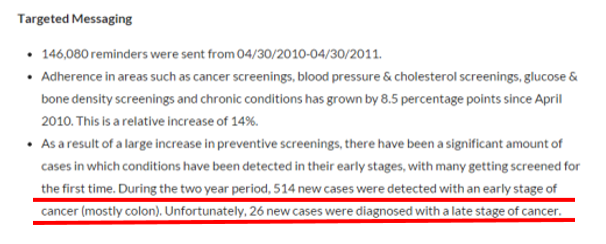
But then, a hour following the call from this third party the morning of the debate, the original award application suddenly read:
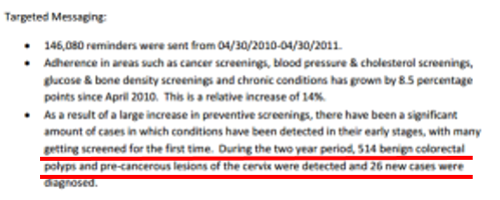
In the original application, this excerpt appears in a letter from the Governor of Nebraska. Only now the Governor’s letter says the opposite what he actually wrote. In the real world, this would be considered forgery. In wellness, a forged cover-up of a blatant and admitted lie about saving the lives of cancer victims who didn’t have cancer is considered business as usual. Johns Hopkins and Truven (Ron’s employers) don’t seem to mind either.
April 2016
The state is rescinding its award to Health Fitness and terminating its wellness program. In the immortal words of the great philosopher Stewey Griffin, victory is mine.
September 2016: The cover-up of the cover-up
Mr. Goetzel finally acknowledges that Health Fitness Corporation told a whopper, and the Koop Committee overlooked it, allegedly by accident, for the four years during which I’ve repeatedly pointed it out.
He now calls this an “erratum.” However, the word “erratum” is usually used to correct honest mistakes (in sharp contrast to this one), usually within hours or days of their discovery (in sharp contrast to this one). You can’t forge official state documents and then call the whole thing an “erratum.” Is a robber allowed to give the money back after he gets caught and just uncommit the crime?

So now, having admitted that the award-winning vendor told the biggest lie in wellness history (against stiff competition), and knowing that all Nebraska’s obviously fabricated savings were mathematically impossible, and that waiving age restrictions for screening is akin to waiving age restrictions for buying beer, the Koop Committee finally, after four years, rescinded the Nebraska award.
Haha. No one falls for that line any more. Quite the opposite, they are doubling down. They say that whopping lies like this one don’t disqualify you, assuming you are an award sponsor. You get to keep your award.
Ditto, if your entire claim of “separation” between participants and non-participants is shown to be false but you are sponsor, Ron merely doctors the data and you get to keep your award.
Also, if it turns out you lied about your savings because there was no change in the biometrics to attribute the savings to, but Ron was a consultant on your project, you get to keep your award.
Likewise and as was confirmed in 2016, if you are a committee member, as Wellsteps’ CEO was until recently, despite your own data showing that you actually harmed employees, you get to keep your award.
Bottom line: as a friend-of-Ron, you might get to keep your award even if you shoot someone on Fifth Avenue.
Share this:

Let’s meet in person at the Employee Healthcare and Benefits Congress next weekend
At the risk of knocking the Interactive Health posting — worth a read if for no other reason than to take the Interactive Health IQ test — off the front page, this one is a bit time-sensitive.
This site has 5200 followers. I’d love to meet some of you. I’ll be at the Employee Healthcare and Benefits Congress Sunday afternoon (speaking on incentives) and all day Monday. Please text me at 781-856-3962 during that period and we can meet in person and chat about all the worthwhile things they are doing, and compare notes on what we are doing.
Obviously some people can’t make it because it conflicts with the HERO conference, at which the Koop Award will officially get bestowed on a vendor that actually harmed employees according to its own data, which is a first even for the Koop Award, which has had more than its share of ethical and analytical challenges over the years. The chat there will emphatically not be about all the worthwhile things they are doing, but rather the news coverage that is likely to appear around the same time “outing” Wellsteps for harming the Boise employees.
Now get back to the IQ test. See if you can figure out what Interactive Health apparently couldn’t.
Share this:
Are you smarter than a wellness vendor? Take the Interactive Health IQ test and find out.
I’ve raised the bar for getting “profiled” on this site. Life is too short to simply highlight every wellness outfit that tests inappropriately and then lies about their outcomes.
Nor can you get on this list simply with bold proclamations of fatuous statements, like Interactive Health does:

Hey, Interactive Health, we get that you don’t understand statistics in general, based on the mind-boggling excuses your consultant offered about your completely invalid savings report (“Al, the [massive] savings on Page 4 have nothing to do with the [trivial] risk reduction on Page 9. It’s a completely separate analysis.”).
Even so, maybe you can find a smart person to explain this particular statistic to you:
- According to the CDC, the number of annual deaths caused by smoking: 480,000
- According to the CDC, the number of annual deaths caused by sitting: 0
Here are some other differences between the two activities: Chairs don’t carry excise taxes or warning labels. If you’re under 18, you can buy a chair without a fake ID. Workers are allowed to sit inside the building. Chairs don’t make you clothes smell, cause lung cancer or dangle from the lips of gunslingers in old John Ford westerns. Sitters aren’t assessed health insurance penalties. Your Match date will not feel misled if he or she catches you taking a seat, even if your profile didn’t disclose that you sit.
Sitting isn’t the “new smoking.” Opioids are the “new smoking.” But since you don’t help employees understand the risks of opioid addiction, it’s probably because you don’t understand these risks yourselves. Quizzify has produced a painkiller/pain reliever awareness quiz that you might benefit from. Welcome to 2016. THIS is what’s harming and even killing employees, not sitting.
The Interactive Health IQ Test
Which of these images is most unlike the others?

No, these days to get into this column, you need to soar above and beyond ordinary wellness vendor stupidity and dishonesty, because Wellsteps has totally raised the bar…and yet Interactive Health has cleared it.
I was recently screened by Interactive Health. They were supposed to send me a standard summary writeup, which I asked for repeatedly but never received. Instead, weeks later, their lab sent me a lab report, with no interpretation. There are one of three explanations for this:
- They are too incompetent to send out summary writeups in a timely way;
- They think an unadorned, highly technical, lab report sent three weeks after the fact constitutes a useful summary writeup;
- They were about to send out their standard summary writeup, before someone noticed my name and said: “Whoa! That’s Al Lewis. He is nowhere near stupid enough to find our usual nonsense acceptable. He has already exposed our savings lies in the Wall Street Journal, and if we give him our usual writeup on his screening, he will expose our stupidity on his blog. We need to cover that up. So let’s just send him a lab report.”
By process of elimination, I originally landed on #3. Quite flattering really. I’d make a few observations.
First, I specifically asked them, in accordance with USPSTF guidelines, not to measure my PSA. They interpreted that — as you can see from the top of that page reproduced at the very end — as a request specifically to measure my PSA. (It is on Page 2 of the report, which I can’t put my hands on right this very moment. However, the Wellness Ignorati, who still think it predicts cancer, will be disappointed to learn that it was quite low.)
Second, the glucose is slightly high because some very generous folks had just treated me to a large and delicious breakfast. A classic false-positive, the type of reading that makes wellness vendors’ hearts go all aflutter, because then they can do a followup reading and show that they improved the outcome, after it improves on its own. Interactive Health’s lab report was completely unhelpful on this high reading. No advice offered.
Third, Interactive Health shattered the record, previously shared by Total Wellness and Star Wellness, for most USPSTF non-recommended blood tests. I don’t know what half these things are, which means neither does Interactive Health. (Total Wellness might win a second-place tiebreaker because they would still be testing for ovarian cancer — it’s still advertised on their website — except that the only company that makes the test has pulled it from the market following FDA warnings not to use it. Hopefully, Total Wellness stockpiled some assays ahead of the recall, like Elaine did with the sponges.)
Interactive Health also tested me for calf tightness, as I mentioned in an earlier blog. It turns out my calves are tight, and right on-site they loosened them. I could feel my productivity soaring…until the left one went into spasm that night. Still, loose calves are a useful trait for some jobs, such as first baseman.

Interactive Health may have also just assumed that because they don’t like me, no one else in the industry does either. That’s actually a fairly accurate assumption, one I am quite proud of given the integrity of most of them, with their trade association, the Health Enhancement Research Organization, leading by example in the pants-on-fire department. Indeed a good rule of thumb to determine if a wellness vendor is honest is to ask them what they think of me.
Nonetheless, I was able to find someone who was screened at a different screening and said he received an actual wellness outcomes report from these people, someone who likes me well enough to send it to me. Coincidentally, this individual had been urging me to post on Interactive Health for quite some time. I figured, cool, I could see what a real report from Interactive Health looks like, the kind that changes employee behavior enough to explain their whopping savings claims of $54,000 for each employee who reduced a risk factor.
No such luck. He sent me exactly the same lab printout that they sent me. Only he hadn’t lost the second page, so I could count the total: 43 lab values. “Knowing your numbers” could be a full-time job. One would think they had covered all the risk factors with all those lab values, but, curiously, the guy said his blood pressure was quite high, and they missed that altogether.
Hmm…how come he got the same completely unhelpful report I did? Did Interactive Health view my linkedin profile — as their executives are wont to do on a regular basis bordering on the obsessive –and decide that it wasn’t safe sending any of my connections their typical employee printout, on the theory that if I’m not stupid, neither are most of my connections? If so, that would be their second fairly accurate assumption.
The only other explanation is that everyone receives the same unadorned lab report, full of letters and numbers and signifying nothing, at least to the average person without a PhD in biochemistry. My feelings were shattered. I wasn’t special. Do they send everyone else incomprehensible lab reports with 43 different numbers in them along with assortments of letters most people would associate with Scrabble…and no interpretations or advice?
Whether incompetence or botched coverup, the explanation itself remains a mystery. Nonetheless here are a few numbers and letters from his report.

Maybe Interactive Health could interpret this for us, but I would be more confident of their ability to distinguish (for example) AST-SGOT from ALT-SGPT if they could distinguish (for example) a chair from a cigarette.
Another one:

How is anyone supposed to make any sense out of this? Most employees would think a “negative risk factor” is a bad thing,” as in “telling the truth is a negative risk factor for the profitability of wellness companies, which is why most of them never do it.” And what does “VLDLCH” mean and why isn’t it reported? Still no interpretations.
And then of course there is the PSA test. If you don’t speak up — or even if you do speak up, as I learned — they’ll do one on you, even though the USPSTF rates it “D”, not to mention that the actual inventor of the test says the test is “inaccurate and a waste of money.” My friend’s PSA result is listed at the bottom of this apparently random number and letter generator…

And, yes, finally, an interpretation!
“Values obtained with different assay methods or kits cannot be used interchangeably. Results cannot be interpreted as absolute evidence of the presence or absence of malignant disease.”
In other words, the interpretation is that this test doesn’t explain anything, so we recommend ignoring the result.
It would have been even more helpful for them to recommend ignoring Interactive Health altogether– the calves, the chairs, the cigarettes, the AST and ALT, and, to be discussed in a future posting, the fabricated outcomes report.
Here is the entire first page of my own results, so that you know we are not taking this out of context…

Share this:

More employees weigh in on Slate’s wellness expose
Silly us! We already published comments from employees on the Slate article “Workplace Wellness Programs Are a Sham” on the assumption that, two weeks after publication, the news cycle would have ended. And yet the article has “legs” — it’s up to 5500 Facebook shares (about five times Slate’s already-impressive average) and 611 retweets (ditto). Most importantly for our purposes, a new wave of beleaguered employees is weighing in, so to speak:
- My husband’s new employer uses these programs and in my experience the extreme challenge of actually downloading the correct forms to submit my wellness check only led to someone with very good blood pressure to have theirs raised significantly. As my husband put it, this program is an ‘unvitation’ to save money. If I were the employee, I would have spent half a workday navigating in order to accomplish this task.
- I teach an inherited “Wellness for Healthcare Administrators” class at a college in California. It took me a month to figure out there was complete fraud in the wellness program claims that you expose in your excellent article. Unfortunately, textbook publishers are still pumping out fatuous tomes of enormous size laden with B.S. so vulnerable students are robbed of their money as well as the truth. THANK YOU FOR EXCELLENT JOURNALISM!
- At my last job, they offered on-site yoga, but kept a list of who attended…[and said the] next time they had to do layoffs, they were going straight to the yoga list because if people had time to do yoga, they obviously weren’t working hard enough.
- Do people really consider HRA’s and biometric screenings as wellness programs? That’s part of the problem. And why should I listen to what they have to say? It’s not like I don’t know what they are going to say or tell me. I can even Google what they will tell me.
- The whole idea of these wellness programs is that if you are ill, you must be stupid, irresponsible, or both. It’s all about blaming people who are sick. I absolutely hate the people who made me go through all that humiliation when I was so sick. If I could punch them in the face, I would.
Um, tell us how you really feel…
Share this:
Tom Emerick reviews Quizzify: “There May Be a Cure for Wellness.”
Not all wellness vendors are as bad as Slate makes them out to be. Companies whose names begin with “Q” are doing quite splendidly.
Quizzify’s stack of stellar reviews and reviewers (see Employee Benefit News, Not Running a Hospital (Paul Levy), and Bob Merberg) now includes Tom Emerick, who just wrote an Insurance Thought Leadership review entitled: There May Be a Cure for Wellness.
Far be it from us to discourage anyone from reading the full review, but here are some excerpts:
“Quizzify…transforms the boring but long-overdue task of educating employees about health, healthcare and their health benefit into an entertaining trivia game.”
“Quizzify provides a plethora of shock-and-awe, ‘counter-detailing’ questions-and-answers (with full links to sources) that will educate even the savviest consumers of healthcare and entertain even the dourest CFO.”
“Scores and scores of people have told me they fudge answers on HRAs. Interestingly, they feel they are on the ethical high ground to do that because of the goofy, nosy and intrusive questions they are asked to answer, e.g., asking about your [future] pregnancy plans… Quizzify, on the other hand, encourages people to cheat. Quizzify wants you to look up the answers because that’s how you learn. So instead of denying human nature, Quizzify channels it.”
Tom also addresses the concern that employees might think Quizzify is all about trying to keep them from spending money on healthcare:
“On the other hand, there are instances where people should go to the doctor but don’t. Swollen ankles? Painless, perhaps, but you may have a circulation problem, possibly a serious one. Blood in your urine, but it goes away before you even make an appointment? That could be a bladder tumor tearing and then re-attaching itself, especially if you smoke. And show me one health risk assessment that correctly advises people over 55 or 60 to get a shingles vaccine if they had chicken pox as a kid.”
That last point is pretty emblematic of the difference between wellness and Quizzify. It’s a classic example of wellness vendors wasting opportunities to actually provide employees with useful information. Virtually no HRA advises shingles vaccines for the relevant subset of employees.
Conversely, to focus on one of the longstanding obsessions of wellness vendors, there are no questions in Quizzify where the answer is: “Buckle your seat belt.” We figure HRAs have that covered.
We would also observe that if your employees don’t realize they should buckle their seat belts, wellness is probably not your biggest problem.
Boring but Important Disclosure: While this blog is independent of Quizzify, I am a principal in Quizzify.
Share this:
Test your knowledge of artificial sweeteners and maybe earn real money
Try our sample Artificial Sweeteners quiz to see how much you already know – and/or learn some rather scary things that you really should know. Four $25 gift cards will be awarded via drawing from the 10 highest scorers who are also advisors or self-insured employers or transparent PBMs.
Further, we’ll reveal the best way to avoid their hazards while still using them, since sometimes we just gotta have something sweet. Water or flavored water just won’t do the trick.
This month’s contest closes August 29th. The ten high-scorers will be announced August 30th. Based on the formula we use (matching the winners to the last 4 digits the August 31st stock market close), four winners will be randomly selected from the ten high-scorers and announced September 3rd.
Oh yeah, and if you want to see how to prevent initial uptake of weight loss drugs specifically amongst employees who are likely to drop out after a few months, join our September 5th webinar for The Big Reveal.
Share this:

Comments to Slate article reveal what employees actually think about wellness
When it comes to reporting on feedback on wellness programs, someone in the wellness industry needs to listen to employees, instead of just speaking for them. But what fun would that be?
In their defense, one of wellness vendors’ few talents is lying about data. So why report what employees think when you can simply lie about what employees think?
Here is Wellness Workdays–apparently selected by none other than Katherine Baicker (author of the now hilariously discredited “Harvard Study” showing the 3.27-to-1 ROI) as the very model of a modern clueless wellness vendor: “Employees like wellness programs…These initiatives make employees feel like their employers care.”
LivingHealthy.com uses “science-based facts” to say: “The truth of the matter is that employees like wellness programs.”
Virgin Pulse says: “Employees love wellness programs.” And another vendor saying: “Employees love wellness programs because they feel cared for by the company.”
But here’s an interesting question: what would vendors say if they actually solicited and reported on real employee feedback, as opposed to just spouting whatever random thoughts their imaginary friend is implanting into the vacuum between their ears?
Slate just answered that question, in a big way. And the answer is — SPOILER ALERT — employees hate wellness programs. (Except for the part where they think they get to collect free money for doing nothing, without realizing the free money simply offsets what had formerly been a more generous benefit. Only now it’s usually taxable.)
Slate received more then five hundred comments to their article, “Workplace Wellness Programs Are a Sham.” The commenters overwhelmingly agreed with the title. Aside from the free-money crowd, the only readers defending wellness argued that they shouldn’t have to subsidize fat people or smokers. News: they don’t subsidize smokers. Smokers pay a penalty already at most companies. And except at both(!) extremes, there is only a trivial correlation between weight and health spending, in the employed population.
Here are some greatest hits from the comments thread:
- My husband’s HMO gave me a choice of either going to Weight Watchers or doing a minimum amount of walking every day. While I had cancer. And if I didn’t do it, my husband and I were going to be charged thousands of dollars more out-of-pocket each year. Luckily, my husband found a new job while I was in the hospital having my double mastectomy.
- I am a statistician who used to work for a large health plan. Dubious methods used to arrive at savings estimates are prevalent in this industry, whether it is for wellness programs or for other (often vendor driven) programs that propose simple solutions to complex problems.
- I was wondering if I was the only person on the planet who realized these schemes are just a rip off of the employee and an invasion of medical privacy that ought to be against the law. And the health advice – gee, perhaps since I have insomnia I should … get more sleep. Thank you, Dr. Genius. That didn’t occur to me.
- What’s worse is wasting workers’ time and energy with endless pointless seminars and meetings and flyers and crap and insisting on collecting their personal medical information under the guise of caring about them.
- Funny how killer projects requiring 80 hour weeks and toxic office politics are never cited or recognized as a major cause of health problems.
- We have this thing where you’re encouraged to meet step goals so you can qualify for the lower deductible wellness plans – and our commissioner just sent word down that she’s annoyed at how many people are walking for 15 min in the afternoon.
- They did wellness checks at my last place of work where nearly everyone was also a heavy smoker. So, for the month before the wellness exam, everyone would try to quit smoking so they could “game the system” and avoid paying an extra $1200 per person for the next year (they were all in manufacturing, there was no way they could afford that, especially not if both spouses smoked). Nearly the entire workforce turned into Satan for that month from nicotine withdrawals. Jittery, irritated Satans. Productivity would plummet, HR would be overtaxed from complaints, and people would just stand around discussing ways they could fool the wellness inspector and wholeheartedly complaining about the company. The second they walked out of their wellness check, they celebrated with a smoke break.
- The worst part of wellness programs is the stupid, mandatory barrage of calls from the utterly worthless and ignorant WebMD “professionals,” who are obviously just call center rats with no education whatsoever.
And don’t get these people started on HRAs. One of the many ironies of wellness vendors is that they lie more often than presidential candidates…and yet they assume that all the information on HRAs is accurate.
- Yeah, I lied through my whole honor-based questionnaire. No ,I absolutely do not have insomnia. Yes, I don’t drink more than one drink a week. No, I have no work-related stress (never mind the constant mass layoffs). Outside of my doctor, no one needs to know this.
- I won’t fill out a survey in a meaningful way. If I had depression, for example, I would never give answers that indicated that on a workplace wellness survey.
- Mine asked about sleep. I don’t get enough and said so. “What are you doing about it?” What am I doing about it? I worked 10.5-hour days and have menopause-based insomnia, for which I’ve tried everything from black cohosh to Ambien. At the moment, I’m doing nothing about it. What’s needed is for my employer to let me come in later so I can actually keep sleeping in the morning when my body allows me. My employer won’t do that. The survey interpreted that to mean I’m not taking care of my health. That’s the caliber of idiocy we’re dealing with.
- I am a triathlete and ultra runner. My BP tends to run dangerously low unless I eat a ton of salt. After a bunch of tests and doctor’s appointments because I kept feeling like I was going to pass out any time that I wasn’t moving, I was just told to eat more salt. But then I was dinged on our automated questionnaire because it said I eat too much salt.
- Initially, most of us pretty much tried to provide a somewhat accurate reporting, but the kicker was that if your survey didn’t reflect someone in tip-top shape, you were harassed by a phone call every couple of weeks from a nosy nurse who wanted to know what you were doing to address the 5 extra points for HDL or whatever. Therefore, most of us researched the numbers that constituted excellent health and used them. So–pretty much worthless as an assessment of anything and a waste of a half-hour.
I’d encourage people to read the Slate article and add their own comments, and send it around to your Wellness Ignorati friends. Tell them this is what employees really think of their “pry, poke and prod” schemes and biggest-loser contests.
They might not believe you, so tell them Harvey says so too.
Share this:

Welcome Slate Readers!
Please enjoy your visit to our site, “follow” it, and share it. The best example of a wellness story is how the city of Boise got completely snookered by Wellsteps. Wellsteps harmed their employees but obfuscated the data so the Boise administrators wouldn’t notice. Then they got some friends of theirs to give them an award for it. We can’t make this stuff up.
If you have a story to tell, please contact us directly at al@quizzify.com . There are journalists-in-waiting, who want a story, even a not-for-attribution story, in order to write one of their own.
Also, see if your own vendor is listed (via the “search” function) and forward it to HR, with the suggestion that we can help them if they were snookered. Your HR department should demand that your wellness vendor endorse the Employee Health Program Code of Conduct, which commits them to not harming you, respecting your dignity, and not lying to your HR department. A very modest threshold and yet United Health Care’s program, among others, refuses to commit to it.
Finally and most importantly, visit www.quizzify.com . That is the way real wellness works. You play a game and learn things about the healthcare system and your own health that you didn’t know. Imagine Jeopardy-meets-health education-meets-Comedy Central.
Don’t just take our word for it. Play the game, and send it to your HR department. It’s guaranteed to improve health and save money, and as you can see, the content is reviewed by Harvard Medical School.
 They Said What?