Home » Articles posted by whynobodybelievesthenumbers (Page 47)
Author Archives: whynobodybelievesthenumbers
Total Wellness: The Best Argument for Regulating the Wellness Industry
Total Wellness, having been “profiled” on this blog for being second only to Star Wellness in “playing doctor” with inappropriate employee screening, isn’t about to lose this race to the bottom without a fight.
So in order to try to out-stupid Star Wellness, Total is offering yet another test (they are now up to 8) either rated D by the United States Preventive Services Task Force or (in the case of Chem-20s and Complete Blood Counts) not rated as preventive screens at all because [WARNING: Spoiler Alert]: these two aren’t preventive screens. They are tests, but Total Wellness apparently doesn’t know the difference between a screen and a test.
For those of you who also don’t know it — and you aren’t required to because you’re not poking employees with needles to fulfill your mother’s fantasy of you becoming a doctor — a screen is done wholesale on everyone in order to hunt for disease and then brag about how many sick people you found. You’ll find plenty if you force employees to either participate or forfeit lots of money. Like Total Wellness says, you need to be “stern” about making employees submit to these worthless and harmful screens. And being “stern” means it’s wellness–or else:

By contrast, a test is what a real doctor might order — if an actual patient presents with relevant symptoms. Chem-20s and CBCs haven’t been used as screens for decades. Even the professional organization whose physician members get paid to perform them doesn’t recommend them. “These tests rarely identify clinically significant problems when performed routinely on an outpatient population.”
Here is Total Wellness’s Totally Inappropriate Screen #8, along with the USPSTF grade:
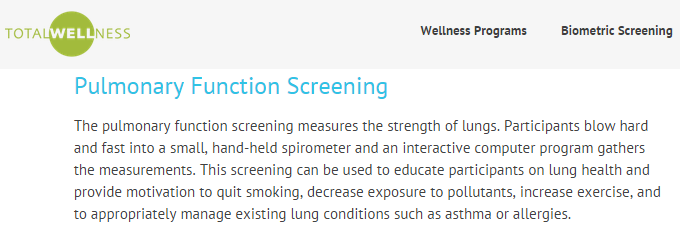

Doctors routinely performing and billing these 8 “preventive” screens could and should lose their licenses. The good news for Total Wellness is that they aren’t going to lose their license for inappropriately screening employees, for the simple reason that you don’t need a license in order to inappropriately screen employees.
Quite the contrary. Unlike in regular grown-up type healthcare, in the wellness industry any idiot can perform these screens and tests as long as that idiot can find an even bigger idiot willing to pay for them.

Do your employees know what screening tests are actually worthwhile & which ones are scams?
Is this a great country or what?
By the way, if you haven’t read the originals for Total Wellness or Star Wellness, you’re in for a treat. Some of our best work. Helps to have such great material to start with.
Share this:

NBGH: Wellness Programs Aim for the Wrong Target…And Miss
The following is a guest post by George D. Burns. George is an employee benefits and tax Consultant who has developed the Burns ERP, which significantly reduces the costs of providing employee health benefits. He can be reached at gburns12@bellsouth.net He is also a frequent Top Contributor to many LinkedIn groups and is a message board moderator at BenefitsLink.com.
The truth about wellness programs was revealed at the recent NBGH conference. Two studies in combination explain both that wellness fails and why wellness fails.
The first was a Towers Watson survey showing that wellness fails because employees don’t like it. (In the wellness industry, this counts as an insight.) In contrast to every other study showing high satisfaction among participants–who of course are largely “satisfied” by the money–this one surveyed all employees, not just participants. It showed that 52% of employees did not participate in even a single wellness program or activity. Employers offered a maximum of $880 but paid out an average of $365 with 40% of employees receiving $0. “[Employees] feel like it’s too hard or not worth it, or that it adds unneeded complexity to their lives.” said Shelly Wolff, a consultant at Towers. “Whatever the reason, it’s a big disengagement number.”
The second, an employee poll at Bright Horizons LLC, showed why wellness fails. Wellness programs have failed because they targeted the wrong goals with the result that — even if employees had been interested when cash was offered and even if the program had been successful — a conventional wellness program would have little impact on well-being.
Specifically, this employee poll showed that physical health, the highly profitable obsession of wellness vendors and consultants, counts for only 5% of employee well-being — far less than job satisfaction, stress, financial wellness and personal issues.
Further, “physical health” was a catch-all category including current acute issues such as colds and back pain, not just chronic major issues like diabetes or heart disease or “risk factors” that are the focus of wellness programs. So even the 5% figure dramatically overstated the impact of risk factors on well-being.
So we’ve found two more reasons wellness vendors need to falsify their results to stay in business. According to the Bright Horizons study, they are chasing the wrong goal to begin with…and according to TowersWatson, they are failing at chasing the wrong goal.
Your employees will love Quizzify. Because it works and it’s fun
One recalls the old Woody Allen joke about the two old ladies in the Catskills. One says, “You know, the food here is terrible.” The other replies: “Yes, and the portions are so small.”
Share this:

They Said What? makes list of three top healthcare websites
OK, so maybe this news got pushed off the front page by the other prizes announced this week, but They Said What? made the list of Tom Emerick’s three favorite websites.
TSW occupies a unique niche, Rachel Carson-meets-wellness-meets-Dave Barry. As an added bonus, all of our wellness statements are true, which makes us unique in the field (and explains why we have been blacklisted by many conference organizations).
Most importantly, we are in august company with the other two selected sites. Not Running a Hospital and The Doctor Weighs In are both take-no-prisoners websites as well, and we recommend both.
Disclosure: I co-authored Cracking Health Costs with Tom Emerick. I don’t exactly expect a Nobel Prize for integrity here for simply pointing that out, but typically wellness vendors don’t disclose things like, oh, I don’t know, sponsoring the committee that gives their customers awards or even mentioning that the program they are “applauding” is their own. Although in this case — Health Fitness Corporation and Nebraska — full disclosure would have also required them to admit that the entire thing was made up. And therein lies the problem wellness vendors face. In wellness, ethics is more than just a slippery slope. It’s more like Half Dome coated with WD40.
Share this:

Wellness isn’t only junk science. It’s also junk arithmetic.
Vendors of “pry, poke and prod” programs often wax rhapsodic about “Wellness 2.0.” Translation: HRA-screening-checkup programs have historically failed. Likewise, vendors talk about how more “wellness champions” or better “communications plans” or higher incentives/penalties are needed to make wellness work–as though it’s HR’s fault vendors are misrepresenting what their programs can do.
Unfortunately for those vendors, tinkering with wellness is like tinkering with alchemy. Nothing can turn “pry, poke and prod” lead into gold. Understanding that wellness is alchemy is why we’ve offered the million-dollar reward…and also why that reward has had no takers. Wellness outcomes measurement is junk arithmetic, to go with the junk science of screening the stuffing out of employees in order to hyperdiagnose them. All told, vendored wellness is the kind of junk that gives junk a bad name.
We’ve covered the junk science at length, showing how vendor after vendor ignores clinical guidelines either because they don’t understand healthcare or because they want to maximize profits. Today we are covering junk arithmetic.
Here is Part One of the very simple mathematical proof of why “pry, poke and prod” can’t possibly save money. All this information comes from the wellness industry’s own materials, notably the HERO Outcomes Guidelines Report. They can’t “challenge the data” because it’s their data. All we’ve done is fashion it into a proof.
The Size of the Pie: “Potentially Preventable Hospitalizations” (PPHs)
The HERO Report places the current PPH rate at 2.62 per 1000. (It was once higher — 3.14, as noted below — but usual care improvements continue to reduce admissions for both asthma and cardio/IVD, reducing the need for wellness even as vendors insist that all your employees are getting sicker.)
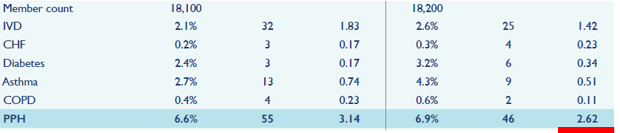
That same page (23) of that same report lists the episode costs of a PPH at $22,500.

The product of those two components? About $59,000 per 1000 people, or $59/person.
And alas you can forget about adding other healthcare cost savings from wellness to that $59. That’s wishful thinking. The Goetzel crowd not only admits they don’t decrease, but says they are likely to increase (p.22)

The Cost of Wellness
Against that $59, what is the cost of a wellness program? $150/employee, according to Ron Goetzel. (Your cost could be higher or lower, obviously. Wellness vendors collect about $7 billion by prying, poking and prodding about 70 million people, so typical vendor fees are about $100.)
Therefore even a wellness program that eliminates every potentially preventable hospitalization without increasing doctor visits or those other listed expenses would lose money–$91, if Mr. Goetzel’s advice is taken.
And this is according to the wellness industry’s own cost figures, which of course are highly suspect, largely because their costs count vendor fees only. Our figures would add in all the other costs of wellness. Though the HERO Report ignored these other costs in its own calculations, it nonetheless listed them on p 11. (This list overlooks the hefty consulting fees involved in making up positive outcomes figures to show to the C-Suite. This is no surprise given that Mercer was a co-sponsor of this report.)

Want proof that Quizzify is more fun & smarter than any wellness program? Take the quiz.
Also remember that this $91 loss is for a perfect wellness program –one that eliminates all $59 in spending with no added preventive services cost. Coming soon is the second half of the proof, showing that wellness programs are anything but perfect.
Share this:

Is Bravo Wellness Running Out of Money?
USA Today and Kaiser Health News just published a terrific story on the hazards of overscreening, overtesting, and pry-poke-and-prod programs.
It revealed how screening all employees every year–and then sending them in for checkups –makes no sense on any level, and is contrary to all guidelines and literature. All it does is lead to hyperdiagnosis. Hyperdiagnosis is overdiagnosis on steroids. Instead of being the unfortunate result of good-faith efforts to figure out what is wrong with a patient (that’s “overdiagnosis”), hyperdiagnosis is the breathless reporting by wellness vendors on how many sick employees a company has, and how they will have an “epidemic” of something-or-other unless they force employees to get coached etc.
Hyperdiagnosis is also, however, the wellness industry’s bread-and-butter, so naturally wellness vendors defend this practice. In this article, Bravo Wellness CEO Jim Pshock was quoted as saying: “The hope is that the program will get people to proactively see their physicians to manage their health risks. Yes, this will, hopefully, mean more prescription drug utilization and office visits, but fewer heart attacks and cancers and strokes.”
The only innocent explanation for this comment is that Bravo canceled its subscription to the internet to conserve cash. Seems that all the literature, easily searchable online — plus Choosing Wisely — says that “proactive” annual checkups are a waste of time and money and will not prevent heart attacks and strokes, and certainly not cancers. (They will, however, make drug use and physician office visit expense increase. That much he got right.) A quick Google search would have revealed that to him…if only he had access to Google.
This whole thing would be pretty amusing except that Bravo’s business model includes fining employees for not getting checkups that are more likely to harm them than benefit them, according to the New England Journal of Medicine. Harming employees is where the joke ends.
Otherwise, the only other explanation for this comment is that he is — heaven forbid — lying. And we would be pshocked, pshocked to learn that lying is going on in here!
Why would any smart person waste time & money on low-value medical care? Better not ask Bravo.
Therefore, since a wellness vendor would never lie, Mr. Pshock must have allowed his internet subscription to expire. We’d urge all readers to donate early and often to Bravo Wellness to help them keep the lights on.
Share this:

Expose of Corporate Weight-Shaming Programs Among Year’s Top Articles

We published “Employers Should Disband Corporate Weight Control Programs,” in the peer-reviewed American Journal of Managed Care, in February. We recently learned that it is trending close to #1 for the year among articles in this and related journals. Its findings have never been challenged, with no critical comments or letters to the editor by wellness vendors or consultants.
If you struggle with weight, you are probably wondering why your employer appears to be discriminating against you by weight-shaming you. The answer is that while a company would certainly want to facilitate employees’ desires to become healthier on their own, there is no economic basis for fining employees or withholding incentives based on weight.
It’s not just that the threat of financial forfeiture (penalties or lost incentives) doesn’t help people lose weight. Here are highlights from the rest of the article:
(1) As ShapeUp has shown when confronted with the invalidity of its data (and being fired by Highmark as a result of it), vendors’ weight-loss figures are basically fabricated. Here is an article showing how that fabrication takes place, the “Last Man Standing” fallacy.
(2) Weight generally does not affect job performance. At the CEO level, this is generally known. That’s why when new factories are built, they tend to go up in states with lower wages and motivated (and non-union) workforces. Those states also have the highest obesity rates, but that doesn’t matter when major corporate decisions are made. CEOs, voting with their own dollars, have determined that these higher obesity rates have no noticeable effect on productivity.
(3) Weight also has only a trivial effect on healthcare expenses. Extra spending that was once attributed to weight turns out to be due to age, as people get naturally heavier over time and naturally tend to spend more on healthcare. Those two variables correlate but the actual causality is attributable to other factors. Among older people, some extra weight may be protective, as well.
So three things need to be true for these discriminatory programs (age discrimination and class discrimination) to justify their existence. The programs need to get people to lose weight, and weight has to matter somehow, in productivity and/or health spending. Instead, none of those things are true. So why engage in an activity that isn’t going to work, that embarrasses your employees?
We’d encourage you to read the article or at least the abstract, and pass it along to decision-makers. And send us your stories–how has corporate weight-shaming affected your job performance, or the performance of people you know?
PS And if Aetna comes a-knockin’ with the industry’s most expensive and most dangerous anti-obesity “wellness” jihad, don’t answer the door. Here’s what will happen if you do.
Good health is not about weight-shaming. It’s about education.
Share this:

Just because it’s healthcare, doesn’t mean it’s good for you
Wellness is about pushing employees into the healthcare system, almost always both against their will and their better judgment. This story is a perfect example of the consequences of how too much healthcare can be hazardous to your health, and why your best defense against overdoctoring is knowledge.
Once you start asking questions, doctors have to start answering them. While many doctors welcome that, others start fidgeting. If your doctor is one of the latter, it’s probably time to switch.
I myself get occasional bladder tumors. Ironically — and once again, showing the unintended consequences of wellness — I got bladder cancer from eating more broccoli, which of course is exactly what wellness programs would have us do. (And which, in all fairness, is generally a good idea.) The problem was that the broccoli was grown in a garden that was way too close to railroad ties, which leach creosote into the soil. Creosote causes bladder tumors.
So every few years, one grows back and has to be scooped out “non-invasively” (that’s easy for the doctor to say). And every year I go in and get checked, also “non-invasively”. After my last check, the urologist — a new one, whom I had never seen before — suggested a CT scan of the kidneys and ureters.
I asked her why, and she said, because I had had bladder cancer for 15 years and never had this scan.
I replied: “Well, I founded a company, Quizzify, that educates on overutilization. CT scans have 500 times the radiation of x-rays, and that particular set of views is likely to spot tumors on my adrenal glands that are completely clinically insignificant, and yet once spotted will be tracked and possibly removed, for no good reason other than that they are there.”
She said: “OK, why don’t we just start with a urinanalysis.”
Quizzify Q&A is your tool to save employees’ time & money
From a hazardous and likely counterproductive $1000 scan to a $10 urinalysis in 30 seconds. That’s what knowledge is worth.
Share this:

Mr. Goetzel Covers Up his Cover-Up: The latest on the Nebraska Koop Award
To our new readers, while 2016 was the first time a Koop Award ever went to a company that harmed employees, 2016 wasn’t the first Koop Award ever to go to a company whose own data showed they fabricated results. Below is a history of one of the Koop Award’s Greatest Hits.
For those of you who haven’t been following the saga of the Nebraska state employee wellness program, here is a crash course, aka “Lies, Damn Lies, and the Nebraska State Wellness Program.” If you have been following it, you can skip to the end for the latest installment, Mr. Goetzel’s cover-up of his cover-up.
By way of background, this program is called “wellnessoptions” (imagine e.e. cummings-meets-poking employees with needles-meets-a sticky spacebar). They used to say the Holy Roman Empire was neither Holy nor Roman nor an Empire. Likewise, wellnessoptions is neither optional, if you want a decent deal on healthcare, nor wellness. Instead of wellness, it features a hyperdiagnostic anti-employee jihad in which Health Fitness Corporation (HFC) diagnoses employees but does nothing about the diagnosis except take credit for it.
TIMELINE — PART ONE: HFC’S TROUSERS COMBUSTED
September 24, 2012, 2:00 PM
I read Health Fitness Corporation announcement that its customer, the state of Nebraska, won Ron Goetzel’s C. Everett Koop Award for program excellence.
September 24, 2012, 2:01 PM
I recognize that the cancer outcomes were obviously made up. Until then, I hadn’t been following the Koop award closely enough to realize that making up outcomes was apparently one of the award criteria, as I later came to learn.
October 2012
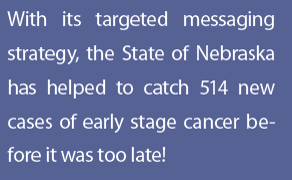
I read the full write-up on the program and realize that not only were most of the other outcomes made up, but they had actually lied about saving the lives of cancer victims. If you screen a few thousand people for colon cancer, you don’t find 514 cases of cancer, and you certainly don’t save their lives, as HFC was claiming. And you absolutely don’t save money, as they were also claiming. All this is even more true when you waive age-related guidelines and let anyone get screened, and encourage overscreening by sending out 140,000 letters to state employees graced with the picture of a beautiful young model way too young to be getting a colonoscopy.

How this invalid nonsense ever got by all the eagle-eyed Koop Committee members would be a mystery, except that HFC is a sponsor of the Koop Committee.
December 2012
I review the entire application and all the marketing materials. It becomes obvious that the entire thing was made up, not just the cancer part. They claimed to save $4.2 million because 161 of their roughly 6000 participants reduced a risk factor.
The math is quite self-evident. Suppose you doubled the number of participants who reduced risks to 312. It stands to reason that you could save $8.4-million. Double it again to 624 and you save $16.8.
Now double it one more time. If 1,248 people out of those 6000 reduced one single risk factor, you’d save $31.6-million, which is about equal to the entire spending for all 6000 participants. And of course most medical spending has nothing to do with identifying previously unrecognized risk factors, so this would be quite a feat. (Do you even know anyone under 65 who had a heart attack that could have been avoided by one more workplace screening?)
I later learn that all the Koop Award-winning program outcomes are made up, using exactly the same math.
November 2012 to June 2013
I try to contact the authorities, like Roger Wilson, who allegedly runs this program for the state, but no one seems to care. The rule of thumb in the wellness industry is that what you say counts. What you do is pretty irrelevant.
June 20, 2013
Breakthrough: The Wall Street Journal editors decide that I am correct, and that the outcomes were made up. Vik and I are allowed to publish this on their op-ed page.
July 14, 2013
Breakthrough again: Another very well-read blogger professes shock-and-awe that any vendor could lie so blatantly and apparently get away with it.
July 15, 2013
Breakthrough yet again: Ace reporter Martha Stoddard of the Omaha World Herald gets Dennis Richling of Health Fitness Corporation to admit that the outcomes — at least the “life-saving catches” of “early stage cancer” outcomes — were indeed made up. Richling tries to spin his gaffe by calling the difference between “life-saving catches of early-stage cancer” and saying someone might possibly get cancer in the future “semantics.” So, according to Richling, having cancer and not having cancer are the same thing.
February 1, 2014
The hilarious wellness industry smackdown Surviving Workplace Wellness is published. Since the HFC Nebraska program had too many lies to fit on a page or two, it gets its own chapter. Here’s the opening paragraph, which in all modesty I must admit is one of my favorite in the book.

February 23, 2014
Nebraska political blogger ReadMoreJoe picks up the scent. He points out that this wellness program is an obvious fraud. The problem is that the same posting is also exposing several other equally obvious frauds, so this one gets overlooked.
TIMELINE–PART TWO: GOETZEL STRIKES BACK
Ron Goetzel isn’t about to sit back and let his friends/sponsors/clients be pilloried for a little white lie about saving the lives of cancer victims who didn’t have cancer.
June 2, 2014
At the Health Datapalooza conference, Ron Goetzel, while admitting the Nebraska cancer outcomes data was made up, claims they/HFC still deserve the Koop Award because he somehow didn’t realize the data was made up at the time the award was granted. And it is true that HFC didn’t actually announce they had made up the outcomes. Ron would have had to actually read the materials to figure it out, same as I did.
September 2014
Ron Goetzel calls the Nebraska program a “best practice” in the Journal of Occupational and Environmental Medicine but refuses to answer any questions about the obvious mistakes and inconsistencies in the article.

November 2014
After knowing for 16 months that they had lied, Ron Goetzel, writing in Employee Benefit News, finally drops Nebraska from his list of best-practice programs:

Being a fair-minded person, I take it upon myself to congratulate him on his newfound sense of ethics. I don’t specifically agree that what he did was ethical, because the ethical thing would have been to admit complicity, apologize, and revoke their Koop Award. But I do say that Nebraska being dropped from the list of best practices means ethical “progress is definitely being made,” albeit from a low base.

Only 29 minutes elapses before Ron erases all my illusions about his honesty and re-adds Nebraska to the list of “best practice organizations.”

He also adds PepsiCo to the list. I guess losing only $2 for every $1 you spend qualifies as such in wellness, where most organizations lose much more.
May 2015
In a rally-the-base invitation-only webinar, we are told that Ron has promoted the Nebraska program from “best practice” to “exemplar.” It seems like the more obvious it becomes that the whole thing was fabricated, the more Mr. Goetzel worships its outcomes.
TIMELINE–PART THREE: RON STANDS ALONE
September 2015
WELCOA finally takes the fabricated case study of Nebraska’s outcomes off their website, 26 months after the fraud was admitted. Perhaps some pressure is being put on them to come clean, given that this is Nebraska’s program and they themselves are based in Omaha.
Just for the record, I’m not saying that an organization founded by all-you-can-eat cafeteria magnate “Warren Buffet” knowingly kept a false document on their site for those 26 months. History suggests they might just be slow learners. [2016 update: WELCOA is under new management, and they appear to be doing a great job, as exemplified by their development of the Employee Health Program Code of Conduct.]
This means Ron Goetzel is literally the only person left who thinks it’s perfectly OK — indeed, a “best practice/exemplar” — to lie about saving the lives of cancer victims. Good luck with that in the upcoming debate. It’s him against the world.
Or, as he sees it, everybody’s out of step but Ronnie.
October 2015
Nebraska tentatively re-awards the wellness contract to Health Fitness Corporation. I am looking over the precipice towards utter humiliation.
TIMELINE–PART FOUR: THE ORIGINAL DATA DISAPPEARS
November 2, 2015–the original cover-up, on the morning of the Great Debate
At our urging (and we must confess to delighting in creating this “Sting” operation), a third party alerted Mr. Goetzel to the fact that, his protestations to the contrary, the Koop Award Committee did know (even if they had somehow not seen the marketing materials quoted above) that Health Fitness Corporation was making fictitious claims about saving the lives of cancer victims. It was right in the award application. The original award application from Nebraska had originally stated (underlining is ours):
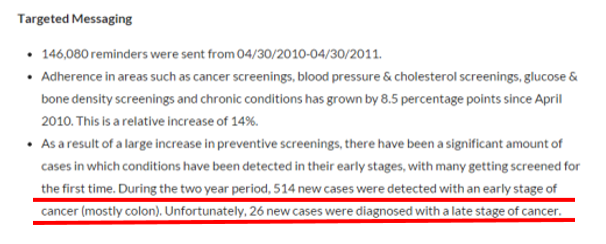
But then, a hour following the call from this third party the morning of the debate, the original award application suddenly read:
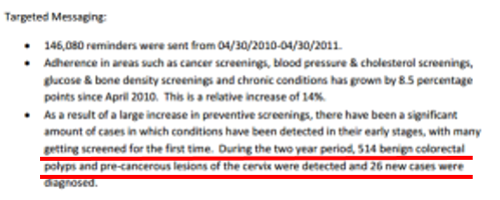
In the original application, this excerpt appears in a letter from the Governor of Nebraska. Only now the Governor’s letter says the opposite what he actually wrote. In the real world, this would be considered forgery. In wellness, a forged cover-up of a blatant and admitted lie about saving the lives of cancer victims who didn’t have cancer is considered business as usual. Johns Hopkins and Truven (Ron’s employers) don’t seem to mind either.
April 2016
The state is rescinding its award to Health Fitness and terminating its wellness program. In the immortal words of the great philosopher Stewey Griffin, victory is mine.
September 2016: The cover-up of the cover-up
Mr. Goetzel finally acknowledges that Health Fitness Corporation told a whopper, and the Koop Committee accidentally overlooked it. He now calls this an “erratum.” The technical term for it is a “lie-um.” You can’t forge official state documents and then call the whole thing an “erratum.” Is a robber allowed to give the money back after he gets caught and just uncommit the crime?

So now, having admitted that the award-winning vendor told the biggest lie in wellness history (once again, quite a feat), and knowing that all the obviously fabricated outcomes were mathematically impossible, and that waiving age restrictions for screening is akin to waiving age restrictions for buying beer, the Koop Committee finally, after 4 years, rescinded the Nebraska award.
Haha. No one falls for that line any more. Quite the opposite, they are doubling down. They say that whopping lies like this one don’t matter, if you are an award sponsor. You get to keep your award.
Ditto, if your entire claim of “separation” between participants and non-participants is shown to be false but you are sponsor, Ron merely doctors the data and you get to keep your award.
Also, if it turns out you lied about your savings because there was no change in the biometrics to attribute the savings to, but Ron was a consultant on your project, you get to keep your award.
Likewise and as was confirmed in 2016, if you are a committee member, as Wellsteps’ CEO was until recently, despite your own data showing that you actually harmed employees, you get to keep your award.
Bottom line: as a friend-of-Ron, you might get to keep your award even if you shoot someone on Fifth Avenue.
Share this:

Let’s Raise a Glass to the Pittsburgh BGH and Others
I recently attended the annual meeting of the Pittsburgh Business Group on Health. it was a great session, and I am not just saying this because (future exhibitors and sponsors take note!) Quizzify got about 25 inquiries in the subsequent week, and the Pittsburgh Post-Gazette did a great follow-up article. It was very favorable coverage because, as we had predicted to the reporter, WELCOA refused to challenge/rebut/comment. WELCOA doesn’t engage in intellectual or analytical debate for reasons that would become apparent if you read this write-up, which might cause a cynic to conclude that a beam of light leaving intelligence might not reach WELCOA headquarters for several seconds.
However, to WELCOA’s credit, they have finally learned how to spell their founder’s name. Hey, it’s a start. Those who would like to see the original spelling (as well as many other greatest hits of WELCOA and their brethren) might want to visit This Is Your Brain on Wellness.
With uncharacteristic humility, I’ll admit I learned a lot at this conference. In particular, I was very impressed by the wellness program at First Commonwealth Bank. It was the best example I’ve ever seen of a CEO embracing a culture of wellness…and walking the walk by doing wellness for his employees instead of to them, for the most part. One of the tests I recommend to see if a wellness program is valuable is to ask if you can brag about it in recruiting. First Commonwealth Bank clearly can.
The Integrated Benefits Institute’s Tom Parry also gave a very insightful presentation on wellness economics, though I am not sure the opinions he intended to convey aligned 100% with the data on the slides, to put it gently. Kudos to Nicole Ausmus for finding a head-scratcher in this presentation that I hadn’t even noticed — read her comment on this post.
In addition, the PBGH event was very well-produced in every respect…and the place was packed.
And I’d like to take a minute to — once again, with uncharacteristic humility — thank other organizations that did not buy into the wellness industry’s blacklisting of me following publication of the emperor-is-buck-naked best-seller Why Nobody Believes the Numbers. The blacklisting made it possible for wellness to keep snookering customers, who (unless they attended conferences hosted by the folks listed below) had no way of knowing their vendors were making stuff up.
Two groups that never bought into the blacklisting, and for that I am disproportionately grateful, were the Population Health Alliance (which is hosting the Great Debate) and David Nash’s/Peter Grant’s Population Health Colloquium.
Next is the Silicon Valley Employers Foundation, whose Lauren Vela stepped up early. Our presentation wasn’t popular, but we have gotten a lot of follow-up inquiries since then from attendees, including one apology for publicly disbelieving our conclusion. Lauren took a lot of flak for the crime of being ahead of her time, but, Lauren, if you’re out there, thank you.
The National Business Coalition on Health (NBCH) was right out in front too, as were their affiliated organizations in the Northeast, Philadelphia, South Carolina and now Pittsburgh. Note: I know this is confusing (so don’t try to explain it to WELCOA), but the regional business groups/coalitions are loosely affiliated with NBCH, even if their name includes the phrase “Business Group on Health.” They are NOT affiliated with the National Business Group on Health.
Still, even the moribund National Business Group on Health is making progress in understanding the need to present facts about wellness. Example: the previous voicemail I left for them has gone unreturned for two years whereas the most recent has only been ignored for two weeks. (So much for my uncharacteristic humility.)
Share this:
Integrated Benefits Institute’s Tom Parry Guilty — Of Honesty
Next to facts, integrity is the wellness industry’s worst nightmare. Like if one of their brethren were to actually say something honest. Tom Parry of the Integrated Benefits Institute just did exactly that. And unlike the HERO Report, where the self-immolating honesty was accidental (and at odds with the propaganda in the text itself), this slide might actually have been honest on purpose.
***Please read this post all the way through including the new postscript***
I also checked with him, and he is quite clear that you can’t get an ROI on health savings from spending money on “pry, poke, and prod” wellness programs. His exact words are: “It is difficult to spend medical dollars to save medical dollars, particularly in the short term.” (This is at odds with Ron Goetzel’s giving out awards to Eastman Chemical and Health Fitness Corporation, for a program that “saved medical dollars” two years before it started. Mr. Goetzel, unlike Mr. Parry, does not appear to be constrained by self-evident facts.)
And Tom Parry is indeed right. But — as we’ll see — his valid insights don’t stop with healthcare ROI. His slide makes excellent points about absenteeism, “presenteeism” and wellness — even if perhaps they weren’t the points he intended to make.
First, let’s look at the actual slide, the top ten health-related drivers of expense.
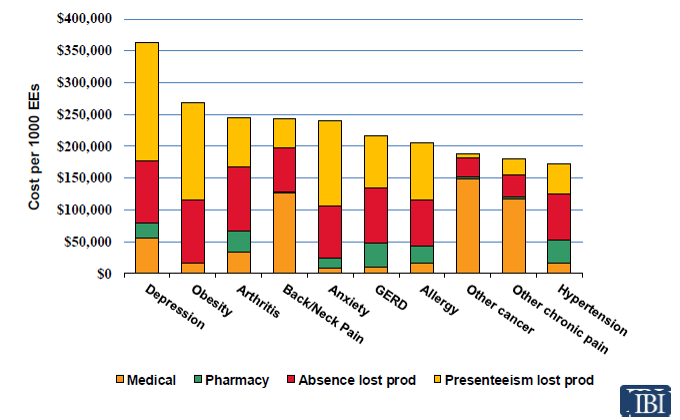
Only two “wellness-sensitive” items make it into the top-ten drivers of ill health: obesity and hypertension. Estimating off the y-axis (and dividing by 1000 to come up with costs per employee), it appears that the cost of each of those two is about $10 per employee per year. We already know that employers can’t reduce obesity–that’s in our peer-reviewed article. And let’s say you could reduce hypertension by 10%. That’s a $1 savings per employee per year–before adding back the (much higher) cost of the hypertension drugs. (Presumably extending this top-ten list would eventually reach the other diseases that wellness vendors love to hyperdiagnose, so add a couple of dollars of potential savings there, for a total of maybe $3 per employee per year in savings before adding back costs.)
This being the wellness industry, even the “honest” slides are full of head-scratchers. For instance, how can there be so much absenteeism due to hypertension, which has no symptoms in 99.9% of cases? Do you even know anyone who doesn’t go into work because their hypertension is acting up? And how can HR even track absences due to hypertension, assuming there are any? Absences aren’t coded by ICD-9s (and are rarely even coded by sickness vs. vacation).
Back to the top of the slide, if your biggest problem is depression, why would you institute a wellness program which — according to the HERO report which Tom Parry co-authored — is bad for morale? We don’t mean to make trouble here. We’re just askin’…
And this slide is actually the best argument against “pry, poke, prod and punish” wellness I have ever seen: the nine most expensive items either have nothing to do with screening or HRAs, or in the case of obesity, aren’t fixable by wellness.

Do you know how much radiation there is a CT scan vs an xray? Do your employees know? We know the answer. Click to find out.
We look forward to many more presentations in “support” of wellness. In the immortal words of the great philosopher George W. Bush, bring ’em on.
POSTSCRIPT: Explanation from Tom Parry. We, as you know, are unlike wellness vendors in that we are in the “integrity segment” of the market, which means we print all responses. (We used to seek responses prior to publication but never got any, so we gave that up.) Tom explains below. Albeit not as funny as the “insights” we gleaned, it is the right answer, so here it is. (It doesn’t change the overall narrative or conclusions about the money — and it doesn’t address Nicole’s comment — but it does describe how the findings on the slide can be accurate and can logically have come out of IBI’s research.)
Al – one clarifying point on the research graph (and I’d be happy to send you a copy of the research paper if you like). It is a person-centric analysis rather than an analysis of the marginal impact of individual diseases (parsing out the marginal impact in this kind of data is extraordinarily difficult). We wanted to look at the experience of PEOPLE with different conditions (and because of the prevalence of co-morbidities tend to have other conditions as well). So as you point out, you don’t miss work because of high-cholesterol but those with high cholesterol often have other conditions that together cause them to miss work. Tom

 They Said What?