Home » Uncategorized (Page 30)
Category Archives: Uncategorized
If Wellsteps and the Koop Committee can show they aren’t lying, they can collect the $1-million reward
Those of you with long memories may recall our standing offer of a $1-million reward to anyone who can show that the wellness industry has broken even during this century. You need a long memory because no one ever claimed the reward. For all the bluster of Ron Goetzel and his cronies, apparently none of them actually believe what they say…or they would be $1-million richer.
Oh, wait, in the case of both Ron Goetzel and his cronies, maybe they haven’t claimed the reward because they do believe what they say.
The offer is legally binding. There are clear rules. There is an entry fee, but it is refundable to the claimant if they win.
We would now extend that offer specifically to Wellsteps and/or the Koop Award Committee, and we’ll throw in HERO too, since it’s all the same inbred crowd. All they have to show is what they have already claimed: that Wellsteps made Boise School District employees so much healthier — perhaps by reciting their mantra that “it’s fun to get fat and it’s fun to be lazy” — that the School District could, as a direct result of this enhanced employee health, reduce their healthcare benefit spending by roughly one-third after three years.
To make it extra easy for the these people, I’ll relax the requirements:
- They can submit the existing “This Is How You Win a Koop Award” self-congratulatory paean. That means both that they don’t have to do any extra work (besides adding to up 20 links at their option, as the rules allow), and that the word limit on the reward application is waived to accommodate the size of that posting.
- Any or all Koop Committee members can participate with you in the oral arguments, but I myself am not allowed to bring a second. This means they can gang up on me, by crowdsourcing their IQs.
And of course they already know what arguments I am going to make because I posted them. That’s like having the debate questions in advance.
They would have to file the entry fee, or formally request a month’s extension, by November 1. The only reason for the deadline is that when they ignore this offer, as they inevitably will, I can start saying they are admitting they’re lying as early as November 2.
As with the regular award, I am perfectly happy to offer it the other way around, where I pay the entry fee, and I have to prove they’re lying, as opposed to them proving they are telling the truth. That way they can’t say the game is rigged, since I’m willing to play either hand.
Since the Koop Committee members are all such civic-minded citizens, they need not personally collect the windfall if they win. I am perfectly willing to — indeed, would prefer to — donate a million dollars to the Boise School District, either as an unrestricted gift or to set up a fund to update, enhance, and increase employee (and student) access to their fitness facilities and equipment.
Surely, Mr. Aldana and Mr. Goetzel, if you truly care about the health and well-being of those employees, you will make the small effort required to secure this million-dollar contribution on their behalf.
And, Mr. Aldana, please don’t pretend you aren’t applying for the award because you are unaware of my work. For instance, you view my Linkedin profile with a regularity roughly halfway between obsessive and man-crush.*
*As recently as…

Share this:

Why do employee wellness industry leaders hate employees so much?
I would like to express my gratitude to the editor of the American Journal of Health Promotion, Michael O’Donnell. He recently decreed that “despite common lore, I am not an idiot.” Coming from a man brilliant enough to singlehandedly create entire alternative universes of arithmetic and statistics, “not an idiot” is mighty praise indeed.

I’m unsure exactly what “common lore” he is disputing, unless he means that the Phi Beta Kappa committee at Harvard also thinks I am an idiot, relatively speaking, because they snubbed me until I was a senior.
I will return the compliment. Michael O’Donnell is not an idiot either. Quite the contrary, he and his Koop Committee buddies knew exactly what they are doing when they gave their friends at Wellsteps awards for harming employees. Bottom line is, these people simply hate employees, and happily throw them under the bus whenever it’s profitable to do so. While Boise is a great example, Penn State still reigns supreme.
While we could write a post about almost any member of that Committee, this post focuses only on one member, Mr. O’Donnell. Still, it’s hard to dislike the man given all the kudos he throws my way. For instance, in addition to not being an idiot, I am also praised above as: “close to being accurate.” Since we disagree on everything, he is therefore acknowledging that he himself is many light-years from accurate — as Wellsteps and every other Koop award demonstrates.
Michael O’Donnell’s Anti-Employee Jihad
Michael O’Donnell also said, as you can see above, that I am not a “misanthrope.” However, in this case, I can’t return the compliment. His new editorial is a misanthropic anti-employee jihad. First, he says prospective new hires should be subjected to an intrusive physical exam, and hired only if they are in good shape. OK, not every single prospective new hire — only those applying for “blue collar jobs or jobs that require excessive walking, standing, or even sitting.” Hence he would waive the physical exam requirement for mattress-tester, prostitute, or Koop Committee member, because those jobs require only excessive lying.
Second, he would fine people for not meeting “outcomes standards.” In an accompanying document, he defines those “outcomes standards.” He specifies fining people who have high BMIs, blood pressure, glucose, or cholesterol.
Finally, he wouldn’t hire smokers at all, because they are so unworthy and untalented. Meaning Humphrey Bogart never should have been cast in Casablanca. Ernest Hemingway and George Orwell should have piled up rejection letters. Roger Maris should get his asterisk back.* Rihanna, Simon Cowell, Adele, Brad Pitt, Obama, Churchill, Einstein. Sinatra, Twain, Kidman. Sheesh! I agree with you, Michael. What a bunch of losers.
And thank goodness Watson didn’t smoke or Moriarty would likely still be at large.

A Unique Way to Charge Employees for Health Insurance: By the Pound
Almost every nonsmoker would be caught in his dragnet too, as he would “set the standard for BMI at the level where medical costs are lowest.” Since people with very low BMIs incur higher costs than people with middling BMIs, Mr. O’Donnell would fine not only people who weigh more than his ideal, but also employees with anorexia.
If employees didn’t already have an eating disorder, what better way of giving them one — and hence extracting more penalties from them — than to levy fines based on their weight? Hopefully, he would allow people with wasting diseases like cancer to appeal their fines.
Employees above his ideal weight would pay per pound, sort of like they were ordering lobster or mailing packages.
Yes, I have a hard time believing anyone would disdain employees that much too, so here is the screenshot:
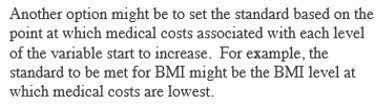
He claims that all these fines will “enhance morale” for employees, whether they like it or not.
How would Michael defend his anti-employee jihad?
The Wellness Ignorati don’t engage with me, for obvious reasons given their self-immolating comments when they do. So I’ll provide his rebuttal. It would be, as he said in the first screenshot above, that I am once again “creating controversy where it does not exist.” Clearly, his editorial and white paper are mainstream, and I’m just causing trouble again for no reason.
Michael wonders why, in his own words (echoed by Ron Goetzel), 90% to 95% of wellness programs fail. He says it’s because employers don’t spend remotely enough money on them. He recommends up to $300/employee/year…and what better way to reach that spending target than to make them go to the doctor, and set up expensive weigh-ins, inspections and fining procedures?
While Michael O’Donnell may not be an idiot, I’m not sure I could say the same about any CEO who takes his advice.
*Maris should get his asterisk back because, as a smoker, he still holds the record for “Most home runs by a player who never should have made the team.”
Share this:

How the 2016 Koop Award Raises Lying to an Art Form
If you were at the HERO conference, you witnessed a surreal experience. Executives from Johns Hopkins, Mercer, United Healthcare and elsewhere willing to risk their jobs by perpetuating what has now been exposed as a bald-faced, presidential candidate-level lie: that Wellsteps deserves an award for a program allegedly benefiting Boise teachers so dramatically that costs fell by a third. They will not mention the article in STATNews that came out yesterday showing that school district employee health deteriorated.
You read the article, so you know they are lying. And they know you know they are lying. And yet the whole thing just continues as though it is somehow all OK because no one is admitting it publicly.
Here is some more detail on the lies in question.
Sharon Begley’s article Wellness Award Goes to Workplace Where Many Health Indicators Got Worse does not lose anything in the re-reading. Quite the contrary, almost every quote in it is either a lie, or exposes the Wellsteps application as a lie. In each case, Wellsteps’ Steve Aldana, Johns Hopkins’ Ron Goetzel, United Health Care’s Seth Serxner, and all the other committee members know it’s a lie, because of the aforementioned article.
“Lie” might seem like a harsh term, but the alternative is to assume that Ron and his cronies have absolutely no idea how to read an outcomes report, even though I have already showed them how to read this report in particular.
True, one could argue that Ron has been known to use the “dumb and dumber defense” when giving his friends their awards, but in this case he can’t pretend he doesn’t know any better because he was quoted in the article. Another argument that these are lies: no one — not even a member of the Koop Committee — can possibly be this stupid accidentally.
Let’s go lie by lie. Let’s start with the last quote from Ron “the Pretzel” Goetzel, because it sets the stage for the others. He got his moniker because he has a way of twisting and turning words to make himself sound like he isn’t lying. In this case, he said if “an application said everything went exactly right,” it would certainly “raise eyebrows” on the Committee.
“Went exactly right”??? Ron, isn’t the entire point of wellness to make employees healthier? So if a program makes employees unhealthier, we say it didn’t go “exactly right”?
Using this definition, here are a few other things that did not “go exactly right”: New Coke, Yugos, the 1962 Mets, Vietnam, subprime loans, Yahoo, and the 2016 presidential nominating process. And for that matter, Begley’s article points out that McKesson’s 2015 award also wasn’t “exactly right,” in that the program didn’t do anything and the data self-contradicted. It’s not just McKesson. I have been tracking these Koop Award-winners for years, and they all self-invalidate. Each is more hilariously not “exactly right” than the other.
Yessirree, if there is one thing that shouldn’t keep Koop Committee members up at night, it’s the fear that one of their award applications might be exactly right. So the good news is that no Committee member has to worry about contracting an acute case of over-raised eyebrows.
Another lie exposed: It turns out the Koop Estate licenses the name to this cabal in order to make money, just like Dr. Koop licensed his name to make videotapes. The award is now admitted to be “industry sponsored.” This is the first time this provenance has been disclosed in print. It is basically a marketing scheme for the committee members and sponsors. They had claimed to be a “private-public” organization. That Orwellian Pretzel-speak is a lot different from being admittedly industry sponsored.
Next, Dr. James Fries — whose major wellness expert credential is writing an article finding massive population-wide savings against a phony control group by getting a few diabetics to eat less fat — called this “an exemplary program” that “showed improvements in health behavior” leading to cost reduction. Yes, a few self-reported behaviors improved. We suspect the Boise teachers lied, because they clearly lied when they self-reported their smoking (only 2.5% admitted it) and drinking (only 20%).
But let’s assume they didn’t lie–meaning somehow they are different from everyone else when they complete workplace health assessments. Exercising three more minutes a day and eating 0.11 more fruits and vegetables/day cannot reduce health care costs at all, let alone by a third, especially when the employees became unhealthier overall.
This statement would therefore qualify as a mistake, assuming Dr. Fries is not bright enough to already realize it is wrong. If Dr Fries doesn’t retract it now that he knows it’s wrong, it becomes a lie.
That brings us to Steve Aldana. He has been caught lying many times, including this example where he accidentally told the truth before retracting it. (He and his friends burn a lot of time trying to explain away instances in which have to explain why they accidentally told the truth but didn’t really mean it.)
His biggest lie is his discussion of regression to the mean. Compare his quote to his application. First, the quote, which shows he is actually familiar with the concept:
“In just one year, many employees will move from one [risk] group to the other,” he explained, “even though they did not participate in any wellness programs or any intervention whatsoever.” That movement, he continued, “reflects changes in health risks that occur naturally,” making it possible that some high-risk people become low risk “even though your program didn’t do anything.”
Contrast that to his application, in which he pretends he has never heard of regression to the mean, and instead attributes the “dramatic improvements” in the highest-risk Boise employees to the “program impact”:

He also contributed my favorite line of the article: even “one more bite of a banana” can make a difference in people’s health. This is true, of course, for the segment of the population that is starving to death. Otherwise, how dumb is this claim? Let’s just say that if a college taught him this, it could lose its accreditation.
And that brings us to his biggest lie of all: He says I didn’t understand the program benefits because I didn’t read the data. I did, of course. I even actually added up the datapoints, which no one on the Koop Committee did. I’ll give Committee members the benefit of the doubt and assume they failed to add the datapoints not because they didn’t want to expose the truth that Boise employees got worse in their friend’s program, but because calculators are not yet available in their cave.
Adding the data would have revealed to them — as it did to me — that they harmed employees. 6397 biometric indicators deteriorated, while only 5293 improved. This conclusion shared by both Ms. Begley and the Boise consultant, Kellie Wirth, who helped set up the program. Apparently, the law of averages caught up with the perpetrators of this Boise scheme, because Kellie Wirth is honest. She calls the biometric results “very disappointing” and says my concerns “are valid.”
The biggest lie of all: that these extra banana bites and trivial improvements in self-reported health behaviors — combined with statistically significant deteriorations in self-rated health and risk scores — could have any effect, let alone an effect of mind-boggling magnitude, on overall spending:
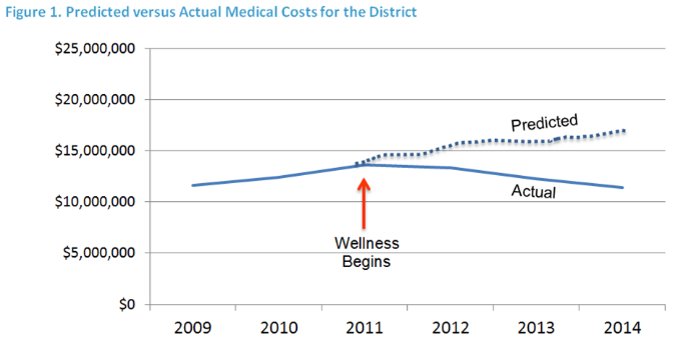
Funny thing, Ron Goetzel insists that “most programs fail” because they aren’t done right, and that getting to a 1-to-1 ROI is a heroic accomplishment, only achievable when employee health is improved:

And yet when it comes to giving his friends awards, failed programs harming employees but generating massive phony ROIs don’t seem to bother him at all. Let’s see him Pretzel his way out of this one.
One thing vendors love to do is play blame-the-victim. The Pretzel pioneered this approach by saying he had “absolutely nothing to do with Penn State,” when in fact he was in the room when they defended their program to the media.
Seth Serxner stood up, on camera, and basically declared United Health Care/Optum hates it when employees spend too much money on their screening programs, and typically begs to do less. United Healthcare complained that I was making them look bad, but then couldn’t produce a single name of a single employer who would admit to deciding to spend more money for the express purpose of screening inappropriately.
And now here comes Steve Aldana, blaming the Boise school administrators for insisting on throwing taxpayer money away and harming their employees, by flouting US Preventive Services Task Force guidelines. My suspicion is that their Boise customers have an alternative view, but — despite the presumably obvious pride they must be taking in this award — they are refusing to comment on it. One can only imagine the conversations taking place in Boise right now…and this is before the Idaho Statesman gets hold of this debacle.
And Ron wonders why the number of applications for the Koop Award was down by two-thirds this year…which brings us to yet another lie told by Mr. Goetzel in this article. He attributes the decline to the following:
the application process, including the requirement that wellness programs submit statistics and rigorous data analysis, has become so strict that fewer programs want to go through the process.
However, if you actually look at the application form, it is exactly the same now as it has been every year this century. And indeed the data submitted, if anything, was more comprehensive then. For instance, the 2000 winner, Fannie Mae, clearly documented all the prostate, pulmonary function and other USPSTF D-rated tests they forced employees to submit to.
Share this:

The back story of the scathing STATNews smackdown of Wellsteps and Goetzel
This posting is for folks who found us via award-winning journalist Sharon Begley’s “Wellness Award Goes to Workplace Where Many Health Measures Got Worse.” (Note that no one has ever challenged any of her two dozen awards.)
In the event that you are new to the Wellsteps./Boise School District debacle, here is the back story, very quickly.
- Wellsteps lied about savings.
- I predicted the combination of lying, incompetence and cronyism would win them a Koop Award.
- Wellsteps said: It’s fun to get fat. It’s fun to be lazy.“
- Wellsteps showed a complete failure to understand wellness.
And so, inevitably…
Wellsteps won a Koop Award. Ron Goetzel and Seth Serxner have never let their friends down in the past, so why should integrity, competence and facts stand in the way this time?
Share this:

Let’s meet in person at the Employee Healthcare and Benefits Congress next weekend
At the risk of knocking the Interactive Health posting — worth a read if for no other reason than to take the Interactive Health IQ test — off the front page, this one is a bit time-sensitive.
This site has 5200 followers. I’d love to meet some of you. I’ll be at the Employee Healthcare and Benefits Congress Sunday afternoon (speaking on incentives) and all day Monday. Please text me at 781-856-3962 during that period and we can meet in person and chat about all the worthwhile things they are doing, and compare notes on what we are doing.
Obviously some people can’t make it because it conflicts with the HERO conference, at which the Koop Award will officially get bestowed on a vendor that actually harmed employees according to its own data, which is a first even for the Koop Award, which has had more than its share of ethical and analytical challenges over the years. The chat there will emphatically not be about all the worthwhile things they are doing, but rather the news coverage that is likely to appear around the same time “outing” Wellsteps for harming the Boise employees.
Now get back to the IQ test. See if you can figure out what Interactive Health apparently couldn’t.
Share this:
Are you smarter than a wellness vendor? Take the Interactive Health IQ test and find out.
I’ve raised the bar for getting “profiled” on this site. Life is too short to simply highlight every wellness outfit that tests inappropriately and then lies about their outcomes.
Nor can you get on this list simply with bold proclamations of fatuous statements, like Interactive Health does:

Hey, Interactive Health, we get that you don’t understand statistics in general, based on the mind-boggling excuses your consultant offered about your completely invalid savings report (“Al, the [massive] savings on Page 4 have nothing to do with the [trivial] risk reduction on Page 9. It’s a completely separate analysis.”).
Even so, maybe you can find a smart person to explain this particular statistic to you:
- According to the CDC, the number of annual deaths caused by smoking: 480,000
- According to the CDC, the number of annual deaths caused by sitting: 0
Here are some other differences between the two activities: Chairs don’t carry excise taxes or warning labels. If you’re under 18, you can buy a chair without a fake ID. Workers are allowed to sit inside the building. Chairs don’t make you clothes smell, cause lung cancer or dangle from the lips of gunslingers in old John Ford westerns. Sitters aren’t assessed health insurance penalties. Your Match date will not feel misled if he or she catches you taking a seat, even if your profile didn’t disclose that you sit.
Sitting isn’t the “new smoking.” Opioids are the “new smoking.” But since you don’t help employees understand the risks of opioid addiction, it’s probably because you don’t understand these risks yourselves. Quizzify has produced a painkiller/pain reliever awareness quiz that you might benefit from. Welcome to 2016. THIS is what’s harming and even killing employees, not sitting.
The Interactive Health IQ Test
Which of these images is most unlike the others?

No, these days to get into this column, you need to soar above and beyond ordinary wellness vendor stupidity and dishonesty, because Wellsteps has totally raised the bar…and yet Interactive Health has cleared it.
I was recently screened by Interactive Health. They were supposed to send me a standard summary writeup, which I asked for repeatedly but never received. Instead, weeks later, their lab sent me a lab report, with no interpretation. There are one of three explanations for this:
- They are too incompetent to send out summary writeups in a timely way;
- They think an unadorned, highly technical, lab report sent three weeks after the fact constitutes a useful summary writeup;
- They were about to send out their standard summary writeup, before someone noticed my name and said: “Whoa! That’s Al Lewis. He is nowhere near stupid enough to find our usual nonsense acceptable. He has already exposed our savings lies in the Wall Street Journal, and if we give him our usual writeup on his screening, he will expose our stupidity on his blog. We need to cover that up. So let’s just send him a lab report.”
By process of elimination, I originally landed on #3. Quite flattering really. I’d make a few observations.
First, I specifically asked them, in accordance with USPSTF guidelines, not to measure my PSA. They interpreted that — as you can see from the top of that page reproduced at the very end — as a request specifically to measure my PSA. (It is on Page 2 of the report, which I can’t put my hands on right this very moment. However, the Wellness Ignorati, who still think it predicts cancer, will be disappointed to learn that it was quite low.)
Second, the glucose is slightly high because some very generous folks had just treated me to a large and delicious breakfast. A classic false-positive, the type of reading that makes wellness vendors’ hearts go all aflutter, because then they can do a followup reading and show that they improved the outcome, after it improves on its own. Interactive Health’s lab report was completely unhelpful on this high reading. No advice offered.
Third, Interactive Health shattered the record, previously shared by Total Wellness and Star Wellness, for most USPSTF non-recommended blood tests. I don’t know what half these things are, which means neither does Interactive Health. (Total Wellness might win a second-place tiebreaker because they would still be testing for ovarian cancer — it’s still advertised on their website — except that the only company that makes the test has pulled it from the market following FDA warnings not to use it. Hopefully, Total Wellness stockpiled some assays ahead of the recall, like Elaine did with the sponges.)
Interactive Health also tested me for calf tightness, as I mentioned in an earlier blog. It turns out my calves are tight, and right on-site they loosened them. I could feel my productivity soaring…until the left one went into spasm that night. Still, loose calves are a useful trait for some jobs, such as first baseman.

Interactive Health may have also just assumed that because they don’t like me, no one else in the industry does either. That’s actually a fairly accurate assumption, one I am quite proud of given the integrity of most of them, with their trade association, the Health Enhancement Research Organization, leading by example in the pants-on-fire department. Indeed a good rule of thumb to determine if a wellness vendor is honest is to ask them what they think of me.
Nonetheless, I was able to find someone who was screened at a different screening and said he received an actual wellness outcomes report from these people, someone who likes me well enough to send it to me. Coincidentally, this individual had been urging me to post on Interactive Health for quite some time. I figured, cool, I could see what a real report from Interactive Health looks like, the kind that changes employee behavior enough to explain their whopping savings claims of $54,000 for each employee who reduced a risk factor.
No such luck. He sent me exactly the same lab printout that they sent me. Only he hadn’t lost the second page, so I could count the total: 43 lab values. “Knowing your numbers” could be a full-time job. One would think they had covered all the risk factors with all those lab values, but, curiously, the guy said his blood pressure was quite high, and they missed that altogether.
Hmm…how come he got the same completely unhelpful report I did? Did Interactive Health view my linkedin profile — as their executives are wont to do on a regular basis bordering on the obsessive –and decide that it wasn’t safe sending any of my connections their typical employee printout, on the theory that if I’m not stupid, neither are most of my connections? If so, that would be their second fairly accurate assumption.
The only other explanation is that everyone receives the same unadorned lab report, full of letters and numbers and signifying nothing, at least to the average person without a PhD in biochemistry. My feelings were shattered. I wasn’t special. Do they send everyone else incomprehensible lab reports with 43 different numbers in them along with assortments of letters most people would associate with Scrabble…and no interpretations or advice?
Whether incompetence or botched coverup, the explanation itself remains a mystery. Nonetheless here are a few numbers and letters from his report.

Maybe Interactive Health could interpret this for us, but I would be more confident of their ability to distinguish (for example) AST-SGOT from ALT-SGPT if they could distinguish (for example) a chair from a cigarette.
Another one:

How is anyone supposed to make any sense out of this? Most employees would think a “negative risk factor” is a bad thing,” as in “telling the truth is a negative risk factor for the profitability of wellness companies, which is why most of them never do it.” And what does “VLDLCH” mean and why isn’t it reported? Still no interpretations.
And then of course there is the PSA test. If you don’t speak up — or even if you do speak up, as I learned — they’ll do one on you, even though the USPSTF rates it “D”, not to mention that the actual inventor of the test says the test is “inaccurate and a waste of money.” My friend’s PSA result is listed at the bottom of this apparently random number and letter generator…

And, yes, finally, an interpretation!
“Values obtained with different assay methods or kits cannot be used interchangeably. Results cannot be interpreted as absolute evidence of the presence or absence of malignant disease.”
In other words, the interpretation is that this test doesn’t explain anything, so we recommend ignoring the result.
It would have been even more helpful for them to recommend ignoring Interactive Health altogether– the calves, the chairs, the cigarettes, the AST and ALT, and, to be discussed in a future posting, the fabricated outcomes report.
Here is the entire first page of my own results, so that you know we are not taking this out of context…

Share this:

More employees weigh in on Slate’s wellness expose
Silly us! We already published comments from employees on the Slate article “Workplace Wellness Programs Are a Sham” on the assumption that, two weeks after publication, the news cycle would have ended. And yet the article has “legs” — it’s up to 5500 Facebook shares (about five times Slate’s already-impressive average) and 611 retweets (ditto). Most importantly for our purposes, a new wave of beleaguered employees is weighing in, so to speak:
- My husband’s new employer uses these programs and in my experience the extreme challenge of actually downloading the correct forms to submit my wellness check only led to someone with very good blood pressure to have theirs raised significantly. As my husband put it, this program is an ‘unvitation’ to save money. If I were the employee, I would have spent half a workday navigating in order to accomplish this task.
- I teach an inherited “Wellness for Healthcare Administrators” class at a college in California. It took me a month to figure out there was complete fraud in the wellness program claims that you expose in your excellent article. Unfortunately, textbook publishers are still pumping out fatuous tomes of enormous size laden with B.S. so vulnerable students are robbed of their money as well as the truth. THANK YOU FOR EXCELLENT JOURNALISM!
- At my last job, they offered on-site yoga, but kept a list of who attended…[and said the] next time they had to do layoffs, they were going straight to the yoga list because if people had time to do yoga, they obviously weren’t working hard enough.
- Do people really consider HRA’s and biometric screenings as wellness programs? That’s part of the problem. And why should I listen to what they have to say? It’s not like I don’t know what they are going to say or tell me. I can even Google what they will tell me.
- The whole idea of these wellness programs is that if you are ill, you must be stupid, irresponsible, or both. It’s all about blaming people who are sick. I absolutely hate the people who made me go through all that humiliation when I was so sick. If I could punch them in the face, I would.
Um, tell us how you really feel…
Share this:
Tom Emerick reviews Quizzify: “There May Be a Cure for Wellness.”
Not all wellness vendors are as bad as Slate makes them out to be. Companies whose names begin with “Q” are doing quite splendidly.
Quizzify’s stack of stellar reviews and reviewers (see Employee Benefit News, Not Running a Hospital (Paul Levy), and Bob Merberg) now includes Tom Emerick, who just wrote an Insurance Thought Leadership review entitled: There May Be a Cure for Wellness.
Far be it from us to discourage anyone from reading the full review, but here are some excerpts:
“Quizzify…transforms the boring but long-overdue task of educating employees about health, healthcare and their health benefit into an entertaining trivia game.”
“Quizzify provides a plethora of shock-and-awe, ‘counter-detailing’ questions-and-answers (with full links to sources) that will educate even the savviest consumers of healthcare and entertain even the dourest CFO.”
“Scores and scores of people have told me they fudge answers on HRAs. Interestingly, they feel they are on the ethical high ground to do that because of the goofy, nosy and intrusive questions they are asked to answer, e.g., asking about your [future] pregnancy plans… Quizzify, on the other hand, encourages people to cheat. Quizzify wants you to look up the answers because that’s how you learn. So instead of denying human nature, Quizzify channels it.”
Tom also addresses the concern that employees might think Quizzify is all about trying to keep them from spending money on healthcare:
“On the other hand, there are instances where people should go to the doctor but don’t. Swollen ankles? Painless, perhaps, but you may have a circulation problem, possibly a serious one. Blood in your urine, but it goes away before you even make an appointment? That could be a bladder tumor tearing and then re-attaching itself, especially if you smoke. And show me one health risk assessment that correctly advises people over 55 or 60 to get a shingles vaccine if they had chicken pox as a kid.”
That last point is pretty emblematic of the difference between wellness and Quizzify. It’s a classic example of wellness vendors wasting opportunities to actually provide employees with useful information. Virtually no HRA advises shingles vaccines for the relevant subset of employees.
Conversely, to focus on one of the longstanding obsessions of wellness vendors, there are no questions in Quizzify where the answer is: “Buckle your seat belt.” We figure HRAs have that covered.
We would also observe that if your employees don’t realize they should buckle their seat belts, wellness is probably not your biggest problem.
Boring but Important Disclosure: While this blog is independent of Quizzify, I am a principal in Quizzify.
Share this:
Test your knowledge of artificial sweeteners and maybe earn real money
Try our sample Artificial Sweeteners quiz to see how much you already know – and/or learn some rather scary things that you really should know. Four $25 gift cards will be awarded via drawing from the 10 highest scorers who are also advisors or self-insured employers or transparent PBMs.
Further, we’ll reveal the best way to avoid their hazards while still using them, since sometimes we just gotta have something sweet. Water or flavored water just won’t do the trick.
This month’s contest closes August 29th. The ten high-scorers will be announced August 30th. Based on the formula we use (matching the winners to the last 4 digits the August 31st stock market close), four winners will be randomly selected from the ten high-scorers and announced September 3rd.
Oh yeah, and if you want to see how to prevent initial uptake of weight loss drugs specifically amongst employees who are likely to drop out after a few months, join our September 5th webinar for The Big Reveal.
Share this:

Comments to Slate article reveal what employees actually think about wellness
When it comes to reporting on feedback on wellness programs, someone in the wellness industry needs to listen to employees, instead of just speaking for them. But what fun would that be?
In their defense, one of wellness vendors’ few talents is lying about data. So why report what employees think when you can simply lie about what employees think?
Here is Wellness Workdays–apparently selected by none other than Katherine Baicker (author of the now hilariously discredited “Harvard Study” showing the 3.27-to-1 ROI) as the very model of a modern clueless wellness vendor: “Employees like wellness programs…These initiatives make employees feel like their employers care.”
LivingHealthy.com uses “science-based facts” to say: “The truth of the matter is that employees like wellness programs.”
Virgin Pulse says: “Employees love wellness programs.” And another vendor saying: “Employees love wellness programs because they feel cared for by the company.”
But here’s an interesting question: what would vendors say if they actually solicited and reported on real employee feedback, as opposed to just spouting whatever random thoughts their imaginary friend is implanting into the vacuum between their ears?
Slate just answered that question, in a big way. And the answer is — SPOILER ALERT — employees hate wellness programs. (Except for the part where they think they get to collect free money for doing nothing, without realizing the free money simply offsets what had formerly been a more generous benefit. Only now it’s usually taxable.)
Slate received more then five hundred comments to their article, “Workplace Wellness Programs Are a Sham.” The commenters overwhelmingly agreed with the title. Aside from the free-money crowd, the only readers defending wellness argued that they shouldn’t have to subsidize fat people or smokers. News: they don’t subsidize smokers. Smokers pay a penalty already at most companies. And except at both(!) extremes, there is only a trivial correlation between weight and health spending, in the employed population.
Here are some greatest hits from the comments thread:
- My husband’s HMO gave me a choice of either going to Weight Watchers or doing a minimum amount of walking every day. While I had cancer. And if I didn’t do it, my husband and I were going to be charged thousands of dollars more out-of-pocket each year. Luckily, my husband found a new job while I was in the hospital having my double mastectomy.
- I am a statistician who used to work for a large health plan. Dubious methods used to arrive at savings estimates are prevalent in this industry, whether it is for wellness programs or for other (often vendor driven) programs that propose simple solutions to complex problems.
- I was wondering if I was the only person on the planet who realized these schemes are just a rip off of the employee and an invasion of medical privacy that ought to be against the law. And the health advice – gee, perhaps since I have insomnia I should … get more sleep. Thank you, Dr. Genius. That didn’t occur to me.
- What’s worse is wasting workers’ time and energy with endless pointless seminars and meetings and flyers and crap and insisting on collecting their personal medical information under the guise of caring about them.
- Funny how killer projects requiring 80 hour weeks and toxic office politics are never cited or recognized as a major cause of health problems.
- We have this thing where you’re encouraged to meet step goals so you can qualify for the lower deductible wellness plans – and our commissioner just sent word down that she’s annoyed at how many people are walking for 15 min in the afternoon.
- They did wellness checks at my last place of work where nearly everyone was also a heavy smoker. So, for the month before the wellness exam, everyone would try to quit smoking so they could “game the system” and avoid paying an extra $1200 per person for the next year (they were all in manufacturing, there was no way they could afford that, especially not if both spouses smoked). Nearly the entire workforce turned into Satan for that month from nicotine withdrawals. Jittery, irritated Satans. Productivity would plummet, HR would be overtaxed from complaints, and people would just stand around discussing ways they could fool the wellness inspector and wholeheartedly complaining about the company. The second they walked out of their wellness check, they celebrated with a smoke break.
- The worst part of wellness programs is the stupid, mandatory barrage of calls from the utterly worthless and ignorant WebMD “professionals,” who are obviously just call center rats with no education whatsoever.
And don’t get these people started on HRAs. One of the many ironies of wellness vendors is that they lie more often than presidential candidates…and yet they assume that all the information on HRAs is accurate.
- Yeah, I lied through my whole honor-based questionnaire. No ,I absolutely do not have insomnia. Yes, I don’t drink more than one drink a week. No, I have no work-related stress (never mind the constant mass layoffs). Outside of my doctor, no one needs to know this.
- I won’t fill out a survey in a meaningful way. If I had depression, for example, I would never give answers that indicated that on a workplace wellness survey.
- Mine asked about sleep. I don’t get enough and said so. “What are you doing about it?” What am I doing about it? I worked 10.5-hour days and have menopause-based insomnia, for which I’ve tried everything from black cohosh to Ambien. At the moment, I’m doing nothing about it. What’s needed is for my employer to let me come in later so I can actually keep sleeping in the morning when my body allows me. My employer won’t do that. The survey interpreted that to mean I’m not taking care of my health. That’s the caliber of idiocy we’re dealing with.
- I am a triathlete and ultra runner. My BP tends to run dangerously low unless I eat a ton of salt. After a bunch of tests and doctor’s appointments because I kept feeling like I was going to pass out any time that I wasn’t moving, I was just told to eat more salt. But then I was dinged on our automated questionnaire because it said I eat too much salt.
- Initially, most of us pretty much tried to provide a somewhat accurate reporting, but the kicker was that if your survey didn’t reflect someone in tip-top shape, you were harassed by a phone call every couple of weeks from a nosy nurse who wanted to know what you were doing to address the 5 extra points for HDL or whatever. Therefore, most of us researched the numbers that constituted excellent health and used them. So–pretty much worthless as an assessment of anything and a waste of a half-hour.
I’d encourage people to read the Slate article and add their own comments, and send it around to your Wellness Ignorati friends. Tell them this is what employees really think of their “pry, poke and prod” schemes and biggest-loser contests.
They might not believe you, so tell them Harvey says so too.

 They Said What?