Home » Posts tagged 'Health Fitness Corporation' (Page 2)
Tag Archives: Health Fitness Corporation

News flash: The Wellness Ignorati are ignoring facts for a change

There has to be a limit, even to deception
The Wellness Ignorati got their name by ignoring facts. Facts, of course, are the wellness industry’s worst nightmare. They ignore them In order to avoid creating news cycles that might reach human resources departments despite the best efforts of their consultants and vendors to shield them from actual information.
And they’re at it again.
First, Atul Gawande wrote a scathing article in the New Yorker about massive overscreening earlier this month. As Mitch Collins noted in The Health Care Blog, not a peep in response from the perpetrators of those hyperdiagnostic jihads. Nor has their been any response to Mitch’s article itself. Literally, no one defends wellness industry practices. And yet somehow all the laws are on their side.
Speaking of which, Mitch mentioned the famous Nebraska debacle, in which the vendor, Health Fitness Corporation, lied about making “life-saving catches” of “early-stage cancers.” Since HFC was a sponsor of Ron Goetzel’s Koop Award, Ron naturally gave them that prize for these lies.
However, we’ve thrown down the gauntlet. HFC, come on out and fight. Give us your side of the story. How was this not a deliberate lie designed to score political points in Nebraska? If it was a mistake, why didn’t you change it and apologize? How do those 514 cancer non-victims feel? And Mr. Goetzel, why do you not only keep defending HFC, but have even upped the ante? They’ve been promoted from “best practice” to “exemplar” in your most recent webinar.

As long as wellness vendors are silent, we won’t shut up.
Speaking of non-responses from Mr. Goetzel, where is the correction of or explanation for the massive mistake in Mr. Goetzel’s most recent wellness program evaluation? All those readers have been misled by his blog into thinking Graco’s costs/employee are $2280/year when in reality the cost per employee contract holder — according to Mr. Goetzel’s own blog — is about $11,100, like almost every other company. (That includes spouses and dependents but any reasonable dependent ratio would yield more like a typical $5000 to $6000 per employee rather than $2280.) I know he knows about this mistake because I’ve submitted a comment to his blog, which shockingly hasn’t been posted.
So, please, could someone actually respond for a change, even if it’s just to accuse us of bullying.
Share this:

WELCOA: In the Belly of the Belly of the Beast
First, a little background. For those of you unfamiliar with the Wellness Council of America, or WELCOA, this organization, based in Omaha, Nebraska, was founded by the inventor of the all-you-can-eat self-serve restaurant.

Hey, it’s an honest mistake! Anyone could misspell their founder’s name on their home page, especially when it’s one of those long foreign-sounding unpronounceable names of somebody no one’s heard of. Besides, WELCOA in particular can’t be expected to know how to spell “Warren Buffett.” I mean, it’s not like they’re both based in the same city or anything.
WELCOA is wellness’s perfect storm, exemplifying the standards for literacy, numeracy and integrity that have endeared the wellness industry to us humor writers. Along with Ron Goetzel’s Koop Award Committee (chronicled at length in these pages and never shy about coming back for more), WELCOA truly does put the “Ig” in “Wellness Ignorati.”

Fun + facts = smarter, happier employees
In general, the modus operandi of the Ignorati — and especially WELCOA — is to suppress facts, because facts are their worst nightmare. If facts are their worst nightmare, we’re their Night of the Living Dead. We are tickled pink that we are considered so threatening that nowhere on their site is there the slightest hint that we — or any wellness skeptics — even exist. For instance, the first time ever that the entire wellness industry (as opposed to individual debacles, like Penn State) was newsworthy enough to be covered by Health Affairs, LA Times, Incidental Economist, Chicago Sun-Times, All Things Considered, Huffpost, the Federalist etc., WELCOA’s lead “news” story was: “How to Jump-Start Your Wellness Program with Big Data.” (This editorial choice echoed the New York Post, which, on the day the hostages were freed and Reagan was inaugurated, led with “Joan and Ted to Split.”)
By contrast, we embrace transparency, and urge you to read the entire WELCOA site, especially the “premier providers,” who are kind enough to pay WELCOA for the privilege of having their creative approaches to grammar and math become TSW? fodder. (We have a source inside WELCOA who brought our attention to the comedic potential of this material.)
One of our favorite WELCOA premier providers is Trotter Wellness, which gets its own entry in “On the (Even) Lighter Side.“.

Remember that scene in Catcher in the Rye when Stradlater gets Holden to write his English composition but tells him not to put all the commas in the right places so the teacher won’t suspect he wrote it? The good news is, WELCOA could never be confused with JD Salinger. In their ad for Trotter Wellness, WELCOA didn’t put any of the commas in the right places.

Frankly, we’re not sure WELCOA has ever put a comma in the right place…
At the risk of ruining a joke by explaining it, it’s not just that all the punctuation is missing from the descriptor. It’s that the exact spot WELCOA’s crack grammarians decided to place a comma is also the exact spot they shouldn’t have placed a comma, according to Trotter’s own website screenshot right above this screenshot. That gives WELCOA both a false-positive and a false-negative rate of 100%, which even in wellness is a bit on the high side.
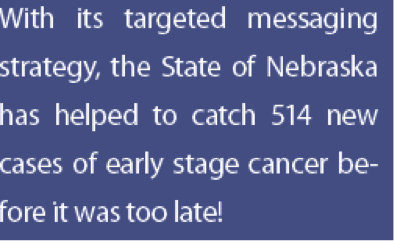
Along with Ron Goetzel’s Koop Committee and Health Fitness Corporation, they were a co-conspirator in the Nebraska workplace wellness fraud, thus proving that great minds aren’t the only ones that think alike. It was actually their website that claimed the famously fictitious “life-saving catches” of the 514 victims of “early stage cancer.”


What boggles the mind, even by the uniquely gauzy ethical standards of the wellness industry is that they still make that claim, albeit on someone else’s website. We’ll readily admit they posted the claim originally because they didn’t realize that HFC was lying (again), and that screening about 5000 people wouldn’t yield 514 cases of cancer. (While Ron Goetzel’s Koop Committee was also snookered, It took us about 2 minutes to figure out that the alleged rate of cancers would have been roughly 50-100 times that of Love Canal. You could come up with this insight too, using ingredients you already have in your kitchen: an internet connection, a calculator, and a triple-digit IQ.)
But two years later – after (1) we told them this was wrong; (2) we “outed” them in the Wall Street Journal; and (3) HFC admitted right in the Omaha World Herald they made up the claim – this statement is still being made. We must now reluctantly conclude WELCOA is deliberately lying, because nobody, not even WELCOA, could be this stupid accidentally.*
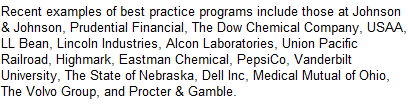
Even Ron Goetzel briefly stopped defending WELCOA and HFC. He claimed at the Datapalooza conference in June 2014 that the reason they won his award was due to a technicality. Apparently, because they had only disclosed this particular lie on their website and not in their award application itself, it didn’t count against them. Even so, a few months later, the Datapalooza conference being a distant memory, Ron once again declared that WELCOA/HFC/Nebraska was a “best practice”:

Just because it’s healthcare doesn’t mean it’s good for you
There is too much to say about WELCOA for a single posting, so we would direct you to two places. First, in This Is Your Brain on Wellness, WELCOA merits its own entry, of course. But WELCOA, truly a target-rich environment, also proffered screenshots for Midland Health, Bravo, Balance, Well Nation, the Healthy Company Alliance, Trotter, and Star Wellness.
Second, you can find Chapter 7 of Surviving Workplace Wellness right here. Even in the target-rich environment of the wellness industry, getting one’s own chapter is quite a feat. Just to get you in the mood, here is the first paragraph of that chapter:

Now that we have your attention, you can click on this link and download Chapter 7, with our compliments.
*Our bad! It turns out WELCOA may very well be this stupid accidentally. You see, when we pointed out in Surviving Workplace Wellness that they had misspelled the name of their founder, they fixed it on their home page. (Apparently, while many people can spell and many people have visited their home page, the intersection set consists only of us.) But it never occurred to them to do a find-and-replace. You’d think that someone there would have thought: “You know, since we didn’t spell Buffett correctly on our home page, perhaps there are other places we didn’t spell it correctly either. If only there were some way of testing that hypothesis…”
And that one of WELCOA’s other luminaries maybe couldn’t spell “Buffett” either but had studied the intricacies of Word’s find-and-replace function. And that maybe — just maybe — these two folks would have bumped into each other, like in those old Reese Cup commercials, and collectively come up with the insight that the “answer” was: run the find-and-replace function on “Buffet.”
But no such luck. Hence to this very day, the original spelling still appears on their website, in that very same Nebraska case study.

We’ve just spent 1350 words observing WELCOA’s foibles, but we do like to be balanced in our reporting, so we’ll close with some good news. The good news is, there is indeed one place where WELCOA is undeniably right: WELCOA truly has “helped influence the face of workplace wellness in the US”…
…By putting a great big smile on it.
Share this:

Congratulations to RAND’s Soeren Mattke on PepsiCo study award
 We are proud (but also insanely jealous) of our friend Soeren Mattke, whose PepsiCo article was named the #2 most-read for the year 2014 in Health Affairs. We, as our avid albeit narrow fan base may recall, ranked only #12–and even then that was just for blog posts, not articles in print.
Yes, we know it’s not always about Ron “The Pretzel” Goetzel and his twisted interpretations, but he seems to have come up with what appears to be exactly the opposite interpretation of what the PepsiCo study said. Don’t take our word for it — we’ve cut-and-pasted both what the study says about PepsiCo’s results and what he says about the study.
Here is what the article says about the financial impact of health promotion at Pepsico: ROIs well below 1-to-1, meaning a net financial loser, for health promotion. (DM, though, was a winner.)
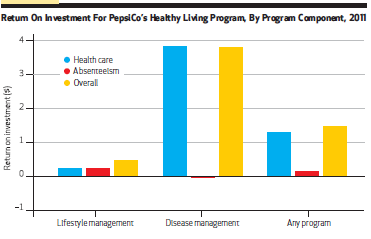
As low as these ROIs are, several major elements of cost were not available for the calculation — probably enough extra cost to literally make the financial returns so meager that even if the program had been free, PepsiCo would have lost money.

Clear enough? Negative returns from health promotion at PepsiCo, even without tallying many elements of cost. Nonetheless, Mr. Goetzel pretzelized that finding in his recent wellness apologia. Listed under “examples of health promotion programs that work” as a program that is a “best practice” is: PepsiCo. It stands proudly beside the transcendant programs at Eastman Chemical/Health Fitness and the State of Nebraska.

We look forward to a clarification from Mr. Goetzel about how a program that lost a great deal of money on health promotion can be an “example of a health promotion program that work(s),” which we will duly print…but don’t be sitting by your computer screens awaiting it.
Share this:

Health Fitness Corp wins a Koop award for curing non-existent cancers in Nebraska
C. Everett Koop National Health Award Committee,
Wellness Council of America and Health Fitness Corp.
Short Summary of Award:
The C. Everett Koop award committee’s mission is:
“…to seek out, evaluate, promote and distribute programs with demonstrated effectiveness in influencing personal health habits and the cost effective use of health care services. These programs have the objectives of
- Providing appropriate quality care
- Sharply reducing the alarming rate of health care inflation, by holding down unnecessary expenditures.”
Materials Being Reviewed:
The brochure in question describing the Nebraska program is downloadable from the WELCOA website.
Case Study of Award Winner for 2012: Health Fitness Corporation and Nebraska
Summary of key figures and outcomes:
Alleged cancer outcomes include the following:
Risk reduction outcomes include the following:

Questions for C. Everett Koop Award Committee:
I: Alleged Cancer Outcomes
Were you troubled by the program sponsors’ decision to waive all age-related colon cancer screening guidelines established by the government, and send out 140,000 flyers, at taxpayer expense, featuring a beautiful woman much too young to have a screening colonoscopy?

ANS: Refused to answer
How come, when the program reported that 514 of the 5000 (or fewer) people screened had colon cancer (in addition to the ones who would have been screened anyway), none of the Committee members with health informatics backgrounds from Truven Health Analytics and Mercer and Milliman (and from Wellsteps and Staywell, both of whose programs are also highlighted) were concerned that this alleged 11% colon cancer rate was at least 100 times greater than Love Canal’s?
ANS: Refused to answer
When Health Fitness Corporation admitted lying and reversed their story from making “life saving, cost-saving catches” of “early stage [colon] cancer” to revealing that those 514 people didn’t have cancer, why did the Koop Committee re-endorse what would appear to be outright data falsification, instead of rescinding the award?
ANS: Refused to answer
Even if the committee is allowing Health Fitness Corporation to keep its award and not even apologize, why does this claim of “life-saving, cost-saving catches” still appear on the WELCOA website even though the lie has been admitted?
ANS: Refused to answer
Wouldn’t the fact that the perpetrator of this acknowledged lie is also a sponsor of this Koop award that its own customers have won three times (including this incident) create the perception of a conflict of interest?

ANS: Refused to answer
Does anyone on the Committee think if Dr. Koop were still alive that he would endorse your position on data falsification of cancer victims?
ANS: Refused to answer
WELCOA’s website said it was founded by someone who appears to be the inventor of the self-serve all-you-can-eat restaurant. Despite his well-deserved reputation for integrity, did he endorse data falsification of cancer victims even after the perpetrators admitted it?
ANS: Refused to answer (but did change the spelling)
II: Risk Reduction Outcomes
How do you reconcile the claimed savings figure exceeding $4-million with your own chart above showing that only 161 active participants (3.1%) reduced a risk factor? (That chart of course doesn’t include dropouts and non-participants, whose risk factors may have increased.)
ANS: Refused to answer
Dividing the total savings by 161 yields more than $20,000/person in savings. Wouldn’t that $20,000+ for each risk factor avoided imply that all 161 would have had a heart attack even though the entire eligible population only had about 30 heart attacks the previous year, while the participating population would have had about 7?
ANS: Refused to answer
How do you reconcile your statement that 40% of the population had previously undiagnosed high blood pressure or high cholesterol with your other statement that “the total number of prescription scripts [sic] filled within the Wellness Plan reduced [sic] 3% last year,” despite your reducing or waiving the copays? Shouldn’t prescriptions have gone up, if indeed 40% more people were at risk?
ANS: Refused to answer
How can you attribute the 3% reduction in prescriptions to “improved lifestyles” with the fact that your own graph shows only 161 people improved their lifestyles enough to reduce a risk factor? What happened to the thousands who were diagnosed but were neither medicated nor improved their lifestyles?
ANS: Refused to answer
How do you reconcile that same finding – that 40% had high blood pressure or cholesterol — with that same graph, showing that almost three-quarters of the population was low-risk?
ANS: Refused to answer
How do you reconcile the brochure’s claim that the “majority of employees touted how the program has improved their lives” with the brochure’s own admission that only a minority of employees (42%) even bothered to be screened once and only 25% twice despite the four-figure financial incentive?
ANS: Refused to answer
Follow-up response
Not-for-attribution response received August 1, stating that the reason the Committee let them keep their award was not because were a sponsor but rather because they did not make the life-saving claim on their application. (They did make all the other invalid claims.) Because they didn’t make the claim on the application, they are not in violation of the Committee’s ethical standards by making it in other venues.
Our reaction:
So it is OK if a ballplayer admits using steroids as long as he didn’t happen to test positive?
Follow-Up Response
September 2014: Nebraska listed as a “best practice program” by Ron Goetzel
Our Reaction:
Doesn’t this listing contradict your initial excuse — that you forgot to ask them about whether they made up their cancer statistics during your due diligence — because now you know about that lie and all the other lies in their outcomes measurement…and yet you still call them a best-practice program?

 They Said What?