
Home » 2016 (Page 15)
Yearly Archives: 2016
Something in Wellness that Actually Works (Pinch Me)
Yes, I know it’s not always about me (my ex-wife was quite clear about that) but we did just receive our first “review” of Quizzify from a major, highly respected healthcare blogger, Paul Levy, former CEO of Beth Israel-Deaconess Medical Center in Boston. (Disclosure: I do know Mr. Levy socially, but nowhere near well enough to convince him to lie for me.)
Because there are so many new scams in workplace wellness to expose (and every time we expose one, they come up with another, this being our favorite example of invalidity-meets-Whack-a-Mole), we don’t have time for a lot of selfies.
Today is one of those rare exceptions. Here is the summary of the review:
“If I were in the corporate world, I’d seriously consider offering this service to my employees. The messages learned are much more likely to have a beneficial effect on people’s health and on their use of the health care system than a lot of the more invasive programs being forced on employees.”
If anyone out there would like to play the Launch Quiz — the first step in creating a culture in which employees understand that wise and cost-effective choices in healthcare extend way beyond eating broccoli, obsessing with cholesterol, walking 5000 steps, and buckling seat belts — let me know and I’ll set you up.
Update January 12: Here is a comment submitted on the original blog. We think it captures the essence of workplace wellness — the bewilderment by an employee that HR thinks these things could possibly save money, and the running joke in this person’s office that the program has become:
My employer has added a wellness program. I’m not sure if its the same category as the Safeway ones that you refer to, but what it does is give funds to a health-care account for completing programs run by an outside wellness company about healthy eating, meditation, stress, etc. You can get $100 or so in real money (spendable only on health care) for doing these, up to a capped amount. So the cost to the company is this money plus whatever the 3rd party charges to run it.
If the research shows these to be effective, I can’t imagine how. People joke about going “click, click, click” until they’ve completed as much of a program as they are allowed that day, then coming back a day or two later for more.
Share this:

Wellness Greatest Hits Collection: Wellnet Detects Undetected Claims Costs
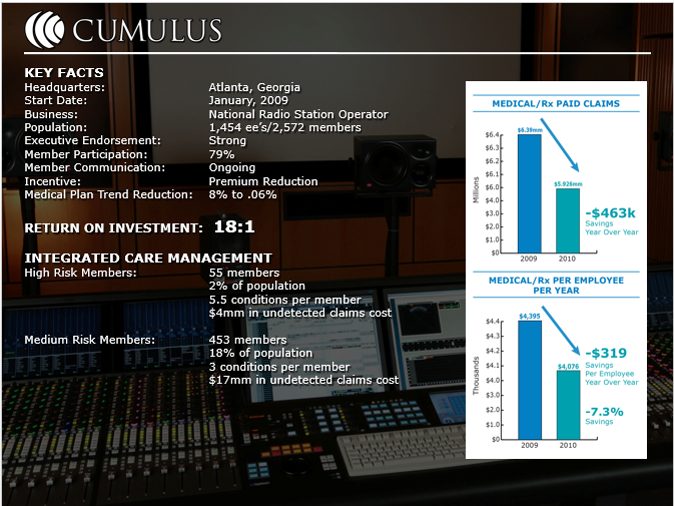
We are actually doing our “Day Jobs” today, which means we are digging into our Greatest Hits Collection rather than, in the immortal words of the great philosophers in ABC’s sports department, spanning the globe to find the Agony of Defeat. (Truth be told, we don’t have to span anything except our keyboards for that.) Here is one of our favorites, Wellnet. Besides the usual wellness vendor numerical creativity (check the y-axis on both graphs), Wellnet features “undetected claims costs.” If, despite all your years in the benefits business, you’ve never heard of “undetected claims costs,” you might want to google on that phrase. You will find two sets of references to “undetected claims costs”:
(1) Wellnet
(2) Us making fun of Wellnet.
We asked them a number of questions, which naturally they refused to answer. So before we published Why Nobody Believes the Numbers, we hired a well-known team of investigators to answer them for us. This is what they found.
‘‘Holmes, Wellnet saved $4 million in ‘undetected claims cost’ just on the highest-cost Cumulus employees. That is very impressive.’’
‘‘Watson, you see but you do not observe. The most common mistake in wellness is to present conclusions that are mathematically or epidemiologically impossible. The distinction is clear. Wellnet’s website says that the most expensive 2 percent of the employees of Cumulus Media avoided about $72,000 apiece—in so-called ‘undetected claims cost.’ This has Moriarty’s fingerprints all over it. Claims costs that don’t get incurred because they aren’t detected. No doubt those claims are making their way into Moriarty’s pocket.’’
‘‘You cannot detect them, Holmes? But you are the world’s greatest detective.’’
‘‘Indeed perhaps I am not, if I cannot detect undetected claims cost and Wellnet can. Or at least Wellnet has benefits consultants and HR executives believing that impossible arithmetic is possible. If Moriarty has invented a way to control our wellness industry through Wellnet so that benefits managers believe impossible results, he is making new rules of math. He could rewrite all the textbooks used in Grade 1 to Grade 6, in whatever those schools are called.’’
‘‘Elementary, my dear Holmes.’’
‘‘Watson, now what do you have for me?’’
‘‘Holmes, I have a lot of questions about how Wellnet detects undetected claims cost. Could they be using those gadgets for finding coins on the beach? Or do the employees have to pass through a scanner every day, like Karen Silkwood or Meryl Streep? And if Wellnet did not avoid all those undetected claims, how would employees get reimbursed for them? Would they fill out claims forms using invisible ink?’’
‘‘I’ll ask the questions, Watson. You get me the data. I can’t make my bricks without clay. Tell me, Watson, what is the data?’’
‘‘The data, Holmes, is that they also avoid $37,000 apiece in ‘undetected claims cost’ for the medium-risk members. Quite an impressive wellness company.’’
‘‘Watson, you ignorant slut. You see everything, but you fail to reason from what you see. $72,000 is much more than the top 2 percent of a company’s employees would be predicted to spend in avoidable expenses in the year following their inclusion in the top 2 percent, and equates to about four avoided hospitalizations apiece. Add to that about $37,000 in ‘undetected claims cost’ avoided for the medium-risk members, and Wellnet is avoiding $21 million of ‘undetected claims cost’ for Cumulus Media.
‘‘Here’s the rub, Watson: Cumulus Media’s total healthcare spending is only about $6 million/year. Therefore they can’t have saved $21 million. When you have eliminated the impossible, whatever remains, however improbable, must be the truth. Another case solved. Another Moriarty plot foiled. Math is saved for future generations to enjoy.’’
‘‘Brilliant, Holmes. How do you do it?’’
‘‘You know my method, Watson. It is founded upon the observation of trifles, a little cocaine, and an occasional allusion to Saturday Night Live.’’
Share this:

And Another One Bites the Dust: Employee Benefit News Eviscerates McKesson’s Koop Award
Believe it or not, I do have a Day Job (www.quizzify.com), but it’s hard to focus on it when the Wellness Ignorati keep throwing me red meat. I would suspect a conspiracy to distract me masterminded by the Ignorati and my competitors, except that Quizzify doesn’t have competitors. No company except Quizzify seems to employ executives who know how to read. Otherwise, vendors would have read that insured Americans already consume far too much healthcare, so the solution should not be to force them to get even more of it, via bribes and fines.
Employee Benefit News just published a smackdown of McKesson’s 2015 Koop Award. It is based largely on our own smackdown of McKesson. The article itself predated our Unified Theory of Koop Award Cluelessness, which shows that McKesson has lots of company in fabricating outcomes — all Koop Award winners overstate savings by roughly the same mathematically and clinically impossible multiple. We call this multiple the “Goetzel Factor.”
McKesson made a big deal out of their principal investigator being a graduate student at the Harvard School of Public Health named Andrea Feigl. However, I don’t recall Ms. Feigl being in class the day I guest-lectured on wellness outcomes evaluation. Had she shown up that day, she might have avoided some of her rookie mistakes. (Bada-Bing!)
As is always the case with wellness evaluators, her defense merely confirms our findings. She is still claiming $13 million in savings, but says it’s based on a “cohort” of roughly a third (14,000) of McKesson’s 43,000 employees, whose risk collectively declined by 2%. We had observed that $13 million is about 7% of McKesson’s total spending on all 43,000 employees. Watch what happens if we accept her argument that we should only allocate the savings only to the third of McKesson’s employees who participated. In that case, instead of being 7% of total spending on the whole population, $13MM is 21% of the spending on that third. 21%! Not bad –wiping out a fifth of all McKesson’s spending by urging people to eat more broccoli. (There is no mention of their off-the-charts 27% tobacco use rate, which barely budged, and seems just slightly off-kilter for a company with an award-winning wellness program.)
This figure of course is a massive multiple of all spending on wellness-sensitive medical events (WSMEs). To achieve that savings, the program would have to wipe out WSMEs not only on all participants but also all non-participants — plus about 160,000 of their closest friends. Plausibility test, anyone?
To support that finding, she said:
“Health indicators in 2013 and 2014 were adjusted in the analysis, while several sensitivity analyses of the ‘inter-individual’ impact that used a matching approach confirmed the results.”
In other words: “I can’t explain it in English so you’ll have to take my word for it.”
She also said that I confused the narrative, that said McKesson employees lost weight, with the data, which said McKesson employees gained weight. Those would seem to be opposite results, which she calls “apples and oranges” because the narrative and the data are different. One is “descriptive” and the other is based on “repeated cross-sections.” So it’s OK for these results to completely contradict each other. Got it.
In any event, neither gaining a little weight nor losing a little weight generates a 21% cost savings, especially when tobacco use is basically unchanged (-1%).
The bottom line: there was no plausibility test, no attempt to reconcile the narrative findings with the data, no curiosity about how such a trivial risk reduction could generate such a substantial reduction in total costs, no understanding of participation bias, no understanding of population health, and no concern that neither tobacco use nor weight changes could possibly support the financial findings.
In other words, McKesson was a shoo-in for a Koop Award.
Update, January 9: Actually it’s even worse than I thought. Kudos to Robert Dawkins, for pointing out on Linkedin that I was crediting McKesson with a 1% decline in tobacco usage over this period…but if you look at the CDC data, it turns out that the rest of the country declined by a greater percentage over the same period. So McKesson quite literally achieved less than nothing both in weight and in tobacco.
Share this:
Catch up on all the wellness news that WELCOA censors.
We’ve added a number of recent news items to our “In the News” feature. Real news of the kind that real people might read if they want real information. Hence this is news you won’t find on other wellness websites, which only publish rally-the-base propaganda. (Really–see if you can find a single site that thinks the New York Times’ articles on wellness are worthy of mention.)
Most recently, Michael Prager did an interview with me in which he called me a “Corporate Wellness Leader.” I’ve been called a lot of things but never that. So, which is it? Bully? Jerk? Corporate Wellness Leader? Or all three. You make the call.
Earlier this week, the Society for Human Resources Management published a great article on the hazards of overscreening. Kudos to Stephanie Pronk of AonHewitt for stepping up with some very thoughtful comments. On the other hand, the National Business Group on Health, which, a la Walter White, has devolved from an important player in DC to a trade group of wellness vendors determined to hold back the tides, still supports overscreening today, overscreening tomorrow, overscreening forever.
Last month, in case you missed it (and you did, since it is subscription-only and online copies aren’t even available), The Bloomberg BNA Health Care Report absolutely eviscerated this scam. Literally, all you need to know about fabricated data and employee harms is in these 1500 words, summarized and linked here.
Share this:
Wellness Shock-and-Awe: Federal Court OKs 100% Non-Participation Fines
While most of us were buying supplies for partying down on New Years Eve (in my case, I was in charge of bringing broccoli and Boggle), the federal court in the Western District of Wisconsin quietly handed down an earth-shattering decision in the Flambeau case, which pretty much went unnoticed due to the timing. You may recall that this was the case where employees refusing wellness lost all insurance benefits. The case looked like a layup win for the EEOC. After all, the Affordable Care Act clearly states that penalties for non-smokers are capped at 30%, and this was 100%.
But here’s the rub: Flambeau conditioned the entire insurance benefit on participation in their “pry, poke and prod” program. They knew most employees hate “pry, poke and prod” programs to begin with. So they created a program so onerous that some number of employees would prefer to forego insurance altogether than participate in wellness. And indeed, that’s what happened at Flambeau. This decision means they’re getting away with it, saving thousands of dollars apiece for each employee who refused to submit.
Make sure you catch that distinction between the 30% penalties and the 100% penalties:
(1) It is not OK to penalize an employee more than 30% for refusing to submit to a “pry, poke and prod” program if they already have insurance, or they can get insurance through the employer without this requirement.
(2) However, it is OK to say: “There is no incentive or penalty for wellness once you have insurance, but you can’t have insurance at all unless you submit.” If that seems like an artificial distinction, well, that’s because it is. All an employer has to do is require pry-poke-and-prod before you get insurance.
Assuming other federal courts follow this district’s lead (as they usually do), employers create a 100% de facto non-participation penalty: If you don’t participate, you don’t get insurance, period.
The implications of this case:
(1) It will allow some vendors, like Bravo, to double down on bragging about the “savings” from wellness by creating programs that employees don’t like;
(2) Because the decision only applies to participatory programs and not outcomes-based programs, many companies will either not switch to outcomes-based programs or else maybe switch back.
It also puts pressure on the EEOC to put the kibosh on this end-run around the ACA’s wellness provision. Note that the decision can and should be appealed. Otherwise it is a de facto repeal of a big chunk of the Affordable Care Act.
The bottom line is, now there is universal agreement (albeit inadvertently in the case of HERO, which apparently didn’t mean to tell the truth, but failed to proofread their own document) that wellness loses money. So any pretense of “pry, poke and prod” being about the employee is gone. Obviously, forced wellness isn’t about trying to save the $0.99 PMPM (that’s before program fees!) that HERO Says can be saved with healthier employees. It’s about gutting the key ACA requirement that employers provide insurance.
And unless the EEOC steps up in its final regulations and/or prevails on appeal of Flambeau, they will have succeeded.
Share this:
Eureka! Someone who thoughtfully disagrees with me…and has good points!
Usually a tease like that leads to exactly the opposite content, as in Wellness Corporation Solutions Gives Us A Dose of Much-Needed Criticism, which of course turned into the poster child for our observation that “in wellness you don’t have to challenge the data to invalidate it. You merely have to read the data. It will invalidate itself.”
This is not that situation.
Michael Prager points out on his blog that I overstated the wellness-programs-as-fat-shaming case. Note he doesn’t say I’m wrong, but he does say I overplayed my hand, which I did. Many wellness programs fit my thesis…but some don’t. If a company’s program is all about offers rather than threats, about creating an environment conducive to health improvement instead lecturing people on their weight, about doing wellness for employees instead of to them, and about leaving people alone who don’t want to or can’t lose the weight, then I’m all for it. I should have been clearer about that.
If anyone would like to nominate an employer who has such a program, I would be happy to write it up.
And as you can see, we are also open to criticism of our positions, as long as the person writing the critique has a good point. Naturally, this industry is overflowing with vendors and consultants who probably have never had a good point in their lives…and naturally Wellsteps is leading the way. When we observed that Wellsteps’ most recent outcomes report showed costs going up and down at the same time, here is their (Troy Adams) rebuttal: We are full of “hot air.”

Share this:

Dee Edington’s book is inscrutable.
I apologize. He asked me to do a review but I couldn’t make any sense out of it. It simply isn’t a good book. I got about 100 pages in and just gave up.
Wish I could say something positive about it.
 They Said What?