
HealthFitness takes credit for program savings without having a program
HealthFitness
Short Summary of Intervention:
“When you partner with HealthFitness, we work collaboratively with you to develop a strategic plan for program implementation, which includes a cultural assessment and an operational plan. You can expect results-oriented programs and services delivered through a highly personalized strategy, matched to your employees and culture.”
Materials Being Reviewed:
Success at risk reduction and translation of that risk reduction into cost savings. These excerpts are from the successful Koop Award application at http://www.thehealthproject.com/documents/2011/EastmanEval.pdf.

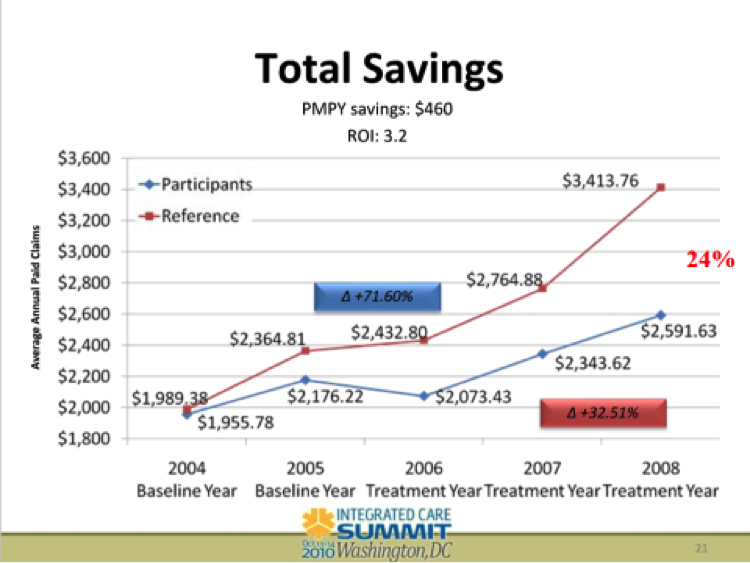
Summary of key figures and outcomes:
- Reduction in risk factors from 3.20 to 3.03 — net change of 0.17 — over 5 years. This success excludes dropouts.
- 24% improvement in costs vs. non-participants, or $460/year at Eastman Chemical (currently up to >$500/year according to HFC website)
Questions for Health Fitness Corporation:
Since only about 20% of all inpatient events are wellness-sensitive, and you only reduced risk factors by 0.17 per person, and hospital expenses are at most 50% of total spending, how is it that you are able to reduce spending by 24%?
ANS: Refused to answer
Why did you take credit for savings in 2005, even though according to your own slide you didn’t have a program in 2005?
ANS: Refused to answer
Does starting the Y-axis at $1800 instead of $0 create the illusion of greater separation between the two cohorts?
ANS: Refused to answer
Your website says that comparing participants to non-participants “adheres to statistical rigor and current scientific standards for program evaluation” and “is recognized by the industry as the best method for measurement in a real-world corporate wellness program.” Can you explain how non-motivated non-volunteers who decline financial incentives to improve their health are comparable to motivated volunteers, especially in light of the separation between the two groups that took place just on the basis of differential mindset in 2005, before you had a program?
ANS: Refused to answer
You and your customers have won three Koop Awards in the last 4 years. Do you think also being a sponsor of the Koop Award (along with Eastman, in this case) has helped you win these awards or is this just a coincidence?
ANS: Refused to answer
Why Nobody Believes the Numbers defines the “Wishful Thinking Multiplier” as “alleged cost saviings divided by alleged risk reduction.” Your cost savings is $460 and your risk reduction in 0.17, for a Wishful Thinking Multiplier of 2700, the highest in the industry. The book calculates that a risk reduction of your magnitude (even assuming dropouts also reduced risk by the same amount) could generate roughly a $8 reduction in annual spending. To what do you attribute your ability to reduce spending by 50x what is mathematically possible?
ANS: Refused to answer
Help us with the arithmetic below, also from this Koop Award application.

How is it mathematically possible to have a higher ROI ($3.62) when also including the cost of incentives in program expense than the ROI ($3.20) excluding the cost of paying incentives to employees to participate?
ANS: Refused to answer
Update December 2014: Ron Goetzel admits HFC lied. (See #5 and #6.) The slide was “unfortunately mislabeled,” using the passive voice, as though it was an act of God (“the game was rained out” ) or else perhaps the North Koreans. The geniuses at HFC apparently didn’t notice this “unfortunate mislabeling” for 4 years, despite it’s having been pointed out to them many times before this.
Share this:

Health Fitness Corp wins a Koop award for curing non-existent cancers in Nebraska
C. Everett Koop National Health Award Committee,
Wellness Council of America and Health Fitness Corp.
Short Summary of Award:
The C. Everett Koop award committee’s mission is:
“…to seek out, evaluate, promote and distribute programs with demonstrated effectiveness in influencing personal health habits and the cost effective use of health care services. These programs have the objectives of
- Providing appropriate quality care
- Sharply reducing the alarming rate of health care inflation, by holding down unnecessary expenditures.”
Materials Being Reviewed:
The brochure in question describing the Nebraska program is downloadable from the WELCOA website.
Case Study of Award Winner for 2012: Health Fitness Corporation and Nebraska
Summary of key figures and outcomes:
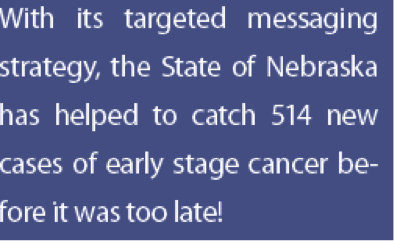
Alleged cancer outcomes include the following:
Risk reduction outcomes include the following:

Questions for C. Everett Koop Award Committee:
I: Alleged Cancer Outcomes
Were you troubled by the program sponsors’ decision to waive all age-related colon cancer screening guidelines established by the government, and send out 140,000 flyers, at taxpayer expense, featuring a beautiful woman much too young to have a screening colonoscopy?

ANS: Refused to answer
How come, when the program reported that 514 of the 5000 (or fewer) people screened had colon cancer (in addition to the ones who would have been screened anyway), none of the Committee members with health informatics backgrounds from Truven Health Analytics and Mercer and Milliman (and from Wellsteps and Staywell, both of whose programs are also highlighted) were concerned that this alleged 11% colon cancer rate was at least 100 times greater than Love Canal’s?
ANS: Refused to answer
When Health Fitness Corporation admitted lying and reversed their story from making “life saving, cost-saving catches” of “early stage [colon] cancer” to revealing that those 514 people didn’t have cancer, why did the Koop Committee re-endorse what would appear to be outright data falsification, instead of rescinding the award?
ANS: Refused to answer
Even if the committee is allowing Health Fitness Corporation to keep its award and not even apologize, why does this claim of “life-saving, cost-saving catches” still appear on the WELCOA website even though the lie has been admitted?
ANS: Refused to answer
Wouldn’t the fact that the perpetrator of this acknowledged lie is also a sponsor of this Koop award that its own customers have won three times (including this incident) create the perception of a conflict of interest?

ANS: Refused to answer
Does anyone on the Committee think if Dr. Koop were still alive that he would endorse your position on data falsification of cancer victims?
ANS: Refused to answer
WELCOA’s website said it was founded by someone who appears to be the inventor of the self-serve all-you-can-eat restaurant. Despite his well-deserved reputation for integrity, did he endorse data falsification of cancer victims even after the perpetrators admitted it?

ANS: Refused to answer (but did change the spelling)
II: Risk Reduction Outcomes
How do you reconcile the claimed savings figure exceeding $4-million with your own chart above showing that only 161 active participants (3.1%) reduced a risk factor? (That chart of course doesn’t include dropouts and non-participants, whose risk factors may have increased.)
ANS: Refused to answer
Dividing the total savings by 161 yields more than $20,000/person in savings. Wouldn’t that $20,000+ for each risk factor avoided imply that all 161 would have had a heart attack even though the entire eligible population only had about 30 heart attacks the previous year, while the participating population would have had about 7?
ANS: Refused to answer
How do you reconcile your statement that 40% of the population had previously undiagnosed high blood pressure or high cholesterol with your other statement that “the total number of prescription scripts [sic] filled within the Wellness Plan reduced [sic] 3% last year,” despite your reducing or waiving the copays? Shouldn’t prescriptions have gone up, if indeed 40% more people were at risk?
ANS: Refused to answer
How can you attribute the 3% reduction in prescriptions to “improved lifestyles” with the fact that your own graph shows only 161 people improved their lifestyles enough to reduce a risk factor? What happened to the thousands who were diagnosed but were neither medicated nor improved their lifestyles?
ANS: Refused to answer
How do you reconcile that same finding – that 40% had high blood pressure or cholesterol — with that same graph, showing that almost three-quarters of the population was low-risk?
ANS: Refused to answer
How do you reconcile the brochure’s claim that the “majority of employees touted how the program has improved their lives” with the brochure’s own admission that only a minority of employees (42%) even bothered to be screened once and only 25% twice despite the four-figure financial incentive?
ANS: Refused to answer
Follow-up response
Not-for-attribution response received August 1, stating that the reason the Committee let them keep their award was not because were a sponsor but rather because they did not make the life-saving claim on their application. (They did make all the other invalid claims.) Because they didn’t make the claim on the application, they are not in violation of the Committee’s ethical standards by making it in other venues.
Our reaction:
So it is OK if a ballplayer admits using steroids as long as he didn’t happen to test positive?
Follow-Up Response
September 2014: Nebraska listed as a “best practice program” by Ron Goetzel
Our Reaction:
Doesn’t this listing contradict your initial excuse — that you forgot to ask them about whether they made up their cancer statistics during your due diligence — because now you know about that lie and all the other lies in their outcomes measurement…and yet you still call them a best-practice program?
Share this:

Better health guaranteed by CIGNA…maybe not
Cigna
Short Summary of Intervention:
Risk reduction program aimed at high- and medium- risk employees. Cigna guarantees that a significant percentage of that high- and medium-risk population will reduce risk factors over the next twelve months.
Links to Materials Being Reviewed:
This is the short version of the brochure and this is the long version. 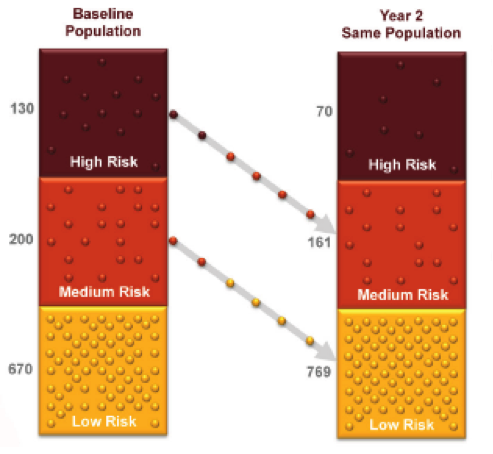
Summary of key figures and outcomes:
30% of high- and medium-risk members will reduce their risk factors in the ensuing 12 months. (Note: the actual guaranteed figures have varied in the past and may today be different from what you are reading here. However, the concept is still the same.)
Questions for Cigna:
According to noted wellness authority Dee Edington, whose slide is reproduced below, there is a natural flow of risk in a population, so that many high- and medium-risk people would reduce risk factors on their own even absent a program, while some low-risk people might increase their risk factors. How does your Better Health Guarantee adjust for that?
ANS: Refused to answer  It appears from this bar chart that low-risk people account for two-thirds of a population, and yet only one-third of the bar chart. Why did you elect not to draw these segments to scale, in keeping with the tradition of bar charts being drawn to scale?
ANS: Refused to answer
On that same chart, there is no indication that any of those two-thirds (670 out of 1000) might increase their risk factors, perhaps by regaining weight previously lost. How does your Better Health Guarantee account for the likelihood that people might regain weight or resume smoking?
ANS: Refused to answer
Speaking of which, let us assume that there is only one risk factor, smoking. Let us also assume that everyone in my organization smokes half the time, but they also quit half the time. Wouldn’t your Better Health Guarantee methodology show a 100% decline in smoking every year even if you don’t do anything and the actual rate of smoking remains the same every year?
ANS: Refused to answer
Share this:

Dr. Aetna Will See You Now
Aetna
Short Summary of Intervention:
“Aetna is launching a pilot program to test the benefits of new FDA-approved, prescription weight-loss drugs combined with lifestyle support. – See more in this news release.
- Aetna Press Release
- ”Special Communication” in JAMA Internal Medicine, published by the American Medical Association
- Aetna Presentation April 17
Summary of Aetna’s key points:
Self-insured employers can sign up for this program in which Aetna will outreach to obese employees and recommend use of the drugs Belviq and Qsymia
Questions for Aetna:
You are only offering this program to self-insured employers. If this is, as your title says: a “strategy to improve health status and reduce costs,” why are you denying this program to your own fully insured members, where the cost savings would accrue directly to your own shareholders while the health status improvements would benefit your own members?
ANS: Refused to answer
Does it concern you that neither drug in your pilot is approved in Europe and that JAMA Internal Medicine says the drugs have been associated with serious harms and that these well-respected JAMA physician editorialists state that these drugs should not have been approved for use in the United States?
ANS: Refused to answer
How does your description of these drugs on your sales slide as “safe and effective” square with the question above?
ANS: Refused to answer
Why, over the course of the 70-minute webinar (for which attendees were charged $300), didn’t you mention the JAMA essay or any other safety concerns?
ANS: Refused to answer
In addition to omitting mention of the potential harms in the JAMA article, none of your materials mention that the (many) known side effects include impacts on memory, attention and language. Wouldn’t those side effects be of concern to an employer who is interested in, as your materials say, increasing the productivity of the employees taking the drugs?
ANS: Refused to answer
Does it concern you that these drugs have been by and large rejected by patients and physicians, with sales for Belviq “well below even reduced Wall Street expectations” while Qsymia has been described as ”flailing” ?
ANS: Refused to answer
Does it concern you that, of any drug on the market, Belviq has the highest ratio of payments to doctors to overall sales?
ANS: Refused to answer
Suppose an employee’s doctor won’t prescribe these drugs. Many doctors refuse to prescribe these drugs because of the side effect profiles (hence the very low sales figures). In that case, will you pressure the doctor to prescribe the drugs, get a list from the manufacturers of doctors in the area willing to prescribe the drugs and encourage the employee to switch doctors, or pressure the employer to tell the employee to drop out of this program they were just recruited into at your request? In other words, if the doctor doesn’t comply, will Aetna play doctor?
ANS: Refused to answer
Are you aware of any other health plans that will recommend name-brand drugs to members who call and say that they have obesity or any other disease?
ANS: Refused to answer
Are you aware of any other health plans that, rather than wait for members to ask for drug recommendations, outreach to members who have a disease in order to recommend proprietary name-brand drugs?
ANS: Refused to answer
Are you aware of any other health plans that outreach to members who do not have a disease, but only a high BMI, to recommend proprietary prescription drugs, especially prescription drugs that “have been associated with serious harms”?
ANS: Refused to answer
You said on your webinar that people who go off these drugs will “gradually regain weight.” In that sense, other than the $2400/year cost and “potential for serious harm,” how would this result different from any other diet, in that people who stop adhering carefully will gradually regain their weight?
ANS: Refused to answer
Any responses, apologies, retractions, changes etc. by the vendor are listed here:
June 23, 2014: Note from Ed Pezalla at Aetna, Vice President for Pharmacy Policy and Strategy: “Thank you for reaching out and inviting additional dialogue. We have a new article about the program that addresses many of your questions. We expect to publish the article in the next week or so in Aetna’s Health Section. I can send you a link once it is posted.”
August 11, 2014: Ed Pezella sent an article that would “answer some of the questions“. I am having trouble locating the answers in that article but perhaps that’s because I can’t find my reading glasses.
October 2015: Qsymia sales still “flailing.” May be off the market by 2017. Belviq struggling as well. Aetna could have avoided this entire embarrassment in the first place if they had simply asked us if pitching obesity drugs to its customers was a good idea. Come to think of it, they didn’t have to ask us. They could have asked anyone with an IQ over 80.
May 2016: STATNews finds that obesity drugs — specifically these two — have been abject failures in the marketplace.

 They Said What?