Home » Articles posted by whynobodybelievesthenumbers (Page 5)
Author Archives: whynobodybelievesthenumbers
Webinar featuring uberjournalist Marshall Allen 6/16

You saw Marshall take on surprise bills in our March webinar featuring Theresa Costa (and also Marty Makary and Leah Binder) … and it looks like we’re winning that one, though it’s still too early to declare victory.
Now, with open mikes, we’ll be featuring Marshall in our June 16th 1:00 PM webinar to talk about Never Pay the First Bill, certain to be the biggest healthcare bestseller since (and possibly including) Marty Makary’s The Price We Pay. (SPOILER ALERT: Both feature Quizzify, though you have to look pretty hard.)
His book is TheySaidWhat laid large. Turns out we’re not alone in the universe. Tons of abuse, he names names, and has been collecting these anecdotes for years.
Speaking of anecdotes, this book will feature plenty of them — all completely aligned with what we’ve been saying for years. But it’s one thing for us to point them out. It’s something else altogether to point out the same things in a (likely) bestselling book.
https://us02web.zoom.us/webinar/register/WN_hZZVGiASRKWHld3NmOd7Nw
Share this:

EEOC guidance on COVID vaccine incentives released!
Dear TheySaidWhat Nation,
Exactly as we predicted, today EEOC just OK’ed modest incentives to get the COVID vaccine. Specific words:
“If employers set up a system in which they administer the vaccine themselves on a voluntary basis, businesses can also offer employees incentives — be they perks or penalties — so long as they are “not so substantial as to be coercive.”
A summary of the EEOC’s position on COVID and employment can be found here. https://bit.ly/3fYvmEq. They kinda “buried the lede” in that you have to scroll way down to find that quote.
Meanwhile, there is still no safe harbor, and won’t be, for substantial incentives and penalties for clinical wellness programs. To learn how to easily navigate this new EEOC normal, contact al@quizzify.com. (Our shattered feelings will recover if you don’t reach out to us until Tuesday.)
Share this:

Wellsteps: “We’re the stupidest vendor.” Wellness360: “Hold my 15 glasses of water.”

Streaks are made to be broken, and Wellness360 looks ready to dethrone the three-time Deplorables Award winner, Wellsteps.
Their recent blog post was headlined on Linkedin: “Here are 6 simple, yet crucial corporate wellness challenges ideas for 2021.” I’m going to take a screenshot…

I clicked through to their blog post on the “6 simple, yet crucial wellness challenges ideas.” I have quoted excerpts here with no words changed, starting with the headline. Needless to say, these excerpts are generously annotated.
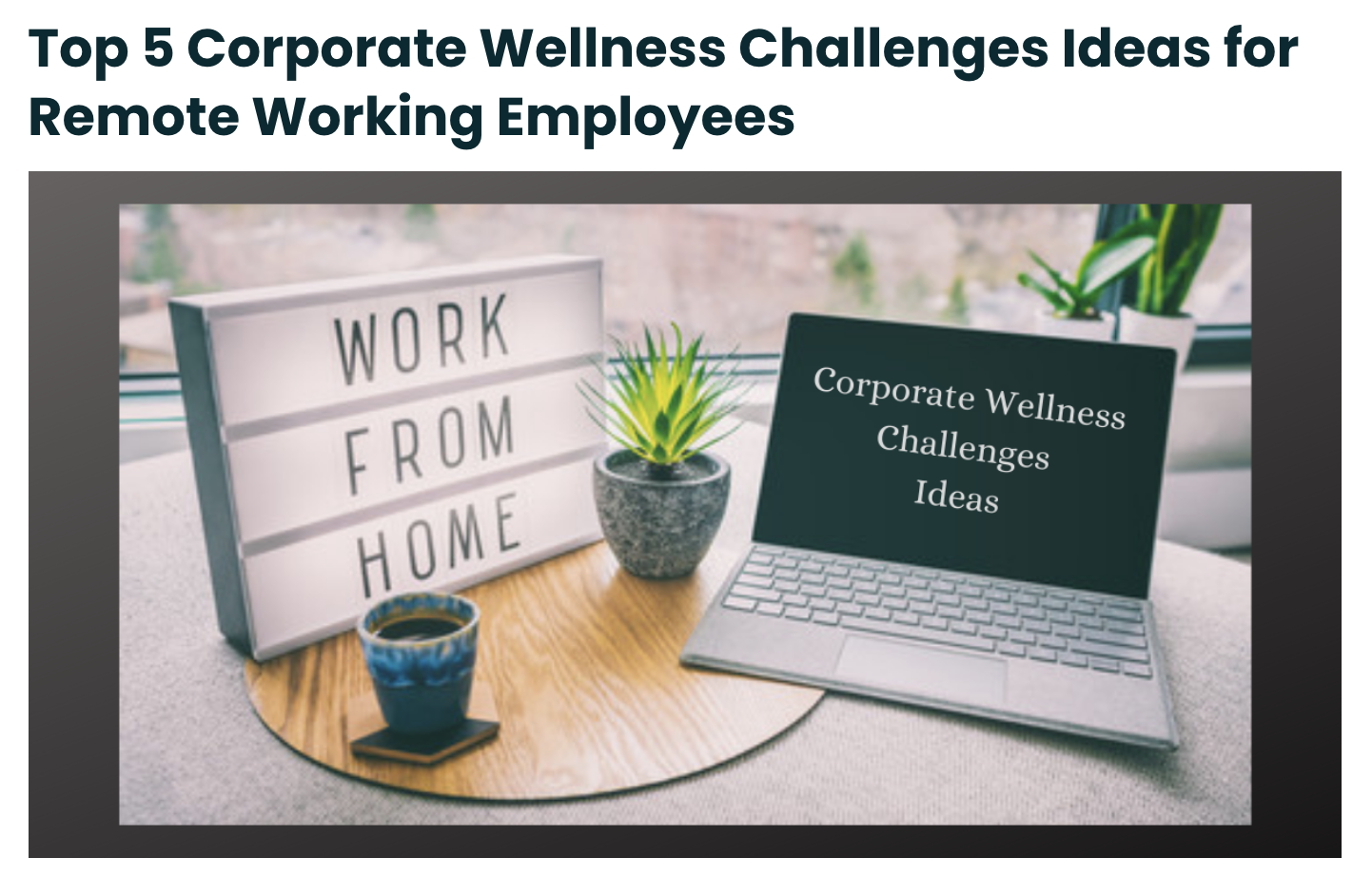
- Um, how many fingers do you have on each hand?
- That’s great for “working employees.” But what “challenges ideas” do you propose for non-working employees?
- I loves your grammar.
“According to a CDC report, even before the pandemic started, almost 80% of Americans were getting the recommended amount of physical activity for the week. With the current remote working situation, the little physical activity that came from the daily commute, walks and talks at the workplace, lunch breaks, and other workplace culture traditions have come to a halt.”
- So only 20% of Americans were out of shape before the pandemic?
- I hadn’t realized that talking and lunch breaks were such a major source of physical activity.
- “The little physical activity…have come to a halt?” Is that why we need “challenges ideas”?
“Commuting, roaming around the office and other physical activities at the workplace helped employees take at least some steps in the whole day. Without those daily activities, the physical activity count has fallen down the cliff.”
- Commuting is how I used to keep in shape too: steering, shifting gears, and yelling at the WHDH 850 Sportstalk guy.
- The syntactical activity count has fallen down the cliff as well.
- “Roaming around the office?” More on this later.
“Hold a Wellbeing Hydration Challenge. A male adult in the US must consume at least 15 cups of water daily, and a woman must drink a minimum of 11 cups. Many studies show that 75% of American adults suffer from chronic dehydration, causing headaches, nausea, fatigue, and lack of concentration, impacting employee health, productivity, and overall wellbeing.”
- Is the winner of the challenge the first person to die from overhydration?
- Can you cite one of these “many studies”?
- Will someone please give those 75% a drink of water?
- You were drinking this much water at work??? No wonder you needed to “roam around the office.”
“Employers can…also encourage sharing recipes for hydration like cinnamon water, green tea variants, and more to make sure they keep water healthily without…preservatives.”
- Will you please share your “recipe” for cinnamon water? I forgot what the ingredients are.
- I want to “keep my water healthily” but apparently the government is spiking our water with preservatives. Write your Congressman!
- Wouldn’t those “green tea variants” keep me up at night and wouldn’t those 15 cups of water wake me up once I finally got to sleep? Oh, wait, I forgot you also offer…
“Better Sleep Wellbeing Challenges. Lack of sleep can cause fatigue, disturb mood, affect decision-making skills, and loss of concentration…The wellness program administrators can assign better sleep wellness challenges in which employees have to track their sleep hours every day on the corporate wellness platform. Those who seem to have trouble sleeping well can be offered coaching or other supporting resources to improve their sleeping habits.”
- Being “assigned” to “have to track…sleep hours every day on the corporate wellness platform” sounds like a great way to relieve the stress that keeps me up at night.
- Wouldn’t the “coaching or other supporting resource” tell me to stop drinking so much water and green tea?
With this kind of advice, it’s lucky that their “sixth” recommendation is:

Share this:

Behavior Change without Breaking a Sweat
Tums asked: “Who says medicine has to taste bad to be good?”
Symms said: “At Symms, an educated consumer is our best customer.”
And Grey Poupon’s memorable: “Ah, the finer things in life. Happily some are affordable.”*
Our 1:00 PM May 12 webinar combines all three. https://bit.ly/3eOLhEC
Turns out that knowledge is more fun (Tums), and more effective (Symms) than cajoling, bribing or fining employes into eating more broccoli. It can also cost less per employee than a year’s supply of mustard. (If not, then close enough.)
So why not learn some easy behavior changes you didn’t already know? Last month you learned that preemies are predictable. The month before that you learned that cavities don’t have to be filled. Join us May 12 at 1:00 PM for more of the Greatest Hits of health literacy. https://bit.ly/3eOLhECAl Lewis
*Not to distract anyone from registering, but that clip above is the best mustard commercial, possibly the best commercial, of all time. https://www.youtube.com/watch?v=2JJbwlEySDM
Share this:

Do you have to “drive” employee behavior change?

It’s generally assumed that employee behavior change (weight loss, smoking cessation etc.) is work. And the way wellness vendors want you to do it, it usually is. It has to be “driven.” Also, it fails most of the time.
But Quizzify’s behavior change is fun. This May 12 webinar will show how employees happily change behaviors through our “Jeopardy-meets-health education-meets-Comedy Central” trivia games.
The key? Our behavior changes are “driven” by knowledge, not willpower. For instance, did you know that:
- a new non-invasive test is cheaper, safer, more accurate–and more “fun,” relatively speaking — than a colonoscopy screening?
- most cavities no longer need to be drilled-and-filled?
- a simple blood test predicts premature birth with 80%+ accuracy instead of 17% accuracy?
- surprise bills for non-electives can be prevented if your employees know what to sign and what not to sign?
It’s all about the knowledge. Who would get a colonoscopy screening, a filling, or a surprise bill if they didn’t have to? What mom doesn’t want to know her risk of premature delivery?
Further, knowledge-based behavior change gets right to the bottom line. Imagine 5x the ROI of wellness at a fifth of the price, with 100% of fees at risk for ROI? And some very happy employees.
Register here. If you register and can’t make the webinar, you can still get the recording.
Share this:

The best vendor ever (and it’s not Quizzify)
TSW reader know that we usually devote this space to blowing the whistle on the most dishonest and clueless vendors, most recently and frequently and hilariously Wellsteps. However, thanks to long-time Quizzi-fan Justin Leader, we have discovered a vendor that is actually better than Quizzify. Quizzify is now only #2, but that’s as compared to thousands of others. So, to slightly paraphrase the immortal words of the great philosopher Bill Murray, we’ve got that going for us, which is nice.
Quizzify has conferred our Valid Vendor award on Sera Prognostics…and now we would like to show you why. Valid Vendors is no ordinary award — joint customers actually earn a financial guarantee from Quizzify itself, to go with whatever the vendor itself offers.
Theirs isn’t just another “point solution” that “shows savings” by violating every rule of study design. Quite the opposite, the College of American Pathology and CLIA have such strict guidelines for their class of product that this is the first time one of our webinar registrations has included footnotes.
You can register for Thursday’s 1 PM webinar here.
Sera Prognostics has developed the only validated, commercially available blood test providing accurate, early, individualized prediction of premature birth risk for asymptomatic, singleton pregnancies. It is a giant leap ahead of other approaches. In 25 years of vendor evaluation, I’ve never seen anything close. I feel like Robert August and that other guy searching the world for the perfect wave…and then finally finding it.
The difference is that even the non-perfect wave spots in Endless Summer were good, whereas until now I’ve been surfing largely in raw sewage.

We consider Sera Prognostics, freshly validated by the Validation Institute, to be the perfect wave of vendors, or at least as close as we can come to it. Totally voluntary, makes your employees happy, truly improves their lives in every respect. Yes, it saves money (guaranteed) but as one of my clients said: “I don’t care if it doesn’t save a nickel. We’re doing this.”
To be sure, there are plenty of speedbumps. The moms have to be educated (that’s Quizzify’s job), obstetricians have to be detailed, the protocols have to be in place once the prediction is made, the moms have to follow the protocols…and even then, there is no certainty of going to term. Nonetheless, if you sign up for Thursday’s webinar, you see that even if their data is half right (meaning that a much larger study might show more modest results), they would still be the best vendor I’ve ever seen.
A cynic might say that being the “best vendor” is partly this is because most vendors, to use a technical term, suck. So that my calling Sera the best vendor is a little like Benjamin assuring Mrs. Robinson that he considers her to be the most attractive of all of his parents’ friends.
I beg to differ. If you join this webinar, you will see that Sera truly is an outstanding vendor even as compared to Elaine.

Join the webinar to see for yourself.
Share this:

Wellsteps accomplished the impossible: they got stupider.
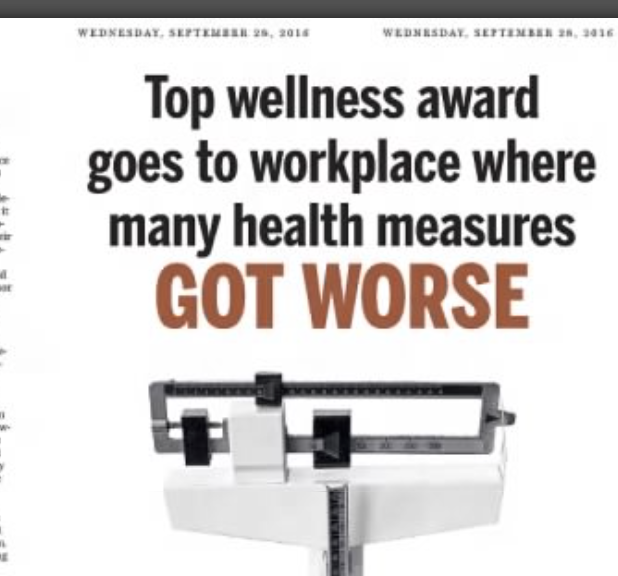
Readers of Why Nobody Believes the Numbers may recall that you can’t reduce a number by more than 100%. This is true no matter how hard you try. And just in case our friends Down Under were wondering, this is not one of those things that’s the opposite in the Southern Hemisphere.

Wellsteps is giving that assertion a run for its money.
Following that headline above (from a full-page spread in the Boston Globe) they’ve doubled down on stupidity to win the wellness industry’s race to the bottom, and, with the demise of Interactive Health, Wellsteps is easily the dumbest vendor in all of wellness.
Still, you have to admire their commitment to stupidity. I and others have pointed out maybe a dozen times that their entire business doesn’t accomplish anything other than harming employees, but they refuse to budge.
Calling them the dumbest vendor in all of wellness is quite a compliment. That’s because the alternative would be to call them the most dishonest vendor in all of wellness. Besides insulting their integrity, that’s not an easy feat to accomplish in this industry. It would be like calling out a specific entitled zillionaire as the most dishonest parent in the entire Varsity Blues scandal.
Perhaps disheartened by their loss of the uncoveted Deplorables Award to Angioscreen after having won or shared two of the last three, they have decided to take stupidity to a new plateau.
Their “Updated ROI Calculator”
The reason they’ve made the news today is that they’ve just published an “updated ROI calculator.” And a big thank you to Jon Robison for forwarding it to me, as Wellsteps has banned me from their linkedin group and everything else.
There are a few things you might want to know about their updated ROI calculator. As you’ll see once you expose it to light, this updated ROi calculator:
- is not “updated“
- doesn’t show an ROI
- doesn’t calculate.
Three lies in three words. That breaks Ron Goetzel’s record of 14 lies in 45 minutes.
No need to take our word for any of this. Here’s the only thing that is updated: the font. This makes it easier to see what happens if you actually try to enter data into this model. Sort of like actually trying to drive a Yugo
Start by zeroing out inflation as a confounder (“0”). Then, for simplicity and consistency, enter “1” into number of employees, as below. I entered $1000 into annual healthcare costs, just to use a round number.
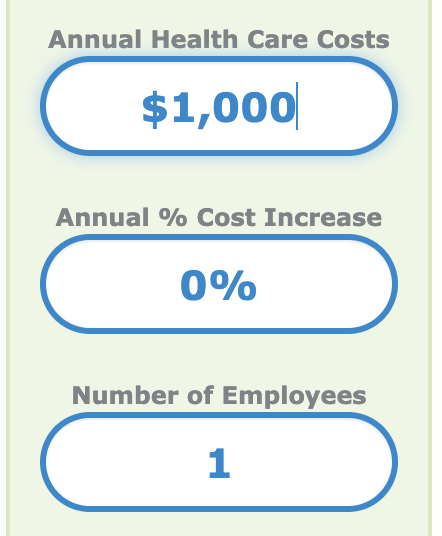
Then let the games begin.
Let’s see how much they save in the best-case scenario. Enter 100% into the two fields “% Employees that [sic] are obese” and “% Employees that [sic] are smokers.”

As an aside, normally one would use “who” in this situation, but they don’t, for two reasons. First, One of Wellsteps’ signature moves is creative sentence structure, spelling, and mixed metaphors. The CEO, Dr. Steve Aldana, called the late award-winning journalist Sharon Begley a “lier.” He once accused me of violating the Law of Conservation of Matter, saying that I am “great at creating BS out of thin air.”
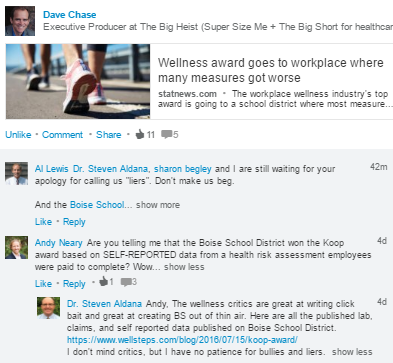
Second, perhaps the reason they preferred “employees that” to “employees who” is because another of their signature moves is to dehumanize employees. Their exact words, subsequently deleted after criticism, were: “It’s fun to get fat. It’s fun to be lazy.”
Back to the Calculator
Let’s see what happens if you do a fantastic job, and reduce the number of “employees that are obese” and “employees that are smokers” from 100% to 0%. So enter those two figures:
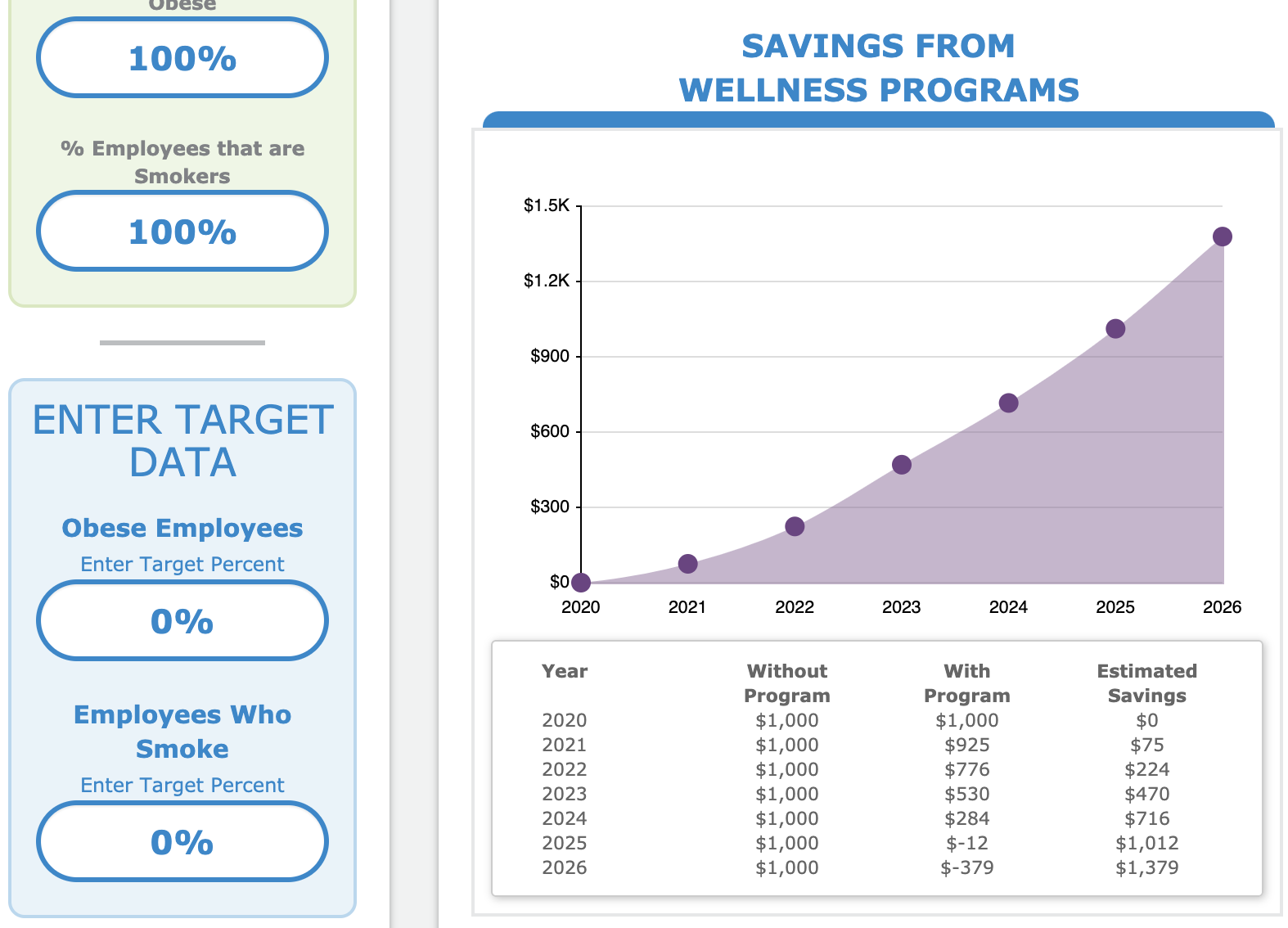
Then go to the right — directly on top of this “hockey stick” graph as you can see, and hit “savings from wellness programs.”
Congratulations. You’ve reduced the $1000 spend by $1379, which is a reduction of more than 100%. While I merely allegedly violated the Law of Conservation of Matter, they’ve just clearly violated a basic law of arithmetic, and those are strictly enforced.
You might say: “That’s not fair. Let’s use a more realistic risk reduction figure, like 0%, which is what all the literature says is achieved:

In the immortal words of the great philosopher Gomer Pyle: “Surprise, surprise, surprise.” You still show mathematicaly impossible savings.

You still show savings even if employees get worse. This is Wellsteps’ signature move in real life, as they harmed the employees at the Boise School district…and still fabricated massive savings:

The actual savings they fabricated — along with their inadvertent admission that costs actually increased — can be found here. Costs can’t go up and down at the same time. Yet another rule of math that is strictly enforced.
What if you don’t have any employees on your health plan, so you spend $0 to begin with? Turns out you can still save a bundle if you have no costs to begin with, even without reducing smoking or obesity.

Before you start fiddling with it, be aware that the very stable geniuses at Wellsteps who came up with this calculator once accused me of “entering false data” into it. So make sure your “data” isn’t “false.” To avoid that:
- use only arabic numerals…
- …in base ten.
Turns out no matter what data you enter, you save money. Don’t take my word for it–see it with your own eyes.
Stupid? Well, let’s just put it this way. NASA engineers need not worry about their job security on account of Wellsteps, because these people are not rocket scientists.

Or Wellsteps’ CEO, Steve Aldana, actually dishonest?
Let’s examine the evidence both ways. Here are the three best arguments for stupid:
- He says he needed 11 years to get through college. (p. 7) That’s 4 more years than Bluto Blutarski.
- He thinks “even one more bite of a banana” will improve your health.
- He is friends with Ron Goetzel.

Here are the the three best arguments for dishonest:
- He admitted that his alleged savings at the Boise School District was just regression to the mean. (Scroll down.)
- He knows this “model” is fabricated and has criticized me for pointing that out.
- He is friends with Ron Goetzel.
And let’s not forget that Wellsteps’ claim to fame is actually bragging about harming employees. To this day, they are the only vendor willing to publish data admitting that employees got worse on their watch. And that puts them in a category all their own. Like Juan Garcia, whose espionage work won him the highest military awards from both Germany and Britain, this performance earned them both a Koop Award (see #3 above) and a Deplorables Award.
Does that mean they are dishonest, stupid, or both? To slightly paraphrase the immortal words of the great philosopher Clarice Starling, there isn’t a word for what they are.
Update: Many of you know about the $3 million reward for showing wellness works. If Steve Aldana and his team of very stable geniuses with very good brains can show that their calculator is more accurate than Quizzify’s ROI calculator, I am doubling my $3 million reward and halving the $300,000 entry fee. The rest of you can stop reading here. Steve, that would be a $6 million reward for a mere $150,000 entry fee.
Share this:

“Overcoming Employee Vaccine Hesitancy” webinar now features CDC guru!

Until now, the word “emergency” has never been used to modify the word “webinar.”
But this April 7th webinar is kinda sorta an emergency, by webinar standards. COVID vaccine hesitancy could derail your entire return-to-work effort by polarizing your workforce. This topic is not just clickbait for Quizzify to get more business (though that too). It’s been widely reported in the last several weeks:
• Employee Benefit News (“Vaccine misinformation is a hurdle”)
• The New England Journal of Medicine (“Overcoming COVID vaccine hesitancy”)
• The National Library of Medicine (“A Challenge the US must overcome”)
But the good news comes from a widely reported focus group of vaccine skeptics. 19 out of 20 of them changed their minds after learning more from objective sources. One said: “We want to be educated, not indoctrinated.”
And this simple 45-minute webinar —Wednesday, April 7 at 1 PM EDT — will show you how to do exactly that, starting now. Plus, you yourself can test your COVID vaccine IQ in real time with a few of our “Vaccine Mythbusters” questions.
The Expert Panel
We are featuring two Experts, with a capital “E,” to address your questions, Dr. Christa-Marie Singleton and Dr. Scott Conard. In any ordinary webinar, Scott would get top billing…but this is no ordinary webinar.
Dr. Singleton is the Associate Director for Science and Science Lead in the CDC’s COVID-19 Response Chief Health Equity Office. She is also the Senior Medical Advisor in the CDC’s Population Health and Healthcare Office where she serves as the senior medical advisor regarding planning with commercial insurer partners and physician providers. In terms of COVID and the COVID vaccine, she works with teams to include health equity principles in science-related projects and improve the impact of COVID in disproportionally affected populations.
She will be joined by Dr. Scott Conard. One of the country’s best-known practicing family physicians and Linkedin commentators, Dr. Conard also serves as Medical Director for corporations and regional benefit coalitions. As such, he will apply his unparalleled understanding of the intersection of corporate communications with employee/patient concerns to show attendees how to overcome vaccine hesitancy.
Or you could just cut to the chase and contact us about getting started with the full set of questions posthaste.
Share this:


Monday at 1 PM: a webinar featuring Dr. Marty Makary, Leah Binder, and Marshall Allen
Dear TSW nation,
So maybe this posting is not funny like last month’s, when Angioscreen won the uncoveted Deplorables Award. But “funny” isn’t going to give you insights into how to perform more effectively — other than, of course, not using Angioscreen, a decision that will benefit your workforce immeasurably.
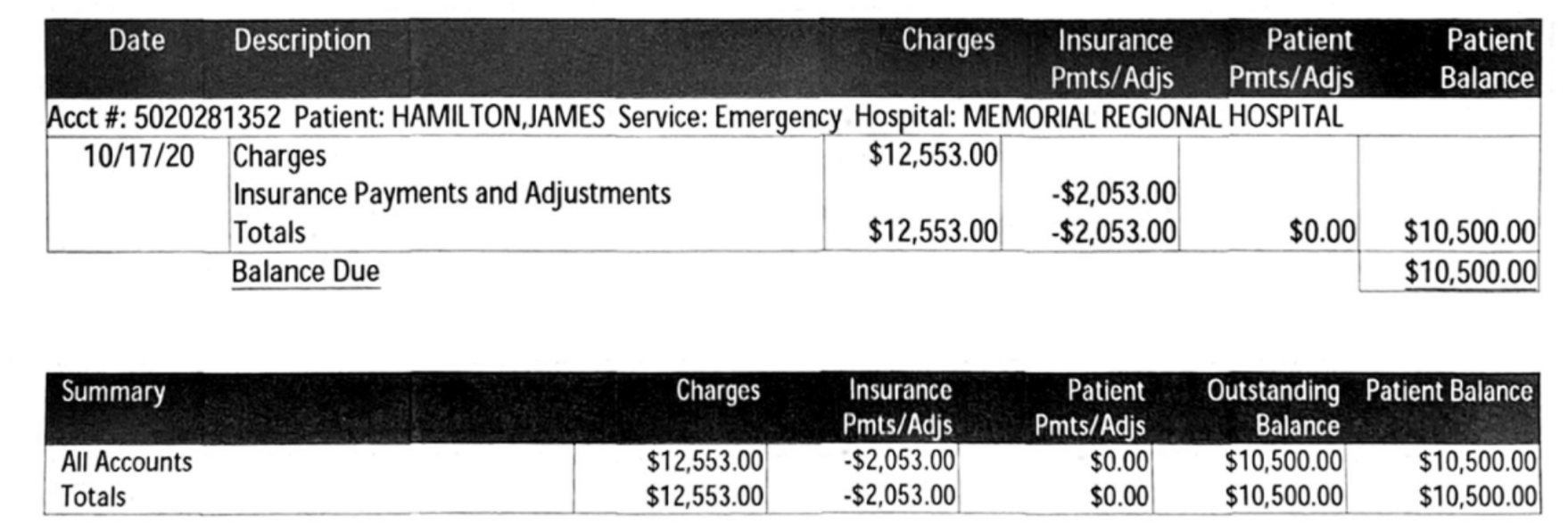
This posting has a bit more substance to it, announcing a webinar Monday, March 22nd at 1 PM EDT on “Hospital Financial Ethics.” It will feature a real price-gouging incident with a real bill — and a real patient with a real name (James Hamilton).
This bill will be deconstructed by an expert panel. I am humbled (which doesn’t happen often) by the talent we’ve been able to attract to this panel, none of whom even need an introduction:
- Marty Makary
- Leah Binder
- Marshall Allen
And as long as you are signing up for our webinars, there are more on the docket (all at 1 PM EDT)
April 7: An “Emergency Webinar” on overcoming vaccine hesitancy in your workforce.
April 22: The best premature birth avoidance technology we have ever seen…and we never endorse vendors. We’re making an exception here because they actually do something that employees love and saves money besides.
May 12: The Top Ten Easiest Employee Behavior Changes. Turns out — who knew? — that employees can’t keep weight off, they don’t like broccoli, and they already buckle their seat belts. But there are ten behavior changes that either save money or improve health or both, that are so easy to make you don’t need to bribe or fine them.
June 15: Never Pay the First Bill. A pre-publication look at Pro Publica uber-investigator Marshall Allen’s new book of the same name on how not to get snookered by a healthcare bill.
July 15: Featuring Dr. Eric Bricker (yes, the very same) on aligning incentives with your providers, your PBMs and your consultants.
Share this:

You can stuff that colonoscopy! Here’s something better.
This is reprinted from Quizzify. I probably should have posted it here in the first place because, as someone has already noted, my particular style of writing works very well with this, uh, material.

As you can no doubt tell from all the store window displays and promotions, March is colorectal cancer awareness month. That’s only the start of the good news.
The other good news is that the colonoscopy guideline-writers, whom I suspect are all over 50 by now, don’t want a colonoscopy any more than you do. Hence, they now say a colonoscopy once every ten years is OK, up from every five.
The procedure itself is uncomfortable and carries a 1.7% chance of a complication. That means a company with 150 people getting screened will see two landing back in the doctor’s office, the ER or even the hospital. (The odds are actually a bit more favorable than 1.7%, because complications are more common in older patients.)
And that fluid they make you drink for 24 hours beforehand? I don’t know what’s in it but, in the immortal words of the great philosopher Dave Barry, it should never be allowed to fall into the hands of America’s enemies.
The better news is there are three non-invasive alternatives that can avoid both the discomfort and the complications of a routine colonoscopy screening. This blog post looks at each in turn.
But before you click through to that page-turner, don’t forget to register for the March 22nd webinar featuring healthcare uberstars Marty Makary and Leah Binder, speaking on the oxymoronic topic of Hospital Financial Ethics.


