
Home » Obesity (Page 2)
Category Archives: Obesity
Wellsteps: Employees are fat because “it’s fun to be fat”
Wellsteps may be best-known for insulting the intelligence of its customers, by writing outcomes reports that show costs going up and down at the same time, and creating “ROI Models” that anybody can see are blatantly fabricated. However, their customers deserve what they get. No one is forcing them to retain Wellsteps. For example, if the Boise School District can’t figure out they got snookered, they need to go back to school.
On the other hand, overweight and obese people, like perhaps 2/3 of Boise’s teachers, who find themselves forced to submit to these programs at the pain of significant financial forfeitures, don’t have the option of firing Wellsteps or even walking away from them. In order to avoid forfeiting money, they must agree to be coached by a company that just announced that the reason people can’t lose weight is that: “It’s fun to be fat. It’s fun to be lazy.”
And: “Not everyone likes the taste of fresh fruits and vegetables, they would prefer chocolate, soda, and Cheetos.”
These lines were penned by Wellsteps’ Troy Adams, who proudly asserts as his qualifications that he “spent 11 years in college as a student and another 20 years as a professor.”
Wellsteps Apologizes
After a while, Mr. Adams realized that letting employees know how they really feel was a bad idea, so he went back in and removed the first line. He then apologized for Wellsteps’ insensitivity and complete lack of understanding about wellness.
Haha, good one, Al.
Obviously they didn’t apologize. To paraphrase the immortal words of the great philosopher Ryan O’Neal or maybe it was Ali MacGraw (I wouldn’t know because about halfway through the movie, I had to leave the theater to go puke), being a wellness vendor means never having to say you’re sorry. They just did the Ron Goetzel thing where you go back in and quietly doctor the original once you realized how much trouble you could get into by leaving the original original up. (The difference is, Ron does that with other people’s originals. At least Wellsteps only did it with their own.)
The Comments Say It Best…
Wellsteps didn’t exactly have an epiphany. They removed the line following scathing comments to the post. Adele Hite wrote:
This is reminiscent of arguments that the unemployed just don’t want to work (it’s fun to be poor! sleep late every day!). I thought we gave that up for more enlightened thinking, but I guess I was wrong.
Another health educator, Erica Thomas, wrote:
This article is appalling. “Fun to be fat”, “fun to be lazy”?! How do you conduct business with that mindset?
A third wrote:
Dear Mr. Adams, Do you truly believe that getting fat is fun and pleasurable? Have you ever been around anybody in this culture who has gotten fat? Do you truly believe that will power is all there is to the issue of fat?
The Regulators Will Sanction Wellsteps (not)
Yes, of course the comments are right, but there’s nothing we can do about Wellsteps. They will remain prominent on the Koop Award Committee (where the key qualification is having no qualifications) and of course the Health Enhancement Research Organization. There won’t be any sanctions by regulators because this industry is completely unregulated. Wellsteps can continue to pitch this line to unsuspecting employers as long as they can get away with it, and as long as employers don’t care about the morale of the 2/3 of employees who are overweight or obese.
As for Mr. Adams, his total lack of contrition indicates that there is no chance he has learned anything from this episode. Ah, well, to paraphrase the immortal words of the great philosopher Bluto Blutarski, 11 years of college down the drain.
Share this:

Another Expert Slams Fat-Shaming Corporate Weight-Loss “Challenges”
While vendors like HealthyWage are pushing company weight challenges onto unsuspecting and poorly advised wellness directors — and wellness promoters at the University of Pennsylvania are subjecting their own employees to weight-loss experiments to encourage corporations to do more of them — real researchers are urging a halt to these activities. They do more harm than good.
We, of course, have been calling out fat-shaming for months on this site–with specific attention to companies like Johnson&Johnson, ShapeUp, and Vitality Group, all companies that want to profit from fat-shaming in various ways. In particular, we wrote a very well-received Huffpost on this topic three months back.
And a year ago, we called for an end to these fat-shaming programs, showing that they made no impact on health expenses, productivity or profitability.
However, we did not explore this topic remotely as well as Pat Barone, in today’s LifeZette. (While LifeZette is Laura Ingraham’s publication, Pat Barone lives in the People’s Republic of Madison, so the politics cancels itself out.) We urge everyone take a looksee here…and then when you’re ready to sue your wellness vendor and need an expert witness, who you gonna call?
We invariably get fast settlements. No vendor wants to face me in court, where even wellness vendors are required to tell the truth. Facts, as we often say, are the wellness industry’s worst nightmare.
Share this:
For Its Get-Thin-Quick Programs, HealthyWage Proposes Unhealthy Wagers
Just when you thought wellness vendors have all finally connected to the internet, HealthyWage comes along.
They write: “Given the financial upside and the fact that they’re just plain fun, it’s no wonder that diet competitions and weight-loss betting programs are exploding across America and beyond.” Crash-dieting is “just plain fun” ? That recalls the line from Surviving Workplace Wellness: “Wellness programs are designed to make employees happy whether they like it or not.” More importantly and to elaborate on the opening sentence, HealthyWage has managed to overlook all the research, easily accessible online, that says:
- Short-term weight loss is meaningless;
- Weight cycling — exactly the type of thing crash-dieting causes — is harmful;
- Employers can’t get employees to lose weight, and even if they could, weight loss doesn’t generate savings;
- In the commercially insured population, no avoidable admissions can be avoided by weight loss betting, making HealthyWage’s “financial upside” claim about as likely as its claim that these crash diets are “just plain fun.”
HealthyWage is resuscitating the old “Biggest Loser Contests,” under two new names: “Diet for Dollars” and “Pay for Pounds.” After I read this, I checked my calendar. It assures me that we have not reached the end of March yet, which means these names are intended to be serious, as is the program. They really want you, as a wellness manager in an HR department, to institute crash-diet programs.
But not so fast. They urge you to first undertake “a touch of due diligence before you pay to play.”
Further, they thoughtfully provided the “due diligence” questions they advise HR departments to ask before retaining a vendor to weigh their employees. Let’s play a little game here. I’ll excerpt four real questions that HeathyWage wants you to ask, but then sneak in a fifth phony one. See if you can guess which question that should not be part of due diligence, according to HealthyWage. (By the way, you may find this hard to believe after you read them, but I am not making up any of the other four.)
- Where does your prize money for our employees come from?
- How do you verify the weigh-in and prevent “fraudulent participants” ?
- Will you show us the body of research highlighting the effectiveness of paying employees to lose weight (um, like this article)?
- Does your get-thin-quick scheme come with a warning label, and will you indemnify us if any of our employees harm themselves while bingeing before the initial weigh-in or crash-dieting before the last one?
- How do we get media attention when you weigh our employees?
Since the fourth question addresses the harms of the ironically named company’s program, and is the most important question of all, it is no surprise that this is the question they don’t want asked, the phony one I inserted.
While the fourth is the most important, the second the most inscrutable, the third the most impossible, and the first the most naive, the fifth is the biggest head-scratcher.
For the fifth, I have a follow-up question for HealthyWage: Why would you want people like me writing columns like this about programs like yours?
Share this:
NY Times Economists Diss Corporate Weight-Shaming…but It’s Even Worse than They Say
We never post on Sundays. We are making an exception today on the theory that a lot of people in the Northeast are at home and would welcome the distraction. Here in Massachusetts it’s so cold that the Governor is urging people to stay indoors. Heck, we even decided to cancel Ultimate Frisbee.
This is now the seventh time that the New York Times —or its The Incidental Economist bloggers (“TIE” as they call themselves) — has observed that conventional corporate wellness doesn’t work. Links to the previous six instances follow this posting. Perhaps the seventh time will be the charm. Having covered every other angle except the actual health hazards of wellness, this TIE post specifically eviscerates “biggest loser” programs and their brethren.
HR executives may think they are “supporting” employees by holding weight-loss contests or paying them to lose weight. Unfortunately, all they are doing is reducing self-esteem, encouraging crash-dieting before weigh-ins, drawing attention to people’s weight, and — in addition to distracting employees from their actual jobs — distracting them from the one thing that benefits people of all sizes: exercise. It is much better to be “fit and fat” than fight a losing battle to keep weight off with various fad diets.
Further, the Body Mass Index, the 200-year-old metric wellness vendors still use to establish how much to pay or fine employees, turns out to be a very misleading measure of population health. (As “Brad F.’s” comment to a previous blog pointed out, BMIs may be of value if conducted as part of an actual physician-patient relationship. However, actual medicine is of no interest to wellness vendors, other than making people get useless annual checkups. Most physicians practicing actual medicine find wellness programs to be a misguided nuisance.)
Worse than The Incidental Economist says it is
The case against these programs is even stronger than TIE says. TIE supports its case by citing randomized control trials. But if RCTs are the Gold Standard, the Platinum Standard is wellness vendors’ consistent and total self-immolation in attempting to show their own program impact– despite ample opportunity to manipulate data, select motivated participants, ignore dropouts, and run ridiculously short “weight loss challenges” that end before the weight is regained. We love to cite ShapeUp as an example of that, having exposed them in the Pittsburgh Post-Gazette. (This was probably overkill on our part, but their CEO had thought a good way to get some attention might be to fallaciously attack our numbers even though his own figures were made up.)
Because great minds apparently aren’t the only ones that think alike, ShapeUp has plenty of company on the Biggest Loser List. Wellness Corporate Solutions has also been “profiled” on this site, largely for comic relief. Pfizer, where actively motivated employees lost a few ounces over a year, actually earned an award from Ron Goetezel for this stellar performance, as well as a spot on our Biggest Loser List. Our favorite example is McKesson. They also won one of Ron Goetzel’s Koop awards even though their average employee showed an actual increase in — you guessed it — BMI (and cholesterol):
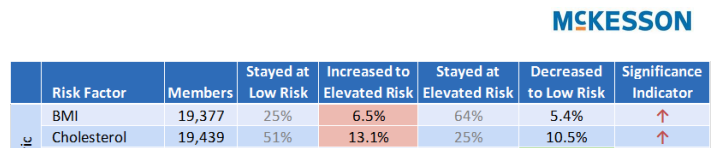
If award-winning companies can’t get employees to lose weight, who can?
And where would a Biggest Loser List be without Vitality, which pitches its weight-loss program to others but can’t even get its own employees to lose weight? If wellness companies can’t get their own employees to lose weight, who can?
Where we differ with TIE is on weight control interventions for school-age kids. They quote one definitive-sounding study, with 4600 kids in it. We don’t have a problem with the actual study. However, because the long-term health and social prognosis for obese children is negative, and because this problem is so pervasive, we ourselves would insist on a much higher level of proof and more experimentation with different program designs before throwing in the towel on these interventions. (We may very well end up agreeing with TIE when all is said and done. We would just like more to be said and especially done.)
As for employers, our recommendation remains the same: do wellness for your employees, not to them. This means supporting employees who want to pursue health goals, but otherwise just leaving them alone to do their jobs. Don’t even make them play Quizzify if they don’t want to. (But they’ll want to — we guarantee it.)
The Incidental Economist/New York Times on Wellness: A Chronology
September 2014 TIE says wellness “usually” doesn’t work.
October 2014: TIE headlines: “Wellness Programs Don’t Seem to Work as Advertised”
December 2014 TIE says: “We’ve said it before, many times and in many ways, wellness doesn’t save money.”
February 2015 TIE headlines “Another Call to Eliminate Employee Weight Loss Programs”
October 2015 New York Times says: “Provide us with your...weight, or pay up.”
November 2015: TIE headlines “The Feds Are Wrong. Lots of Wellness Programs Violate the ADA.”
Share this:

Johnson & Johnson Proposes a “Fat Tax” on Businesses
This J&J/Goetzel/Vitality proposal is a Fat Tax, pure and simple. If they are right about shareholders caring how many overweight people a company employs (and they aren’t), it is a tax on overweight employees, each one costing the company a slight amount of its market value. If they are wrong, this represents a pure transfer of wealth from corporate America and their employees to companies like Johnson & Johnson and Vitality.
Read the full posting here. Comment and share it.
By the way, these wellness people don’t understand math any more than they understand wellness. One of their premises for the Fat Tax is that over 14 years, companies with wellness programs outperformed the market. Besides failing to use sector indexes as benchmarks, they don’t understand the way compounding works. Suppose the average market performance is set to 0%. If all your stocks perform at a market level, your return will be 0%. However, if half of them increase 10% a year and the other half decrease 10% a year, you’ll be way ahead of the averages because each year the 10% increases are applied to an increasingly larger figure, and the 10% decreases are applied to an increasing smaller figure. And if you look at their portfolio, it’s disproportionately weighted to the healthcare sector, which boomed over the period, and the financial services sector, which dramatically contracted. Towards the end of the period, the performance of Citigroup etc. didn’t matter any more.
This is true even if you set the market performance to a figure other than 0%. It’s just clearer this way.
Share this:
Overweight? Johnson & Johnson’s Dream Is Your Worst Nightmare
Every time I think wellness promoters can’t possibly match their previous shock-and-awe levels of egregious statements and proposals, they come through with another one. This post is from the employee’s viewpoint. To see it from the employer’s viewpoint, view the posting on the Proposed Johnson & Johnson Fat Tax. That company wants corporate America to pay them to count the number of overweight employees a corporation has.
PS Obviously we don’t have any money to oppose this with, so please share it on social media.
Suppose there were: (1) a widely held but false perception that gays had lower productivity and higher healthcare costs than straights; (2) false literature that companies with gay conversion programs outperformed the stock market; and (3) a proposal that companies disclose to shareholders the percentage of gays they employ.
Obviously, many corporate CEOs would stop hiring gays, de facto require gay conversion among current employees, and fire gays who failed the program, in order to maximize stock price and hence their own net worth.
Preposterous? Of course, but if Johnson & Johnson (J&J), Vitality Group and a few pharmaceutical companies get their way, this exact same scenario will befall overweight employees. Indeed, two-thirds of this dystopian scenario is already in place:
- Despite proof to the contrary, the popular misperception is that working-age thin people have higher productivity and spend less on healthcare than working-age overweight people;
- To help bring weight discrimination into the boardroom, some wellness apologists — led by Ron Goetzel, of course — published a facile and misleading study in a third-tier journal (that had already admitted poor peer review practices) showing companies with wellness programs (the obesity equivalent of gay conversion in ineffectiveness, and almost as likely to harm participants) outperformed the stock market. The opposite is actually true, if one uses sector indexes as benchmarks. (This is the correct methodology with small numbers of companies concentrated in a few industries. And it’s the correct result given the fact that conventional “pry, poke and prod” wellness loses money, period.)
To complete this trifecta of weight discrimination, all that remains is to convince publicly traded corporations to disclose the weight of their employees…and that’s exactly what this cabal — led by J&J and Vitality — proposed at Davos. (They also want companies to disclose their stress levels. I have no idea how one measures stress. The one company that tried measuring stress, Keas, failed both miserably–and, this being the wellness industry, hilariously.)
Weight measures used by companies are also facile and misleading. Typically — as with Vitality Group, an outspoken advocate of this proposed regulation — they use the Body Mass Index, or BMI. The BMI was invented by a mathematician 200 years ago, using a simplistic formula that he could never really justify…and yet has been the de facto standard for measuring overweight ever since. It’s misleading along many dimensions. Further, it now turns out that the whole workplace BMI obsession might be pointless, as people with normal BMIs are at higher risk than people with high BMIs, if their weight is distributed badly. Most recently, it’s been shown to be just plain wrong, doing a horrible disservice to overweight people and, in some workplaces, costing them money,
While I can’t explain why PepsiCo would be signing on other than for corporate image reasons, the agendas of J&J and Vitality are quite clear: disclosing weight to shareholders would encourage publicly traded companies to use “pry, poke and prod” workplace wellness services, which they coincidentally happen to provide. (The drug companies involved, such as Novo Nordisk, stand to benefit from selling more drugs.)
Unintended Ironies: A Hallmark of Wellness
Ironically, though, during that same Davos meeting, Vitality also candidly admitted that their wellness services don’t work even in the best-case scenario of their own employees. That admission undermines the entire fiction that this scheme would somehow benefit the employees being fat-shamed.
Here is another irony. (One hallmark of the wellness industry is its obliviousness to its own many ironies.) This industry thrives on being totally unregulated — uniquely in healthcare, wellness companies and individuals face no licensing, education, training, oversight or certification requirements. Consequently they can and do get away with whatever they want. And yet now they want every other company to make more disclosures in regulated filings, for no purpose other than enhancing their own bottom lines.
Still another irony: The prime schemer behind this initiative, David Yach of Vitality, assured STATNews that existing laws would prevent employees from bring fired due to weight. But “existing laws” don’t prevent anything in wellness now. A federal court says it’s fine to deny insurance to employees for failing to participate in wellness. And despite flouting federal health guidelines with impunity, no wellness vendor has ever been prosecuted for doing things to employees that would get doctors sent to jail. And as Health Fitness Corporation learned, you can lie to states as much as you want about anything — including saving the lives of cancer victims who don’t have cancer — and not be prosecuted. Indeed, no wellness company or program has ever been successfully prosecuted or sued for anything under “existing laws.”
The Inevitable Result: Institutionalized Weight Discrimination
Many things in life have unforeseeable consequences. However, the consequence here is perfectly foreseeable: If you are overweight or especially if you are obese, you should be able to keep your current job if your company likes your work. But your chances of getting hired anew by a publicly traded company — if you are competing for the job with an almost-but-not-quite-equally qualified thin person — would nosedive.
I rarely editorialize in this blog, because I don’t have to — facts are the wellness industry’s worst nightmare. (See the Vitality example above. I don’t need to come out and say they’re clueless. I merely highlight the data they themselves helpfully provided to make that conclusion self-evident.) However, I’ll make an exception here: I find it appalling that J&J, Vitality, and Novo Nordisk advocate subjecting huge numbers of employees to institutionalized discrimination and to programs that they admit don’t work, simply to make a few bucks.
Share this:
Eureka! Someone who thoughtfully disagrees with me…and has good points!
Usually a tease like that leads to exactly the opposite content, as in Wellness Corporation Solutions Gives Us A Dose of Much-Needed Criticism, which of course turned into the poster child for our observation that “in wellness you don’t have to challenge the data to invalidate it. You merely have to read the data. It will invalidate itself.”
This is not that situation.
Michael Prager points out on his blog that I overstated the wellness-programs-as-fat-shaming case. Note he doesn’t say I’m wrong, but he does say I overplayed my hand, which I did. Many wellness programs fit my thesis…but some don’t. If a company’s program is all about offers rather than threats, about creating an environment conducive to health improvement instead lecturing people on their weight, about doing wellness for employees instead of to them, and about leaving people alone who don’t want to or can’t lose the weight, then I’m all for it. I should have been clearer about that.
If anyone would like to nominate an employer who has such a program, I would be happy to write it up.
And as you can see, we are also open to criticism of our positions, as long as the person writing the critique has a good point. Naturally, this industry is overflowing with vendors and consultants who probably have never had a good point in their lives…and naturally Wellsteps is leading the way. When we observed that Wellsteps’ most recent outcomes report showed costs going up and down at the same time, here is their (Troy Adams) rebuttal: We are full of “hot air.”

Share this:

That Was the Year that Was: Our Top Contributions of 2015
Our year-end jubilee has so far featured lists of the worst vendors and the funniest vendors. To close out the year on a more serious note — if for no other reason than to show we are indeed capable of treating the extremely serious topic of wellness with the Extreme Seriosity it deserves — we’ll list the most influential posts of the year.
In terms of views, the top spot is shared by our two smackdowns of worthless employee weight control programs. Our peer-reviewed smackdown, in the American Journal of Managed Care, should end the year at #1 on their list too, of the most-viewed articles. I say “should” because a lot will depend on people clicking through on it today or tomorrow (hint) and at least pretending to be enthralled by it, even though it is a bit dry.
The Reader’s Digest version got picked up on Huffpost. Absent the constraints of peer review, we took the gloves off. Our reward is that we are the most-widely read Huffpost of the year on wellness.
If “most shocking” is the criterion, the winner is our recent evisceration of Aetna’s employee DNA collection program. This one is best viewed here, at Insurance Thought Leadership, but was also picked up by The Health Care Blog. You know the old Woody Allen joke about the two ladies in the Catskills? One of them says: “You know the food here is terrible.” The other replies: “Yeah, and the portions are so small.”
Collecting employee DNA is a shockingly stupid idea on many levels — the kind of program that someone would make up in order to make wellness look bad, but we didn’t have to. As if that weren’t enough, Aetna also decided to fabricate outcomes. And because the program was so expensive, to show a 2-to-1 ROI they had to concoct $1464/person in savings in the first year alone–on employees who, by Aetna’s own admission, weren’t even sick. One of the editorial board members of the journal that published it wrote that it should never have passed peer review.
The biggest category — and the one where it would be hardest to pick a winner from among the many worthy entries — would be: “Most likely to show Ron Goetzel making things up.”
You might vote for yesterday’s post on how Ron said wellness programs increased stock price valuations when in reality they reduce stock prices. (Ron also misused the word “valuation”. It is not a synonym for “stock price.” In all fairness, the only people who would be expected to know the distinction would be people who write articles about stock valuations that are actually intelligent and insightful.) However, he probably didn’t make up that conclusion. I reviewed 5 years and compared each company to its relevant sector index. By contrast, he reviewed a longer period and has probably never heard of a sector index. We reached opposite conclusions about the correlation of wellness programs and stock prices. The real answer, though, is that wellness programs have absolutely no meaningful effect on either stock prices or stock valuations. If they did, one securities analyst somewhere, writing a report on one company anywhere, would have noted it. Not to mention that a hedge fund would have made a business out of buying shares in companies with the best wellness programs.
Another candidate would be our expose of the HERO report, in which we observed that HERO and their cronies accidentally admitted — a la Robert Durst — that wellness loses money. Despite co-signing this document — a document that required “two years and countless hours” of collaboration, and in which the word “consensus” appears 39 times, Ron insisted during our debate that he had nothing to do with anything in this document that he himself didn’t write. (Of course, in the debate he also insisted that he had nothing to do with Penn State — meaning he just wandered into their press conference by mistake, or maybe I am confusing him with another Ron Z. Goetzel.)
Nonetheless our vote goes to the Unified Theory of the C. Everett Koop Award, in which we reverse-engineered the mathematically impossible formula (the “Goetzel Factor”) that Ron and his integrity-challenged cronies use to anoint award winners, whose programs are almost invariably hilarious and show a complete lack of understanding of the way healthcare and healthcare math work. To paraphrase the immortal words of the great philosopher Samuel Goldwyn, “If Dr. Koop were still alive, he’d be rolling in his grave.”
Share this:
End Fat-Shaming Corporate Wellness Programs
Here is our Huffpost on fat-shaming. We of course encourage click-throughs (and “likes” and shares!) but the Reader’s Digest version (if you are under 30 ask your parents what that expression means) is:
- Many wellness programs embarrass overweight employees due to a simplistic notion that their inability to keep weight off is due to a lack of willpower. Of course, that facile hypothesis got disproven decades ago, about the time real researchers concluded that homosexuality is not a “lifestyle choice.” The wellness industry does tend to be a few decades behind the curve, though.
- This is especially the case for older employees, for whom weight loss is more difficult. It is also quite possible that some extra weight is protective in older adults.
- There is no rationale corporate objective that gets served by jawboning employees into weight loss (unless you’re a ballclub, specifically the Red Sox, and your two 2015 high-priced free agent signings weigh as much as three regular-priced free agent signings).
- Typical corporate weigh-loss programs are more likely to encourage unhealthy eating behaviors than help your employees become healthier.
Share this:
Expose of Corporate Weight-Shaming Programs Among Year’s Top Articles

We published “Employers Should Disband Corporate Weight Control Programs,” in the peer-reviewed American Journal of Managed Care, in February. We recently learned that it is trending close to #1 for the year among articles in this and related journals. Its findings have never been challenged, with no critical comments or letters to the editor by wellness vendors or consultants.
If you struggle with weight, you are probably wondering why your employer appears to be discriminating against you by weight-shaming you. The answer is that while a company would certainly want to facilitate employees’ desires to become healthier on their own, there is no economic basis for fining employees or withholding incentives based on weight.
It’s not just that the threat of financial forfeiture (penalties or lost incentives) doesn’t help people lose weight. Here are highlights from the rest of the article:
(1) As ShapeUp has shown when confronted with the invalidity of its data (and being fired by Highmark as a result of it), vendors’ weight-loss figures are basically fabricated. Here is an article showing how that fabrication takes place, the “Last Man Standing” fallacy.
(2) Weight generally does not affect job performance. At the CEO level, this is generally known. That’s why when new factories are built, they tend to go up in states with lower wages and motivated (and non-union) workforces. Those states also have the highest obesity rates, but that doesn’t matter when major corporate decisions are made. CEOs, voting with their own dollars, have determined that these higher obesity rates have no noticeable effect on productivity.
(3) Weight also has only a trivial effect on healthcare expenses. Extra spending that was once attributed to weight turns out to be due to age, as people get naturally heavier over time and naturally tend to spend more on healthcare. Those two variables correlate but the actual causality is attributable to other factors. Among older people, some extra weight may be protective, as well.
So three things need to be true for these discriminatory programs (age discrimination and class discrimination) to justify their existence. The programs need to get people to lose weight, and weight has to matter somehow, in productivity and/or health spending. Instead, none of those things are true. So why engage in an activity that isn’t going to work, that embarrasses your employees?
We’d encourage you to read the article or at least the abstract, and pass it along to decision-makers. And send us your stories–how has corporate weight-shaming affected your job performance, or the performance of people you know?
PS And if Aetna comes a-knockin’ with the industry’s most expensive and most dangerous anti-obesity “wellness” jihad, don’t answer the door. Here’s what will happen if you do.

Good health is not about weight-shaming. It’s about education.

 They Said What?