
Home » Uncategorized (Page 47)
Category Archives: Uncategorized
Bravo Wellness Offers “Savings” by Fining Employees
With all the incompetence, innumeracy, illiteracy and downright dishonesty we’ve documented in this field and with all the employee dissatisfaction, revolts and lawsuits, one can’t help but wonder: Why?
Why would any employer do this to their employees?
Why aren’t vendors held to minimal standards of competence?
Why do vendors and consultants caught lying simply double down on the lies and/or ignore questions about their lies–knowing full well they’ll get away with it because workplace wellness has nothing to do with actual wellness so no one cares that it doesn’t work?
Why are benefits consultants allowed to lie about outcomes for their partnered vendors?
Why, after they get caught lying, do they win awards for those very same outcomes?
Why doesn’t anyone care that much of what they say and do is wrong?
Why doesn’t anyone care that poking employees with needles far more than the USPSTF advises produces no savings?
Why put up with the morale hit from disgruntled employees and possible lawsuits?
Bravo to Bravo for admitting the reason: It’s to claw back insurance money from employees by making programs so unappealing and requirements so onerous that many employees would rather forfeit their money than have anything to do with them. Here are Bravo’s exact words:

You might say, they don’t actually “admit” it. Well, obviously they aren’t going to skywrite it. But how else would one interpret this comment? Obviously they aren’t going to save money right away by “playing doctor” and poking employees with needles. Especially because they aren’t even adhering to legitimate preventive services guidelines, such as those from the United States Preventive Services Task Force (USPSTF).
They also still subscribe to the urban legend that 75% of an employer’s spending is lifestyle-related, even though that myth has long since been discredited as meaningless and misleading for employers.

Creatinine and thyroid screens are not recommended by the USPSTF, so they shouldn’t be done at all, let alone provide the basis for claiming savings. So, we have eliminated everything except the obvious: employers get to collect fines for employees who care too much about their health and/or their dignity to submit to Bravo’s offer to play doctor.
This is the classic example of wellness done to employees instead of for them. The Bravo website is sprinkled with discussions of appeals processes for employees who face punishments for the crime of weighing too much and/or other personal shortcomings having nothing to do with work performance (and precious little to do with healthcare spending during the working years)…but everything to do with transfering wealth back to the owners.
As is our policy, we offered Bravo a chance — and $1000 — to provide an alternate explanation in a timely way, which they didn’t. Two differences between that forfeiture and Bravo’s punishments: Bravo lost their $1000 (of our money) for simply being unwilling to jot down a few words, whereas they brag about fining employees $1000 (of their money) for not being able to lose weight and keep it off, which is far harder than writing down a few words. And the other difference about the $1000? Having just raised $22-million, Bravo won’t miss it.
August Update: As a result of this expose, Bravo has taken all this stuff off their website. They no longer brag about fining employees, they no longer discuss their appeals process at length on their site and they no longer pitch their D-rated lab tests like creatinine and thyroid. This is typical vendor behavior after getting caught. Score one for They Said What.
Share this:

Interactive Health
The Interactive Health case study has been removed from the “Smoking Guns,” because it has so many obvious errors that we use it instead as the “issue spotter” for the advanced-level course and certification in Critical Outcomes Report Analysis.
I also wouldn’t trust them as my wellness vendor even if they didn’t make up outcomes. I had the misfortune of attending one of their screens. They “screened” me for calf tightness. It turns out my calves are tight. Admittedly, I can see why tight calves could impact productivity for some employees. (Example: first basemen.) And I could just feel my own productivity soaring after they loosened them up…until the left one went into spasm that night.
It also would be nice, assuming they are going to do these screens, to actually send people their results without being reminded four or five times.
Share this:

Viverae wellness primes its own pump for an EEOC wellness lawsuit
Viverae
Category: Wellness
Short Summary of Company:
“Viverae gives our clients a platform for managing healthcare costs by motivating their employees to make healthy choices. Our comprehensive wellness programs address your organization’s goals to meet your employees where they are.”
Materials Being Reviewed:


Questions for Viverae:
General: What customers have actually signed up for this and are willing to admit it?
ANS: Refused to answer
Provision #2: Since your biometrics are out of compliance with USPSTF guidelines, wouldn’t a customer be risking an EEOC lawsuit by “requiring” every employee to do this against their will, subject to a large fine?
ANS: Refused to answer
Provision #4: Isn’t this the same as saying “If you sign up for two years, we’ll give you a third year maybe at a 20% discount if you do everything perfectly, but by doing so you waive your right to cancel after one or two years” ?
ANS: Refused to answer
Provision #5: Has any customer of Viverae or any other wellness vendor with 1000 or more employees completed HRAs and submitted to biometric screens at a 100% rate, as you require in Provision #2?
ANS: Refused to answer
Provision #6: How could a health plan get a positive return on this program by offering people $720 apiece, when wellness-sensitive medical events account for less than $200/person in claims spend?
ANS: Refused to answer
Speaking of Provision #6, if your very own website says savings are $500/person (I’d be curious what legitimate academic research supports that), how can you guarantee savings when the cost of the incentive alone is $720?
ANS: Refused to answer
Share this:

Did you know 100% of your employees have chronic disease? Wellsource says so!
Wellsource
Short Summary of Company:
“Wellsource pioneered the concept of computer-assisted wellness. Today, more than 30 years later, Wellsource continues to offer innovative, evidence-based health assessments and online wellness tools that improve lives and contribute to a healthy bottom line.”
Materials being reviewed:

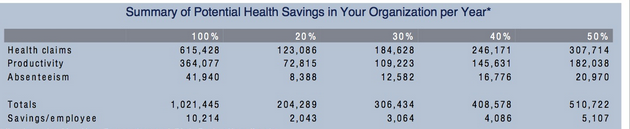
Questions for Wellsource
How is it that 100% of the employees at this company have a chronic disease?
ANS: Refused to answer
If “cancer” were a chronic disease as you claim it is, like diabetes or heart disease or asthma, how come no one ever says: “I have lung cancer, but my doctor says we’re staying on top of it”?
ANS: Refused to answer
If “stroke” were a chronic disease as you claim it is, how come every minute you don’t get to the ER following a stroke increases the odds you’ll end up like the Kardashians? Wouldn’t “stroke” be the epitome of an acute event rather than a chronic disease?
ANS: Refused to answer
If all these people are so sick, how come the largest opportunity per employee to save money ($40,000/employee!) is to get a few more people to buckle their seatbelts 100% of the time instead of 95% of the time?
ANS: Refused to answer
Speaking of seat belts, does it increase your credibility with potential purchasers that seat belt use is expressed the wrong way (96% buckle, meaning the correct figure to enter here would be “4%,” the ones who don’t always buckle)?
ANS: Refused to answer
If a whopping 89% of your employees have high blood pressure as defined by 140/90, do you think there is a chance you made a mistake in measuring this variable?
ANS: Refused to answer
How can you save $6154.28 per employee in health spending just on these items when the average employee doesn’t spend $6154.28 in healthcare costs altogether?
ANS: Refused to answer
How is this $6154.28 savings/employee figure (expressed in your materials as $615,428 for the 100 employees in this company) consistent with sourcing Steve Aldana, who claims that you always save $1358.85 per employee, whether you get a 0% improvement or a 100% improvement in risk factors?
ANS: Refused to answer


