
Home » Uncategorized (Page 46)
Category Archives: Uncategorized
HealthFair Wins Wellness Industry’s Race to the Bottom
Ever wonder why students don’t just grade themselves? For your answer, look no further than HealthFair.com’s self-assessed grade:

And yet by any standard other than their own, HealthFair completely flunks the test. Literally, their “basic package” proposes more “D”-rated tests (and “D” is a failing grade by US Preventive Services Task Force standards) than any vendor we’ve ever seen. They would lose their wellness vendor license tomorrow, except for the fact that wellness vendors don’t need licenses.

The first four all get “D”s. Here are the screenshots if you don’t believe that any vendor could possibly offer so many inappropriate tests at all, let alone in the “basic” package.

The abdominal aortic ultrasound test is such a stupid (where “stupid” is synonymous with “profitable”) idea for the non-elderly population that the USPSTF doesn’t even bother to say no:

Along with their “D” as a general screening tool, The EKG gets a whopping “I” for individuals at risk, but since HealthFair’s basic package includes no basic tests to see who is at risk, and by law they can’t ask about history, they would still have to screen everyone whether or not they are at risk:

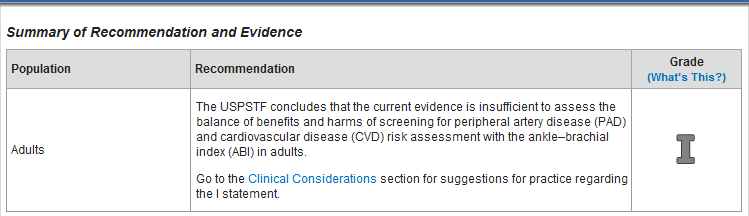
By earning another “I”, the peripheral artery disease test does well by HealthFair’s standards. The USPSTF concludes that researchers don’t know enough about it to recommend it, which doesn’t stop HealthFair.
As for “hardening of the arteries,” the USPSTF doesn’t bother to grade it due to the fact that no one uses this test as a screen…except wellness vendors. But even the American Heart Association, not exactly shy when it comes to screening people for cardiac disease whose treatment can enrich their members who treat it, disses this test:

Speaking of D-Rated tests, sorry, guys. If you want a D-rated PSA screen — a screen not even recommended by its own inventor — you have to insist that your employer buy HealthFair’s “advanced” package:


Give your employees wellness that always earns an “A”
That brings us to the H Pylori screen, Healthfair’s groundbreaking, earth-shattering, pushing-the-envelope leap forward in the wellness vendor competition to out-stupid one another.
Where to start…
First, the US Preventive Services Task Force doesn’t bother to offer a recommendation on it, largely because no self-respecting doctor would ever screen patients for this. Shame on the USPSTF for consistently failing to anticipate all the ways in which wellness vendors can misunderstand basic clinical science!
Second, most of us who harbor H Pylori have no symptoms. So why screen for something that’s not causing problems? That’s why this is a test, not a screen. If you have an ulcer or symptoms that suggest an ulcer, go to the doctor. Even then, the doctor probably won’t even bother to test you, since most people get relief simply from well-tolerated, commonly used, proton pump-inhibitor medications–some of which don’t even require a prescription. It is only if the first-line medications fail that most doctors will even test you.
Third, there is a significant school of thought that says H. Pylori is beneficial. Screening us for something we’re better off having in our bodies represents a new frontier in the wellness industry’s answer to overdiagnosis, which we call hyperdiagnosis.
Fourth ironically, given the wellness industry’s obsession with employees’ weights, it is even slightly possible that killing off H. Pylori contributes to weight gain.
Fifth, what exactly are we supposed to do, if it turns out we harbor H. Pylori? Get a course of antibiotics to clear the bacteria out of our system? That’s a great idea. We’ve always maintained that one of the problems with America’s healthcare system is that patients don’t get to take enough antibiotics.
The good news for the pharmaceutical industry is due to the nature of H Pyroli, hiding in our stomach mucus, it takes a lot of antibiotics to ferret it out, plus a bunch of other pills. Is this a great country or what?
Sixth, the H Pylori tests themselves are among the most complex, unhelpful and inaccurate commonly used tests in existence.
Finally, half the world’s population has it. Given the expense and inaccuracy of the test and the prevalence of the bacterium, why not eliminate the middle step and just put all your employees on antibiotics?
One of us is a screaming libertarian. And even he thinks the cowboys that populate the wellness industry need to be reigned in with some regulation, before they screen the American workforce to death. The regulation would be very straightforward: employers and vendors must disclose the USPSTF recommendations to employees before making them take these tests. If after this disclosure, a few employees still insist on getting these D-rated or off-the-charts-inappropriate screens, congratulations! Your screening program will have just done something useful: identified employees who are totally incapable of making an intelligent decision.
To those of you who are reading this and thinking: “Haven’t I heard this song before?”, the answer is, you have. HealthFair is the “Intel Inside” for the screening jihad offered by SSM Healthcare, the Sisters of Saint Mary health system we “profiled” a few weeks ago, thus once again proving that wellness mantra: great minds aren’t the only ones that think alike.
Share this:

Johnson & Johnson accepts our analysis that wellness loses money
Newsflash: Someone from Johnson & Johnson named Michael Schmidt responded to our posting that the HERO Report shows wellness loses money. This is the first time anyone associated with HERO has strayed from the tried-and-true Wellness Ignorati strategy of ignoring us. We were concerned that he might have found a mistake in our math, which no one has ever done.
Fortunately, our math is OK with Mr. Schmidt, and — by implication, since he is writing on their URL — J&J itself. His point is different. He argues that we write these columns to do the following: generate business. Touche!
He also says that the headline is inflammatory and that we will turn off more people than we turn on. That is probably accurate. However, the people we would turn off — traditional “pry, poke, prod and punish” wellness vendors such as Johnson & Johnson — have had and would have no interest in paying us to find out that wellness is worthless.
In any event the headline “The Wellness Wars Are Over. Wellness Lost” captures exactly what the HERO report says — and was edited by the ITL editor. Headlines, as Mitt Romney found out when his New York Times op-ed was entitled “Let Detroit Go Bankrupt,” are the purview of the editor, not the author.
The curious thing is, Johnson & Johnson is listed as one of the “endorsers” of the HERO report. So as an endorser of the report, Johnson & Johnson is tacitly nonetheless acknowledging that the report is right–wellness loses money.
In case there is some ambiguity, here is the screenshot of the first set of comments

Share this:


Is Wellness-Driven Life Insurance Hancock’s New Coke?
 John Hancock Insurance recently announced a plan to sell life insurance based on healthy behaviors. You get a discount on life and disability insurance for exercising and reporting good blood values on an ongoing basis, not just once when you sign up.
While we have been quite vocal in saying wellness is a waste of money and potentially injurious to health and morale (and lately the two wellness trade associations themselves have candidly supported that position), we find Hancock’s strategy to be a shockingly good idea.
There are many distinctions between Hancock’s offering and health insurance. First, life and disability insurance are opt-in products. No one is forcing you to buy them in order to get health insurance at work, or fining you if you don’t. No one is violating USPSTF guidelines, screening the entire workforce, or making you get checkups that are worthless at best.
Second, the same numbers that don’t remotely add up for wellness add up quite elegantly for life and disability. Cut 50% out of your heart attack rate for the latter and you probably reduce overall claims payout by 5%. Cut 50% out of your heart attack rate for health insurance and you reduce overall claims payout by less than 1%. Additionally, Hancock can possibly accomplish that goal through underwriting. An employer doesn’t have that option. So besides being worth more, a 50% reduction is achievable.
Finally, they should be able to generate some good self-selection into this product. People have to be willing to give up some privacy, and our colleague Anna Slomovic is quoted on this topic in the article in the New York Times, but as long as you know what risk you are taking and as long as there is some recourse, it isn’t the same thing as being forced to reveal personal information for a wellness program.

Declare your independence from wellness intrusion. Quizzify.
One asterisk: the article says they are relying on Vitality to come up with the risk adjustments. I doubt seriously that is the case. Hancock has real grownup actuaries whose job it is to price these risk adjustments. We assume the article is wrong — Hancock isn’t going to rely on a vendor that can’t even quote Dee Edington correctly and doesn’t understand how to design a study.
Absent that asterisk, we are confident that they will be successful and wish them the best of luck.
Share this:

Total Wellness’s Total Package of Totally Inappropriate Tests
Total Wellness is very concerned about “fostering a positive culture in your office.”

And what better way to “foster a positive culture,” and “recruit talented employees to your workforce” so that they can “improve relationships with one another” than by screening the stuffing out of them?
To start with, don’t just ask your “talented employees” that you just “recruited” if they smoke. That would be too easy and obviously they would all lie, right? Isn’t lying exactly what talented employees do the day after you hire them? Of course! And isn’t deceit what a positive culture is all about? Of course! That’s why you have to test their nicotine 7 ways to Sunday.
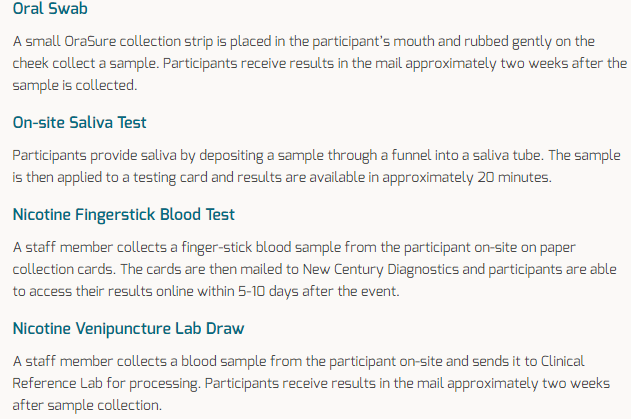
And if those tests are too easily gamed, here’s another one — just in case a few of those lying, cheating employees manage to pass the first set of tests, a la Lance Armstrong. And we wouldn’t put it past them to game the test. After all, they are “talented.”

When you’re done with nicotine, screen them for body fat. Nothing spells “talented employee” like an absence of body fat.

But wait…there’s more. Total Wellness offers a package of seven additional tests that aren’t recommended by the US Preventive Services Task Force. Now how much would you pay?
A lot, as it turns out (not even including follow-up from false positives). The more inappropriate tests you authorize, the more money they make.
Total Wellness is able to do this through their “partnership with Clinical Reference Laboratory.” Translation: they charge you, send some of the money to this other outfit, and keep the rest.
Let’s go test by test down their list.
First are two sets of tests that the USPSTF doesn’t even bother to evaluate because it would never occur to them that anyone, even a doctor, would use them as a screen.


Chem-20s aren’t even recommended as screens by the doctors who get paid to do them.
No one bothers to recommend against CBC screens…because CBC tests aren’t screens. A CBC is a test that actual doctors, not wellness vendors, order for patients who are not feeling well. Get it? As has been well-established for two decades, it’s not a screen. it’s a test. It’s useful for finding the sources of symptoms in a patient who presents in an actual doctor’s office, not for telling healthy people they’re sick. By analogy, if you think you broke your arm, the doctor might x-ray it. That’s a test. But even the dumbest wellness vendor wouldn’t propose X-raying all your employees as a screen to see if their arms are secretly broken.

Helping employees achieve health shouldn’t include lying to them. Quizzify them instead.
Assuming a CBC were used as a screen, it would be much more potentially hazardous than if a doctor were to do the test. Since apparently Total Wellness doesn’t understand the concept of false positives anyway (a prerequisite for being in the screening business is not understanding false positives), they would likely misinterpret the results.
How did Total Wellness manage to get a license as a wellness vendor without knowing the difference between a screen and a test? Simple — you don’t need a license to be a wellness vendor. That means wellness vendors are allowed to charge employers to perform screens on employees that would get doctors in a lot of trouble if they tried to bill insurers for them.
We’d encourage you to visit their site to see a few more proposed screens that the USPSTF doesn’t recommend doing, like TSH, homocysteine, CRP. But let’s end with the mother lode of the screening industry: screens that the USPSTF specifically recommends not doing, but are very profitable for vendors.

The good news is, Total Wellness isn’t overselling this test. They say it is “possibly an indicator of ovarian cancer cells,” which makes the test literally less than useless, due to the overwhelming number of false positives and false negatives from such a test. That’s why no grownup doctors use it as a screen and that’s why the USPSTF says:
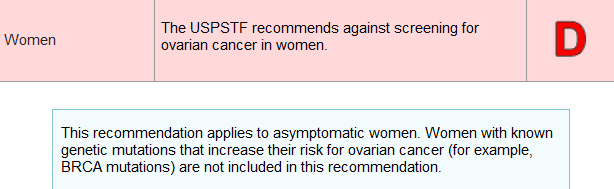
You may say: “Yes, but this ‘D’ recommendation doesn’t apply to women with the BRCA mutation.” Alas, by law, wellness vendors aren’t allowed to ask an employee whether she has a BRCA mutation or any other family history question, dramatically the reducing the already abysmal odds that a screening vendor might do something useful.
Let us close with my favorite test:
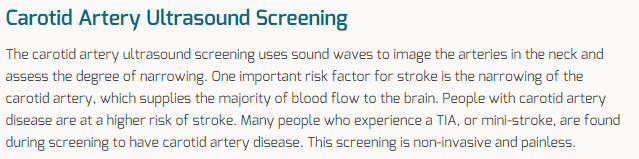
Ask vendors why they do it and they’ll say exactly what this one says: this test is “non-invasive and painless.” Sure. In that respect it’s not unlike palm-reading. The more relevant adjective that applies to both: useless.
If you want to get technical, “D” means less-than-useless.
We do like to close on a high note. Total Wellness is right in that this screening program would indeed help your employees “improve relationships with one another.” Forcing your employees to participate in this costly and misanthropic jihad might lead them to use their “talents” to all get together and revolt–just like at Penn State.
Share this:

Health Advocate Caught in the Act…
…Of getting it right!
Proof that wellness can be both useful & fun.
People think this site is all about “outing” scoundrels, but we’re just presenting facts, usually in the form of screen shots, that can’t be denied. That’s why none of the organizations or people “profiled” have ever sued us, despite our entreaties. However, sometimes the facts are actually good, and we want to recognize that too.
For this posting let’s set aside policy/economics issues and just focus on on-site execution of screenings. I attended a Health Advocate biometric screening which was being held in my neighborhood, to attract potential customers, meaning the attendees were comped but had been invited on the hopes that they would set up a screening event. The first thing they got right was the list of tests. The manager on site, Rich Prall, listed the usual tests. I then asked what other tests they had available. As you know, many vendors “profiled” on this site push completely inappropriate tests, that even if they were free would cause more harm than good. We have three more vendors in the queue too, each worse than the previous one in pushing tests that the US Preventive Services Task Force specifically says not to do.
Mr. Prall listed the same bunch of tests that the USPSTF recommends not doing, but then volunteered without being prompted that the right answer was indeed for an employer not to do them. (“If you do them at all, it should be at the doctor’s office. What’s an employer going to do about your potassium level, anyway?”) So Mr. Prall was willing to sacrifice revenues for integrity. Literally, this is the first time we’ve seen that happen. What Mr. Prall was appropriately shying away from, other vendors call their “Gold” or “Platinum” packages.
Next, I did some height/weight stuff. They had a device that measures body fat (and BMI, which of course is a bit squirrelly as a measure, but leave that aside for now). The body fat measurement was almost 20%. I am usually 2-3 points lower. It could have been the inaccuracy of the machine or perhaps because this winter’s weather has crimped my workout routine, but I expressed a little concern. The screener said: “Actually as you get older (I’m 59), you want to have a little body fat.” That is, once again, the right answer,an answer which shockingly few vendors are aware of.
Finally, I did the fingerstick. The screener explained it all very thoroughly, understood the distinction between fasting and non-fasting, and did everything quite well. Unlike Vik’s experience with Provant’s six-week delay, he ran the numbers right on the spot.
Even though a finger-stick is not particularly accurate, my values were what they usually are, except cholesterol. My cholesterol, at 127, was 30 points lower than usual. I expressed concern that a cholesterol value could be too low, and the screener said he didn’t know what too low was, but didn’t think it was an issue at 127.
So I googled it, and indeed there is a “too low,” but it is south of 127. Apparently people with too-low cholesterol tend to do impulsively self-destructive things, like attempt suicide or drive recklessly. I’ve never done anything particularly impulsive/self-destructive, unless one counts running this blog. So, once again, the Health Advocate person was right. That was 3 in a row, which might be a record for wellness vendors.
I could have talked to a counselor about the numbers but there was a bit of a line to get into these private areas, and in any event, I was so pleased with these guys that I didn’t want to risk bursting my balloon with one more conversation. (Nor have I visited their website to see if they make wacky ROI claims. Let me just live the moment, please…)
So I idenitifed myself (I hadn’t misrepresented myself earlier–remember, Vik and I are in the “integrity segment” of the market — but I just hadn’t given the full story) and congratulated them on best-in-class job of screening.
Literally every other vendor on this site could learn a lot from Health Advocate. I know I did.
Share this:

Apologies to HERO and the Wellness Ignorati!
(March 18) Due to vacation schedules, we are taking a brief time-out from both our “profiles” of vendors and our serial analysis of the HERO report (Part 1 was our most popular posting ever — don’t forget to “Follow” us so as not to miss a single installment.).

Knowledge + fun + respect = happiness + health
This posting is to apologize to the HERO Wellness Ignorati. A comment our posting on the HERO report said we shouldn’t call the Wellness Ignorati “ignorant.” We aren’t calling them ignorant and we apologize if we were misunderstood. Since it has sold almost 6000 copies despite Wiley’s decision to price it to finance their retirement accounts, we thought by now most people had read Cracking Health Costs. That was the book in which the term was coined. It emphatically does NOT mean “ignorant.” We would never call them “ignorant” and the Ignorati are anything but. Quite the contrary, they are smart enough to realize that facts are their worst nightmare.
Or as Tom Friedman said in today’s New York Times, “We wouldn’t be human if we didn’t outright ignore facts that make a laughingstock of our hopes.” (I actually did the opposite. See the blog post: Founding Father of Disease Management Astonishingly Declares: “My Kid Is Ugly.” Dee Edington did something very similar. Both of us were simply not willing to sacrifice our integrity for filthy lucre.)
The Wellness Ignorati are more than smart. They are brilliant. They have elevated fact-ignoring to an art form.
They realize that enough people seeing this site will derail their HR-financed gravy train, so they keep to a strict strategy of not even acknowledging that facts exist. Example: us. Not a mention of our existence in their entire report. A brilliant strategy for them, and one that flatters us immensely. Obviously, in the massive tome they just published, if they thought we were wrong, they could have said: “They Said What and its authors offer a competing view, but it’s wrong because…”
Fact suppression is of course the opposite of what we do — we want facts to be front-and-center. We welcome transparency and debate, though the latter is tough because people either repeatedly decline (Ron Goetzel) or, after the debate, wouldn’t agree to release the recording (Michael O’Donnell).
Instead they simply disappear us. This is despite the fact that the two of us (plus our colleagues like Jon Robison and Tom Emerick) have sold more books, been interviewed in more major publications, authored more articles in high-impact journals than all the Ignorati combined.

Do you employees know when to just say “no” when it comes to medical care?
I’ll close with a f’rinstance. We copied a screenshot from that report showing that the Ignorati finally admitted that “pry, poke, prod and punish” programs damage morale. This guy looked at that screenshot, and put a comment on our post that this screenshot didn’t exist, but rather it was our propaganda. Someone else said the screenshot was out of context, so we invite everyone to read the context.
The bottom line is, of course the HERO Report is correct about the cost of morale damage. Coincidentally, I am writing this from State College, Pennsylvania. I am here as an honored guest of the Penn State Faculty Benefits Committee, feted for my role in helping to free them from the Goetzel/Highmark forced wellness program (featuring those immortal testicle checks). Try telling Penn State there’s no morale impact. (For those of you thinking of sending your kids here, do it! I’ve never been to a university where the professors were more passionate about teaching their students than PSU–despite what happened to them in 2013.)
“Everyone is entitled to their own opinions, but not to their own facts.”
–Daniel Patrick Moynihan
Share this:

A Short Painless Primer on the Value of Screening
At the risk of knocking our second-most-widely viewed posting (the first of several analyses of the HERO report) off our front page, this is a brief and amusing lesson on the value of screening
If you like this, you’ll love this–it will also tickle your funny bone.
Share this:

HERO Report: Wellness Industry Leaders Shockingly Admit that Wellness Is Bad for Morale

The question is: how do you help employees spend less and get healthier at the same time?
(March 14) This is the first in a series looking at the strengths and weaknesses of the HERO Outcomes Guidelines report, recently released by the Wellness Ignorati. One explanatory note: A comment accused us of insulting the Wellness Ignorati by calling them that. It is not an insult. It describes their brilliant strategy of ignoring facts and encouraging their supporters to do the same. We are very impressed by the disclipline with which they have executed this strategy, and will be providing many examples. However, if they prefer a different moniker to describe their strategy, they should just let us know.
We encourage everyone to pick up a copy of this report, the magnum opus of the Wellness Ignorati. Unlike the Ignorati, we are huge advocates of transparency and debate (which they call “bullying”). We want employers to see both sides and decide for themselves what makes sense, rather than spoon-feed them selected misinformation and pretend facts don’t exist.
The latter is the strategy of the Wellness Ignorati. Indeed, they earned their moniker by making the decision to consistently ignore inconvenient facts. (This is actually a smart move on their part, given that basically every fact about wellness is inconvenient for them.) For example, they just wrote 87 pages on wellness outcomes measurement without admitting our existence, even though we wrote the only book — an award-winning trade best-seller — on wellness outcomes measurement. Observing the blatant suppression of facts and the loss of credibility that comes with blatantly suppressing facts is just one of the many reasons to read this report. In total, their report provides a far more compelling argument against pry, poke, prod and punish programs than we ourselves have ever made, simply by bungling the (admittedly impossible) argument in favor of them.
There is too much fodder for us to deconstruct in one posting, so over the next several weeks we will highlight aspects of this report that we think are especially revealing about the sorry state of the wellness industry.
In terms of getting off to a good start, the Ignorati are right up there with Hillary Clinton, with their first self-immolation appearing on Page 10. Remember our mantra from Surviving Workplace Wellness: In wellness, you don’t have to challenge the data to invalidate it. You merely have to read the data. It will invalidate itself.
And sure enough…
Ironically, the first self-immolation is the direct result of that rarest of qualities among the Ignorati: integrity. We were shocked by the revelation that the Ignorati actually realize that employee morale and a company’s reputation both suffer when companies institute wellness programs – but here is the screenshot. Both morale and reputation are listed, as “tangential costs.”
Try telling a CEO that the morale of his workforce and his corporate reputation are “tangential” to his business. We ourselves run a company, and we would not list low morale as a “tangential cost.” Quite the opposite — our entire business depends on our employees’ intrinsic motivation to do the best job they can. If their morale suffers, our profit suffers. That’s why we would never institute a wellness program. The last thing we want to do is impact our morale in order to measure our employees’ body fat. Obviously, it is harder to hire and retain people if you value body fat measurement over job performance, and we are pleased to see the ignorati finally admit this.

Why, having now read this revelation in the ignoratis’ own words, that wellness is bad for morale, would any company still want to “do wellness”? Or as we say in Cracking Health Costs, “If you’re a general, would you rather have troops with high morale or troops with low cholesterol?”
The fact that employees hate wellness isn’t exactly a news flash. Anytime there is an article in the lay press, the public rails against wellness — or “bullies” the wellness industry, to use the term that the Ignorati use for people who disagree with them publicly. You don’t have to look far—just back to HuffPost on Wednesday. Or All Things Considered.
Obviously, if you have to bribe employees to do something (or fine them if they don’t), it’s because they don’t like it. If employees would rather sacrifice considerable sums of money than be pried, poked and prodded, they are sending you a message: “This is a stupid idea we want nothing to do with.”
The news flash is that this whole business of “making employees happy whether they like it or not,” as we say in Surviving Workplace Wellness is now acknowledged – by the Ignorati as a group — to be a charade.
HERO seems to have exhausted their integrity quota pretty quickly, because after that welcome and long-overdue and delightfully shocking admission, they slip back into character.

To get good answers, you must ask good questions. We do.
Specifically, in their listing of costs, they conveniently forgot a bunch of direct, indirect and “tangential” costs. Like consulting fees. Generally, the less competent and/or honest the consultants, the more they charge. (For instance, we can run an RFP for $40,000 or less, and measure outcomes for $15,000 or less — and do both to the standards of the esteemed and independent GE-Intel Validation Institute. Most other consultants can’t match either the price or the outcome.) We’re not calling any consulting firm incompetent or dishonest other than pointing to a few examples that speak for themselves, but it does seem more than coincidental that the consultants involved in this report have conveniently forgotten to include their own fees as a cost.
And what about the costs of overdiagnosis caused by overscreening far in excess of US Preventive Services Task Force guidelines? The cost of going to the doctor when you aren’t sick, against the overwhelming advice of the research community?
Still, we need to give credit where credit is due, so we must thank the Ignorati for acknowledging that wellness harms morale. It took even less time for this acknowledgement than for the tobacco companies to admit that smoking causes cancer.
Share this:

Stop the Presses: We Goofed!
When you are in the “countererrorism” business like we are, it’s important to have a zero tolerance for errors. Occasionally one slips through. In that case the important thing to do is to admit it, rather than fire the Attorney General and the Special Prosecutor and have your secretary erase the tape.
Vik and I wrote a posting for The Health Care Blog, the upshot of which was that the Affordable Care Act should no longer require insurers to cover adult checkups. Free checkups are ubiquitous in self-administered plans. On balance, our posting shows what grownups in health services research already know: they are worthless. Not completely satisfied with their innate worthlessness with a full subsidy, many employers — guided by benefits consultants — attach additional money to them: you are either fined for not getting one or else receive a bonus for getting one. Our proposed solution was/is quite simple: employers that attach bonuses or fines to physicial exams need to disclose that checkups are a waste of time and money. That simple disclosure requirement would end forced checkups.
It turns out, however, that adult checkups are not required by ACA. It was a complete benefits consulting urban legend and we fell for it. So we were wrong.
Here are the lessons from this.
First, if someone proves us wrong, we admit it. See? Admitting error is a concept that is lost on the wellness and benefits consulting industries. For example, after we pointed out that Mercer’s client British Petroleum got completely snookered by Mercer Staywell, the response of Mercer to BP wasn’t: “We apologize to for letting your vendor snooker you.” It was: “Let’s nominate this program for a Koop Award,” which naturally they won because both Mercer and Staywell are represented on the board of the group that gives out the award.
Second, the particular someone who proved us wrong, Chris Glason, did not “bully” us. He merely asked a tough question that invalidated a (minor) premise of our argument. However, when we do something quite similar, the people who are wrong (or lying) say we are “bullying” them. But all we did was ask 11 questions to clarify what someone already said — and offer him $1000 to answer the questions. Trust us: if Chris Glason had offered us $1000 to look it up and get back to him, we would have. (Instead we were rather dismissive, to put it mildly, for which we also publicly apologize.)
Third, our mistake was to assume that benefits consultants actually know something about, well, benefits consulting. We know they know nothing about wellness—Mercer and Milliman have both basically self-immolated by participating in the aforementioned Koop Award Committee and getting snookered four times by dishonest vendors. On two occasions the Committee was forced to backtrack as a result of our exposes, though they never admitted they got snookered. We kind of assumed that since benefits consultants don’t know anything about wellness, the only way they could stay in business was to actually know the first thing about benefits….and we listened to them.
Sidebar: a few benefits consultants are highly competent. We recommend the ones whom the Validation Institute (which is not connected with us but which we have a lot of respect for) has certified. (Don’t strain your eyes–no one from Mercer or Milliman appears on their listing.)
Fourth and most importantly, the answer doesn’t change: End “pry, poke, prod and punish” programs — especially the “prodding” part, now that even benefits consultants can see that prodding someone to go to the doctor when they aren’t sick is a complete waste of time and money.
“I made a mistake. I listened to the experts.”
— John F. Kennedy
Share this:
Lewis and Goetzel: A Brief Prequel
Note: This is not as clever as our usual stuff. The sequel (in this case, prequel) is never as good as the original. Nonetheless, it’s important to know how we got to where we are and how the now-viral “Open Apology to Ron Goetzel” came to be.
 I was just called “mean-spirited” by Michael O’Donnell regarding Ron Goetzel, so I thought a little background might be in order. Some people no doubt think Vik and I just popped up out of the blue and started insulting people. Michael O’Donnell’s editorial says we haven’t been willing to engage in “respectful debates” and all sorts of other stuff. So let’s climb into the Wayback Machine and set the dial for 2011. I submitted the final manuscript of Why Nobody Believes the Numbers to the publisher, John Wiley & Sons, for June 2012 publication. For those of you whose consultants and vendors haven’t told you about it (for obvious reasons), this was an award-winning trade-bestselling book on outcomes measurement, that is used in at least 5 graduate-level classrooms.
Despite being almost 3 years old, it is quite relevant today, as a new “official” welness outcomes measurement guide compiled by many of the people profiled on this site recommends 7 approaches to measurement, 5 of which my book had already completely invalidated.
Page 82-83 contain the following lines. I am using screen shots because, as is usual, no one would believe me if I just quoted text.

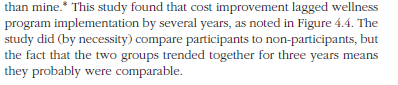
I genuinely believed that he was seeking the truth and that his analysis was “much better than mine.” I was the Boxer to his Snowball.
But then, over the following years, a funny thing happened. I reluctantly realized that the entire Wellness Ignorati cabal — the Koop Committee, WELCOA etc. — had no interest in facts. They simply wanted to perpetuate their existence at the expense of their customers. I had originally been very polite. for instance, when I displayed the infamous Health Fitness Corporation slide (now disowned) on p 85 of Why Nobody Believes, I didn’t name names:
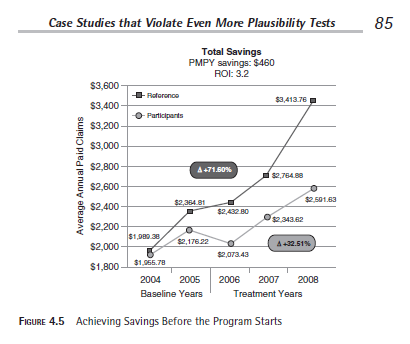
And I know Ron read p. 85, because he copied pages 82-83 and used it in his own presentations until Wiley made him stop.
But you know what happened after Ron read that HFC’s award-winning slide had self-invalidated? No “respectful debates.” Nothing. (We’re still not sure how he didn’t notice in the first place.) HFC didn’t apologize and didn’t stop using the slide. Ron didn’t retract their Koop Award. (It wasn’t until our Health Affairs expose almost three years later, that Ron was shocked, shocked to discover that that infamous and highly visible slide was, to use his choice of the passive voice, “unfortunately mislabeled.” It is still a mystery who did the mislabeling. No one has stepped forward. We think it might have been the North Koreans.)
The same thing kept happening — Nebraska, Staywell, Mercer, Milliman, Wellsteps etc. Basically most of the Koop Committee and plenty of others All of them had mistakes quietly pointed out…and none of them did anything to correct them. Politeness failed. When a “mistake” is pointed out and not fixed, it becomes a lie. In retrospect, what we did was as naive as if Rachel Carson had brought her findings to Monsanto and asked them to please stop selling DDT.
Jeopardy meets Comedy Central meets healthcare.
That’s why and when we started blowing the whistle, which has been interpreted as bullying. Leave a comment: what you would have done? The health of employees all over the country is being jeopardized by overscreening, overdiagnosis and overdoctoring, the evidence is being ignored by the perpetrators…what choice did we have?


