Home » wellness doesn’t work (Page 11)
Category Archives: wellness doesn’t work
Ron Goetzel’s “Dumb and Dumber” Defense Deflects Latest Koop Award Ethical Scandal
By Al and Vik
Oh, the twists and turns as Ron “The Pretzel” Goetzel tries to wriggle out of all his ethical stumbles.
This time around, we thought we had nailed both him and his cabal handing out the ironically named C. Everett Koop Award to themselves and their friends based on made-up outcomes. Specifically, this time they gave their sponsor (Health Fitness Corporation, or HFC) an award based on data that was obviously made up, that no non-sponsor could have gotten away with submitting. This was the third such instance we’ve uncovered of a pattern of giving awards to sponsors for submitting invalid data while making sure that the award announcement contains no reference to the sponsorship. (There are probably others; we’ve only examined 3, which might explain why we’ve only found 3.)
How obviously was the data made up? Well, take a looksee at this slide, comparing participants to non-participants. This is the classic wellness ignorati ruse: pretending that non-motivated inactive non-participants can be used as a valid control for comparison to active, motivated participants. The wellness ignorati would have us believe that any healthcare spending “separation” between the two groups can be attributed to wellness programs, not to inherent differences in motivation between the two groups. Unfortunately for the ignorati, their own slide invalidates their own argument: in 2005, the label “Baseline Year” shows there was no program to participate in, and yet – as their own slide shows – participants (in blue) significantly underspent non-participants (in red) nonetheless. In Surviving Workplace Wellness, we call this “Wellness Meets Superman,” because the only way this could happen is for the earth to spin backwards.
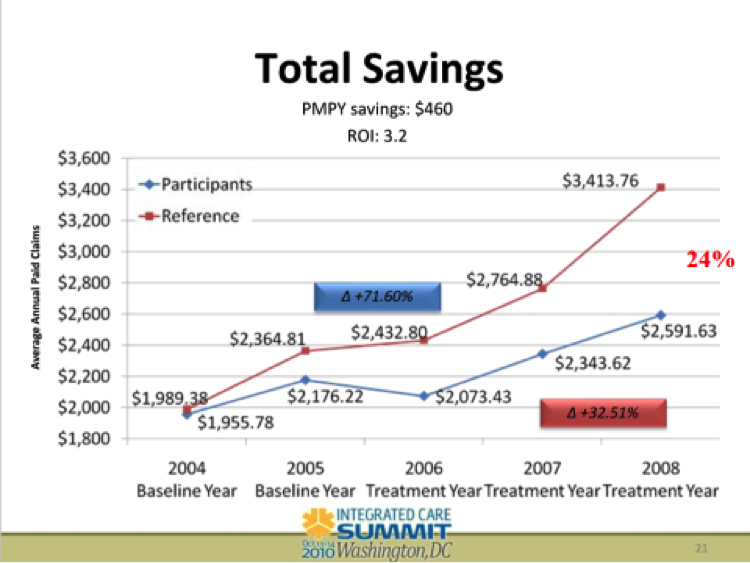
Given that the 2005 baseline label was in plain view, we just assumed that HFC did not indeed have a program in place for this customer (Eastman Chemical) in 2005, which is why they called 2005 a “Baseline Year” instead of a “Treatment Year.” Not actually having a program would logically explain why they said that didn’t have a program, and why they used that display or variations of it like the one below for 4 years with the exact same label. Presumably if they had had a program in 2005, someone at HFC would have noticed during those 4 years and relabeled it accordingly.
Originally we thought the Koop Award Committee let this invalidating mistake slide because HFC — and for that matter, Eastman Chemical — sponsor the awards they somehow usually win. But while trying to throw a bone to HFC, the Koop Award luminaries overlooked the profound implication that the year 2005 separation of would-be participants and non-participants self-invalidated essentially the entire wellness industry, meaning that is is an admission of guilt that the industry-standard methodology is made up.
 Goetzel the Pretzel to the rescue. He painstakingly explains away this prima facie invalidation. Apparently the year 2005 was “unfortunately mislabeled.” Note the pretzelesque use of the passive voice, like “the ballgame was rained out,” seemingly attributing this mislabeling to an act of either God or Kim-Jung-Un. He is claiming that instead of noticing this invalidator and letting this analysis slide by with a wink-and-a-nod to their sponsor, none of the alleged analytical luminaries on the Koop Committee noticed that the most important slide in the winning application was mislabeled — even though this slide is in plain view. We didn’t need Edward Snowden to hack into their system to blow up their scam. They once again proved our mantra that “in wellness you don’t need to challenge the data to invalidate it. You merely need to read the data. It will invalidate itself.”
We call this the “Dumb and Dumber” defense. Given two choices, Goetzel the Pretzel would much prefer claiming sheer stupidity on the part of himself, his fellow Koop Award committee members like Staywell’s David Anderson and Wellsteps’ Steve Aldana, and his sponsor HFC, rather than admit the industry’s methodology is a scam and that they’ve been lying to us all these years to protect their incomes.
Still, the Dumb-and-Dumber defense is a tough sell. You don’t need Sherlock Holmes, Hercule Poirot or even Inspector Clouseau to detect a few holes in the Pretzel’s twisted logic:
- How could no one – no member of the Koop Award Committee or employee of Health Fitness Corporation (which used this as its “money slide” for years) – have noticed this until we pointed it out for the third time (the first two times not being as visible to the public)?
- In early 2012, this slide was reproduced–with the permission of Health Fitness Corporation–right on p. 85 of Why Nobody Believes the Numbers, with the entire explanation of its hilarious impossibility. We know Mr. Goetzel read this book, because he copied material out of it before the publisher, John Wiley & Sons, made him stop. So we are curious as to why it has taken until now for him to notice this “unfortunate mislabeling.” Hmm…would the fact that it was just exposed to the world in Health Affairs have anything to do with this sudden epiphany? We’re just sayin’…
- If indeed it was just an “unfortunate mislabeling,” how come HFC has now expunged all references to this previously highlighted slide from their website, rather than simply change the label?
As regards the third point, we would recommend that next time Mr. Goetzel invokes the Dumb-and-Dumber defense, he coordinate his spin with his sponsor.
But let’s not overlook the biggest point: the entire Koop Committee – including “numbers guys” like Milliman’s Bruce Pyenson and Mercer’s Dan Gold — is apparently incapable of reading a simple outcomes slide, as they’ve proven over and over.
So, as a goodwill gesture, we will offer a 50% discount to all Koop Committee members for the Critical Outcomes Report Analysis course and certification. This course will help these committee members learn how to avoid the embarrassing mistakes they consistently otherwise make and (assuming they institute conflict-of-interest rules as well to require disclosure of sponsorships in award announcements) perhaps increase the odds that worthy candidates win their awards for a change.
Share this:

Will the Real Kate Baicker of the Harvard School of Public Health Please Stand Up?
By Al and Vik
Harvard Professor Katherine Baicker is arguably the most acclaimed health policy researcher at arguably the most acclaimed (and not even arguably, the best-endowed) school of public health in the country. Her seminal account of the effect of Medicaid coverage on utilization and health status is a classic. As luck would have it, in 2008 Oregon used a lottery to ration available Medicaid slots. A lottery controls for motivation and as such eliminates participant-non-participant bias, since everyone who enters the lottery wants to participate. That meant only one major variable was in play, which was enrollment in Medicaid or not.

Wellness ROI claims appear lost in space
Chance favors the well-prepared, and Professor Baicker jumped on this research windfall. She found that providing Medicaid–and thereby facilitating access to basic preventive medical care–for the previously uninsured did not improve physical health status, but did increase diagnoses and utilization. Because of the soundness of the methodology, the conclusion were unassailable – more access to medical care does not improve outcomes or optimize utilization, which is a proxy for spending. (We ourselves reached a similar conclusion based on a similar analysis on North Carolina Medicaid’s medical home model.)
Yet Professor Baicker herself used exactly the opposite methodology to reach the exact opposite conclusion for workplace wellness. And that’s where the identity crisis begins.
She and two colleagues published a meta-analysis in 2010 of participant-vs-non-participant workplace wellness programs. Somehow—despite her affinity for Oregon’s lottery control—she found this opposite methodology to be acceptable. She concluded that workplace wellness generated a very specific two significant-digit 3.27-to-1 ROI from health care claims reduction alone, with another 2.37-to-1 from absenteeism reduction. The title of the article–now celebrating its fifth anniversary as the only work by a well-credentialed author in a prestigious journal ever published in support of wellness ROI—was equally unambiguous: Workplace Wellness Can Generate Savings.
This article wasn’t just an academic exercise. It gave the Obama administration academic cover for what has proven to be the most unpopular, dishonest, and even hazardous component of the Affordable Care Act: allowing employers to financially and clinically punish employees with coercive directives to lose weight, get unnecessary checkups, and answer intrusive, distasteful, and counterproductive questions about (for example) checking their testicles.
Professor Baicker did not question her too-good-to-be-true conclusion. Yet the Law of Diminishing Returns clearly contradicts her finding. Compelling privately insured people to get more healthcare is very unlikely to improve health status and reduce healthcare expense if provision of basic insurance to a medically needy population doesn’t noticeably improve health status while increasing healthcare expense.
Instead, she reveled in the limelight, receiving 307 citations, vs. 18 and 9 for two other Health Affairs articles on wellness that didn’t support more spending on vendors and consultants. (Even 307 citations aren’t enough to satisfy one of the leaders of the wellness movement, Larry Chapman, who says this study should be cited much more frequently since it’s basically the one that supports the entire industry.) However, at some point in 2013, overwhelming evidence totally invalidated her findings. At that point – like Dee Edington and Al Lewis, both of whom had previously reversed positions when the data didn’t support their previous positions—she could have acknowledged that her initial findings had been wrong and moved on.
Instead, she neither defended her position nor clearly refuted it, choosing instead a yin and yang middle ground that shifted with every interview. The metamorphosis from Queen of Significant Digits into the Queen of Significant Doubt started in July 2013, when she announced on NPR’s Marketplace that “it’s too early to tell” if wellness saves money, and that employers need to “experiment” with these programs to “see what happens to participants’ weight and blood pressure.” Right there, she invalidated herself. First, by then she certainly knew that a participants-vs-non-participants methodology was invalid since the key “smoking gun” slide in our Health Affairs posting was already widely circulated and her own opposing Oregon methodology was being widely praised. Second, even if she is right, the financial payoff for the modest “weight and blood pressure” improvements that the best programs might generate is 10-20 years in the future — and even then only if the improvements are sustained.
But then came another personality change.
In February 2014, she blamed readers for focusing on her attention-grabbing headline, the certainty of her two significant digits, and the gist of the conclusion…while ignoring the fine print, such as a caution about publication bias. Publication bias? You think? Start with the standard publication bias that negative articles rarely get published because they don’t get cited and hence reduce the all-important “impact factor” – recall the difference in Health Affairs citations in her own wellness article vs. the others.
Add to that a publication bias specific to those journals: most of the articles comprising her meta-analysis were published in third-tier journals. Among them, these journals have exactly once published an article critical of wellness (twice if you include a book review by the esteemed Norton Hadler, whom a third-tier journal is thrilled to publish regardless of what he says, and three times if you include publication of an article by a graduate student at the University of Tasmania that accidentally undercut the true believers’ own storyline, that they are now having to explain away).
Weeks later, a totally different personality emerged: she told the editor of Insurance Thought Leadership that she no longer focused on wellness and consequently has no opinions to share. Leaving aside the irony that the wellness true believers continue to cite as gospel someone who says she has no interest in what they are citing her for, this spin further invalidates her next comment, delivered in December 2014 – when suddenly, as a result of yet another personality change, she has opinions again. She told All Things Considered: “It could be that when the full set of evidence comes in, [wellness] will have huge returns on investment.”
Oops. First, she has just admitted she doesn’t follow wellness, so why speculate on future studies she has no knowledge of in a field she’s not involved in? Second, there is a rule of thumb in epidemiology: the bigger the impact, the smaller the sample size needed to discern it. An example would be smoking and lung cancer, a previously very rare disease whose cause was discernable from a handful of cases. A sample of only hundreds of veterans was needed to prove that very high blood pressure causes strokes, and studies of exercise almost always show either a physical or emotional benefit, even in small groups of people with significant disease. On the other hand, there have been probably close to a half-billion employee-years of wellness with nothing to show for themselves except results going the other way and a bunch of self-invalidating vendor lies.

Available now at Amazon.com
So we are going to make a radical proposal to the true believers: you can continue to cite Katherine Baicker but must also note that she herself no longer supports the study you are citing — until and unless she says she does. In exchange for this disclosure, when do you cite her, we will acknowledge that you are telling the truth for a change.
Share this:

Wellnet: “Trusted Advisors Need Trusted Partners”…so we’ll pay you
Wellnet Materials Being Reviewed
See “For Brokers” on the Wellnet website, leading with the line:

Questions for Wellnet
Are you using the term “trusted advisors” (scroll down this linked page) to describe your prospects’ brokers? Then it appears you are offering to pay them an undisclosed sum of money to place Wellnet. Are we reading this correctly?
ANS: Refused to answer
Then it seems like you want the broker to become a trusted advisor, meaning you want to pay them money to sell to their client, who absent this language would appear to be working for their client:

Clicking through on “learning more about becoming a trusted advisor” brings you to this grammatically challenged question:

How do brokers creating new revenue for themselves at their clients’ expense (meaning selling their clients more forced wellness programs like yours) enhance their reputation as a “trusted advisor” ?
ANS: Refused to answer
If this is on the level, why not simply be explicit: “We will pay you a commission to sell our product to your clients” ?
ANS: We didn’t even bother to ask
Share this:

Ron Goetzel and Co-Authors Claim Workplace Wellness Evidence That a CSI Couldn’t Find
Questions for Ron Goetzel and co-authors based on September 2014 article
Category: Wellness
Short Summary of Goetzel Article’s Marketing Claim:
“Evidence accumulated over the past three decades shows that well-designed and well-executed programs that are founded on evidence-based principles can achieve positive health and financial outcomes.”
(This study was paid for by American Specialty Health, a successful and well-regarded company in the alternative network business that also, not surprisingly, has a wellness subsidiary.)
Materials Being Reviewed:
The study in question appeared in a recent issue of the Journal of Occupational and Environmental Medicine.
Most of these questions were originally asked by Jon Robison of Salveo Partners, in this post.
Questions for Ron Goetzel (who has not answered any relevant follow-up question asked of him about his Koop Award either, meaning now he has forfeited $2000 in honoraria)
Is it ethical to claim “no conflict of interest” in writing this article when a wellness company paid you for it and when you and most co-authors make their living in the wellness industry?
ANS: Refused to answer
Can you explain your reasoning for listing (see below) the Koop Award-winning State of Nebraska as a “best practice wellness program” after they admitted lying about saving the lives of cancer victims who never had cancer, and after it turned out their savings figures were clinically and mathematically impossible, and after it was exposed that the state’s wellness vendor sponsors the Koop Award?

ANS: Refused to answer
Why didn’t you disclose that literally none of these “best practice” programs (especially Nebraska’s, which deliberately waived all age-related cancer screening guidelines) follow US Preventive Services guidelines and therefore companies that follow these best practices on balance are more likely to harm their employees through overdiagnosis than benefit them?
ANS: Refused to answer
You describe (among others) a Procter & Gamble study from two-decade-old data as “recent”. Can you define “recent” ? Can you name anyone at Procter & Gamble who even remembers this “recent” study?
ANS: Refused to answer
Why do you still cite Larry Chapman’s 25%-savings-from-wellness-programs allegation even though readily available online government data below shows wellness-sensitive medical events account for only 8.4% of a typical employer’s hospital cost (about 4% of total employer spending), thus making it impossible to save 25%?

ANS: Refused to answer
Why are you still citing Prof. Baicker’s article when she herself has backed off it three times, it’s never been replicated, and all attempts to replicate it, including the most recent attempt to replicate it (in the “American Journal of Health Promotion”), have shown the opposite and she herself says “there are very few reliable studies to confirm the costs and the benefits”?
ANS: Refused to answer
How can you cite RAND’s negative article as supporting the conclusion that “wellness can achieve positive financial outcomes” even though the author Soeren Mattke has specified that the modest health improvements among active participants produced no “positive financial outcomes”?
ANS: Refused to answer
Likewise, how can you cite the Pepsico health promotion study in Health Affairs in support of that same conclusion when that study concluded exactly the opposite: that health promotion had a negative ROI?

ANS: Refused to answer
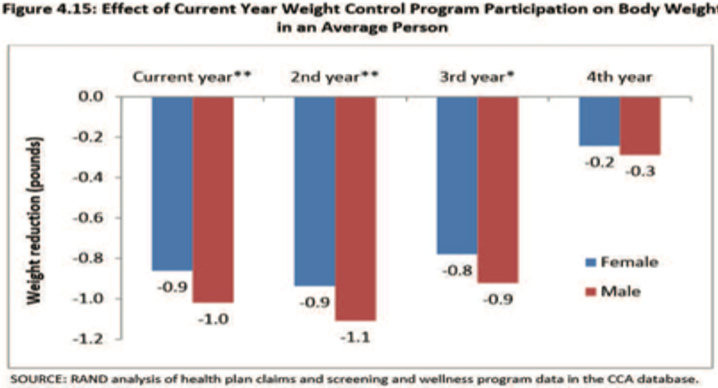
Guest question submitted by Dr. Jon Robison: On p 931 you say that the RAND study found weight reduction — of course, only on active participants, excluding dropouts and non-participants — that was “clinically meaningful” and “long-lasting.” How does that square with this slide from that very same RAND study showing exactly the opposite? (Since this chart may be difficult to read,we’ll highlight the key finding, which was that by the 4th year the average active participant had sustained weight loss of only a few ounces.)
ANS: Refused to answer

 They Said What?