
Home » Posts tagged 'Nebraska wellness'
Tag Archives: Nebraska wellness
Official Rules for Acacia $100,000 Validity/Outcomes Challenge
Congratulations to Acacia Clinics for achieving the highest level of validation from the Validation Institute. That comes with a $100,000 Credibility Guarantee.
In rare cases, such as Virta Health or Diathrive or Sera Prognostics or Ault International Medical Management, I add my own guarantee.
Any mental health vendor (I’m lookin’ at you, Lyra) can challenge my statement that Acacia has the most validly measured good outcomes. Here are the terms to earn my $100,000.
Terms and Conditions of Challenge
Selection of Judges
There will be five judges, selected as follows:
- Each side gets to appoint one, drawn from the Healthcare Hackers listserve with 1200 people on it, from all walks of healthcare.
- Two others are appointed objectively. That will be whichever health services researchers/health economists are the most influential at the time the reward is claimed. “Most influential” will be measured by a formula: the highest ratio of Twitter followers/Twitter following, with a minimum of 15,000 followers.
- Those four judges will agree on the fifth.
Using the criteria below, judging will be based on validity of the measurement. Measurements deemed invalid, such as those described on the Validation Institute site, is a disqualifying factor, i.e., any challenge by a vendor that is not validated by the Validation Institute.
If the challenging party/vendor is deemed by the judges to have an equally valid metric as Client, the decision is made on the impact of the program in outcomes for people with treatment-resistant OCD.
Written submissions
Each side submits up to 2,000 words and five graphs, supported by as many as 20 links; the material linked must pre-date this posting to discourage either side from creating linked material specifically for this contest.
Publicly available materials from the lay media or blogs or the Validation Institute may be used, as well as from any academic journal that is not open-access.
Each party may separately cite previous invalidating mistakes made by the other party that might speak to the credibility of the other party. (There is no limit on those.)
Oral arguments
The judges may rule solely on the basis of the written submissions. If not, the parties will convene online for a 2.5-hour recorded virtual presentation featuring 10-minute opening statements, in which as many as 10 slides are allowed. Time limits are:
- 30-minute cross-examinations with follow-up questions and no limitations on subject matter;
- 60 minutes in which judges control the agenda and may ask questions of either party based on either the oral or the written submissions;
- Five-minute closing statements.
Entry process
The entry process is:
- Challenger and TheySaidWhat deposit into escrow the amount each is at risk for ($100k for the Challenger, and $100k for TheySaidWhat). Each party forwards $10,000 to the judges as well, as an estimate of their combined fees and/or contributions to their designated nonprofits.
- If the Challenger or Service Provider pulls out after publicly announcing an application, the fee is three times the amount deposited.
- The escrow is distributed to the winner and the judges’ fees paid by the winner are returned by the judges to the winner, while the judges keep the losers’ fees.
Other
The competition is open to any mental health vendor outcomes claim which was made before June 1, 2024. This date may be updated by TSW from time to time, and indeed was now just extended to cover the hilarious Aon report on Lyra.
Share this:

Official Rules for Acacia $100,000 Validity/Outcomes Challenge
Congratulations to Radial Health for achieving the highest level of validation from the Validation Institute. That comes with a $100,000 Credibility Guarantee.
In rare cases, such as Virta Health or Sera Prognostics or Ault International Medical Management, I add my own guarantee.
Any mental health vendor mentioned in the Peterson Report (I’m lookin’ at you, Lyra) can challenge my statement that Radial (nee Acacia) has the most validly measured good outcomes. Here are the terms to earn the $100,000.
Terms and Conditions of Challenge
Selection of Judges
There will be five judges, selected as follows:
- Each side gets to appoint one, drawn from the Healthcare Hackers listserve with 1000 people on it, from all walks of healthcare.
- Two others are appointed objectively. That will be whichever health services researchers/health economists are the most influential at the time the reward is claimed. “Most influential” will be measured by a formula: the highest ratio of Twitter followers/Twitter following, with a minimum of 15,000 followers.
- Those four judges will agree on the fifth.
Using the criteria below, judging will be based on validity of the measurement. Measurements deemed invalid, such as those described on the Validation Institute site, would be a disqualifying factor, i.e., any challenge by a vendor that is not validated by the Validation Institute.
If the challenging party/vendor is deemed by the judges to have an equally valid metric as Client, the decision is made on the impact of the program in outcomes for people with treatment-resistant OCD.
Written submissions
Each side submits up to 2,000 words and five graphs, supported by as many as 20 links; the material linked must pre-date this posting to discourage either side from creating linked material specifically for this contest.
Publicly available materials from the lay media or blogs or the Validation Institute may be used, as well as from any academic journal that is not open-access.
Each party may separately cite previous invalidating mistakes made by the other party that might speak to the credibility of the other party. (There is no limit on those.)
Oral arguments
The judges may rule solely on the basis of the written submissions. If not, the parties will convene online for a 2.5-hour recorded virtual presentation featuring 10-minute opening statements, in which as many as 10 slides are allowed. Time limits are:
- 30-minute cross-examinations with follow-up questions and no limitations on subject matter;
- 60 minutes in which judges control the agenda and may ask questions of either party based on either the oral or the written submissions;
- Five-minute closing statements.
Entry process
The entry process is:
- Challenger and TheySaidWhat deposit into escrow the amount each is at risk for ($100k for the Challenger, and $100k for TheySaidWhat). Each party forwards $10,000 to the judges as well, as an estimate of their combined fees and/or contributions to their designated nonprofits.
- If the Challenger or Service Provider pulls out after publicly announcing an application, the fee is three times the amount deposited.
- The escrow is distributed to the winner and the judges’ fees paid by the winner are returned by the judges to the winner, while the judges keep the losers’ fees.
Other
The competition is open to any mental health vendor outcomes claim which was made in the Peterson Report.
Share this:
The latest on Nebraska: Ron Goetzel covers up his cover up.
To our new readers, while 2016 marked the first instance in which a Koop Award was ever bestowed upon a company that harmed employees, 2016 wasn’t the first Koop Award ever to go to a company whose own data showed they fabricated results. Below is a history of one of the Koop Award’s Greatest Hits.
For those of you who haven’t been following the saga of the Nebraska state employee wellness program, here is a crash course, aka “Lies, Damn Lies, and the Nebraska State Wellness Program.” If you have been following it, you can skip to the end for the latest installment, Mr. Goetzel’s cover-up of his cover-up.
By way of background, this program is called “wellnessoptions” (imagine e.e. cummings-meets-poking employees with needles-meets-a sticky spacebar). They used to say the Holy Roman Empire was neither Holy nor Roman nor an Empire. Likewise, wellnessoptions is neither optional, if you want a decent deal on healthcare, nor wellness. Instead of wellness, it features a hyperdiagnostic anti-employee jihad in which Health Fitness Corporation (HFC) diagnoses employees but does nothing about the diagnosis except take credit for it.
TIMELINE — PART ONE: HFC’S TROUSERS COMBUSTED
September 24, 2012, 2:00 PM
I read Health Fitness Corporation announcement that its customer, the state of Nebraska, won Ron Goetzel’s C. Everett Koop Award for program excellence.
September 24, 2012, 2:01 PM
I recognize that the cancer outcomes were obviously made up. Until then, I hadn’t been following the Koop award closely enough to realize that making up outcomes was apparently one of the award criteria, as I later came to learn.
October 2012
I read the full write-up on the program and realize that not only were most of the other outcomes made up, but they had actually lied about saving the lives of cancer victims. If you screen a few thousand people for colon cancer, you don’t find 514 cases of cancer, and you certainly don’t save their lives, as HFC was claiming. And you absolutely don’t save money, as they were also claiming. All this is even more true when you waive age-related guidelines and let anyone get screened, and encourage overscreening by sending out 140,000 letters to state employees graced with the picture of a beautiful young model way too young to be getting a colonoscopy.
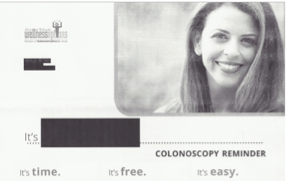
How this invalid nonsense ever got by all the eagle-eyed Koop Committee members would be a mystery, except that HFC is a sponsor of the Koop Committee.
December 2012
I review the entire application and all the marketing materials. It becomes obvious that the entire thing was made up, not just the cancer part. They claimed to save $4.2 million because 161 of their roughly 6000 participants reduced a risk factor.
The math is quite self-evident. Suppose you doubled the number of participants who reduced risks to 312. It stands to reason that you could save $8.4-million. Double it again to 624 and you save $16.8.
Now double it one more time. If 1,248 people out of those 6000 reduced one single risk factor, you’d save $31.6-million, which is about equal to the entire spending for all 6000 participants. And of course most medical spending has nothing to do with identifying previously unrecognized risk factors, so this would be quite a feat. (Do you even know anyone under 65 who had a heart attack that could have been avoided by one more workplace screening?)
I later learn that all the Koop Award-winning program outcomes are made up, using exactly the same math.
November 2012 to June 2013
I try to contact the authorities, like Roger Wilson, who allegedly runs this program for the state, but no one seems to care. The rule of thumb in the wellness industry is that what you say counts. What you do is pretty irrelevant.
June 20, 2013
Breakthrough: The Wall Street Journal editors decide that I am correct, and that the outcomes were made up. Vik and I are allowed to publish this on their op-ed page.
July 14, 2013
Breakthrough again: Another very well-read blogger professes shock-and-awe that any vendor could lie so blatantly and apparently get away with it.
July 15, 2013
Breakthrough yet again: Ace reporter Martha Stoddard of the Omaha World Herald gets Dennis Richling of Health Fitness Corporation to admit that the outcomes — at least the “life-saving catches” of “early stage cancer” outcomes — were indeed made up. Richling tries to spin his gaffe by calling the difference between “life-saving catches of early-stage cancer” and saying someone might possibly get cancer in the future “semantics.” So, according to Richling, having cancer and not having cancer are the same thing.
February 1, 2014
The hilarious wellness industry smackdown Surviving Workplace Wellness is published. Since the HFC Nebraska program had too many lies to fit on a page or two, it gets its own chapter. Here’s the opening paragraph, which in all modesty I must admit is one of my favorite in the book.

February 23, 2014
Nebraska political blogger ReadMoreJoe picks up the scent. He points out that this wellness program is an obvious fraud. The problem is that the same posting is also exposing several other equally obvious frauds, so this one gets overlooked.
TIMELINE–PART TWO: GOETZEL STRIKES BACK
Ron Goetzel isn’t about to sit back and let his friends/sponsors/clients be pilloried for a little white lie about saving the lives of cancer victims who didn’t have cancer.
June 2, 2014
At the Health Datapalooza conference, Ron Goetzel, while admitting the Nebraska cancer outcomes data was made up, claims they/HFC still deserve the Koop Award because he somehow didn’t realize the data was made up at the time the award was granted. And it is true that HFC didn’t actually announce they had made up the outcomes. Ron would have had to actually read the materials to figure it out, same as I did.

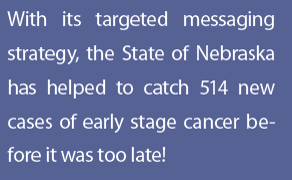
September 2014
Ron Goetzel calls the Nebraska program a “best practice” in the Journal of Occupational and Environmental Medicine but refuses to answer any questions about the obvious mistakes and inconsistencies in the article.

November 2014
After knowing for 16 months that they had lied, Ron Goetzel, writing in Employee Benefit News, finally drops Nebraska from his list of best-practice programs:

Being a fair-minded person, I take it upon myself to congratulate him on his newfound sense of ethics. I don’t specifically agree that what he did was ethical, because the ethical thing would have been to admit complicity, apologize, and revoke their Koop Award. But I do say that Nebraska being dropped from the list of best practices means ethical “progress is definitely being made,” albeit from a low base.

Only 29 minutes elapses before Ron erases all my illusions about his honesty and re-adds Nebraska to the list of “best practice organizations.”

He also adds PepsiCo to the list. I guess losing only $2 for every $1 you spend qualifies as such in wellness, where most organizations lose much more.
May 2015
In a rally-the-base invitation-only webinar, we are told that Ron has promoted the Nebraska program from “best practice” to “exemplar.” It seems like the more obvious it becomes that the whole thing was fabricated, the more Mr. Goetzel worships its outcomes.
TIMELINE–PART THREE: RON STANDS ALONE
September 2015
WELCOA finally takes the fabricated case study of Nebraska’s outcomes off their website, 26 months after the fraud was admitted. Perhaps some pressure is being put on them to come clean, given that this is Nebraska’s program and they themselves are based in Omaha.
Just for the record, I’m not saying that an organization founded by all-you-can-eat cafeteria magnate “Warren Buffet” knowingly kept a false document on their site for those 26 months. History suggests they might just be slow learners. [2016 update: WELCOA is under new management, and they appear to be doing a great job, as exemplified by their development of the Employee Health Program Code of Conduct.]
This means Ron Goetzel is literally the only person left who thinks it’s perfectly OK — indeed, a “best practice/exemplar” — to lie about saving the lives of cancer victims. Good luck with that in the upcoming debate. It’s him against the world.
Or, as he sees it, everybody’s out of step but Ronnie.
October 2015
Nebraska tentatively re-awards the wellness contract to Health Fitness Corporation. I am looking over the precipice towards utter humiliation.
TIMELINE–PART FOUR: THE ORIGINAL DATA DISAPPEARS
November 2, 2015–the original cover-up, on the morning of the Great Debate, in which Mr. Goetzel told 14 lies in 90 minutes, which is a lot even for him
At our urging, a third party alerted Mr. Goetzel to the fact that, his protestations to the contrary, the Koop Award Committee did know (even if they had somehow not seen the marketing materials quoted above) that Health Fitness Corporation was making fictitious claims about saving the lives of cancer victims. It was right in the award application. The original award application from Nebraska had originally stated (underlining is ours):
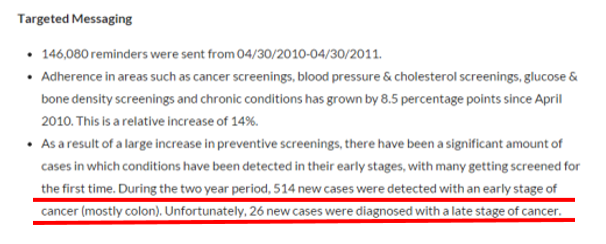
But then, a hour following the call from this third party the morning of the debate, the original award application suddenly read:
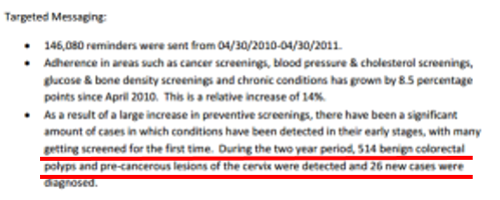
In the original application, this excerpt appears in a letter from the Governor of Nebraska. Only now the Governor’s letter says the opposite what he actually wrote. In the real world, this would be considered forgery. In wellness, a forged cover-up of a blatant and admitted lie about saving the lives of cancer victims who didn’t have cancer is considered business as usual. Johns Hopkins and Truven (Ron’s employers) don’t seem to mind either.
April 2016
The state is rescinding its award to Health Fitness and terminating its wellness program. In the immortal words of the great philosopher Stewey Griffin, victory is mine.
September 2016: The cover-up of the cover-up
Mr. Goetzel finally acknowledges that Health Fitness Corporation told a whopper, and the Koop Committee overlooked it, allegedly by accident, for the four years during which I’ve repeatedly pointed it out.
He now calls this an “erratum.” However, the word “erratum” is usually used to correct honest mistakes (in sharp contrast to this one), usually within hours or days of their discovery (in sharp contrast to this one). You can’t forge official state documents and then call the whole thing an “erratum.” Is a robber allowed to give the money back after he gets caught and just uncommit the crime?

So now, having admitted that the award-winning vendor told the biggest lie in wellness history (against stiff competition), and knowing that all Nebraska’s obviously fabricated savings were mathematically impossible, and that waiving age restrictions for screening is akin to waiving age restrictions for buying beer, the Koop Committee finally, after four years, rescinded the Nebraska award.
Haha. No one falls for that line any more. Quite the opposite, they are doubling down. They say that whopping lies like this one don’t disqualify you, assuming you are an award sponsor. You get to keep your award.
Ditto, if your entire claim of “separation” between participants and non-participants is shown to be false but you are sponsor, Ron merely doctors the data and you get to keep your award.
Also, if it turns out you lied about your savings because there was no change in the biometrics to attribute the savings to, but Ron was a consultant on your project, you get to keep your award.
Likewise and as was confirmed in 2016, if you are a committee member, as Wellsteps’ CEO was until recently, despite your own data showing that you actually harmed employees, you get to keep your award.
Bottom line: as a friend-of-Ron, you might get to keep your award even if you shoot someone on Fifth Avenue.
Share this:

Nebraska’s Award-Winning Wellness Program Meets an Ignominious Demise
No program epitomized conventional “pry, poke and prod” wellness more than Nebraska’s state employee wellness program. And by that of course I mean no wellness vendor has ever lied about outcomes more blatantly or won more awards than Nebraska’s state employee wellness program vendor, Health Fitness Corporation. (Blatantly lying about outcomes and winning Koop Awards, in the immortal words of the great philosopher Frank Sinatra, go together like a horse and carriage.) Their big mistake was admitting it. (See the timeline link.)
Not to mention the cover-up of the lies, that Ron Goetzel and his Koop Committee friends botched so badly that the state’s HR team and procurement department could no longer do the Sergeant Schultz thing. I guess now, finally, Mr. Goetzel will stop referring to this program as a “best practice.”
Now, the program is officially dead. It was close. On October 1, we thought we had lost:
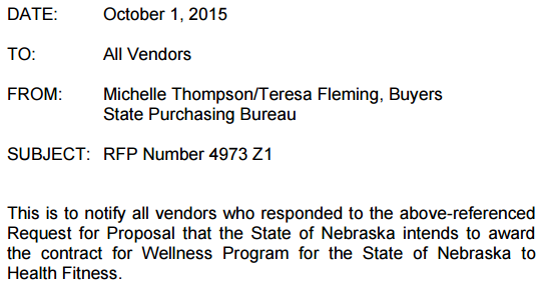
But then last week, following a number of behind-the-scenes conversations and finally a bit of googling by the state:

In other words:

Share this:

Cancergate: Did a Koop Award Committee Member Commit a Crime?
As part of the cover-up of Health Fitness Corporation falsely claiming to save the lives of 514 Nebraskans with cancer, someone doctored their Koop Award application to remove the evidence of that claim and replace it with a literally and figuratively much more benign statement. For reasons described below, this may not even be legal. We are offering our assistance to Ron Goetzel to help him find the perp.
What would Dr. Koop say?
After Health Fitness Corporation (HFC) admitted lying about saving the lives of 514 alleged Nebraskan cancer victims who turned out never to have had cancer in the first place as part of their Koop Award-winning wellness program, someone tampered with their original award application to try to erase that lie. The “514 early-stage cancers” they claim to have cured morphed into “514 polyps.”
At the 2015 Great Debate, Ron Goetzel (who runs the Koop Award Committee) insisted that the Koop Committee knew nothing of the original lie about finding 514 cases of cancer, even though that line appeared twice in the original Koop Award application. The Koop Award Committee also saw nothing suspicious in HFC’s marketing materials, which, incredibly, still resided on the HFC website for years after HFC was outed. HFC finally took it down, an obvious admission of guilt on their part (to go with the actual admission in the newspaper), given how much they had ballyhooed it in the past. Naturally we have copies of the entire “case study” if anyone would like one.
Admittedly, that original lie was a little hard to spot in that case study. You needed to actually open your eyes:
And a lot of people did open their eyes. The claim made its way into Google…and all the way to CalPERS:

The Koop Committee missed this, though. Claiming to know nothing and see nothing — the Sergeant Schultz defense — is a Koop Committee favorite. However, the initial oversight doesn’t explain why Ron has called Nebraska a “best practice” three times even after he was shocked, shocked to learn that lying was going on in here.
Rewriting History
I want to be very clear: we are not accusing Ron Goetzel of sneaking back in and rewriting the original applications (including forging a section of a letter from the governor of Nebraska) to cover up the lies told by Health Fitness Corporation, which sponsors his award. He could lose his job at Johns Hopkins if he did, so he wouldn’t. Quite the opposite, both of us would want to get to the bottom of this!
Clearly, though, someone with the same coverup agenda and with the same access to the same Koop Award site rewrote the original HFC/Nebraska award application. Specifically, someone replaced “514 new cases of early-stage cancers” with these employees having only “benign polyps” in order to make it consistent with the denial that the Committee knew anything about HFC’s lie:

Owing to the previous doctoring of original evidence in the Koop Award (for which Ron Goetzel did admit responsibility), we now know to keep screenshots of originals. Note the difference in the last sentences. The original is claiming “514 new cases…of cancer” below. This is the original that Mr. Goetzel insists did not appear in the application. And yet, here it is.

This bungled evidence-tampering shows our book, Surviving Workplace Wellness, is right: “In wellness you don’t have to challenge the data to invalidate it. You merely have to read the data. It will invalidate itself.”
The doctored paragraph has now replaced the original paragraph in both places where it appears. Ours is the only extant copy of the original screenshot. We learned long ago that you need to capture screenshots because these people always cover their tracks when they get caught lying. And since most of wellness is a lie, they have a veritable Pennsylvania Station of tracks to cover.
Cancergate?
The perpetrator is in a lot of trouble: In the application, this altered phrase appears in a letter from then- Governor Heineman’s office in support of the Koop Award. Obviously that’s not legal. The reason we assume Ron Goetzel didn’t do it is because he would have had to get permission from Johns Hopkins, and they would not have let him forge official state documents while using their affiliation in his title.
Goetzel’s History of Rewriting History
We don’t know who the perpetrator is, but one reason to doubt that Ron Goetzel is the guilty party is that he was already caught doctoring original Koop applications, and it wasn’t fun for him. Hence, one could assume he would be unlikely to do the same thing again.
So Mr. Goetzel is a victim here too because of the Koop Award’s shattered credibility. He should be as horrified as we are, and we should work together on this, and offer our help. We urge, demand, insist that as the leader of this committee, Ron Goetzel get to the bottom of this! He needs to find out who tampered with this letter from the Governor, turn him in to Nebraska authorities if indeed that is illegal, apologize, and rescind that Koop Award.
We can’t investigate this ourselves without his cooperation. Even if we knew who it was, we can’t convene the wellness industry ethics committee because in wellness, there is no ethics committee. That’s because in wellness, as this website has repeatedly shown, there are no ethics.
2022 Update
It appears that the perpetrator once again hacked into Mr. Goetzel’s Koop Aweard website…and this time, like the Secret Service, deleted the entire submission, including the forged letter from Gov. Heineman, from the award application. There is literally no documentation of what the State of Nebraska won the award for. There is only the erratum statement. “Erratum,” in Goetzel-speak, means none of the very stable geniuses on his committee managed to spot an obvious mistake when confering an award on one of their friends.

So it looks like we will never know who in this industry committed forgery.
Share this:

First, Do Harm: The Ten Most Dangerous Wellness Vendors
If corporate wellness didn’t already exist, no one would invent it. In that sense, it’s a little like communism, baseball, pennies, or Outlook.
After all, why would any company want to purchase programs that damage morale, reduce productivity, drive costs up…and don’t work 90%-95% of the time? And that’s according to the proponents. What the critics say can’t be repeated in a family publication such as ours.
Still, those are the employers’ problems. However, the employers’ problems become the employees’ problems when employees are “voluntarily” forced to submit to programs that are likely to harm them. (As the New York Times recently pointed out, there is nothing voluntary about most of these programs.)
Recently, the head of United Healthcare’s (UHC) wellness operations (Optum), Seth Serxner, admitted that Optum’s programs consciously ignore US Preventive Services Task Force (USPSTF) screening guidelines. Lest anyone was expecting a wellness vendor to actually apologize for bad behavior, Mr. Serxner went on to blame employers for insisting on overscreening and overdiagnosing their own employees…and (by implication) overpaying for the privilege of doing so. “Our clients make us do it,” were his exact words.
Funny thing, we first asked our own clients who use Optum about why they turned down Optum’s generous offer to do more appropriate screenings at a lower price. None of them remember receiving this offer. Go figure. Then a UHC executive wrote and said we were making them look bad. I softened some of the language (like the paragraph below), and said I would happily retract the whole thing if indeed they could introduce me to just one customer — one out of their thousands — who recalls insisting on overscreening and overpaying. Never heard back…
United Healthcare isn’t alone in harming employees. They are just the first company to admit it, and far from the worst offender, as the harms of overscreening for the usual suspects (glucose, cholesterol etc.) don’t hold a candle to some of the more creative ideas listed below. Here, in order, are the ten vendors most likely to harm employees in the name of wellness.
#10 Healthmine
Healthmine’s CEO, Bryce Williams, isn’t blaming the victim like United did. He has publicly announced that Healthmine flouts clinical guidelines. He says he is right and everyone else — specifically including the “US Preventative [sic] Services Task Force” — is wrong. A real doctor acting on this pronouncement might be risking his or her license. Fortunately for Mr. Williams, being a wellness vendor doesn’t require a license, so regardless of the harms a wellness vendor inflicts on employees, no one can confiscate it because there is nothing to confiscate..
In addition to not misspelling the name of the group he is attacking, we might also recommend that he not misquote the sources on which his faulty argument is based. We’re just sayin’…
For starters Mr. Williams declares: “One out of every two people in America has at least one chronic condition according to the CDC…”
Here’s what the CDC really said: “One out of every two adults has at least one chronic condition.” And if you dig deeper, you’ll see that this list of chronic conditions cited by the CDC includes arthritis, mental illness, eye disorders and asthma, none of which Healthmine’s hyperscreening is going to reveal.
He also claims that “chronic diseases account for $3 out of every $4 spent on healthcare.” Here’s what the CDC really said: $3 out of every $4 “is spent on people with chronic conditions.” That is a much broader statement. It would include someone with borderline hypertension giving birth. In any event, we long ago eviscerated Mr. Williams’ cherished myth and just this week showed that essentially none of the top 25 hospital admissions has anything to do with screening, broccoli, or Fitbits.
#9 Cerner
The employee who recorded this blood pressure is essentially dead. Cerner’s diagnosis? Blood pressure “higher than what is ideal.” Cerner’s recommendation? “Talk to your healthcare provider.” A real doctor’s recommendation? “Call an ambulance. The guy barely has a pulse.”
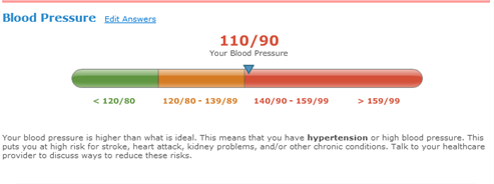
This is not a random mistake. This is the front cover of their brochure.
#8 Nebraska/Health Fitness Corporation
USPSTF Screening age recommendations aren’t minimums. They are optimums, the ages at which screening benefits might start to exceed harms, even if they still fall far short of costs. Otherwise you are taking way too much risk. This is especially true for colonoscopies, one of this program’s favorite screens — complications from the test itself can be very serious.
Your preventive coverage is not supposed to be “greater than health care reform guidelines.” That’s like “rounding up twice the number of usual suspects.” And you aren’t supposed to waive “age restrictions.” That’s like a state waiving minimum “age restrictions” to get a driver’s license.

Yet despite or perhaps because of this and other examples of total cluelessness and pure dishonesty, this program won a C. Everett Koop Award for excellence in wellness, not to mention the unwavering support and admiration of leading wellness apologist Ron Goetzel.
#7-#6 (tie) ShapeUp and Wellness Corporate Solutions
Both these outfits pitch exactly the opposite of what you are supposed to do in weight control: unhealthy crash dieting. Attaching money to this idea and setting a start date makes it even worse: along with crash-dieting during these eight weeks, you’re incentivizing employees to binge before the initial weigh-in.
Here is ShapeUp:

Here is Wellness Corporate Solutions:
Both also made up outcomes. In ShapeUp’s case they had to rescind their “findings” after their customer, Highmark, skewered them in the press. And neither seems to care that corporate weight control programs are proven not to work.
In addition to its dystopian wellness program that collects employee DNA (partnered, ironically, with a company called Newtopia) and then makes up savings, Aetna owns the distinction of launching the only wellness program whose core drugs are specifically editorialized against in the Journal of the American Medical Association. This would literally be the most harmful wellness program ever, except that the only employees being harmed are (1) obese employees who (2) answer the phone when their employer’s health plan calls them to pitch these two drugs; (3) have a doctor who would willingly prescribe drugs that almost no other doctors will prescribe due to their side effect profile; and (4) not google them. Presumably in combination this is a very low percentage of all employees.
The good news is that these drugs, Belviq and Qsymia, should be off the market in a couple of years because almost no one wants to take them, so the harms of this Aetna program should be self-limited.
Star Wellness offers a full range of USPSTF D-rated screens. “D” is the lowest USPSTF rating, and means harms exceed benefits. Star gets extra credit for being the first wellness vendor to sell franchises. All you need is a background in sales or “municipal administration” plus $67,000 and 5 days of training and you too can poke employees with needles and lie about your outcomes. Is this a great country or what?
Also, their vaccination clinic features Vitamin B12 shots. We don’t know which is more appalling–routinely giving employees Vitamin B12 shots, or thinking Vitamin B12 is a vaccine.

Angioscreen doesn’t have the most USPSTF D-rated screens. In fact, it offers only one screen in total, for carotid artery stenosis. That screen gets a D grade from USPSTF, giving Angioscreen the unique distinction of being the only vendor 100% guaranteed to harm your workforce.

Angioscreen’s other distinction is that they admit right on their website that this screen is a bad idea. This is probably literally the only non-tobacco company in America to admit you are better off not using their product.
Total Wellness loses the wellness industry’s race to the bottom only because the winner, HealthFair, has out-stupided them. However, in addition to the usual assortment of D-rated tests, they offer screens that the USPSTF hasn’t even rated, because it never, ever occurred to them that anyone would ever use these tests for mass screening of patients or employees. Criticizing the USPSTF for not rating these “screens” (CBCs and Chem-20s) would be like criticizing Sanofi-Aventis for not warning against taking Ambien after parking your car on a railroad crossing.
#1 HealthFair
Let’s leave aside for a fact that the majority of their other screens are harmful too, and focus on their screening for H.pylori, the strain of bacteria associated with ulcers. To say it is a stupid idea would be an understatement. As Clarice Starling replied when asked if Hannibal Lecter was a sociopath: “They don’t have a word for what he is.”
Likewise, this idea is too stupid for words, certainly for the small number of words we can allot to this overview blog. Visit our full treatment here. In a nutshell, the majority of us harbor H.pylori–without symptoms. It may even be beneficial. The screening test is expensive and notoriously unreliable, and the only way to get rid of it is with some very powerful antibiotics, a treatment rarely even used on patients with symptoms due to its inconvenience, ineffectiveness and potential long-term side-effects.
A Modest Proposal
So how should we as a country protect employees from these harms? Our policy recommendation is always the same, and very non-intrusive. We aren’t saying wellness vendors shouldn’t be allowed to harm employees. That would be too radical to ever pass Congress. If it did, the Business Roundtable would pressure the White House again, to preserve their hard-earned right to medicalize the workplace, and literally and figuratively, show employees who’s boss.
Instead, we recommend merely a disclosure requirement. The harms of screens or (in United Healthcare’s case) screening intervals that don’t earn at least a “B” from USPSTF should be disclosed to employees, and employees should get a chance to “opt out” into something that isn’t harmful (like Quizzify, perhaps?) without suffering financial consequences. Call us cockeyed optimists, but we don’t think employers should be able to force employees to choose between harming themselves and paying fines.
Share this:

They Said What? makes list of three top healthcare websites
OK, so maybe this news got pushed off the front page by the other prizes announced this week, but They Said What? made the list of Tom Emerick’s three favorite websites.
TSW occupies a unique niche, Rachel Carson-meets-wellness-meets-Dave Barry. As an added bonus, all of our wellness statements are true, which makes us unique in the field (and explains why we have been blacklisted by many conference organizations).
Most importantly, we are in august company with the other two selected sites. Not Running a Hospital and The Doctor Weighs In are both take-no-prisoners websites as well, and we recommend both.
Disclosure: I co-authored Cracking Health Costs with Tom Emerick. I don’t exactly expect a Nobel Prize for integrity here for simply pointing that out, but typically wellness vendors don’t disclose things like, oh, I don’t know, sponsoring the committee that gives their customers awards or even mentioning that the program they are “applauding” is their own. Although in this case — Health Fitness Corporation and Nebraska — full disclosure would have also required them to admit that the entire thing was made up. And therein lies the problem wellness vendors face. In wellness, ethics is more than just a slippery slope. It’s more like Half Dome coated with WD40.
Share this:
Hyperdiagnosis: The Wellness Industry’s Anti-Employee Jihad
Healthmine just released a survey bragging about how many employees were diagnosed through wellness programs. That reminded us of our popular 2013 posting on The Health Care Blog called Hyperdiagnosis. We are re-posting and updating it below.
By now we are all familiar with the concept of overdiagnosis, where “we” is defined as “everyone except the wellness industry.”
Wellness vendors haven’t gotten the memo that most employees should simply be left alone. Instead, they want to screen the stuffing of employees, at considerable cost to the employer and risk to the employee. The wellness vendors who overscreen employees the most win awards for it, like Health Fitness Corporation did with the Nebraska state employee program.
We call this new plateau of clinical unreality “hyperdiagnosis,” and it is the wellness industry’s bread-and-butter. It differs from overdiagnosis four ways:
- It is pre-emptive;
- It is either negligently inaccurate or purposefully deceptive;
- It is powered by pay-or-play forfeitures;
- The final hallmark of hyperdiagnosis is braggadocio – wellness companies love to announce how many sick people they find in their screens.
1. Pre-Emptive
Overdiagnosis starts when a patient in need of testing visits a doctor. By contrast, in hyperdiagnosis, the testing comes in need of patients, via annual workplace screening of up to seventy different lab values–most of which, as They Said What? has shown, make no clinical sense. Testing for large numbers of abnormalities on large numbers of employees guarantees large numbers of “findings,” clinically significant or not. The more findings, the more money wellness vendors can add on for coaching and the more savings they can claim when they re-test.
2.Inaccurate or Deceptive
Most of these findings turn out to be clinically insignificant or simply wrong, no surprise given that the US Preventive Services Task Force recommends universal annual screening only for blood pressure, because for other screens the potential harms of annual screening outweigh the benefits. The wellness industry knows this, and they also know that the book Seeking Sickness: Medical Screening and the Misguided Hunt for Disease demolishes their highly profitable screening business model. (We are not cherry-picking titles here—there is no book Here’s an Idea: Let’s Hunt for Disease.) And yet most wellness programs require employees to undergo annual screens in order to avoid a financial forfeiture.
Hyperdiagnosis also obsesses with annual preventive doctor visits. Like screening, though, annual “preventive” visits on balance cause more harm than good. The wellness industry knows this, because we posted this information on their LinkedIn groups, before we were banned from most of them. They also presumably have internet access on their own.
3. Pay-or-play forfeitures
The worthlessness, the inconvenience, and the privacy invasion make screens very unpopular. The wellness industry and their corporate customers “solve” that problem by tying large and increasing sums of money annually — now $694 on average – to participation in these schemes. Yet participation rates are still low.
4. Braggadocio
While doctors are embarrassed by overdiagnosis, boasting is an essential ingredient of hyperdiagnosis. We’ve already blogged on how Health Fitness Corporation bragged (and lied, as they later admitted) about the number of cancer cases they found in Nebraska. They also bragged about the rate of cardiometabolic disease they found — 40% in the screened population — even though they admitted almost no employee did anything about those findings, and only 161 state employees reduced risk factors. Hence, it was the worst of both worlds: telling people they are sick without helping them get better. Nothing like telling someone they’re sick to increase their productivity.
Compass Health is our favorite example of hyperdiagnosis braggadocio. We realize this screenshot is a bit tough to read, but the hilarity is worth the effort. We pulled this vignette from On The (even) Lighter Side, They Said What?‘s most popular feature.
The Definition of a “Healthy Employee” Is One Who Has Not Been Diagnosed by Compass Health
Feeling fine today? Alas, you better get your affairs in order, bid your loved ones adieu, and watch the shows you’ve DVR-ed. Why? Because, dodo-brain, feeling fine means you have:

You are “walking around without a clue that [you have] a debilitating or terminal condition.” According to Compass Health (which at this point, having been “outed” by us, had the good sense to take this off their website…but not until we captured a screen shot), the major symptom of I Feel Fine Syndrome is: not having symptoms.
We’ll let them take it from here, to display not only their epidemiological prowess but also, this being the wellness industry, their grammar and spelling prowess as well:

We must confess we learned a lot from Compass. We had not realized that employers’ concerns about employees feeling fine had their roots in ancient history. But there it is, right in the opening words: these concerns date back “millenia” [sic], when employers failed to get their employees tested for “percolating” conditions before throwing them to the lions.
So the bad news is that feeling fine may be hazardous to your health. The good news is that your ICU bed may not need a DNR notice anytime soon because elsewhere Compass says it “has programs and solutions to help your employees overcome their I Feel Fine Syndrome.” And it is “very likely” these programs and solutions can “completely cure the problem…forever in our bodies.”
And not a moment too soon, because we’re never felt better in our lives, which means the clock is ticking. That’s the good news. The bad news is, if we join Compass’s program it sounds like we need to start contributing more to our 401K’s.
Summary
We’d like to think that all our exposés have made a dent in the wellness industry’s business model, but the forces arrayed in the other direction have so far overwhelmed us. The price of screening has plummeted almost to the $1-per-lab-value level for comprehensive screens, and as with anything, the lower the price, the greater the amount sold.
Couple those economics with the advent of genetic testing as part of wellness, big and profitable fines for non-participants, and the EEOC being defanged as a sop to the Business Roundtable, and it’s clear the wellness industry’s highly profitable hyperdiagnostic jihad against the American workforce has barely begun.
By contrast, Quizzify teaches employees that “just because it’s healthcare, doesn’t mean it’s good for you,” and to only get screened according to the USPSTF guidelines. That’s a message that employees would love to hear, but that wellness vendors can’t afford to tell them.
Share this:


News flash: The Wellness Ignorati are ignoring facts for a change

There has to be a limit, even to deception
The Wellness Ignorati got their name by ignoring facts. Facts, of course, are the wellness industry’s worst nightmare. They ignore them In order to avoid creating news cycles that might reach human resources departments despite the best efforts of their consultants and vendors to shield them from actual information.
And they’re at it again.
First, Atul Gawande wrote a scathing article in the New Yorker about massive overscreening earlier this month. As Mitch Collins noted in The Health Care Blog, not a peep in response from the perpetrators of those hyperdiagnostic jihads. Nor has their been any response to Mitch’s article itself. Literally, no one defends wellness industry practices. And yet somehow all the laws are on their side.
Speaking of which, Mitch mentioned the famous Nebraska debacle, in which the vendor, Health Fitness Corporation, lied about making “life-saving catches” of “early-stage cancers.” Since HFC was a sponsor of Ron Goetzel’s Koop Award, Ron naturally gave them that prize for these lies.
However, we’ve thrown down the gauntlet. HFC, come on out and fight. Give us your side of the story. How was this not a deliberate lie designed to score political points in Nebraska? If it was a mistake, why didn’t you change it and apologize? How do those 514 cancer non-victims feel? And Mr. Goetzel, why do you not only keep defending HFC, but have even upped the ante? They’ve been promoted from “best practice” to “exemplar” in your most recent webinar.

As long as wellness vendors are silent, we won’t shut up.
Speaking of non-responses from Mr. Goetzel, where is the correction of or explanation for the massive mistake in Mr. Goetzel’s most recent wellness program evaluation? All those readers have been misled by his blog into thinking Graco’s costs/employee are $2280/year when in reality the cost per employee contract holder — according to Mr. Goetzel’s own blog — is about $11,100, like almost every other company. (That includes spouses and dependents but any reasonable dependent ratio would yield more like a typical $5000 to $6000 per employee rather than $2280.) I know he knows about this mistake because I’ve submitted a comment to his blog, which shockingly hasn’t been posted.
So, please, could someone actually respond for a change, even if it’s just to accuse us of bullying.
Share this:

Congratulations to RAND’s Soeren Mattke on PepsiCo study award
 We are proud (but also insanely jealous) of our friend Soeren Mattke, whose PepsiCo article was named the #2 most-read for the year 2014 in Health Affairs. We, as our avid albeit narrow fan base may recall, ranked only #12–and even then that was just for blog posts, not articles in print.
Yes, we know it’s not always about Ron “The Pretzel” Goetzel and his twisted interpretations, but he seems to have come up with what appears to be exactly the opposite interpretation of what the PepsiCo study said. Don’t take our word for it — we’ve cut-and-pasted both what the study says about PepsiCo’s results and what he says about the study.
Here is what the article says about the financial impact of health promotion at Pepsico: ROIs well below 1-to-1, meaning a net financial loser, for health promotion. (DM, though, was a winner.)
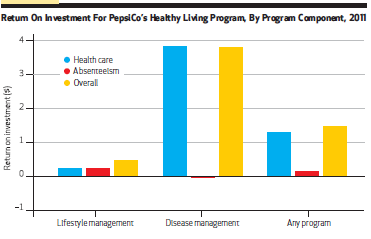
As low as these ROIs are, several major elements of cost were not available for the calculation — probably enough extra cost to literally make the financial returns so meager that even if the program had been free, PepsiCo would have lost money.

Clear enough? Negative returns from health promotion at PepsiCo, even without tallying many elements of cost. Nonetheless, Mr. Goetzel pretzelized that finding in his recent wellness apologia. Listed under “examples of health promotion programs that work” as a program that is a “best practice” is: PepsiCo. It stands proudly beside the transcendant programs at Eastman Chemical/Health Fitness and the State of Nebraska.

We look forward to a clarification from Mr. Goetzel about how a program that lost a great deal of money on health promotion can be an “example of a health promotion program that work(s),” which we will duly print…but don’t be sitting by your computer screens awaiting it.

 They Said What?