
Home » Posts tagged 'Ron Goetzel' (Page 7)
Tag Archives: Ron Goetzel
Cancergate: Did a Koop Award Committee Member Commit a Crime?
As part of the cover-up of Health Fitness Corporation falsely claiming to save the lives of 514 Nebraskans with cancer, someone doctored their Koop Award application to remove the evidence of that claim and replace it with a literally and figuratively much more benign statement. For reasons described below, this may not even be legal. We are offering our assistance to Ron Goetzel to help him find the perp.
What would Dr. Koop say?
After Health Fitness Corporation (HFC) admitted lying about saving the lives of 514 alleged Nebraskan cancer victims who turned out never to have had cancer in the first place as part of their Koop Award-winning wellness program, someone tampered with their original award application to try to erase that lie. The “514 early-stage cancers” they claim to have cured morphed into “514 polyps.”
At the 2015 Great Debate, Ron Goetzel (who runs the Koop Award Committee) insisted that the Koop Committee knew nothing of the original lie about finding 514 cases of cancer, even though that line appeared twice in the original Koop Award application. The Koop Award Committee also saw nothing suspicious in HFC’s marketing materials, which, incredibly, still resided on the HFC website for years after HFC was outed. HFC finally took it down, an obvious admission of guilt on their part (to go with the actual admission in the newspaper), given how much they had ballyhooed it in the past. Naturally we have copies of the entire “case study” if anyone would like one.
Admittedly, that original lie was a little hard to spot in that case study. You needed to actually open your eyes:

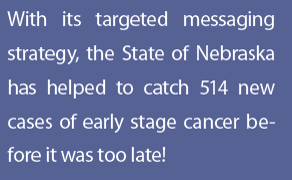
And a lot of people did open their eyes. The claim made its way into Google…and all the way to CalPERS:

The Koop Committee missed this, though. Claiming to know nothing and see nothing — the Sergeant Schultz defense — is a Koop Committee favorite. However, the initial oversight doesn’t explain why Ron has called Nebraska a “best practice” three times even after he was shocked, shocked to learn that lying was going on in here.
Rewriting History
I want to be very clear: we are not accusing Ron Goetzel of sneaking back in and rewriting the original applications (including forging a section of a letter from the governor of Nebraska) to cover up the lies told by Health Fitness Corporation, which sponsors his award. He could lose his job at Johns Hopkins if he did, so he wouldn’t. Quite the opposite, both of us would want to get to the bottom of this!
Clearly, though, someone with the same coverup agenda and with the same access to the same Koop Award site rewrote the original HFC/Nebraska award application. Specifically, someone replaced “514 new cases of early-stage cancers” with these employees having only “benign polyps” in order to make it consistent with the denial that the Committee knew anything about HFC’s lie:

Owing to the previous doctoring of original evidence in the Koop Award (for which Ron Goetzel did admit responsibility), we now know to keep screenshots of originals. Note the difference in the last sentences. The original is claiming “514 new cases…of cancer” below. This is the original that Mr. Goetzel insists did not appear in the application. And yet, here it is.

This bungled evidence-tampering shows our book, Surviving Workplace Wellness, is right: “In wellness you don’t have to challenge the data to invalidate it. You merely have to read the data. It will invalidate itself.”
The doctored paragraph has now replaced the original paragraph in both places where it appears. Ours is the only extant copy of the original screenshot. We learned long ago that you need to capture screenshots because these people always cover their tracks when they get caught lying. And since most of wellness is a lie, they have a veritable Pennsylvania Station of tracks to cover.
Cancergate?
The perpetrator is in a lot of trouble: In the application, this altered phrase appears in a letter from then- Governor Heineman’s office in support of the Koop Award. Obviously that’s not legal. The reason we assume Ron Goetzel didn’t do it is because he would have had to get permission from Johns Hopkins, and they would not have let him forge official state documents while using their affiliation in his title.
Goetzel’s History of Rewriting History
We don’t know who the perpetrator is, but one reason to doubt that Ron Goetzel is the guilty party is that he was already caught doctoring original Koop applications, and it wasn’t fun for him. Hence, one could assume he would be unlikely to do the same thing again.
So Mr. Goetzel is a victim here too because of the Koop Award’s shattered credibility. He should be as horrified as we are, and we should work together on this, and offer our help. We urge, demand, insist that as the leader of this committee, Ron Goetzel get to the bottom of this! He needs to find out who tampered with this letter from the Governor, turn him in to Nebraska authorities if indeed that is illegal, apologize, and rescind that Koop Award.
We can’t investigate this ourselves without his cooperation. Even if we knew who it was, we can’t convene the wellness industry ethics committee because in wellness, there is no ethics committee. That’s because in wellness, as this website has repeatedly shown, there are no ethics.
2022 Update
It appears that the perpetrator once again hacked into Mr. Goetzel’s Koop Aweard website…and this time, like the Secret Service, deleted the entire submission, including the forged letter from Gov. Heineman, from the award application. There is literally no documentation of what the State of Nebraska won the award for. There is only the erratum statement. “Erratum,” in Goetzel-speak, means none of the very stable geniuses on his committee managed to spot an obvious mistake when confering an award on one of their friends.

So it looks like we will never know who in this industry committed forgery.
Share this:

Laura Ingraham’s blog slams wellness
Who says the country is polarized? In wellness, bipartisanship rules!
Having just been eviscerated by the Guardian on Monday, today wellness got quite literally its worst coverage ever — from the blog of Laura Ingraham. Yes, the very same Laura Ingraham who has her own radio show and guest-hosts The O’Reilly Factor. This may be the only instance ever in which the left-wing Guardian agrees with the right-wing Laura Ingraham.
The wellness industry is running out of wings.
Hers is just the latest media salvo. Right, left, and center — the same media that used to fawn over this stuff (“everybody wins — employees are healthier and employers save money”) — has consistently been savaging these vendors and “pry, poke and prod” programs worse than we do, ever since Penn State.
Because we are an equal-time blog, we’ll review both the Guardian’s and Ms. Ingraham’s. However, read our entire posting. I will hint that, regardless of politics, you will think we are saving the best for last. (Actually, since we strive for 100% accuracy, we should say we are saving the better for later.)
The Left Wing
The Guardian published an extensive article on the privacy invasion that can accompany wellness programs. Much as I am not a fan of “pry, poke and prod,” I do think the folks who attack wellness on the basis of privacy substantially overstate their case. There are many things wrong with wellness, but we need to tell the truth on this site, since we are in the “integrity segment” of the market. And the truth is that wellness vendors don’t hand over employee personal health information (PHI) to employers. Not that we want to give them any ideas.
PHI can also be leaked accidentally, of course. Staywell wasn’t exactly forthcoming about this so you may not have heard about it, but they got breached. Hence we would recommend that you “stay well” away from them as a wellness vendor. Other wellness vendors have managed to keep hackers at bay. It could be airtight security measures on the part of the industry, but it’s more likely that hackers simply have no interest in wellness data because of its worthlessness.
Still, these wellness people have no one but themselves to blame when articles like this get published. Castlight, for example, is feeding this beast by boasting that they can predict who is going to become pregnant. The Guardian called them out on this. I have nothing against Castlight but that is eerily reminiscent of the Highmark/Goetzel/Penn State debacle when women were fined $1200 if they didn’t disclose their pregnancy plans on their health risk assessments.
And how did The Guardian write a couple thousand words on privacy without noticing Aetna’s employee DNA collection-and-storage program? In all fairness, it probably never occurred to them that a major company would ever do such a thing, so they didn’t think to look for it.
And basically every article ever published on privacy starts with the assumption that these programs must save money. Otherwise why would employers do them, given their cost and morale impact? So the Guardian never called out these vendors on lying about savings.
The Right Wing
The Guardian’s smackdown is figuratively and almost literally yesterday’s news. The news got worse today, for the wellness industry. The LifeZette (the name of Laura Ingraham’s website) skewered the wellness industry to a degree never seen outside this blog. The LifeZette article starts by pointing out that no one even pretends any more that there is an ROI from wellness. (We just covered that newfound wellness industry candor from a different angle, in Insurance Thought Leadership.)
The article also laments the lack of regulation in wellness, possibly the only time in history when any even loosely Fox-affiliated publication has opined that there isn’t enough government regulation of something. They are, of course, right. There is literally no defense of unregulated wellness industry practices that are more likely to harm employees than benefit them, just to line their own pockets. No doctor could get away with this.
Absent regulation, the article points out that companies like ShapeUp — specifically, ShapeUp — harm employees with their yo-yo dieting programs. The reporter, Pat Barone, extensively documents the harms that ShapeUp creates with its get-thin-quick “challenges,” and then notes many other harms wellness programs can cause.
We never take sides in politics on this site. Instead we frequently note — as in this posting — that both “wings” agree with us. But I will give a shout-out to this right-wing site here. Ms. Barone’s article absolutely nails the dishonest and harmful business practices of ShapeUp and others.
Usually we try to end these postings with a clever line of our own, but instead we’ll end with one of Barone’s:
The [new] alliance of ShapeUp with the two additional companies [Virgin Pulse being the lead dog], presumably means many more crash dieters wreaking havoc on their future health.
Please add comments here when you’re done reading it. LifeZette doesn’t take comments.
Share this:

STAT News: Ron Goetzel Admits Most Wellness Programs Fail
Those of you with actual jobs, families, lives etc. may still not have noticed there is a new healthcare/healthcare research daily news publication. Needless to say I noticed on the first day.
It’s free and a summary pops into your mailbox each weekday morning. And, though this publication is only a few months old, they’re already onto the workplace wellness scam (LA Times’ word, not mine). Most notably, author Sharon Begley got Ron Goetzel, of “Expect a 3-to-1 ROI” fame ($450/$150, scroll to second page), to finally admit WAY more than 90% of wellness programs fail.
Is this a great country or what?
The entire story is here. Trust us we aren’t just being polite when we urge you to read it. Yes, like most reporting should be, it quotes both sides, but it’s easy to read between the lines. It’s even double-spaced.
Highlights (taken out of context; some are quotes from others)
“A startling lack of rigorous evidence that they achieve their stated goals.”
“A lot of things are evidence-based…but wellness is faith-based.”
“Vendors’ ‘research’ has made so many elementary mistakes as to inspire voluminous criticism.” <blushing>
“Tiny if any benefits…increase in fruit and vegetable consumption [equivalent to] one bite of banana.”
“A quarter-pound of weight loss.” Not unlike Pfizer’s award-winning 3-ounce weight loss.
And of course, Ron Goetzel: “There is a group of about 100 employers whose programs have really smart ingredients…but thousands of others still don’t do wellness right and are not getting good health outcomes.” (Note: We have no clue who is in that “group,” since every recent Koop Award winner has provably fabricated savings. The 2015 winner, McKesson, didn’t even get anyone to lose weight or stop smoking.)
Here’s the clincher: If you do Ron’s math — 100 successful programs divided by “thousands” of failures — you get a failure rate similar to the 90% to 95% that leading wellness apologist Michael O’Donnell also admits to. Maybe that failure rate is OK when you’re drilling for oil, but what rational business would undertake a program that has a 95% of failing? As I said during The Great Debate: “That’s not an industry. That’s a lottery.”
Ron specifically warns against “pry, poke and punish” programs, like the ones he recently endorsed at Highmark (during our debate) and Graco. Oh, and of course Penn State.
Ron Throws Kate Baicker under the Bus
Ron also invalidated Kate Baicker’s famous “Workplace Wellness Can Generate Savings” 3.27-to-1 ROI meta-analysis, that we and RAND’s Soeren Mattke have already invalidated. Soeren did it the way a health services researcher would do it, challenging data and methods. I did it the way I do it, simply quoting her own words. She has never defended this finding, by the way.
As The Incidental Economist noted this morning, meta-analyses are squirrelly, due to bias of the authors. This particular study was co-authored by one of President Obama’s healthcare advisers, David Cutler. The President needed the Business Roundtable on his side, but the support of the Business Roundtable for ACA was and is conditioned on maintaining corporations’ ability to claw back 30% to 50% of premiums based on wellness participation and outcomes.
And–voila–an article endorsing wellness in a highly respected publication appears, to coincide with the ACA debate. In the immortal words of those great philosophers The Lovin’ Spoonful, do you believe in magic?
Ron added himself to the list of people who doubt Prof. Baicker’s finding. He admitted that: “Many [meaning ‘most’] unsuccessful programs are not reported.” In other words. that 6-year-old Health Affairs article had a publication bias built on top of an author bias.
Now that You Know Your Program Has Failed…
Hey, I know it’s not always about us, but when you’re ready to sue your wellness vendor for making up all these outcomes and savings etc., we do offer forensic consulting and litigation support. We always win (actually, settle on very favorable terms). And the more of this site you read, the more you’ll see why: against these people, it would be impossible to lose. For them, the only bigger nightmare than facts are their own words.
A brief shout-out to Koop Committee member Debra Lerner on the topic of meta-analyses. She herself wrote one on wellness…but it has no apparent author bias. Rather it was fastidious in its article selection criteria. Showing that no good deed goes unpunished, her excellent work has rarely been cited, as the wellness industry studiously ignores it. Here it is.
Share this:
Has the “Epidemic of Chronic Disease” Gone MIA from the Workplace?
Looks like employers have been fighting the wrong battle: fat employees are not the bad guys. So stop letting wellness vendors harass your employees about their BMIs, and start creating a safer, healthier work environment instead, using the tips below.
Wellness vendors live by the mantra that “75% of healthcare spending is due to preventable chronic disease.” Some variation of this appears 200,000 times on google. For instance, Johnson & Johnson (the same Johnson & Johnson proposing that companies disclose the number of fat employees to shareholders) says: “chronic diseases, most of which are preventable, account for 75%” of healthcare spending.
Leading wellness defender Ron Goetzel, in our soon-to-be-released debate tape, upped the ante. He says companies should do wellness because 80% of their cost is due to mostly preventable chronic disease.
A few observations about this claim. For starters, if I had one of the many non-preventable chronic diseases afflicting mankind, I might be offended by this blame-the-victim generalization, but maybe that’s just me being hypersensitive. And wouldn’t this statistic literally mean that if you eat broccoli, wear Fitbits, and (as recommended by Johnson & Johnson, among others) get your annual useless and possibly harmful checkups, you can live forever?
Plus, that whole 75%-(or 80%-)of-spending-due-to-chronic-disease epidemic-in-the-workplace cliche turns out to be a complete urban legend.
But rather than argue with these people, we will simply quote them, since the wellness industry’s own worst enemy is their own data. It turns out that healthcare is not about the broccoli. And Ron Goetzel’s own company, Truven, has published exactly the opposite of his sound bite — wellness-sensitive hospitalizations are rare in commercially insured populations. In the HCUP database that Truven maintains for the government, the top 25 commercially insured hospitalizations are:

To paraphrase the immortal words of the great philosopher Clara Peller, where’s the broccoli?

There is none. instead, the corporate mania of massive overscreening, broccoli, Fitbits and the now-fully-discredited employee BMI jihad is distracting companies from noticing exactly what actually does drive hospital spending and hence where prevention opportunities arise. Here are some random observations about Truven’s revelation:
- The musculoskeletal category certainly has many preventable opportunities. Ergonomics is one. Exercise classes, for sure. Benefits design and education to include encouraging access to lower-cost care is another. Reference pricing is one more. And opiate abuse is also tied into this category…but doesn’t get remotely the attention accord to cholesterol, or even seat belts.
- A lot of items on this list shouldn’t be there at all. Spinal fusion? Stents? Hysterectomies for non-cancers? Many of these procedures are unnecessary and/or harmful. (We know it’s not always about us, but the Quizzify business model helps educate employees on avoiding harms.)
- The wellness industry is ignoring the actual preventable hospitalizations in order to focus on the only thing that generates revenues for them, which is to”pry, poke and prod” employees, make them try to lose weight, and insist that they “know their numbers.” And when employees fail, they forfeit money back to their employer, which is what finances these programs in the first place.
- Why hasn’t Ron Goetzel told his wellness friends about this database his company maintains? Why is he running away from his own company’s great insights? Why doesn’t the Koop Award recognize companies that address these issues? Why is there not a single mention of this database in any of his writings?
- Despite the wellness industry’s breathless hyperdiagnosis of cardiometabolic disease due to rising BMIs, there are no diabetes events on this list. And the only cardiac events are arrythmias (no amount of broccoli will prevent them) and heart events other than heart attacks. Those events (like angina) have warning signs and symptoms, so you don’t need to hunt for them at great expense. (Heart attacks themselves are way down at #70 and #85.)
- Hospital infections appear twice on this list (#12 and #23). These could be addressed with benefits design: pay hospitals a few dollars more for each case, but don’t pay them at all for hospital errors and infections…and sit back and watch them clean up their acts, literally and figuratively. Speaking of which, why doesn’t every major employer join the Leapfrog Group and quit the National Business Group on Health instead, which still promotes biggest-loser competitions and overscreening?
- Finally, why is the government (both President Obama’s EEOC and the GOP-controlled Congress) encouraging employers to harass their employees with “pry, poke and prod” programs instead of helping employers and employees avoid low-value care? Employers can demand intrusive medical exams and even employee DNA. But they can’t simply tell employees: “You need to complete this education module before demanding low-value care.” (Quizzify has created some workarounds here, of course.)
Isn’t the right approach to look at the actual data before racing ahead with a program? Of course, but the wellness industry prefers the Yogi Berra approach: “We don’t know where we’re going, but we’re making good time.” Isn’t the right approach to tailor the solution to the problem? Of course.
But they won’t. In the immortal words of the great philosopher Upton Sinclair, you can’t prove something to someone whose salary depends on believing the opposite.
A commenter suggested doing this by costs instead. You get different DRGS…but still no wellness-sensitive medical events:

Share this:

Read Their Lips: An Apology to HERO Is Long Overdue
You may remember our series on the HERO Outcomes Guidelines Report. We had observed that their own numbers showed wellness loses money. Specifically, they showed a program costing $18/person/year or $1.50 PMPM:

Gross savings were pegged at $0.99 PMPM:

Silly ol’ me reasoned that if a program costs $0.51 more per month than it saves, that annual net losses would exceed $6.00. Of course, that’s before counting all the other costs that the HERO Guidebook listed (pp 10-11) but conveniently overlooked in their actual cost calculation:

Silly ol’ me also assumed these cost and savings figures had been approved by the 60 “subject matter experts” who reached “consensus” in this report, consensus being a word that appears 16 times. The report itself required “two years and countless hours of collaboration.” (p. 3)
Hopefully you can see how I might have been inadvertently misled into thinking the report actually did represent expert consensus, reached after two years and countless hours of collaboration.
I’ve since learned that the nice people at HERO are very upset with me for falsely assuming that the information in their report represents the information in their report.
They call my lapse of integrity “outrageous.” This adjective was contained in a letter read but not sent to me by a member of the HERO Board. (At the risk of blowing his cover, this is a guy known for his integrity.) Staywell’s Paul Terry, whose own escapades have been well-chronicled on The Health Care Blog, had apparently circulated this letter around a while back on behalf of HERO.
Specifically, Terry stated it was “outrageous” that I had failed to mention that this money-losing scenario in the HERO Report was just one example of a wellness outcome. For some unknown reason, HERO elected to illustrate the financial benefits of wellness with an example that loses money. That would be like a tobacco company illustrating the health benefits of smoking with this example:

Piling on, Ron Goetzel also disavowed the HERO report’s figures during our debate, stating that his numbers are “wildly different” from the ones in the report he co-authored.
Apology and Atonement
I apologize.
To atone, I will substitute Ron’s recommended “wildly different” wellness budget of $150 per employee per year for the report’s $18 PEPY. Then let’s adjust the $0.99 PEPM savings in reduced wellness-sensitive medical event (WSME) spending for the natural decline in WSMEs that occurred over the same period, according to Truven. Truven is Ron’s employer and hence is presumably the source of Ron’s “wildly different” figures for WSMEs.

If you can’t read Truven’s numbers above, they show a decline in WSMEs in the working-age insured population between 2009 and 2012 of 23%. This actually greater than the 17% (3.14 down to 2.62 “potentially preventable hospitalizations” per 1000) decline in the HERO example over the same period:

But we’ll give HERO the benefit of the doubt and say doing wellness reduced wellness-sensitive events as much as not doing wellness would have reduced them.
That actually is the “benefit of the doubt” because a review of all the Truven data compiled for the government shows that indeed WSMEs have consistently trended more favorably in the non-exposed populations than in the”privately insured” population below (in green), much of which was exposed to wellness.
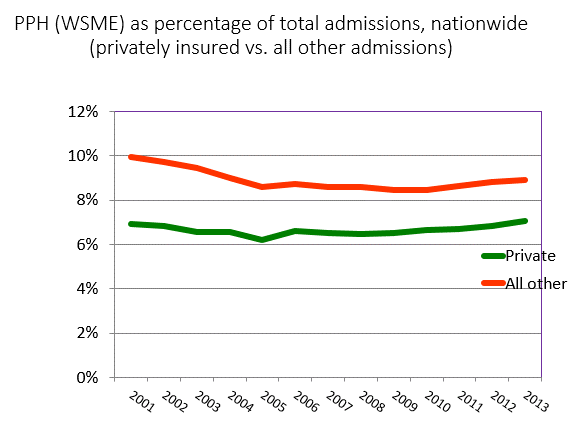
Adjusting for the benefit-of-the-doubt secular decline in WSMEs wipes out gross savings — even without counting all the following claims costs that HERO says should actually increase:

Or maybe those cost increases also only happen in this one rogue example in this one rogue chapter. And maybe this one rogue chapter (Chapter 1) just contains a terrible, horrible, no good, very bad example that somehow accidentally found its way into the HERO Guidelines Report even though none of the 60 subject matter experts believe it. Or maybe two years wasn’t enough time for these experts to review it, though my review required only five minutes. Perhaps that’s because when I read, I don’t move my lips.
So…
Per HERO’s and Ron’s request, I’ll replace their original estimate of $6 in annual losses PEPY with Ron’s new net loss estimate of $150 PEPY. And that’s without the multitudinous added costs that they also listed but never counted.
All in, my original estimate was off by almost two decimal points. However, I take responsibility only for the magnitude of the error, not for the delay in correcting it. If HERO had told me last year to substitute these real figures for their rogue example, I would have corrected the figures posthaste.
And my lips would have morphed into a great big smile.
Share this:

Johnson & Johnson Proposes a “Fat Tax” on Businesses
This J&J/Goetzel/Vitality proposal is a Fat Tax, pure and simple. If they are right about shareholders caring how many overweight people a company employs (and they aren’t), it is a tax on overweight employees, each one costing the company a slight amount of its market value. If they are wrong, this represents a pure transfer of wealth from corporate America and their employees to companies like Johnson & Johnson and Vitality.
Read the full posting here. Comment and share it.
By the way, these wellness people don’t understand math any more than they understand wellness. One of their premises for the Fat Tax is that over 14 years, companies with wellness programs outperformed the market. Besides failing to use sector indexes as benchmarks, they don’t understand the way compounding works. Suppose the average market performance is set to 0%. If all your stocks perform at a market level, your return will be 0%. However, if half of them increase 10% a year and the other half decrease 10% a year, you’ll be way ahead of the averages because each year the 10% increases are applied to an increasingly larger figure, and the 10% decreases are applied to an increasing smaller figure. And if you look at their portfolio, it’s disproportionately weighted to the healthcare sector, which boomed over the period, and the financial services sector, which dramatically contracted. Towards the end of the period, the performance of Citigroup etc. didn’t matter any more.
This is true even if you set the market performance to a figure other than 0%. It’s just clearer this way.
Share this:
Overweight? Johnson & Johnson’s Dream Is Your Worst Nightmare
Every time I think wellness promoters can’t possibly match their previous shock-and-awe levels of egregious statements and proposals, they come through with another one. This post is from the employee’s viewpoint. To see it from the employer’s viewpoint, view the posting on the Proposed Johnson & Johnson Fat Tax. That company wants corporate America to pay them to count the number of overweight employees a corporation has.
PS Obviously we don’t have any money to oppose this with, so please share it on social media.
Suppose there were: (1) a widely held but false perception that gays had lower productivity and higher healthcare costs than straights; (2) false literature that companies with gay conversion programs outperformed the stock market; and (3) a proposal that companies disclose to shareholders the percentage of gays they employ.
Obviously, many corporate CEOs would stop hiring gays, de facto require gay conversion among current employees, and fire gays who failed the program, in order to maximize stock price and hence their own net worth.
Preposterous? Of course, but if Johnson & Johnson (J&J), Vitality Group and a few pharmaceutical companies get their way, this exact same scenario will befall overweight employees. Indeed, two-thirds of this dystopian scenario is already in place:
- Despite proof to the contrary, the popular misperception is that working-age thin people have higher productivity and spend less on healthcare than working-age overweight people;
- To help bring weight discrimination into the boardroom, some wellness apologists — led by Ron Goetzel, of course — published a facile and misleading study in a third-tier journal (that had already admitted poor peer review practices) showing companies with wellness programs (the obesity equivalent of gay conversion in ineffectiveness, and almost as likely to harm participants) outperformed the stock market. The opposite is actually true, if one uses sector indexes as benchmarks. (This is the correct methodology with small numbers of companies concentrated in a few industries. And it’s the correct result given the fact that conventional “pry, poke and prod” wellness loses money, period.)
To complete this trifecta of weight discrimination, all that remains is to convince publicly traded corporations to disclose the weight of their employees…and that’s exactly what this cabal — led by J&J and Vitality — proposed at Davos. (They also want companies to disclose their stress levels. I have no idea how one measures stress. The one company that tried measuring stress, Keas, failed both miserably–and, this being the wellness industry, hilariously.)
Weight measures used by companies are also facile and misleading. Typically — as with Vitality Group, an outspoken advocate of this proposed regulation — they use the Body Mass Index, or BMI. The BMI was invented by a mathematician 200 years ago, using a simplistic formula that he could never really justify…and yet has been the de facto standard for measuring overweight ever since. It’s misleading along many dimensions. Further, it now turns out that the whole workplace BMI obsession might be pointless, as people with normal BMIs are at higher risk than people with high BMIs, if their weight is distributed badly. Most recently, it’s been shown to be just plain wrong, doing a horrible disservice to overweight people and, in some workplaces, costing them money,
While I can’t explain why PepsiCo would be signing on other than for corporate image reasons, the agendas of J&J and Vitality are quite clear: disclosing weight to shareholders would encourage publicly traded companies to use “pry, poke and prod” workplace wellness services, which they coincidentally happen to provide. (The drug companies involved, such as Novo Nordisk, stand to benefit from selling more drugs.)
Unintended Ironies: A Hallmark of Wellness
Ironically, though, during that same Davos meeting, Vitality also candidly admitted that their wellness services don’t work even in the best-case scenario of their own employees. That admission undermines the entire fiction that this scheme would somehow benefit the employees being fat-shamed.
Here is another irony. (One hallmark of the wellness industry is its obliviousness to its own many ironies.) This industry thrives on being totally unregulated — uniquely in healthcare, wellness companies and individuals face no licensing, education, training, oversight or certification requirements. Consequently they can and do get away with whatever they want. And yet now they want every other company to make more disclosures in regulated filings, for no purpose other than enhancing their own bottom lines.
Still another irony: The prime schemer behind this initiative, David Yach of Vitality, assured STATNews that existing laws would prevent employees from bring fired due to weight. But “existing laws” don’t prevent anything in wellness now. A federal court says it’s fine to deny insurance to employees for failing to participate in wellness. And despite flouting federal health guidelines with impunity, no wellness vendor has ever been prosecuted for doing things to employees that would get doctors sent to jail. And as Health Fitness Corporation learned, you can lie to states as much as you want about anything — including saving the lives of cancer victims who don’t have cancer — and not be prosecuted. Indeed, no wellness company or program has ever been successfully prosecuted or sued for anything under “existing laws.”
The Inevitable Result: Institutionalized Weight Discrimination
Many things in life have unforeseeable consequences. However, the consequence here is perfectly foreseeable: If you are overweight or especially if you are obese, you should be able to keep your current job if your company likes your work. But your chances of getting hired anew by a publicly traded company — if you are competing for the job with an almost-but-not-quite-equally qualified thin person — would nosedive.
I rarely editorialize in this blog, because I don’t have to — facts are the wellness industry’s worst nightmare. (See the Vitality example above. I don’t need to come out and say they’re clueless. I merely highlight the data they themselves helpfully provided to make that conclusion self-evident.) However, I’ll make an exception here: I find it appalling that J&J, Vitality, and Novo Nordisk advocate subjecting huge numbers of employees to institutionalized discrimination and to programs that they admit don’t work, simply to make a few bucks.
Share this:
And Another One Bites the Dust: Employee Benefit News Eviscerates McKesson’s Koop Award
Believe it or not, I do have a Day Job (www.quizzify.com), but it’s hard to focus on it when the Wellness Ignorati keep throwing me red meat. I would suspect a conspiracy to distract me masterminded by the Ignorati and my competitors, except that Quizzify doesn’t have competitors. No company except Quizzify seems to employ executives who know how to read. Otherwise, vendors would have read that insured Americans already consume far too much healthcare, so the solution should not be to force them to get even more of it, via bribes and fines.
Employee Benefit News just published a smackdown of McKesson’s 2015 Koop Award. It is based largely on our own smackdown of McKesson. The article itself predated our Unified Theory of Koop Award Cluelessness, which shows that McKesson has lots of company in fabricating outcomes — all Koop Award winners overstate savings by roughly the same mathematically and clinically impossible multiple. We call this multiple the “Goetzel Factor.”
McKesson made a big deal out of their principal investigator being a graduate student at the Harvard School of Public Health named Andrea Feigl. However, I don’t recall Ms. Feigl being in class the day I guest-lectured on wellness outcomes evaluation. Had she shown up that day, she might have avoided some of her rookie mistakes. (Bada-Bing!)
As is always the case with wellness evaluators, her defense merely confirms our findings. She is still claiming $13 million in savings, but says it’s based on a “cohort” of roughly a third (14,000) of McKesson’s 43,000 employees, whose risk collectively declined by 2%. We had observed that $13 million is about 7% of McKesson’s total spending on all 43,000 employees. Watch what happens if we accept her argument that we should only allocate the savings only to the third of McKesson’s employees who participated. In that case, instead of being 7% of total spending on the whole population, $13MM is 21% of the spending on that third. 21%! Not bad –wiping out a fifth of all McKesson’s spending by urging people to eat more broccoli. (There is no mention of their off-the-charts 27% tobacco use rate, which barely budged, and seems just slightly off-kilter for a company with an award-winning wellness program.)
This figure of course is a massive multiple of all spending on wellness-sensitive medical events (WSMEs). To achieve that savings, the program would have to wipe out WSMEs not only on all participants but also all non-participants — plus about 160,000 of their closest friends. Plausibility test, anyone?
To support that finding, she said:
“Health indicators in 2013 and 2014 were adjusted in the analysis, while several sensitivity analyses of the ‘inter-individual’ impact that used a matching approach confirmed the results.”
In other words: “I can’t explain it in English so you’ll have to take my word for it.”
She also said that I confused the narrative, that said McKesson employees lost weight, with the data, which said McKesson employees gained weight. Those would seem to be opposite results, which she calls “apples and oranges” because the narrative and the data are different. One is “descriptive” and the other is based on “repeated cross-sections.” So it’s OK for these results to completely contradict each other. Got it.
In any event, neither gaining a little weight nor losing a little weight generates a 21% cost savings, especially when tobacco use is basically unchanged (-1%).
The bottom line: there was no plausibility test, no attempt to reconcile the narrative findings with the data, no curiosity about how such a trivial risk reduction could generate such a substantial reduction in total costs, no understanding of participation bias, no understanding of population health, and no concern that neither tobacco use nor weight changes could possibly support the financial findings.
In other words, McKesson was a shoo-in for a Koop Award.
Update, January 9: Actually it’s even worse than I thought. Kudos to Robert Dawkins, for pointing out on Linkedin that I was crediting McKesson with a 1% decline in tobacco usage over this period…but if you look at the CDC data, it turns out that the rest of the country declined by a greater percentage over the same period. So McKesson quite literally achieved less than nothing both in weight and in tobacco.
Share this:
That Was the Year that Was: Our Top Contributions of 2015
Our year-end jubilee has so far featured lists of the worst vendors and the funniest vendors. To close out the year on a more serious note — if for no other reason than to show we are indeed capable of treating the extremely serious topic of wellness with the Extreme Seriosity it deserves — we’ll list the most influential posts of the year.
In terms of views, the top spot is shared by our two smackdowns of worthless employee weight control programs. Our peer-reviewed smackdown, in the American Journal of Managed Care, should end the year at #1 on their list too, of the most-viewed articles. I say “should” because a lot will depend on people clicking through on it today or tomorrow (hint) and at least pretending to be enthralled by it, even though it is a bit dry.
The Reader’s Digest version got picked up on Huffpost. Absent the constraints of peer review, we took the gloves off. Our reward is that we are the most-widely read Huffpost of the year on wellness.
If “most shocking” is the criterion, the winner is our recent evisceration of Aetna’s employee DNA collection program. This one is best viewed here, at Insurance Thought Leadership, but was also picked up by The Health Care Blog. You know the old Woody Allen joke about the two ladies in the Catskills? One of them says: “You know the food here is terrible.” The other replies: “Yeah, and the portions are so small.”
Collecting employee DNA is a shockingly stupid idea on many levels — the kind of program that someone would make up in order to make wellness look bad, but we didn’t have to. As if that weren’t enough, Aetna also decided to fabricate outcomes. And because the program was so expensive, to show a 2-to-1 ROI they had to concoct $1464/person in savings in the first year alone–on employees who, by Aetna’s own admission, weren’t even sick. One of the editorial board members of the journal that published it wrote that it should never have passed peer review.
The biggest category — and the one where it would be hardest to pick a winner from among the many worthy entries — would be: “Most likely to show Ron Goetzel making things up.”
You might vote for yesterday’s post on how Ron said wellness programs increased stock price valuations when in reality they reduce stock prices. (Ron also misused the word “valuation”. It is not a synonym for “stock price.” In all fairness, the only people who would be expected to know the distinction would be people who write articles about stock valuations that are actually intelligent and insightful.) However, he probably didn’t make up that conclusion. I reviewed 5 years and compared each company to its relevant sector index. By contrast, he reviewed a longer period and has probably never heard of a sector index. We reached opposite conclusions about the correlation of wellness programs and stock prices. The real answer, though, is that wellness programs have absolutely no meaningful effect on either stock prices or stock valuations. If they did, one securities analyst somewhere, writing a report on one company anywhere, would have noted it. Not to mention that a hedge fund would have made a business out of buying shares in companies with the best wellness programs.
Another candidate would be our expose of the HERO report, in which we observed that HERO and their cronies accidentally admitted — a la Robert Durst — that wellness loses money. Despite co-signing this document — a document that required “two years and countless hours” of collaboration, and in which the word “consensus” appears 39 times, Ron insisted during our debate that he had nothing to do with anything in this document that he himself didn’t write. (Of course, in the debate he also insisted that he had nothing to do with Penn State — meaning he just wandered into their press conference by mistake, or maybe I am confusing him with another Ron Z. Goetzel.)
Nonetheless our vote goes to the Unified Theory of the C. Everett Koop Award, in which we reverse-engineered the mathematically impossible formula (the “Goetzel Factor”) that Ron and his integrity-challenged cronies use to anoint award winners, whose programs are almost invariably hilarious and show a complete lack of understanding of the way healthcare and healthcare math work. To paraphrase the immortal words of the great philosopher Samuel Goldwyn, “If Dr. Koop were still alive, he’d be rolling in his grave.”
Share this:
Listen to Ron Goetzel’s Stock-Picking Advice…and then Do the Opposite
A good rule of thumb is that when Ron Goetzel publishes something, you should reach the opposite conclusion. TEASER: In this case, had you done the opposite 5 years ago of what he (retrospectively) recommends now, you’d be sitting on a pile of cash.

The only things made up in Quizzify are hilarious wrong answers.
Yesterday, the Journal of Occupational and Environmental Medicine, fresh off its Aetna wellness DNA collection debacle (which, in all fairness, one of their board members did candidly admit should never have passed peer review — see the comments), published Ron Goetzel’s article claiming that Koop Award-winning companies outperform the averages, thus showing that outstanding wellness programs “favorably affect a company’s stock valuation.”
Try telling that to Gary Loveman. He was the head of the Business Roundtable’s Health and Wellness Committee. As such, he was the biggest supporter of wellness among all corporate CEOs. He even leveraged the Business Roundtable’s formidable financial resources to convince a bunch of senators to take time off from their real jobs in order to host a fact-finding committee hearing with the title: “Employer Wellness Programs: Better Health Outcomes and Lower Costs.”
Ask Mr. Loveman how his company, Caesar’s Entertainment, is enjoying their bankruptcy proceedings. (He might not know because he is no longer allowed to run the company.)
But we digress…
Let’s look at what happens if you had invested in other companies with “outstanding” wellness programs five years ago. Below is the entirety of companies that have won Koop Awards since 2010 — all of which made up their outcomes, as we’ve noted — that are also publicly traded. (There might be 1 or 2 more. The Koop website is down this morning, so I am going off the list I have.) In each case we tracked 5 years of stock prices ending yesterday, and compared to industry indexes. We’ve linked to the indexes.
2010 — Pfizer.
Pfizer stock has risen about 85% — but simply investing in a drug company index would have made you a 156% return.
Highlight of their wellness program: participating employees lost 3 ounces over a year while non-participants gained 2 ounces. Or maybe it was the other way around.
2011 — Eastman Chemical
Eastman Chemical has outperformed the chemical industry index by 33% over this period.
Highlight of their wellness program: Ron Goetzel doctored the original application recently and then covered it up, because this was the company that “showed savings” 2 years before the program even started. Removing the embarrassingly accurate x-axis labels of the original while claiming “the original is still online and available for review” would have been a very effective cover-up had we not kept a screenshot of the original original.
2013 — Dell (the 2012 winners are not publicly traded)
Dell underperformed the tech stock index by 31% before it stopped trading in October of 2013. (We don’t comment on their wellness program so as not to embarrass them, so there aren’t highlights.)
2014 — British Petroleum
Long after underperforming due to the oil spill before this most recent 5-year period, they continued to underperform the oil stock index by 13%.
Highlight of their wellness program: Mercer “validating” outcomes that were not only mathematically impossible, but were also 100 times greater than what the vendor itself, Staywell, had said was possible. Staywell never explained this discrepancy, shockingly.
2015 — McKesson
There is no good drug distribution stock price index, but McKesson did outperform the drug stock price index by 12%. The closest thing to an “index” might be its close competitor, Cardinal Health. McKesson outperformed them over the 5-year period, but over the most recent 3-year period, Cardinal did somewhat better.
Highlight of their program: They boast one of the highest tobacco use rates in the country, but that didn’t stop them from winning an award because employees who attended a bevy of Weight Watchers meetings lost a few ounces.
Put it all together, and you would have been much better off shorting these companies and hedging with the industry index than actually buying stock in them. As noted at the beginning of this article, had you done this hedge, you’d be sitting on a pile of money right now. As they say in the stock market, the only person as valuable as the person who is always right is the person who is always wrong. Perhaps Mr. Goetzel has a future in securities analysis.

 They Said What?