They Said What?

Home » Posts tagged 'Wellsteps' (Page 5)

Tag Archives: Wellsteps

The back story of the scathing STATNews smackdown of Wellsteps and Goetzel

This posting is for folks who found us via award-winning journalist Sharon Begley’s “Wellness Award Goes to Workplace Where Many Health Measures Got Worse.”  (Note that no one has ever challenged any of her two dozen awards.)

In the event that you are new to the Wellsteps./Boise School District debacle, here is the back story, very quickly.

  1. Wellsteps lied about savings.
  2. I predicted the combination of lying, incompetence and cronyism would win them a Koop Award.
  3. Wellsteps said: It’s fun to get fat. It’s fun to be lazy.
  4. Wellsteps showed a complete failure to understand wellness.

And so, inevitably…

Wellsteps won a Koop Award. Ron Goetzel and Seth Serxner have never let their friends down in the past, so why should integrity, competence and facts stand in the way this time?


Are you smarter than a Koop Award Committee member? Take this quiz to find out

Last week we asked if you were smarter than a wellness vendor. (SPOILER ALERT:  you are — assuming you can read this posting without moving your lips.)  I suggested taking the Interactive Health IQ test, just to be sure.

Now, see if you are smarter than a Koop Committee member. They all reviewed this Wellsteps application and decided it was award-worthy.*

Do you agree that this application is award-worthy? If not, see how many self-invalidators you can find. I don’t mean “challenges” to the data. I mean self-immolations. Remember the mantra: “In wellness you don’t have to challenge the data to invalidate it. You merely have to read the data. It will invalidate itself.”

After you’ve finished, review the answers to see what you got right and what you missed.  You may have read it before since it’s been getting lots of views for six weeks, but I’ve added several observations since the original posting.

You may even find things I missed, so let me know. The reason is that — aside from possibly the first Sunday in November — there aren’t enough hours in a day to identify everything that Koop Committee members “overlook” in their friends’ applications.

If this type of analysis interests you, I might recommend applying for Critical Outcomes Report Analysis certification. This program is run by the Validation Institute, the gold standard in all things analytical regarding population health and employee health. (Disclosure: while I am not an employee, they occasionally subcontract to me.)

There is nothing highly technical in the answer posting. In order to make it possible for a Koop Committee member to understand and hence decide to rescind the award, I used only fifth-grade math, simple declarative sentences, short words, and lots of pictures.


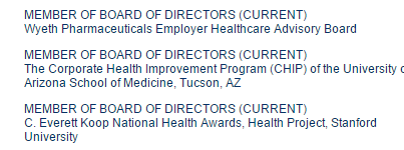
*Speaking of disclosures that don’t appear in the award application, the Wellsteps CEO also served on the awards committee itself until very recently. Indeed, until so very recently that he still says he is on it.

aldana-resume

The latest on Nebraska: Ron Goetzel covers up his cover up.

To our new readers, while 2016 marked the first instance in which a Koop Award was ever bestowed upon a company that harmed employees, 2016 wasn’t the first Koop Award ever to go to a company whose own data showed they fabricated results. Below is a history of one of the Koop Award’s Greatest Hits.


For those of you who haven’t been following the saga of the Nebraska state employee wellness program, here is a crash course, aka “Lies, Damn Lies, and the Nebraska State Wellness Program.”  If you have been following it, you can skip to the end for the latest installment, Mr. Goetzel’s cover-up of his cover-up.

By way of background, this program is called “wellnessoptions” (imagine e.e. cummings-meets-poking employees with needles-meets-a sticky spacebar).   They used to say the Holy Roman Empire was neither Holy nor Roman nor an Empire.  Likewise, wellnessoptions is neither optional, if you want a decent deal on healthcare, nor wellness. Instead of wellness, it features a hyperdiagnostic anti-employee jihad in which Health Fitness Corporation (HFC) diagnoses employees but does nothing about the diagnosis except take credit for it.

TIMELINE — PART ONE: HFC’S TROUSERS COMBUSTED

September 24, 2012, 2:00 PM

I read Health Fitness Corporation announcement that its customer, the state of Nebraska, won Ron Goetzel’s C. Everett Koop Award for program excellence.

September 24, 2012, 2:01 PM

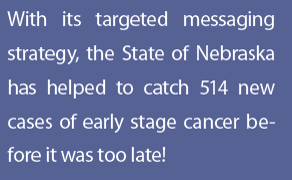
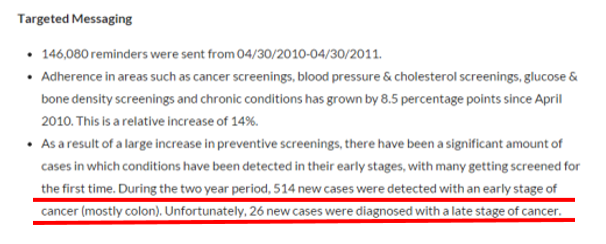
I recognize that the cancer outcomes were obviously made up.  Until then, I hadn’t been following the Koop award closely enough to realize that making up outcomes was apparently one of the award criteria, as I later came to learn.

October 2012

I read the full write-up on the program and realize that not only were most of the other outcomes made up, but they had actually lied about saving the lives of cancer victims.  If you screen a few thousand people for colon cancer, you don’t find 514 cases of cancer, and you certainly don’t save their lives, as HFC was claiming.  And you absolutely don’t save money, as they were also claiming.  All this is even more true when you waive age-related guidelines and let anyone get screened, and encourage overscreening by sending out 140,000 letters to state employees graced with the picture of a beautiful young model way too young to be getting a colonoscopy.

age related colon cancer screenings

How this invalid nonsense ever got by all the eagle-eyed Koop Committee members would be a mystery, except that HFC is a sponsor of the Koop Committee.

December 2012

I review the entire application and all the marketing materials.  It becomes obvious that the entire thing was made up, not just the cancer part. They claimed to save $4.2 million because 161 of their roughly 6000 participants reduced a risk factor.

The math is quite self-evident.  Suppose you doubled the number of participants who reduced risks to 312.  It stands to reason that you could save $8.4-million. Double it again to 624 and you save $16.8.

Now double it one more time. If 1,248 people out of those 6000 reduced one single risk factor, you’d save $31.6-million, which is about equal to the entire spending for all 6000 participants.  And of course most medical spending has nothing to do with identifying previously unrecognized risk factors, so this would be quite a feat. (Do you even know anyone under 65 who had a heart attack that could have been avoided by one more workplace screening?)

I later learn that all the Koop Award-winning program outcomes are made up, using exactly the same math.

November 2012 to June 2013

I try to contact the authorities, like Roger Wilson, who allegedly runs this program for the state, but no one seems to care. The rule of thumb in the wellness industry is that what you say counts.  What you do is pretty irrelevant.

June 20, 2013

Breakthrough: The Wall Street Journal editors decide that I am correct, and that the outcomes were made up.  Vik and I are allowed to publish this on their op-ed page.

July 14, 2013

Breakthrough again: Another very well-read blogger professes shock-and-awe that any vendor could lie so blatantly and apparently get away with it.

July 15, 2013

Breakthrough yet again: Ace reporter Martha Stoddard of the Omaha World Herald gets Dennis Richling of Health Fitness Corporation to admit that the outcomes — at least the “life-saving catches” of “early stage cancer” outcomes — were indeed made up.  Richling tries to spin his gaffe by calling the difference between “life-saving catches of early-stage cancer” and saying someone might possibly get cancer in the future “semantics.”   So, according to Richling, having cancer and not having cancer are the same thing.

February 1, 2014

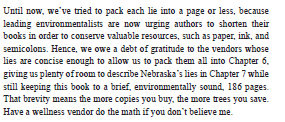
The hilarious wellness industry smackdown Surviving Workplace Wellness is published.  Since the HFC Nebraska program had too many lies to fit on a page or two, it gets its own chapter.  Here’s the opening paragraph, which in all modesty I must admit is one of my favorite in the book.
sww nebraska chapter

February 23, 2014

Nebraska political blogger ReadMoreJoe picks up the scent.  He points out that this wellness program is an obvious fraud.  The problem is that the same posting is also exposing several other equally obvious frauds, so this one gets overlooked.

TIMELINE–PART TWO: GOETZEL STRIKES BACK

Ron Goetzel isn’t about to sit back and let his friends/sponsors/clients be pilloried for a little white lie about saving the lives of cancer victims who didn’t have cancer.

June 2, 2014

At the Health Datapalooza conference, Ron Goetzel, while admitting the Nebraska cancer outcomes data was made up, claims they/HFC still deserve the Koop Award because he somehow didn’t realize the data was made up at the time the award was granted.  And it is true that HFC didn’t actually announce they had made up the outcomes.  Ron would have had to actually read the materials to figure it out, same as I did.

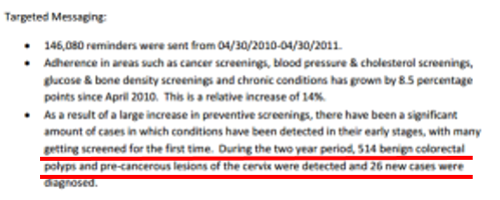
nebraska life saving catches

nebraska cancer cases

September 2014

Ron Goetzel calls the Nebraska program a “best practice” in the Journal of Occupational and Environmental Medicine but refuses to answer any questions about the obvious mistakes and inconsistencies in the article.

list of best practices

November 2014

After knowing for 16 months that they had lied, Ron Goetzel, writing in Employee Benefit Newsfinally drops Nebraska from his list of best-practice programs:

goetzel ebv 1

Being a fair-minded person, I take it upon myself to congratulate him on his newfound sense of ethics.  I don’t specifically agree that what he did was ethical, because the ethical thing would have been to admit complicity, apologize, and revoke their Koop Award.  But I do say that Nebraska being dropped from the list of best practices means ethical “progress is definitely being made,” albeit from a low base.

goetzel ebv 2

Only 29 minutes elapses before Ron erases all my illusions about his honesty and re-adds Nebraska to the list of “best practice organizations.”

goetzel ebv 3

He also adds PepsiCo to the list.  I guess losing only $2 for every $1 you spend qualifies as such in wellness, where most organizations lose much more.

May 2015

In a rally-the-base invitation-only webinar, we are told that Ron has promoted the Nebraska program from “best practice” to “exemplar.”  It seems like the more obvious it becomes that the whole thing was fabricated, the more Mr. Goetzel worships its outcomes.

TIMELINE–PART THREE: RON STANDS ALONE

September 2015

WELCOA finally takes the fabricated case study of Nebraska’s outcomes off their website, 26 months after the fraud was admitted. Perhaps some pressure is being put on them to come clean, given that this is Nebraska’s program and they themselves are based in Omaha.

Just for the record, I’m not saying that an organization founded by all-you-can-eat cafeteria magnate “Warren Buffet” knowingly kept a false document on their site for those 26 months. History suggests they might just be slow learners.  [2016 update: WELCOA is under new management, and they appear to be doing a great job, as exemplified by their development of the Employee Health Program Code of Conduct.]

This means Ron Goetzel is literally the only person left who thinks it’s perfectly OK — indeed, a “best practice/exemplar” — to lie about saving the lives of cancer victims.  Good luck with that in the upcoming debate.  It’s him against the world.

Or, as he sees it, everybody’s out of step but Ronnie.

October 2015

Nebraska tentatively re-awards the wellness contract to Health Fitness Corporation.  I am looking over the precipice towards utter humiliation.

TIMELINE–PART FOUR: THE ORIGINAL DATA DISAPPEARS

November 2, 2015–the original cover-up, on the morning of the Great Debate, in which Mr. Goetzel told 14 lies in 90 minutes, which is a lot even for him

At our urging, a third party alerted Mr. Goetzel to the fact that, his protestations to the contrary, the Koop Award Committee did know (even if they had somehow not seen the marketing materials quoted above) that Health Fitness Corporation was making fictitious claims about saving the lives of cancer victims.  It was right in the award application.  The original award application from Nebraska had originally stated (underlining is ours):
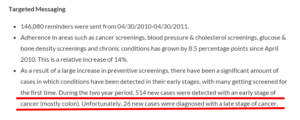
nebraska cancer original redlined

But then, a hour following the call from this third party the morning of the debate, the original award application suddenly read:
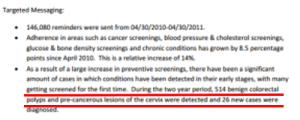
nebraska doctored application

In the original application, this excerpt appears in a letter from the Governor of Nebraska. Only now the Governor’s letter says the opposite what he actually wrote.  In the real world, this would be considered forgery.  In wellness, a forged cover-up of a blatant and admitted lie about saving the lives of cancer victims who didn’t have cancer is considered business as usual. Johns Hopkins and Truven (Ron’s employers) don’t seem to mind either.

April 2016

The state is rescinding its award to Health Fitness and terminating its wellness program. In the immortal words of the great philosopher Stewey Griffin, victory is mine.


September 2016: The cover-up of the cover-up

Mr. Goetzel finally acknowledges that Health Fitness Corporation told a whopper, and the Koop Committee overlooked it, allegedly by accident, for the four years during which I’ve repeatedly pointed it out.

He now calls this an “erratum.”  However, the word “erratum” is usually used to correct honest mistakes (in sharp contrast to this one),  usually within hours or days of their discovery (in sharp contrast to this one).   You can’t forge official state documents and then call the whole thing an “erratum.”  Is a robber allowed to give the money back after he gets caught and just uncommit the crime?
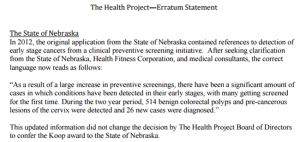
nebraska-erratum

So now, having admitted that the award-winning vendor told the biggest lie in wellness history (against stiff competition), and knowing that all Nebraska’s obviously fabricated savings were mathematically impossible, and that waiving age restrictions for screening is akin to waiving age restrictions for buying beer, the Koop Committee finally, after four years, rescinded the Nebraska award.

Haha. No one falls for that line any more.  Quite the opposite, they are doubling down. They say that whopping lies like this one don’t disqualify you, assuming you are an award sponsor. You get to keep your award.

Ditto, if your entire claim of “separation” between participants and non-participants is shown to be false but you are sponsor, Ron merely doctors the data and you get to keep your award.

Also, if it turns out you lied about your savings because there was no change in the biometrics to attribute the savings to, but Ron was a consultant on your project, you get to keep your award.

Likewise and as was confirmed in 2016, if you are a committee member, as Wellsteps’ CEO was until recently, despite your own data showing that you actually harmed employees, you get to keep your award.

Bottom line: as a friend-of-Ron, you might get to keep your award even if you shoot someone on Fifth Avenue.

Test your knowledge of artificial sweeteners and maybe earn real money

Try our sample Artificial Sweeteners quiz to see how much you already know – and/or learn some rather scary things that you really should know. Four $25 gift cards will be awarded via drawing from the 10 highest scorers who are also advisors or self-insured employers or transparent PBMs.

Further, we’ll reveal the best way to avoid their hazards while still using them, since sometimes we just gotta have something sweet. Water or flavored water just won’t do the trick.

This month’s contest closes August 29th. The ten high-scorers will be announced August 30th. Based on the formula we use (matching the winners to the last 4 digits the August 31st stock market close), four winners will be randomly selected from the ten high-scorers and announced September 3rd.


Oh yeah, and if you want to see how to prevent initial uptake of weight loss drugs specifically amongst employees who are likely to drop out after a few months, join our September 5th webinar for The Big Reveal.

Wellsteps Apologizes, Returns Koop Award, and Endorses Code of Conduct

Wellsteps has profusely apologized for harming Boise’s employees, according to objective and subjective health indicators, for overscreening the employees, for demonizing even the slightest consumption of alcohol, for suppressing their earlier acknowledgement that costs increased, and for mis-attributing the allegedly massive savings figures.

Not!

They’ve recognized that these smoking guns exist, of course — that much we’ve learned from other sources.  But obviously they haven’t apologized.  In case you haven’t noticed, these days refusing to apologizing is a thing. Indeed it’s more than a thing. It’s a Major Lifestyle Trend, potentially even bigger than quinoa, bidet toilets, and the Kardashians combined.

They (Wellsteps, not the Kardashians) aren’t going to give up their Koop Award voluntarily.  To paraphrase the immortal words of the great philosopher S.I. Hayakawa, they stole it fair and square. (Helps that Wellsteps’ CEO is on the award committee, of course, though you wouldn’t guess it from their announcement.)

And they (Wellsteps again, but probably also the Kardashians) certainly aren’t going to endorse the Code of Conduct.  They can’t, because they and their whole Koop Award cabal would be in immediate violation of its call for no harms to employees and no lying about outcomes.


However, the Code of Conduct is getting great reviews everywhere else, which is actually what this column is all about.

First, honest, well-intentioned, and competent vendors, brokers and consultants — none of which are connected with the Koop Committee or the Health Enhancement Research Organization — have shown their support in large numbers. The Code has garnered tons of “likes” and very supportive comments.  If you see your consultant or vendor on this list of “likers” and commenters, give them the kudos they deserve. And add your own too.

Quizzify

Second, Quizzify on Friday became the first vendor to endorse the Code, and will be incorporating it in every contract going forward.  Read the Quizzify statement, and urge other vendors to follow suit. Embracing the code should be easy for others like it was for Quizzify. Any honest, competent vendor should find the principles self-evident.

ConscienHealth

Third is a pleasant surprise twist, the one referred to in the Linkedin “tease” for this column.  On Sunday, I was delighted to see http://www.ConscienHealth.org pick it up.  By way of background, ConscienHealth is an advocacy group for the evidence-based treatment and prevention of obesity. In their own words:

We develop strategies that are based on sound science [and] public policy, and a deep understanding of consumer needs.”

Here is a summary of what they said, but we’d urge you to read the whole shebang, because they stated it better than we did. Alone among websites with an interest in wellness, ConscienHealth speaks specifically for the overweight employees who are victimized by crash-dieting schemes and other corporate fat-shaming activities:

We now have enough regulations on the subject of employer wellness programs to make your head spin…but the most encouraging development is a code of conduct based on a simple premise: act purely to improve health and do no harm.

The folks who developed this code – Ryan Picarella, Al Lewis, Rosie Ward, and Jon Robison – applied deep knowledge of the good and the harm that employer wellness programs can do. While others fight over the fine points, this code brings us back to the big picture with a few key principles:

  1. Wellness programs should work for the benefit of employees.
  2. Programs should not single out, fine, or embarrass employees for their health status.
  3. Employers should respect and protect employee privacy.
  4. Employers should measure and report program outcomes honestly.

If those considerations seem obvious, it’s because they are. And yet we have examples of “wellness” that have disrespected, humiliated, and financially exploited employees. Sometimes it’s been done out of ignorance. Sometimes it’s a subterfuge for cost shifting to people with chronic diseases – health problems that nobody wants to have.

We here at They Said What would urge Wellsteps and other “pry, poke and prod” vendors to develop programs that satisfy those same four criteria. Unfortunately, they aren’t quite there yet. Indeed a beam of light leaving criteria #1, and #4 wouldn’t reach them for several seconds.


Disclosure: Al Lewis, who co-maintains this site, is also a principal in Quizzify, which endorsed the Code.  Attention to Wellsteps: See how conflict-of-interest disclosures work?  It’s not that hard. Next time you win a Koop Award — and based on the number of consultants and vendors on the award committee (plus sponsors) who need to be win one too, it should be your turn again in about 6 years — try disclosing your presence on the award committee in your breathless announcement of how brilliant you are.

Or, as Mark Twain said: “Always tell the truth. This will delight some people and astonish others.” We will be both, if it ever happens.

Wellsteps Raises the Koop Award Standard for Outcomes Invalidity to a New Low

Wellsteps claims to have dramatically reduced the total cost of the Boise School District’s health spending. Their Koop Committee colleagues gave them an award for it, as they typically do for their fellow board members and sponsors.  (Yes, Wellsteps’ CEO, Steve Aldana is on the committee that grants the award, but, in accordance with Koop Committee tradition and Wellsteps ethical standards, there is no mention of this possible conflict of interest in the announcement from Wellsteps. This is not a violation of the Wellness Industry Code of Ethics, because there is none.)

Unfortunately for Wellsteps, three completely distinct observations from Wellsteps’ own data invalidate their analysis separately. In combination, these observations create a level of impossibility demonstrating that whoever invented the English language was unfamiliar with the wellness industry, or they would have come up with a word meaning: “Impossible doesn’t begin to describe it.”


First, as we saw in the last posting, employee health deteriorated over the course of the program, measured both subjectively and objectively.

There is a concept, covered in Health Services Research 101, called “causation.” Wellness vendors love taking credit for everything that happens during their program. Hence we can conclude that Wellsteps’ program caused employee health to decline.

Therefore, no reduction in costs due to a healthier employee population can be attributed to Wellsteps’ program.


Second, also covered in Health Services Research 101, is the concept of “fifth-grade arithmetic.” Potentially Preventable Hospitalizations (PPH), as described in the official Health Enhancement Research Organization (HERO) outcomes measurement guidelines (a report on which Wellsteps’ CEO claims to have collaborated), account for a very small percentage of all spending. Specifically, as described in the HERO report  and reproduced below, these events account for 2.62 hospitalizations per 1000.  Boise’s 3284 employees would therefore suffer about 9 PPH’s. If each PPH cost Boise the HERO-assumed cost/admission of $22,500, that’s about $202,000. Not enough to cover even the out-of-pocket fees for the Wellsteps program, assuming the Wellsteps did a perfect job. And as we’ve learned in the past, a beam of light leaving “perfect” wouldn’t reach Wellsteps for several seconds.

Still, we’ll never know because despite their endorsement of the HERO report, Wellsteps decided not to disclose the rates of Boise’s PPH’s, likely to obscure the fact that they didn’t reduce it.

hero total page 23 with red bar

And as the HERO guidebook says, any reduction in PPH’s is offset by more spending elsewhere. In Wellsteps’ case, “more spending elsewhere” is annual biometric screenings.  Curiously, Wellsteps admitted annual screenings are a stupid idea four whole days before they announced their Koop Award for doing exactly the opposite.

July 11 blog

wellsteps july 11 blog

July 15 announcement:

wellsteps july 20 blog biometrics

Yet Wellsteps reported annual savings ultimately exceeding $5-million, or about a third of Boise’s total spending.  This would be equivalent to wiping out every hospitalization unconnected with childbirth plus every ER visit.  Adding yet another layer of impossibility to this narrative, at the end of this, we show the rank order of the top 25 reasons people visited the ER or went to the hospital, which basically have nothing to do with corporate wellness programs. Hence the cost of these visits and admissions couldn’t be dented, let along wiped out, by massive overscreening or even by appropriate screening.

Compounding this impossible outcome (and wellness is one of the few industries in which there are degrees of impossibility, since a typical wellness vendor makes at least a dozen impossible claims before breakfast) is the surprising health of the Boise population to begin with. People rated their health as 7.98 out of 10, and only 2.5% reporting smoking (vs. 20% for Idaho as a whole) and only 20% reported drinking (vs. 70% for the US as a whole). These ridiculously low levels did not strike Wellsteps as suspicious, so we will assume they are accurate.

Further, most Boise employees had fairly normal blood pressure, glucose and cholesterol — at least before they got sucked into the program.

So, with impossibly smoking and drinking, excellent reported health status, and largely normal biometrics, how is there room to improve health enough to save money, especially when health status is declining and the population is being overdiagnosed?


Speaking of misunderstanding the concept of arithmetic, third and most important is the data Wellsteps suppressed between their initial report and their Koop Award application. Normally Koop Award Committee Chairman Ron Goetzel suppresses the invalidating data after the award is announced, as with Health Fitness Corp/Eastman Chemical, and then the state of Nebraska (technically actually incriminating, not just invalidating). That’s because in the past I haven’t predicted who would win the award. Rather I just pointed out all the obviously incorrect data after the fact. By predicting Wellsteps would win a Koop Award and pointing out exactly why their data was sufficiently fictitious to merit it, I gave Wellsteps itself the opportunity to suppress their own data, so Ron wouldn’t have to do it for them.

Contrast below the trend they reported for total spending for Boise against the claims cost per person for Boise. The former goes up. The latter goes down even though the number of employees stays the same.  Obviously, this is an impossible coexistence, as mentioned both in the first installment of this series and in every elementary school in the world. This time, we are going to transpose the bar graph, which separated participants from non-participants, onto the line graph, which included both cohorts, for the baseline and the first two years of the program. The assumption, as Wellsteps states, is that their participation rate is 80%, largely because of the massive $870/year incentive, which in classic wellness fashion is not included in the savings calculation. The number of employees seems to bounce around a bit between reports, but we’ll go with 3284 for this valuation.

By way of review from the first installment, here is total spending:

wellsteps overall trend

Also by way of review, here it total spending, participants vs. non-participants, going exactly the other way:

wellsteps cost per person

Now let’s overlay the second set of figures onto the first. In addition to trending in opposite directions during the wellness program years, the total spending on these dueling slides doesn’t even coincide in the baseline year.  Since the whole point of the exercise is to look at the trend subsequent to the baseline, we will add about $3-million to each year for the bar graph figures, so that the 2011 starting points coincide. That let’s us focus on the difference-of-differences in the program years. Starting at the baseline, costs increased about $1.7-million by 2013, putting the 2013 red endpoint almost exactly in line with their prediction.

wellsteps overlaid slides

In all fairness, let’s continue the analysis, by looking at the Wellsteps performance in 2014:

wellsteps overlaid through 2014

As you can see, costs did fall below the “prediction” in 2014, though still way above “Wellsteps Begins” and “Actual.”  The only problem?  More than 100% of the entire decline from the previous year was due to non-participants’ costs plummeting, while participant costs increased.

wellsteps 4 year view

So where do we stand? Wellsteps, by their own admission, overscreened and overdiagnosed this population. And their own admission, the population was quite healthy to begin with. By their own admission, the health of the Boise employees deteriorated. And, by their own admission, the only successful annual performance is attributable to a large improvement in non-participants.

To paraphrase the immortal words of the great philosopher Samuel Goldwyn, the title of this post, Wellsteps has raised the Koop Award standard for outcomes invalidity to a new low.


Top hospital discharge codes:


hcup rank order top 25 costs

Top ER visit codes:

er visits using ccs


Wellsteps: 20% of Boise’s teachers drink too much

Yikes! Wellsteps just announced–and the Koop Award Committee just agreed–that 20% of Boise’s teachers have a drinking problem.  Boise parents, before you start worrying, the good news is that it may not specifically be the teachers with the drinking problems. It’s technically 20% of all school employees, so you can relax. Maybe the problem is more prevalent in non-teaching employees, such as, oh, I don’t know, school bus drivers.

Is Wellsteps right or wrong about the drinking problem in Boise? Read on and then you can decide for yourself. Having read their alcohol analysis ourselves, we’re doubling down on our original conclusion that Wellsteps deserves a Koop Award like Vladimir Putin deserves a Nobel Peace Prize. Wellsteps is way off base, meaning Boise’s schoolchildren are safe.

Our original conclusion was reached simply by looking at the “smoking gun” slide in our previous posting, which they had tried to suppress (but we took a screenshot).  We’ll expand on that slide another day. For now, just ignore that particular smoking gun and instead consider the rest of the smoking arsenal they just wrote up in their self-congratulatory press release.

Speaking of smoking, today in addition to reviewing the Wellsteps analysis of Boise’s drinking, we’ll also include their smoking write-up.


Alcohol Consumption in the Boise School District

There was a saying in the old Soviet Union: “We pretend to work. They pretend to pay us.” For employees completing the Wellsteps’ Health Risk Assessment (HRA), the corollary would be: “We pretend to tell the truth. They pretend to believe us.”  Of 3284 employees, 671 admitted to drinking.  That means 80% of the Boise School District employees are teetotalers, as compared to 30% of the country as a whole. Or else — a shocker — 50% of the HRA respondents are lying.

The Koop Committee did not question this result.

But wait. There’s more.

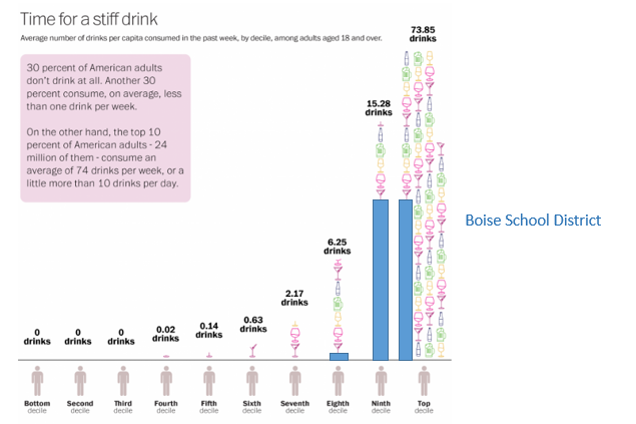
Now let’s consider the 20% of respondents who admitted to drinking at all. How much do they claim to drink? A paltry 1.31 drinks a day, or about 10 ounces of alcohol a week.  By contrast, the top 20% of drinkers in the US not employed by the Boise School District (“Boise”) consume roughly 43 ounces of alcohol a week.  Let’s overlay the Boise School District consumption (in blue) against US consumption, on the following chart. It shows 10 ounces for Boise vs. 15 ounces for the second-to-top decile for the US as a whole, and vs. a whopping 73 ounces for the top decile.

boise alcohol consumption

The Koop Committee did not question this result.

But wait.  There’s even more.

How much do you have to drink in order for Wellsteps to accuse you of having a drinking problem? Answer: any amount. According to Wellsteps, drinking alcohol at all counts as a “worst health behavior.”  Shame on us for not realizing the evils of a glass of wine!

This screenshot from their writeup captures both the average respondent’s self-reported consumption of alcohol, at the very top, with the “worst health behaviors” in alcohol consumption at the very bottom. Note that the two rows of figures are identical. In other words, everyone who drinks has a “high level of…alcohol use” no matter how much they drink. The average consumption (meaning at least half are even lower) to count as a “worst behavior” and “high level of alcohol use” is the aforementioned 10 ounces a week.

wellsteps problem drinking

The Koop Committee did not question this result.


Smoking

Squirrelly HRA findings aren’t confined to drinkers. Of the 3284 school district employees, apparently only 77 smoke (see chart above), placing the Boise School District’s alleged smoking rate at roughly 2.5%, or about 80% lower than the national or Idaho average. And those 2.5% are very light smokers. Whereas the average Idaho smoker burns through 16 cigarettes a day, Boise School District smokers abstain from smoking 10 days a month. So just like alcohol, hardly anyone smokes…and even the smoking employees hardly smoke.

With this amazingly healthy population, it’s a wonder Wellsteps could make any improvements at all. But as we will see later this week, they made enough improvements to save massive sums of money, defying all odds and all rules of arithmetic, which are strictly enforced.

The Koop Committee did not question this result.

We called it! We predicted the combination of invalidity and cronyism would win Wellsteps a Koop Award!

We cannot, cannot make this stuff up.

Wellsteps, which could take lessons in integrity from the presidential candidates, was obviously fabricating the outcomes for its Boise School District. How do we know this? Simple. Costs can’t rise and fall at the same time, even using wellness industry math. And yet Wellsteps claimed they did.

As soon as we saw how obviously, hilariously invalid their result was, we predicted that Wellsteps would win a Koop Award for the Boise School District.  We based this prediction on the combination of data fabrication, cronyism, nonsense, and cluelessness which are the DNA of both that award and of Wellsteps’ phony outcomes. Our only mistake was thinking they would win in 2015, but you’ll see at the end, we said that if they didn’t win in 2015, it was because they were late, and would win in 2016, which is what they just did.

Note when you compare Wellsteps Stumbles Onward: Costs Rise and Fall at the Same Time to their current press release, you’ll see there is something missing from the latter.  They removed the “smoking gun,” which invalidates the entire program.  In both documents, they said costs absolutely declined across the whole population, including non-participants…

wellsteps overall trend

…but on a per capita basis the costs of both participants and non-participants increased, at least in their initial writeup. This slide below has now been conveniently disappeared from their press release. I suspect this is not an accident. Here it is:

wellsteps cost per person

Participants’ cost rose just a little while non-participants’ cost rose a lot.  This separation is due to the proven fallacy of the participants-vs-non-participants methodology.  Even so, the line graph says the whole enchilada at Boise declined, not just the participants.

The only way per capita costs could increase AND total costs decline is if the program is so bad that employees prefer to join their spouse’s health plan, or if the number of employees declines.  But even the most dishonest wellness vendor wouldn’t credit either of those changes to their wellness program, and no member of the Koop Award Committee could “overlook” that impossibility.

Or would they?


Be sure to read the second installment, where we dive even deeper into the Wellsteps doodoo.


Wellness Industry Leaders Help the CDC Build a Maginot Line Against Disease

If you listen to the Centers for Disease Control and Prevention (CDC), you would think chronic disease is the main health problem we face, and workplace wellness is the main weapon we have to face it with.  I know what you’re thinking (at least for the former): isn’t it?

Nope.  The country’s main health problem — at least among those addressable by the CDC as opposed to by Congress — is something else altogether, essentially the opposite of what the Wellness Ignorati say it is. But before we reveal the answer, let’s review the CDC’s chronic disease talking points, which naturally are hilarious, as most talking points in support of wellness tend to be.

First, in the screenshot below, they quote the “arresting” statistic that “7 out of 10 deaths are due to chronic disease.” Um, that is called civilization, folks. Countries where 7 out of 10 deaths are due to causes other than chronic disease would love to have this arresting statistic. In case anyone doesn’t believe that the CDC — or indeed, that any human being other than a wellness vendor — could possibly be so stupid as to think civilization is a problem that needs solving, here is the screenshot, and here is the link.

cdc statistic

Second, they recently bumped the “75% of costs are due to chronic disease” urban legend in the first line of the screenshot to a mind-boggling 86%.  Surely even the dumbest CDC employee can’t believe this. Surely they can back-of-the-envelope an estimate that birth events, preventive care, and trauma alone account for much more than 14% of spending. Birth events by themselves account for about 16% of all hospital discharges.

Meanwhile, wellness vendors are now flogging those “7 of 10 deaths” and “86% of the nation’s healthcare cost” statistics to lobby Congress for wellness subsidies. Congress had wisely stopped funding one of the CDC’s many wellness boondoggles (Work@Health). That didn’t sit well with the industry, so they are starting a lobbying campaign. Fortunately, if their lobbying prowess is anything like their wellness prowess, the budget deficit is not likely to increase anytime soon. The letter reads:

wellness lobbying letter


Here is the real problem

This would all be very amusing, as the CDC and wellness vendors converge on these two statistics like monarch butterflies of innumeracy, except that our health is stake. And that (finally) brings me to the title of this posting.

The Maginot Line, as you might recall, proved about as worthless combating the Nazis as the CDC’s wellness obsession is today in combating the real healthcare problem: a massive explosion in blood-borne infections, or septicemia. While the CDC, wellness vendors, and of course the Health Enhancement Research Organization are all atwitter about diabetes and heart attacks (which none of these people can prevent and whose admissions in combination have been in check in all subpopulations for many years), consider ICD-9 038.9, Septicemia. There were 928,000 inpatient cases in 2013, the last year available.

hcup septicemia underlined

It’s not just that it’s huge, almost twice as costly as the next most costly ICD9. It’s also exploding:

septicemia

How can the CDC run around fulminating that chronic disease costs have jumped from 75% to 86% of total spending, when septicemia, the most acute condition of all:

  1. has increased almost sevenfold;
  2. is now the by far the largest single diagnosis code;
  3. twice as costly as the second-largest…
  4. …and its growth is accelerating?

More importantly, why doesn’t anyone at the CDC seem to care about pathogens? This is what they are supposed to do–identify pathogens and prevent, contain or eradicate them.

Literally anyone (almost 1 in 300 people annually) could get a cut or injury or infection in the hospital, get septicemia, and, 13% of the time, die. Yet the CDC is blissfully unaware of this. If you’ve heard this “blissfully unaware” song before, the CDC’s Wellness Watchdogs also completely missed the workplace opioid epidemic. That happened right under their noses. The drugs were legal, prescriptions were filled, and PBMs paid for them.

Where was the CDC when this was happening? The same place the wellness industry was: nowhere.  Most health risk assessments queried about illegal drug use and alcohol, but abuse of legal opioids? Off the table.

We can’t let the CDC overlook this epidemic too, due to their singularly misguided wellness obsession. We need to embarrass them into action–please send this note around to as many people as possible.


And if you’re wondering how the CDC (with the very notable exception of NIOSH!) has dumbed down so fast, so was I. These were, after all, the people who rid the US of malaria and rid the world of smallpox. So I did a little search on their site.

The first thing I noticed was that their workplace wellness information is “science-based.” That was the giveaway. In wellness, the phrase “science-based” means “not science-based.”  To use one example, Wellsteps’ claim that their ROI model is “based on every ROI study ever published.” This translates as: “We made the whole thing up.”

Additionally, the references the CDC relied upon should look familiar.  Besides being comprised of the usual serial liars, serial cheaters, and serial idiots, the list of references ends with Katherine Baicker, truly the Typhoid Mary of the workplace wellness epidemic–and hence one of the people most responsible for advising the CDC to create the Maginot Line that failed to prevent or event identify the opioid and bacteria epidemics that have taken millions more lives than workplace wellness has ever saved.


By the way, while you were reading this and the links, 6 to 12 more people (depending on how fast you read) just contracted a hospital-acquired infection, with probably 1 or 2 people dying from it.

To put that in perspective, the comparable statistics for wellness would be that 6 to 12 vendors just lied to their prospects, with 1 or 2 prospects believing them.

Wellsteps: Employees are fat because “it’s fun to be fat”

Wellsteps may be best-known for insulting the intelligence of its customers, by writing outcomes reports that show costs going up and down at the same time, and creating “ROI Models” that anybody can see are blatantly fabricated.  However, their customers deserve what they get.  No one is forcing them to retain Wellsteps. For example, if the Boise School District can’t figure out they got snookered, they need to go back to school.

On the other hand, overweight and obese people, like perhaps 2/3 of Boise’s teachers, who find themselves forced to submit to these programs at the pain of significant financial forfeitures, don’t have the option of firing Wellsteps or even walking away from them. In order to avoid forfeiting money, they must agree to be coached by a company that just announced that the reason people can’t lose weight is that: “It’s fun to be fat. It’s fun to be lazy.”

And: “Not everyone likes the taste of fresh fruits and vegetables, they would prefer chocolate, soda, and Cheetos.”

These lines were penned by Wellsteps’ Troy Adams, who proudly asserts as his qualifications that he “spent 11 years in college as a student and another 20 years as a professor.”

Wellsteps Apologizes

After a while, Mr. Adams realized that letting employees know how they really feel was a bad idea, so he went back in and removed the first line. He then apologized for Wellsteps’ insensitivity and complete lack of understanding about wellness.

Haha, good one, Al.

Obviously they didn’t apologize.  To paraphrase the immortal words of the great philosopher Ryan O’Neal or maybe it was Ali MacGraw (I wouldn’t know because about halfway through the movie, I had to leave the theater to go puke), being a wellness vendor means never having to say you’re sorry.  They just did the Ron Goetzel thing where you go back in and quietly doctor the original once you realized how much trouble you could get into by leaving the original original up.  (The difference is, Ron does that with other people’s originals. At least Wellsteps only did it with their own.)

The Comments Say It Best…

Wellsteps didn’t exactly have an epiphany.  They removed the line following scathing comments to the post. Adele Hite wrote:

This is reminiscent of arguments that the unemployed just don’t want to work (it’s fun to be poor! sleep late every day!). I thought we gave that up for more enlightened thinking, but I guess I was wrong.

Another health educator, Erica Thomas, wrote:

This article is appalling. “Fun to be fat”, “fun to be lazy”?! How do you conduct business with that mindset?

A third wrote:

Dear Mr. Adams, Do you truly believe that getting fat is fun and pleasurable? Have you ever been around anybody in this culture who has gotten fat? Do you truly believe that will power is all there is to the issue of fat?

The Regulators Will Sanction Wellsteps (not)

Yes, of course the comments are right, but there’s nothing we can do about Wellsteps.  They will remain prominent on the Koop Award Committee (where the key qualification is having no qualifications) and of course the Health Enhancement Research Organization. There won’t be any sanctions by regulators because this industry is completely unregulated. Wellsteps can continue to pitch this line to unsuspecting employers as long as they can get away with it, and as long as employers don’t care about the morale of the 2/3 of employees who are overweight or obese.

As for Mr. Adams, his total lack of contrition indicates that there is no chance he has learned anything from this episode.  Ah, well, to paraphrase the immortal words of the great philosopher Bluto Blutarski, 11 years of college down the drain.