
Home » 2015 (Page 5)
Yearly Archives: 2015
Wellsteps Stumbles Onward: Costs Go Up and Down at the Same Time
As our regular readers know, we have often had a very slight issue with Wellsteps’ math Nothing major. Just the fact that it’s completely made up.
So it’s no surprise that they’re at it again. Before we get to the math they’ve done for the Boise School District to justify costing taxpayers as much as adding a number of extra teachers, there is another little tidbit. They decided to use the classic fallacy of listing the improvements in the highest-risk sliver only –“those with the worst health behaviors.” These “improvements” of course, omit dropouts, and — more importantly — the deterioration in risk factors among the overwhelming majority, the ones who didn’t have the “worst health behaviors” to begin with. As the paper says: “There was consistent risk reduction among those who had the unhealthiest numbers at baseline.”

It’s not just us (and common sense) saying that. Dee Edington’s “natural flow of risk” model showed that the cohort with the worst health risk behaviors always improves, even in the absence of a program. (In this version below, Dee circled the low-risk bucket to make a different point. The point for Wellsteps is that a very significant portion of the 4691 initially high-risk people decline on their own, and are replaced by others whose risk is increasing. Wellsteps isn’t showing us the replacement people, just the cohort that declined on its own.)

There is a bit of irony in that this Wellsteps White Paper cites him several times…but somehow “forgot” to take account of Dr. Edington’s most important finding, which coincidentally disqualifies their own.
Fuzzy Math
Saving the best for last, Wellsteps once again demonstrates our mantra from Surviving Workplace Wellness: “In wellness you don’t have to challenge the data to invalidate it. You merely have to read the data. It will invalidate itself.”
On one page, they show a declining overall cost trend by roughly 15% since the start of the Wellsteps program:

Now, compare that chart of the “actual” cost decrease among the entire population (participants + nonparticipants) since 2011 (“Wellsteps Begins”) to the chart below of cost/person, which shows a dramatic cost increase over the 2011-2013 period among the entire population (participants + non-participants):*

So which is it? Did overall population costs go up or down? Even using wellness math, which Wellsteps excels at, overall population costs can’t have both gone up and gone down at the same time.
There are four possible explanations for this, all of which are plausible given Wellsteps modus operandi:
(1) They are stupid;
(2) They are lying;
(3) Their program is so unappealing that employees are switching to their spouses’ coverage simply to avoid it;
(4) The number of employees in the school district declined, making it possible for total costs to decline even as costs/employee jumped. However, even the most dishonest wellness vendor wouldn’t claim credit for that, and even the most gullible customer wouldn’t let them if they did.
One explanation we can rule out: Wellsteps is doing a great job and telling the truth about it. But anyone who knows this outfit could have ruled out that possibility before we even posted this.
As of this writing, Wellsteps has now “rebutted” these findings. They say these dueling trendlines are “rock solid” and that we are full of “hot air.”

(Postscript: In 2014, for some undisclosed reason, non-participants costs dropped almost 40% while participant costs increased. No one has any idea why, and whatever the reason is has nothing to do with wellness. Total costs were still up from the start of the program.)
*Wellsteps didn’t mention the participation rate, so we are inferring a participation rate to the vector of this arrow based on them saying 60% were overweight of 3269 employees, but the number of overweight people listed in their report as participants is 1421.
Share this:

You Too Can Become a Wellness Vendor…in Just 5 Days
Anyone care to become a wellness vendor? Good news: you can buy a wellness franchise from Star Wellness without knowing a single thing about healthcare…

…as long as you have your checkbook handy.
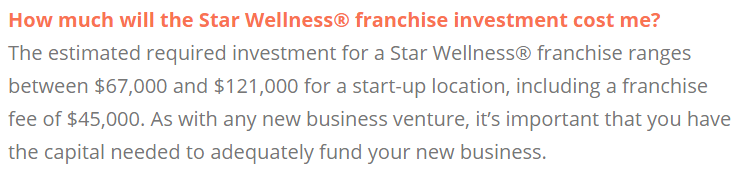
They do, however, recommend a background in sales, finance, or municipal administration.
The other good news — for you salespeople, financiers, or city managers — is that Star Wellness will teach you everything you need to know about wellness:

Yes, in five days you too can learn everything that Star Wellness knows, like how to ignore USPSTF guidelines, which is one category in which Star leads the industry. (One place they lag is reading comprehension, since we have already pointed out that most of what they propose is more likely to harm employees than benefit them…and yet they continue to advertise these hazardous screens.)
In addition to “up to” 5 days in the classroom, franchisees also get 3 days of on-the job training. So in case anyone is keeping score at home:
- Training required to get a job as a wellness vendor: 8 days
- Training required to get a job as a housekeeper at the Four Seasons: 10 days
This intensive training has captured the attention of WELCOA, which has named Star a Premier Provider:
WELCOA has very high standards, as we have noted on They Said What. One thing they excel at is spelling the name of their founder, assuming their founder invented the all-you-can-eat self-service restaurant.

A commitment to excellence, like that displayed by Star Wellness and WELCOA, might explain why employers have gone all-in on the notion that teaching employees, for example, to drink eight glasses of water a day will reduce healthcare costs, and also increase productivity, at least between trips to the water coolers and the rest rooms.
You’d learn far more than the typical wellness vendor knows about wellness simply by taking the Quizzify quiz. You’d learn more just by taking the demo quiz on the landing page.
Heck, you’d learn more just by reading the Quizzify landing page itself.
Share this:


Mark Twain Explains Why Wellness Endures Despite TheySaidWhat?
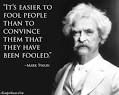
OK, OK, we admit we’re a little light on content this week. (And thanks to Chris Davis for posting this image.) We’re waiting for a REALLY BIG announcement. The wellness-meets-Roger and Me debate we’ve all been hoping for is GOING TO TAKE PLACE.
Watch this space. The date, venue, rules etc. have all been agreed upon and the sponsoring organization is just finishing up the press release.
Share this:

Show Wellness Isn’t an Epic Fail and Collect a $1-Million Reward
Executive Summary:
We are getting very frustrated with the failure of wellness advocates to show even the slightest net savings using a legitimate methodology. Therefore we are offering a million-dollar reward for the first person who does. To win this reward, there are specific rules that must be followed regarding data sources and the selection of panelist judges, all listed below.
Recently a group calling themselves the Global Wellness Institute Roundtable put out a press release and report criticizing us for “mud-slinging on ROI.” We are not familiar with this group. Their headliner seems to be a Dr. Michael Roizen, head of the Cleveland Clinic’s much-vilified wellness program. If that name sounds familiar, it’s because he used to work with Dr. Oz, though to Dr. Roizen’s credit, he avoided the Congressional investigation of Dr. Oz.
The report says we “impose a standard of evidence that doesn’t exist for any other workplace investment.” Um, like it needs to break even? Wouldn’t a company go bankrupt pretty quickly if it didn’t insist that its investments should break even?
Also, there are three very specific reasons why wellness needs a high “standard of evidence.” If Dr. Roizen doesn’t understand these reasons, he can get a smart person to explain them to him.
We get a little frustrated when we prove something, and then members of the wellness industry dress themselves up with words like “Global” and “Institute” and “Roundtable” and then say things like: “critics are misusing ROI science to castigate…workplace health efforts.” Then they cite articles that inadvertently undermine their own arguments and support the critics.
They also say things like: “93% of the workplace wellness return in the first year is in productivity gains, not reduced cost.” This is squirrelly even by the lax standards of wellness math. No company can measure its productivity gains with that precision. Still — assuming you exclude time wasted in filling out forms, being screened, and getting unnecessary checkups — maybe they’re right. After all, nothing focuses the mind on work-related issues like being told you’re sick.
And yet casual observers assume there are two sides to this “debate.” It doesn’t help that journalists need to print opposing quotes. However, pry, poke, and prod” wellness loses money, period–unless you count the money forfeited by employees who don’t participate, or don’t lose enough weight to earn their payment. Those payments are not counted for the purposes of this reward since they are transfers, not savings.
Leaving out employee forfeitures, the country as a whole has not even remotely approached breaking even on wellness spending vs. claims costs.
But don’t take our word for this. We are offering a million-dollar reward for anyone who can show that it is more likely than not that “pry, poke, and prod” wellness breaks even through healthcare claims savings.
Not” Show a 2-to-1 ROI” or “Defend the famous 3.27-to-1 ROI.” Just: “Show a breakeven.” Not “wellness is a success.” Just “wellness is not a epic fail.”
The Rules
Specifically, you just need to show, using publicly available databases (not private “case studies” or vendor reports), that:
- it is mathematically possible that the country’s employers can reduce their medical claims costs enough to cover the wellness industry’s $8 billion in annual billings by enough to offset internal costs and consulting fees (you can estimate those); and
- during this millennium the wellness industry has reduced costs (by avoiding wellness-sensitive medical events, which is the methodology HERO and us agree on) by enough to break even according to the first calculation;
- The so-called “best programs” in the country — Koop Award winners the last 3 years — are, if not exemplary, then at least good performers that earned the savings they claimed to save, by significantly reducing risk factors.
Here are the rules. This is a binding legal contract. We can’t offer something like this and then say we had our fingers crossed.
- You need to start out with a lie detector test, to be performed by the Boston police, as I will. The questions to be asked are: “Are you telling the truth?” and “Is the opposing party either deliberately lying, and/or has no clue how to measure outcomes?” Either side may submit either or both sides’ results, as they prefer.
- You must provide your view of the C. Everett Koop Award to Wellsteps and Boise (600 words, 6 hyperlink maximum), and rebut the other view (600 words, 6 hyperlink maximum). We will also both be asked: “Did the Wellsteps program reduce costs in Boise by roughly a third, as they claimed?” in the lie detector test.
- In order to facilitate your quest, you can use include the wellness industry’s own HERO Outcomes Guidelines, which represents the “consensus” (their word) of 39 “subject matter experts” who support wellness. (None who oppose wellness were invited to participate.) US Census Bureau information, Kaiser Family Foundation, and the AHRQ’s HCUP database can also be used. Other databases will be allowed in at the discretion of the panelist judges if they deem their probative value to be very strong.
- You may cite/quote any peer-reviewed article in rebuttal of the opposing view; however articles in support of the position in question must be sourced from one of the ten medical journals with the highest reported “impact factors,” and have been published within the last five years;
- Once an article is brought into the discussion, the opposing party may also cite it in cross-examination.
- We give you a lien on $1,000,000 as soon as you escrow $100,000 to cover the costs of the program (honoraria for panelists, venue etc). The loser pays this (meaning that if you win, you get it back). If the costs are less than $100,000, the winner keeps the difference.
- We each pick four panelists from Peter Grant’s “A-List” of the leading 260 health economists and policy experts (this is an invitation-only email list in which health policy and health economics concerns are addressed and debated) that are unaffiliated with the wellness industry or with Quizzify . Each party can veto two of the other’s picks. Together, the remaining four pick a 5th.
- Each side submits up to 2000 words and 5 graphs, supported by no more than 20 links;
- The material linked must predate the claim for the award by 6 months, in order to discourage either side from creating linked material specifically for this contest.
- Each party may separately cite previous invalidating mistakes made by the other party that might speak to the credibility of the other party.
- Either side may cite an unlimited number of “declarations against interest,” made within the last 4 years–meaning comments made by the other party so prejudicial to their own position that the other party would only have said them if they were true. Example: if I said, “Wellness definitely saves money” (except when I said it as an April Fool’s gag), you could cite that. There is no word limit on these.
- Each party can then rebut the other party with up to 2000 words and 5 graphs, and 20 links.
- The parties will be convened, in Boston (or another agreed-upon city, if the other party is willing to pay my travel expenses), for a two-hour finalist presentation in which the panelists (whose travel expenses and professional charges are paid for out of the entry fee) can ask questions of either party, and both parties can cross-examine the other for up to 40 minutes, with followup questions and no limitations on subject matter. Each party can make a 10-minute opening and 10-minute closing statement. Up to 20 slides are allowed.
- During their 40 minutes, each party that has not achieved Certification in Critical Outcomes Report Analysis by the Validation Institute must explain why they haven’t, and each party that has not signed the Employee Health and Wellness Code of Conduct must explain why they haven’t.
We invite the wellness industry leaders — the “Global Wellness Initiative Roundtable,” the Koop Award Committee, and the Business Roundtable (BRT) and of course the Health Enhancement Research Organization — to collect their million dollars. Or shut up.
Share this:

Our Number 1 posting ever: The Wellness ROI Calculator
Our most widely read blog post offers a free Wellness ROI calculator. It’s been getting hit after hit in the weeks we’ve had it up. Further, no one has found any mistakes in it, which is unique in the ROI calculator field. (The Brand X ROI calculator — we won’t mention any names but it rhymes with Wellsteps — is nothing but a mistake, since if you zero out inflation, their model always shows $1359/employee in savings by 2020.)
If you missed it (meaning ours), this is a good opportunity to download it and use it yourselves.
Here is the link directly to the calculator. You still need to scroll down, though, to the June 30 posting.
Share this:
Guest Post: Janet Bates Sums Up the Wellness Industry
Occasionally in a linkedin group, someone posts a comment that seems to merit more exposure, a “new voice” in the debate. Janet Bates posted such a comment. I asked her to expand and re-post it here, so that others could see it.
Follow the Money to Find the Truth
As long as there is money to be made, smoke and mirrors will abound. This is overwhelmingly evident in the current hysteria around corporate wellness. Insurance companies have their business customers whipped into a frenzy of “get those employees well (whatever that means) or else we’ll have no choice but to raise your premiums yet again.”
So in swoop the wellness “experts” to save the day with their “magic wellness dust”. The wellness people boldly claim that all it will take are education, incentives and contests for employees to improve their “numbers” (which somehow prove good health) or face penalties (or lose their incentives—same thing) if they don’t. Running these programs will keep insurance premiums in line, increase productivity, improve engagement, reduce absenteeism, make everyone love their jobs and probably save the world from insurgents all while delivering a jaw-dropping ROI.
What’s wrong with that? Nothing, except that it doesn’t work and it isn’t true. So what gives? Why do so many companies choose to believe this stuff?
They Can’t Handle the Truth
It’s pretty simple…few companies want to truly look at their own role in what may be impacting employee health. Hardly a company wants to honestly face the fact that the REAL causes of employee un-wellness include tangible items like:
- Low wages
- Limited or no paid sick time, family leave or vacation
- Too many part-time jobs with non-guaranteed schedules and no health benefits
- Hiring temps and contractors to avoid any type of commitment
- Moving jobs off-shore
And then there are the intangibles, like:
- Lack of flexibility and autonomy
- Inept and bullying management
- Required 24/7/365 connectivity and excessive hours for salaried employees with minimal, if any, salary increases
- High deductible medical plans that employees can’t afford to use
- A strong feeling of job insecurity leading to chronic stress
- And other shoddy business practices and HR policies
So why don’t wellness vendors who claim to be experts help their customers face these real facts. Two reasons:
- There’s no fast money in it for the vendor. Helping customers address these facts won’t lead to the immediate sale of the vendor’s very profitable health risk assessments, screens, coaching, or contests.
- Employers don’t want to hear it. It’s much easier and cheaper to spend a few hundred bucks per employee for the “magic wellness dust” than it is to dig into the muck of the company and spend the money to fix what’s really wrong.
Following the money and facing the facts does lead to the truth. It might not be easy to hear and doing what’s right FOR employees won’t be free, but it will improve their well-being and ultimately that’s good for everyone. Unfortunately, the insurance companies will find other reasons to raise premiums. That, of course, is the real money trail to follow.
About the author:
Janet Bates is a semi-retired writer who spent close to 40 years in the “performance improvement” business.
Share this:
We Caught a Wellness Vendor Doing Something Right: US Preventive Medicine
For a year now, we’ve been outing wellness vendors whose endless stream of rookie mistakes in outcomes calculations (that somehow always seem to overstate savings) has provided a correspondingly endless stream of mirth and merriment to our expanding cadre of visitors, whose numbers now exceed 50,000 in total.
During this period, like Diogenes, we’ve been searching for an honest, competent wellness vendor, one that we could highlight to show that we are not simply mean-spirited anti-wellnites who for some unknown reason were intent on denying employees the opportunity to become healthy.
Diogenes had it easy compared to us.
Quite literally we have sifted through hundreds of wellness vendors. Some are just a few fries short of a Happy Meal. They get highlighted in our popular On the Even Lighter Side compilation. Some have very squirelly data. They win Golden Squirrel Awards. Others, well, we’re not calling anybody scoundrels but let’s just say they could never be confused with Mother Theresa. They get Smoking Guns, featuring questions that buyers can ask them based on their own claims that can’t be answered.
None of these vendors or any other wellness vendor, it is worth noting, have managed to receive validation from the Intel-GE Care Innovations Validation Institute, despite the obvious advantages of a respected third-party’s endorsement…and the offer by They Said What? to remove all unflattering references to them if they achieved such validation, as many non-wellness companies have,
Finally, however, our quest for an honest and competent wellness vendor is rewarded. US Preventive Medicine has both achieved validation for its contractual language and has compiled an enviable record–across its entire book of business–of event reduction. The full press release can be viewed here.
Further, they measure risk factors on the entire population, which is valid, not just the highs-to-lows.
We applaud their willingness to attempt validation but especially the results they’ve achieved and the contracts that codify those results, assuring that their customers will also receive validation should they choose to apply for it.
Share this:
Hyperdiagnosis: The Wellness Industry’s Anti-Employee Jihad
Healthmine just released a survey bragging about how many employees were diagnosed through wellness programs. That reminded us of our popular 2013 posting on The Health Care Blog called Hyperdiagnosis. We are re-posting and updating it below.
By now we are all familiar with the concept of overdiagnosis, where “we” is defined as “everyone except the wellness industry.”
Wellness vendors haven’t gotten the memo that most employees should simply be left alone. Instead, they want to screen the stuffing of employees, at considerable cost to the employer and risk to the employee. The wellness vendors who overscreen employees the most win awards for it, like Health Fitness Corporation did with the Nebraska state employee program.
We call this new plateau of clinical unreality “hyperdiagnosis,” and it is the wellness industry’s bread-and-butter. It differs from overdiagnosis four ways:
- It is pre-emptive;
- It is either negligently inaccurate or purposefully deceptive;
- It is powered by pay-or-play forfeitures;
- The final hallmark of hyperdiagnosis is braggadocio – wellness companies love to announce how many sick people they find in their screens.
1. Pre-Emptive
Overdiagnosis starts when a patient in need of testing visits a doctor. By contrast, in hyperdiagnosis, the testing comes in need of patients, via annual workplace screening of up to seventy different lab values–most of which, as They Said What? has shown, make no clinical sense. Testing for large numbers of abnormalities on large numbers of employees guarantees large numbers of “findings,” clinically significant or not. The more findings, the more money wellness vendors can add on for coaching and the more savings they can claim when they re-test.
2.Inaccurate or Deceptive
Most of these findings turn out to be clinically insignificant or simply wrong, no surprise given that the US Preventive Services Task Force recommends universal annual screening only for blood pressure, because for other screens the potential harms of annual screening outweigh the benefits. The wellness industry knows this, and they also know that the book Seeking Sickness: Medical Screening and the Misguided Hunt for Disease demolishes their highly profitable screening business model. (We are not cherry-picking titles here—there is no book Here’s an Idea: Let’s Hunt for Disease.) And yet most wellness programs require employees to undergo annual screens in order to avoid a financial forfeiture.
Hyperdiagnosis also obsesses with annual preventive doctor visits. Like screening, though, annual “preventive” visits on balance cause more harm than good. The wellness industry knows this, because we posted this information on their LinkedIn groups, before we were banned from most of them. They also presumably have internet access on their own.
3. Pay-or-play forfeitures
The worthlessness, the inconvenience, and the privacy invasion make screens very unpopular. The wellness industry and their corporate customers “solve” that problem by tying large and increasing sums of money annually — now $694 on average – to participation in these schemes. Yet participation rates are still low.
4. Braggadocio
While doctors are embarrassed by overdiagnosis, boasting is an essential ingredient of hyperdiagnosis. We’ve already blogged on how Health Fitness Corporation bragged (and lied, as they later admitted) about the number of cancer cases they found in Nebraska. They also bragged about the rate of cardiometabolic disease they found — 40% in the screened population — even though they admitted almost no employee did anything about those findings, and only 161 state employees reduced risk factors. Hence, it was the worst of both worlds: telling people they are sick without helping them get better. Nothing like telling someone they’re sick to increase their productivity.
Compass Health is our favorite example of hyperdiagnosis braggadocio. We realize this screenshot is a bit tough to read, but the hilarity is worth the effort. We pulled this vignette from On The (even) Lighter Side, They Said What?‘s most popular feature.
The Definition of a “Healthy Employee” Is One Who Has Not Been Diagnosed by Compass Health
Feeling fine today? Alas, you better get your affairs in order, bid your loved ones adieu, and watch the shows you’ve DVR-ed. Why? Because, dodo-brain, feeling fine means you have:

You are “walking around without a clue that [you have] a debilitating or terminal condition.” According to Compass Health (which at this point, having been “outed” by us, had the good sense to take this off their website…but not until we captured a screen shot), the major symptom of I Feel Fine Syndrome is: not having symptoms.
We’ll let them take it from here, to display not only their epidemiological prowess but also, this being the wellness industry, their grammar and spelling prowess as well:

We must confess we learned a lot from Compass. We had not realized that employers’ concerns about employees feeling fine had their roots in ancient history. But there it is, right in the opening words: these concerns date back “millenia” [sic], when employers failed to get their employees tested for “percolating” conditions before throwing them to the lions.
So the bad news is that feeling fine may be hazardous to your health. The good news is that your ICU bed may not need a DNR notice anytime soon because elsewhere Compass says it “has programs and solutions to help your employees overcome their I Feel Fine Syndrome.” And it is “very likely” these programs and solutions can “completely cure the problem…forever in our bodies.”
And not a moment too soon, because we’re never felt better in our lives, which means the clock is ticking. That’s the good news. The bad news is, if we join Compass’s program it sounds like we need to start contributing more to our 401K’s.
Summary
We’d like to think that all our exposés have made a dent in the wellness industry’s business model, but the forces arrayed in the other direction have so far overwhelmed us. The price of screening has plummeted almost to the $1-per-lab-value level for comprehensive screens, and as with anything, the lower the price, the greater the amount sold.
Couple those economics with the advent of genetic testing as part of wellness, big and profitable fines for non-participants, and the EEOC being defanged as a sop to the Business Roundtable, and it’s clear the wellness industry’s highly profitable hyperdiagnostic jihad against the American workforce has barely begun.
By contrast, Quizzify teaches employees that “just because it’s healthcare, doesn’t mean it’s good for you,” and to only get screened according to the USPSTF guidelines. That’s a message that employees would love to hear, but that wellness vendors can’t afford to tell them.
Share this:

Finally–a Free Wellness ROI Tool That Isn’t Made Up
We are pleased to present a free wellness ROI estimation model, as we promised about 3 months ago. This is the only tool of its kind in the industry. (Wellsteps has one, but let’s just say the good news is that NASA employees don’t have to worry about job security, because these people aren’t rocket scientists. If you zero out inflation, no matter what other variables you enter, the Wellsteps model always shows savings of $1359.)
You can also use this to compare two wellness programs, to determine whether your vendor is lying (they are — and we are happy to help you get your money back from them), and to pressure-test Quizzify.

Quizzify, where facts are your friend, and they’re fun, too
Share this:

Eureka! An actual good idea for employee health and morale
I just read a provocative article by the IHPM’s Deborah Love, who points out the value of OTC drugs in self-care, citing multiple articles and sources.
I myself am a case study. One day at work, out of the blue, I got this wicked case of indigestion. I had to get in my car and drive all the way to CVS to buy a roll of Tums. This would be considered a classic case of presenteeism followed by an hour of absenteeism. The episode would definitely have reduced my productivity except for the fact that this particular job was a complete waste of a perfectly good cubicle, and the company was no doubt better off for my inattention to my half-soused boss’s half-witted directives.
If it is indeed the case that OTC drugs can alleviate, avoid or resolve some conditions that could cause absenteeism or presenteeism, perhaps they should be encouraged. Many people have advocated that they be covered. I have always thought that was unrealistic. When you think about how much paper is consumed in health benefit administration today, coverage of OTC — requiring receipts and perhaps a doctor’s note — would be like adding more shrapnel to a hand grenade.
So perhaps the “answer” is that some OTC drugs should be made available — at cost — onsite. Not all drugs. Many OTC offerings are of dubious value or have long-term side effects, like taking a Prevacid every day, which can reduce bone density. But stocking those that are helpful in self-care could both encourage self-care and, — because they carry a lower price than the same drugs in a store — would be seen as a benefit by employees. (If the price is low and employees are buying stuff for their friends, you can limit the number sold at one time. Or sell them in a vending machine, where it is inconvenient to buy more than one at a time. But if you are selling them at cost, it really doesn’t matter if your employees are buying more.)
Thoughts? This seems pretty obvious and it always scares me when I think of things that should be obvious that I am missing something.
Otherwise, this should be a challenge to wellness vendors: come up with an actual good idea, like this or like Quizzify. If you do, we’ll be happy to tell people about it.
 They Said What?