
Home » 2015 (Page 6)
Yearly Archives: 2015
Validation Institute adds Linda Riddell as Validator
When I went on Jeopardy and my opponent (seen here) got the Daily Double right, I clapped. It killed me because generally you don’t like your competitors to thrive, but, hey, it was national TV and you don’t want people — at least people who are not members of the Wellness Ignorati — to think you’re a jerk.
In the case of Linda Riddell becoming the second validator anointed by the Validation Institute and hence a “competitor” of mine, I am clapping but this time for real. Linda is very smart, well-qualified educationally, and professionally she has whizzed through all the certifications needed to reach this level.
I welcome her “competition” and look forward to other consultants of her caliber following in our paths.
PS I lost. Bad draw. My opponent, Bob Verini, went on to win the Tournament of Champions and then within the last year or so became the 80s decade TOC winner. Lucky I didn’t give up my day job.

Share this:

It’s not just us–every grownup thinks there is too much prevention
When you read articles on prevention and corporate wellness, you tend to notice a pattern. Articles written by people who make their money pushing this stuff always say that the answer is more prevention. Those written by everyone else always say the answer is less prevention.
Here is an excellent example of the latter. It’s basically everything we’ve been saying, minus our trademark snarkiness.
Share this:

Wellness promoter admits a 50% reduction in heart attacks needed to break even

Who do wellness vendors remind you of?
Next to a being a Red Sox fan, I can’t imagine anything more depressing than being a member of the Wellness Ignorati. ALL the news about wellness is bad, and can’t be spun, which is just as well because the strategy of the Ignorati is not to “spin,” It’s to ignore facts rather than debate them. This prevents a news cycle, and reduces the odds that customers find out wellness doesn’t work.
Still, I am not sure how they would spin their way out of their latest debacle even if they tried.
CFO Magazine just posted a set of four essays in a debate. Mine summarizes the “con” arguments in 600 words. Since most of the first-string Ignorati refuse to debate, the editors found Mike Tinney and Mike Booth to pen the “pro” side. (No, we haven’t heard of them either.) Mr. Tinney urges CFOs to “take a leap of faith” on wellness ROI. Not sure that’s a compelling argument for an audience of CFOs, to put it mildly.
Indeed, one might conclude that, like the Red Sox, apparently the Ignorati don’t have much of a bench.
But wait…there’s more. Once again, the mantra: “In wellness, you don’t have to challenge the data to invalidate it. You merely have to read the data. It will invalidate itself” proves true. Mr. Tinney says to assume you have 1000 employees, and they will have about 2 heart attacks. Then he says: “If even one less [sic] person has a heart attack,” you save enough to pay for the program. What he failed to note is, in that hypothetical, a reduction of one heart attack would be a 50% reduction in heart attacks. No wellness promoter, even the most dishonest ones, say you can achieve remotely close to a 50% reduction in heart attacks. Hence, he is admitting you need an impossible reduction in events just to break even.
While reducing the number of heart attacks by one sounds feasible on its face, multiply the size of the population by 100. Now you have 100,000 people generating 200 heart attacks. Mr. Tinney says you need to avoid a Nobel Prize-worthy 100 of those heart attacks just to break even. By contrast, the HERO report achieved a zero reduction in their study.
So much for Mr. Tinney’s argument. But, hey, it beats Mike Booth’s defense of wellness. Incredibly, Mike Booth is still quoting the Harvard study. At this point every member of the Wellness Ignorati knows that study has been thoroughly debunked and basically retracted by its author (who says she has no interest in discussing wellness any more, and blames readers for misinterpreting her conclusion), so quoting this study without mentioning these tidbits is basically lying. It’s only slightly better than quoting the study linking autism to vaccines without mentioning it’s a fraud.
So that’s who’s promoting wellness now: yet another guy who can’t do math, and yet another guy who is either deliberately misleading people or lacks access to the internet.
More big news is that RAND finally came out of the closet altogether against wellness. No nuances, no “on the other hands”, no chance of being misinterpreted: Wellness is a loser.

Quizzify has GE-Intel validation.
Basically, every posting, every article, whether pro or con, leads an informed reader to the conclusion that wellness is a dumb idea. By contrast, even the Red Sox occasionally win a game.
Share this:

The Graco-Goetzel-Bravo plot thickens…more twists and turns
The Graco-Goetzel-Bravo-Hopkins case study is turning into another Nebraska fiasco. As with Nebraska, the numbers all contradict one another. But unlike Nebraska, there has as yet been no admission of deliberate lying in the Graco case study. That’s why Graco only earned an honorable mention in the Koop Awards, instead of winning one outright like Nebraska did.
Consider Bravo’s case study on Graco covering the exact same population over the same period as Ron Goetzel’s study. Let’s assume Ron Goetzel is right in that the wellness program should be measured from 2009 rather than 2008, when the program started. (Bob Merberg’s brilliant analysis points out the cherrypicking of the date has a huge impact on claimed success, but let’s concede this start date choice to Ron, and use 2009 according to his wishes.)
Bravo’s case study displays the PMPM costs by year. The first thing to note is, they list employee healthcare costs at $328 PMPM, which actually makes sense, instead of the $190 PMPM in the Hopkins report. I don’t know why these two figures, purporting to cover the exact same population in the exact same period, are completely inconsistent, but I do know that $190 PMPM is an impossible figure, as any population health expert knows. (“Plausibility checking” would have caught that error but Ron has never taken our course in Critical Outcomes Report Analysis, which would have covered plausibility-testing and likely prevented him from making such a rookie mistake.)
Second, Bravo lists children’s healthcare costs in this report as well. Funny thing: over the same exact period in which Mr. Goetzel was claiming that the wellness program was responsible for controlling employee participant costs, children’s healthcare costs trended better than wellness participants’ costs. Mr. Goetzel obviously had access to this children’s cost trend data (we had no trouble finding it, thanks to Bob Merberg) but elected to — get ready to fall out of your seats — ignore it. The wellness ignorati rarely step out of character.
This children’s cost trendline appears to invalidate the entire Goetzel-Johns Hopkins conclusion that the healthcare cost trend was due to the wellness program, since not one single child participated in the wellness program.

For some reason Graco’s spouses cost about $7000 apiece a year. We’ll leave that for someone else to dissect.
As an aside, if anyone thinks they recognize the name “Bravo Wellness” from an earlier posting, it’s because they do. Bravo is the outfit that brags about their ability to save employers money by fining employees. Their website is disproportionately about their appeals process when those fines are levied. This sounds like a company that does wellness to employees instead of for them.
Not sure how bragging about fining employees is consistent with the positive culture that Mr. Goetzel says Graco has, but maybe I’m missing something here.
Share this:

Eureka! We got criticized! An entire blogful of harsh words
 Please visit Michael Prager’s blog. Ironically, I don’t think we would take issue at all with his main point which appears to be that wellness should be done for employees instead of to them. (He is in the business of doing wellness for employees, not to them.) And, in fact, if he were actually thinking clearly about his own business success, he’d be pointing that out and trying to figure out ways to work together.
Second, note that our math and facts are never, ever criticized, even by our most virulent critics. What he criticizes is that we “mock critics who say that calling people ignorant is bullying.” Well, we call them the “ignorati,” not ignorant. “Ignorati” means they ignore facts, which is a brilliant strategy.
Third, he is breaking ranks with the ignorati, by not ignoring us. This creates a problem because he doesn’t actually point out a single thing we say that is wrong. Indecorous, perhaps, but wrong, no.
What’s both right and fun for employees? Quizzify, of course. Click and take our demo.
Michael, have at it: find a mistake in our math or a lie that we told about your integrity-challenged colleagues and we’ll apologize to it and link people to it. Go ahead, make our day. Because right now the fact that you, having shown that you are willing to criticize us, can’t find anything to actually criticize us about (other than our “bullying” observations that people who can’t do arithmetic shouldn’t be doing arithmetic), makes our case much better than we ever could.
Addendum: his is actually a very interesting blog on its own merits. He does do wellness for employees instead of to them ∞
Share this:

Britney Spears Meets Ron Goetzel’s Institute for Health and Productivity Studies
 In the immortal words of the great philosopher Britney Spears, oops, they’re at it again.
How this “study” gets published and why Johns Hopkins would allow its name to be used on it is anyone’s guess. In our last posting, we pointed out that in one place Graco’s employees cost $11,100 apiece to insure, just like other companies that offer competitive benefits. Yet later on in the story we see that employees only cost $2280. No mention of how these figures could be so inconsistent.
We let the rest of the study go, figuring we had already found the Macguffin. Ace reporter Bob Merberg, though, was not so easily convinced.
We’d urge reading his blog. Among the claims made by Mr. Goetzel was “revenues have doubled since 2009.” Well, yeah, but:
(1) it turns out Graco made a sizable acquisition in 2012, which might have had a teeny-weeny effect on revenues;
(2) revenues had plummeted in 2009, the year after the wellness program was introduced.
If you (a) measure from 2008, the year the wellness program was introduced, instead of cherrypicking the baseline year to give the best result, and (b) factor out the acquisition, revenues over the 2008-2014 period have pretty much tracked the economy as a whole. So nothing happened.
Try the Quizzify demo and see how many you get right.
We can’t make this stuff up. Fortunately we don’t have to.
Share this:


News flash: The Wellness Ignorati are ignoring facts for a change

There has to be a limit, even to deception
The Wellness Ignorati got their name by ignoring facts. Facts, of course, are the wellness industry’s worst nightmare. They ignore them In order to avoid creating news cycles that might reach human resources departments despite the best efforts of their consultants and vendors to shield them from actual information.
And they’re at it again.
First, Atul Gawande wrote a scathing article in the New Yorker about massive overscreening earlier this month. As Mitch Collins noted in The Health Care Blog, not a peep in response from the perpetrators of those hyperdiagnostic jihads. Nor has their been any response to Mitch’s article itself. Literally, no one defends wellness industry practices. And yet somehow all the laws are on their side.
Speaking of which, Mitch mentioned the famous Nebraska debacle, in which the vendor, Health Fitness Corporation, lied about making “life-saving catches” of “early-stage cancers.” Since HFC was a sponsor of Ron Goetzel’s Koop Award, Ron naturally gave them that prize for these lies.
However, we’ve thrown down the gauntlet. HFC, come on out and fight. Give us your side of the story. How was this not a deliberate lie designed to score political points in Nebraska? If it was a mistake, why didn’t you change it and apologize? How do those 514 cancer non-victims feel? And Mr. Goetzel, why do you not only keep defending HFC, but have even upped the ante? They’ve been promoted from “best practice” to “exemplar” in your most recent webinar.
As long as wellness vendors are silent, we won’t shut up.
Speaking of non-responses from Mr. Goetzel, where is the correction of or explanation for the massive mistake in Mr. Goetzel’s most recent wellness program evaluation? All those readers have been misled by his blog into thinking Graco’s costs/employee are $2280/year when in reality the cost per employee contract holder — according to Mr. Goetzel’s own blog — is about $11,100, like almost every other company. (That includes spouses and dependents but any reasonable dependent ratio would yield more like a typical $5000 to $6000 per employee rather than $2280.) I know he knows about this mistake because I’ve submitted a comment to his blog, which shockingly hasn’t been posted.
So, please, could someone actually respond for a change, even if it’s just to accuse us of bullying.
Share this:


Ron Goetzel reports on Graco, the company with the country’s most expensive spouses
Talk about “burying the lead.”

Need we say more?
Ron Goetzel just reported on a company called Graco, where employees were subjected to a “pry-poke-prod-and-punish” wellness program. These are line employees in an “old economy” company–exactly the type of company where healthcare spending would be high. And it is high. According to the article, Graco spent $29,000,000 on healthcare for 2600 employees. That’s about $11,100 apiece, roughly what you’d expect. This estimate is with or without a wellness program, since as Ron’s recent HERO report noted, wellness programs have no positive impact on spending.
Yet later on in the article he writes:

In the immortal words of the great philosopher Rick Perry, oops.
$190 per member per month (and we assume that he meant just for employees, not members) is $2280/year/employee. Here are the possibilities:
(1) Graco has the country’s mot expensive spouses, costing about $18,000/year (to bring the average spend to $11,000 per employee contractholder per year) but hasn’t noticed
(2) Graco has some magical special sauce that kept costs way below average even before the wellness program started that Ron failed to tell us about (hence “buried the lead”)
(3) Ron Goetzel made yet another rookie mistake in his math, thus invalidating the entire study, just like most of his Koop Awards.
You can rule out that this $190 had anything to do with the wellness program. Smoking rates (the only thing that really affects spending) remained unchanged, and obesity only fell a few points. And a company can’t save money by overscreening people, paying for their drugs, and making them get unnecessary checkups. In any event, it wasn’t $190/month. It was $11,100/year.
$2280 vs. $11,100… We look forward to Mr. Goetzel’s explanation of how both these figures could be true, since it appears they are completely at odds with each other. In the immortal words of the great philosophers Dire Straits, if two men say they’re Jesus, one of them must be wrong.
And once again, the mantra of Surviving Workplace Wellness holds true: In wellness, you don’t have to challenge the data to invalidate it. You simply have to read the data. It will invalidate itself.
Here’s a Quizzify number that adds up: a 100% guarantee you’ll save money
We will no doubt be accused of “bullying” him for invalidating this study, which he obviously spent a lot of well-compensated time on. So just to show our good intentions, we will offer him our course and certification in Critical Outcomes Report Analysis gratis. It seems he could learn a lot from it and we look forward to announcing his successful completion.
Update: Ron apparently “forgot” to include the actual data in his writeup, which showed that, um, how to put this tactfully, his entire conclusion is wrong. Looks like kids (who had no access to wellness) trended better than the adults who did have access. We added this as the second installment.
Share this:


Measuring Wellness-Sensitive Medical Events: The Grand Finale of the HERO Analysis
 The eighth in the series deconstructing the HERO Outcomes Guidelines, covering Page 14. The full series can be found here. This installment in particular should be read in conjunction with installment #4 This Grand Finale will be presented in 3 parts…with a downloadable tool to help you calculated your wellness program savings as part 3.
PART ONE: HERO ACCEPTS OUR METHODOLOGY
In the stock market, no one is as valuable as the person who’s always right, except the person who’s always wrong. Therefore, until now we have greatly appreciated the opportunity HERO’s report has created for us to explain how to measure outcomes correctly.
So imagine our disappointment when one of their methodologies, the sixth of the seven listed, turned out to actually be valid. No surprise — this is the methodology I invented. Also no surprise given the industry’s standards for integrity, they didn’t acknowledge that particular factoid anywhere in their 88 pages. (And yet they accuse us of being impolite.) Here is the screen shot.

The philosophy of #6 is quite straightforward. If you were introducing a flu vaccine program, you’d measure the reduction in number of people who got the flu. If you offered a new program for conservative treatment of meniscal tears, you’d measure the reduction in the number of people who had meniscal surgery. That’s the way experimentation works. You hypothesize an outcome that the intervention should create…and then you measure that outcome to see if the experiment worked.
Except, of course, in population health, where any improvement in anything (cost, trend, utilzation) gets attributed to any wellness program that happened to be in place. The masters of this would be Mercer. Mercer once “found” massive, mathematically impossible, savings for North Carolina Medicaid’s medical home in a cohort that, as luck would have it, wasn’t even eligible for the medical home. And one wellness industry stalwart, Larry Chapman, says the simple act of completing a health risk assessment can reduce total healthcare spending by 50%, even when the information in the HRA is wrong, as is often the case.
And did you ever notice that when a company switches to a high-deductible health plan and adds some needle-poking, they attribute the reduction in spending to the needle-poking, not the fact that everyone in their company suddenly gets socked with a bigger annual deductible?
Enter wellness-sensitive medical event rates (WSMEs). This is the only methodology that tallies hospitalizations for conditions targeted by a wellness program – statistically avoided heart attacks etc. This is the only one of the seven HERO methodologies that would be acceptable to legitimate researchers. Hence, its use both in Health Affairs and by the GE-Intel Validation Institute. The former is the most respected health policy publication and the latter is the most (the only) respected outcomes evaluation organization. Further evidence of its validity is that there is no mention of it in the leading wellness promotional publication, the American Journal of Health Promotion, perhaps because – as HERO has attested – it doesn’t show savings.
History of event rate-based plausibility testing
Even though it isn’t attributed to me in the HERO guidebook, I invented this methodology in 2007. This is incontrovertible. No one else had anything remotely close to it. Unlike the automobile, TV, the computer, etc., this was not one of a series of incremental improvements to or the amalgamation of existing technologies.
And none of the other invention clichés apply either. The Chinese didn’t invent it in 1000 BC. Leonardo DaVinci didn’t sketch it in 1541. The Germans and the Allies weren’t racing to develop it at the end of World War II. By contrast, I’ve been presenting on it and using it for validation since then (meaning 2007). It figured prominently in Why Nobody Believes the Numbers too, before being highlighted in Health Affairs and the Validation Institute. For a modest fee, the detailed how-to can be downloaded from our website, though a Reader’s Digest version appears below.
While a number of employers and health plans use it now, several health plans – more than coincidentally three of the highest-rated in the country (Harvard Pilgrim, Blue Cross of Massachusetts, and Providence Health Plans) – have been measuring hospitalizations for conditions targeted by wellness/DM programs since the methodology’s inception.
So needless to say I was surprised and totally flattered that the 88-page HERO Report contained no attribution to me as the inventor of the WSME plausibility test. As mentioned previously, the strategy of the Wellness Ignorati is to ignore facts (hence their moniker), especially including my very existence. That strategy reduces the likelihood that one of their customers might click through to the site. They aren’t much for our recommending that companies learn our helpful insights, which they call “bullying.”
The wellness industry has had a love-hate flip-flopping relationship with WSME measurement.

Click on the Q to try our demo
First, until 2013, the entire Wellness Ignorati, quite in character, ignored this methodology, which is a powerful testament to its validity.
Then, in 2013, that strategy took a body blow: the exact methodology was used in Health Affairs. You may recall the same thing happened with another epiphany of ours — the expose of the invalid Koop Award-winning Health Fitness Corporation fabricated results. The Wellness Ignorati completely ignored our whistle-blowing expose until it appeared in Health Affairs, when they were forced to admit we were right and the whole thing was made up, or to use Ron Goetzel’s phrase in the passive voice, “was unfortunately mislabeled” for four years.
Just as Ron Goetzel — the leader of the Wellness Ignorati — caved when the Health Affairs light was shined on the Koop-HFC debacle, he caved on WSMEs when the Health Affairs light was shined on them. In this case, “caving” was acknowledging the fact that this methodology existed. He reviewed the aforementioned Health Affairs article that specifically analyzed WSMEs — hospitalizations for conditions targeted by the wellness program. In September 2014, he wrote:
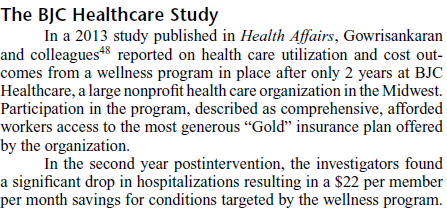
But then he un-caved. Once the Health Affairs storm had passed, he invoked the Sergeant Schultz defense. In December 2014 he said: ,

He may have just forgotten in December that he reviewed them in September. But in March he and his colleagues re-remembered wellness-sensitive event rates, and put them right in the HERO report, for which we are immensely grateful.
Hopefully they won’t re-forget in June. (Their memory appears to be correspond with the change of seasons.) Hopefully instead, to paraphrase the immortal words of the great philosopher George Gershwin, our methodology is here to stay.
How do I feel about HERO rewriting history so that I am no longer the inventor of this methodology? Honestly, having firmly staked out a niche in the small but growing “integrity segment” of the wellness industry, I prefer them staying out of that niche as long as possible. So I’m glad they show no interest in facts.
In part two, which we will post in a few days, we will explain how we do WSME plausibility testing and why it’s the essential method for assessing the impact of your wellness and disease management efforts.
Share this:

Greatest Hits Collection: Staywell

Collaborating with Staywell may not be enhancing the American Heart Association’s reputation.
Occasionally we have to attend to our Day Jobs and can’t post regularly. Fortunately, we have access to a bolus of posts from mid-2014, the posts that went up on this site initially. There were too many stories to highlight, so we decided to inventory them, in order to fill in gaps when we didn’t have time for new posts.
High on that list would be Staywell. First was their collaboration with Mercer, in which they agreed to tell British Petroleum that they found $17,000/person savings. They knew those savings were mathematically impossible since the average person only spends $6000/year. They also forgot that they themselves had said it was only possible to save $100/person.
Following on the heels of that was a collaboration with the American Heart Association to create screening guidelines that (surprise) call for much more screening than the United States Preventive Services Task Force recommends.
In both cases, we welcomed — and in the latter case offered $1000 honorarium for — responses to our questions, but our good-faith offer was met with silence.
Also, in both articles Staywell continued to cite Katherine Baicker’s study that she herself no longer defends, with the added wrinkle of referring to it as “recent” in the hopes that no one looks at the endnotes and sees that it was submitted for publication in 2009 and covered studies from a decade before that. With any luck they’ll have enough integrity to stop citing that study now that RAND has invalidated it. A good rule of thumb is that anyone who cites Baicker’s study without noting that no one (including Professor Baicker) believes that 3.27-to-1 ROI any more is prima facie deliberately misleading people. It is no longer credible to say one doesn’t know that her study has been shown to be hooey and that she is no longer defending it (and actually says she has no more interest in wellness).
Our health benefit education will never break your heart
We recommend click-throughs to both studies. Each raises questions that Staywell refused to answer, after initial conversations which confirmed they knew about these issues. You’ll also see how the American Heart Association was shocked, shocked, that anyone would question their integrity (perhaps they haven’t read The Big Fat Surprise) but then let it go, rather than create a news cycle.
Staywell also helped give British Petroleum a Koop Award. Nice to be on the award committee AND be an award sponsor–makes it easy to give your customers awards. With one or two exceptions, we can’t remember the last time the Koop Award went to a company with no connection to a sponsor or committee member. Perhaps someone could let us know?

 They Said What?