
Home » 2016 (Page 13)
Yearly Archives: 2016
Aetna’s Employee DNA Collection Obsession Combines Junk Science, Junk Arithmetic, and Junk Integrity
It seems like most of my columns should or do start with a line like: “Just when you thought it couldn’t get any worse…”
Well, this time it really can’t get any worse. Aetna’s obsession with collecting employee DNA has truly reached the pinnacle of junk science, junk arithmetic, and junk integrity. (Not to mention junk privacy, as our guest-posting privacy expert noted.)
Junk Science and Junk Arithmetic
By way of background, we have already chronicled not just the junk science of using employee DNA to predict and prevent diabetes, but also the inability of their partner organization, Newtopia, to understand fifth-grade math. Nonetheless Newtopia wants us to trust their understanding of PhD-level science — and also trust them to store our DNA. (Like many vendors who were absent the day the teach taught arithmetic, they took their fuzzy math off their website following our instructional posting. We never received a thank-you note for this free consult, in case you were wondering.)
That same posting covered their reference site-from-hell, in which only a small fraction of employees participated, and the customer complained about the price tag, which is the wellness industry’s highest, @$500 per employee.
That price tag means claiming an ROI at the industry standard level of 3-to-1 requires fabricating far greater savings than wellness vendors usually fabricate. For instance, Ron Goetzel says programs should cost $150 and save $450. (Note: in all fairness he doesn’t say that any more. After our initial exposes, he retreated to a 1-to-1 ROI, as he admitted during our debate. Most recently he’s even backed off that. Now he says most programs fail.)
But showing that industry-standard ROI on a $500 program requires concocting savings approaching $1500/employee in the first year alone, an industry record. And did we mention that ROI was achieved on employees who were specifically selected for having nothing wrong with them to begin with, other than the possibility of getting metabolic syndrome at some point later in their lives? (Or as we originally wrote, these employees were “at risk for being at risk”.)
Oh, yes, and there was no clinically or statistically significant improvement in the set of health indicators that Aetna measured? And that Aetna was a co-author of the HERO study showing wellness loses money?
We said all this — posted it right on The Health Care Blog. Then the most amazing thing happened. One of the members of the editorial advisory board of the Journal of Occupational and Environmental Medicine (JOEM) –a trade journal with a long and glorious history of publishing suspect claims about the wondrous world of workplace wellness — essentially apologized in the comments. Specifically, he agreed the study never should have gotten past peer review. This wasn’t just any member of their board. This was the only member, Nortin Hadler, who has an actual national reputation in population health, having written many successful, influential and well-reviewed books on screening, overtreatment, and the harms of pushing people into the medical system.
Junk Integrity
So far, all we have noted is that Aetna has combined junk science with junk math. Next is where the junk integrity comes in. Just to set the stage by recapping the points above:
- Aetna must have already known their outcomes are made up because no one in population health –and very few people not in population health — could possibly think you could save $1400/person on healthy people in 12 months without doing anything other than assigning an “inspirator” to tell them to eat more broccoli, DNA or no DNA;
- They did already know wellness loses money because they co-authored the HERO report saying wellness loses money;
- If they genuinely had no idea their outcomes were made up, they would have learned that when they read my proof — a mathematical proof, not open to dispute like a scientific proof;
- And if they still doubted it, they could have read the comment by Nortin Hadler.
What does a wellness vendor do in these situations? Simple. It recalls the words of the French General Ferdinand Foch: “My left is collapsing. My right is in retreat. I shall attack.”
Their PR department called Bloomberg, had them assign a reporter completely new to the wellness beat, and then wheedled a complete puff piece out of her, crossing their fingers that the reporter wouldn’t google this thing, which would have created a front-page story.
In the Bloomberg paean, Aetna’s thesis is that best way to motivate people to lose weight is to tell them their genes make it very difficult to lose weight. If that logic doesn’t resonate with you, you have company. Here is a quote from that article — one single quote — that basically invalidates the entire remainder of the story, puff piece or not:
George Annas, a bioethics professor at Boston University, cautions against reading too much into DNA tests. “The chance that they have a genetic test that can determine if you’re prone to be fatter than other people is very, very unlikely,” he said. “What [Newtopia] really seems to be saying is that if you tell people that you have a genetic condition that may predispose you to be overweight, that may motivate people.” For some, he said, DNA testing could have the opposite effect: If someone is predisposed to gaining weight, then why bother dieting or exercising?
Speaking of things which have almost no chance of happening, here are two more. First, we’ve asked JOEM for a formal retraction, given that the study was admitted by Dr. Hadler (who hadn’t seen it pre-publication) to be blatantly wrong. Second, Aetna isn’t likely to apologize either, any more than they did for their last foray into wellness, which involved pitching some of the most controversial drugs on the marketplace to patients who weren’t even sick and didn’t ask for them. Instead, they will probably double down on DNA.
The behavior of both JOEM and Aetna can be explained with an old Chinese proverb: “When you are riding a tiger, the hardest thing is getting off.”
Share this:

Court Would Allow Dismissal of Employee Who Refuses Inappropriate Medical Tests
A list of the medical field’s worst ideas would include annual checkups, chest x-rays, and PSA tests. All are panned in the literature and/or by the United States Preventive Services Task Force (USPSTF), because the potential harms/hazards exceed the benefits. Alfred Ortiz, an employee of the San Antonio Fire Department, had the unbridled temerity to refuse to submit to those items, plus a bunch of other unspecified screens involving various and sundry other precious bodily fluids no doubt also panned by the USPSTF.
If your personal physician wanted to do these things to you (and most wouldn’t), you could refuse. Not so if your employer insists. A federal court has just ruled that — even if the employee wellness program is, to use a technical legal term, really stupid — you can be fired if you don’t submit to it.
And this San Antonio Fire Department program was indeed one of the dumbest. It included:

The justification was that these tests, designed for “early detection of serious medical conditions,” were needed to see if Mr. Ortiz could “perform his position’s essential duties.” However, my google search revealed no cases in which a house burned down because a fireman had an enlarged prostate.
If fire departments seriously want to test skills related to “essential duties”, why not a job-specific triathlon? They could make employees (1) run up 5 flights of stairs in a firesuit carrying a heavy hose; (2) retrieve a cat from a tree; and (3) attend a career day at a junior high school. But don’t endanger their health to please a wellness consultant or vendor.
Partly I suspect Mr. Ortiz’ lawyer didn’t cite or even suspect the hazards of overscreening and overdiagnosis. People who make their livings in other fields tend to assume that people who run wellness programs know the first thing about wellness, notwithstanding our 80 posts to the contrary. A plaintiff attorney overlooking the hazards of overdoctoring ends up in a tough debate on privacy-vs.-alleged job requirements, instead of a much more winnable debate on the employer’s right to gratuitously harm the employee by “playing doctor.”
Mr. Ortiz caved, and went back to work, but the ruling was quite clear that he could have been fired if he hadn’t caved.
Nonetheless, this case is now precedent, at least in the 5th Circuit. The implications? There are no regulations, licenses, or oversight board preventing wellness vendors and employers from harming employees (at taxpayer expense this time), and now there is no case law either.
Share this:

STAT News: Ron Goetzel Admits Most Wellness Programs Fail
Those of you with actual jobs, families, lives etc. may still not have noticed there is a new healthcare/healthcare research daily news publication. Needless to say I noticed on the first day.
It’s free and a summary pops into your mailbox each weekday morning. And, though this publication is only a few months old, they’re already onto the workplace wellness scam (LA Times’ word, not mine). Most notably, author Sharon Begley got Ron Goetzel, of “Expect a 3-to-1 ROI” fame ($450/$150, scroll to second page), to finally admit WAY more than 90% of wellness programs fail.
Is this a great country or what?
The entire story is here. Trust us we aren’t just being polite when we urge you to read it. Yes, like most reporting should be, it quotes both sides, but it’s easy to read between the lines. It’s even double-spaced.
Highlights (taken out of context; some are quotes from others)
“A startling lack of rigorous evidence that they achieve their stated goals.”
“A lot of things are evidence-based…but wellness is faith-based.”
“Vendors’ ‘research’ has made so many elementary mistakes as to inspire voluminous criticism.” <blushing>
“Tiny if any benefits…increase in fruit and vegetable consumption [equivalent to] one bite of banana.”
“A quarter-pound of weight loss.” Not unlike Pfizer’s award-winning 3-ounce weight loss.
And of course, Ron Goetzel: “There is a group of about 100 employers whose programs have really smart ingredients…but thousands of others still don’t do wellness right and are not getting good health outcomes.” (Note: We have no clue who is in that “group,” since every recent Koop Award winner has provably fabricated savings. The 2015 winner, McKesson, didn’t even get anyone to lose weight or stop smoking.)
Here’s the clincher: If you do Ron’s math — 100 successful programs divided by “thousands” of failures — you get a failure rate similar to the 90% to 95% that leading wellness apologist Michael O’Donnell also admits to. Maybe that failure rate is OK when you’re drilling for oil, but what rational business would undertake a program that has a 95% of failing? As I said during The Great Debate: “That’s not an industry. That’s a lottery.”
Ron specifically warns against “pry, poke and punish” programs, like the ones he recently endorsed at Highmark (during our debate) and Graco. Oh, and of course Penn State.
Ron Throws Kate Baicker under the Bus
Ron also invalidated Kate Baicker’s famous “Workplace Wellness Can Generate Savings” 3.27-to-1 ROI meta-analysis, that we and RAND’s Soeren Mattke have already invalidated. Soeren did it the way a health services researcher would do it, challenging data and methods. I did it the way I do it, simply quoting her own words. She has never defended this finding, by the way.
As The Incidental Economist noted this morning, meta-analyses are squirrelly, due to bias of the authors. This particular study was co-authored by one of President Obama’s healthcare advisers, David Cutler. The President needed the Business Roundtable on his side, but the support of the Business Roundtable for ACA was and is conditioned on maintaining corporations’ ability to claw back 30% to 50% of premiums based on wellness participation and outcomes.
And–voila–an article endorsing wellness in a highly respected publication appears, to coincide with the ACA debate. In the immortal words of those great philosophers The Lovin’ Spoonful, do you believe in magic?
Ron added himself to the list of people who doubt Prof. Baicker’s finding. He admitted that: “Many [meaning ‘most’] unsuccessful programs are not reported.” In other words. that 6-year-old Health Affairs article had a publication bias built on top of an author bias.
Now that You Know Your Program Has Failed…
Hey, I know it’s not always about us, but when you’re ready to sue your wellness vendor for making up all these outcomes and savings etc., we do offer forensic consulting and litigation support. We always win (actually, settle on very favorable terms). And the more of this site you read, the more you’ll see why: against these people, it would be impossible to lose. For them, the only bigger nightmare than facts are their own words.
A brief shout-out to Koop Committee member Debra Lerner on the topic of meta-analyses. She herself wrote one on wellness…but it has no apparent author bias. Rather it was fastidious in its article selection criteria. Showing that no good deed goes unpunished, her excellent work has rarely been cited, as the wellness industry studiously ignores it. Here it is.
Share this:
My Dinner with Bob Merberg
Freud once said: “People are not privileged observers of their own behavior.” Nor am I. So I can’t offer a third-person view of myself. Thus I present, in its entirety, “My Dinner with Al Lewis,” by Bob Merberg. I would say he is the best-known wellness blogger in the country who actually does corporate wellness for a corporation, except that you already knew that and in any case there aren’t any others.
It might be enlightening for you to compare his impression of me with that of HERO (“Outrageous”), Ron Goetzel (“Harmful to you, me and all of society”) and of course Michael O’Donnell (“Al is not an idiot”).
Share this:
A total deconstruction of the myth that 75% (now 86%) of your company’s healthcare spend is on chronic disease
This American Journal of Managed Care posting should end that nonsense. However, as mentioned my last blog, whenever wellness economics nonsense is exposed, you can count on the Wellness Ignorati to double down. So instead of 75% of costs being spent on people with chronic disease, it’s now 86%.
Don’t take my word for any of this. Just try this exercise with your own numbers.
Share this:
CDC’s New Whopper Fuels Rampant Confusion in the (Admittedly Easily Confused) Wellness Industry
The Centers for Disease Control and Prevention (CDC) rid this country of malaria, and do you even know anybody with smallpox or polio? For trivia buffs, here is a brief history about them. When they do epidemiology, they do it very well, better than anyone else on earth. Likewise, their National Institute for Occupational Safety and Health (NIOSH) has been a major contributor to the dramatically lower number of occupational fatalities in the US. When NIOSH was founded in 1970, there were about 14,000 fatal work-related injuries per year. In 2014, with a workforce nearly twice as large, there were 4,679 — still 4,769 too many, but significant progress nonetheless.
But when the CDC does fifth-grade math and Statistics 101, not so much. Consider one of the CDC’s “arresting facts:’

They are actually right about this arresting fact: 7 out of 10 Americans do die of chronic disease each year. The cause of this? It’s called “civilization.”
Here is another one of their statistics:

Newsflash: You can’t fit 20% of kids into 5 percentiles no matter how much they weigh.
And in the immortal words of the great philosopher Carole King, on the whole it was a very good year for the undertaker. Diabetics die an average of 1.5 times apiece:
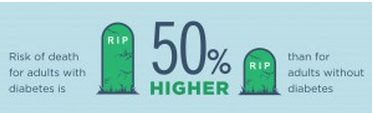
In each case, we kinda know what they meant. But they didn’t actually say what they meant. And I can tell you from my experience on Jeopardy that if you don’t say what you intend to say, Alex will take away your money. Not saying what you intended to say means what you did say is wrong, no matter how big you write your name.

And now, they’ve done the exact same thing for chronic disease…except that I really can’t figure out what they mean. “86% of healthcare spending is on people with chronic disease.” Even at 75%, this was already the#1 urban legend in all of healthcare. But 86%? Seriously? $6 out of every $7? Take out birth events, and it’s more like $11 out of every $12. Take out trauma, primary care, gynecology, imaging, sports injuries, and you’re already in mathematically impossible territory.
While this CDC whopper is bad news for frustrated fifth-grade math teachers everywhere, this sudden and unexplained boost from 75% to 86% is good news for the wellness industry. This timing is not likely a coincidence given the ties between the CDC and some wellness promoters. It comes at a time when the wellness industry is getting skewered in the media, employees (the actual end-users) hate wellness so much they need to be bribed or fined to submit, the industry’s own numbers don’t add up and when we change their numbers per their request, they add up even less,
Wellness industry executives never miss an opportunity to misinterpret a statistic they don’t understand, and the CDC is just begging to have wellness vendors misinterpret this as “Chronic disease now accounts for 86% of healthcare spending” — and push employers into more prying, poking and prodding. Of course, what they should be doing instead, based on the list of costly admissions below, is exactly what Quizzify proposes: educating employees on how to avoid harms of overtreatment, rather than pushing them into the treatment trap.
Funny thing, for an industry so behind the times that they still urge guys to get PSA tests (and fire them if they don’t, in one case we’ll be posting soon), wellness vendors didn’t let a minute go by before misinterpreting the CDC statistic, as we predicted. Here is Concentra, saying: “Chronic disease accounted for 86% of healthcare spending,” and if you read down, proposing more prying, poking and prodding.
A couple of weeks ago, Concentra decided even 86% wasn’t enough, so they added a little extra, just in case the CDC omitted a few cases of dishpan hands:

We hate to pour coffee on the wellness industry’s invalidity bender here, but someone has to provide actual facts, since the CDC seems to fear them as much as wellness vendors do. We’ve already posted the top 25 inpatient DRGs in the country for employees, both by frequency and by cost, and we’re posting them again below. As you can see, none of those conditions accounting for “more than 86% of health care spending” — nor any of their common complications — show up on this list. Instead, the overlap with anything that can be avoided with pry, poke and prod programs is almost zero. Even randomly, you’d expect more of an overlap, let alone if 86% of cost is due to things that 3-P programs address.
If that’s the case, how did the CDC come up with that statistic? It’s not sourced, so we have no idea. Our suspicion is that they’ve lumped a whole bunch more diseases in there, like maybe gum disease. So why not add tooth decay? Dandruff? Cellulite? Ring around the collar? They already list “stroke,” which is about as acute as diseases get. As we say in Surviving Workplace Wellness, every minute of delay after a stroke increases the odds you’ll end up like the Kardashians.” Likewise, they list cancer, as in: “My doctor says I have lung cancer, but we’re staying on top of it. He says I need to lose 15 pounds.” (For these two items, we do think we know what they mean. Some cancers stay with you but can be controlled, and disease leading to stroke is chronic…but that’s not what they said.)
Perhaps this 86% statistic is technically accurate for some health policy wonk parlor game where one player tries to act out a chronic disease, but it’s wrong on its face for any useful purpose involving employee wellness. For employees, it’s all about birth events, orthopedics, day surgeries, imaging, drugs, doctor visits, and a ton of one-time events, small potatoes, catastrophic illnesses, and/or none-of-the-above. While the CDC is busy lumping everything together into this 86% figure, we are recalling the opposite observation in Why Nobody Believes the Numbers that “everything in life has an 80-20 rule, and in healthcare the 80-20 rule is that 80% of the time, there is no 80-20 rule.”
Boys and girls, DO try this one at home…
Who Are You Going to Believe, the CDC or Your Own Eyes?
Before you answer, “Oh, our consultants told us to do more wellness,” try one thing. Try what we suggested above, for your own population. List the top episodes of care in total in your own organization. Here it is for the country as a whole:

As we’ve mentioned on multiple occasions, this list is populated with things no one can do anything about, as well as things addressed by Quizzify. Feed your population all the broccoli they can eat, and make them wear fitbits 24-7. You won’t prevent a single one of those DRGs.
Share this:

Podcast on wellness industry, for that morning commute
Howard Stern isn’t as shocking as he used to be, and snippets of news that repeat every 15 minutes are only interesting the first time around. You’re stuck in the traffic already and there are many ways to tell what the weather is (cold), so you don’t need “traffic and weather together on the 3’s.” And that classic hits station repeating the same 500 songs? Newsflash: We aren’t cool any more (I now freely admit I never was) and no amount of bouncing up and down playing “air guitar” and drumming on the steering wheel to “Jumping Jack Flash” is going to change that.
So why not try a podcast on the wellness industry? This podcast will tell you, as Paul Harvey would say, the rest of the story. It covers not just outcomes issues but also some lurid history, including how I originally “didn’t just drink the vendor KoolAid. I even mixed it up and sold it.” And how I abandoned a lucrative business brokering population health when I figured out the numbers didn’t add up and I had been accidentally telling my clients they were going to save money.
Two quick fixes that the producer can’t retroactively edit in. First: I accidentally said “Health Industry Research Organization” when I meant “Health Enhancement Research Organization.” My apologies to the former. I’m sure they would be upset to have been conflated with the latter. Second, the information about the University of California system canceling its wellness program for 200,000 people and not getting a single complaint was stated in HRDive but is disputed by the UCal system. I learned about this dispute only after I taped the interview. So in the immortal words of the great philosopher Gilda Radner, never mind. (A great link by the way)
These are both pretty minor in the overall scheme of things, but our policy is to correct (or at least give both sides of) every inaccurate or disputable statement that is brought to our attention. It is called “integrity” and the wellness industry ought to try it sometime.
Share this:
NY Times Economists Diss Corporate Weight-Shaming…but It’s Even Worse than They Say
We never post on Sundays. We are making an exception today on the theory that a lot of people in the Northeast are at home and would welcome the distraction. Here in Massachusetts it’s so cold that the Governor is urging people to stay indoors. Heck, we even decided to cancel Ultimate Frisbee.
This is now the seventh time that the New York Times —or its The Incidental Economist bloggers (“TIE” as they call themselves) — has observed that conventional corporate wellness doesn’t work. Links to the previous six instances follow this posting. Perhaps the seventh time will be the charm. Having covered every other angle except the actual health hazards of wellness, this TIE post specifically eviscerates “biggest loser” programs and their brethren.
HR executives may think they are “supporting” employees by holding weight-loss contests or paying them to lose weight. Unfortunately, all they are doing is reducing self-esteem, encouraging crash-dieting before weigh-ins, drawing attention to people’s weight, and — in addition to distracting employees from their actual jobs — distracting them from the one thing that benefits people of all sizes: exercise. It is much better to be “fit and fat” than fight a losing battle to keep weight off with various fad diets.
Further, the Body Mass Index, the 200-year-old metric wellness vendors still use to establish how much to pay or fine employees, turns out to be a very misleading measure of population health. (As “Brad F.’s” comment to a previous blog pointed out, BMIs may be of value if conducted as part of an actual physician-patient relationship. However, actual medicine is of no interest to wellness vendors, other than making people get useless annual checkups. Most physicians practicing actual medicine find wellness programs to be a misguided nuisance.)
Worse than The Incidental Economist says it is
The case against these programs is even stronger than TIE says. TIE supports its case by citing randomized control trials. But if RCTs are the Gold Standard, the Platinum Standard is wellness vendors’ consistent and total self-immolation in attempting to show their own program impact– despite ample opportunity to manipulate data, select motivated participants, ignore dropouts, and run ridiculously short “weight loss challenges” that end before the weight is regained. We love to cite ShapeUp as an example of that, having exposed them in the Pittsburgh Post-Gazette. (This was probably overkill on our part, but their CEO had thought a good way to get some attention might be to fallaciously attack our numbers even though his own figures were made up.)
Because great minds apparently aren’t the only ones that think alike, ShapeUp has plenty of company on the Biggest Loser List. Wellness Corporate Solutions has also been “profiled” on this site, largely for comic relief. Pfizer, where actively motivated employees lost a few ounces over a year, actually earned an award from Ron Goetezel for this stellar performance, as well as a spot on our Biggest Loser List. Our favorite example is McKesson. They also won one of Ron Goetzel’s Koop awards even though their average employee showed an actual increase in — you guessed it — BMI (and cholesterol):
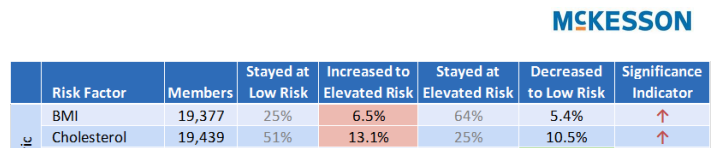
If award-winning companies can’t get employees to lose weight, who can?
And where would a Biggest Loser List be without Vitality, which pitches its weight-loss program to others but can’t even get its own employees to lose weight? If wellness companies can’t get their own employees to lose weight, who can?
Where we differ with TIE is on weight control interventions for school-age kids. They quote one definitive-sounding study, with 4600 kids in it. We don’t have a problem with the actual study. However, because the long-term health and social prognosis for obese children is negative, and because this problem is so pervasive, we ourselves would insist on a much higher level of proof and more experimentation with different program designs before throwing in the towel on these interventions. (We may very well end up agreeing with TIE when all is said and done. We would just like more to be said and especially done.)
As for employers, our recommendation remains the same: do wellness for your employees, not to them. This means supporting employees who want to pursue health goals, but otherwise just leaving them alone to do their jobs. Don’t even make them play Quizzify if they don’t want to. (But they’ll want to — we guarantee it.)
The Incidental Economist/New York Times on Wellness: A Chronology
September 2014 TIE says wellness “usually” doesn’t work.
October 2014: TIE headlines: “Wellness Programs Don’t Seem to Work as Advertised”
December 2014 TIE says: “We’ve said it before, many times and in many ways, wellness doesn’t save money.”
February 2015 TIE headlines “Another Call to Eliminate Employee Weight Loss Programs”
October 2015 New York Times says: “Provide us with your...weight, or pay up.”
November 2015: TIE headlines “The Feds Are Wrong. Lots of Wellness Programs Violate the ADA.”
Share this:

Did Healthmine’s Credibility Just Collapse?
A good rule of thumb: people who challenge the US Preventive Services Task Force — but lack the requisite knowledge, credentials, relevant education, support in the literature and any rationale to do so other than protecting their own revenues — should at least spell its name correctly.
Overscreening is central to the wellness vendor business model. If screenings were to conform to US Preventive Services Task Force (USPSTF) guidelines designed to balance harms and benefits in the best interest of the public, the whole industry would collapse.
There are three ways wellness vendors can preserve their overscreening revenue stream against this onslaught of the USPSTF’s scholarship and research. The first is simply to shut up and hope no one notices. That strategy works quite well, because when it comes to screening recommendations, many human resources directors trust their advisers, often an Animal House–type mistake [WARNING: hyperlink rated PG]
The second is the blame-the-victim strategy embraced by Optum’s Seth Serxner. According to him, vendors like Optum really, really want employers to send them less money to do less screening (perhaps their salespeople are on a negative commission schedule?) — but employers nonetheless insist on screening the stuffing out of their employees. His specific statement: “Our clients won’t let us screen” appropriately. Employers “deliberately” want to overscreen. Of course, neither he nor Optum, in followup conversations initiated by Optum (saying I made them “look bad” by quoting Mr. Serxner), shared any examples of this despite repeated requests. (The unabridged statement is on the “Great Debate” tape, which hasn’t been posted yet.)
Healthmine’s Bryce Williams has a third strategy, which is to publicly announce Healthmine’s decision to flout the USPSTF guidelines. He says he is right and everyone else — specifically including the “US Preventative [sic] Services Task Force” — is wrong. A real doctor making this pronouncement might be risking his or her license. Fortunately for Mr. Williams, being a wellness vendor doesn’t require a license, so regardless of the harms a wellness vendor inflicts on employees, no one can take it away.
In addition to spelling the name of the group he is attacking correctly, we might also recommend that he not misquote the sources on which his faulty argument is based. We’re just sayin’…
For starters Mr. Williams declares: “One out of every two people in America has at least one chronic condition according to the CDC, and many more are at risk for developing one.”
Here’s what the CDC really said: “One out of every two adults has at least one chronic condition.” And if you dig deeper, you see that this list of chronic conditions cited by the CDC includes arthritis, mental illness, eye disorders and asthma, none of which Healthmine’s hyperscreening is going to reveal.
He also claims that “chronic diseases account for $3 out of every $4 spent on healthcare.” Here’s what the CDC really said: $3 out of every $4 “is spent on people with chronic conditions.” That is a much broader statement. It would include someone with borderline hypertension giving birth. That figure also includes the retiree population, where chronic disease is far more prevalent than in the working-age population relevant to wellness. In any event, we long ago eviscerated Mr. Williams’ cherished myth and just this week showed that essentially none of the top 25 hospital admissions has anything to do with screening, broccoli, or Fitbits.
Most importantly, Mr. Williams was apparently absent the day the teacher explained arithmetic. Suppose you screen 1000 employees for a 1-in-1000 hidden pathogen or disorder and your test is 90% accurate. 900 employees will test negative, as they should, and the remaining 100 employees will test positive. Since only one of those hundred employees actually has whatever you are screening for, your false positive rate is: 99%. In addition to costing a fortune to follow up on all those false positives, imagine the angst and harms from overtreatment that can befall those 99%.
If you do work out the false-positive math, you’ll see it costs at least $1 million to find and prevent a heart attack via a workplace wellness screen. And that assumes half the at-risk employees identified in the screen change behavior, whereas the last company to win a Koop Award, McKesson, had roughly 1% do those things.
None of this is to say that the USPSTF can’t be challenged. But a challenge shouldn’t be based on misspellings, misquotes, and misunderstandings of the way arithmetic works.
Mr. Williams closes with a quote that hopefully someone can explain to us because we can’t decipher it. He asks: “Which is more expensive: Over-testing or over-screening? We don’t have a definitive, quantitative answer. But let’s make sure we are asking the right question.”
We have no idea what the “right question” is, except that it’s not the one he’s asking. My vote would be: “Why are these people allowed to deliberately harm employees and there’s nothing anyone can do about it?”
Share this:
Has the “Epidemic of Chronic Disease” Gone MIA from the Workplace?
Looks like employers have been fighting the wrong battle: fat employees are not the bad guys. So stop letting wellness vendors harass your employees about their BMIs, and start creating a safer, healthier work environment instead, using the tips below.
Wellness vendors live by the mantra that “75% of healthcare spending is due to preventable chronic disease.” Some variation of this appears 200,000 times on google. For instance, Johnson & Johnson (the same Johnson & Johnson proposing that companies disclose the number of fat employees to shareholders) says: “chronic diseases, most of which are preventable, account for 75%” of healthcare spending.
Leading wellness defender Ron Goetzel, in our soon-to-be-released debate tape, upped the ante. He says companies should do wellness because 80% of their cost is due to mostly preventable chronic disease.
A few observations about this claim. For starters, if I had one of the many non-preventable chronic diseases afflicting mankind, I might be offended by this blame-the-victim generalization, but maybe that’s just me being hypersensitive. And wouldn’t this statistic literally mean that if you eat broccoli, wear Fitbits, and (as recommended by Johnson & Johnson, among others) get your annual useless and possibly harmful checkups, you can live forever?
Plus, that whole 75%-(or 80%-)of-spending-due-to-chronic-disease epidemic-in-the-workplace cliche turns out to be a complete urban legend.
But rather than argue with these people, we will simply quote them, since the wellness industry’s own worst enemy is their own data. It turns out that healthcare is not about the broccoli. And Ron Goetzel’s own company, Truven, has published exactly the opposite of his sound bite — wellness-sensitive hospitalizations are rare in commercially insured populations. In the HCUP database that Truven maintains for the government, the top 25 commercially insured hospitalizations are:

To paraphrase the immortal words of the great philosopher Clara Peller, where’s the broccoli?

There is none. instead, the corporate mania of massive overscreening, broccoli, Fitbits and the now-fully-discredited employee BMI jihad is distracting companies from noticing exactly what actually does drive hospital spending and hence where prevention opportunities arise. Here are some random observations about Truven’s revelation:
- The musculoskeletal category certainly has many preventable opportunities. Ergonomics is one. Exercise classes, for sure. Benefits design and education to include encouraging access to lower-cost care is another. Reference pricing is one more. And opiate abuse is also tied into this category…but doesn’t get remotely the attention accord to cholesterol, or even seat belts.
- A lot of items on this list shouldn’t be there at all. Spinal fusion? Stents? Hysterectomies for non-cancers? Many of these procedures are unnecessary and/or harmful. (We know it’s not always about us, but the Quizzify business model helps educate employees on avoiding harms.)
- The wellness industry is ignoring the actual preventable hospitalizations in order to focus on the only thing that generates revenues for them, which is to”pry, poke and prod” employees, make them try to lose weight, and insist that they “know their numbers.” And when employees fail, they forfeit money back to their employer, which is what finances these programs in the first place.
- Why hasn’t Ron Goetzel told his wellness friends about this database his company maintains? Why is he running away from his own company’s great insights? Why doesn’t the Koop Award recognize companies that address these issues? Why is there not a single mention of this database in any of his writings?
- Despite the wellness industry’s breathless hyperdiagnosis of cardiometabolic disease due to rising BMIs, there are no diabetes events on this list. And the only cardiac events are arrythmias (no amount of broccoli will prevent them) and heart events other than heart attacks. Those events (like angina) have warning signs and symptoms, so you don’t need to hunt for them at great expense. (Heart attacks themselves are way down at #70 and #85.)
- Hospital infections appear twice on this list (#12 and #23). These could be addressed with benefits design: pay hospitals a few dollars more for each case, but don’t pay them at all for hospital errors and infections…and sit back and watch them clean up their acts, literally and figuratively. Speaking of which, why doesn’t every major employer join the Leapfrog Group and quit the National Business Group on Health instead, which still promotes biggest-loser competitions and overscreening?
- Finally, why is the government (both President Obama’s EEOC and the GOP-controlled Congress) encouraging employers to harass their employees with “pry, poke and prod” programs instead of helping employers and employees avoid low-value care? Employers can demand intrusive medical exams and even employee DNA. But they can’t simply tell employees: “You need to complete this education module before demanding low-value care.” (Quizzify has created some workarounds here, of course.)
Isn’t the right approach to look at the actual data before racing ahead with a program? Of course, but the wellness industry prefers the Yogi Berra approach: “We don’t know where we’re going, but we’re making good time.” Isn’t the right approach to tailor the solution to the problem? Of course.
But they won’t. In the immortal words of the great philosopher Upton Sinclair, you can’t prove something to someone whose salary depends on believing the opposite.
A commenter suggested doing this by costs instead. You get different DRGS…but still no wellness-sensitive medical events:

 They Said What?