

“Springbuk does not certify the information, nor does it guarantee the accuracy and completeness of such information.”
Home » Articles posted by whynobodybelievesthenumbers (Page 26)
Author Archives: whynobodybelievesthenumbers

Just sit right back and you’ll hear a tale, a tale of wellness incentives

It turns out that the “answer” to the question of whether and when wellness incentives work can be found in the theme song to Gilligan’s Island. Who would have guessed?
As is the new TSW policy, when we don’t “profile” various perps in the wellness industry by name, we do our postings on the Corporate Wellness magazine website. So you’ll have to visit there to see the details.
Share this:
Springbuk wants employees to go to the bathroom
Oh, so lovely sittin’
Abso-bloomin’-lutely still
I would never budge till spring
Crept over me window sill
–Eliza Doolittle
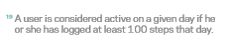
Springbuk has found the key to dramatic reduction in healthcare spending: getting out of bed. It doesn’t matter whether it’s to eat, find the remote, or, of course, pee. Just do something, anything, other than lie in bed all day — and you count as an “active” person who saves a ton of money, as compared to people who never get out of bed. Yes, Springbuk classifies you as “active” if you take at least 100 steps a day:
My question, for now, is not about how all this money was allegedly saved. Rather, my question for now is: how did these “less active” people — a huge chunk of the total population studied –manage to take fewer than 100 steps a day in the first place? Consider this random floor plan:

Now overlay the steps you take just in order to get up in the morning. A one-way trip to the bathroom and then to the breakfast nook appears to require about 20 steps. You haven’t even had your coffee yet and already you are a fifth of the way to your daily goal.

Speaking of coffee, add in a few more trips to the bathroom and <voila> you’ve reached your steps goal. Conclusion: it is impossible not to walk 100 steps a day, unless you want to starve to death, burst your bladder, or work at Spacely’s Sprockets. We wouldn’t recommend any of those three, especially the last, a very high-stress environment.


As a sidebar, I would note that George Jetson ironically has a lower BMI than Fred Flintstone, thus showing that taking more than 100 steps a day doesn’t reduce weight. Nor does a paleo diet, apparently. (Portion sizes might have something to do with it.) On the other hand, Fred can power his own car, thus showing the value of maintaining health at any size.



The Economics of Getting out of Bed
And needless to say, Springbuk provides some very compelling economics about the cost savings impact of getting out of bed. 100 steps a day for only 274 days a year (meaning you can take a well-deserved breather on weekends, holidays, vacation days and Beethoven’s birthday) generates a dramatic 28% reduction in costs. Wow! Who knew that peeing, eating, and looking for the remote (try your fridge or dresser drawers) could be so beneficial to your health?
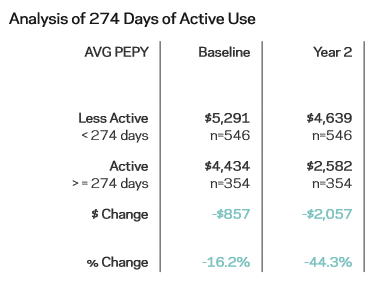
Springbuk has additional bad news and good news.
The bad news is that taking 100 steps a day for more than 182 days (as opposed to more than 274 days) makes only a 3% differential impact on health spending, vs. taking 100 steps a day for less than 182 days. Still, there is some good news, which is that staying in bed for half the year also generates a huge reduction in costs, 31% to be exact.
Springbuk didn’t mention this, but the only way both these findings could be consistent would be that people –we will call them “semi-active” — who take 100 steps on more than 182 days but fewer than 274 days must have ridiculously high, off-the-charts healthcare spending and presumably morbidity. Apparently, moving those semi-active people between “less active” and “active” swings overall healthcare spending for the entire population by 25%.

The implication, as any exercise physiologist would tell you, is that starting in January, you need to track the number of days on which you take 100 steps. If you get to 181 such days by late summer, but don’t think you can make it to 274 days by the end of the year, then your best bet, statistically speaking, is to stay in bed until the ball drops in Times Square. Your bosses will love you for it, because you’ll be saving them 31%.

Naturally, Springbuk’s findings contradict all the other findings on wearables showing trivial changes in activity due to wearables after a short burst of interest. These trivial changes predictable show only trivial improvements in health and costs.
And someone should tell the Einsteins at Springbuk what anyone with a triple-digit IQ could intuit and what every other study shows: that a typical American takes many times more than 100 steps a day. 6886 steps per day, according to one study. So Springbuk’s study is wrong, making them eligible for a Koop Award.
Springbuk’s analysis may be wrong for another reason too: It does not account for the health hazards of taking too many steps. (Yes, you need to click through for the punchline.)
An accurate line in this report
I can’t believe I missed this, but Pete Aren didn’t, and pointed it out on linkedin. There is indeed one accurate line in their report, buried in the footnotes:
Share this:

Testing employee prostates is the new black.
After considerable deliberation by our management team and Board of Directors, and after putting it to a vote of the shareholders after consulting our bylaws, we have adopted a new policy of moving all posts not actually calling out vendors by name to The Corporate Health and Wellness Association website. The only problem with that website for this article is that no article on prostate testing is complete without mentioning Interactive Health and their policy of testing your prostate whether you like it or not, or even whether you still have one or not.
So visit our follow-up prostate cancer post there. (The initial prostate article can be found here.)
Coming soon on this site: Is Interactive Health the new Wellsteps?
Share this:

Top Ten Things Wellness Vendors Don’t Know about Employee Weight
Because I didn’t mention any names, I published this one on the Corporate Health and Wellness Association blog. So you’ll have to click through. SPOILER ALERT: the bad news is that there are a boatload of things — 10, to be exact — that wellness vendors don’t know about BMI.
The good news is, there some things wellness vendors do know about BMI, like how to spell it. This is a big accomplishment, because spelling is right up there — along with arithmetic, integrity, behavior change, and of course wellness itself — on the list of things that most befuddle wellness vendors. We’ve chronicled many examples, such as Wellsteps’ Steve Aldana calling award-winning journalist Sharon Begley a “lier.”
Our favorite:

Share this:

Health News Review’s wellness “debate” podcast
Health News Review just podcasted a wellness “debate.” I put “debate” in quotes because the other side — the Health Enhancement Research Organization — refused to participate, according to the moderator. The strategy of the Wellness Ignorati is to avoid actually telling anyone what they do, on the theory that the more people who know what they do, the more likely they are not to be able to get away with it any more.
It’s a brilliant strategy, because transparency is one of their five worst nightmares, the other four being facts, data, outcomes, integrity, and me.
Share this:
USPSTF announces the Urologist Full Employment Act
The United States Preventive Services Task Force (USPSTF) just announced that for men aged 55 to 69, the Prostate-Specific Antigen (PSA) test grade is improving from a “D” to a “C.” Needless to say the media overhyped this ever so slight grade inflation, with headlines like: USPSTF Could Drop Its Opposite to Routine Prostate Screening. Reading beyond the headlines reveals not that you should run out and get your prostate screened. Rather, you should talk to your doctor about it. Hardly a ringing endorsement by USPSTF, and probably only reflects what is already happening during checkups.
Even so, we looked at the exact same data the USPSTF is looking at…and we still don’t want to be screened:
If 1000 men have the PSA test, 240 will have a positive results, and 100 will have a positive biopsy which shows cancer (but 20-59% of these will be cancer that does not grow, spread or harm the individual). Of the 100 with a positive biopsy, 80 will choose treatment (surgery or radiotherapy), and 60 will suffer serious complications (including incontinence and impotence), with the net results that 3 men (out of the initial 1000) will avoid metastatic disease and 1-2 men will avoid prostate cancer death.
Surgery? Incontinence? Impotence? I’m onto Wife #2 (#3 if you count the one who died…), and without getting into TMI here, the whole point of having a Wife #2 seems to be at variance with this USPSTF recommendation.
But let’s keep going. One or two men (of this 1000) will avoid prostate cancer death. Since there are about 26,000,000 men in that age cohort, it seems like the benefits of PSA testing would be high. Let’s take the low, conservative estimate that 1-in-1000 will be saved. That’s 26,000 lives saved through the PSA test. Not bad, I must admit.
But then I do that thing which wellness vendors hate — a plausibility test. Turns out that annually only 26,000 men die of prostate cancer to begin with. Presumably some number of them — let’s say 11,000, yielding 15,000 — are not in the 55-69 year-old age category. Unless, then, that prostate test is better than perfect, something is amiss. It wouldn’t be possible to save more than 15,000 lives.
A close read reveals the missing link: to get this 1-per-1000 benefit, you’d have to be screened for up to 15 years. So in any given year, only 1/15th of these estimated 15,000 men would have their lives saved. Or something like that. That’s 1000 lives saved annually, or possibly 2000, if it’s 2-per-1000.
Some Perspective Here, Folks
- Annual number of Americans who would be saved by PSA tests: 2000 (high end)
- Annual number of Americans who would have serious complications due to prostate cancer treatment: 60,000
- Annual number of people struck by lightning worldwide: 240,000
Or for those of you who prefer visual learning, squint really hard:

So, yes, I will take the USPSTF recommendation to “talk to my doctor,” and tell her to please leave my prostate alone or I’ll find another doctor.
Share this:

Insurance Thought Leadership Joins In
They just reposted this article,with the title “A Wellness Program Everyone Can Love.” Heck, if I can love a program, so can anybody else, right?
Spread the word…wellness is ba-ack.
Share this:
Wellness 3.0: A Wellness Program even Al Lewis could love
I like wellness now.
This is not an April Fool’s joke. Wellness 3.0 — the 401W Savings Plan — solves the major problems of wellness:
- Voluntary — yes (for real, not “voluntary” as in “drag you off the airplane”);
- Popular — well, probably not unpopular, which is a huge advantage over current configurations;
- Effective — hey, it can’t be less effective than current offerings, and is likely to be more effective since incentives are totally aligned;
- Affordable — yes. This is affordable because screening is done according to USPSTF guidelines, which means infrequently, which offers considerable savings;
- Consistent with Code of Conduct — yes. It would still be possible to violate it using Wellness 3.0, but you’d have to try very hard.
It has many other attributes as well, as the article shows. Cheating would no longer be an issue because no one would need to cheat. No PHI, meaning no HIPAA issues. No EEOC concerns, not that the EEOC cares about employees any more. And retention should increase.
Share this:
New Ocean Health Solutions Declares War on Decency (WARNING: Rated R)
Get a jump on April Fools Day by watching this New Ocean Health Solutions video on HRAs, preferably not in a public place. Here is a screenshot. no explanation required.

Three other breakthroughs for this very disruptive program:
- First wellness company that could defend itself from a lawsuit by citing the First Amendment
- First wellness company website requiring parental controls.
- First wellness company to be fully transparent.
Share this:

NYT: A first-person account of Preserving Employee Wellness Programs Act
Nothing like a first-hand account to drive a point home.
It’s hard to imagine HR1313, the Preserving Employee Wellness Programs Act, getting any worse press than it has already gotten, but the NYT just published that account –penned by someone who would be a victim of it, in the increasingly unlikely event that it ever gets signed into law.
The name is a bit misleading. HR1313 should be called the Employee DNA Full Disclosure Act.
The Ethical Wellness group has already pilloried this. Ron Goetzel and the rest of the Wellness Ignorati at the Health Enhancement Research Organization have remained stone-cold silent on this, being trapped between the drool-worthy profit potential and the fact that even they realize this is a stupid idea. Yet until now there has been no wellness idea that was considered too stupid for them to support, meaning that this silence is precedent-setting. Remember, these are the folks who want to institute a “fat tax,” and charge for insurance by the pound.
Show your support for ethical wellness by going to the website, and joining our linkedin group.
 They Said What?