
Home » Articles posted by whynobodybelievesthenumbers (Page 48)
Author Archives: whynobodybelievesthenumbers
An Employee Describes Her Personal Wellness Program Experience
Rants by actual employees subjected to wellness programs are pretty easy to come by. In that respect, the Change.org petition against the Goetzel-Penn State program is basically the Greatest Hits compilation.
Here is one of our newest favorites, that just came in over the transom last week, reprinted word-for-word with identifiers removed and a little punctuation added–and, as you can see a few lines down, a soupcon of bowdlerization.
Since we now know wellness has no ROI, perhaps this is what the Wellness Ignorati mean by “value on investment” — if employees quit as a result of wellness programs, you can save the severance pay from firing them.
My husband and I have had the joy of recently completing our wellness assessments. Here is my rant.
First, it’s a giant pain in the [gluteus maximus]. Second, the questionnaire could not have been more ridiculous and third, my doctor didn’t really do anything with it. She just gets to bill an unnecessary office visit [to my employer] in order to sign a form.
On the first topic, the questionnaire took 45 min for each of us, plus the inconvenience of having to schedule and go to an appointment we didn’t need. And in my case, having just gone through 9 months of prenatal care, labor and delivery care and postpartum care on top of all the newborn appointments, the last thing I needed was another doctor’s appointment.
On the second point, the questions they asked were terrible for assessing my actual health. There was an obvious right answer in every case, and it seemed to want to judge my mental health/level of happiness more than actual health. “Think of yourself on a ladder in terms of xxx (happiness, social status, personal accomplishments). What rung on the ladder would you place yourself, 1 being the lowest and 10 the highest?” How does that assess my health? It’s a personal fulfillment questionnaire that also asks if you exercise. At the end they ask for all these lab values which I don’t have and my doctor didn’t think she was supposed to request so they aren’t filled out at all.
And on the last point, my doctor never looked at the 30 page final assessment that I had to print and she just asked me if I think I’m healthy and I said yes. She was fine with that. The only thing she told me was that I could lose a few pounds to get my BMI in the right place – well OF COURSE! I just had a baby, which on a side note is not a part of the wellness assessment at all. There are all these questions about how much sleep I’m getting, am I stressed, etc… but no accounting for the natural things that happen in life like a newborn.
Share this:

Prediction: Wellsteps-Boise School District wins 2015 Koop Recognition
We are going to make a prediction. We might be wrong, though, because in the immortal words of the great philosopher Yogi Berra, “It’s tough to make predictions, especially about the future.” We predict that the Boise School District, a Wellsteps customer, is going to win the 2015 Koop Award. At a minimum, they will get an honorable mention.
We base this prediction on three insights. First, as our previous posting shows, the award tends to go to the program that spews the most nonsense. Specifically, to the one that ignores both biostatistics and fifth-grade math most creatively. Obviously, Wellsteps misunderstands the statistical concept of regression to the mean. Misunderstanding biostatistics is a requirement for being a wellness vendor. What’s more surprising is that they were absent that day in third grade when the teacher explained the law of math that numbers can’t increase and decrease at the same time. Laws of math tend to be strictly enforced.
In all fairness, it is possible that both Wellsteps’ claims are true: total costs may very well have declined even as cost/person increased. The Boise School District might simply employ or insure fewer people in 2014 than in 2011. Or maybe the Wellsteps program was so unpopular and worthless that employees opted to get insurance through their spouses. But even the most dishonest wellness vendor with the most clueless customer wouldn’t claim credit for a reduction in costs due to fewer people being insured. And even the ethically challenged Koop Committee isn’t dishonest enough to endorse a claim that blatantly specious.
Second, the award almost always goes to a client or customer of a Koop Award Committee member, or to a client or customer of a sponsor of the Committee. Wellsteps’ Steve Aldana sits on the Committee. All the other vendors and sponsors on this Committee have already been graced with an award for one of their customers. So now it’s Wellsteps’ turn, as they have yet to win one for a customer of any size. (This partly reflects their lack of customers of any size.)
After all, why even bother being on this C.Everett Koop Award committee if you can’t give a C. Everett Koop Award to yourself? Isn’t that what Dr. C. Everett Koop was all about — self-dealing, cronyism and corruption? (not)
Third, the timing of the “White Paper” Wellsteps just published is quite fortuitous. Sort of like in World War I, when one side knew an infantry attack was coming because it was preceded by an artillery bombardment by the other side, Wellsteps is preparing us for more “over the top” claims of success in a program that — by their own admission — was a total failure at controlling costs through 2013, and only did OK in 2014 because the cost of non-participants declined precipitously.
Fourth, if the Committee was at all on the fence, our posting last month would have helped them decide in favor of Wellsteps. One thing this Committee enjoys doing is showing us that facts and math doesn’t matter because their customers don’t read our material. The more outrageous their claims, the more they like to rub our faces in the reality that very few people in human resources care what we have to say.
This isn’t because they have, to use Mr. Aldana’s hilariously misinformed term, I-don’t-care-itis. Instead it’s because most HR executives don’t hear what we have to say, as we are blocked from most linked-in groups run by members of the wellness ignorati.
We are actually quite proud of the enemies we’ve made…but even so would appreciate if you could re-post this.
Update: it is also possible that Wellsteps didn’t get their act together in time to apply for this award–applications were due in May and their White Paper just came out last month. In that case, we’ll look forward to revisiting this post next year.
Share this:
Koop Award Committee-meets-Sergeant Schultz
Ever wonder why no one notices that wellness results are completely made up?
Wonder no longer. it all starts with The Health Project, which gives out the C. Everett Koop Award. This month is award season, meaning some of the award’s sponsors or committee members gets to ingratiate themselves with customers. In honor of this month, let’s review previous years’ awards, and see the self-invalidating, but somehow unnoticed, details that call to mind the immortal words of the great philosopher Sergeant Wolfgang Schultz: “I know nothing. I see nothing. I hear nothing.”
To that iconic phrase, the Koop Committee adds: “I notice nothing.”

2014: British Petroleum (BP America)
Last year, the award went to British Petroleum. BP’s candidacy wasn’t exactly a longshot, since both its vendor (Staywell) and its consultant (Mercer) are on the Committee AND are “sponsors” of this volunteer committee. By the way, if you’re looking for any disclosure on the award announcement of those connections when you click through on the first sentence above, you’ll need x-ray vision, since there is none. No one seems to have noticed this omission.
Besides not understanding ethics, apparently Mercer and Staywell don’t understand arithmetic: their “rigorous analysis” claimed almost $20,000/person in savings for active participants who reduced a risk factor. Besides being mathematically impossible, clinically laughable, unchecked for plausibility in violation of their own HERO guidelines, and not adjusted for dropouts and non-participants, this figure, as the screen shot below shows, is over 100 times more than Staywell itself says is possible. Once again, no one seems to have noticed this glaring contradiction.

2013–GRACO (honorable mention)
Ron Goetzel has written at length about Graco, as have we and others. By starting the measurement in 2009, the year after the program started (as opposed to starting the measurement two years before the program started — see the 2011 award winner, Eastman Chemical), and “forgetting” to count revenues added by an acquisition. Mr. Goetzel was able to tie the growth in Graco’s revenues to the “bottom line performance” of its wellness program. Of course, when you actually start measuring the year the program actually started (2008) — which coincidentally was also the year before the recession knocked 29% out of Graco’s revenues — and then adjust for the 2012 acquisition’s added revenues, Graco organically grew at about the same rate as everyone else. Wellness had nothing to do with it. Graco’s salespeople did not exceed their quotas because they ate more broccoli.

Here’s what else didn’t happen due to its wellness program: savings. As our post showed, Mr. Goetzel didn’t notice that the cost trend for children (none of whom were in the wellness program) outperformed the cost trend for wellness participants. This means, of course, that the favorable trend among participants couldn’t be attributed to wellness, since the trend for a cohort without access to wellness was even more favorable. It’s all right here.
Oh, yes, and it also turns out that Graco’s insistence on making its employees go to the doctor was more likely to harm them than benefit them. That’s not us–that’s the New England Journal of Medicine.
2012: The State of Nebraska
We’ve already chronicled this one at length. There were quite a number of glaringly obvious rookie mistakes that escaped the notice of the award committee, either due to incompetence or perhaps the fact that the state’s vendor, Health Fitness Corporation (HFC), was also a sponsor of the award. See if you can find that sponsorship disclosure in their press release “congratulating” the State and LL Bean (the other winner, also a customer of HFC). You’ll need an electron microscope to go with your x-ray vision.
HFC actually admitted lying about saving the lives of cancer victims who as it turned out didn’t have cancer, but still got the award because, according to Ron Goetzel at the 2014 Datapalooza conference, apparently this particular lie didn’t count because it wasn’t on their application, just everywhere else. It was impossible to miss, but Ron said he didn’t notice. Is this a great country or what?
2011: Eastman Chemical
Another HFC customer. (HFC is really getting its money’s worth out of its sponsorship.) This was the one where — unlike 2013’s Graco, which started measuring outcomes the year after the program started in order to maximize the results — HFC started measuring outcomes two years before the program started in order to maximize the results. They separated participants and non-participants in 2004 but didn’t start the program until 2006. By 2005 the would-be “participants” were already 9% ahead…and by the time the program got underway in 2006, they were almost 20% lower-cost than the non-participants.

Once again, all this information was perfectly obvious at the time of the award submission, as well as highlighted in all of my books. It was also re-printed and re-presented multiple times, but somehow no one on the Koop Committee noticed until late 2014, when it was in Health Affairs. At that point, the light being shined on him being too glaring to hide from, Mr. Goetzel had to respond. Employing the passive voice to great advantage, Ron said the slide was “unfortunately mislabeled.”

Read that carefully. If it’s hard to read, here is the source. It’s towards the bottom. He says this slide and other data “convinced” the Koop Committee to give them an award. That’s his story and he’s sticking to it.
Recently, for the second time, he went back into the Koop Award submissions and rewrote history. Compare the original Koop submission screen shot with the photoshopped version. Note the missing X-axis:
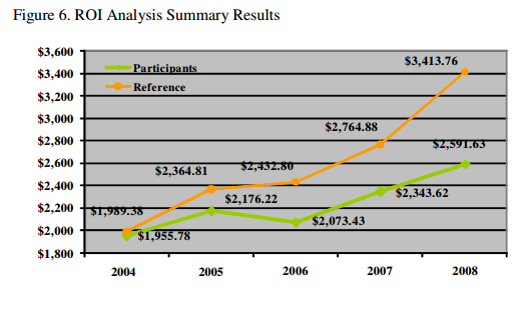
The original was:

His explanation didn’t indicate who mislabeled this slide, why he didn’t notice until now, why he snuck into the old files to relabel it, what the labels should have read — or why HFC never apologized, as others outside the wellness industry do when mistakes are made.
I can explain the last — just look at the wellness industry motto, on YouTube: “A Koop Award means never having to say you’re sorry.”
2010: Pfizer
None of Pfizer’s outcomes figures stand up to even the slightest scrutiny, and Mercer did the analysis — making Pfizer a shoo-in for this award. By their own admission only 4% of people moved out of high-risk status. (Naturally this tally excludes non-participants and dropouts, who likely increased risk factors at a faster rate than participants reduced them.) In other words out of 30,000 employees, 1200 reduced a risk factor. And yet somehow Pfizer saved $9.4 million, almost $9000 per risk factor. So if everyone at Pfizer reduced a risk factor, they’d easily wipe out all their healthcare spending.
They did some secure messaging, but only about a quarter of the at-risk population even opened their messages…and only about a quarter of them clicked through to the messaging.
Smokers self-reported at 6% before the program and 3% after it. No one hazarded a guess that perhaps some employees were, oh, I dunno, lying?
However, no one can accuse Pfizer of lying about their weight loss results. In particular check out this comparison, which was offered with a straight face, of employees who read their weight-loss messages vs. employees who didn’t.
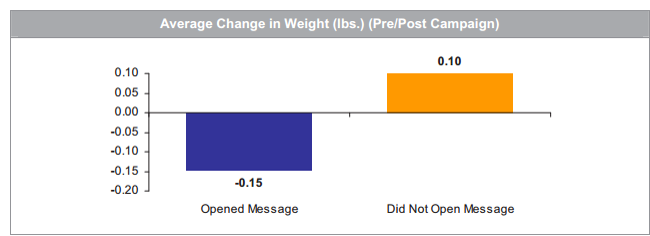
Over the course of the study, people who didn’t read their messages gained 1.6 ounces while employees who did lost 2.9 ounces. You could practically attribute that differential performance to the calories required to open the emails.
Share this:

Book Review: An Illustrated Guide to Personal Health
A company wanting to replace the advice given on health risk assessments with actual good advice need look no further than An Illustrated Guide to Personal Health, by Tom Emerick and Robert Woods.

It’s very entertaining, laced with clever illustrations and apropos quotes, but most importantly contains some of the best common-sense health advice you’ll ever read. Not coincidentally, virtually none of this advice shows up in wellness programs. The true determinants of health aren’t how much broccoli you consume or those other tired cliches spouted by wellness vendors, but rather things like your social network, your ability to avoid medical care except when needed, whether you like your job, enjoy your hobbies etc. Forced wellness programs, designed to make employees happy whether they like it or not, just get in the way of true well-being.
In addition to reinforcing good common sense, the book provides a few good tidbits that I myself didn’t know…and that are immediately going into the Quizzify quiz database. Like not using antibacterial soaps. (Who knew? I mean, I don’t use them, but I had no idea of the hazards of those antibacterial chemicals.) Indeed, one of the messages of the Illustrated Guide is that most bacteria are our friends. Or, as our parents used to say, they are much more scared of us than we are of them. One chapter is called: “Let Kids Play in the Dirt.” Really, if dirt were bad for kids none of them would reach adulthood. Common sense, and yet we all know of kids with all sorts of allergies, many of whom were raised almost aseptically.
A great deal of the advice mirrors that of Quizzify closely enough that one idea for a wellness program would be to let employees take the quiz (giving them $1 for every correct answer) after they read the book. Example of the separated-at-birth advice common to both: regardless of what Keas says, don’t routinely swallow multivitamins or vitamin pills of any type. With the possible exception in certain circumstances of Vitamin D and Niacin (and folic acid for pregnant women), they are more likely to harm you than benefit you. And do you even know anyone who has a vitamin deficiency?
Most importantly, An Illustrated Guide is easily digestible, fun to read and in terms of health, the perfect antidote for the stress caused by pry-poke-and-prod wellness programs.
Share this:

Altarum Executive Speaks Out Against Wellness Despite Altarum’s Presence on Koop Committee
Ron Goetzel has a tough enough job already because every article about wellness appearing anywhere but his obsequious trade journals is bad news. That means he has to spin them and/or hope vendors and consultants can prevent their customers from seeing them. (Example: we have been banned from most wellness-oriented linkedin groups. That’s a smart strategy on their part since no one other than us in those groups is going to publicize these articles.)
Also, in our upcoming debate, he needs to defend the indefensible proposition that wellness saves money, when – as his co-authored HERO report shows – he can’t even defend that proposition against findings in his own report. Likewise, he will have to explain how, even though he’s sure wellness saves tons of money, he won’t attempt to claim a $1 million reward for showing it merely breaks even.
But the unkindest cut of all: he now has to face down a revolt amongst his own Koop Committee members, who are the self-proclaimed leaders of the wellness industry. True, they do “lead” the wellness industry in two ways. The first is their analytical leadership. Combined they lead the industry in self-invalidation. We’ve found 10 instances of made-up data–including three by Mercer, two by Health Fitness Corporation, two whoppers by Wellsteps, and three others. Indeed, it was the Koop Committee’s fuzzy math that inspired the line in our book: “In wellness you don’t have to challenge the data to invalidate it. You merely have to read the data. It will invalidate itself.”
Second is their ethical leadership: when Koop Committee members bestow Koop Awards upon their own customers (meaning themselves), a la Nero and the Olympics, their press releases never mention that they sit on and/or sponsor the Committee.
Specifically, Dr. Goetzel now has to explain an employee of one of the most respected organizations ever to be represented on that committee (some might argue the only respected organization on that committee other than Procter & Gamble), just came out against wellness.
Jim Lee, Vice President of the Altarum Institute, just wrote a blog post to that effect. Note: Jim Lee’s views represent his own, not Altarum’s, but you don’t see anyone at Altarum rushing to rebut him.
To put this in perspective, this is equivalent to the time Reagan’s budget director, David Stockman, spoke out against Reagan’s economic policy. Tip O’Neill would be expected to oppose it…but David Stockman? He was exiled as a result.
By way of background, Altarum is a nonprofit whose motto is: “Systems research for better health.” We urge people to visit their website to learn more. Dr. Goetzel apparently didn’t foresee that if you invite an organization known for its integrity onto your board, there is always the chance that members of that organization — acting on their own (as in this case) or on behalf of the organization — will demonstrate, well, integrity. We have noted often that integrity–and its cousins, facts and validity–are the wellness industry’s worst nightmares.
Altarum is not the first organization where an employee of a member organization didn’t toe the Koop Committee line. Another (current!) Koop Committee member, Debra Lerner, also questioned the value of wellness.
Specifically, Altarum Vice President Jim Lee, writing on his own blog (not the “official” Altarum website — these are his own views) cited the pro forma annual wellness visit to the doctor as an example of “low value care.” I urge you to read the full posting rather than just the highlights below, because in all fairness, his criticism is a bit more muted than the highlights might imply. He does say that he personally found value in that visit—though he noted he ended up back at the doctor for a real reason two weeks later and covered the same ground, thus making the actual “wellness visit” superfluous.
Altarum (until now, at least) paid its employees to get these wellness visits. When he reported this example of low-value care to his colleagues, he writes:
“I was pleasantly surprised to see the eye rolls, sighs, and strong reactions even from well-regarded prevention advocates regarding its low value. It is not just new, expensive technologies and medications that are running up our nation’s health bill.”
He also reported that: “Altarum Institute [just] had its annual Biometric Screenings, which cost about $70 per person plus $200 in incentives deposited into our health savings accounts [for] Altarum employees [who] completed the biometric screening and annual wellness visit.”
His conclusion? To recommend to the director of Human Resources that they end this requirement and save “a few hundred thousand dollars.” He admits this would also “annoy his colleagues,” who would lose the $200 incentive. (The best part of wellness is getting, in the immortal words of those great philosophers Dire Straits, money for nothing. Lee recommended taking that perk away in the interest of efficiency and avoidance of overdoctoring.)
Yes, we know it’s not always about us, but too bad he didn’t know about Quizzify – he could tell his HR department to offer that instead, so that employees could still get their $200, but by actually learning something useful about how “just because healthcare doesn’t mean it’s good for you.” Altarum wouldn’t even have to drop wellness, just offer both options side-by-side and see who takes which and which one actually works.
Plus, every time someone opts for Quizzify over wellness, the savings are immediate owing to Quizzify’s much lower price tag. And that’s even before counting Quizzify’s savings guarantee, which no wellness vendor dares match.
As for Ron Goetzel and his Koop Committee? In all probability, they’ll probably ignore this mutiny (hence their moniker “the leaders of the wellness ignorati”).
Otherwise, I don’t know they could spin this one, though perhaps they could hire a consultant to advise him. I hear David Stockman is available.
Share this:
Signup information for the Mother of All Wellness Debates
And don’t forget to vote in the poll before the line gets too long. I’m the underdog, it would appear. However, borrowing a page from wellness math, only a minority of people think Ron is going to win, so that means I’m ahead. As Wellsteps just showed, in wellness, there is no requirement that numbers not totally contradict themselves.

Share this:

Lincoln-Douglas, Ali-Frazier, Roadrunner-Coyote…and now: LEWIS-GOETZEL
The pundits said it would never happen. The oddsmakers had it at 100-to-1 against. Nate Silver predicted it could never come to pass. And yet, LEWIS AND GOETZEL WILL BE DEBATING WELLNESS ECONOMICS ON NOVEMBER 2 in WASHINGTON DC
It’s at the Population Health Alliance Annual Forum. It’s not officially announced yet but save the date. More details to follow.
PS Feel free to add your own choice to the poll. We’ll award a free pdf of Surviving Workplace Wellness to the most creative proposed answer
Share this:
Wellsteps Stumbles Onward: Costs Go Up and Down at the Same Time
As our regular readers know, we have often had a very slight issue with Wellsteps’ math Nothing major. Just the fact that it’s completely made up.
So it’s no surprise that they’re at it again. Before we get to the math they’ve done for the Boise School District to justify costing taxpayers as much as adding a number of extra teachers, there is another little tidbit. They decided to use the classic fallacy of listing the improvements in the highest-risk sliver only –“those with the worst health behaviors.” These “improvements” of course, omit dropouts, and — more importantly — the deterioration in risk factors among the overwhelming majority, the ones who didn’t have the “worst health behaviors” to begin with. As the paper says: “There was consistent risk reduction among those who had the unhealthiest numbers at baseline.”

It’s not just us (and common sense) saying that. Dee Edington’s “natural flow of risk” model showed that the cohort with the worst health risk behaviors always improves, even in the absence of a program. (In this version below, Dee circled the low-risk bucket to make a different point. The point for Wellsteps is that a very significant portion of the 4691 initially high-risk people decline on their own, and are replaced by others whose risk is increasing. Wellsteps isn’t showing us the replacement people, just the cohort that declined on its own.)

There is a bit of irony in that this Wellsteps White Paper cites him several times…but somehow “forgot” to take account of Dr. Edington’s most important finding, which coincidentally disqualifies their own.
Fuzzy Math
Saving the best for last, Wellsteps once again demonstrates our mantra from Surviving Workplace Wellness: “In wellness you don’t have to challenge the data to invalidate it. You merely have to read the data. It will invalidate itself.”
On one page, they show a declining overall cost trend by roughly 15% since the start of the Wellsteps program:

Now, compare that chart of the “actual” cost decrease among the entire population (participants + nonparticipants) since 2011 (“Wellsteps Begins”) to the chart below of cost/person, which shows a dramatic cost increase over the 2011-2013 period among the entire population (participants + non-participants):*

So which is it? Did overall population costs go up or down? Even using wellness math, which Wellsteps excels at, overall population costs can’t have both gone up and gone down at the same time.
There are four possible explanations for this, all of which are plausible given Wellsteps modus operandi:
(1) They are stupid;
(2) They are lying;
(3) Their program is so unappealing that employees are switching to their spouses’ coverage simply to avoid it;
(4) The number of employees in the school district declined, making it possible for total costs to decline even as costs/employee jumped. However, even the most dishonest wellness vendor wouldn’t claim credit for that, and even the most gullible customer wouldn’t let them if they did.
One explanation we can rule out: Wellsteps is doing a great job and telling the truth about it. But anyone who knows this outfit could have ruled out that possibility before we even posted this.
As of this writing, Wellsteps has now “rebutted” these findings. They say these dueling trendlines are “rock solid” and that we are full of “hot air.”

(Postscript: In 2014, for some undisclosed reason, non-participants costs dropped almost 40% while participant costs increased. No one has any idea why, and whatever the reason is has nothing to do with wellness. Total costs were still up from the start of the program.)
*Wellsteps didn’t mention the participation rate, so we are inferring a participation rate to the vector of this arrow based on them saying 60% were overweight of 3269 employees, but the number of overweight people listed in their report as participants is 1421.
Share this:

You Too Can Become a Wellness Vendor…in Just 5 Days
Anyone care to become a wellness vendor? Good news: you can buy a wellness franchise from Star Wellness without knowing a single thing about healthcare…

…as long as you have your checkbook handy.
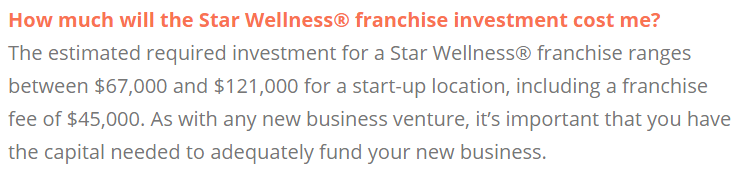
They do, however, recommend a background in sales, finance, or municipal administration.
The other good news — for you salespeople, financiers, or city managers — is that Star Wellness will teach you everything you need to know about wellness:

Yes, in five days you too can learn everything that Star Wellness knows, like how to ignore USPSTF guidelines, which is one category in which Star leads the industry. (One place they lag is reading comprehension, since we have already pointed out that most of what they propose is more likely to harm employees than benefit them…and yet they continue to advertise these hazardous screens.)
In addition to “up to” 5 days in the classroom, franchisees also get 3 days of on-the job training. So in case anyone is keeping score at home:
- Training required to get a job as a wellness vendor: 8 days
- Training required to get a job as a housekeeper at the Four Seasons: 10 days
This intensive training has captured the attention of WELCOA, which has named Star a Premier Provider:
WELCOA has very high standards, as we have noted on They Said What. One thing they excel at is spelling the name of their founder, assuming their founder invented the all-you-can-eat self-service restaurant.

A commitment to excellence, like that displayed by Star Wellness and WELCOA, might explain why employers have gone all-in on the notion that teaching employees, for example, to drink eight glasses of water a day will reduce healthcare costs, and also increase productivity, at least between trips to the water coolers and the rest rooms.
You’d learn far more than the typical wellness vendor knows about wellness simply by taking the Quizzify quiz. You’d learn more just by taking the demo quiz on the landing page.
Heck, you’d learn more just by reading the Quizzify landing page itself.
Share this:


Mark Twain Explains Why Wellness Endures Despite TheySaidWhat?
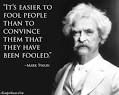
OK, OK, we admit we’re a little light on content this week. (And thanks to Chris Davis for posting this image.) We’re waiting for a REALLY BIG announcement. The wellness-meets-Roger and Me debate we’ve all been hoping for is GOING TO TAKE PLACE.
Watch this space. The date, venue, rules etc. have all been agreed upon and the sponsoring organization is just finishing up the press release.

 They Said What?