Home » Articles posted by whynobodybelievesthenumbers (Page 53)
Author Archives: whynobodybelievesthenumbers
Pittsburgh Post-Gazette Bullies Shape-Up
In wellness, “bullying” is apparently defined as “asking hard questions, particularly to people who make claims they refuse to defend.” This time it’s not us bullying anyone. It’s the Pittsburgh Post-Gazette bullying Shape-Up, in a reprise of the last time Shape-Up challenged our numbers.
Guess who won, again? (Hint: you won’t see this link on Shape-Up’s website.)
And kudos to the Pittsburgh Business Group on Health for its forward-thinking quotes on the value of wellness programs.
Mrs. Brooks, whose business group members represent some of the region’s largest employers, said workplace wellness “has become a commoditized multibillion-dollar industry versus a value-based solution that addresses the whole.
What happens when Jeopardy collides with Comedy Central and healthcare?
“We need to figure out how to motivate employees. Many programs today aren’t strategic or focused and, more importantly, culturally integrated into how companies do business.”
Share this:

Lewis and Goetzel: A Brief Prequel
Note: This is not as clever as our usual stuff. The sequel (in this case, prequel) is never as good as the original. Nonetheless, it’s important to know how we got to where we are and how the now-viral “Open Apology to Ron Goetzel” came to be.
 I was just called “mean-spirited” by Michael O’Donnell regarding Ron Goetzel, so I thought a little background might be in order. Some people no doubt think Vik and I just popped up out of the blue and started insulting people. Michael O’Donnell’s editorial says we haven’t been willing to engage in “respectful debates” and all sorts of other stuff. So let’s climb into the Wayback Machine and set the dial for 2011. I submitted the final manuscript of Why Nobody Believes the Numbers to the publisher, John Wiley & Sons, for June 2012 publication. For those of you whose consultants and vendors haven’t told you about it (for obvious reasons), this was an award-winning trade-bestselling book on outcomes measurement, that is used in at least 5 graduate-level classrooms.
Despite being almost 3 years old, it is quite relevant today, as a new “official” welness outcomes measurement guide compiled by many of the people profiled on this site recommends 7 approaches to measurement, 5 of which my book had already completely invalidated.
Page 82-83 contain the following lines. I am using screen shots because, as is usual, no one would believe me if I just quoted text.

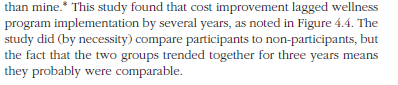
I genuinely believed that he was seeking the truth and that his analysis was “much better than mine.” I was the Boxer to his Snowball.
But then, over the following years, a funny thing happened. I reluctantly realized that the entire Wellness Ignorati cabal — the Koop Committee, WELCOA etc. — had no interest in facts. They simply wanted to perpetuate their existence at the expense of their customers. I had originally been very polite. for instance, when I displayed the infamous Health Fitness Corporation slide (now disowned) on p 85 of Why Nobody Believes, I didn’t name names:
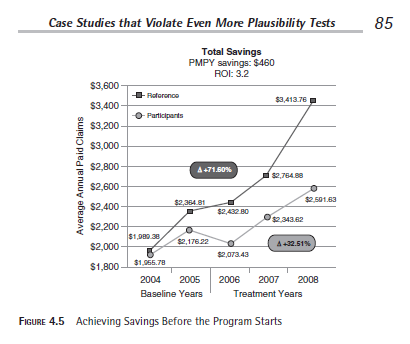
And I know Ron read p. 85, because he copied pages 82-83 and used it in his own presentations until Wiley made him stop.
But you know what happened after Ron read that HFC’s award-winning slide had self-invalidated? No “respectful debates.” Nothing. (We’re still not sure how he didn’t notice in the first place.) HFC didn’t apologize and didn’t stop using the slide. Ron didn’t retract their Koop Award. (It wasn’t until our Health Affairs expose almost three years later, that Ron was shocked, shocked to discover that that infamous and highly visible slide was, to use his choice of the passive voice, “unfortunately mislabeled.” It is still a mystery who did the mislabeling. No one has stepped forward. We think it might have been the North Koreans.)
The same thing kept happening — Nebraska, Staywell, Mercer, Milliman, Wellsteps etc. Basically most of the Koop Committee and plenty of others All of them had mistakes quietly pointed out…and none of them did anything to correct them. Politeness failed. When a “mistake” is pointed out and not fixed, it becomes a lie. In retrospect, what we did was as naive as if Rachel Carson had brought her findings to Monsanto and asked them to please stop selling DDT.

Jeopardy meets Comedy Central meets healthcare.
That’s why and when we started blowing the whistle, which has been interpreted as bullying. Leave a comment: what you would have done? The health of employees all over the country is being jeopardized by overscreening, overdiagnosis and overdoctoring, the evidence is being ignored by the perpetrators…what choice did we have?
Share this:

Vivify Brings Incompetence to Life
The population health industry never ceases to delight us with its creativity. Vendors come up with ways of demonstrating their incompetence that are so creative we are compelled to use screenshots to back up our observations. Otherwise no one would believe us.
Consider Vivify. They reported on a study of in-home post-discharge telemonitoring led by a:

Not being able to spell the name of his own occupation is the good news. The bad news is, the “principle investigator” also can’t write, can’t do simple arithmetic, and – most importantly for someone who claims to be a “principle investigator” — can’t investigate. (Those shortcomings aside, this is a very impressive study. For instance, the font is among the most legible we’ve ever seen.)
The Writing
There is some redundancy in the writing, but, giving Vivify the benefit of the doubt, perhaps the extra verbiage reflects the principle investigator’s concern that someone might miss the nuances or subtleties in his exposition. Examples:
- Vivify’s home monitoring system is “simple and easy”;
- The patient receives a “weight scale”;
- They had an “ROI of $2.44 return for every dollar invested”, and…
- “With appropriate connectivity, patients could engage in real-time interactive videoconferencing.”
Needless to say, these product attributes are very intriguing, so intriguing that you may want to learn more about the company. They are only too happy to oblige, making sure we catch yet another nuance:

The Arithmetic
The study claims the average patient’s cost declined $11,706, for a 2.44-to-1 ROI. Doing the math, that means Vivify’s post-discharge in-home self-care tele-monitoring costs…let me just get my calculator out here…$4797/patient? At that price, why rely on self-monitoring? Why not just move a nurse in?

(Note for the literal-minded: the ROI language is slightly different here than the passage we quoted, which appears elsewhere in the case study.)
The Principle Investigation
In general, Vivify targets patients with “specific chronic illnesses,” including pneumonia. (Vivify, I don’t know how to break this to you gently, but: pneumonia isn’t a chronic illness, specific or otherwise. No one ever says: “I was diagnosed with chronic pneumonia a few years ago, but my doctor says we’re staying on top of it.”)

However, for this investigation, only CHF was targeted: a cohort of 44 recently discharged CHF patients with an average age of 66. This raises the question: How did the principle investigator scrounge up a cohort of 44 discharged CHF patients with an average age of only 66? More than half of CHF discharges are over 75. It’s statistically impossible to randomly select 44 CHF discharges with an average age of 66. And – isn’t this a lucky coincidence – the study claimed a large (65%!) reduction in readmission rates but readmission rates are already much lower for younger patients. Once again, not a word of explanation.
Because Vivify’s apparent level of misunderstanding of basic arithmetic and study design boggled even our minds (which is difficult to do, given that we mostly blog about wellness), we decided to give them a chance to explain directly that we might have missed something. Further, because these explanations would have taken them 15 minutes if indeed we were missing something obvious, we offered them $1000 to answer them, money they decided to leave on the table. (Anyone have questions for me? Send me $1000 and I will happily spend 15 minutes answering them.)
This email to Vivify is available upon request.
We don’t even know what the 65% reduction is compared to. Usually – and call us sticklers for details here – when someone claims a 65% reduction in something vs. something else, they tell us what the “something else” is. Are they saying 35% were readmitted? Or 66-year-olds are readmitted 65% less than 75-year-olds?
Savings Claims
My freshman roommate was like the bad seed in the old Richie Rich comics. Among other things, he would have a snifter of cognac before bed, whereas I had never tasted cognac and thought a “snifter” was for storing tobacco. We didn’t get along and at one point I accused him of being decadent.
“Decadent, Al? Let me tell you about decadent. I spent last summer at a summer camp – everyone was there, Caroline Kennedy, everyone – where we played tennis on the Riviera for a month and then went skiing in the Alps.” I had to admit that was indeed decadent.
“Al,” he replied. “I haven’t even gotten to the decadent part yet.”
Likewise, we haven’t even gotten to the best example of arithmetic-gone-wild: the savings claim. Remember that $11,706 savings claim above? Well, read that passage again–it turns out that represents a “90% decrease in the cost of care.” Apparently, the patients cost $12,937 when they were in the hospital, but after they went home, they only cost $1231. (We have no idea how that squares with the other finding, that the Vivify system itself costs $4797, based on the ROI of 2.44, or, as they put it, “an ROI of $2.44 return for every dollar invested.”.)

We can spell “guaranteed savings” and other words too.
The irony is that other vendors in this space really do save money and really do measure validly. It’s one thing to make up outcomes in wellness. That’s a core part of the industry value proposition. But, unlike wellness vendors, tele-monitoring vendors other than Vivify typically know the basics: what they are doing, how to measure outcomes, how to save money–and how to spell.
Share this:


Wellness Corporate Solutions Gives Us a Dose of Much-Needed Criticism
Oh, when bad things happen to good bloggers…
Shame on us! Here’s what Wellness Corporate Solutions had to say about our observations of the wellness industry:

And, in all fairness, when we went to the Wellness Corporate Solutions website, we felt quite chastened. Their website was a breath of fresh air, taking the rest of the industry to task for expecting “instant cost savings,” noting that a “focus on ROI is short-sighted.”
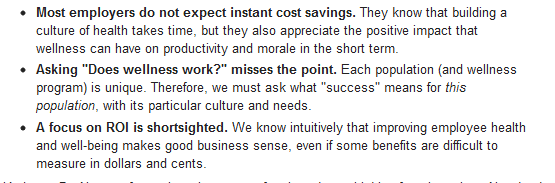
Further, they are totally opposed to wacky crash diets, of the type that 8-week weight loss “challenges” inspire, that cause abnormally large weight swings As most people know by now, those may be harmful and are of course ineffective at long-term weight control. The weight is likely to be regained and then some. Plus contestants often binge before the initial weigh-ins to maximize contest weight loss. That’s why Wellness Corporate Solutions quite appropriately says “stop dieting,” and “avoid making unreasonable weight loss goals.” And “banish weight-obsessive thoughts.”
We were also thrilled to see that they “respect and appreciate size diversity” because “size prejudice hurts us all.”

Finally, a company that has done enough research to realize that you can’t save money instantly by getting employees to crash-diet for 8 weeks! How exciting is that – we discovered a wellness vendor with access to Google!
Unfortunately, perhaps along the way someone at Corporate Wellness Solutions must have failed to “respect and appreciate the size diversity” of a certain Kim Jung Un, because the North Koreans appear to have hacked into their website and announced: a program that saves money instantly by getting employees to crash-diet for 8 weeks.


How many of your employees know the difference between a deductible and a copayment?
Naturally, this being a wellness vendor, the savings are made up. If 20% of your employees achieve a “healthy” BMI (a statement which by itself is open to a great deal of debate, since recent research overwhelmingly says it’s better to be fit and fat than to lose weight and not keep it off), for a company to reduce its total cost by 20% means that the costs for each employee who lost the weight would have to fall 100%.
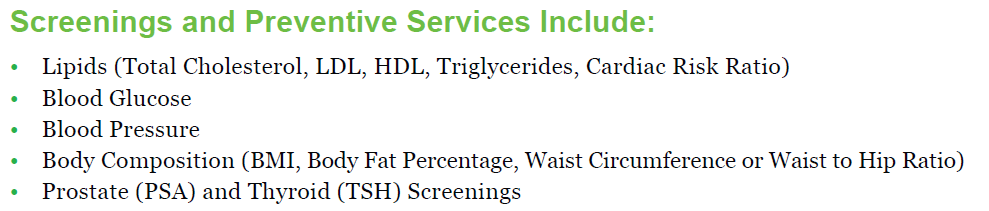
And naturally, being a wellness vendor, they don’t stop there. It’s part of wellness vendor DNA to ignore US Preventive Services Task Force recommendations, while saying they abide by them. In this case, they are doing both thyroid screens (not recommended) and PSA tests (emphatically not recommended).
And, naturally, being a wellness vendor, there is no concept of learning. They did exactly the same thing that ShapeUp, Ron “the Pretzel” Goetzel, Wellsteps and others have done, which is failing to realize that we bite back. Actually, we don’t bite back as much as we allow these geniuses to bite themselves back. The wellness ignorati invariably self-immolate in the attempt to criticize us. Hence our mantra: “In wellness you don’t need to challenge the data to invalidate it. You merely need to read the data. It will invalidate itself.”
However, there is some good news about Wellness Corporate Solutions: NASA employees don’t need to worry about their job security, because these people are not rocket scientists.
Share this:

Bravo Wellness Offers “Savings” by Fining Employees
With all the incompetence, innumeracy, illiteracy and downright dishonesty we’ve documented in this field and with all the employee dissatisfaction, revolts and lawsuits, one can’t help but wonder: Why?
Why would any employer do this to their employees?
Why aren’t vendors held to minimal standards of competence?
Why do vendors and consultants caught lying simply double down on the lies and/or ignore questions about their lies–knowing full well they’ll get away with it because workplace wellness has nothing to do with actual wellness so no one cares that it doesn’t work?
Why are benefits consultants allowed to lie about outcomes for their partnered vendors?
Why, after they get caught lying, do they win awards for those very same outcomes?
Why doesn’t anyone care that much of what they say and do is wrong?
Why doesn’t anyone care that poking employees with needles far more than the USPSTF advises produces no savings?
Why put up with the morale hit from disgruntled employees and possible lawsuits?
Bravo to Bravo for admitting the reason: It’s to claw back insurance money from employees by making programs so unappealing and requirements so onerous that many employees would rather forfeit their money than have anything to do with them. Here are Bravo’s exact words:

You might say, they don’t actually “admit” it. Well, obviously they aren’t going to skywrite it. But how else would one interpret this comment? Obviously they aren’t going to save money right away by “playing doctor” and poking employees with needles. Especially because they aren’t even adhering to legitimate preventive services guidelines, such as those from the United States Preventive Services Task Force (USPSTF).
They also still subscribe to the urban legend that 75% of an employer’s spending is lifestyle-related, even though that myth has long since been discredited as meaningless and misleading for employers.

Creatinine and thyroid screens are not recommended by the USPSTF, so they shouldn’t be done at all, let alone provide the basis for claiming savings. So, we have eliminated everything except the obvious: employers get to collect fines for employees who care too much about their health and/or their dignity to submit to Bravo’s offer to play doctor.
This is the classic example of wellness done to employees instead of for them. The Bravo website is sprinkled with discussions of appeals processes for employees who face punishments for the crime of weighing too much and/or other personal shortcomings having nothing to do with work performance (and precious little to do with healthcare spending during the working years)…but everything to do with transfering wealth back to the owners.
As is our policy, we offered Bravo a chance — and $1000 — to provide an alternate explanation in a timely way, which they didn’t. Two differences between that forfeiture and Bravo’s punishments: Bravo lost their $1000 (of our money) for simply being unwilling to jot down a few words, whereas they brag about fining employees $1000 (of their money) for not being able to lose weight and keep it off, which is far harder than writing down a few words. And the other difference about the $1000? Having just raised $22-million, Bravo won’t miss it.
August Update: As a result of this expose, Bravo has taken all this stuff off their website. They no longer brag about fining employees, they no longer discuss their appeals process at length on their site and they no longer pitch their D-rated lab tests like creatinine and thyroid. This is typical vendor behavior after getting caught. Score one for They Said What.
Share this:

Congratulations to RAND’s Soeren Mattke on PepsiCo study award
 We are proud (but also insanely jealous) of our friend Soeren Mattke, whose PepsiCo article was named the #2 most-read for the year 2014 in Health Affairs. We, as our avid albeit narrow fan base may recall, ranked only #12–and even then that was just for blog posts, not articles in print.
Yes, we know it’s not always about Ron “The Pretzel” Goetzel and his twisted interpretations, but he seems to have come up with what appears to be exactly the opposite interpretation of what the PepsiCo study said. Don’t take our word for it — we’ve cut-and-pasted both what the study says about PepsiCo’s results and what he says about the study.
Here is what the article says about the financial impact of health promotion at Pepsico: ROIs well below 1-to-1, meaning a net financial loser, for health promotion. (DM, though, was a winner.)
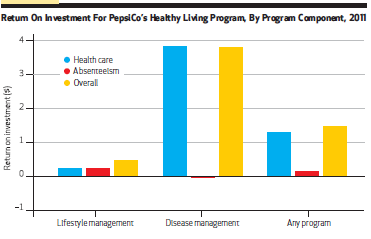
As low as these ROIs are, several major elements of cost were not available for the calculation — probably enough extra cost to literally make the financial returns so meager that even if the program had been free, PepsiCo would have lost money.

Clear enough? Negative returns from health promotion at PepsiCo, even without tallying many elements of cost. Nonetheless, Mr. Goetzel pretzelized that finding in his recent wellness apologia. Listed under “examples of health promotion programs that work” as a program that is a “best practice” is: PepsiCo. It stands proudly beside the transcendant programs at Eastman Chemical/Health Fitness and the State of Nebraska.

We look forward to a clarification from Mr. Goetzel about how a program that lost a great deal of money on health promotion can be an “example of a health promotion program that work(s),” which we will duly print…but don’t be sitting by your computer screens awaiting it.
Share this:

Ron Goetzel’s “Dumb and Dumber” Defense Deflects Latest Koop Award Ethical Scandal
By Al and Vik
Oh, the twists and turns as Ron “The Pretzel” Goetzel tries to wriggle out of all his ethical stumbles.
This time around, we thought we had nailed both him and his cabal handing out the ironically named C. Everett Koop Award to themselves and their friends based on made-up outcomes. Specifically, this time they gave their sponsor (Health Fitness Corporation, or HFC) an award based on data that was obviously made up, that no non-sponsor could have gotten away with submitting. This was the third such instance we’ve uncovered of a pattern of giving awards to sponsors for submitting invalid data while making sure that the award announcement contains no reference to the sponsorship. (There are probably others; we’ve only examined 3, which might explain why we’ve only found 3.)
How obviously was the data made up? Well, take a looksee at this slide, comparing participants to non-participants. This is the classic wellness ignorati ruse: pretending that non-motivated inactive non-participants can be used as a valid control for comparison to active, motivated participants. The wellness ignorati would have us believe that any healthcare spending “separation” between the two groups can be attributed to wellness programs, not to inherent differences in motivation between the two groups. Unfortunately for the ignorati, their own slide invalidates their own argument: in 2005, the label “Baseline Year” shows there was no program to participate in, and yet – as their own slide shows – participants (in blue) significantly underspent non-participants (in red) nonetheless. In Surviving Workplace Wellness, we call this “Wellness Meets Superman,” because the only way this could happen is for the earth to spin backwards.
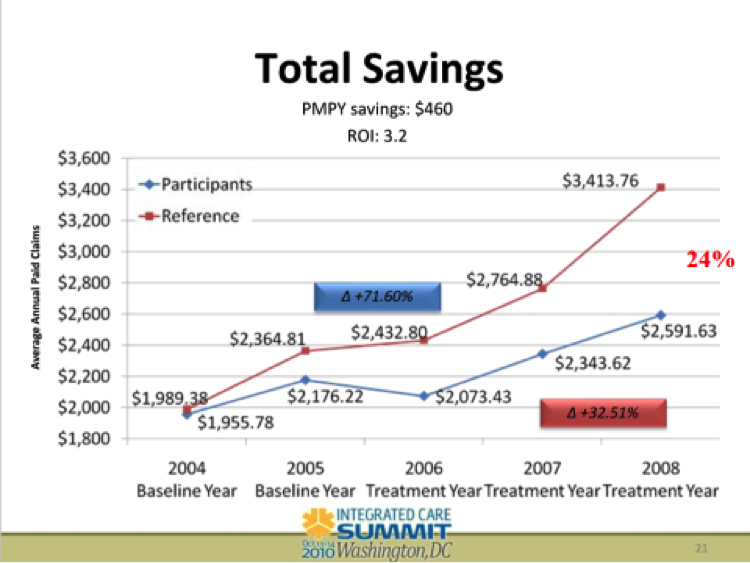
Given that the 2005 baseline label was in plain view, we just assumed that HFC did not indeed have a program in place for this customer (Eastman Chemical) in 2005, which is why they called 2005 a “Baseline Year” instead of a “Treatment Year.” Not actually having a program would logically explain why they said that didn’t have a program, and why they used that display or variations of it like the one below for 4 years with the exact same label. Presumably if they had had a program in 2005, someone at HFC would have noticed during those 4 years and relabeled it accordingly.
Originally we thought the Koop Award Committee let this invalidating mistake slide because HFC — and for that matter, Eastman Chemical — sponsor the awards they somehow usually win. But while trying to throw a bone to HFC, the Koop Award luminaries overlooked the profound implication that the year 2005 separation of would-be participants and non-participants self-invalidated essentially the entire wellness industry, meaning that is is an admission of guilt that the industry-standard methodology is made up.
 Goetzel the Pretzel to the rescue. He painstakingly explains away this prima facie invalidation. Apparently the year 2005 was “unfortunately mislabeled.” Note the pretzelesque use of the passive voice, like “the ballgame was rained out,” seemingly attributing this mislabeling to an act of either God or Kim-Jung-Un. He is claiming that instead of noticing this invalidator and letting this analysis slide by with a wink-and-a-nod to their sponsor, none of the alleged analytical luminaries on the Koop Committee noticed that the most important slide in the winning application was mislabeled — even though this slide is in plain view. We didn’t need Edward Snowden to hack into their system to blow up their scam. They once again proved our mantra that “in wellness you don’t need to challenge the data to invalidate it. You merely need to read the data. It will invalidate itself.”
We call this the “Dumb and Dumber” defense. Given two choices, Goetzel the Pretzel would much prefer claiming sheer stupidity on the part of himself, his fellow Koop Award committee members like Staywell’s David Anderson and Wellsteps’ Steve Aldana, and his sponsor HFC, rather than admit the industry’s methodology is a scam and that they’ve been lying to us all these years to protect their incomes.
Still, the Dumb-and-Dumber defense is a tough sell. You don’t need Sherlock Holmes, Hercule Poirot or even Inspector Clouseau to detect a few holes in the Pretzel’s twisted logic:
- How could no one – no member of the Koop Award Committee or employee of Health Fitness Corporation (which used this as its “money slide” for years) – have noticed this until we pointed it out for the third time (the first two times not being as visible to the public)?
- In early 2012, this slide was reproduced–with the permission of Health Fitness Corporation–right on p. 85 of Why Nobody Believes the Numbers, with the entire explanation of its hilarious impossibility. We know Mr. Goetzel read this book, because he copied material out of it before the publisher, John Wiley & Sons, made him stop. So we are curious as to why it has taken until now for him to notice this “unfortunate mislabeling.” Hmm…would the fact that it was just exposed to the world in Health Affairs have anything to do with this sudden epiphany? We’re just sayin’…
- If indeed it was just an “unfortunate mislabeling,” how come HFC has now expunged all references to this previously highlighted slide from their website, rather than simply change the label?
As regards the third point, we would recommend that next time Mr. Goetzel invokes the Dumb-and-Dumber defense, he coordinate his spin with his sponsor.
But let’s not overlook the biggest point: the entire Koop Committee – including “numbers guys” like Milliman’s Bruce Pyenson and Mercer’s Dan Gold — is apparently incapable of reading a simple outcomes slide, as they’ve proven over and over.
So, as a goodwill gesture, we will offer a 50% discount to all Koop Committee members for the Critical Outcomes Report Analysis course and certification. This course will help these committee members learn how to avoid the embarrassing mistakes they consistently otherwise make and (assuming they institute conflict-of-interest rules as well to require disclosure of sponsorships in award announcements) perhaps increase the odds that worthy candidates win their awards for a change.
Share this:

Larry Chapman Meets Where’s Waldo
Questions for The Chapman Institute’s Larry Chapman:
We are looking all through the study you cited in defense of Health Risk Assessments (HRAs) and cannot find the 50% savings from HRAs that you say is hidden in here somewhere. This study, despite your CAPITALIZED insistence to the contrary, seems to show the opposite: In 4 of the 6 study periods — and in all 6 periods combined compared to baseline — the control group spending was actually lower than the study group. So where is the 50% savings that we can’t find?


ANS: Refused to Answer
You say HRAs should be treated like “one of your children or at least a beloved pet”. Have you taken into account the possibility that some HRA respondents may lie, as Professor Woessner advised his Penn State colleagues to do, and as most of the people I know do since most people feel their personal lives should not be the concern of their employers?
ANS: Refused to Answer
Many people have questioned your understanding of arithmetic even before you found a 50% total healthcare cost reduction due to HRAs by reading the data excerpted above, so here is your chance to enlighten them. In this article below, you originally stated that Baicker’s analysis (which she has now backed off) reduced medical claims by “327%” and absenteeism costs by “273%”. How is it possible to reduce a number by more than 100%?

ANS: “Workplace Wellness Management” January 10 comment:
“You seem to conveniently forget that the editor of the CFO blog made the error, not me.”
Followup: You submitted, reviewed and signed off on the original “327% savings” and “273% reduction.” However — after a commentator pointed out the impossibility of those figures — the editor does acknowledge that you did notice at that point that 327% and 273% reductions in any number are not possible, and asked him to change the figures, first to the above 32.7% and 27.3%, but then to the 3.27-to-1 and 2.73-to-1 (now discredited) figures that were in the Baicker article. So in the narrowest sense of the word — after you made the initial, most revealing, mistake by misunderstanding that “3.27-to-1 ROI” and “327% savings” are not interchangeable figures — the editor of the CFO blog is acknowledging “the error,” by not making the final correction in a timely way. The larger point is that you did submit “327% savings” and “273% reduction” originally, raising the question of why anyone should believe the research findings of someone who doesn’t know that you can’t reduce a number by more than 100%.
ANS: Refused to answer
You also wrote in 2012 that studies show you can save 25% through wellness. Most of these studies took place in decades (1980s and 1990s) when dietary advice consisted of telling people to eat more sugar and less fat, and when the AHA gave Kellogg’s Frosted Flakes a “heart-healthy” label?. How could that kind of misinformed advice show not just savings, but savings 6x greater than the total amount that employers spend on wellness-sensitive medical events, which is 4%?
ANS: Refused to answer
Share this:

Goetzel, Koop Committee, Staywell, Mercer, BP America meet Groundhog Day
Perhaps the strategy of the leaders of the wellness ignorati (who constitute the Koop Committee) is to overwhelm us with so many lies that we don’t have time to expose every one and still get home in time for dinner.
No sooner have we finished pointing out the numerous (and unrebutted) implausibilities and internal inconsistencies in Ron Goetzel’s posting on the value of workplace wellness, than the Koop Committee (Mr. Goetzel and his cabal) feeds us even more red meat: They gave the 2014 Koop Award to British Petroleum. However, apparently only British Petroleum wants to tell the world about it. The Koop Committee hasn’t even updated its own website to list 2014 award winners.
Recall that we’ve spent months excoriating Goetzel and his sidekicks (Wellsteps’ Steve Aldana, Milliman’s Bruce Pyenson, Mercer’s Dan Gold and the rest of them) for doing three things in the Nebraska award, for a program that prima facie seems to be in violation of Nebraska’s state contractor anti-fraud regulations:
(1) Gave it to a program where the numbers were obviously fabricated and later admitted to be
(2) Gave it to a program whose vendor sponsors the Committee
(3) Forgot to disclose in the announcement that the vendor sponsors the Committee
Perhaps what you are about to read isn’t their fault. Perhaps their mothers simply failed to play enough Mozart while the Committee members were in their respective wombs, but here’s how they applied the learning from the Nebraska embarrassment to their decision to award British Petroleum. This time they:
(1) Gave it to a program where the numbers had already been shown to be fabricated
(2) Gave it to a program whose vendor sponsors the Committee
(3) Forgot to disclose in the announcement that the vendor (Staywell) sponsors the Committee
(4) Forgot to disclose in the announcement that the vendor sits on the Committee
(5) Forgot to disclose in the announcement that the consulting firm (Mercer) sponsors the Committee
(6) Forgot to disclose in the announcement that the consulting firm sits on the Committee

I suspect we will be writing a similar analysis again next year, when once again, the Committee will attempt to demonstrate the value of sponsoring a C. Everett Koop Award.
Share this:

Wellnet: “Trusted Advisors Need Trusted Partners”…so we’ll pay you
Wellnet Materials Being Reviewed
See “For Brokers” on the Wellnet website, leading with the line:

Questions for Wellnet
Are you using the term “trusted advisors” (scroll down this linked page) to describe your prospects’ brokers? Then it appears you are offering to pay them an undisclosed sum of money to place Wellnet. Are we reading this correctly?
ANS: Refused to answer
Then it seems like you want the broker to become a trusted advisor, meaning you want to pay them money to sell to their client, who absent this language would appear to be working for their client:

Clicking through on “learning more about becoming a trusted advisor” brings you to this grammatically challenged question:

How do brokers creating new revenue for themselves at their clients’ expense (meaning selling their clients more forced wellness programs like yours) enhance their reputation as a “trusted advisor” ?
ANS: Refused to answer
If this is on the level, why not simply be explicit: “We will pay you a commission to sell our product to your clients” ?
ANS: We didn’t even bother to ask

 They Said What?