
Home » Uncategorized (Page 15)
Category Archives: Uncategorized

Ron Goetzel Spins Gold into Straw, Part 1
I would invite everyone to join tomorrow (Tuesday’s) webinar by Ron Goetzel. He will be attempting to undermine the National Bureau of Economic Research’s (NBER) outstanding University of Illinois study, which showed — surprise — that conventional wellness programs don’t come close to changing behavior, let alone saving money. I would love to attend, but I, of course, am not invited to his events any more than he is invited to mine. Oh, wait a sec, I invite him to all my events and alert him to all my postings on linkedin so that he can correct any errors I’ve made. Sorry, my memory failed me there for a second.
Speaking of failed memories, he is being joined on this webinar by Jessica Grossmeier. If that name rings a bill, it’s because she claimed her company, Staywell, saved $17,000 per risk factor reduced — about $3000/pound shed — for British Petroleum, having forgotten that she herself claimed it is only possible to save $105/avoided risk factor. See “British Petroleum Wellness Program is Spewing Invalidity.”
Despite this being the Gold Standard of randomized control trials, he will be accusing the NBER of many errors. (A cynic might note that being accused of making errors in a wellness study by Ron Goetzel is like being accused of cheating on your taxes by Paul Manafort. ) He will argue that:
- The study only covered the first year — he won’t mention that the authors also said the first year suggests nothing “is trending towards savings” in future years either;
- The study contradicts — you guessed it — Kate Baicker’s infamous 3.27-to-1 ROI, without mentioning that the NBER’s principal investigator, as coincidence would have it, reports to Kate Baicker, so it’s pretty unlikely he would diss her unless the data left him no choice;
- The study contradicts all the other findings out there — except for all the other studies testing the par-vs-non-par study design against a benchmark, all of which showed results quite literally identical to the University of Illinois result, in that the wellness program accomplished zero;*
- The participants outperformed the non-participants;
- They haven’t reported on the screening yet;
- It wasn’t a good program. To hear Ron tell it (literally hear him tell it — you can listen to the tape), anytime a program fails, it’s because it wasn’t done correctly. “100 employers [have] programs with really smart ingredients…but thousands of others still don’t do wellness right,” are his exact words in print. He is refusing to name any of them, other than the old Johnson & Johnson analysis. (J&J is a wellness vendor. Investigator bias, anyone?)
What else will he argue? Tough to say. One thing for certain: he won’t mention my name — any more than Bravo did when they wrongly predicted that the EEOC rules would be replaced in January while I predicted the opposite. Instead he uses a new vernacular for my postings: “Industry chatter.”

He probably picked up this idea from Bravo, which uses the phrase “industry noise” to describe me.

Where’s Waldo-meets-Ron Goetzel: Spot the errors and you may win a big prize
So let’s make this interesting. Whoever comes up with the best smackdown of the webinar’s obvious fallacies (and omissions) automatically gets entered in the contest to win the Martha’s Vineyard vacation, with the house, car and private (well, semi-private) beach. It is otherwise open only to people who have won various Quizzify trivia contests, but being able to identify five or ten pieces of “chatter” or “noise” in this self-anointed “expert webinar” clearly counts as being health-literate. To compete, send me an email with an attachment. I’ll pick a couple of finalists and put them on linkedin. (If you don’t want your name used — and Ron does bite back, so I don’t blame you — I will post on my own.)

*The result is also quite consistent with Ron’s observation that there is basically no change in behavior leading to risk reduction. If we are splitting hairs here, Ron found a 1-2% reduction, not 0%. Of course, that took three years.
Share this:


A vendor’s guide to snookering self-insured employers
Dear Wellness, Diabetes, Clinic, Price Transparency, and Medication Therapy Management Vendors,
While most of you already know the majority of these tricks, there might be a few you haven’t deployed yet. So take good notes.
Sincerely,
Al Lewis
PS If you are an employer, just pass this along to your vendors…and watch your savings skyrocket. Or use “An Employer’s Guide to NOT being snookered” to see your savings become realistic.
Best practices for every vendor
Compare participants to non-participants. Using non-participants as a control for participants allows you to show massive savings without doing anything. This is not an overstatement. Here is a program — which naturally won an award for its brilliance from Ron Goetzel and his friends before I observed that they were a fraud according to their own data– that did just that. They separated participants from non-participants but didn’t bother to implement a program for two years—by which point the participants had already improved by 20% vs. the non-participants — without even having a program to participate in. (Note on this slide that the control and study group were set up in 2004 but the program didn’t start until 2006, when the cost separation had already reached the aforementioned 20%.)

Two other observational trials support this conclusion. Most recently, the National Bureau of Economic Research ran a controlled trial to test exactly this hypothesis. Sure enough, like the three observational trials, they found that virtually the entire outcome in wellness can be explained by that popular study design itself, rather than the intervention.
In any participation-based program, ignore dropouts. Assume that employees who drop out do so randomly, not because they are discouraged by their lack of progress or interest.
Draw a line upwards and then claim credit for the “savings” between the actual upward spending and the “trend” you drew. As Optum’s Seth Serxner stated so succinctly: “We can conclude that the choice of trend has a large impact on estimates of financial savings.”

Start with the ridiculously high utilizers, high-risk people, or people taking lots of drugs. Let the group regress to the mean, and then claim that as savings.
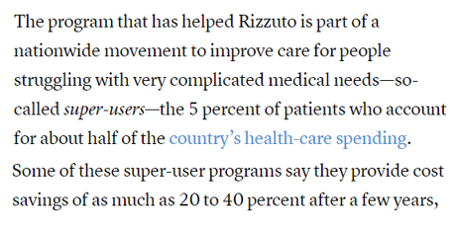
Never admit, like Wellsteps did, that you are familiar with regression to the mean, since most employers are not aware of it. The higher the costs/risks of the original users, the more savings you can claim. Here are two verbatim claims:
- A heavy equipment manufacturer found high use of the ER was a becoming a cost concern, so it send mailings that showed appropriate care settings to the homes of members with two or more visits to the ER in the past year. As a result, ER visits were down 59 percent those who got the mailing.
- A pharmaceutical company saw a spike in ER claims was coming from repeated use by the same people, so two mailers were sent: one to households with one ER visit in the past year; another for those with two or more visits. Following the mailings, there was a 63 percent drop in ER visits.
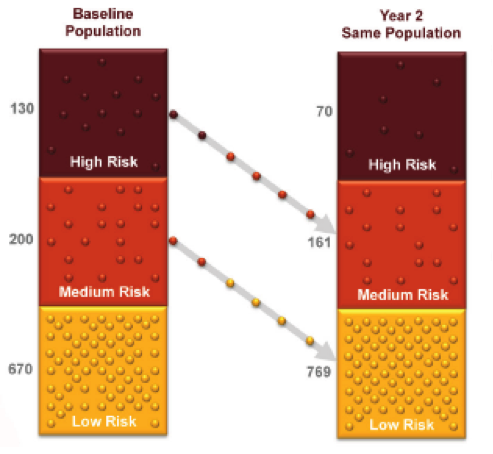
Pretend not to notice that low utilizers can show an increase in utilization — or especially that low-risk people can increase in risk. Focus the mark (I mean, the customer) on the high-risk people who decline in risk. Never draw graphs to scale, or your customer might notice that 2/3 of their employees are low-risk in the first place.
It doesn’t matter what your intervention is. Claim credit for the entire difference in trend. For instance, in this example, Community Care of North Carolina claimed credit for a huge reduction in PMPM costs for babies for their medical home program…but babies weren’t even included in the program. (Neonatal expenses didn’t decline either.)

Or do what Safeway did, launching the wellness craze: change to a high-deductible plan, and transfer a large chunk of costs to employees. Don’t even bother to institute a wellness program, but attribute all the savings (from the transferred deductible spending) to wellness anyway, so that you get invited to the White House. And after that blows up on you, demonstrate that your very stable genius investment in wellness was not a fluke by investing your company’s money in Theranos.
Special Instructions for transparency tool vendors
Assume that every employee who uses your tool is looking to save their bosses some money, rather than (for instance) to find the closest MRI…and that none of them would have used a lower-cost venue absent your tool.
If only 10% of employees use your transparency tool, and only 10% of events are shoppable, nonetheless take credit for the entire difference in trend across the board, and ignore the literature showing online price-comparison tools don’t work.
If people who haven’t met their deductible shop more than people who have, attribute the former’s lower cost to use of the tool, rather than to the fact that by definition people who don’t meet their deductible spend less than people who blow through it.
Special instructions for wellness and diabetes vendors
If you are a wellness or diabetes prevention/management vendor, never ever let employers know that every year since statistics have been kept, fewer than 1 in 1000 employees/dependents end up in the hospital with diabetes. (And another 1 in 1000 with a heart attack.) Always tell them how many employees are at risk and how many “newly discovered conditions” they have, and how they will all end up in the hospital, even though hospitalizations for heart attacks and diabetes in the employer-insured population have been declining for years.

Wellness vendors should always put the trivial percentage reduction in risk (for participants only, of course – and ignoring dropouts) on one page and the massive savings on another page. Most employers won’t bother to do the math to notice, for example, that Interactive Health claimed $50,000 in savings for every employee who reduced one risk factor, while the state of Nebraska won an award for claiming to save $20,000+ for every risk factor reduced, as did Staywell for British Petroleum.
If you didn’t reduce risk factors, present your outcomes in a format no one can make heads or tails of, like this one, from Wellsteps. If Wellsteps was able to snooker an entire committee of self-anointed outcomes experts to win an award for program excellence, surely you can snooker a few customers.

Claiming people lose weight is a big part of your outcome reporting, so make sure to do the following:
- Never count nonparticipants, and ignore dropouts.
- Don’t do any long-term follow-up to see who regained the weight (most participants)
- Give them time to binge before the initial weigh-in
Special instructions for diabetes vendors
In addition to measuring on active participants only, raise the bar for Hb A1c so that only people with high Hb A1c’s can be included. That belt-and-suspenders approach will ensure that you can’t fail to show savings, even if (as is likely the case) you don’t change anyone’s behavior other than the employees who were going to change anyway, which you might as well count.
Next — most diabetes vendors and a few wellness vendors have already figured this out — you can charge much more if you can submit claims, rather than just be an admin expense line item. You see, most employers focus much more on the 10% admin expense than they do the 90% medical expense, which they consider to be beyond their control. Your claims expense – which would draw attention to itself as an admin cost — won’t get noticed in the 90% of medical losses, sort of like the dirt from the tunnel sprinkled around the Stalag in The Great Escape.

Special instructions for medication therapy management vendors
Only mention “gaps in care” that you close, not the ones that open up. And, as noted in the chart below, always use percentages. So in this chart (provided by one of the major PBMs), they claimed that twice as many gaps were closed (37%) vs opened (18%), and yet, as is almost always the case with MTM vendors, nothing happened to the total number of gaps, which remained at exactly 820:

Tally all the employees who were on large numbers of meds and now take fewer. But don’t mention all the employers who were on fewer meds and now take more.
What to do if you’re asked why you aren’t validated by the Validation Institute
Here are the most popular answers to that question:
- No one has asked us to. (Quizzify didn’t need to be asked.)
- We hired our own outside actuarial firm to validate us, and they concluded we save a lot of money.
- Sure, we’ll get validated as soon as you sign the contract with us.
Share this:


Wellsteps stumbles into the truth
Seems like half our postings involve three vendors. These three very stable vendors — Interactive Health, Bravo and Wellsteps — constitute the wellness industry’s “Axis of Genius.”

In a recent video that we urge everyone to watch, Steve Aldana of Wellsteps (proud recipient of the 2016 Deplorables Award) recently admitted that “wellness is the most researched topic in healthcare.”
He is absolutely right about that. There are dozens of studies showing that wellness loses money and often harms employees.
And he would know because he has produced a ream of research showing that Wellsteps’ very own program is arguably the worst program on the planet. I say “arguably” because Wellsteps’ Boise program may not be the worst program on the planet. It is only the worst program on the planet according to its own documented findings. I never thought I would say this, but I applaud Mr. Aldana! His willingness to tell the truth is admirable.
Funny thing about the wellness industry. Every other industry’s “research” always make their product look good. For years, cigarettes were safe–according to the tobacco industry. The oil and gas industry often publishes research showing there is no global warming. And Monsanto executives are probably the only people on earth who think Agent Orange is harmless.
Sure, critics can and do “challenge the data” those other trade groups publish, but to the credit of those organizations, at least they don’t accidentally disprove their own message in their own “findings.”
Quite the opposite in wellness. About 40 seconds in, Mr. Aldana says: “Critics of the wellness industry say that the studies are flawed.” No, Mr. Aldana, we are not accusing you of being “flawed,” or even of lying. We are accusing you of telling the truth, for once. The wellness industry is unique in that its own data is its own worst enemy. Remember the saying: “In wellness, you don’t have to challenge the data to invalidate it. You merely have to read the data. It will invalidate itself.”
While he showed great integrity by reporting the Boise outcomes accurately (and even exposed his results to a wider audience, albeit under duress), that display of integrity turns out to be out of character. Alternative fact-tellers need to have long memories, and his is apparently quite short. When he first reported the financial results, he made the impossible claim that Boise’s healthcare costs fell by a third, due to his forced wellness program even though flouting clinical guidelines and giving out questionable advice also caused a 20% increase in risk factors:
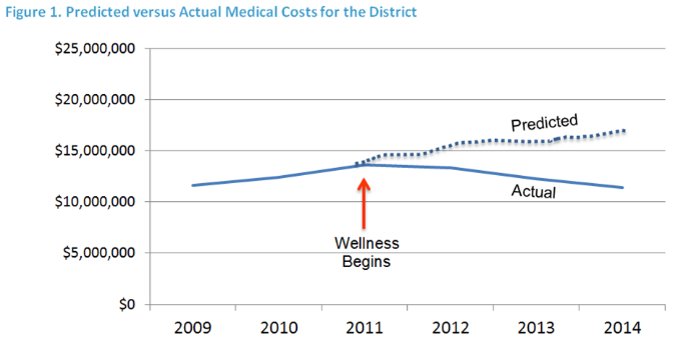
But his report was so long that by the time he got to the end of it, he had completely forgotten this alleged savings claim…and accidentally admitted costs actually increased. (He later suppressed the latter finding, but I always anticipate cover-ups by wellness vendors so I take screenshots before posting anything. It’s been said that the beginning of the end of “pry, poke and prod” was the day a millennial taught me how to capture a screenshot.)

Yes, you might note, the participants did marginally better than the non-participants (though the latter seem to have the momentum). And that brings us to his next claim in the video, where he laments the lack of randomized clinical trials. Actually, there have been two, the most recent one highlighted in the New York Times recently. And, yes, of course, they show “pry, poke and prod” has no impact. The NYT article specifically demonstrated that participants-vs-non-participants is an invalid methodology that will always show savings even if nothing happens. A vendor called Newtopia also did an RCT…and showed the same thing. 100% of savings was caused by the act of separating the two groups based on motivation…and when you re-combined them, there was no savings.
The wellness trade magazine had also previously admitted this, though as noted Mr. Aldana has a short memory.
Mr. Aldana closes by claiming that if I am right about wellness losing money, then all these CEOs and CFOs who still think it saves money are “idiots.” Well, if he says so. And this is not the first time he has dissed his own clients. When he was caught flouting clinical guidelines, he claimed his customer made him do it.
This statement — that “we must be right or else we would have been outed before” — is akin to Paul Manafort’s original defense to tax fraud charges: “If he was committing such large-scale fraud, why didn’t the IRS audit him?” Manafort’s attorney quickly backed off that defense. Like Paul Manafort and the IRS, the only thing that a company still using one of these vendors in the “Axis of Genius” proves is that the wellness industry excels in snookering them.
Please feel free to email a colleague about Mr Aldana. Not because we are asking you to, but because he is:

Share this:


False positives for dummies (and smarties)
Wellness vendors love to brag about the number of sick employees they find through their screenings. Screening employees against their will, overdiagnosing them, then bragging about how many of them are sick is called “hyperdiagnosis.” Most of those “newly discovered conditions,” to use Interactive Health’s phrasing, are false positives.
No surprise here, given they perform about 40 tests. Doctors, as it turns out, don’t understand how to interpret lab results. If doctors — with four years of pre-med math and science requirements, four years of medical school, and likely four more years of residency – can’t do this, it is a very safe bet that unlicensed, unregulated, unsupervised wellness vendors would demonstrate even less ability to distinguish false positives from true ones. We’re talking about outfits that can’t even distinguish the words “cessation” and “recession.”
And speaking of not being able to distinguish things, if you haven’t already done so, take the Interactive Health IQ Test.
Here is another quiz: what is wrong with this list of vaccinations from Star Wellness:

Yet another quiz, from Cerner:
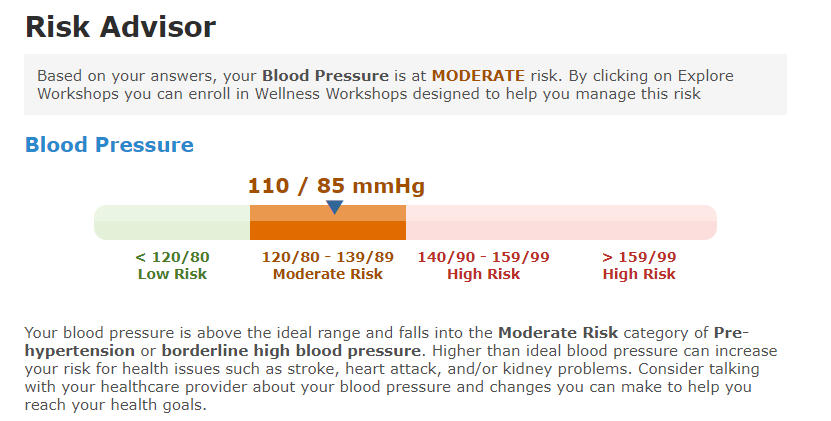
This one might be a little harder, since Cerner was so oblivious that they put this screenshot right on their brochure. This person’s blood pressure is 110/85, which Cerner says is “in the moderate risk category of pre-hypertension.” They overlooked the ever-so-slight detail that the “pulse pressure” of this unfortunate employee is only 25, a level typically found only in ICU patients with DNR orders. More likely, Cerner’s employee simply didn’t take the reading correctly, and no one at Cerner knew enough about blood pressure to realize the error before the brochure went to press.
…And yet we are trusting this industry — whose ethical and competence lapses consume 50 pages in the leading law-medicine journal — to interpret our lab results?
These examples illustrate two realms in which wellness vendors can mess up. The first is in the actual testing, as with Cerner. The second in the interpretation, as with Interactive Health. Star Wellness is in a league of its own, having outstupided virtually every other vendor in wellness, which is stiff competition indeed.
Lab test science for dummies and smarties
Scientific error is largely but not entirely based on the innate inaccuracy of finger-pricks. Wellness vendors like to tout these fairly painless blood draws because they don’t scare employees away, hence creating more revenue potential. However, finger pricks are somewhat unreliable. First, there isn’t a lot of blood to begin with. Measuring multiple blood values requires diluting the specimens so that each reagent has enough to work with. And it’s Labs 101 that every manipulation of the blood – dilution being a prime example — increases the potential for error.
Another “manipulation” is the very fact of pushing the blood through the skin. This can contaminate the blood, and also causes something called hemolysis, the rupture of red blood cells. Hemolysis can seriously skew results for many blood values. And yet it’s extremely doubtful that your vendor has figured out how to mitigate hemolysis, largely because they’ve never heard of it. Test this hypothesis simply by asking a vendor how they mitigate hemolysis in a finger-stick test.
Don’t be surprised if you get a non-answer. Remember, wellness vendors are not trained in screening–or in anything else for that matter. One of the attractions of becoming a wellness vendor is no one is tasked with educating, licensing, regulating or supervising you in any way. Becoming a wellness vendor is the healthcare industry equivalent of applying for a zero doc loan, except with a lower chance of being turned down.
Venipuncture is more accurate than finger-sticks, but even so, the level of training that wellness vendors receive – as little as five days, provided you have a background in “municipality administration, finance or sales” – does not inspire confidence that they will get this right. Many variables are involved, in collection, handling, storage, transport and interpretation of the specimens. Each sample is like a little lab experiment, one that’s been repeated many times and has a standard protocol, but is not a pure algorithm. Technique, time of day, employee activity and diet before the test, elapsed time between collection and analysis, and even ambient temperature during transport influence the outcome.
Lab test arithmetic for Interactive Health and smarties
Nonetheless, let’s give the vendors the benefit of the doubt and assume their tests are 90% accurate, because in all fairness, most finger-stick tests don’t purport to measure values that specifically involve red blood cells. Glucose is one such accurate-enough test – assuming the employee has really fasted.
Yet accurate or not, glucose is one of the least cost-effective blood values to measure. An employee in the lower part of the diabetic range now (meaning most of them) wouldn’t crash for years no matter what you do. Sure, you can find them, treat them, and get them to check their glucose daily, but it’s doubtful you’ll change anything other than how much money you spend on preventing a complication or hospital admission likely not to occur until after retirement. (Annually, only about 1 in 1000 <65 insured people end up with the hospital with a primary diagnosis of diabetes.) It also turns out that for the vast majority of diabetics (those who are not insulin-dependent), daily glucose testing is a waste of time and money.
And do you really want employees to obsess with keeping their blood sugar down? Does it increase productivity if employees have low blood sugar?
But at least the science of the glucose test itself is accurate enough, assuming the employee has fasted and assuming you retest several times before coming to a conclusion. Let’s look at some predictive tests (including mammograms) whose accuracy is more like the mainstream 90% and see what happens when you apply lab test math in those circumstances. Heart attacks are the best example. If you, as an employer, could predict and prevent a heart attack, that would be cost-effective…or would it?
Maybe 2 in every 1000 employees will have a heart attack next year. Of those, at least 1, if not more, fit one of the following descriptions:
- already have a known CAD diagnosis, diabetes, or metabolic syndrome (and hence screening won’t yield any new insights) or
- are among the many people whose heart attacks are completely unpredictable from a standard blood test.
Optimistically, then, you’re looking at a 1-in-1000 chance of actually finding someone this year who would otherwise not be found and would have a heart attack unless it is predicted and prevented. It doesn’t help your accuracy that the Genetic Information Nondiscrimination Act does not allow inquiries about family history, which is a very major risk factor.
Let’s further assume that — highly optimistically and despite not being able to inquire about family history — the cardiac tests that a wellness vendor runs on an employee can predict a heart attack with 90% accuracy. Anyone who could predict heart attacks with 90% accuracy would win a Nobel Prize, so this is a very generous assumption.
Watch what happens when that 90%-accurate test is performed on a population of 1000 employees. First, the good news: there is indeed a 90% chance that the employee who would infarct can be found. That’s 1 positive. Next, the bad news. A 90%-accurate test is also 10% inaccurate, which means about 99 of the other 999 employees will have a phantom heart attack “predicted.” We can send this Excel spreadsheet on request:
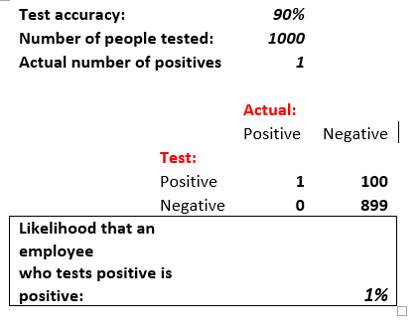
100 employees in total will test positive. 99 of those will be false. And yet all 100 will be sent to the doctor, and likely given a barrage of further tests and possible stents. Lab test arithmetic explains why it costs about $1-million for an employer to prevent a heart attack assuming it can be prevented at all.
What does this mean for employers and employees?
Simple: testing decisions should be left to employees and their doctors. Employers should not play doctor with their employees.
Overtesting creates overdiagnosis, which in turn requires overspending on overtreatment. Example: A bank sent its top executives to a hospital for testing. The 16 executives tested were informed of a total of 18 new diagnosis, in addition to diagnoses they already had. The bank spokesman admitted “it’s still too early to see savings,” while the hospital spokesman candidly admitted that this executive screening program “offers another source of income” to the hospital.
Next is one of the wackier ideas to come down the pike, the celebrity-fueled myth that employees should get tested for ovarian cancer. This test doesn’t approach any baseline level of accuracy, so the USPSTF rates it a D.
Even the wellness vendor that advertises it the most, Star Wellness, admits it is “notoriously difficult to detect in its early stages.” Insurance won’t pay for the test, and as Star says, it is “not readily available from doctors.” Perhaps there might be a reason for that?
It also means that you shouldn’t encourage mammograms for the <50 population, following USPSTF guidelines. That decision can be between them and their doctors. Mammograms in younger women are notorious for generating false positives. In one well-regarded study, of 2100 women screened for 11 years starting at age 45, 690 received a false-positive along the way, and 75 underwent an unnecessary biopsy.
On the other hand, you don’t want to discourage mammograms, on the off-chance that an employee really does have cancer. Staying out of a conversation in which you have no expertise is the best idea.
Another good rule of thumb in these situations is, look at what Interactive Health does…and then do the opposite. This is their result from testing the generally healthy population of young employees, testing them for 40 things, 39 of which (except blood pressure) are not recommended for young employees due to the preponderance of false positives. So their rate of positives is not much lower than their 45% rate overall.

They are, of course, fully aware that most of their positives are false. I know this for two reasons.
- Here is a list (scroll down) of the top 25 hospitalizations for people insured by employers, in order. Obviously, if 38% or 45% or whatever huge percent really had these “newly discovered conditions” and the employer didn’t discover them, they’d crash, right? Do you see anything on here that could have been “discovered” and prevented by a wellness vendor?
- They also follow my postings, where I have made this quite clear, Exhibit A being this one. And as Confucius said: “If you don’t correct a mistake after it is pointed out, you are creating a lie.”In that case, Interactive Health’s “mistakes” could make a White House correspondent blush.
Update October 30
Yes, Interactive Health is that stupid.

Share this:

Wellness News Roundup: New EEOC rulemaking delay, obesity myths, and celebrity-fueled overscreening
Folks, if you want the news, you’re going to have to subscribe to it.” From now on, TSW is only going to carry summaries, likely a few days late now that fall frisbee season is taking up my weekends. Here’s what you missed Friday:
- In a completely unanticipated* move, the EEOC is pushing out its proposed rulemaking date once again, this time to June 2019. That means new rules likely won’t be formally in place until 2020.
- Of course what’s another week of news without yet another expert observing that wellness vendors’ obsession with weight loss is harming employees?
- Speaking of yet anothers, yet another celebrity is urging mass screening for yet another USPSTF D-rated screen, this time ovarian cancer. Early-stage ovarian cancer is pretty darn undetectable — except of course by wellness vendors. Total Wellness says its test is “possibly an indicator of cancer cells,” a ringing endorsement indeed. Another vendor pushing these screens, Star Wellness, says these tests are “not readily available from your doctor,” as though that’s a selling point. (It reminds me of a kid I knew in high school who used to brag about not brushing his teeth.) Maybe doctors know something that Total Wellness and Star Wellness, which thinks Vitamin B12 is a vaccine, don’t.
Read the full summary, with links, here.
Got news? Clue us in. (How do you think we found these nuggets?)
*Except by me
Share this:

Wellness News Roundup: Shocking New Diabetes Findings, Provant’s Bankruptcy, & Too Many EKGs
We’re only gonna carry Quizzify’s News Roundups a few more weeks. If you want to see it every week, you need to follow us.
A study showed that non-insulin-dependent diabetics (meaning about 80% of them) do not benefit from daily blood glucose checks. These checks have no impact on HbA1c’s or quality of life. The specific wording: People who tested their blood sugar levels daily had slightly lower blood sugar levels in the middle of the study than those who didn’t test. But this difference didn’t last until the end of the study. Among people who checked their blood sugar levels, there were no differences in blood sugar levels or quality of life between those who did and didn’t receive text messages.
Conclusion: the inconvenience, discomfort and expense of daily monitoring – estimated at $1630/diabetic employee – is not merited. This result matches a study by the Ohio Public Employee Retirement System (available through Freedom of Information Act request) showing that making drugs, supplies, and strips free to diabetics had no impact on admissions or ER visits for diabetes, over a two-year period.
Should Employees Get Routine EKGs?

The USPSTF didn’t extend this recommendation to teenagers because of course no pediatrician would ever perform routine EKGs on children, and obviously no high school would ever be stupid enough to encourage all its students to get EKGs.

Missed last week’s news roundup, and maybe the ones before that? Here they are.
Share this:


So much winning! Provant Health goes bankrupt.
Even by wellness industry standards, Provant Health’s business practices earned it our first multi-part series. It required nine parts to do them justice…
And now they are bankrupt too. Their remaining assets are being purchased by Quest Diagnostics, a reference lab company no doubt hoping to run additional lab tests on Provant’s dwindling employee base.
We knew this was coming because they had already started cutting back on spending, by dropping their internet connection, and hence didn’t realize that employees are not supposed to drink 8 glasses of water a day.


Or perhaps the kiss of death was being endorsed by Wellsteps,
Here is a real-life example of what an employer can expect to achieve by spending a million bucks on these very stable geniuses:
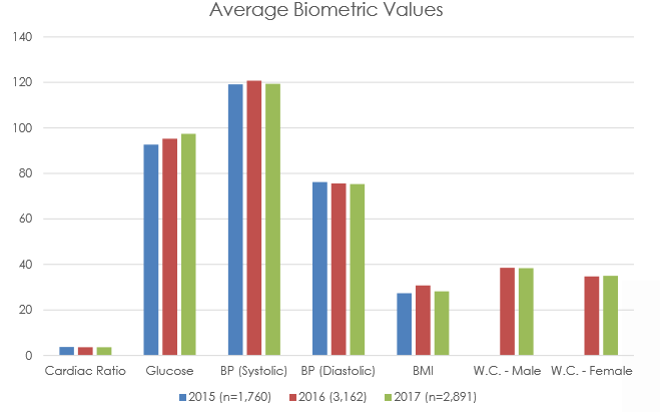
BMI and glucose got worse. Somehow, blood pressure stayed the same — 120 over 75. Yes, despite the average employee being almost prediabetic, and sporting a 40-inch waist for males (and close to that for females), pretty much everyone in this company has ideal blood pressure. One explanation for this would be that Provant, whatever their shortcomings in weight control, are the world’s leading experts in all things cardio. (And that’s even before they started — when everyone in this company already had ideal blood pressure.)
That expertise might also explain how they were able to keep the cardiac ratio so low. An alternative explanation might be that there is no such thing as a “cardiac ratio.” (Google it.) I’ve heard of wellness vendors making up data, but this is a first–making up an entire metric to present its made-up data. Maybe the reason Quest Diagnostics purchased them was to develop a new lab test for cardiac ratios.
The good news is that, despite these underwhelming results, Provant was able to beat its targets, which is easy enough if you move the goalposts to the 50 yard line:

So much winning! Provant “wins” if the average employee is overweight but not quite obese yet, has glucose only 74 points higher than the threshold to be considered diabetic, and is only borderline hypertensive. No target is set for the cardiac ratio, of course, because it doesn’t exist.
In that sense the cardiac ratio is not unlike Provant itself.
Share this:


Wellness News Roundup: Too much healthcare, too many tests…and too much prevention
Too much healthcare can be hazardous to your health, as three findings released last week have shown.
- America’s Epidemic of Overtreatment
Health Affairs reports an epidemic of overtreatment. Author Shannon Brownlee proposes that patients “start asking uncomfortable questions,” to determine if treatments are appropriate. The problem is that employees don’t know what uncomfortable questions to ask, unless one counts: “Do you mean to say I’m not eating enough broccoli?” The questions don’t have to be uncomfortable. They get more comfortable, the more one learns about healthcare. Seems simple enough, and yet 99% of employers still don’t offer employee healthcare literacy education.
2. America’s Epidemic of Innumeracy
It would help if doctors knew the first thing about interpreting lab test results before recommending these treatments, but apparently they don’t. The Washington Post reports that professionals reading lab test results don’t understand false positive arithmetic. As a result, your employees may be getting diagnosed and treated for conditions they don’t have. Wellness vendors don’t understand it either. As compared to real medical professionals, the difference is that the they take great pride in their ignorance, and brag about how many false positives they find. I’m talking to you, Interactive Health.
No, they don’t. We’ll post on false positive arithmetic next week.
3. America’s Epidemic of Overprevention
As reported on They Said What Thursday, it looks like too much spending on prevention can backfire. Specifically, spending more on employee healthcare, and sending more employees to the doctor, does not deliver better outcomes, fewer ER visits, or even more HbA1c checks for diabetics. Quite the contrary, the correlation, though weak, goes in the “wrong” direction.
Bottom line: looks like Quizzify had it right all along: just because it’s healthcare doesn’t mean it’s good for you.
Share this:


Comprehensive new report shows workplace wellness efforts firing blanks
The Commonwealth Fund recently released a comprehensive report comparing employer healthcare spending with various outcomes measures. The result — and you’re way ahead of me here, I’m sure — is bad news for the wellness industry. It shows basically no correlation between employer spending and outcomes. Examples:
- No correlation between doctor office visits and prevention of avoidable ER visits
- No correlation between total employer spending and prevention of avoidable ER vistis
Let’s see how all those diabetes programs are doing…
- A slightly negative correlation between employer spending and people getting their HbA1cs checked.
And of course, the holy grail: how are employers doing in preventing hospitalizations?
- Spending more doesn’t get better results. It’s in how wisely the money is spent. Iowa scores way ahead in preventing hospitalizations while spending less than average, perhaps due to Bill Appelgate’s Iowa Chronic Care Consortium. Nebraska, right next door, shows the opposite, spending somewhat more and preventing somewhat less. As you recall, Nebraska put their very stable genius wellness vendors on the case and ended up on the front page of the Omaha World Herald. Not to mention ongoing color commentary from They Said What, featuring — you guessed it — Ron Goetzel, trying to explain how Nebraska’s state program got an award for lying about saving the lives of cancer patients who didn’t have cancer in the first place. Not to mention the rest of program simply threw money away: of 20,000 state employees, only 180 reduced a risk factor.
Curiously, the loser states in these analyses are not the usual loser states in health status. Mississippi scores high. Not because the outcomes are great. They are around the average. However, very few employers in Mississippi spend anything on prevention or workplace wellness to achieve those outcomes. Other states spend tons of money on vendors and doctor visits…with basically the same results as Mississippi.
The displays don’t lend themselves to cut-and-pasting, since they are interactive (by state) and for some reason the axes are rather shy when you try to copy them. Nonetheless, worth noting is the slightly negative correlation between spending and quality in the employer population. (Quality on the left axis, spending on the bottom.) After a point, more healthcare only makes things worse. Or, as Quizzify says, “Just because it’s healthcare doesn’t mean it’s good for you.” Exhibit A being Interactive Health, of course. They are the most expensive wellness vendor, do the most tests, and send the most employees (45%!) to the doctor with “newly discovered conditions.” And yet they haven’t actually accomplished anything, other than getting exposed in the Wall Street Journal.

The conclusion? Like everything else in life, there can be too much prevention. Annual screenings plus annual doctor visits for asymptomatic and younger employees is simply way too much…and as this graph shows, too much healthcare can be hazardous to your health.
Too much healthcare and not enough healthcare education is a recipe for lots of excess costs.
Share this:

This week in wellness: Conflicted physicians, diet failures, and nicotine successes
New England Journal of Medicine published its first-ever article about wellness. Its viewpoint: primary care physicians should not be forced to choose whether to report employee noncompliance (which itself could harm the employee, violating the Hippocratic Oath) or whether to give employees a pass and allow them to earn their incentives or avoid fines even if they aren’t complying. See: The Physician as Double-Agent. (Behind a paywall but worth signing up for the free near-term subscription.)
The Cochrane Review (the most influential publication no one has heard of) published a meta-analysis concluding that nicotine replacement therapy is much more successful than previously believed. It might be time to reconfigure wellness programs to incorporate more of it.
Obesity is a more complex problem than many people think. And wellness programs to “help” employees may be backfiring. See Everything We Know About Obesity is Wrong. (OK, that was two weeks ago but still worth a read this week.)
The keynote session at the HEROForum18 conference, presented by Professor Gary Bennett of Duke University, had a similar theme: “We know that just about any diet program will show success at 3/6 months, but within a year or two they’ve gained it back.” He also noted that coaching may produce behavior change (not necessarily sustained weight loss) – if an employee gets the same coach, the coach is highly competent, and both parties have sufficient time for coaching.
Miss last week’s news roundup? Here it is.

 They Said What?