
Home » Uncategorized (Page 21)
Category Archives: Uncategorized
The 2017 Deplorables Awards — Runners Up
It’s time for the 2017 Deplorables Awards, lovingly bestowed on those vendors who do the best job making other vendors look good.
The good news is that you don’t have to actually win the Deplorables Award to sue me. Runners-up are eligible too. Here is my address for hand-service delivery most of the year:
890 Winter Street #208, Waltham MA 02451
In case you decide to sue me between June 22 and August 8, use:
8 Paddock Circle, Chilmark, MA 02535
And don’t leave out my attorney:
Josh Gardner, GARDNER & ROSENBERG P.C., 33 Mount Vernon Street, Boston, Massachusetts 02108
I don’t know how much more I can do for you, other than lick the envelope. So go for it. Don’t make me beg.
But, remember, unlike your usual business model, in court you are required to actually tell the truth (I would be happy to explain to you how that works), meaning there is no chance of your winning — or likely even avoiding summary judgment, since none of the evidence is in dispute. It’s all your own writings. Oh, and I do my own cross, which means you won’t be able to find an expert witness. Anyone who knows enough about wellness to be an expert witness also knows enough about wellness to know that attempting to defend you would be a humiliating, on-the-record experience.
And there is always the chance that some annoying jerk might blog about it…
The 2017 Runners-Up
Imagine a four-square matrix with competence on one axis and integrity on the other. The people and organizations we’ll be highlighting today would intersect with the companies mentioned in Monday’s posting at only one single point.
Springbuk and Fitbit
As many of you recall, earlier in the year we analyzed the study done by Springbuk that secretly financed by Fitbit. Or maybe I need new glasses, because I just couldn’t find the disclosure in the Springbuk report that this paean to Fitbit was financed by Fitbit, the way Nero used to have the judges award him Olympic medals.
Coincidentally, the study showed Fitbit saving gobs of money because employees taking more than 100 steps a day spend less money than those taking fewer. However, a simple tally of one’s own footsteps shows that it is impossible not to take 100 steps a day unless you are both:
- in a hospital bed; and also
- on dialysis.
This 100 steps-a-day threshold was repeated many times in the study, with no explanation of how that number came to be. However, it turns out we owe these two outfits an apology. Fitbit and Springbuk have told a number of people privately (not publicly, in order to avoid an embarrassing news cycle) that they didn’t really mean to say that 100 steps a day constituted activity. They meant to say that taking 100 steps a day implied you had your Fitbit on. My apologies for failing to read their minds that their conclusions were based on reading people’s minds to determine whether they wore the Fitbit deliberately, or simply forgot/remembered/cared to put their Fitbit on.
They never did explain — privately or publicly or to anyone — how employees who took an average number steps during the baseline year could show huge savings by taking an average number of steps in the study year too.
They also never explained how these two statements didn’t completely contradict each other, even though I specifically asked them to in a personal letter, excerpted here:
Third, can you reconcile this statement…:
“The materials in this document represent the opinion of the authors and not representative of the views of Springbuk, Inc. Springbuk does not certify the information, nor does it guarantee the accuracy and completeness of such information.”
“This demonstration of impact achieved by integrating Fitbit technology into an employee wellness program reinforces our belief in the power of health data and measurement in demonstrating ROI,” said Rod Reasen, co-founder and CEO of Springbuk.
National Business Group on Health
Next up is the National Business Group on Health. Last year they made the list for criticizing the US Preventive Services Task Force for not demanding enough screenings, in a country that is drowning in them. Not content to rest on those laurels, this year they earned an Honorable Mention for inviting Dr. Oz to keynote on the role of quackery in corporate wellness, and perhaps tell us about his latest lose-weight-by-eating-chocolate miracle diet.
Health Enhancement Research Organization
HERO of course also earns a runner-up award. 2017 will be remembered as the year they finally came to grips with the realization that a business model based on fabricating outcomes requires that perpetrators possess that critical third IQ digit. Without that extra “1”, an organization trafficking in math that can at best be considered fuzzy is going to be outed.
This year’s set of lies? By way of background, their 2016 poison-pen letter insisted they had fabricated that data set showing that wellness loses money without disclosing that it was fabricated — and also never reviewed their fabricated data before publication. Early in the year, I had the insight that, wow, this “fabricated” Chapter in their guidebook is so much better than the other chapters that something is amiss. No one at HERO can analyze data competently…and yet, here it was, a competent data analysis.
I did something I had never thought to do before, which was look up the actual author of that chapter. It was Iver Juster MD. He was a great analyst even before he read all my books, took all my courses, and achieved all my certifications in Critical Outcomes Report Analysis.
So I called Iver. Here’s what I learned:
- Whereas Paul Terry and Ron Goetzel had insisted that Iver fabricated the data, Iver said, of course he didn’t — whatever made me think that? (“If it wasn’t real, I would have disclosed that,” he observed. Of course he would have. Iver has tremendous integrity.)
- The Board discussed and reviewed his chapter at length, and made helpful suggestions, for which he was quite grateful. This review process required “countless hours,” just as the HERO document says:
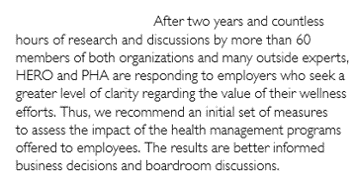
The number of transparent lies HERO tells could make a president blush. In the immortal words of the great philosopher LL Cool J, they lied about the lies they lied about.
Even though 2017 was an off-year for them in terms of the number of lies, they still told enough to be named a runner-up.
Wellness Corporate Solutions
Next is Wellness Corporate Solutions, famous for its crash-dieting contests. WCS now offers a water-drinking contest. The idea is to set up a “challenge” for your team to drink more water than other teams. They call this a “healthy competition.” I guess they didn’t get the memo that forcing yourself to drink when you don’t want to drink, just to make more money, is anything but healthy. Here is a novel idea: drink when you are thirsty. Evolution 1, WCS 0.

Perhaps as an encore, WCS, Dr. Oz and the National Business Group on Health could team up to offer a chocolate-eating contest.
I looked into this outfit to see where they get their ideas. The CEO previously ran something called the Washington Document Service. That qualifies her to run a wellness company. As Star Wellness says, to run a wellness company successfully, your background needs to be in sales, or “municipality administration.” After all, what is more central to administering a municipality than documents?
Wellsteps
What fun would a list of runners-up be without Wellsteps, the proud recipient of the 2016 Deplorables Award? While their streams of consciousness weren’t as memorable in 2017 as in 2016 (“It’s fun to get fat. It’s fun to be lazy“), they get credit for trying. Their 2017 weight-loss campaign was headlined: “This campaign is not really about weight loss, it is about helping you apply the behavioral secrets of those who have lost weight.”
So if your kids ever want you to teach them how to ride a bike, say: “It’s not really about riding a bike. It’s about helping you apply the secrets of people who have ridden bikes.”
And what secrets are we talking about? What person who has lost weight doesn’t brag to everyone or even write a book? If there is a secret to weight loss, like eating chocolate, Wellsteps owes it to the country to tell them. Don’t make us beg.
Odds and Ends
No Koop Award winner this year, but an honorable mention to past winners and runners up for their commitment to wellness:
- McKesson, for flooding the country with opioids;
- Pepsi, for flooding the world with sugar.
Sounds like in 2018 the logical winners would be Philip Morris, or maybe The Asbestos Corporation of America.
Veering briefly into the public sector, kudos to Representative Virginia Foxx, (R-NC5) for introducing the Required Employee DNA Disclosure Act. Even HERO thought it was a dumb idea…and their threshold for thinking something that increases wellness industry revenues is a dumb idea is quite high, having all rallied behind the Johnson & Johnson Fat Tax, in which companies would be required to disclose the weight of their employees.
Next up…the winner of the 2017 Deplorables Award
Share this:

Wellness Stars of 2017
The good news about wellness is that many very well-intentioned people and groups are making some major, disruptive strides in replacing wellness done to employees with wellness done for employees. So we see less of this…

and more of this… (photo courtesy of Limeade)

The bad news is that nominees for this posting in previous years have been so few and far between that I used to be able to effuse at length about each of the winners. However, there are so many of them now that this will be more like a listing than a posting.
Nonprofit and Advocacy Organizations
Many honorable mentions here, but only one winner. First, the honorable mentions. The National Association of Healthcare Purchasing Coalitions and their affiliated groups, notably Philadelphia, one of the fastest-growing regional coalitions, with additional kudos to the Colorado Business Group on Health and the Northeast Oklahoma Business Group on Health for being way out in front of the move towards the intersection of culture of health and culture of health literacy. Despite great pressure from sponsors and vendors, these regional coalitions stick to their charter and actually represent the constituency they say they represent–the employers. Doing your job may seem like a pretty low bar, but it’s one that the National Business Group on Health needs a telescope to look up at, having invited Dr. Oz to give a keynote on the role of quackery in a wellness program.
Next, the US Preventive Services Task Force. “Screen according to USPSTF guidelines” remains the mantra of the Welligentsia. Conversely, wellness vendors brag about how they ignore guidelines. Along with often testing for far too many things, they ignore the frequencies set by USPSTF, instead testing annually, because they say: “We need to measure progress.” Two thoughts on that:
- They don’t need to “measure progress” for one simple reason: there is no progress to measure. Annual prying, poking and prodding employees generates virtually zero positive impact. Hence my reward for showing cost-effective progress using “pry, poke and prod” is now $3 million.
- Flouting the guidelines just to measure the cholesterol of the employees would be like burning the roast just to measure the temperature of the oven.
Since hyperscreening is one humongous medical error, it’s no surprise the The Leapfrog Group wins plaudits again this year.
On the conference side, both WELCOA and Global Health Resources hosted excellent conferences, with emphasis on wellness done for employees instead of to them. Here in Massachusetts, the New England Employee Benefits Council conference last week was also a big hit. The exhibit hall included only one antediluvian wellness vendor, but that only reminded attendees of how far we’ve come. In sharp contrast, the speaker roster featured Brian Klepper, one of the most disruptive people in healthcare.
Just in terms of sheer drama and enjoyment, though, the Rock Stars of Health conference would be the winner. Worth traveling all the way to Montana for.
However, among nonprofit and advocacy organizations, the hands-down winner for 2017 is AARP, specifically Debbie Chalfie. Unlike us here at TSW, who simply report the news, or HERO, which simply fabricates the news, AARP makes the news. In 2017 they got a court — and this should not have been a heavy lift, but it was — to agree that maybe, just maybe, the words “forced” and “volutary” are not synonyms, meaning that employers can’t make employees choose between submitting to vendors playing doctor or paying large fines. We still don’t know how this will turn out, ultimately, but at least it is now up for debate. The EEOC is supposed to propose new rules next year. For now, there are still no constraints on fining employees large sums for not participating in these programs.
Publications
As usual, the media is lined up 100% against the pry-poke and prod agenda. The winner this year is the law-medicine journal of Case Western Reserve, HealthMatrix. It is the oldest law-medicine journal in the country and arguably the most respected. This year they tried to do an issue on wellness with representation from both advocates and critics…but couldn’t find any of the former who weren’t conflicted out by their role in the industry. Literally, there is not one single non-industry-connected person who supports wellness on its merits enough to write about it. So all five articles were critical conventional wellness-done-to-employees-not-for-them, representing five different authors (or groups of authors) detailing five different major issues.
These articles are all available for download gratis.
Vendors and Other Groups
In wellness, the big news was the establishment of the Employee Health and Wellness Program Code of Conduct. Jon Robison, Rosie Ward and Ryan Piccarella get the credit for that. We just added our first Amendment, urging crash-dieting vendors to disclose the likelihood of weight regain and the possibility that weight-cycling could be harmful. As you can see if you visit the site, there are now many endorsers of the Code, and only three opponents — Optum, HERO and Wellsteps. Having seen data from all three, I can understand how ethics would be incompatible with their business model.
Looking beyond wellness, perhaps the year’s big news was the ascent of Dave Chase, Brian Klepper, and their disciples (of which I am one). Apparently, wellness is not the only industry sector in healthcare corrupted by greed at the expense of the employee and employer. The providers, PBMs, carriers and drug companies all have their hands in the cookie jar as well. The difference — as described in Dave Chase’s book — is that whereas employees actually need access to drugs, providers etc. and therefore employers are exposed to vendor rapaciousness as a byproduct, wellness is a self-inflicted wound. Simply cutting back from annual screenings to doing wellness according to guidelines immediately reduces wellness expense by about 60% – 70%. That is still frequent enough to identify issues to address — but without the hyperdiagnosis that some vendors salivate over. And it frees up far more than enough money to undertake other initiatives, such as employee health literacy.
And the Validation Institute continues to be seen as the “gold standard” for measurement of outcomes. No one else even close.
Some vendors distinguished themselves this year too. Sterling Wellness, It Starts With Me, Switchbridge, Sustainable Health Index, Impact Health, SelfHelpWorks, HealthAdvocate, Redbrick, Wellable, American Institute of Preventive Medicine, USPM, Healthcheck360, and Limeade, for starters.
Likewise some brokerages clearly distinguished themselves as well — Connect Healthcare Collaboration, Arthur J. Gallagher, Hayes (Boston Office), Gibson Group, AIA-BRG, Lake Norman Benefits, Axion-RMS, Benefits Services Group.
And kudos to Mercer for being the first major consultancy (second employee health services organization overall, after Quizzify) to address the elephant in the room, opioids.
Employer Workplaces
I would normally name a number of workplaces here — and there are many deserving ones — but in the public sector, it looks like a tie between Hilliard City Schools and the City of Chelmsford, MA, part of the innovative and equally deserving Massachusetts Interlocal Insurance Association. In both cases, the level of voluntary participation in a wide range of programs, with no coercion and surprisingly modest incentives, has been over the top. In the private sector jumbo employer category, there is only one: Cummins. There’s a reason that when Fortune asked me who they should profile for wellness, I recommended Cummins. Among mid-sized employers, Pace Industries and PTA Plastics lead the way.
Individuals
I’m sure I’m leaving some people out. If I did, just mention them privately and I’ll slip them in. I’m also not re-naming names of people in organizations already mentioned. Bob Merberg, Jayne Schmitz, Wendy Gammons, Tom Emerick, Bill McPeck, Mitch Collins, Kristie Howard, Julie Fulton, Justin Leader, Brian Uhlig, David Contorno, Marty Makery, Craig Lack, Andy Neary, Aaron Witwer, Cassidy Posey, Sean White, Kristie Howard, Samantha Gardiner, Matteo Zanella, Dan Cronin, Linda Riddell, Gretchen Day, Romy Antoine, Krisna Hanks.
Don’t miss the upcoming finale…
…In which a worthy 2017 successor to Wellsteps will be named as winner of the annual Deplorables Award.
Share this:

The reward for showing wellness works is now $3 million!
2023 Update — we aren’t just “outing” the worst. Instead we are claiming to be the best: The reward now applies to any behavior-change vendor — diabetes, wellness etc. — vs. Quizzify. $3 million is yours if found by the 5 judges (and remember, we only appoint one!) to be more cost-effective than Quizzify.
Here are the specific rules to claim the reward.
Almost any behavior-change vendor – e.g., Bravo, Accolade, Livongo, any wellness vendor other than USPM and Personify (nee Virgin Pulse) whose claims are valid – is eligible to claim the reward. A “behavior change” vendor would be one whose value depends on employees doing something voluntarily or with an incentive/penalty, paid via an admin fee, which counts in the calculation. Eligible categories include wellness, diabetes, weight loss, mental health, sleep, coaching, EAPs, “challenges” programs, fitness, nutrition, and patient-centered medical homes. (The orthopedic companies – Kaia, Sword, Hinge – do actually accomplish something so they are not eligible.)
Aon is also eligible, as they are the “Intel Inside” for Accolade and Lyra. two of the most noteworthy snookers.
We say “almost any” because those featured favorably in Cracking Health Costs and Why Nobody Believes the Numbers, and Virta and Twin Health, which legitimately reverse diabetes, are ineligible.
If indeed a vendor considers itself to be a behavior change company and Quizzify looks at it and says, no, this is not behavior change, the vendor may announce that Quizzify rejected their application. The vendor may then apply to the Validation Institute to arbitrate whether it is a behavior change company or not. If it wins, Quizzify agrees to pay for its validation.
Selection of Judges
There will be five judges, selected as follows:
- Each side gets to appoint one, drawn from The Healthcare Hackers listserve with more 1000 people on it, from all walks of healthcare.
- Two are appointed objectively. That will be whichever health services researchers/health economists are the most influential at the time the reward is claimed. “Most influential” will be measured by a formula: the highest ratio of Twitter(X) followers/Twitter(X) following, with a minimum of 15,000 followers.
- Those four judges will agree on the fifth.
Using the criteria below, the judging will be based largely on value per dollar of the program spent on the program and incentives. In the event this is considered to be roughly a tie, the judges will consider the validity of their measurement and whether they are validated by the Validation Institute.
Written submissions
Each side submits up to 2,000 words and five graphs, supported by as many as 20 links; the material linked must pre-date this posting to discourage either side from creating linked material specifically for this contest.
Publicly available materials from the lay media or blogs may be used, as well as from any of the 10 academic journals with the highest “impact factors,” such as Health Affairs, published within the last ten years.
Each side must:
- list their average prices per employee per year
- speak to compliance with ACA, ADA, USPSTF, and Choosing Wisely;
- allow the other to test its materials (for example, taking the health risk assessment) and review them as part of the submission.
Each party may separately cite previous invalidating mistakes made by the other party that might speak to the credibility of the other party. (There is no limit on those.)
In the case of Aon, it is the existing documents which will be judged: their reports on Accolade and Lyra, vs. my rebuttals. No other submissions from either party are involved.
Oral arguments
The judges may (or must, in the case of Aon) rule just on the basis of the written submissions. If not, the parties will convene online for a 2.5-hour presentation (or, at the discretion of the judges, in-person at a conference of their choosing), featuring:
- 10-minute opening statements, in which as many as 10 slides are allowed;
- 30-minute cross-examinations with follow-up questions and no limitations on subject matter;
- 60 minutes in which judges control the agenda and may ask questions of either party based on either the oral or the written submissions;
- Five-minute closing statements.
Entry process
The entry process is:
- Applicant puts $3000 into escrow, at which point an NDA is signed and Quizzify/Quizzify guarantors (“Quizzify”) demonstrate liquid assets exceeding $3 million. Applicant may either go forward at this point, or forfeit the $3000.
- Applicant adds $27,000, at which point earning assets exceeding $3,000,000 are placed in escrow, though the income from the escrow does not go to the applicant. Assuming the $3,000,000 is sufficiently secured, applicant may either go forward, or forfeit the $30,000. If not secured, Quizzify pays the applicant $100,000.
- Applicant adds $270,000 to the escrow within 30 days, at which point the entry process is completed. Both sides then have 30 days to submit materials and 7 days to rebut. Online argument then takes place, if needed.
- Judges are paid from the escrow, 50-50 from Quizzify’s and applicant’s shares.
- If the applicant pulls out after publicly announcing he or she is applying and before adding the $270,000, there is a $50,000 liquidated damages fee, tripled if it has to be procured through litigation. If Quizzify pull outs, there is a $150,000 liquidated damages fee in favor of the applicant, tripled if it is procured through litigation.
- The winner collects the escrow.
2025 Update: Personify’s claims are valid
March 2021 Update: Wellsteps can claim double the reward ($6 million) for half the entry fee ($150,000) simply by showing that their ROI calculator is more accurate than Quizzify’s.
January 2021 Update: Omada is claiming outcomes on their home page that are textbook examples of both regression to the mean and participant bias. They are aware this is not valid. They can claim this reward by defending their specious claims.
December 2020 Update: This reward is now applicable to any actuary or other self-proclaimed expert who claims that their published analyses of the wellness/diabetes/disease management industries showing favorable outcomes and savings are better than mine showing losses and general cluelessness.
Here is the original offer and how it is changed.
As almost everyone in the wellness industry knows, we have offered a $2 million reward to anyone who can show that conventional annual “pry, poke and prod” wellness saves money. I’m feeling very generous today, what with the holidays upon us, so let’s make the reward $3 million.
Even more importantly, let’s loosen the rules — a lot — to encourage applicants. You’ll find the $3 million reward is not just more generous, but also far easier to claim than the previous $2 million reward.
Special Offer for HERO
Ah, yes, the Health Enhancement Research Organization (HERO). The belly of the beast.
Let me make them a special offer. Paul Terry, the current HERO Prevaricator-in-Chief, has accused me of the following (if you link, you’ll see they had enough sense not to use my name, likely on advice of counsel, given that I already almost sued them after they circulated their poison pen letter to the media):
I’m convinced responding to bloggers who show disdain for our field is an utter waste of time. I’ve rarely been persuaded to respond to bloggers [Editors note, in HERO-speak, “rarely” means “never” — except for that intercepted Zimmerman Telegram-like missive], and each time I did it affirmed my worry that, more than a waste, it’s counter-productive. That’s because they’ll not only incessantly recycle their original misstatements, but worse, they’ll misrepresent your response and use it as fodder for more disinformation.*
Tell ya what, Paul. let’s debate disinformation, including your letter.
I have asked you on multiple occasions to clue me in as to what my alleged disinformation actually is, if any. That way I can publicly apologize and fix it, should I choose to do so. Before applying for this award, you need to disclose this alleged disinformation. You can’t just go around saying my information is made up etc. without specifying what it is.
By definition, “disinformation” is deliberate misrepresentation. To my knowledge, as a member of the “integrity segment” of the wellness industry, I have never, and would never, spread disinformation.
On the other hand, if I did spread inadvertently incorrect information by mistake, it seems only fair to let me fix it — especially given that I have been totally transparent and generous with my time in explaining to you what yours is, and how to correct it. (I might have missed some. Keeping up with yours is a challenge of Whack a Mole-meets-White House press correspondent proportions.)
So perhaps it is time to man up, Mr. Terry. You and your cronies claim to have been collecting my “disinformation” for years, without disclosing any of it. I’m offering you a public forum and $3-million to present it…with only one of 5 judges on “my” side.
Otherwise, perhaps you should, in the immortal word(s) of the great philosopher Moe Howard, shaddap.
*As a side note, Mr. Terry writes: “We’re fortunate to work in an industry with a scant number of vociferous critics.” This “scant” number appears to include the entire media — left-wing, right-wing, centrist, and health policy. Apparently also most employees, according to Towers Watson. The good news about “pry, poke and prod” is that it truly bridges the partisan divide, in that everyone hates it.
Share this:

Aaron Carroll’s new book asks: Can “bad food” be good for you?
When I was a kid, there was a seasoning called Accent. Both its TV commercials and its canisters featured a little horn with the slogan: “Wake up the flavor.” We poured that stuff on everything (except for our Captain Crunch), often accompanying our culinary adventures by making little horn sounds.
It turns out Accent was pure MSG. Who knew? And yet we lived to tell the tale. Neither me nor my siblings ever got headaches as kids. Or ever get headaches as adults. Indeed, we seem to have acquired some headache immunity from using this stuff. (Correlation, not causation, a good researcher would say.)
The reason, as you’ll learn in The Bad Food Bible, is that MSG isn’t bad for you, even apparently in the quantities we devoured. (Yes, we know – you get a headache when you go to a Chinese restaurant. That could be your imagination, or you may be one of the few people with a sensitivity to it, just like a few people have sensitivities to other foods.)
MSG isn’t the only maligned food. Is butter good for you or bad? Milk? Artificial sweeteners? Organic foods? Sugar? Meat? Red meat? Tuna? Coffee? Wine? Eggs? Salt?
Oh, and don’t forget gluten. Turns out, virtually every one of these foods has been studied in depth…and here the studies in both directions are summarized and sourced.
How does this apply to wellness vendors?
Wellness vendors – and I’m looking at you, Interactive Health – want to micromanage our diet in so many ways that most employees just tune their advice out. This book reveals that tuning vendor wellness advice out is probably the right response in most cases. Not all, but most.
We’ve shown repeatedly that wellness vendors, once they move beyond eat-more-broccoli-olive oil-nuts-and-fruit, are usually peddling very controversial or decidedly incorrect unsolicited dietary advice. Not that they care, because they show huge savings no matter what they do. One study – so seminal that it became part of Kate Baicker’s infamous “Harvard study” meta-analysis – found massive short-term savings by advising diabetics to swap out fats in favor of carbs. Not surprisingly, that study qualified the author for a coveted spot on the Koop Award Committee. Apparently bad advice is part of the Koop Award’s DNA.
What that study did and what Interactive Health does should not be called “dietary micromanagement.” Rather, it should be termed “dietary micromismanagement.” Interactive Health’s advice to non-hypertensive diabetics and people at risk for diabetes is exactly that: swap out the whole milk for skim milk and cut way back on the salt. As a previous column noted, that turns out to be exactly the opposite of what they should do.
So what should we eat…and what shouldn’t we?
The great philosopher Dan Quayle once uttered the immortal words: “The role of the Vice President can be summed up in one word: to be prepared.” Likewise, with the exception of sugar and soon-to-be-extinct artificial trans fats, the book can be summed up one word: chill out.
Author Aaron Carroll, part of The Incidental Economist (the country’s leading health economics blog), lays out the case for OK-in-moderation for most controversial foods. This guy doesn’t have an ax to grind – except when it comes to skewering people who have an ax to grind. He goes after faddists, extremists, and people who ignore research with a zeal approaching ours in exposing dishonest wellness vendors (and I’m looking at you, Interactive Health…and Wellsteps and Fitbit and about 50 others).
Since The Incidental Economist’s positioning is that of arbiter, not advocate – the go-to place for evidence-based answers no matter what the evidence shows – their answers on these topics are highly credible and carefully sourced. (Hence their smackdowns of the Koop Award Committee and wellness vendors are even more credible than mine.)
The answers boil down to: stop knocking yourselves out trying to be perfect. You are probably stressing more over your diet than you are gaining from fine-tuning your diet. Yes, there are a few things to avoid, like added sugars (but you knew that, or if not you would as soon as you play a round of Quizzify). Or, if you have a predisposition to hypertension due to history or ethnicity, you might want to go easy on the salt. (Most people needn’t – there is a reason your taste buds welcome the flavor).
So live a little, let your employees live a little, and know there are really only a few things that all the evidence says you truly need to avoid: trans fats, added sugars, and Koop Award-winning wellness vendors.
Share this:
Should Interactive Health’s wellness advice carry a warning label?
This is the third in our series exposing the hilarious antics of Interactive Health.
Hilarious, that is, unless you are one of those unfortunate souls who are:
- paying their bills;
- believing their outcomes; or
- taking their advice.
The first and third are closely related in the sense that one would think with their fees –which rank among the wellness industry’s highest due to their industry-leading embrace of hyperdiagnosis — they could afford to train their employees in wellness.
However, since they apparently forgot to check that box, I’ll do it for them. I owe them this favor, having recently made unflattering observations regarding their botched cover-up of their invalid outcomes reporting.

First the good news
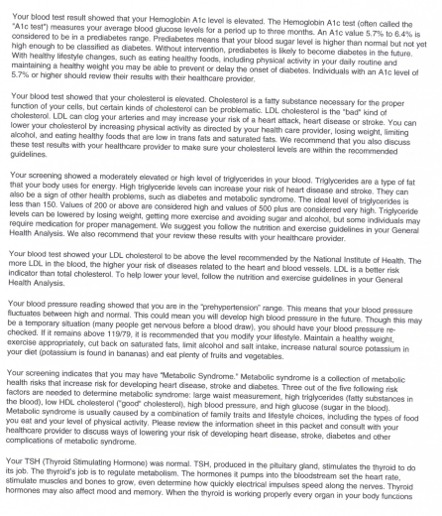
No one can accuse Interactive Health of wasting money on excessively silly, excessively gimmicky, excessively readable user interfaces. Here is the advice they give to employees, all 1350 words of it, starting with Page 1.

But wait…there’s more. Page 2
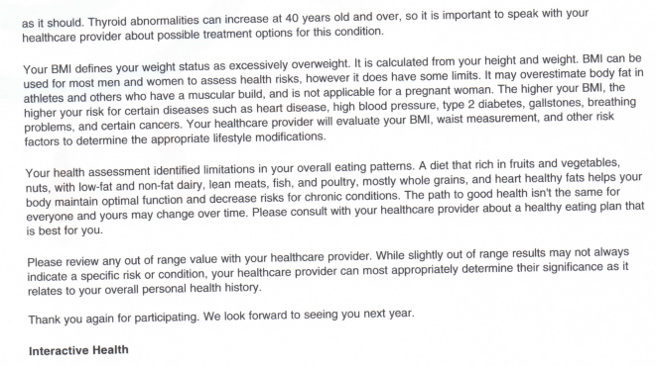
And for all those employees who simply have too much free time on their hands at work, Page 3.
More good news. They do tell this employee, after informing her that she has metabolic syndrome, to “avoid sugar.” Credit the law of averages with that — if you write 1350 words, it is likely that 2 of them — 0.14% — will be correct. These two words are in the middle of the second page, so I’m sure she saw them. Who wouldn’t?
Next, the bad news
To prevent that metabolic syndrome from progressing to diabetes, the letter also recommends “lowfat or nonfat dairy” in the diet. However, according to the the journal Circulation, people with the most dairy fat in their diets had a 50% lower risk of diabetes. Likewise, a study of 18,000 women showed lower obesity among those who consumed full-fat dairy. Journal articles are likely beyond Interactive Health’s grade level, so here are two lay summaries and two lay books:
- The Skim Milk Scam: Words of Wisdom from a Doctor Dairy Farmer
- Lowfat Dairy: Zombie Guidance
- The Big Fat Surprise
- The Bad Food Bible
It’s not just dairy fat, where the science, though perhaps not definitive, is settled enough that even the dumbest wellness vendor should know not to tell diabetics to switch to skim milk. It’s also saturated fat in general, where the change in scientific understanding over the last 10 years has caught many wellness vendors by surprise, and they haven’t had time to react.
If consumed in large quantities, perhaps saturated fat may be a heart disease risk factor nonetheless. Who are we to say? However, if it were a culprit of any significance — like trans fats or cigarettes or family history — that conclusion would be definitive by now, given the massive amount of research that’s been thrown at this question. Even if saturated fat were a minor risk factor, there is still one overriding reason Interactive Health shouldn’t be telling people with metabolic syndrome to eat less fat: what the he** do they think people will eat instead? There is a whole body of literature on how telling people to eat less fat helped create the obesity epidemic.
In all fairness to Interactive Health, they recommend eating only less dairy and other saturated fat, not less total fat. However, that is a subtlety that can get lost in those 1350 words brimming with all sorts of random advice. For instance, on the subject of abnormal thyroid function, the letter says: “Talk with your healthcare provider about possible treatment options for this condition.” Sound advice indeed — if in fact the person in question had abnormal thyroid function, but according to this report (bottom of Page 2), her “thyroid was normal.”
More bad news
Even though this person does not have high blood pressure, the letter also recommends eating less salt. For people without high blood pressure and especially people like her who have other diabetes and cardiac risk factors, avoiding salt is likely a bad idea.
Other than the answer being different for different people and different ethnicities (subtleties overlooked by almost all wellness vendors, which prefer to give blanket advice), the science is unsettled. It does, however, increasingly point to the importance of salt — something humans have been consuming in large quantities ever since way before the Roman Empire paid its soldiers in salt — in the diet. This is especially the case for people with, or at risk for, diabetes or heart disease (which this person is). In particular, for people without hypertension, reducing salt intake to a level much below the US average:
- is associated with higher risk of death among diabetics
- may increase insulin resistance
- may increase risk of death from heart disease
- may increase total and “bad” cholesterol
Among other limitations, most of these studies are correlative, not causative, and rely on self-reporting rather than controlled environments. So we can’t conclude with certainty that avoiding salt is a bad idea. Nonetheless, my suspicion is that companies paying Interactive Health millions of dollars — and basically forcing their employees to choose between submitting to them or losing money — have assumed that the advice they are giving employees is settled and likely correct, rather than controversial and likely incorrect.
Other studies, generally older ones, recommend low-salt diets to prevent high blood pressure, so it is still at least arguably fair to say salt science is conflicted. But the overriding reason for Interactive Health stop telling employees at risk for diabetes to eat less salt and less saturated fat is, what the he** do you think they are going to eat instead? Since most proteins come with saturated fat (and salt), there is only one thing left to eat: carbohydrates.
The bottom line is that anyone who actually takes Interactive Health’s advice on how to avoid diabetes is likely to increase their odds of getting diabetes.
Fortunately, most employees will have the good sense to ignore their advice, if for no other reason than it is quite a Herculean task to plow through it all. How do I know this? By definition, any employee reading this blog is more health-conscious than average. And yet the particular employee who, after reading my blog post on them, sent me this letter originally sent me only the first and third page. She hadn’t even realized there was a second page, since Interactive Health printed it on the back of the first page.
Ironically, that was the page where it said “avoid sugar.”
The “coaching” call
In addition to the letter, this employee did receive a coaching call, described as follows:
When they called to offer me advice they simply said, “ Do you know you have high cholesterol?” I said, “yes.” Then she proceeded to ask me what I was going to do about it . I said : “I thought you would tell me what to do.” She had nothing to say. Then I received another call a few weeks later as a follow up and I wanted nothing to do with them as they had already discredited themselves with the first call.
In yet another installment (which will have to wait until 2018 since December is devoted to highlighting the best-in-shows of the wellness industry and of course the Deplorables Awards) we’ll explain how Interactive Health translates ignorance of clinical guidelines, bad dietary advice and massive hyperdiagnosis into quite literally the most inflated savings in the wellness industry this side of Wellsteps.
Share this:

Final installment: 3 more stories of wellness shame and harms
Included in this concluding batch is yet another wellness program debacle regarding eating disorders. The irony is, this one takes place at an addiction facility. I’ve always maintained that, along with facts, integrity, math, data, employees and me, another thing the wellness industry has no appreciation of is irony. Examples:
- The most recent Koop Award for the best wellness program went to Wellsteps, who according to their own data made employees worse;
- Vitality pitches its weight-loss program even though by their own admission they couldn’t get their own employees to lose weight;
- The wellness industry’s own trade association, whose job is to show wellness saves money and improves morale inadvertently admitted that wellness loses money and damages employee morale.
This final set of case studies concludes with a statement from an actual named, LCSW who specializes in the treatment of eating disorders.
Links to previous installments:
- Part 1: Recovering executive with anorexia nervosa begs not to be weighed…DENIED
- Part 2: Recovering technologist with bulimia told to “fit into his skinny jeans”
- Part 3: Recovering employee with anorexia nervosa told “nothing tastes as good as skinny feels” and advised to eat only half her lunch.
- Part 4: Recovering employee with bulimia and a severe grain allergy penalized for eating too many natural fats, as correctly prescribed by her dietitian…and begins purging again.
Joan
The school where I work recently instituted a wellness program. In order for our insurance premiums to not increase, we had to go through a series of tests: total cholesterol, blood pressure, BMI, LDL cholesterol and fasting glucose. If we did not “pass” 4 out of 5 of these biometric screenings, we had to go through six weeks of phone therapy and then have the screenings done again after that time.
If, after the six weeks of phone therapy, the results did not change, our insurance would go up about $50.00/month.
The whole experience was a nightmare. They conducted the screenings in the music room at school, with different tables and stations set up. About 10 or 12 teachers and staff members were in the room at one time, so there was little privacy.
We moved from one station to the next as each of our results was written down and passed to the next person.
When we got to the end, a wellness “counselor” went over our results. The lady saw my triglycerides number and immediately asked, “Does diabetes run in your family?” “Is obesity an issue in your family?” I asked why. She said that a high level of triglycerides means that the body has “too many fat cells” and that I am at an “increased risk.”
To someone who has struggled with an eating disorder, as I have, this was tantamount to saying “Because of your high triglycerides, you are fat. You are obese.”
Being weighed is always a humiliating and shameful experience for me, as it is for many people with eating disorders, and it can trigger exacerbations of my disorder (treating professionals familiar with eating disorders are well aware of this phenomenon and structure treatment accordingly). To have to be weighed in front of my peers made that experience even worse.
This biometric screening triggered my disorder. I was in tears by the time I got to the last “counselor” and had a very hard time controlling my feelings. Right after this, I needed to get into my classroom and be with my kids. I had to “suck it up,” until the end of the day.
It was horrible and it makes me wonder what is in our future in regard to all of this.
Katie
My workplace, an addiction treatment facility, has an employee “wellness” program.
If employees want to obtain the insurance “wellness rate” (the lower of two rates available to employees), we are required to start every year in January with a “health fair” and a “know your numbers screen” where they check weight, blood pressure, glucose levels and cholesterol. Then we are “advised” by a registered nurse to exercise more and eat less (as if that had never occurred to anyone previously).
This year, the medical assistant drawing my blood engaged in numerous behaviors that would trigger most people with an eating disorder. She informed me she “used to be as big as” I am until she “got bypass surgery.” Despite mentioning several times that I see a nutritionist who recommends that I not weigh myself or know my weight, I was asked to guess my weight before I stepped on the scale. I turned around when I stepped on the scale to avoid seeing my weight, but the assistant nonetheless chattered on about my weight.
I was reminded of embarrassing weigh-ins with school nurses and weight loss programs before I was exposed to eating disorder recovery.
This year we are also assigned to a “wellness team” where everyone is supposed to wear pedometers every day and log their steps weekly on a website. Everyone can see everyone else’s steps on the site and a competitive spirit is encouraged.
I am especially saddened and concerned that we have this potentially damaging environment that encourages obsession with weight and numbers in a facility that treats addiction, where one would hope we would be steered away from, rather than toward, the process of addiction to disordered eating.
I have worked with hundreds of patients over the 13 years during which I have worked with people with eating disorders. In the past two years, I have seen a number of patients who were quite negatively impacted by the wellness programs at their place of work.
In one instance, a patient with binge eating disorder reported that she would be financially penalized if she didn’t set weight loss as a goal and make progress toward this goal. However, this was in direct conflict with her treatment goals to stabilize eating and set any goals for weight loss aside. This patient could see how focusing on weight loss increased her binge eating; however, she felt shame and anxiety as a result of these pressures put on her by her employer. She did not feel that as a larger-sized person she could speak up about this injustice.
In another instance, a patient reported that her employer required her to complete a health screening or be charged $600.00, and when she didn’t meet the health targets she was given an opportunity to still get the monetary “rewards” by meeting with a dietician three times. She was also informed that she could get a “Healthy Weight Improvement Reward” by losing five pounds since her last health screening. Again, this is a patient with binge eating disorder whose condition is destabilized by focusing on weight loss. She too felt that as a larger-sized person she could not speak up about how this program could cause her harm.
What now?
Next week, and with the help of others, we will ask, what does this all mean? What can be done to prevent or discourage wellness vendors from harming employees?
And once again, kudos to the good guys, the vendors who are not implicated in this series at all, and indeed would never do such things to people:
American Institute of Preventive Medicine, Health Advocate, HealthCheck360, It Starts with Me, Limeade, Redbrick, SelfHelpWorks, Sterling, Sonic Boom, Sustainable Health Index, US Health Centers, US Preventive Medicine
Share this:
Victims of Wellness Programs Tell Their Stories of Shame and Harm — Part 3
This is the third in the series of major wellness harms perpetrated on employees by wellness vendors and indifferent employers. These narratives have been painstakingly compiled, edited only lightly, and with no detail omitted other than the victim’s name and employer. I won’t tell you who the perps are yet, other than to say that the vendors I have consistently noted to be the best — American Institute of Preventive Medicine, Health Advocate, HealthCheck360, It Starts with Me, Limeade, Redbrick, SelfHelpWorks, Sterling, Sonic Boom, Sustainable Health Index, US Health Centers, US Preventive Medicine — are not among them.
See:
- Part 1: Recovering executive with anorexia nervosa begs not to be weighed…DENIED
- Part 2: Recovering technologist with bulimia told to “fit into his skinny jeans”
Mary
I used to work for a county health program that established a workplace wellness program. One cold January morning, I returned to work for the first time in nearly eight weeks. I had taken a leave of absence after a suicide attempt and inpatient treatment for chronic depression and anorexia. I had gained a few pounds and my depression had stabilized, and I was looking forward to returning to work I found meaningful.
But when I walked in the door, I was inundated with signs about our workplace weight loss contest—a “Biggest Loser”-style competition. For someone who was struggling desperately to gain weight, this was nothing less than an affront. Signs told me that “Nothing tastes as good as skinny feels.” Besides being the same slogans plastered all over the anorexia-enabling websites I used to visit, I had spent the past decade feeling exactly how skinny could make you feel—miserable enough to complete a near-lethal overdose.
I pulled my chin up, set my things down at my desk and walked into the break room for a hot cup of coffee. There, on a big sheet of blue posterboard, was a tally of how much weight everyone had lost. Veronica in accounts receivable had already lost 3.4 pounds. Then, flooding in my inbox were the emails encouraging us to only eat half our lunch, and to try to sneak in an extra workout during our lunch break. Never mind that these behaviors were exactly what had landed me in the hospital. Now, I had a prescribed diet developed in consultation with my dietitian.
For several months, I tried to grin and bear it, but eventually, the madness was just too much. I couldn’t bear the meetings about how good steamed broccoli was. I couldn’t stand working in an external environment that was, quite possibly, more toxic than the internal chatter I endured all day. The poster listing everyone’s weight loss statistics was removed upon my request, but the fact remained that the workplace wellness program had created an environment that was anything but healthy. I had to quit my job.
Perhaps my experience is an unavoidable side effect of a war against obesity that some have determined should be won at all costs (and regardless of strong evidence that existing wellness programs don’t work).
But when you consider that around one in 20 Americans will struggle with an eating disorder at some point in his or her lifetime, that’s a lot of collateral damage.
Share this:
Victims of Wellness Programs Tell Their Stories of Shame and Harm — Part 2
This is the second in a series of first-person narratives of harms caused by wellness vendors. These narratives have been painstakingly compiled, unretouched except for formatting, and with no detail omitted other than the victim’s name and employer. I won’t tell you who the perps are yet, other than to say that the vendors I have consistently noted to be the best — American Institute of Preventive Medicine, Health Advocate, HealthCheck360, It Starts with Me, Limeade, Redbrick, SelfHelpWorks, Sterling, Sonic Boom, Sustainable Health Index, US Preventive Medicine — are not among them.
John
I’m 37 and have put a lot of work into recovering from bulimia. I have been in treatment for bulimia for 12 years. I see a therapist, a doctor specializing in eating disorders, and a psychiatrist.
For the last five years, I’ve worked at a technology company. I’ve noticed that every year, their “wellness program” has become more and more triggering, as it has become increasingly tied to health biometrics and “rewards” on my paycheck. The “rewards” for taking answering the health risk assessment, taking various biometric tests, and meeting certain health outcomes are so significant that I felt I had to participate. These rewards now come to a total of $2470 per year for taking the tests and meeting all of the health targets. With a family and a child in day care, I cannot afford to forego such a large amount of money.
A couple of years ago, the wellness program started to require that employees’ weight, triglycerides, and blood pressure be checked. These biometric screenings happen every year, and I dread it. If my body mass index does not fall into what the program considers “normal,” then I don’t get a “reward” on my paycheck—or, to put it another way, I get penalized. If I forego even one part of the biometric screens, such as the weight check, I lose the reward for all of the screenings. In addition, the program’s instructions for employees, including to keep their meal portions “as small as possible” (to “fit into your skinny jeans”) are inconsistent with and undermine all the work that I have done to overcome my disability.
The wellness program allows employees to have their own physicians perform the screenings. When my doctor heard about the screenings, he was incredulous. He indicated that, out of concern for my health, he did not want me to participate in these tests. But I felt compelled to do so given the large sum at stake. My doctor wrote a letter explaining that having me step on a scale and having my weight read out loud would be extremely damaging. After three months of requests and negotiations, I was ultimately able to get the program to permit me to apply for the incentive without my doctor filling out the screening form (a special “manual process” was used), but this process was extraordinarily stressful and I have no assurance that I will be permitted to do this in the future. I was the first person who was able to forego the screening without losing the incentive—and to my knowledge, the only person. And guess what? It’s time to do the entire thing again for this year’s screening!
Share this:
Victims of Wellness Programs Tell Their Stories of Shame and Harm
This begins a series of first-person narratives of harms caused by wellness vendors. These narratives have been painstakingly compiled, unretouched except for formatting, and with no detail omitted other than the victim’s name and employer. I won’t tell you who the perps are yet, other than to say that the vendors I have consistently noted to be the best — American Institute of Preventive Medicine, Health Advocate, HealthCheck360, It Starts with Me, Limeade, Redbrick, SelfHelpWorks, Sterling, Sonic Boom, Sustainable Health Index, US Preventive Medicine — are not among them.
Jane
I am a corporate executive in a Fortune 500 company. My employer operates a wellness program. Every year, as part of that program, we are required either to have blood drawn and have our weight, height, blood pressure and other things measured or contribute more toward our health insurance. This testing is done on site at the workplace.
I have anorexia. I have been in treatment for four years. Over the years I have built a relationship with my dietician, my therapist, my psychiatrist, and my medical doctor. Their familiarity with my needs, including what helps and what triggers the symptoms of my disability, is critical to ensuring that I receive effective treatment.
In contrast, the wellness program at my workplace is operated by people who have no familiarity with my particular needs and no knowledge of how to address them. Among other things, the program requires employees to undergo weight-related screenings administered in a manner that undermined the treatment regimen carefully designed by my treating professionals and resulted in my relapse and admission to an intensive outpatient treatment program.
I would never have participated in this wellness program of my own accord, but due to the large financial incentives to participate, I felt like I had no choice but to do so. When I found out that the wellness program required me to be weighed, I told my dietician, who was extremely concerned. She wrote a letter indicating that I was receiving intensive nutrition therapy with her and that I should not be weighed or have my body mass index measured by the program, as that would be detrimental to the progress that I had made under her care.
The wellness program nurse read the letter but proceeded to weigh me and, despite my stepping on the scale backward so I would not see my weight, she announced how much I weighed and what my body mass index was. She remarked that “it wouldn’t hurt you to enroll in our healthy eating program.” This is precisely the type of trigger that my treatment – and the treatment of people with similar eating disorders – is designed to avoid. She was telling me I was fat—exactly what I needed to hear to stop eating again.
After this incident, I stopped eating for two weeks and ultimately ended up in an intensive outpatient treatment program. My dietitian was furious about the damage caused by the wellness program.
I am dreading participating in the wellness program again this year. I am uncomfortable about having to tell my employer about my eating disorder – a very personal matter—and I do not want to repeat the experience of questions and screening that are counterproductive to my treatment. If I don’t participate, however, I will have to pay an additional $750.00 for my health insurance, so I cannot afford to avoid it.
Share this:
A Twofer: Interactive Health botches both its analysis and the cover-up
I usually say the reason I can’t expose all the lies in wellness is that there aren’t enough hours in a day. Unfortunately for Interactive Health, today there are. (In your face, Arizona residents!)
PS For my next and final posting in the Interactive Health trilogy, it would help if anyone could send me some of their outcomes reports. Obviously I won’t use your name or the name of your accounts. The advantage for you is if I use your stats, it’s like getting a free consult.
When we last left our antiheroes, we were counting the number of lies their consulting firm told in their report underpinning Interactive Health’s financial savings model. We found ten. That may not seem like a lot by wellness standards, but those were in just two little bullet points. The only people who tell more lies in fewer words have Twitter accounts.
After publication, we discovered a new tidbit about Zoe Consulting. Along with the adjectives “top-tier” and “nationally recognized,” which they used to describe themselves, another would be “hunh?” Yeah, I know, not technically an adjective but Zoe is not technically a company.
Yes, this “top-tier nationally recognized” outfit has disconnected both its internet and its telephone.

And don’t try to find them in person, either. The address listed for them shows this streetview. If you can’t quite see it on your smartphone, I can describe the scene: imagine Narnia-meets-Stephen King.

Interactive Health Outcomes Report
Zoe Consulting called me soon after my first expose of Interactive Health appeared in the Wall Street Journal, and offered to pay me not to write about Interactive Health’s squirrelly outcomes any more, at least on my old website. I agreed — but only on the condition that they promise to tell the truth in the future, which has proven to be an insurmountable hurdle.
By the way, good news for any perps who think they have to pay me to have their material removed. If you are honest and I make a mistake, I pay you! Or if you make a mistake and own up to it, I pay you.
This is not either situation. Indeed, we have never encountered either situation.
Here is the report in question. You’ll notice there are lots of claims about massive savings, extending to workers comp and disability too. But not a peep about risk factors. That’s why they call this a “research summary” and not a “research study”: they removed the actual research after I observed that it invalidated their financial claims. Speaking of which, here is their financial claim: after three years, costs are magically about 18% — thousands of dollars — lower than they would have been.

The “research summary” contains only one sentence about the program itself: “The findings below indicate actual costs fell below the projected costs due to the positive impact of the Interactive Health program.”
How “positive” was that “impact of the Interactive Health program”? Excluding dropouts which of course they conveniently ignore, the number of high-risk employees fell by 1.4%. Since spending on wellness-sensitive medical events is about $100/year, optimistically you’d save $1.40/year by reducing risk 1.4% — assuming the savings accrued immediately. To cover up their mistake, they removed the risk analysis.
Anticipating they would attempt this cover-up, I kept a screenshot. This screenshot is also quite useful to illustrate regression to the mean in my course on Critical Outcomes Report Analysis. (In the display below, the green represents improvement and the red represents deterioration. Obviously — meaning obviously to everyone except Interactive Health — people who are low risk can only get worse or stay the same, while people who are high-risk can only improve or stay the same. Classic regression to the mean.)
In this graphic, you can see 10% as the starting point and 8.6% as the ending point in the high-risk categories:
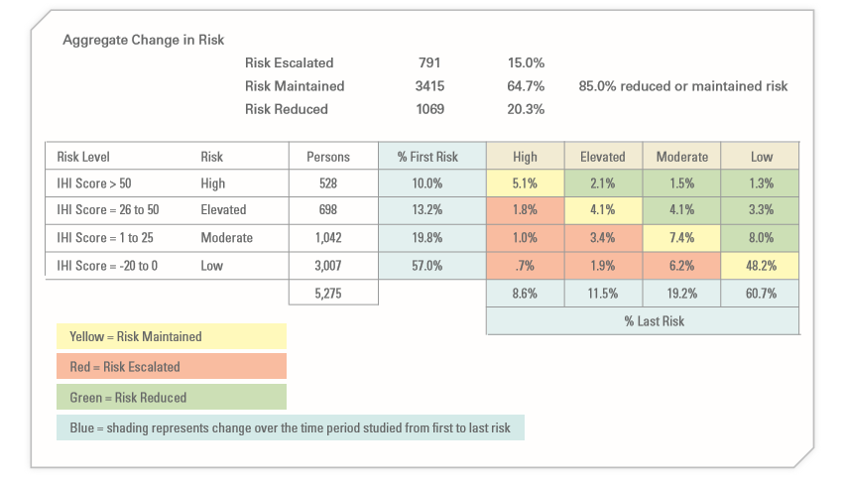
Instead of $1.40/year, they claimed savings of up to $3084/year — exaggerating by a factor exceeding 2000. Not 2000%. In wellness, 2000% would be rounding error. By contrast, a factor of 2000 equates to 200,000%.
200,000 is a big number. To put the number 200,000 in perspective, imagine stacking 6 Empire State Buildings on top of one other. Do that 200,000 times, and you reach the moon.
We are going to call Interactive Health liars. However, we don’t mean that as an insult, or even an objective observation (though that too). We mean that as a compliment. We have too much respect for their intelligence to believe that they could possibly be stupid enough to make a mistake of that magnitude.
However, if they would like to insist that they were this stupid (the “dumb and dumber” defense pioneered by Ron Goetzel) — and substitute what they now know to be the correct answer of $1.40 in place of the $3084 and circulate the revised result to their customers — we will publicly apologize for calling them liars. And, yes, we will pay them the honorarium noted above.
As for their botched cover-up of the initial results, perhaps that was just an unfortunate but inadvertent omission that coincidentally took place immediately after I pointed out their own risk analysis invalidated all their own claims about savings.
Postscript: Zoe Consulting’s Wisest Move
Zoe Consulting did do something right. At one point in the conversation I mentioned above, I recommended that they hire a smart person, based on the observation that a smart person would realize that the trivial risk factor reduction couldn’t possibly support the gargantuan savings claims. The CEO replied: “Al, the savings have nothing to do with the risk reduction. The two analyses are completely separate.”
If you are prone to comments like that, the wisest move is indeed to disconnect your phones and internet.

 They Said What?