


“Springbuk does not certify the information, nor does it guarantee the accuracy and completeness of such information.”
Home » Uncategorized (Page 23)
Category Archives: Uncategorized
Fitbit Throws a Bit of a Fit, Part 2: More Fitbit Tidbits
The “prequels” to this posting are:
Fitbit might just have taken the lead in the wellness industry’s race to the bottom. They are using the “dumb and dumber” defense to deflect their ethical shortcomings. This defense has been shown to work, in the sense that Ron Goetzel still has a job.
In Fitbit’s case, they have no choice. If they claim to be intelligent, that would mean they dramatically overstated the value of Fitbits deliberately, as opposed to out of pure, sheer, unadulterated ignorance. In turn, that would mean that the folks at Fitbit could be facing a little taxpayer-financed vacation in the federal hoosegow. That’s because public companies aren’t allowed to deliberately misrepresent their product to shareholders, which is precisely what this press release does. Stupid is OK. Dishonest isn’t.
Here are a few more morsels from that study:
- There were 22,259 employees in the employer population. Only 905 were in the study population. So the entire analysis of savings was based on projection from 4% of the population.
- For some unexplained reason, the control group –the people who did nothing at all — enjoyed a dramatic 9.3% reduction in medical claims costs, vs. an “expected” increase of 5.8%, a 15.1% swing. So doing nothing turns out to be a great strategy to achieve double-digit savings.
- Speaking of doing nothing, perhaps our favorite tidbit from this study is that an employee could stay in bed for up to 182 days a year — meaning take 100 steps a day or less, getting up just to eat and pee, as described in the original Springbuk study — and “save” 21.8%.
- It’s also possible that employees simply forgot to put on their Fitbits the other 183 days of the year, which is why they didn’t appear to take 100 steps on those days. However, that possibility is not acknowledged anywhere in the study. That could be because it wouldn’t make for much of a study to say: “We compared people who forgot to put on their Fitbit for fewer than 182 days to people who forgot to put on their Fitbit for more than 182 days.”


Therefore, whatever the other criticisms of this study, no one can accuse them of lying or even exaggerating when they say:

Speaking of which, let us now just focus on the 374 people (about 2% of their entire population) who did take more than 100 steps a day for a whopping 274 days out of the year or more. Their savings are massive:

Even the healthier subset of employees can reduce healthcare costs by a quarter by wearing a Fitbit, but that’s nothing compared to “low steps” employees who walk only 6477 steps a day, about the same as everyone else in the country. Those lucky employees can slash costs by more than half by continuing to walk an average number of steps, but this time wearing a Fitbit.
Oh, wait a sec. They were wearing a Fitbit in the baseline year too. Otherwise, how would we know how many steps they took? So they didn’t do anything in order to save massive sums of money.
Come again? This conclusion seems wacky even by Fitbit/Springbuk standards. So let me repeat it: these people did basically nothing in the study year that they didn’t also do in the baseline year…and yet they somehow set a record for greatest cost reduction ever achieved in a year, 50.7%.
Then, these employees broke their own record. This next chart is for employees with “>=365 days” of use over the course of a year. (Not sure how they could have worn a Fitbit for “greater than 365 days” since the baseline for this two-year study was 2013, but maybe every year is a leap year on Springbuk’s planet.)
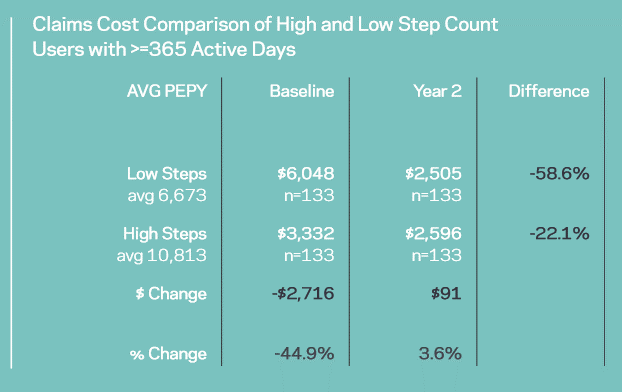
You read that right: a 58.6% reduction in spending for those 133 people taking the average number of steps everyone else takes in both years.
How much is a 58.6% reduction in costs in terms of utilization reduction? That means that simply by continuing to be average, these 133 average everyday folks wiped out the equivalent of all their hospitalizations and ER visits and specialist visits besides. Of course, we won’t know because Springbuk never plausibility-tested the result. As they say in journalism, it was a story too good to check.
Or, if Springbuk and Fitbit understood the concept of attribution as described in Biostatistics 101, they would realize that one can attribute only reductions in wellness-sensitive medical events to a wellness program, since those are what a wellness program is designed to avoid. If only those events can be avoided, they must have wiped out heart attacks and diabetes for these 133 people, their spouses, and roughly 5000 of their closest friends.
If anyone is interested in the real health impact of activity tracking, I’d recommend this JAMA article. It’s the only one on the topic which is not financed by people connected to the industry. Researchers attached activity trackers to some at-risk overweight/obese people to see how much weight they would lose (which would mean a reduction in their risk and possibly a slight reduction in their healthcare costs). The study’s result? The study population gained weight.
Share this:
Fitbit Throws a Bit of a Fit, Part 1
This column originally appeared in the Corporate Health and Wellness Association blog but they were asked to remove it by Springbuk, which did the original analysis. Not because it is inaccurate — no inaccuracies have ever been pointed out despite multiple requests by me to do so — but because it was accurate.
So I’m re-posting it here.
This is a sequel to “Springbuk Wants Employees to Go to the Bathroom,” which should be read prior to reading this posting.
In wellness, it’s totally legal to lie to customers. Indeed, if you don’t, you’ll probably lose them, since your competitors are happy to do exactly that, and most customers aren’t going to notice anyway.
In securities, though, it is totally illegal to lie to shareholders or to pay someone to write a favorable but dishonest report on your product, with the intent of propping up the stock price.
This brings up to Fitbit, and a recent report on savings allegedly generated by their activity trackers, published by Springbuk. Let’s leave aside for a moment the value of activity trackers to users. I like mine enough to generally recommend they be offered and subsidized (not given away) as part of a corporate wellness program, but “like” is not the issue in this savings claim. The issue is whether the math works.
And it doesn’t.
The Springbuk report of savings and outcomes for Fitbit was impossible. Among the clinical issues is the study design itself: the report defines “active” as taking 100 steps a day. However, as the previous installment showed, it is impossible not to take 100 steps in a day without being so sick you can’t get out of bed. So rather than being the threshold for being counted as an “active” person, as the Springbuk study says, it should be the threshold for being a person who can get out of bed. And of course, people who can get out of bed will by definition have lower healthcare costs than people who can’t get out of bed, whether or not they wear a Fitbit.
Among the mathematical issues, it is not possible to reduce costs by 45.6% (one of the claims made) with a fitness device, because in the working-age population, only about 5% of hospital admissions are caused by lack of fitness.
Further, in addition to the apparent mathematical and clinical impossibility of Springbuk’s results, the author — and Fitbit — refused to respond to the following query.
Hi Mr. Daniels,
I have some questions about your report. Perhaps I’ve gotten some things wrong, so I’d love to hear from you in the next 3 business days, if I have.
First, isn’t it the case that anyone who is not in a wheelchair walks at least 100 steps a day, Fitbit or no Fitbit? Is that the threshold for “active” as opposed to “bedridden” ?
Second, Figure 2c indicates that the very fact of being in the “engaged” group, even if you never get out of bed, reduces costs by 30%+. How is this possible? A corollary: It would seem that all savings is being attributed to Fitbit, at least in the Fitbit interpretation. They also seem to be taking credit for this: “266 employees who used their Fitbit tracker for at least half the duration of the program decreased their healthcare costs by 45.6% on average.”
Third, can you reconcile this statement…:
“The materials in this document represent the opinion of the authors and not representative of the views of Springbuk, Inc. Springbuk does not certify the information, nor does it guarantee the accuracy and completeness of such information.”
“This demonstration of impact achieved by integrating Fitbit technology into an employee wellness program reinforces our belief in the power of health data and measurement in demonstrating ROI,” said Rod Reasen, co-founder and CEO of Springbuk.
Fourth, how is it possible to show basically no separation for 182 days of getting out of bed (taking 100 steps a day) from being bedridden, but massive separation for getting out of bed for 274 days? I can’t find the explanation of the exercise science that would lead to that result. It would seem that there is some huge physiological disadvantage to those extra 92 days of taking 100 steps.
Fifth, am I missing the disclosure that Fitbit paid you to do this study? I can’t find it anywhere. Or did you do this on a pro bono basis?
Sixth, would you have come up with this same result if you had been paid by a hedge fund that was shorting Fitbit stock and wanted to show no savings?
Seventh, since most wellness-related healthcare spending is unavoidable altogether by walking 100 steps a days or any other amount for 12 months, I’m wondering if you were able to determine approximately which elements of healthcare spending were reduced, in order to get a 45.6% reduction in costs? You would have to wipe out all hospitalizations, for example – and get roughly a 10% reduction in everything else.
Thanks very much. If you would like to reply, I’ll look forward to your reply by 5 PM EDT on Wednesday 5/24.
Assuming Fitbit paid Springbuk (that’s a big assumption — this obvious conflict of interest is not disclosed anywhere, so the reader has to decide whether Springbuk collected money, or whether they did this study out of the goodness of their heart), one of four outcomes is possible:
- Springbuk genuinely thinks, among other things, that walking 100 steps a day for 274 days reduces healthcare costs by 27% vs. walking 100 steps a day for only 182 days. No crime there, other than the one committed by the grade school that granted them a diploma. It’s unlikely they think this, because Springbuk says they are “obsessed with analytics” and that they sell “the leading health analytics software…[with] powerful insights.” So if Springbuk truly believes their own report, then congratulations are in order: they have accomplished more in this one analysis than most extremely stupid people accomplish in a lifetime. (Not an original line, as Veep fans know, but apropos nonetheless.)
- Springbuk wanted to show savings because they were being well-paid to do so, but Fitbit put no pressure on them when they gave them the check. Once again, doesn’t say much for Springbuk’s ethics, but Fitbit did not commit a crime.
- Fitbit paid Springbuk to lie for them, in order to impress prospects and customers. Once again, no crime. There wouldn’t be enough room in the prison system if lying in wellness were a crime. (See http://www.ethicalwellness.org for a list of wellness vendors that have agreed not to lie. It’s not very long.)
- Fitbit paid Springbuk to lie for them, in order to inter alia impress investors. This is not legal, any more than if Fitbit made up their own data for that reason. Since many Fitbit analyst reports make reference to savings of “up to $1500 per employee per year,” and since this study appears to be one of only two justifications for that statement (the other being equally suspect), there is a case to be made that Fitbit’s stock price would indeed be lower if they told the truth: that no disinterested researcher has ever found more than a trivial impact on employee health status or healthcare insurance cost.
We don’t know which of these four is the case. Is Springbuk dishonest, or just incompetent? Does Fitbit genuinely believe that wearing their device could magically reduce healthcare costs for US corporations by hundreds of billions of dollars, or are they willing to lie in order to boost revenues and their share price?
We look forward to hearing the answers to these questions once the financial media gets hold of this posting.
Header Photo – Copyright: dzejmsdin / 123RF Stock Photo
Opinions expressed in this column are those of Al Lewis individually. They do not necessarily represent the views of the Corporate Health and Wellness Association. Therefore all threats of lawsuits should be directed to the former, to which I say: “Go ahead. Make my day.”
Share this:
Al Lewis said What???
Dear They Said What Nation,
Usually I am the one quoting people verbatim. Being quoted verbatim, of course, is the wellness industry’s worst nightmare. (I’m talking to you, Fitbit. And remember that today is your final day to respond to my observations about all the fallacies in your study. More specifically, this is your final day on your final extension, since you’ve now had 40 days, including 3 “final” deadlines, to answer 6 simple questions, or roughly one week per question.)
So let’s see how I do when the situation is reversed, as I am the one being quoted verbatim in this WELCOA podcast. You have to access it via their site, which means getting on their mailing list. Several people have asked if I could post this in its entirety. I hate to disappoint my fan base, given how few people are in it, but it wouldn’t be fair because it’s WELCOA’s IP, and the only advantage for them of putting in this effort is to expand their mailing list. (We’re only sending the pdf to FOQs — friends of Quizzify.)
However, I can share some highlights with everyone.
First, no one has claimed the $2-million reward for showing wellness doesn’t lose money. Just once it would be great if someone could explain how they can be so certain that wellness saves tons of money but at the same time so certain that it doesn’t save money that they aren’t willing to risk a small entry fee to make $2-million.
Second, there are good programs out there in the well-o-sphere. I named a bunch of them and also special kudos to the program I am in, at Boston College. I said:
I’m in an outstanding traditional program, my wife’s. She teaches philosophy at Boston College. They’re amazing. They screen — but it’s generally according to guidelines, so I go in once every few years. They’ve got Harvard Pilgrim’s nurses doing the coaching. They are excellent and totally up to date with information. Likewise, the actual health risk assessment itself is completely up to date. All good information. If every program were like this, there would be no place for me. I’d be living under a bridge eating squirrel.
Of course some kudos went to Cummins too, and on the public sector side, to Hilliard County (OH) and the City of Chelmsford, MA.
Finally, I noted the Wellness Code of Conduct, which now has quite a number of endorsers and followers. I would urge people to join it, if they haven’t already.
Before anyone starts puking, it isn’t all sweetness-and-light. I called out the usual suspects, and gave the “back story” on how my first book, Why Nobody Believes the Numbers, got me blacklisted due to an overdose of integrity. And, no, it wasn’t because I named names. It didn’t name names. That came after I got blacklisted. I had nothing to lose, so I figured I might as well go public.
Share this:
Please excuse my unexcused absence
I’ve been out of the country, in Switzerland. Interesting place. Their infrastructure is falling apart, there’s a lot of poverty, and there is litter everywhere, but the good news is, no one smokes and it’s a very affordable place to visit. (Not, not, not, not, and you’ve got to be kidding.)
There is more good stuff coming this summer, though probably every other week rather than twice a week.
Share this:
Bobby, We Hardly Knew Ye: Bob Merberg leaving Paychex
Bob Merberg is moving on from Paychex, and in a lengthy (!) podcast with Jen Arnold, offers his “greatest hits” of the many ways in which his mind has been changed (“flip flops”) during his ten years in that position, and some advice for the future.
By way of background, Bob’s IntEWn blog has been a refreshing voice from the wellness trenches. Bob is quite literally the only corporate wellness manager willing to risk the wrath of various internal powers that be in order to report what really happens in wellness. By contrast, most other blogs are written by various outsiders reporting what they think should happen (or they think is happening) in wellness.
Here are the highlights of what he has learned (“flip flops”) in the decade he has been doing this:
- HRAs have very little value
- Screenings have even less value than HRAs (“I was railing against screenings a really long time ago”)
- Incentives have even less value than screenings (“the hallmark of a sh**ty program”) and Bob has de-emphasized them. We have a more nuanced view.
- CEO support is helpful is wellness even if they don’t walk 5000 steps. There are things only CEOs can do (such as employee-friendly building design).
- Culture is very difficult to change, and employees generally hate culture change for many good reasons…but it is much easier to found the company with the right culture to begin with (like we did at Quizzify). “Where are the success stories in culture change?”
- Outcomes-based incentives are “shameful,” and are little more than a cost-shift to employees who can least afford it. (“Given all of us a bad name”)
Here is the good news, his view of Total Worker Health (as described by the CDC), which is influenced by more basic factors than broccoli consumption:
- Living wages and other financial assistance, like 401K
- Work schedules and too much overtime, a huge source of stress, should be managed
- Things like quotas and goals set too high to meet (like at Wells Fargo) that create incredible stress. This Wells Fargo story alone merits the entire podcast. Ironically, they have a wellness program that includes stress management. “You as an employer are creating the conditions of stress.”
- The employer should start with creating healthier jobs, rather than helping employees cope with unhealthy jobs.
- It’s not about behavior and behavior change — it’s about the workplace itself.
I’ll leave the rest to you. Don’t want to steal his thunder.
We wish Bob the best in his new career as a consultant and look forward to working together.
Share this:
Springbuk wants employees to go to the bathroom
Oh, so lovely sittin’
Abso-bloomin’-lutely still
I would never budge till spring
Crept over me window sill
–Eliza Doolittle
Springbuk has found the key to dramatic reduction in healthcare spending: getting out of bed. It doesn’t matter whether it’s to eat, find the remote, or, of course, pee. Just do something, anything, other than lie in bed all day — and you count as an “active” person who saves a ton of money, as compared to people who never get out of bed. Yes, Springbuk classifies you as “active” if you take at least 100 steps a day:
My question, for now, is not about how all this money was allegedly saved. Rather, my question for now is: how did these “less active” people — a huge chunk of the total population studied –manage to take fewer than 100 steps a day in the first place? Consider this random floor plan:

Now overlay the steps you take just in order to get up in the morning. A one-way trip to the bathroom and then to the breakfast nook appears to require about 20 steps. You haven’t even had your coffee yet and already you are a fifth of the way to your daily goal.

Speaking of coffee, add in a few more trips to the bathroom and <voila> you’ve reached your steps goal. Conclusion: it is impossible not to walk 100 steps a day, unless you want to starve to death, burst your bladder, or work at Spacely’s Sprockets. We wouldn’t recommend any of those three, especially the last, a very high-stress environment.


As a sidebar, I would note that George Jetson ironically has a lower BMI than Fred Flintstone, thus showing that taking more than 100 steps a day doesn’t reduce weight. Nor does a paleo diet, apparently. (Portion sizes might have something to do with it.) On the other hand, Fred can power his own car, thus showing the value of maintaining health at any size.



The Economics of Getting out of Bed
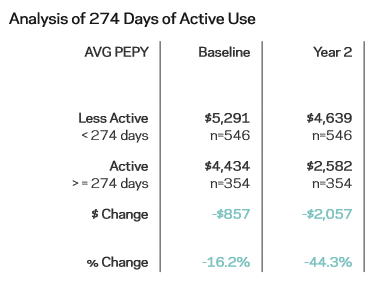
And needless to say, Springbuk provides some very compelling economics about the cost savings impact of getting out of bed. 100 steps a day for only 274 days a year (meaning you can take a well-deserved breather on weekends, holidays, vacation days and Beethoven’s birthday) generates a dramatic 28% reduction in costs. Wow! Who knew that peeing, eating, and looking for the remote (try your fridge or dresser drawers) could be so beneficial to your health?
Springbuk has additional bad news and good news.
The bad news is that taking 100 steps a day for more than 182 days (as opposed to more than 274 days) makes only a 3% differential impact on health spending, vs. taking 100 steps a day for less than 182 days. Still, there is some good news, which is that staying in bed for half the year also generates a huge reduction in costs, 31% to be exact.
Springbuk didn’t mention this, but the only way both these findings could be consistent would be that people –we will call them “semi-active” — who take 100 steps on more than 182 days but fewer than 274 days must have ridiculously high, off-the-charts healthcare spending and presumably morbidity. Apparently, moving those semi-active people between “less active” and “active” swings overall healthcare spending for the entire population by 25%.

The implication, as any exercise physiologist would tell you, is that starting in January, you need to track the number of days on which you take 100 steps. If you get to 181 such days by late summer, but don’t think you can make it to 274 days by the end of the year, then your best bet, statistically speaking, is to stay in bed until the ball drops in Times Square. Your bosses will love you for it, because you’ll be saving them 31%.

Naturally, Springbuk’s findings contradict all the other findings on wearables showing trivial changes in activity due to wearables after a short burst of interest. These trivial changes predictable show only trivial improvements in health and costs.
And someone should tell the Einsteins at Springbuk what anyone with a triple-digit IQ could intuit and what every other study shows: that a typical American takes many times more than 100 steps a day. 6886 steps per day, according to one study. So Springbuk’s study is wrong, making them eligible for a Koop Award.
Springbuk’s analysis may be wrong for another reason too: It does not account for the health hazards of taking too many steps. (Yes, you need to click through for the punchline.)
An accurate line in this report
I can’t believe I missed this, but Pete Aren didn’t, and pointed it out on linkedin. There is indeed one accurate line in their report, buried in the footnotes:
Share this:

Testing employee prostates is the new black.
After considerable deliberation by our management team and Board of Directors, and after putting it to a vote of the shareholders after consulting our bylaws, we have adopted a new policy of moving all posts not actually calling out vendors by name to The Corporate Health and Wellness Association website. The only problem with that website for this article is that no article on prostate testing is complete without mentioning Interactive Health and their policy of testing your prostate whether you like it or not, or even whether you still have one or not.
So visit our follow-up prostate cancer post there. (The initial prostate article can be found here.)
Coming soon on this site: Is Interactive Health the new Wellsteps?
Share this:
Top Ten Things Wellness Vendors Don’t Know about Employee Weight
Because I didn’t mention any names, I published this one on the Corporate Health and Wellness Association blog. So you’ll have to click through. SPOILER ALERT: the bad news is that there are a boatload of things — 10, to be exact — that wellness vendors don’t know about BMI.
The good news is, there some things wellness vendors do know about BMI, like how to spell it. This is a big accomplishment, because spelling is right up there — along with arithmetic, integrity, behavior change, and of course wellness itself — on the list of things that most befuddle wellness vendors. We’ve chronicled many examples, such as Wellsteps’ Steve Aldana calling award-winning journalist Sharon Begley a “lier.”
Our favorite:

Share this:

Health News Review’s wellness “debate” podcast
Health News Review just podcasted a wellness “debate.” I put “debate” in quotes because the other side — the Health Enhancement Research Organization — refused to participate, according to the moderator. The strategy of the Wellness Ignorati is to avoid actually telling anyone what they do, on the theory that the more people who know what they do, the more likely they are not to be able to get away with it any more.
It’s a brilliant strategy, because transparency is one of their five worst nightmares, the other four being facts, data, outcomes, integrity, and me.
Share this:
USPSTF announces the Urologist Full Employment Act
The United States Preventive Services Task Force (USPSTF) just announced that for men aged 55 to 69, the Prostate-Specific Antigen (PSA) test grade is improving from a “D” to a “C.” Needless to say the media overhyped this ever so slight grade inflation, with headlines like: USPSTF Could Drop Its Opposite to Routine Prostate Screening. Reading beyond the headlines reveals not that you should run out and get your prostate screened. Rather, you should talk to your doctor about it. Hardly a ringing endorsement by USPSTF, and probably only reflects what is already happening during checkups.
Even so, we looked at the exact same data the USPSTF is looking at…and we still don’t want to be screened:
If 1000 men have the PSA test, 240 will have a positive results, and 100 will have a positive biopsy which shows cancer (but 20-59% of these will be cancer that does not grow, spread or harm the individual). Of the 100 with a positive biopsy, 80 will choose treatment (surgery or radiotherapy), and 60 will suffer serious complications (including incontinence and impotence), with the net results that 3 men (out of the initial 1000) will avoid metastatic disease and 1-2 men will avoid prostate cancer death.
Surgery? Incontinence? Impotence? I’m onto Wife #2 (#3 if you count the one who died…), and without getting into TMI here, the whole point of having a Wife #2 seems to be at variance with this USPSTF recommendation.
But let’s keep going. One or two men (of this 1000) will avoid prostate cancer death. Since there are about 26,000,000 men in that age cohort, it seems like the benefits of PSA testing would be high. Let’s take the low, conservative estimate that 1-in-1000 will be saved. That’s 26,000 lives saved through the PSA test. Not bad, I must admit.
But then I do that thing which wellness vendors hate — a plausibility test. Turns out that annually only 26,000 men die of prostate cancer to begin with. Presumably some number of them — let’s say 11,000, yielding 15,000 — are not in the 55-69 year-old age category. Unless, then, that prostate test is better than perfect, something is amiss. It wouldn’t be possible to save more than 15,000 lives.
A close read reveals the missing link: to get this 1-per-1000 benefit, you’d have to be screened for up to 15 years. So in any given year, only 1/15th of these estimated 15,000 men would have their lives saved. Or something like that. That’s 1000 lives saved annually, or possibly 2000, if it’s 2-per-1000.
Some Perspective Here, Folks
- Annual number of Americans who would be saved by PSA tests: 2000 (high end)
- Annual number of Americans who would have serious complications due to prostate cancer treatment: 60,000
- Annual number of people struck by lightning worldwide: 240,000
Or for those of you who prefer visual learning, squint really hard:

So, yes, I will take the USPSTF recommendation to “talk to my doctor,” and tell her to please leave my prostate alone or I’ll find another doctor.

 They Said What?