
Home » Uncategorized (Page 27)
Category Archives: Uncategorized
So many candidates for the Deplorables Award countdown, so few numbers between 1 and 10
Having covered the also-rans last week, here are the first runners-up, as we inch ever closer to the coveted top spot. (To read the original postings, click on the numbered headers.)
Today we are highlighting more people and organizations who’ve made the wellness industry what it is. Wednesday we will complete the listing of the Stars of Wellness, the people and organizations who are making the industry what it should be.
Interactive Health conducted what may be the head-scratchingest screen in wellness industry, a difficult feat given all the competition. For starters, they tested me for calf tightness. It turns out my calves are tight–and right on-site they loosened them. I could feel my productivity soaring…until the left one went into spasm that night and I couldn’t get back to sleep. Still, I can see their point — loose calves are a useful trait for many common jobs.

Next, Interactive Health shattered the record, previously shared by Total Wellness and Star Wellness, for most USPSTF non-recommended blood tests. I don’t know what half these things are, which means neither does Interactive Health.

Where would a Deplorables Greatest Hits List be without the Koop Award Committee?
Every year, like clockwork, the industry’s biggest liars select the industry’s biggest lies. 2016 started with last year’s winning program, McKesson’s, being exposed as a joke in Employee Benefit News, and ended with this year’s winner, Wellsteps, being exposed as a joke in STATNews.
When bestowing this year’s award to their fellow Committee member, Wellsteps, they didn’t even pretend not to lie. And what lies they were! Not just regular-sized lies. Not even supersized lies. We’re talking lies that would make a thesaurus-writer blush.
To put their lies in perspective, I may not even know you, but if a Koop Committee member told me the sky was blue, and you told me the sky was green, I’d at least go look out the window.
PS Not everyone on the Committee is a liar. One person is quite honest and can’t believe what goes on every year. I don’t want to name my source because in Koop-land, honesty is grounds for termination. As is getting validation. Or adopting the Code of Conduct. Basically ethical behavior is off-limits. An executive of one group, Altarum, published a blog critical of wellness and <poof> the Committee disappeared them.
Michael O’Donnell seems to crave my attention. When he managed to go three whole months without being featured in a TSW posting, he came up with these irresistible nuggets:
- “Wellness is indeed the best thing since sliced bread, up there with vaccines, sanitation and antibiotics.”
- “[Wellness] can prevent 80% of all diseases.”
- “The ROI from wellness is very strong.”
- “Workplace health promotion may play a critical role in preserving civilization as we know it.”
If nothing else, Mr. O’Donnell presents the best argument for requiring educational standards, or at least a GED, in this field — by demonstrating his total lack of understanding not just of wellness, but also of vaccines, sanitation, antibiotics, percentages, diseases, ROIs, and preserving civilization as we know it.
Oh, yes, and multiplication as well. His article on how to increase productivity with wellness used an example demonstrating a productivity decrease. In 2016, he also went on an anti-employee jihad that should be read in its entirety. (Translation: some of my best work…) Highlights:
- Prospective new hires should be subjected to an intrusive physical exam, and hired only if they are in good shape. OK, not every single prospective new hire — only those applying for “blue collar jobs or jobs that require excessive walking, standing, or even sitting.” Hence he would waive the physical exam requirement for mattress-tester, prostitute, or Koop Committee member–because those jobs require only excessive lying.
- He would “set the standard for BMI at the level where medical costs are lowest.” Since people with very low BMIs incur higher costs than people with middling BMIs, Mr. O’Donnell would fine not only people who weigh more than his ideal, but also employees with anorexia.
If employees didn’t already have an eating disorder, what better way of giving them one — and hence extracting more penalties from them — than to levy fines based on their weight? Employees above his ideal weight would pay per pound, sort of like if they were ordering lobster or mailing packages.
#2: Ron Goetzel, Seth Serxner, and Paul Terry (Health Enhancement Research Organization)
These three characters — naturally also on the Koop Committee — managed to pile more lies, sardine-like, into a single page than anyone else in this industry, in the “poison pen” about me they circulated to the media.
A good starting question would be, why on earth would anyone think that they can send a “confidential” letter to the media? The media are in the business of disseminating information. You see, that’s why they call them “the media.” Am I going too fast for you, Mr. Goetzel?
The funny thing about these Einsteins? Their defense to my observation that their very own numbers show wellness loses money was that their very own numbers were made up. Imagine being so dishonest that the way you defend yourselves is by claiming you fabricated your own report.
That’s not even the punchline. It turns out that this allegedly fabricated report is in truth an actual non-fabricated report. So, in the immortal words of the great philosopher LL Cool J, they lied about the lies that they lied about.
How did I learn this? That will be the subject of a post early year.
Watch this space…soon we will be naming the industry’s #1 Deplorable of 2016.
Share this:

The Wellness Industry Stars of 2016
On Monday, we announced the 2016 Deplorables Awards, highlighting the bad hombres and nasty women who’ve made the wellness industry what it is. In this post we recognize instead those good hombres and gracious women who’ve been trying to make the industry what it should be.
They too deserve recognition for the great work they did in 2016. I apologize if I’ve left anyone off. If you feel like you should be recognized, or know someone who should be recognized, just ping me for inclusion in next week’s Part 2.
Being in first place is not news if you’re the New England Patriots, and have led your division for something like 12 of the last 14 years. Worst-to-first is what generates news, though…and that’s exactly why we are highlighting WELCOA. (Their “worsts” were well-chronicled on this site during the David Hunnicutt era.)
WELCOA’s new executive director, Ryan Picarella, is leading the way both on adoption of the Code of Conduct (and standing firm against Wellsteps calling him part of our “gang of bullies” for supporting it) and in general leadership. Quizzify has signed up for WELCOA and even though our year doesn’t start until January, we are already very impressed with their professionalism, timeliness etc. Quizzify would support them on principle, but joining their Premier Provider Network could easily be justified on merit alone. Current PPN vendors report getting many inquiries.
Speaking of which, next up would be Quizzify. Quizzify, in addition to having earned the privilege to carry the Harvard Medical School shield, was first vendor of any kind to adopt the Code of Conduct, and among the early companies to earn validation from the Validation Institute.
Rather than do a sales pitch here (Quizzify has its own website for that), I would simply ask employers a question: If employees spend an average of about $10,000/year of your money on healthcare, why not invest $1 PEPM to help teach them how to spend it wisely? To decide whether they will learn anything, play the game yourself to see if you do.
Speaking of the Code of Conduct, this list wouldn’t be complete with mentioning Salveo Partners. Rosie Ward of Salveo Partners penned the actual Code of Conduct (with input from her partner Jon Robison, myself and of course Ryan Piccarella, the four of us comprising the aforementioned “gang of bullies”). I found myself dog-earing many pages of their book How to Build a Thriving Culture at Work.
The Code of Conduct has attracted other adherents besides its authors, Quizzify, the 149 people who have “liked” it, and the 29 very positive commenters. Some of the most respected vendors also jumped on board…and it didn’t take long for them to do so. Any honest vendor committed to improving employee health should have no issue with it. Indeed, the most pushback our “Gang of Bullies” gets from honest vendors is: “Shouldn’t we be going farther than just respecting employee dignity, doing no harm, and not lying about outcomes?”
To that we say, most vendors can’t even meet those standards. Hence the pushback from HERO, Optum and Wellsteps.
On the other hand, It Starts with Me and Medencentive have both endorsed the Code and been validated by the Validation Institute — a twofer matched only by Quizzify. Sterling Wellness lives up to its name — these folks have endorsed the Code and while they don’t yet have validation, I can tell you firsthand that their excellent program could certainly meet the standard needed for validation, should they choose to pursue it.
US Preventive Medicine and Healthways are the reverse: two of the rare wellness vendors that have earned validation for at least one of their programs or results.
Speaking of validation, a big shout-out to the Validation Institute. 2 years later, no one has ever been able to find a mistake in their any of their validation language for any of their validated entities. This is despite the fact that, as we’ve noticed with the Health Enhancement Research Organization (HERO), finding whoppers in industry association materials is not exactly a heavy lift.
Another industry association makes the list: The Corporate Health and Wellness Association. They are everything HERO isn’t: honest, competent, and committed to advancing the evolution of employee health programs. And popular too: About five times as many people attended their fall conference as attended HERO’s, which shows that most people prefer not to pay money in order to be lied to.
The media had a tough year in 2016, but if there is one topic they aced, it’s wellness. Here at TheySaidWhat, we ♥ media, whether it be trade or lay, lamestream or right-wing. We keep a complete list of all articles on wellness. Special shout-outs to:
- Sharon Begley, who exposed Wellsteps’ program for Boise as a total failure, and basically allowed the rest of the Wellness Ignorati to self-immolate. Um, Mr. Goetzel, a program that harms employees shouldn’t be described as “not perfect.” The correct adjective would be: “fraudulent.” Still, it was nice of you to give your friends that Koop award anyway. I mean, none of the participants actually died, right? In wellness, that should count for something.
- Laura Anderson, whose Slate expose of the “sham” wellness industry attracted mind-boggling numbers of comments and stories from aggrieved employees;
- Pat Barone, of Laura Ingraham’s Lifezette, writing that “corporate wellness needs a checkup.”
- Among the trades, Employee Benefit News stands out for its willingness to air all sides, even though the other side does most of the advertising;
- And among blogs, what’s there not to love about Insurance Thought Leadership, The Doctor Weighs In (describing how old-line wellness vendors became liars), and The Health Care Blog?
- ConscienHealth and Dances With Fat have helped to shine a light on the hazards and uselessness of corporate crash-dieting programs. As B-to-C websites, they introduce our work to many people who would not otherwise be aware that they are not alone in the universe.
And, course, the New York Times‘ economics bloggers, The Incidental Economists, earns plaudits for the single best wellness smackdown ever.
I’d also like to thank people who consistently reblog, retweet, repost — or even comment using their real names. There are a lot, so I’ll be saving some for Part Two (and if you think I’ll miss one, ping me now). Tom Emerick, Krisna Hanks, Mitch Collins, Bill Fabrey, Nicole Ausmus come to mind.
But most of all, to paraphrase the immortal words of the great philosopher Yogi Berra, I’d like to thank everyone who made this blog necessary. That would be the liars, idiots, cheaters, and misanthropes who have provided seemingly endless material for TheySaidWhat. If not for them, there wouldn’t be an opportunity to highlight people doing things right.
Share this:

Announcing the Wellness Industry 2016 Deplorables Awards
For this year’s Deplorables Awards, I think we’re gonna need a bigger basket. As a result, this will be a two-part series.
Why? Because we need to accommodate all the bad hombres and nasty women who have subverted the perfect elegant philosophy of wellness into nothing more than a profit machine, with no regard for integrity, customers, or employees.
Yes, 2016 was a year in which a record number self-anointed industry leaders gave lying and cheating a bad name. In that sense it was no different from any other year, though 2016 offered even more good news and bad news:
- The bad news: not content with merely lying and cheating, this cabal branched out into harming employees, fat-shaming, and pure misanthropy;
- The good news: wellness did succeed in one way, as a “natural experiment” showing what happens in healthcare if being a provider requires no credentials beyond a GED, a driver’s license, and a pulse.
Indeed, whatever mathematician first postulated that everyone can’t be worse than average had apparently never experienced the wellness industry. (Exceptions of course, being the few that, like Quizzify, are validated by the Validation Institute or have accepted the Employee Health Program Code of Conduct.)
#10 Optum and Wellsteps (Runners-Up);
What do you do when you need to defend your blatant disregard of the US Preventive Services Task Force guidelines? Simple — you blame your customers. Optum’s Seth Serxner said: “Customers make us” do this. Optum’s PR hack said I was making Optum “look bad.”
I said: “Sure, I’ll apologize. Just name one account that will admit to insisting on paying a higher price than you wanted to charge, in order to screen the stuffing out of their employees.” Never heard from them again.
Wellsteps got caught by ace reporter Sharon Begley of STATNews, and their CEO was forced to admit Wellsteps was violating USPSTF guidelines.
#9 The Johnson & Johnson Fat Tax gives misanthropy a bad name. (Honorable mentions to Vitality and Ron Goetzel.)
Misanthropy, greed, and weight-shaming provided the wellness industry with its key “talking points” in 2016. And nothing combined the three like the Johnson & Johnson Fat Tax fiasco. The point of the (apparently stillborn) Fat Tax was to stigmatize overweight employees, by “pressuring” (their word) companies into disclosing to shareholders how many fat employees they had. That in turn would somehow pressure these employers into spending more money on wellness vendors.
It’s not altogether clear what that disclosure would do for the actual overweight/obese employees, but somehow this disclosure was supposed to allegedly benefit shareholders. Indeed, the Fat Tax cabal is right about that in one respect: this disclosure would benefit shareholders — it would indicate to shareholders that they ought to unload their shares in a hurry, because management just disclosed it is stupid.
Vitality was a co-conspirator in hatching this scheme, which is ironic because they admitted they couldn’t even get their own employees to lose weight. And where you hear the word “stupid,” can the name “Goetzel” be far behind? This whole thing was his idea, based on the notion that “playing doctor” with employees makes stock prices increase. However, his claim that companies with Koop Award-winning wellness programs outperformed the market can easily be invalidated by anyone with a calculator and a triple-digit IQ.
#8 IBISWorld: How is wellness different from King Midas and Gold?
Here are links to the postings on the most hilarious report we’ve ever read about the wellness industry:
- New wellness industry report costs $5400 (but that includes shipping)
- New report raises the bar for cluelessness in wellness
- How is wellness different from King Midas and gold?
The answer to the question in the header? Everyone who touches wellness turns to stupid. Not just garden-variety stupid. More like fifty shades of stupid.
Mind you, most wellness industry leaders don’t need to touch anything first before reaching that endpoint, but occasionally a company like IBIS, with no prior experience in wellness, ventures into this field — and that’s where the fun starts. These IBISWorld Young Turks (literally–the writer is named “Turk”) are so excited about this industry, they practically speak in tongues:
Wellness firms may offer employers stress management courses and sessions that offer music therapy, aromatherapy, Tai Chi, and post disaster stress reduction through coaching.
Government-funded initiatives that promote wellness to cut costs related to chronic ailments (e.g., obesity and diabetes) has further exacerbated many businesses movement toward purchasing corporate wellness services.
And my own personal favorite:
The industry provides wellness programs to businesses across the United States, including small, medium and large businesses in the private sector and businesses in the public sector.
“Businesses in the public sector”? I knew that many of our legislators are for sale but I didn’t realize they had incorporated.
#7 Healthfairs USA Raises the Bar for Misbehavior
Healthfairs USA doubled down in 2016 on lying and cheating with an elegant new strategy: insurance fraud. They not only harm employees, but bill insurance companies directly for the privilege of paying for those harms. They offer cancer tests that are “99% accurate” (hence their multiple Nobel Prizes), and over-the-counter nutritional supplements…all of which are covered by most insurance companies because they get a doctor to sign a claim form.
Disclosure: we aren’t entirely sure that billing insurance companies for USPSTF D-rated screens and worthless, possibly harmful, pills constitutes insurance fraud. Our opinion is probably no more accurate than their cancer tests.
#6 Aetna’s DNA wellness program combines junk science, junk math, and junk integrity
In 2014, Aetna decided to “play doctor” with obese members of self-insured customers by telemarketing their employees to pitch very controversial high-priced drugs whose sales are “flailing” because almost no patients seem to want to take them. Among other things, Aetna said these drugs increase productivity even though right on the label, the drugs warn that they could reduce productivity (attention span and language facility).
Not content with the warm welcome that scheme brought them, in 2015 they introduced a DNA-based wellness program and claimed a whopping $1464/participant in savings. What put the whop in that whopper were these two tidbits. These savings were achieved:
- in the first year alone;
- on participants who were not actually sick to begin with. (You couldn’t qualify for this study if you were already sick.)
The reason Aetna needed to fabricate such a high savings figure is that the wellness field requires ROIs greater than 2-to-1, and this DNA test sells for $500/employee. So you need to show savings between $1000 and $1500.
Also, in 2015, we were able to show the program was completely ineffective, a convincing enough demonstration that one of the board members of the journal that published the study with the $1464 claim publicly apologized.
What do you do when it turns out your science is all wrong (news flash: being told you have a gene for obesity doesn’t motivate you to lose weight) and your math is all wrong? Of course, you apologize and retract the study, and offer to return the money to the lucky few companies that signed up for your program.
Haha, good one, Al. Obviously, like all the other Deplorable Award-winners on this list, you sell your snake oil harder than ever, and that’s what gets them on the 2016 list. Whereas in 2015, they could use the dumb-and-dumber defense, this year they know the numbers don’t add up and yet they are still flogging it.
Don’t miss the slam-bang conclusion as we count down to #1. Will Ron Goetzel retain his crown, or will he be unseated as the wellness industry’s #1 Deplorable?
Yes, we realize he has already appeared on this list at #9, but many lists feature the same entities making multiple entries. For instance, the Beatles once held positions #1 through #5 in Billboard’s Top 40, so it can be done.
Not that I want to put any ideas in his head.
Share this:
Oops, they did it again. Wellsteps stumbles on integrity one more time.
There are three ways to win a debate:
- Cite facts that support your position.
- Be smart enough to win a debate even though the facts go the other way.
- Break your opponent’s microphone.
Let’s consider each possibility in turn:
- Not a chance–Wellsteps won a Koop Award. When was the last time you saw a bona fide fact in a Koop Award application? Certainly STATNews doesn’t seem to have found any. And if Wellsteps had an actual fact in their favor — meaning if we were wrong about one single solitary thing — don’t you suppose they would have stumbled onto it by now? Don’t you suppose that just one of their insults would be grounded in reality? In the immortal words of the great philosopher Rick Perry, even a broken clock is right once a day, so the score is: Broken Clocks 1, Wellsteps 0.
- Smart? Hello! We’re talking Steve Aldana and Wellsteps here, not to mention Troy Adams, the originator of the Wellsteps tag line: “It’s fun to get fat. It’s fun to be lazy.“
- Bingo. That’s what Wellsteps just tried to do. When all else fails, cheat. They tried to get Linkedin to shut us down for “bullying” them by adding up their own numbers. Here is their exact “update,” which they were kind enough to put in red so you can’t miss it. To paraphrase the immortal words of the great philosopher Michelle Obama, when they go low, we go paste:

And yet you may have just clicked through to this post from Linkedin, meaning that reports of our death (me and Jon Robison of Salveo Partners) are greatly exaggerated.
The irony is, Wellsteps doesn’t understand irony
The irony is, what greater form of bullying is there than to try to muzzle someone whose only crime was to agree with Wellsteps’ own data?
The other irony is, Wellsteps’ CEO recently wrote: “We certainly support free speech:”
It has come to our attention that an outspoken critic has entered false data into these calculators in order to make a point. We certainly support free speech; however, we wonder how valid the point can be when it is based on false data?”
I guess, to paraphrase the immortal words of the great philosopher John Kerry, Mr. Aldana was for free speech before he was against it. (Is “entering false data” like “bearing false witness”? If so, we yield to Wellsteps’ expertise. And we did enter every combination of data imaginable into their “calculator.” It always gave the same answer. Try it. It’s like wellness savings measurement-meets-Fisher-Price. Just make sure to zero out inflation.)
Being in the “integrity segment” of this industry, we aren’t exactly big fans of Ron Goetzel, and the longer he lets his cronies at Wellsteps keep their Koop Award, despite it now being well-established that they harmed employees in multiple ways, the more his own sullied reputation suffers. However, we will acknowledge one thing that Ron Goetzel excels at, and that’s ignorance. He is great at ignoring facts, ignoring data…and, most strategically, ignoring us. Indeed, as the leader of the Koop and HERO cabals, he inspired the collective noun “the Wellness Ignorati.” He knows better than to debate us, because the Wellness Ignorati always lose debates, even when they break our microphone.
Share this:

An apology for my previous dismissive statements made publicly on Linkedin
Usually when I post an “apology” it is phony, like: “I apologize for calling Wellsteps’ arithmetic fabricated. I should have called Wellsteps’ arithmetic completely fabricated.”
Here’s a similar apology, for Professor Baicker’s infamous “Workplace Wellness Can Generate Savings” meta-analysis claiming the 3.27-to-1 ROI from wellness that RAND also eviscerated:
I had been quite adamant in the previous post that this meta-analysis was likely just a gold-plated package of garbage case studies. I compared it to packaging subprime home loans into AAA-rated collateralized mortgage obligations (CMO).
That was before I looked at the individual studies comprising this meta-analysis. I realize now that comparing the Harvard Study to the CMO scam was unfair. So I owe an apology to Bear Stearns, Lehman Brothers, and Countrywide.
Next, I apologize for pointing out that Ron Goetzel, as recently as last week, is still quoting this very same thoroughly discredited 7-year-old study, as well as many other outdated analyses. For example, he insists on continuing to quote the New York Times economists’ September 2014 analysis that wellness programs “generally” don’t work, even though they subsequently made their conclusion much clearer: “We’ve said it before, many times and in many ways: workplace wellness programs don’t save money.” They then specifically criticized Mr. Goetzel’s own methodology (“industry studies based on study designs that cannot produce valid causal estimates”).
I apologize for thinking that this deliberately selective misinterpretation of these economists’ previous conclusions makes him sound deceitful. And I apologize for being sure that the people who forwarded me this slide would agree with that assessment. And I apologize for once again making phony apologies.
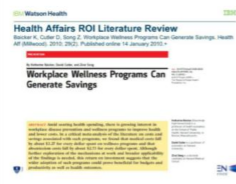

The real apology
Now that I’ve checked off the usual Wellsteps-and-Goetzel-integrity boxes, it’s time to step out of character and seriously apologize. Here’s what I did that I really do need to apologize for: not cutting wellness professionals enough slack on giving them enough time to learn what took me several years to learn about wellness losing money.
I was once guilty myself of believing this 3-to-1 ROI nonsense, specifically about disease management (DM). Why DM in particular? I had some ego wrapped up in it because I am actually credited with inventing DM. Really. Just google on “invented disease management.” Whether or not I did (and plenty of others could share the credit), I was not just drinking the DM Kool-Aid. I was mixing it up and selling it to others.
Then, 10-12 years ago, a few people told me none of the DM savings numbers added up. I didn’t believe them. I thought it was sour grapes because they missed the boat.
True, I had enrolled a few of my own extended family members and friends into DM programs. Vendors were more than happy to offer me their best nurses, VIP treatment, you name it. Yet no one I referred thought these free programs were even worth a second free phone call.
Nonetheless, I was sure that somewhere there existed a whole lot of employees who did benefit from DM. Yes, in my fantasy world tons of people really appreciated these unsolicited calls from their health plan offering to help. After all, who among us doesn’t trust an unsolicited caller from their health plan offering to help?
In my worldview, the lucky recipients of these calls would respond: “You’re right. I should be taking my pills. Hey, thanks. I never would have thought of that on my own. And I was just about to have a heart attack, so you saved a ton of money.”
Yes, I realize this made no sense. Yet I never questioned my own findings. Basically, I ignored the warning signs about DM’s sketchy economics for years. When I finally had the epiphany, it got quite the headline:
A Founding Father of Disease Management Astonishingly Declares: “My Kid Is Ugly.”
Once I questioned my own figures, the rest because immediately obvious to me — one after another after another, sets of numbers in this field simply did not add up. Wellness was a far worse offender than DM, which does appear to roughly break even or better. No surprise about wellness. Screening costs about 10 times as much as DM and whereas people who qualify for DM are already well down the slope to infirmity, screens are performed mostly on healthy employees, who can’t generate any savings. (We of course support screenings according to guidelines, for the health of employees rather than an ROI. But most vendors ignore guidelines and screen the stuffing out of employees.)
Still, it had taken me years to have the initial epiphany…and yet now I was quite curt and dismissive with other people who didn’t immediately get it, and were defensive in support of their lifelong assumption. I was basically saying to others in the field: “You know all those savings claims? Total malarkey. Prying, poking and prodding doesn’t save any money.” I’d expect everyone else to get this right away. When they didn’t, I was not gracious with them in many cases.
Over time, a large number of folks have come around. They did it at their own speed, same as I did. Take WELCOA, for example. They were among the worst (and God bless ’em, funniest) offenders…and yet now you won’t find an organization more committed to getting wellness right, helping employees, and being honest than WELCOA. (In their case, a night-and-day change of leadership helped.) I’m not just saying this–I’m walking the walk. Quizzify is joining WELCOA’s Premier Provider Network for 2017, joining vendors I have a lot of respect for, like It Starts with Me, Populytics, and SelfHelpWorks. The first two, also like Quizzify, are validated by the Validation Institute.
Making good on the apology
A good apology comes with an offer to make it up. So if you feel like I dissed you prematurely, while you were learning wellness economics on your own, you can have one of:
- a free pdf of any of my books — Surviving Workplace Wellness, Cracking Health Costs, or Why Nobody Believes the Numbers
- half-price on a hardcopy of those books (order direct, not through Amazon, of course)
- a free analysis of any outcomes report
- a free month of Quizzify with no commitment (there is a minor asterisk on this one, please inquire)
Share this:

Wellsteps Arithmetic for Dummies
Those of you with lives may not have noticed all the commotion yesterday. Wellsteps moved their post about our bullying from their own blog to Linkedin.
But then, sort of like Dukakis in his tank, once they did that, they realized that wasn’t such a good idea and took it all down, but it was too late. The problem was that on Linkedin, their rant attracted many comments from the triple-digit IQ crowd. So now, in order to find this post, you have to go to the Wellsteps blog. It is posted under: “Great Ideas from the Experts.” Among other highlights, they said we were extorting them. Here is the source for that: we offer $1000 and public apologies if we made a mistake in our writeups, and a $2-million reward for proving wellness breaks even, or that Boise saved money.
To them, and to all members of the Koop Committee that decided this Boise School District outcome was award-worthy, I say, “Find a mistake in my critique and collect the $1000. Or show I’m wrong about my ‘twisted facts’ and claim the reward. Instead of just criticizing me for ‘twisted facts,’ take my money. Sue me. Have me arrested for blackmail and extortion (their words). Anything. Don’t make me beg.”
This isn’t about that — postings on that topic, along with Sharon Begley’s brilliant smackdown in STATNews are easily findable elsewhere. Instead, all we want to do today is simply add up a column of Wellsteps’ own numbers. That is how Wellsteps defines “bullying” — adding up their own numbers. In this case, it is the improvements and deteriorations, year over year, in the Boise School District’s biometrics.
I’ve already done this once, as a service to Wellsteps, but apparently they had a really bad fifth-grade math teacher. So I’m doing it again — and this time color-coding it, so even the dumbest Wellsteps executives can find someone to explain it to them.
Here is the actual screenshot of the year-over-year biometrics, from their Koop Award application. Once again, these are their figures. They often ask why we don’t publish our own studies. We don’t have to — their numbers make our case better than we could make our own, with no “he said-she said” about whose numbers are right. So, we’ll admit it! Their numbers below are facts — they are right! (I guess graciously conceding that one’s adversary is correct is another form of bullying.)

We then twisted their columns of facts into totals, below. I can send the Excel sheet on request.

As you can see, the population deteriorated quite a bit–6397 readings got worse while 5293 improved. Oh, and one other thing: more than 40% of the “improved” values are glucose levels declining, in employees whose glucose was already normal. Attention, Wellsteps: there is no concept of “improving” normal glucose levels. That would be like “improving” on a 98.6 body temperature.
And who amongst us hasn’t felt draggy during a workday as our glucose falls, and eaten a snack to get our energy and productivity back? Excluding the 2134 glucose “improvements” in people who already had normal glucose, deteriorating biometrics outnumbered improving biometrics by 6397 to 3159. That’s more than 2 to 1!
We’re taking those out to be consistent with the word “normal.” Or, since we are very polite bullies, we could leave them in and stick with 6397 vs. 5293, if Wellsteps chooses. We are happy to do the latter because we understand that in Wellsteps’ lexicon, words and phrases mean the opposite. In addition to “normal” and “bullying,” that lexicon would include “extortion,” “blackmail,” “twisted facts,” and “great ideas from the experts.”
Share this:

Wellsteps: We don’t need your stinkin’ Code of Conduct.
Wellsteps has joined Michael O’Donnell, HERO and Optum in attempting to stonewall the Employee Health Code of Conduct, which started as a joint project among WELCOA, myself, and Salveo Partners and has attracted many hundreds of favorable responses. Quizzify and It Starts with Me have both received validation from the Validation Institute for (among other things) our embrace of this simple minimum standard. In both cases, we think the bar should be set much higher, but apparently “do no harm” is already too high a hurdle for HERO, Wellsteps and Optum. Hence their opposition. And Kudos to WELCOA, a very fine organization that Quizzify intends to support for 2017, for standing up to Mr. Aldana’s bullying.
There is some irony in that it was Wellsteps’ harms to Boise employees that inspired my participation in the code-writing. Vendors should not be given awards for harming employees. That doesn’t seem like too much to ask.
Here is the Code, in its entirety.
The Employee Health Program Code of Conduct: Programs Should Do No Harm
Our organization resolves that its program should do no harm to employee health, corporate integrity or employee/employer finances. Instead we will endeavor to support employee well-being for our customers, their employees and all program constituents.
Employee Benefits and Harm Avoidance
Our organization will recommend doing programs with/for employees rather than to them, and will focus on promoting well-being and avoiding bad health outcomes. Our choices and frequencies of screenings are consistent with United States Preventive Services Task Force (USPSTF), CDC guidelines, and Choosing Wisely.
Our relevant staff will understand USPSTF guidelines, employee harm avoidance, wellness-sensitive medical event measurement, and outcomes analysis.
Employees will not be singled out, fined, or embarrassed for their health status.
Respect for Corporate Integrity and Employee Privacy
We will not share employee-identifiable data with employers and will ensure that all protected health information (PHI) adheres to HIPAA regulations and any other applicable laws.
Commitment to Valid Outcomes Measurement
Our contractual language and outcomes reporting will be transparent and plausible. All research limitations (e.g., “participants vs. non-participants” or the “natural flow of risk” or ignoring dropouts) and methodology will be fully disclosed, sourced, and readily available.
What’s there not to like? Plenty, if you negatively impact employee health, as Wellsteps does, according to STATNews. Here is Wellsteps’ response to the code, complete with their signature name-calling.
The Wellness Bully Code of Conduct
Even though the wellness bullies claim that the wellness industry is a sham, they have announced a new code of wellness conduct. I’m very interested in improving the quality and effectiveness of wellness programs. I don’t know any wellness professional who would say otherwise. But I think I speak for all of us when I say that I have no interest in a code of conduct written by a gang of bullies. The wellness industry does not need a code of conduct, we have HIPAA and other laws to do that.
Share this:
Wellsteps’ Steve Aldana gives bullies a good name
There he goes again.
By way of background, Wellsteps was caught harming Boise’s employees and lying about outcomes. His Boise School District friends no longer talk to the media now that they realize they got snookered — and after he blamed them for the failure of the program. Wellsteps got some major unfavorable press in STATNews, in which Steve Aldana admitted that his program wasn’t responsible for seeming improvements in the “worst health behaviors.” Rather it was the regression to the mean.
For a full write-up, see “Protecting Employees from Harmful Vendored Wellness Programs,” American Journal of Managed Care, October 10, 2016.
Yes, Wellsteps’ Steve Aldana is acting out. He is frustrated because we find such a ridiculous number of “mistakes” (actually lies, since mistakes get corrected when they are pointed out) in his work. Since all our findings are correct, there’s nothing he can do except whine.
He is even attacking us — WELCOA, Salveo Partners, myself and hundreds of others — for supporting the Employee Health Program Code of Conduct. (For the uninitiated, the Code is designed to prevent wellness vendors like Wellsteps from harming employees, which I guess is why they are attacking it.)
And so, he calls me a bully. He also calls esteemed health/science reporter Sharon Begley a “lier,” so I am in great company, sort of like being on Nixon’s enemies list.
I’m not going to go line by line through his posting (which I can’t see anyway, because he knows better than to get into a public debate, so he blocks me from seeing it — I am finding out second-hand), except to ask a couple of questions. If I am a bully:
- How come I offer $1000 to people who point out mistakes in my write-ups about them?
- Why doesn’t he claim my $2-million reward for showing that he didn’t harm the Boise School District employees and he saved them money? It also included a $1-million donation to the School District.
He could get rich off my bullying, and make a sizable charitable donation. If what I do fits his definition of bullying, then, Mr. Aldana, please bully me. Offer to send me money and give me rewards for finding mistakes in your work. Don’t make me beg!
Share this:
How to cheat in a corporate weight loss contest (SPOILER ALERT: This gets gross)
2024 Update: This post, intended as humor for HR/benefits professionals, has now attracted 200,000 views, reaching employees intending to cheat their way to a high BMI. Not so much any more for crash-dieting contests and wellness “challenges,” but rather to qualify for weight loss drugs. Eight years later, it still appears on the first page of a Google search on “how to cheat in a corporate wellness program.”

Attention, employees who want to learn how to cheat in a corporate wellness contest: for the actual cheating hints, skim down to: “How to Cheat in a Crash-Dieting Contest.” The suggestions apply not just to corporate biggest loser contests, but to any corporate weigh-in where money is attached to weight. (This post is actually intended for your company’s HR people who for some reason think encouraging you to binge and then crash-diet is a good idea and don’t realize wellness is an obvious scam.)
Further, the law has changed and you can now sue your employer if they fine you (or give you a high-deductible plan and make you “earn the incentive”) for refusing to participate in biometric screens and other clinical wellness activities. You can contact us for more information.
If we were real journalists here, we’d have killed a lot of trees in the cause of exposing the massive amount of lying and cheating by wellness vendors. However, as mere bloggers, all we do is kill millions of defenseless electrons.*
And yet we’ve sacrificed nary a single electron to the cause of exposing the massive amount of lying and cheating by the employees themselves. And massive it is. My very own extended family members are swapping Fitbits around to increase their steps. Less for the money than for bragging rights about who can game the contest the best.
Indeed, these corporate “challenges” are really mental challenges, not physical ones, to see who can do the best job outsmarting the wellness vendor. Outsmarting wellness vendors, as past columns have shown, isn’t exactly a heavy lift: we have often observed that the good news about wellness is that NASA employees don’t have to worry about their job security because wellness vendors aren’t exactly rocket scientists.
To that end, the Wall Street Journal wrote an entire article about employees cheating in wellness programs. Apparently, employees are enlisting puppies, hamsters, even power tools and a ceiling fan in their quest to undermine their company’s wellness program. One enterprising employee posted a youtube showing how to cheat on these programs. A Midwestern cadre of truly dedicated employees took cheating a bit farther than most, and got themselves indicted for defrauding Kansas City out of $300,000 by lying on wellness programs.
There are entire blog posts on how to cheat in a wellness program, and even a gadget available online to help you do exactly that.
30-second shameless plug time
Of course, there is one surefire way to avoid the downside of cheating: design cheating into the program. And that’s exactly what Quizzify does. The way to cheat on Quizzify is to look up the answers and learn about health literacy — which is exactly what we want employees to do!
How to cheat in a crash-dieting contest
Employees especially like to cheat in crash-dieting contests, enough so that countermeasures are needed. For instance, a vendor named Healthywage is bragging about how it ferrets out “fraudulent participants.” I figured I’d see what the internet has to offer on corporate biggest loser program cheating, because, after all, these days almost every search generates tons of hits. I say “almost” because if you search on “honest wellness vendors” and “Wellsteps,” there is only one hit: my observation that the latter could never be confused with the former.
In particular, the search found a group called www.healthstatus.com, which has given this topic altogether too much thought, thankfully. In all fairness to the HealthStatus folks (who do seem very well-intentioned and on the level), before they list their recommendations, they provide a cigarette-type warning label, as these programs richly deserve:
It’s getting to be New Year’s resolution time and many companies will try and “encourage” weight loss with a “Biggest Loser” type contest. Frankly, this is really a bad idea, as it can create all kinds of bad habits and damaging activities by the participants, as they starve, dehydrate and supplement themselves in an effort to win.
Having gotten the grownup stuff out of the way, here are their “recommendations” for employees whose employers, like Schlumberger, somehow got the impression these contests are a good idea, perhaps because their mothers didn’t listen to enough Mozart when they were in the womb. A few recommendations are fairly harmless, like drink a lot of water starting 3 days early and don’t pee (or do number twosies) before your weigh-in. And, of course, wear heavy clothes, carry lots of change in your pockets etc. You know, your typical garden-variety dishonesty that is probably woven into the culture of any employer that sponsors these contests. (These employers think they are “creating a culture of wellness” when in reality they are creating a culture of deceit.)
By contrast, some of these other recommendations boggle our minds, and, having written exposes on the wellness industry for two years now, our minds are not easily boggled:
The day before the weigh-in, ideally about 17 hours or less before your weigh-in time, you want to get yourself a good salty snack. A bag of chips, you know the ones that if you eat too many your lips hurt from all the salt and a nice tray of cheese and crackers.
For your dinner meal you want to load up on the proteins and a big glass of whole milk, also, this is a day you want to skip the fiber. This is one day of eating like this, we don’t encourage it, but a binge day also sets up your metabolism to know that is not starving, and can help in when we start burning fat after the weigh-in.
The day of the weigh-in, minimize your activity, another big glass of whole milk with your breakfast that contains some salty options will help you retain more water.
“At this point,” they observe, “you should be a big bloated sloshing mess that needs to go to the bathroom really bad. This is the perfect time to get weighed and measured.” They also remind you to accentuate poor posture, since the long-since discredited Body Mass Index measure still preferred by most of these vendors is a height/weight ratio. (HealthStatus also offers hints for contests that use waist circumference.)
In other words, do all the wrong things — eat badly, slouch, and don’t exercise. Be as unhealthy as possible. So you’re already obsessing with your weight and abusing your body horrendously in the name of wellness…and the contest hasn’t even started yet!
I hate to leave everyone hanging but HealthStatus hasn’t published the rest of its recommendations yet, meaning advice on how to cheat during the contests themselves.
And a good thing because I don’t know how much more wellness a fellow can take.
Since self-abuse is actually a very serious topic, I would like to step out of character here and offer a few serious notes. First, no wonder Optum and HERO and other Wellness Ignorati are stonewalling the Employee Health Program Code of Conduct. Nothing violates it more than their cherished corporate crash-dieting contests. And a particular call-out of the biggest-loser worst offenders: Virgin Pulse (nee ShapeUp), Wellness Corporate Solutions and HealthyWages. You ought to be ashamed of yourselves, even relative to other wellness vendors like Wellsteps, which had just recently established a new plateau for harming employees, that you people are blasting right through.
*Just for the record, we know that writing blogs does not kill or even injure electrons. And while Keas might find that being used in blog posts stresses them out, we would disagree. Quite the opposite: if they enroll in wellness programs, they can live to be 100.
Share this:

Quizzify, The Employee Health Code of Conduct, and Fabricated Savings
The three hottest topics in all of wellness. Or if not, they should be.
And they are all covered in Dr. James Kelley’s new podcast. You’ll have to download the iTunes app to hear it, but if I can do it, how hard can it be?
 They Said What?