
Home » Uncategorized (Page 45)
Category Archives: Uncategorized
Guest Post: Janet Bates Sums Up the Wellness Industry
Occasionally in a linkedin group, someone posts a comment that seems to merit more exposure, a “new voice” in the debate. Janet Bates posted such a comment. I asked her to expand and re-post it here, so that others could see it.
Follow the Money to Find the Truth
As long as there is money to be made, smoke and mirrors will abound. This is overwhelmingly evident in the current hysteria around corporate wellness. Insurance companies have their business customers whipped into a frenzy of “get those employees well (whatever that means) or else we’ll have no choice but to raise your premiums yet again.”
So in swoop the wellness “experts” to save the day with their “magic wellness dust”. The wellness people boldly claim that all it will take are education, incentives and contests for employees to improve their “numbers” (which somehow prove good health) or face penalties (or lose their incentives—same thing) if they don’t. Running these programs will keep insurance premiums in line, increase productivity, improve engagement, reduce absenteeism, make everyone love their jobs and probably save the world from insurgents all while delivering a jaw-dropping ROI.
What’s wrong with that? Nothing, except that it doesn’t work and it isn’t true. So what gives? Why do so many companies choose to believe this stuff?
They Can’t Handle the Truth
It’s pretty simple…few companies want to truly look at their own role in what may be impacting employee health. Hardly a company wants to honestly face the fact that the REAL causes of employee un-wellness include tangible items like:
- Low wages
- Limited or no paid sick time, family leave or vacation
- Too many part-time jobs with non-guaranteed schedules and no health benefits
- Hiring temps and contractors to avoid any type of commitment
- Moving jobs off-shore
And then there are the intangibles, like:
- Lack of flexibility and autonomy
- Inept and bullying management
- Required 24/7/365 connectivity and excessive hours for salaried employees with minimal, if any, salary increases
- High deductible medical plans that employees can’t afford to use
- A strong feeling of job insecurity leading to chronic stress
- And other shoddy business practices and HR policies
So why don’t wellness vendors who claim to be experts help their customers face these real facts. Two reasons:
- There’s no fast money in it for the vendor. Helping customers address these facts won’t lead to the immediate sale of the vendor’s very profitable health risk assessments, screens, coaching, or contests.
- Employers don’t want to hear it. It’s much easier and cheaper to spend a few hundred bucks per employee for the “magic wellness dust” than it is to dig into the muck of the company and spend the money to fix what’s really wrong.
Following the money and facing the facts does lead to the truth. It might not be easy to hear and doing what’s right FOR employees won’t be free, but it will improve their well-being and ultimately that’s good for everyone. Unfortunately, the insurance companies will find other reasons to raise premiums. That, of course, is the real money trail to follow.
About the author:
Janet Bates is a semi-retired writer who spent close to 40 years in the “performance improvement” business.
Share this:

We Caught a Wellness Vendor Doing Something Right: US Preventive Medicine
For a year now, we’ve been outing wellness vendors whose endless stream of rookie mistakes in outcomes calculations (that somehow always seem to overstate savings) has provided a correspondingly endless stream of mirth and merriment to our expanding cadre of visitors, whose numbers now exceed 50,000 in total.
During this period, like Diogenes, we’ve been searching for an honest, competent wellness vendor, one that we could highlight to show that we are not simply mean-spirited anti-wellnites who for some unknown reason were intent on denying employees the opportunity to become healthy.
Diogenes had it easy compared to us.
Quite literally we have sifted through hundreds of wellness vendors. Some are just a few fries short of a Happy Meal. They get highlighted in our popular On the Even Lighter Side compilation. Some have very squirelly data. They win Golden Squirrel Awards. Others, well, we’re not calling anybody scoundrels but let’s just say they could never be confused with Mother Theresa. They get Smoking Guns, featuring questions that buyers can ask them based on their own claims that can’t be answered.
None of these vendors or any other wellness vendor, it is worth noting, have managed to receive validation from the Intel-GE Care Innovations Validation Institute, despite the obvious advantages of a respected third-party’s endorsement…and the offer by They Said What? to remove all unflattering references to them if they achieved such validation, as many non-wellness companies have,
Finally, however, our quest for an honest and competent wellness vendor is rewarded. US Preventive Medicine has both achieved validation for its contractual language and has compiled an enviable record–across its entire book of business–of event reduction. The full press release can be viewed here.
Further, they measure risk factors on the entire population, which is valid, not just the highs-to-lows.
We applaud their willingness to attempt validation but especially the results they’ve achieved and the contracts that codify those results, assuring that their customers will also receive validation should they choose to apply for it.
Share this:
Hyperdiagnosis: The Wellness Industry’s Anti-Employee Jihad
Healthmine just released a survey bragging about how many employees were diagnosed through wellness programs. That reminded us of our popular 2013 posting on The Health Care Blog called Hyperdiagnosis. We are re-posting and updating it below.
By now we are all familiar with the concept of overdiagnosis, where “we” is defined as “everyone except the wellness industry.”
Wellness vendors haven’t gotten the memo that most employees should simply be left alone. Instead, they want to screen the stuffing of employees, at considerable cost to the employer and risk to the employee. The wellness vendors who overscreen employees the most win awards for it, like Health Fitness Corporation did with the Nebraska state employee program.
We call this new plateau of clinical unreality “hyperdiagnosis,” and it is the wellness industry’s bread-and-butter. It differs from overdiagnosis four ways:
- It is pre-emptive;
- It is either negligently inaccurate or purposefully deceptive;
- It is powered by pay-or-play forfeitures;
- The final hallmark of hyperdiagnosis is braggadocio – wellness companies love to announce how many sick people they find in their screens.
1. Pre-Emptive
Overdiagnosis starts when a patient in need of testing visits a doctor. By contrast, in hyperdiagnosis, the testing comes in need of patients, via annual workplace screening of up to seventy different lab values–most of which, as They Said What? has shown, make no clinical sense. Testing for large numbers of abnormalities on large numbers of employees guarantees large numbers of “findings,” clinically significant or not. The more findings, the more money wellness vendors can add on for coaching and the more savings they can claim when they re-test.
2.Inaccurate or Deceptive
Most of these findings turn out to be clinically insignificant or simply wrong, no surprise given that the US Preventive Services Task Force recommends universal annual screening only for blood pressure, because for other screens the potential harms of annual screening outweigh the benefits. The wellness industry knows this, and they also know that the book Seeking Sickness: Medical Screening and the Misguided Hunt for Disease demolishes their highly profitable screening business model. (We are not cherry-picking titles here—there is no book Here’s an Idea: Let’s Hunt for Disease.) And yet most wellness programs require employees to undergo annual screens in order to avoid a financial forfeiture.
Hyperdiagnosis also obsesses with annual preventive doctor visits. Like screening, though, annual “preventive” visits on balance cause more harm than good. The wellness industry knows this, because we posted this information on their LinkedIn groups, before we were banned from most of them. They also presumably have internet access on their own.
3. Pay-or-play forfeitures
The worthlessness, the inconvenience, and the privacy invasion make screens very unpopular. The wellness industry and their corporate customers “solve” that problem by tying large and increasing sums of money annually — now $694 on average – to participation in these schemes. Yet participation rates are still low.
4. Braggadocio
While doctors are embarrassed by overdiagnosis, boasting is an essential ingredient of hyperdiagnosis. We’ve already blogged on how Health Fitness Corporation bragged (and lied, as they later admitted) about the number of cancer cases they found in Nebraska. They also bragged about the rate of cardiometabolic disease they found — 40% in the screened population — even though they admitted almost no employee did anything about those findings, and only 161 state employees reduced risk factors. Hence, it was the worst of both worlds: telling people they are sick without helping them get better. Nothing like telling someone they’re sick to increase their productivity.
Compass Health is our favorite example of hyperdiagnosis braggadocio. We realize this screenshot is a bit tough to read, but the hilarity is worth the effort. We pulled this vignette from On The (even) Lighter Side, They Said What?‘s most popular feature.
The Definition of a “Healthy Employee” Is One Who Has Not Been Diagnosed by Compass Health
Feeling fine today? Alas, you better get your affairs in order, bid your loved ones adieu, and watch the shows you’ve DVR-ed. Why? Because, dodo-brain, feeling fine means you have:

You are “walking around without a clue that [you have] a debilitating or terminal condition.” According to Compass Health (which at this point, having been “outed” by us, had the good sense to take this off their website…but not until we captured a screen shot), the major symptom of I Feel Fine Syndrome is: not having symptoms.
We’ll let them take it from here, to display not only their epidemiological prowess but also, this being the wellness industry, their grammar and spelling prowess as well:

We must confess we learned a lot from Compass. We had not realized that employers’ concerns about employees feeling fine had their roots in ancient history. But there it is, right in the opening words: these concerns date back “millenia” [sic], when employers failed to get their employees tested for “percolating” conditions before throwing them to the lions.
So the bad news is that feeling fine may be hazardous to your health. The good news is that your ICU bed may not need a DNR notice anytime soon because elsewhere Compass says it “has programs and solutions to help your employees overcome their I Feel Fine Syndrome.” And it is “very likely” these programs and solutions can “completely cure the problem…forever in our bodies.”
And not a moment too soon, because we’re never felt better in our lives, which means the clock is ticking. That’s the good news. The bad news is, if we join Compass’s program it sounds like we need to start contributing more to our 401K’s.
Summary
We’d like to think that all our exposés have made a dent in the wellness industry’s business model, but the forces arrayed in the other direction have so far overwhelmed us. The price of screening has plummeted almost to the $1-per-lab-value level for comprehensive screens, and as with anything, the lower the price, the greater the amount sold.
Couple those economics with the advent of genetic testing as part of wellness, big and profitable fines for non-participants, and the EEOC being defanged as a sop to the Business Roundtable, and it’s clear the wellness industry’s highly profitable hyperdiagnostic jihad against the American workforce has barely begun.
By contrast, Quizzify teaches employees that “just because it’s healthcare, doesn’t mean it’s good for you,” and to only get screened according to the USPSTF guidelines. That’s a message that employees would love to hear, but that wellness vendors can’t afford to tell them.
Share this:

Finally–a Free Wellness ROI Tool That Isn’t Made Up
We are pleased to present a free wellness ROI estimation model, as we promised about 3 months ago. This is the only tool of its kind in the industry. (Wellsteps has one, but let’s just say the good news is that NASA employees don’t have to worry about job security, because these people aren’t rocket scientists. If you zero out inflation, no matter what other variables you enter, the Wellsteps model always shows savings of $1359.)
You can also use this to compare two wellness programs, to determine whether your vendor is lying (they are — and we are happy to help you get your money back from them), and to pressure-test Quizzify.

Quizzify, where facts are your friend, and they’re fun, too
Share this:

Eureka! An actual good idea for employee health and morale
I just read a provocative article by the IHPM’s Deborah Love, who points out the value of OTC drugs in self-care, citing multiple articles and sources.
I myself am a case study. One day at work, out of the blue, I got this wicked case of indigestion. I had to get in my car and drive all the way to CVS to buy a roll of Tums. This would be considered a classic case of presenteeism followed by an hour of absenteeism. The episode would definitely have reduced my productivity except for the fact that this particular job was a complete waste of a perfectly good cubicle, and the company was no doubt better off for my inattention to my half-soused boss’s half-witted directives.
If it is indeed the case that OTC drugs can alleviate, avoid or resolve some conditions that could cause absenteeism or presenteeism, perhaps they should be encouraged. Many people have advocated that they be covered. I have always thought that was unrealistic. When you think about how much paper is consumed in health benefit administration today, coverage of OTC — requiring receipts and perhaps a doctor’s note — would be like adding more shrapnel to a hand grenade.
So perhaps the “answer” is that some OTC drugs should be made available — at cost — onsite. Not all drugs. Many OTC offerings are of dubious value or have long-term side effects, like taking a Prevacid every day, which can reduce bone density. But stocking those that are helpful in self-care could both encourage self-care and, — because they carry a lower price than the same drugs in a store — would be seen as a benefit by employees. (If the price is low and employees are buying stuff for their friends, you can limit the number sold at one time. Or sell them in a vending machine, where it is inconvenient to buy more than one at a time. But if you are selling them at cost, it really doesn’t matter if your employees are buying more.)
Thoughts? This seems pretty obvious and it always scares me when I think of things that should be obvious that I am missing something.
Otherwise, this should be a challenge to wellness vendors: come up with an actual good idea, like this or like Quizzify. If you do, we’ll be happy to tell people about it.
Share this:
Validation Institute adds Linda Riddell as Validator
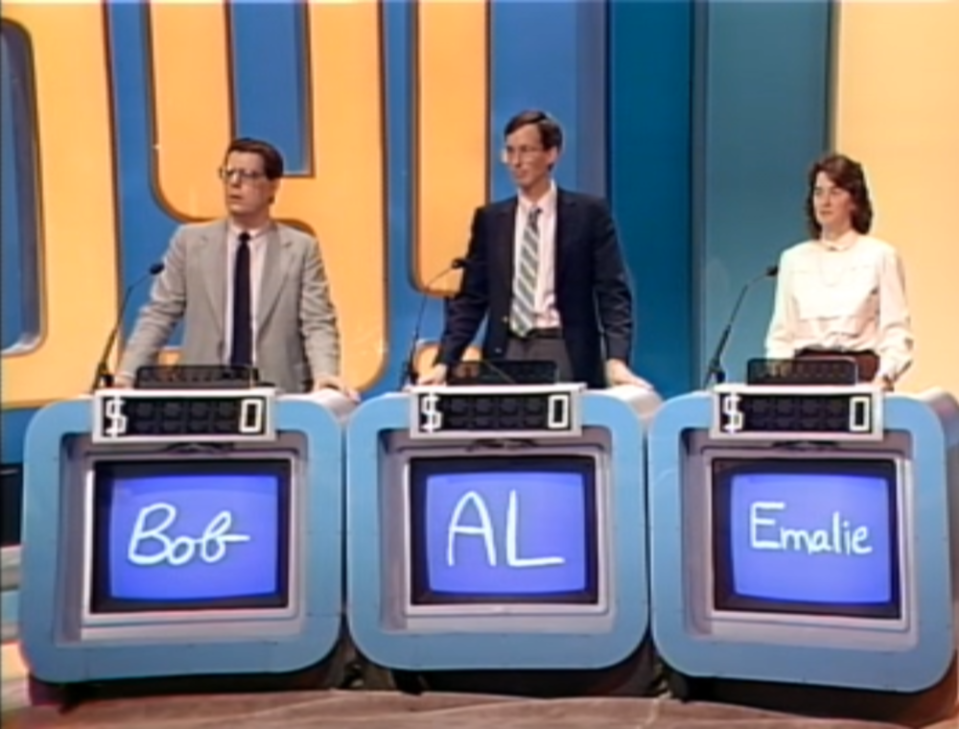
When I went on Jeopardy and my opponent (seen here) got the Daily Double right, I clapped. It killed me because generally you don’t like your competitors to thrive, but, hey, it was national TV and you don’t want people — at least people who are not members of the Wellness Ignorati — to think you’re a jerk.
In the case of Linda Riddell becoming the second validator anointed by the Validation Institute and hence a “competitor” of mine, I am clapping but this time for real. Linda is very smart, well-qualified educationally, and professionally she has whizzed through all the certifications needed to reach this level.
I welcome her “competition” and look forward to other consultants of her caliber following in our paths.
PS I lost. Bad draw. My opponent, Bob Verini, went on to win the Tournament of Champions and then within the last year or so became the 80s decade TOC winner. Lucky I didn’t give up my day job.
Share this:

It’s not just us–every grownup thinks there is too much prevention
When you read articles on prevention and corporate wellness, you tend to notice a pattern. Articles written by people who make their money pushing this stuff always say that the answer is more prevention. Those written by everyone else always say the answer is less prevention.
Here is an excellent example of the latter. It’s basically everything we’ve been saying, minus our trademark snarkiness.
Share this:
The Graco-Goetzel-Bravo plot thickens…more twists and turns
The Graco-Goetzel-Bravo-Hopkins case study is turning into another Nebraska fiasco. As with Nebraska, the numbers all contradict one another. But unlike Nebraska, there has as yet been no admission of deliberate lying in the Graco case study. That’s why Graco only earned an honorable mention in the Koop Awards, instead of winning one outright like Nebraska did.
Consider Bravo’s case study on Graco covering the exact same population over the same period as Ron Goetzel’s study. Let’s assume Ron Goetzel is right in that the wellness program should be measured from 2009 rather than 2008, when the program started. (Bob Merberg’s brilliant analysis points out the cherrypicking of the date has a huge impact on claimed success, but let’s concede this start date choice to Ron, and use 2009 according to his wishes.)
Bravo’s case study displays the PMPM costs by year. The first thing to note is, they list employee healthcare costs at $328 PMPM, which actually makes sense, instead of the $190 PMPM in the Hopkins report. I don’t know why these two figures, purporting to cover the exact same population in the exact same period, are completely inconsistent, but I do know that $190 PMPM is an impossible figure, as any population health expert knows. (“Plausibility checking” would have caught that error but Ron has never taken our course in Critical Outcomes Report Analysis, which would have covered plausibility-testing and likely prevented him from making such a rookie mistake.)
Second, Bravo lists children’s healthcare costs in this report as well. Funny thing: over the same exact period in which Mr. Goetzel was claiming that the wellness program was responsible for controlling employee participant costs, children’s healthcare costs trended better than wellness participants’ costs. Mr. Goetzel obviously had access to this children’s cost trend data (we had no trouble finding it, thanks to Bob Merberg) but elected to — get ready to fall out of your seats — ignore it. The wellness ignorati rarely step out of character.
This children’s cost trendline appears to invalidate the entire Goetzel-Johns Hopkins conclusion that the healthcare cost trend was due to the wellness program, since not one single child participated in the wellness program.

For some reason Graco’s spouses cost about $7000 apiece a year. We’ll leave that for someone else to dissect.
As an aside, if anyone thinks they recognize the name “Bravo Wellness” from an earlier posting, it’s because they do. Bravo is the outfit that brags about their ability to save employers money by fining employees. Their website is disproportionately about their appeals process when those fines are levied. This sounds like a company that does wellness to employees instead of for them.
Not sure how bragging about fining employees is consistent with the positive culture that Mr. Goetzel says Graco has, but maybe I’m missing something here.
Share this:

Britney Spears Meets Ron Goetzel’s Institute for Health and Productivity Studies
 In the immortal words of the great philosopher Britney Spears, oops, they’re at it again.
How this “study” gets published and why Johns Hopkins would allow its name to be used on it is anyone’s guess. In our last posting, we pointed out that in one place Graco’s employees cost $11,100 apiece to insure, just like other companies that offer competitive benefits. Yet later on in the story we see that employees only cost $2280. No mention of how these figures could be so inconsistent.
We let the rest of the study go, figuring we had already found the Macguffin. Ace reporter Bob Merberg, though, was not so easily convinced.
We’d urge reading his blog. Among the claims made by Mr. Goetzel was “revenues have doubled since 2009.” Well, yeah, but:
(1) it turns out Graco made a sizable acquisition in 2012, which might have had a teeny-weeny effect on revenues;
(2) revenues had plummeted in 2009, the year after the wellness program was introduced.
If you (a) measure from 2008, the year the wellness program was introduced, instead of cherrypicking the baseline year to give the best result, and (b) factor out the acquisition, revenues over the 2008-2014 period have pretty much tracked the economy as a whole. So nothing happened.
Try the Quizzify demo and see how many you get right.
We can’t make this stuff up. Fortunately we don’t have to.
Share this:


Measuring Wellness-Sensitive Medical Events: The Grand Finale of the HERO Analysis
 The eighth in the series deconstructing the HERO Outcomes Guidelines, covering Page 14. The full series can be found here. This installment in particular should be read in conjunction with installment #4 This Grand Finale will be presented in 3 parts…with a downloadable tool to help you calculated your wellness program savings as part 3.
PART ONE: HERO ACCEPTS OUR METHODOLOGY
In the stock market, no one is as valuable as the person who’s always right, except the person who’s always wrong. Therefore, until now we have greatly appreciated the opportunity HERO’s report has created for us to explain how to measure outcomes correctly.
So imagine our disappointment when one of their methodologies, the sixth of the seven listed, turned out to actually be valid. No surprise — this is the methodology I invented. Also no surprise given the industry’s standards for integrity, they didn’t acknowledge that particular factoid anywhere in their 88 pages. (And yet they accuse us of being impolite.) Here is the screen shot.

The philosophy of #6 is quite straightforward. If you were introducing a flu vaccine program, you’d measure the reduction in number of people who got the flu. If you offered a new program for conservative treatment of meniscal tears, you’d measure the reduction in the number of people who had meniscal surgery. That’s the way experimentation works. You hypothesize an outcome that the intervention should create…and then you measure that outcome to see if the experiment worked.
Except, of course, in population health, where any improvement in anything (cost, trend, utilzation) gets attributed to any wellness program that happened to be in place. The masters of this would be Mercer. Mercer once “found” massive, mathematically impossible, savings for North Carolina Medicaid’s medical home in a cohort that, as luck would have it, wasn’t even eligible for the medical home. And one wellness industry stalwart, Larry Chapman, says the simple act of completing a health risk assessment can reduce total healthcare spending by 50%, even when the information in the HRA is wrong, as is often the case.
And did you ever notice that when a company switches to a high-deductible health plan and adds some needle-poking, they attribute the reduction in spending to the needle-poking, not the fact that everyone in their company suddenly gets socked with a bigger annual deductible?
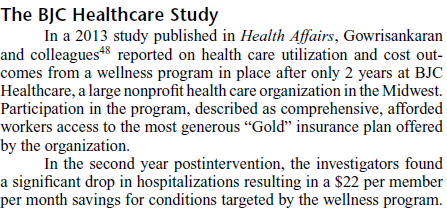
Enter wellness-sensitive medical event rates (WSMEs). This is the only methodology that tallies hospitalizations for conditions targeted by a wellness program – statistically avoided heart attacks etc. This is the only one of the seven HERO methodologies that would be acceptable to legitimate researchers. Hence, its use both in Health Affairs and by the GE-Intel Validation Institute. The former is the most respected health policy publication and the latter is the most (the only) respected outcomes evaluation organization. Further evidence of its validity is that there is no mention of it in the leading wellness promotional publication, the American Journal of Health Promotion, perhaps because – as HERO has attested – it doesn’t show savings.
History of event rate-based plausibility testing
Even though it isn’t attributed to me in the HERO guidebook, I invented this methodology in 2007. This is incontrovertible. No one else had anything remotely close to it. Unlike the automobile, TV, the computer, etc., this was not one of a series of incremental improvements to or the amalgamation of existing technologies.
And none of the other invention clichés apply either. The Chinese didn’t invent it in 1000 BC. Leonardo DaVinci didn’t sketch it in 1541. The Germans and the Allies weren’t racing to develop it at the end of World War II. By contrast, I’ve been presenting on it and using it for validation since then (meaning 2007). It figured prominently in Why Nobody Believes the Numbers too, before being highlighted in Health Affairs and the Validation Institute. For a modest fee, the detailed how-to can be downloaded from our website, though a Reader’s Digest version appears below.
While a number of employers and health plans use it now, several health plans – more than coincidentally three of the highest-rated in the country (Harvard Pilgrim, Blue Cross of Massachusetts, and Providence Health Plans) – have been measuring hospitalizations for conditions targeted by wellness/DM programs since the methodology’s inception.
So needless to say I was surprised and totally flattered that the 88-page HERO Report contained no attribution to me as the inventor of the WSME plausibility test. As mentioned previously, the strategy of the Wellness Ignorati is to ignore facts (hence their moniker), especially including my very existence. That strategy reduces the likelihood that one of their customers might click through to the site. They aren’t much for our recommending that companies learn our helpful insights, which they call “bullying.”
The wellness industry has had a love-hate flip-flopping relationship with WSME measurement.

Click on the Q to try our demo
First, until 2013, the entire Wellness Ignorati, quite in character, ignored this methodology, which is a powerful testament to its validity.
Then, in 2013, that strategy took a body blow: the exact methodology was used in Health Affairs. You may recall the same thing happened with another epiphany of ours — the expose of the invalid Koop Award-winning Health Fitness Corporation fabricated results. The Wellness Ignorati completely ignored our whistle-blowing expose until it appeared in Health Affairs, when they were forced to admit we were right and the whole thing was made up, or to use Ron Goetzel’s phrase in the passive voice, “was unfortunately mislabeled” for four years.
Just as Ron Goetzel — the leader of the Wellness Ignorati — caved when the Health Affairs light was shined on the Koop-HFC debacle, he caved on WSMEs when the Health Affairs light was shined on them. In this case, “caving” was acknowledging the fact that this methodology existed. He reviewed the aforementioned Health Affairs article that specifically analyzed WSMEs — hospitalizations for conditions targeted by the wellness program. In September 2014, he wrote:
But then he un-caved. Once the Health Affairs storm had passed, he invoked the Sergeant Schultz defense. In December 2014 he said: ,

He may have just forgotten in December that he reviewed them in September. But in March he and his colleagues re-remembered wellness-sensitive event rates, and put them right in the HERO report, for which we are immensely grateful.
Hopefully they won’t re-forget in June. (Their memory appears to be correspond with the change of seasons.) Hopefully instead, to paraphrase the immortal words of the great philosopher George Gershwin, our methodology is here to stay.
How do I feel about HERO rewriting history so that I am no longer the inventor of this methodology? Honestly, having firmly staked out a niche in the small but growing “integrity segment” of the wellness industry, I prefer them staying out of that niche as long as possible. So I’m glad they show no interest in facts.
In part two, which we will post in a few days, we will explain how we do WSME plausibility testing and why it’s the essential method for assessing the impact of your wellness and disease management efforts.

 They Said What?