
Home » wellness doesn’t work (Page 6)
Category Archives: wellness doesn’t work
Wellness Promoters Now Agree: Wellness Doesn’t Work
If enough wellness promoters keep insisting wellness fails, at some point we are going to have to believe them.
Usually we publish our own arguments against wellness. But today I posted a blog on Insurance Thought Leadership (ITL) that sums up the wellness promoters‘ arguments against workplace wellness instead. You can read it in its entirety here. It’s a bit “straighter” than our usual biting wit, since ITL, like Quizzify, is a standalone corporate enterprise rather than an individual hobby.
And TSW is indeed a personal hobby of mine (and Vik’s), not a cash cow. The second most frequent question* I get is: “How do you make money off this site?” The answer is I usually don’t, but almost every time a company sues a vendor or consultant, I become the expert witness, which is profitable — and, I might add, invariably successful. Cases never even get to trial. Why? Well, you’ve seen how smart these people are in everyday life. Trust me when I tell you they don’t exactly grow a brain during depositions. Plus they aren’t allowed to lie.
*The most frequent question I get is: “How did you get to be so tall?”
Highlights of the ITL piece, in case you’ve worn out your click-through button from all our other blog posts, would be as follows. For the most part, they are just a summary of what you already know:
- Ron Goetzel says most programs fail. (This is new as of last Friday.)
- Michael O’Donnell says most programs fail.
- Michael O’Donnell’s own meta-analysis says, when measured using an RCT design, programs fail
- Michael O’Donnell also offered a math lesson showing that employees working out during business hours fails to save money. It actually costs $5200/employee/year.
- The HERO Report shows a hypothetical of program economics, failing.
- At HERO’s insistence, we substituted more realistic numbers from Mr. Goetzel…and dramatically increased the loss.
- The most recent award-winning program, McKesson, admits it failed (as most of the previous award-winning programs did).
- The vendor that insists companies should publicly report how many fat employees they have, couldn’t get its own employees to lose weight.
- The most expensive, presumably gold-plated, program failed. (And that’s before adding the $500/employee program expense.)
Further, the promoters are starting to admit that maybe, just maybe, I am — as Michael O’Donnell eloquently put it — not an idiot.
Share this:

Aetna’s Employee DNA Collection Obsession Combines Junk Science, Junk Arithmetic, and Junk Integrity
It seems like most of my columns should or do start with a line like: “Just when you thought it couldn’t get any worse…”
Well, this time it really can’t get any worse. Aetna’s obsession with collecting employee DNA has truly reached the pinnacle of junk science, junk arithmetic, and junk integrity. (Not to mention junk privacy, as our guest-posting privacy expert noted.)
Junk Science and Junk Arithmetic
By way of background, we have already chronicled not just the junk science of using employee DNA to predict and prevent diabetes, but also the inability of their partner organization, Newtopia, to understand fifth-grade math. Nonetheless Newtopia wants us to trust their understanding of PhD-level science — and also trust them to store our DNA. (Like many vendors who were absent the day the teach taught arithmetic, they took their fuzzy math off their website following our instructional posting. We never received a thank-you note for this free consult, in case you were wondering.)
That same posting covered their reference site-from-hell, in which only a small fraction of employees participated, and the customer complained about the price tag, which is the wellness industry’s highest, @$500 per employee.
That price tag means claiming an ROI at the industry standard level of 3-to-1 requires fabricating far greater savings than wellness vendors usually fabricate. For instance, Ron Goetzel says programs should cost $150 and save $450. (Note: in all fairness he doesn’t say that any more. After our initial exposes, he retreated to a 1-to-1 ROI, as he admitted during our debate. Most recently he’s even backed off that. Now he says most programs fail.)
But showing that industry-standard ROI on a $500 program requires concocting savings approaching $1500/employee in the first year alone, an industry record. And did we mention that ROI was achieved on employees who were specifically selected for having nothing wrong with them to begin with, other than the possibility of getting metabolic syndrome at some point later in their lives? (Or as we originally wrote, these employees were “at risk for being at risk”.)
Oh, yes, and there was no clinically or statistically significant improvement in the set of health indicators that Aetna measured? And that Aetna was a co-author of the HERO study showing wellness loses money?
We said all this — posted it right on The Health Care Blog. Then the most amazing thing happened. One of the members of the editorial advisory board of the Journal of Occupational and Environmental Medicine (JOEM) –a trade journal with a long and glorious history of publishing suspect claims about the wondrous world of workplace wellness — essentially apologized in the comments. Specifically, he agreed the study never should have gotten past peer review. This wasn’t just any member of their board. This was the only member, Nortin Hadler, who has an actual national reputation in population health, having written many successful, influential and well-reviewed books on screening, overtreatment, and the harms of pushing people into the medical system.
Junk Integrity
So far, all we have noted is that Aetna has combined junk science with junk math. Next is where the junk integrity comes in. Just to set the stage by recapping the points above:
- Aetna must have already known their outcomes are made up because no one in population health –and very few people not in population health — could possibly think you could save $1400/person on healthy people in 12 months without doing anything other than assigning an “inspirator” to tell them to eat more broccoli, DNA or no DNA;
- They did already know wellness loses money because they co-authored the HERO report saying wellness loses money;
- If they genuinely had no idea their outcomes were made up, they would have learned that when they read my proof — a mathematical proof, not open to dispute like a scientific proof;
- And if they still doubted it, they could have read the comment by Nortin Hadler.
What does a wellness vendor do in these situations? Simple. It recalls the words of the French General Ferdinand Foch: “My left is collapsing. My right is in retreat. I shall attack.”
Their PR department called Bloomberg, had them assign a reporter completely new to the wellness beat, and then wheedled a complete puff piece out of her, crossing their fingers that the reporter wouldn’t google this thing, which would have created a front-page story.
In the Bloomberg paean, Aetna’s thesis is that best way to motivate people to lose weight is to tell them their genes make it very difficult to lose weight. If that logic doesn’t resonate with you, you have company. Here is a quote from that article — one single quote — that basically invalidates the entire remainder of the story, puff piece or not:
George Annas, a bioethics professor at Boston University, cautions against reading too much into DNA tests. “The chance that they have a genetic test that can determine if you’re prone to be fatter than other people is very, very unlikely,” he said. “What [Newtopia] really seems to be saying is that if you tell people that you have a genetic condition that may predispose you to be overweight, that may motivate people.” For some, he said, DNA testing could have the opposite effect: If someone is predisposed to gaining weight, then why bother dieting or exercising?
Speaking of things which have almost no chance of happening, here are two more. First, we’ve asked JOEM for a formal retraction, given that the study was admitted by Dr. Hadler (who hadn’t seen it pre-publication) to be blatantly wrong. Second, Aetna isn’t likely to apologize either, any more than they did for their last foray into wellness, which involved pitching some of the most controversial drugs on the marketplace to patients who weren’t even sick and didn’t ask for them. Instead, they will probably double down on DNA.
The behavior of both JOEM and Aetna can be explained with an old Chinese proverb: “When you are riding a tiger, the hardest thing is getting off.”
Share this:
STAT News: Ron Goetzel Admits Most Wellness Programs Fail
Those of you with actual jobs, families, lives etc. may still not have noticed there is a new healthcare/healthcare research daily news publication. Needless to say I noticed on the first day.
It’s free and a summary pops into your mailbox each weekday morning. And, though this publication is only a few months old, they’re already onto the workplace wellness scam (LA Times’ word, not mine). Most notably, author Sharon Begley got Ron Goetzel, of “Expect a 3-to-1 ROI” fame ($450/$150, scroll to second page), to finally admit WAY more than 90% of wellness programs fail.
Is this a great country or what?
The entire story is here. Trust us we aren’t just being polite when we urge you to read it. Yes, like most reporting should be, it quotes both sides, but it’s easy to read between the lines. It’s even double-spaced.
Highlights (taken out of context; some are quotes from others)
“A startling lack of rigorous evidence that they achieve their stated goals.”
“A lot of things are evidence-based…but wellness is faith-based.”
“Vendors’ ‘research’ has made so many elementary mistakes as to inspire voluminous criticism.” <blushing>
“Tiny if any benefits…increase in fruit and vegetable consumption [equivalent to] one bite of banana.”
“A quarter-pound of weight loss.” Not unlike Pfizer’s award-winning 3-ounce weight loss.
And of course, Ron Goetzel: “There is a group of about 100 employers whose programs have really smart ingredients…but thousands of others still don’t do wellness right and are not getting good health outcomes.” (Note: We have no clue who is in that “group,” since every recent Koop Award winner has provably fabricated savings. The 2015 winner, McKesson, didn’t even get anyone to lose weight or stop smoking.)
Here’s the clincher: If you do Ron’s math — 100 successful programs divided by “thousands” of failures — you get a failure rate similar to the 90% to 95% that leading wellness apologist Michael O’Donnell also admits to. Maybe that failure rate is OK when you’re drilling for oil, but what rational business would undertake a program that has a 95% of failing? As I said during The Great Debate: “That’s not an industry. That’s a lottery.”
Ron specifically warns against “pry, poke and punish” programs, like the ones he recently endorsed at Highmark (during our debate) and Graco. Oh, and of course Penn State.
Ron Throws Kate Baicker under the Bus
Ron also invalidated Kate Baicker’s famous “Workplace Wellness Can Generate Savings” 3.27-to-1 ROI meta-analysis, that we and RAND’s Soeren Mattke have already invalidated. Soeren did it the way a health services researcher would do it, challenging data and methods. I did it the way I do it, simply quoting her own words. She has never defended this finding, by the way.
As The Incidental Economist noted this morning, meta-analyses are squirrelly, due to bias of the authors. This particular study was co-authored by one of President Obama’s healthcare advisers, David Cutler. The President needed the Business Roundtable on his side, but the support of the Business Roundtable for ACA was and is conditioned on maintaining corporations’ ability to claw back 30% to 50% of premiums based on wellness participation and outcomes.
And–voila–an article endorsing wellness in a highly respected publication appears, to coincide with the ACA debate. In the immortal words of those great philosophers The Lovin’ Spoonful, do you believe in magic?
Ron added himself to the list of people who doubt Prof. Baicker’s finding. He admitted that: “Many [meaning ‘most’] unsuccessful programs are not reported.” In other words. that 6-year-old Health Affairs article had a publication bias built on top of an author bias.
Now that You Know Your Program Has Failed…
Hey, I know it’s not always about us, but when you’re ready to sue your wellness vendor for making up all these outcomes and savings etc., we do offer forensic consulting and litigation support. We always win (actually, settle on very favorable terms). And the more of this site you read, the more you’ll see why: against these people, it would be impossible to lose. For them, the only bigger nightmare than facts are their own words.
A brief shout-out to Koop Committee member Debra Lerner on the topic of meta-analyses. She herself wrote one on wellness…but it has no apparent author bias. Rather it was fastidious in its article selection criteria. Showing that no good deed goes unpunished, her excellent work has rarely been cited, as the wellness industry studiously ignores it. Here it is.
Share this:
CDC’s New Whopper Fuels Rampant Confusion in the (Admittedly Easily Confused) Wellness Industry
The Centers for Disease Control and Prevention (CDC) rid this country of malaria, and do you even know anybody with smallpox or polio? For trivia buffs, here is a brief history about them. When they do epidemiology, they do it very well, better than anyone else on earth. Likewise, their National Institute for Occupational Safety and Health (NIOSH) has been a major contributor to the dramatically lower number of occupational fatalities in the US. When NIOSH was founded in 1970, there were about 14,000 fatal work-related injuries per year. In 2014, with a workforce nearly twice as large, there were 4,679 — still 4,769 too many, but significant progress nonetheless.
But when the CDC does fifth-grade math and Statistics 101, not so much. Consider one of the CDC’s “arresting facts:’

They are actually right about this arresting fact: 7 out of 10 Americans do die of chronic disease each year. The cause of this? It’s called “civilization.”
Here is another one of their statistics:

Newsflash: You can’t fit 20% of kids into 5 percentiles no matter how much they weigh.
And in the immortal words of the great philosopher Carole King, on the whole it was a very good year for the undertaker. Diabetics die an average of 1.5 times apiece:
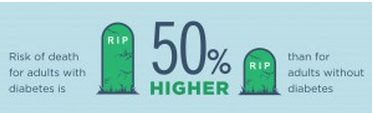
In each case, we kinda know what they meant. But they didn’t actually say what they meant. And I can tell you from my experience on Jeopardy that if you don’t say what you intend to say, Alex will take away your money. Not saying what you intended to say means what you did say is wrong, no matter how big you write your name.

And now, they’ve done the exact same thing for chronic disease…except that I really can’t figure out what they mean. “86% of healthcare spending is on people with chronic disease.” Even at 75%, this was already the#1 urban legend in all of healthcare. But 86%? Seriously? $6 out of every $7? Take out birth events, and it’s more like $11 out of every $12. Take out trauma, primary care, gynecology, imaging, sports injuries, and you’re already in mathematically impossible territory.
While this CDC whopper is bad news for frustrated fifth-grade math teachers everywhere, this sudden and unexplained boost from 75% to 86% is good news for the wellness industry. This timing is not likely a coincidence given the ties between the CDC and some wellness promoters. It comes at a time when the wellness industry is getting skewered in the media, employees (the actual end-users) hate wellness so much they need to be bribed or fined to submit, the industry’s own numbers don’t add up and when we change their numbers per their request, they add up even less,
Wellness industry executives never miss an opportunity to misinterpret a statistic they don’t understand, and the CDC is just begging to have wellness vendors misinterpret this as “Chronic disease now accounts for 86% of healthcare spending” — and push employers into more prying, poking and prodding. Of course, what they should be doing instead, based on the list of costly admissions below, is exactly what Quizzify proposes: educating employees on how to avoid harms of overtreatment, rather than pushing them into the treatment trap.
Funny thing, for an industry so behind the times that they still urge guys to get PSA tests (and fire them if they don’t, in one case we’ll be posting soon), wellness vendors didn’t let a minute go by before misinterpreting the CDC statistic, as we predicted. Here is Concentra, saying: “Chronic disease accounted for 86% of healthcare spending,” and if you read down, proposing more prying, poking and prodding.
A couple of weeks ago, Concentra decided even 86% wasn’t enough, so they added a little extra, just in case the CDC omitted a few cases of dishpan hands:

We hate to pour coffee on the wellness industry’s invalidity bender here, but someone has to provide actual facts, since the CDC seems to fear them as much as wellness vendors do. We’ve already posted the top 25 inpatient DRGs in the country for employees, both by frequency and by cost, and we’re posting them again below. As you can see, none of those conditions accounting for “more than 86% of health care spending” — nor any of their common complications — show up on this list. Instead, the overlap with anything that can be avoided with pry, poke and prod programs is almost zero. Even randomly, you’d expect more of an overlap, let alone if 86% of cost is due to things that 3-P programs address.
If that’s the case, how did the CDC come up with that statistic? It’s not sourced, so we have no idea. Our suspicion is that they’ve lumped a whole bunch more diseases in there, like maybe gum disease. So why not add tooth decay? Dandruff? Cellulite? Ring around the collar? They already list “stroke,” which is about as acute as diseases get. As we say in Surviving Workplace Wellness, every minute of delay after a stroke increases the odds you’ll end up like the Kardashians.” Likewise, they list cancer, as in: “My doctor says I have lung cancer, but we’re staying on top of it. He says I need to lose 15 pounds.” (For these two items, we do think we know what they mean. Some cancers stay with you but can be controlled, and disease leading to stroke is chronic…but that’s not what they said.)
Perhaps this 86% statistic is technically accurate for some health policy wonk parlor game where one player tries to act out a chronic disease, but it’s wrong on its face for any useful purpose involving employee wellness. For employees, it’s all about birth events, orthopedics, day surgeries, imaging, drugs, doctor visits, and a ton of one-time events, small potatoes, catastrophic illnesses, and/or none-of-the-above. While the CDC is busy lumping everything together into this 86% figure, we are recalling the opposite observation in Why Nobody Believes the Numbers that “everything in life has an 80-20 rule, and in healthcare the 80-20 rule is that 80% of the time, there is no 80-20 rule.”
Boys and girls, DO try this one at home…
Who Are You Going to Believe, the CDC or Your Own Eyes?
Before you answer, “Oh, our consultants told us to do more wellness,” try one thing. Try what we suggested above, for your own population. List the top episodes of care in total in your own organization. Here it is for the country as a whole:

As we’ve mentioned on multiple occasions, this list is populated with things no one can do anything about, as well as things addressed by Quizzify. Feed your population all the broccoli they can eat, and make them wear fitbits 24-7. You won’t prevent a single one of those DRGs.
Share this:

NY Times Economists Diss Corporate Weight-Shaming…but It’s Even Worse than They Say
We never post on Sundays. We are making an exception today on the theory that a lot of people in the Northeast are at home and would welcome the distraction. Here in Massachusetts it’s so cold that the Governor is urging people to stay indoors. Heck, we even decided to cancel Ultimate Frisbee.
This is now the seventh time that the New York Times —or its The Incidental Economist bloggers (“TIE” as they call themselves) — has observed that conventional corporate wellness doesn’t work. Links to the previous six instances follow this posting. Perhaps the seventh time will be the charm. Having covered every other angle except the actual health hazards of wellness, this TIE post specifically eviscerates “biggest loser” programs and their brethren.
HR executives may think they are “supporting” employees by holding weight-loss contests or paying them to lose weight. Unfortunately, all they are doing is reducing self-esteem, encouraging crash-dieting before weigh-ins, drawing attention to people’s weight, and — in addition to distracting employees from their actual jobs — distracting them from the one thing that benefits people of all sizes: exercise. It is much better to be “fit and fat” than fight a losing battle to keep weight off with various fad diets.
Further, the Body Mass Index, the 200-year-old metric wellness vendors still use to establish how much to pay or fine employees, turns out to be a very misleading measure of population health. (As “Brad F.’s” comment to a previous blog pointed out, BMIs may be of value if conducted as part of an actual physician-patient relationship. However, actual medicine is of no interest to wellness vendors, other than making people get useless annual checkups. Most physicians practicing actual medicine find wellness programs to be a misguided nuisance.)
Worse than The Incidental Economist says it is
The case against these programs is even stronger than TIE says. TIE supports its case by citing randomized control trials. But if RCTs are the Gold Standard, the Platinum Standard is wellness vendors’ consistent and total self-immolation in attempting to show their own program impact– despite ample opportunity to manipulate data, select motivated participants, ignore dropouts, and run ridiculously short “weight loss challenges” that end before the weight is regained. We love to cite ShapeUp as an example of that, having exposed them in the Pittsburgh Post-Gazette. (This was probably overkill on our part, but their CEO had thought a good way to get some attention might be to fallaciously attack our numbers even though his own figures were made up.)
Because great minds apparently aren’t the only ones that think alike, ShapeUp has plenty of company on the Biggest Loser List. Wellness Corporate Solutions has also been “profiled” on this site, largely for comic relief. Pfizer, where actively motivated employees lost a few ounces over a year, actually earned an award from Ron Goetezel for this stellar performance, as well as a spot on our Biggest Loser List. Our favorite example is McKesson. They also won one of Ron Goetzel’s Koop awards even though their average employee showed an actual increase in — you guessed it — BMI (and cholesterol):
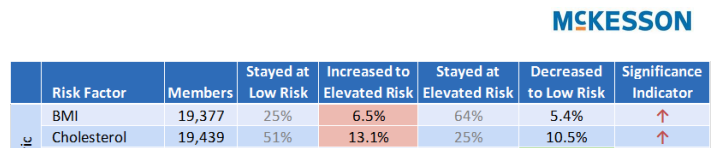
If award-winning companies can’t get employees to lose weight, who can?
And where would a Biggest Loser List be without Vitality, which pitches its weight-loss program to others but can’t even get its own employees to lose weight? If wellness companies can’t get their own employees to lose weight, who can?
Where we differ with TIE is on weight control interventions for school-age kids. They quote one definitive-sounding study, with 4600 kids in it. We don’t have a problem with the actual study. However, because the long-term health and social prognosis for obese children is negative, and because this problem is so pervasive, we ourselves would insist on a much higher level of proof and more experimentation with different program designs before throwing in the towel on these interventions. (We may very well end up agreeing with TIE when all is said and done. We would just like more to be said and especially done.)
As for employers, our recommendation remains the same: do wellness for your employees, not to them. This means supporting employees who want to pursue health goals, but otherwise just leaving them alone to do their jobs. Don’t even make them play Quizzify if they don’t want to. (But they’ll want to — we guarantee it.)
The Incidental Economist/New York Times on Wellness: A Chronology
September 2014 TIE says wellness “usually” doesn’t work.
October 2014: TIE headlines: “Wellness Programs Don’t Seem to Work as Advertised”
December 2014 TIE says: “We’ve said it before, many times and in many ways, wellness doesn’t save money.”
February 2015 TIE headlines “Another Call to Eliminate Employee Weight Loss Programs”
October 2015 New York Times says: “Provide us with your...weight, or pay up.”
November 2015: TIE headlines “The Feds Are Wrong. Lots of Wellness Programs Violate the ADA.”
Share this:

Goofus and Gallant Meet Viverae and Quizzify
Goofus and Gallant is a Highlights for Children feature contrasting different behaviors. Example:


Viverae’s and Quizzify’s guarantees lend themselves to this type of comparison. Honestly, we don’t even know if Viverae still offer theirs. Nonetheless, through the years a number of people have sent it to us and asked for our help interpreting it. (That’s a polite phrasing of what the emails said, and of course we are nothing if not polite.) It provides an excellent opportunity to learn how to read a guarantee with a discerning eye, and we thank Viverae for offering it and hope they too are able to gain some insights from our analysis of it.
Here is Viverae’s guarantee, which we will review clause by clause:

Goofus: Viverae’s Clause #1 doesn’t allow any leeway in program design.
Gallant: Quizzify offers the guarantee even if you want to tweak the program design.
Goofus: Viverae’s Clause #2 is an EEOC violation. You can’t “require” employees to do biometric screens. The program wouldn’t be voluntary. You might as well just send a memo to your employees with the phone number of the EEOC and tell them to sue you.
Gallant: Quizzify guarantees no EEOC lawsuits, and actually indemnifies against them.
Goofus: Viverae’s Clause #3 would seem fairly self-evident–except that in wellness, as the example at the end of this posting* shows, some wellness vendors don’t know there are 12 months in a year.
Gallant: Quizzify assumes its customers know that a year has 12 months in it, so this clause isn’t part of our guarantee.
Goofus: Viverae’s Clause #4 requires you to not only sign up for 3 years to get this 20% guarantee in the third year only, but also to waive your rights to early termination. So basically they are saying: “If you sign up for 3 years with no ‘out’ clause, we might possibly give you a guarantee worth 6.67%/year on average, assuming we measure validly.”
Gallant: Quizzify’s price list offers customers discounts exceeding 6.7% a year for multiyear contracts anyway, even before any guarantee, and allows not-for-cause termination for a small upcharge.
Gallant: Quizzify’s guarantee is 100% in all years, not 20% in year 3.
Goofus: Viverae’s Clause #5 requires a minimum number of 1000 employees, making it off-limits to more than 98% of America’s employers.
Gallant: Quizzify offers a straight 100% satisfaction guarantee if the number of eligible employees is too small to measure savings objectively.
Goofus: Viverae’s employee incentive/penalty requirement in Clause #6 is the “maximum allowed by law.”
Gallant: Quizzify requires a minimum incentive of only $100. We believe that the program should be attractive enough that you don’t need to force employees to participate.
Goofus: Viverae’s Clause #7 requires all carriers and PBMs for all years to turn over all employee-identifiable claims files. Since Viverae is not HIPAA-compliant, that creates a HIPAA issue. (In all fairness to Viverae, most wellness vendors are not HIPAA-compliant. Quizzify is the exception. Quizzify doesn’t collect or store private health information, so HIPAA doesn’t apply.)
It also means Viverae determines how much money Viverae saved, with no oversight.
Gallant: Quizzify allows the customer or its consultant to complete its simple claims extraction algorithm and determine savings, or Quizzify can do it for them. Its claims extraction algorithm is the industry standard required by the Intel-GE Care Innovations Validation Institute.
Speaking of the Validation Institute, Goofus’s guarantee is not validated by them.
Quizzify’s is.

Postscript:
Gallant reminds readers that both he and Goofus are trademarks of Highlights for Children so don’t even think about using these characters without attribution.
Goofus sprinkles Gallant’s DNA at crime scenes.
*Avivia “three-year” study of drug adherence:

If you like this example, you’ll love This Is Your Brain on Wellness
Share this:

Wellness Greatest Hits Collection: Wellnet Detects Undetected Claims Costs
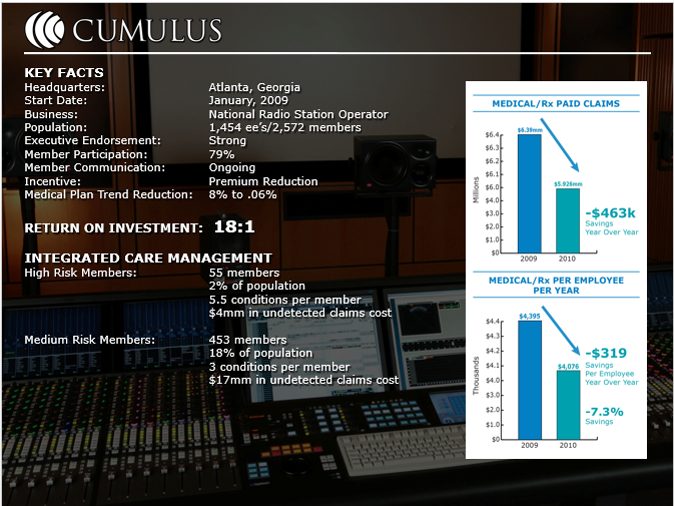
We are actually doing our “Day Jobs” today, which means we are digging into our Greatest Hits Collection rather than, in the immortal words of the great philosophers in ABC’s sports department, spanning the globe to find the Agony of Defeat. (Truth be told, we don’t have to span anything except our keyboards for that.) Here is one of our favorites, Wellnet. Besides the usual wellness vendor numerical creativity (check the y-axis on both graphs), Wellnet features “undetected claims costs.” If, despite all your years in the benefits business, you’ve never heard of “undetected claims costs,” you might want to google on that phrase. You will find two sets of references to “undetected claims costs”:
(1) Wellnet
(2) Us making fun of Wellnet.
We asked them a number of questions, which naturally they refused to answer. So before we published Why Nobody Believes the Numbers, we hired a well-known team of investigators to answer them for us. This is what they found.
‘‘Holmes, Wellnet saved $4 million in ‘undetected claims cost’ just on the highest-cost Cumulus employees. That is very impressive.’’
‘‘Watson, you see but you do not observe. The most common mistake in wellness is to present conclusions that are mathematically or epidemiologically impossible. The distinction is clear. Wellnet’s website says that the most expensive 2 percent of the employees of Cumulus Media avoided about $72,000 apiece—in so-called ‘undetected claims cost.’ This has Moriarty’s fingerprints all over it. Claims costs that don’t get incurred because they aren’t detected. No doubt those claims are making their way into Moriarty’s pocket.’’
‘‘You cannot detect them, Holmes? But you are the world’s greatest detective.’’
‘‘Indeed perhaps I am not, if I cannot detect undetected claims cost and Wellnet can. Or at least Wellnet has benefits consultants and HR executives believing that impossible arithmetic is possible. If Moriarty has invented a way to control our wellness industry through Wellnet so that benefits managers believe impossible results, he is making new rules of math. He could rewrite all the textbooks used in Grade 1 to Grade 6, in whatever those schools are called.’’
‘‘Elementary, my dear Holmes.’’
‘‘Watson, now what do you have for me?’’
‘‘Holmes, I have a lot of questions about how Wellnet detects undetected claims cost. Could they be using those gadgets for finding coins on the beach? Or do the employees have to pass through a scanner every day, like Karen Silkwood or Meryl Streep? And if Wellnet did not avoid all those undetected claims, how would employees get reimbursed for them? Would they fill out claims forms using invisible ink?’’
‘‘I’ll ask the questions, Watson. You get me the data. I can’t make my bricks without clay. Tell me, Watson, what is the data?’’
‘‘The data, Holmes, is that they also avoid $37,000 apiece in ‘undetected claims cost’ for the medium-risk members. Quite an impressive wellness company.’’
‘‘Watson, you ignorant slut. You see everything, but you fail to reason from what you see. $72,000 is much more than the top 2 percent of a company’s employees would be predicted to spend in avoidable expenses in the year following their inclusion in the top 2 percent, and equates to about four avoided hospitalizations apiece. Add to that about $37,000 in ‘undetected claims cost’ avoided for the medium-risk members, and Wellnet is avoiding $21 million of ‘undetected claims cost’ for Cumulus Media.
‘‘Here’s the rub, Watson: Cumulus Media’s total healthcare spending is only about $6 million/year. Therefore they can’t have saved $21 million. When you have eliminated the impossible, whatever remains, however improbable, must be the truth. Another case solved. Another Moriarty plot foiled. Math is saved for future generations to enjoy.’’
‘‘Brilliant, Holmes. How do you do it?’’
‘‘You know my method, Watson. It is founded upon the observation of trifles, a little cocaine, and an occasional allusion to Saturday Night Live.’’
Share this:

Dee Edington’s book is inscrutable.
I apologize. He asked me to do a review but I couldn’t make any sense out of it. It simply isn’t a good book. I got about 100 pages in and just gave up.
Wish I could say something positive about it.
Share this:
That Was the Year that Was: Our Top Contributions of 2015
Our year-end jubilee has so far featured lists of the worst vendors and the funniest vendors. To close out the year on a more serious note — if for no other reason than to show we are indeed capable of treating the extremely serious topic of wellness with the Extreme Seriosity it deserves — we’ll list the most influential posts of the year.
In terms of views, the top spot is shared by our two smackdowns of worthless employee weight control programs. Our peer-reviewed smackdown, in the American Journal of Managed Care, should end the year at #1 on their list too, of the most-viewed articles. I say “should” because a lot will depend on people clicking through on it today or tomorrow (hint) and at least pretending to be enthralled by it, even though it is a bit dry.
The Reader’s Digest version got picked up on Huffpost. Absent the constraints of peer review, we took the gloves off. Our reward is that we are the most-widely read Huffpost of the year on wellness.
If “most shocking” is the criterion, the winner is our recent evisceration of Aetna’s employee DNA collection program. This one is best viewed here, at Insurance Thought Leadership, but was also picked up by The Health Care Blog. You know the old Woody Allen joke about the two ladies in the Catskills? One of them says: “You know the food here is terrible.” The other replies: “Yeah, and the portions are so small.”
Collecting employee DNA is a shockingly stupid idea on many levels — the kind of program that someone would make up in order to make wellness look bad, but we didn’t have to. As if that weren’t enough, Aetna also decided to fabricate outcomes. And because the program was so expensive, to show a 2-to-1 ROI they had to concoct $1464/person in savings in the first year alone–on employees who, by Aetna’s own admission, weren’t even sick. One of the editorial board members of the journal that published it wrote that it should never have passed peer review.
The biggest category — and the one where it would be hardest to pick a winner from among the many worthy entries — would be: “Most likely to show Ron Goetzel making things up.”
You might vote for yesterday’s post on how Ron said wellness programs increased stock price valuations when in reality they reduce stock prices. (Ron also misused the word “valuation”. It is not a synonym for “stock price.” In all fairness, the only people who would be expected to know the distinction would be people who write articles about stock valuations that are actually intelligent and insightful.) However, he probably didn’t make up that conclusion. I reviewed 5 years and compared each company to its relevant sector index. By contrast, he reviewed a longer period and has probably never heard of a sector index. We reached opposite conclusions about the correlation of wellness programs and stock prices. The real answer, though, is that wellness programs have absolutely no meaningful effect on either stock prices or stock valuations. If they did, one securities analyst somewhere, writing a report on one company anywhere, would have noted it. Not to mention that a hedge fund would have made a business out of buying shares in companies with the best wellness programs.
Another candidate would be our expose of the HERO report, in which we observed that HERO and their cronies accidentally admitted — a la Robert Durst — that wellness loses money. Despite co-signing this document — a document that required “two years and countless hours” of collaboration, and in which the word “consensus” appears 39 times, Ron insisted during our debate that he had nothing to do with anything in this document that he himself didn’t write. (Of course, in the debate he also insisted that he had nothing to do with Penn State — meaning he just wandered into their press conference by mistake, or maybe I am confusing him with another Ron Z. Goetzel.)
Nonetheless our vote goes to the Unified Theory of the C. Everett Koop Award, in which we reverse-engineered the mathematically impossible formula (the “Goetzel Factor”) that Ron and his integrity-challenged cronies use to anoint award winners, whose programs are almost invariably hilarious and show a complete lack of understanding of the way healthcare and healthcare math work. To paraphrase the immortal words of the great philosopher Samuel Goldwyn, “If Dr. Koop were still alive, he’d be rolling in his grave.”
Share this:
Forbes’ Shaywitz Takes On Aetna’s DNA Collection Program
Whoever concluded that more is learned from one bridge that falls down than 100 that stay up did not included Aetna’s data in their calculations: 2 major bridge collapses, nothing learned.
Aetna first gained notoriety in these pages — and in our book, Surviving Workplace Wellness, and on The Health Care Blog — for being the first health plan to pitch expensive name-brand drugs to its members. Not just any members, but members who weren’t sick — and that someone else was insuring, since there wouldn’t be any savings.
And not members who requested them, but members who Aetna pitched them to, members who mostly didn’t want them. And not just any drugs, but drugs that were/are so controversial that they became the subject of an essay in the Journal of the American Medical Association concluding they never should have been approved. (As a sidebar, while all of wellness is claimed, mostly falsely, to increase productivity, one of these drugs says right on its label that it reduces productivity, specifically impacting memory, attention and language. And yet Aetna insisted productivity would increase. Using a drug that reduces productivity to increase productivity truly puts the “off” in “off-label” use.)
So what did they learn from a failed wellness program that was expensive, intrusive, ineffective, and incredibly unpopular using a third-party that doesn’t seem to know what it’s doing? Their takeaway was: “Let’s come up with a program that’s even more expensive, intrusive, ineffective, and incredibly unpopular using another third-party that doesn’t seem to know what it’s doing…and, for added measure, let’s lie about the outcomes.”
And thus they hatched their scheme to bring DNA surveillance into the workplace. Not to identify possibly useful mutations, but to estimate the risk of diabetes and heart attacks. And not: “We’ll cover this testing if you go to the doctor and together decide whether to order it.” Rather: “You’ll forfeit money if you don’t agree to this, and our partner gets to keep your DNA and re-sell it.”
We’ve already covered the intrusiveness, and fact that their partner, Newtopia, seems unable to understand basic arithmetic and science. We’ve also covered their reference-site-from-hell, which didn’t exactly embrace this program.
Most recently, we’ve covered the lying-about-outcomes angle. Because the program is going to sell for up to $700, Aetna had no choice but lying– they needed to “show” $1400 in savings to achieve a 2-to-1 ROI. Scroll down to the comments — the most respected member of the editorial board of the journal that published their outcomes now says they never should have published the study. (He himself hadn’t reviewed it.)
But all of our exposes are trumped by David Shaywitz. Writing in Forbes, he points out that the entire idea of using genetics to predict and manage obesity-related illness is, to use a technical genomics term, stupid.
We’d urge reading the whole posting (though he doesn’t get into Aetna/Newtopia until page 2), but here are the takeaways:
(1) “The three variants examined by Aetna/Newtopia explain a very very small fraction of genetic risk;”
(2) “Even if you carry the harmful genes, there is no obvious course of action” different from standard diet-and-exercise.
Shaywitz — who may have done more research before writing this column than Aetna did before starting this program — also clearly distinguishes this type of genetic information from identifying (for example) the BCRA1 mutation, which might actually be useful. “Useful” is not a term found often in wellness programs so you won’t be surprised to hear that Aetna doesn’t include BCRA1 mutations in theirs.
What are the takeaways?
First, Aetna’s wellness programs need some adult supervision. Programs like these should never be allowed out the door. Of course, not offering wellness is not an option. It is way too profitable, and if they don’t, someone else will. However, there are plenty of other ways to rip off employers and humiliate employees that are less expensive and less intrusive than the two Aetna has come up with.
Second, Quizzify is making a bet that — especially because Aetna is not hiring any of them — there are a lot of smart people still out there, people who would prefer to pay a low price for an employee health program that is non-intrusive, fun, guaranteed to save money, Intel-GE Validation Institute-validated, and carries a Harvard Medical School imprimatur than pay a high price for programs that don’t work and employees don’t like.
Yes, we know it’s not always about us, but we appreciate Aetna’s efforts to make us look good by comparison.
 They Said What?