
Home » wellness doesn’t work (Page 7)
Category Archives: wellness doesn’t work
First, Do Harm: The Ten Most Dangerous Wellness Vendors
If corporate wellness didn’t already exist, no one would invent it. In that sense, it’s a little like communism, baseball, pennies, or Outlook.
After all, why would any company want to purchase programs that damage morale, reduce productivity, drive costs up…and don’t work 90%-95% of the time? And that’s according to the proponents. What the critics say can’t be repeated in a family publication such as ours.
Still, those are the employers’ problems. However, the employers’ problems become the employees’ problems when employees are “voluntarily” forced to submit to programs that are likely to harm them. (As the New York Times recently pointed out, there is nothing voluntary about most of these programs.)
Recently, the head of United Healthcare’s (UHC) wellness operations (Optum), Seth Serxner, admitted that Optum’s programs consciously ignore US Preventive Services Task Force (USPSTF) screening guidelines. Lest anyone was expecting a wellness vendor to actually apologize for bad behavior, Mr. Serxner went on to blame employers for insisting on overscreening and overdiagnosing their own employees…and (by implication) overpaying for the privilege of doing so. “Our clients make us do it,” were his exact words.
Funny thing, we first asked our own clients who use Optum about why they turned down Optum’s generous offer to do more appropriate screenings at a lower price. None of them remember receiving this offer. Go figure. Then a UHC executive wrote and said we were making them look bad. I softened some of the language (like the paragraph below), and said I would happily retract the whole thing if indeed they could introduce me to just one customer — one out of their thousands — who recalls insisting on overscreening and overpaying. Never heard back…
United Healthcare isn’t alone in harming employees. They are just the first company to admit it, and far from the worst offender, as the harms of overscreening for the usual suspects (glucose, cholesterol etc.) don’t hold a candle to some of the more creative ideas listed below. Here, in order, are the ten vendors most likely to harm employees in the name of wellness.
#10 Healthmine
Healthmine’s CEO, Bryce Williams, isn’t blaming the victim like United did. He has publicly announced that Healthmine flouts clinical guidelines. He says he is right and everyone else — specifically including the “US Preventative [sic] Services Task Force” — is wrong. A real doctor acting on this pronouncement might be risking his or her license. Fortunately for Mr. Williams, being a wellness vendor doesn’t require a license, so regardless of the harms a wellness vendor inflicts on employees, no one can confiscate it because there is nothing to confiscate..
In addition to not misspelling the name of the group he is attacking, we might also recommend that he not misquote the sources on which his faulty argument is based. We’re just sayin’…
For starters Mr. Williams declares: “One out of every two people in America has at least one chronic condition according to the CDC…”
Here’s what the CDC really said: “One out of every two adults has at least one chronic condition.” And if you dig deeper, you’ll see that this list of chronic conditions cited by the CDC includes arthritis, mental illness, eye disorders and asthma, none of which Healthmine’s hyperscreening is going to reveal.
He also claims that “chronic diseases account for $3 out of every $4 spent on healthcare.” Here’s what the CDC really said: $3 out of every $4 “is spent on people with chronic conditions.” That is a much broader statement. It would include someone with borderline hypertension giving birth. In any event, we long ago eviscerated Mr. Williams’ cherished myth and just this week showed that essentially none of the top 25 hospital admissions has anything to do with screening, broccoli, or Fitbits.
#9 Cerner
The employee who recorded this blood pressure is essentially dead. Cerner’s diagnosis? Blood pressure “higher than what is ideal.” Cerner’s recommendation? “Talk to your healthcare provider.” A real doctor’s recommendation? “Call an ambulance. The guy barely has a pulse.”
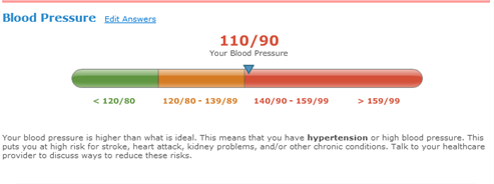
This is not a random mistake. This is the front cover of their brochure.
#8 Nebraska/Health Fitness Corporation
USPSTF Screening age recommendations aren’t minimums. They are optimums, the ages at which screening benefits might start to exceed harms, even if they still fall far short of costs. Otherwise you are taking way too much risk. This is especially true for colonoscopies, one of this program’s favorite screens — complications from the test itself can be very serious.
Your preventive coverage is not supposed to be “greater than health care reform guidelines.” That’s like “rounding up twice the number of usual suspects.” And you aren’t supposed to waive “age restrictions.” That’s like a state waiving minimum “age restrictions” to get a driver’s license.

Yet despite or perhaps because of this and other examples of total cluelessness and pure dishonesty, this program won a C. Everett Koop Award for excellence in wellness, not to mention the unwavering support and admiration of leading wellness apologist Ron Goetzel.
#7-#6 (tie) ShapeUp and Wellness Corporate Solutions
Both these outfits pitch exactly the opposite of what you are supposed to do in weight control: unhealthy crash dieting. Attaching money to this idea and setting a start date makes it even worse: along with crash-dieting during these eight weeks, you’re incentivizing employees to binge before the initial weigh-in.
Here is ShapeUp:

Here is Wellness Corporate Solutions:
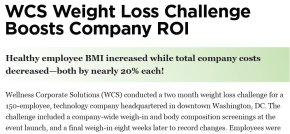
Both also made up outcomes. In ShapeUp’s case they had to rescind their “findings” after their customer, Highmark, skewered them in the press. And neither seems to care that corporate weight control programs are proven not to work.
In addition to its dystopian wellness program that collects employee DNA (partnered, ironically, with a company called Newtopia) and then makes up savings, Aetna owns the distinction of launching the only wellness program whose core drugs are specifically editorialized against in the Journal of the American Medical Association. This would literally be the most harmful wellness program ever, except that the only employees being harmed are (1) obese employees who (2) answer the phone when their employer’s health plan calls them to pitch these two drugs; (3) have a doctor who would willingly prescribe drugs that almost no other doctors will prescribe due to their side effect profile; and (4) not google them. Presumably in combination this is a very low percentage of all employees.
The good news is that these drugs, Belviq and Qsymia, should be off the market in a couple of years because almost no one wants to take them, so the harms of this Aetna program should be self-limited.
Star Wellness offers a full range of USPSTF D-rated screens. “D” is the lowest USPSTF rating, and means harms exceed benefits. Star gets extra credit for being the first wellness vendor to sell franchises. All you need is a background in sales or “municipal administration” plus $67,000 and 5 days of training and you too can poke employees with needles and lie about your outcomes. Is this a great country or what?
Also, their vaccination clinic features Vitamin B12 shots. We don’t know which is more appalling–routinely giving employees Vitamin B12 shots, or thinking Vitamin B12 is a vaccine.

Angioscreen doesn’t have the most USPSTF D-rated screens. In fact, it offers only one screen in total, for carotid artery stenosis. That screen gets a D grade from USPSTF, giving Angioscreen the unique distinction of being the only vendor 100% guaranteed to harm your workforce.

Angioscreen’s other distinction is that they admit right on their website that this screen is a bad idea. This is probably literally the only non-tobacco company in America to admit you are better off not using their product.
Total Wellness loses the wellness industry’s race to the bottom only because the winner, HealthFair, has out-stupided them. However, in addition to the usual assortment of D-rated tests, they offer screens that the USPSTF hasn’t even rated, because it never, ever occurred to them that anyone would ever use these tests for mass screening of patients or employees. Criticizing the USPSTF for not rating these “screens” (CBCs and Chem-20s) would be like criticizing Sanofi-Aventis for not warning against taking Ambien after parking your car on a railroad crossing.
#1 HealthFair
Let’s leave aside for a fact that the majority of their other screens are harmful too, and focus on their screening for H.pylori, the strain of bacteria associated with ulcers. To say it is a stupid idea would be an understatement. As Clarice Starling replied when asked if Hannibal Lecter was a sociopath: “They don’t have a word for what he is.”
Likewise, this idea is too stupid for words, certainly for the small number of words we can allot to this overview blog. Visit our full treatment here. In a nutshell, the majority of us harbor H.pylori–without symptoms. It may even be beneficial. The screening test is expensive and notoriously unreliable, and the only way to get rid of it is with some very powerful antibiotics, a treatment rarely even used on patients with symptoms due to its inconvenience, ineffectiveness and potential long-term side-effects.
A Modest Proposal
So how should we as a country protect employees from these harms? Our policy recommendation is always the same, and very non-intrusive. We aren’t saying wellness vendors shouldn’t be allowed to harm employees. That would be too radical to ever pass Congress. If it did, the Business Roundtable would pressure the White House again, to preserve their hard-earned right to medicalize the workplace, and literally and figuratively, show employees who’s boss.
Instead, we recommend merely a disclosure requirement. The harms of screens or (in United Healthcare’s case) screening intervals that don’t earn at least a “B” from USPSTF should be disclosed to employees, and employees should get a chance to “opt out” into something that isn’t harmful (like Quizzify, perhaps?) without suffering financial consequences. Call us cockeyed optimists, but we don’t think employers should be able to force employees to choose between harming themselves and paying fines.
Share this:

Tenn. Blue Cross tumbles into the wellness outcomes rabbit hole

Quizzify promises only 1 outcome: smarter employees
I know it’s not always about me (my ex-wife was quite clear on that point), but I was deeply saddened to see one of the Blues – specifically, Blue Cross of Tennessee — descending into the fabricated-wellness-outcomes abyss.
In all fairness, wellness vendors have to lie, since it turns out that achieving savings is mathematically impossible. If they told the truth, they’d all be fired. Even so, Blues should be held to a higher standard for integrity than independent wellness vendors, because lies told by one Blue affect all the others by sullying one of the most readily identified and respected trademarks in America.
Before continuing, I do want to emphasize that this isn’t about “the Blues,” which are all independent of one another. It’s specifically about Blue Cross of Tennessee (BCBSTN). By contrast, other Blues – Massachusetts, Rhode Island, Louisiana, Northeast Pennsylvania, Carefirst and South Carolina come to mind (along with the Blue Care Network subsidiary of Blue Cross of Michigan) – have created exemplary outcomes reports. For them, integrity trumps impossibility. Two have even been validated by the Care Innovations Validation Institute, the gold standard in outcomes measurement.
Not so BCBSTN. They published a report in which Onlife Health showed some of the best outcomes in wellness history. BCBSTN calls Onlife their “partner” company in this report. However, a corporate lawyer – or BCBSTN itself, in this other press release – would call Onlife a “subsidiary,” for the simple reason that BCBTN owns Onlife. By contrast, you don’t own your partner (though my ex-wife tried).
In other words, BCBSTN is “validating” itself, not a partner. Normally “validation” is not performed by the entity being validated any more than an attorney is allowed to render the verdict in a case he or she is arguing.
The “intervention” was that these admittedly overweight employees walked an extra 2500 steps (about 19 minutes) a day. Here’s what those literal and figurative “baby steps,” as the report calls them, achieved. This is verbatim from the report:
- Emergency room visits and inpatient hospital stays were more than 50 percent lower in the moderate exercise group, as well. There were 219.6 ER visits and 59.9 inpatient stays per 1,000 for overweight non-exercisers compared to 73.6 ER visits and 30.1 inpatient stays per 1,000 for overweight moderate exercisers.
Let’s consider ER and inpatient separately. About 40-million ER visits a year are specifically caused by injuries, or roughly 126 per 1000 people. This injuries-only figure dwarfs BCBSTN’s all-in ER visit figure of 73.6 per 1000 allegedly achieved by this program. In other words, walking an extra 19 minutes a day not only wiped out every single non-injury-related ER visit, but also about 40% of all injury-related ER visits.
Next, let’s consider the inpatient stays. Their 30 stays per 1000 includes birth events, as compared to the more typical figure, which BCBSTN also experienced in the control group, of about 60 per 1000. All birth events combined are about 15 to 20 per 1000. Taking those birth events out of the BCBSTN tally yields 10-15 admissions per 1000, a Nobel Prize-winning figure.
And all achieved by walking an extra 19 minutes a day.
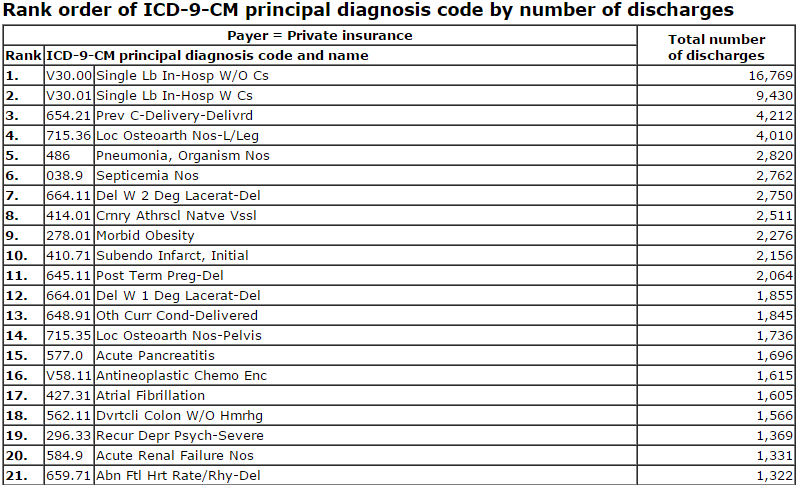
Another way of looking at it: here are the top 21 admissions categories for Tennesseans insured through their employers. With the exceptions of categories #9 and #10 (morbid obesity and heart attacks), probably not one single admission in any of these categories could have been prevented by walking an extra 19 minutes a day. Even in those two categories, optimistically only a handful of admissions would be prevented by short walks.
In addition – this is also part of wellness vendor DNA as this Wellsteps example shows – BCBSTN’s numbers contradict themselves. Compare these three bullet points from the study (italics are ours):
- Contrary to the popular guideline of 10,000 steps a day, employees who took as few as 5,000 steps per day, had annual healthcare costs nearly 20 percent lower than their sedentary counterparts who did not exercise. Spending was $2,038 per member per year (PMPY) for non-exercisers compared to $1,646 PMPY for moderate exercisers.
- Average claims cost PMPY dropped from $5,712 for non-users to $4,248 for employees who participated in one program and $3,120 for those participating in two programs. Employees engaged in three programs saw their claims cost cut almost in half at $2,892.
- Looking at BCBST overall, Danny Timblin, president and CEO of Onlife Health, noted, “Over a three-year period of time when we did this study, their claims were essentially flat.
Well, which is it? (And you gotta click through here.) Is it $2,038 per year for non-exercisers, or $5,712? How is it that “moderate exercisers” only spend $1,646 in the first bullet point but $2,892 in the second? And how can any sizable group of people only spend $1646 per year per person, vs. the more typical $5000-$6000? (Even adding up the cost of just those impossibly low ER and Inpatient utilization figures totals half of the $1646, leaving only enough room in the budget for a couple of doctor visits and non-specialty prescriptions.)
And how does “their claims were essentially flat” in the third bullet point reconcile with the massive decline in claims in the second bullet point?
Yet another head-scratcher: these massive savings were achieved despite the wellness industry’s own report admitting wellness loses money. You might say: “So what? Maybe Onlife disagrees with their own industry’s report.” Except that Onlife co–wrote that report, unless there is a different Onlife Health that is listed as a collaborator on it:

This Onlife “study,” if nothing else, validates the observation in our book Surviving Workplace Wellness: “In wellness, you don’t have to challenge the numbers to invalidate them. You merely have to read the numbers. They will invalidate themselves.”
Which brings us back to what Blue Cross of Tennessee needs to do next, now that their numbers have self-immolated (along with their ability to define the word “partner”). It seems they have, in the immortal words of the great philosopher Ricky Ricardo, some ‘splainin’ to do. At the very least, perhaps an apology to the Blue Cross Association and to their fellow Blues.
And I owe an apology to my ex-wife, who served the purpose of a humorous literary device in this posting, but who in reality is quite charming and lovely, and is inviting us over for Thanksgiving, and all we have to do is bring the pies. But I think BCBSTN will need to give the Association more than a pie or two to make up for this one.
Share this:

Should the Wellness Vendor Oath Be: “First, Do Harm” ?
The Quizzify oath: First, do help.
When Thomas Edison said: “We don’t know a millionth of 1% about anything,” he wasn’t talking about the wellness industry, because wellness vendors aren’t that knowledgeable. And much of what they “know” is harmful.
Smoking and exercise aside, taking wellness vendors’ advice 10 years ago — during the time wellness was somehow allegedly racking up its famously fictitious 3.27-to-1 ROI by making employees healthier– would have been a very bad idea. PSA tests, annual mammograms for younger women, colonoscopies at 5-year intervals, and EKGs were perfect examples of must-to-avoid screens, even if it meant leaving incentives on the table.
And yet even though most wellness vendors (Star Wellness, Bravo Wellness Total Wellness, HealthFair Services and Aetna being notable exceptions) won’t harm employees as much as they did 10 years ago, a lot of mythology still causes a lot of harm today, albeit more subtly.
Myth: “We need to ‘do wellness’ because 75% of our healthcare cost is due to preventable chronic disease.” (Ron Goetzel, in our recent debate, boosted this figure to 80% for reasons unknown.)
Fact: Have ya looked at your high utilizers and other expenses? We-can-prevent-75%-of-cost-due-to-chronic-disease is the biggest urban legend in healthcare. We’ve done multiple articles on it — there are too many fallacies to squeeze in here. Though it’s just arithmetic, this is the most harmful fallacy of all, because by causing employers to obsess with overprevention, it spins off all the other fallacies below.
Myth: “Reducing our employees’ BMIs will save money.”
Fact: The actual science is far more nuanced. Some people have high BMIs because they are healthy. And belly fat — even at “normal” weights — is riskier than all but the highest BMIs. Further, attaching money to weight loss between weigh-ins creates a binge/crash-diet cycle that is decidedly unhealthy.
Myth: “Corporate weight loss programs save money.”
Fact: No corporate weight loss program has ever saved money. They don’t reduce BMIs, BMIs are the wrong measure (see above), and the link between reducing BMIs and saving money is nonexistent.
Myth: “Screening our employees will be good for their health.”
Fact: Annual screenings are a bad idea for the majority of employees. The head of Optum’s wellness operations, Seth Serxner, just acknowledged this inconvenient truth last week. (He somehow shifted the blame to employers, for stupidly spending too much money on Optum and other vendors. That’s a topic for another post.) The US Preventive Services Task Force has a schedule of screenings that essentially no wellness vendor follows. Because so few biometric screens are recommended for working-age adults by the card-carrying grownups who comprise the USPSTF, following USPSTF guidelines would bankrupt the industry.
Myth: “Screening guidelines balance costs and benefits so at worst we’ll break even.”
Fact: Screening guidelines balance harms and benefits, not costs and benefits. The subtlety of the distinction would be lost on most wellness vendors, but it is important. (1) Unless screens are provided free, an employer will lose money even on a screening program done according to guidelines; (2) you are not doing your employees any favors by providing screening “greater than” guidelines, like the Health Fitness Corporation/Nebraska program did. You are simply raising the likelihood of harm.

Myth: “Annual checkups will keep our employees healthy.”
Fact: For wellness vendors, the annual checkup has almost mystical power. Bravo’s CEO Jim Pshock loudly credits checkups with preventing cancer. Wellness vendor bloviating aside, the science is quite settled: employees are more likely to be harmed than benefited by annual checkups.
Myth: “Our employees need to eat healthier.”
Fact: OK, there is a, uh, grain of truth here. Many people have bad diets–fried food, sugar etc. But beyond eating less fried food and sugar, the science remains unsettled. Salt, saturated fat, complex carbohydrates…all in the realm of not completely settled. What is true and remarkably overlooked is the epidemiological rule of thumb that if an impact is major, it shows up in small samples. 86 cases were needed to link lung cancer to smoking. And a famous study of 523 veterans proved very high blood pressure causes strokes. Yet after tons of controlled and observational studies — even comparing countries to one another — we still haven’t found “the answer.” That means “the answer,” whatever it is, won’t matter much in the workplace. So you’re wasting your time trying to get employees to “eat right.”
We could keep going — antioxidants are more likely to cause cancer than prevent it. Sitting is not the new smoking. And drinking eight glasses of water a day is good for you only in that you’ll get more exercise going to and from the restroom.
The biggest myth of all? Wellness vendors actually do anything of value, other than make up savings figures to show your CFO so you look good. Or as my colleague Vik Khanna says: “Love your employees. Fire your wellness vendor.”
Share this:

Hey, How Come Wellness Needs an ROI But Real Healthcare Doesn’t?
Now that the myth that there is any ROI in wellness is thoroughly both debunked and also even acknowledged by the wellness industry, vendors often fall back on the “argument” that nothing else in healthcare needs an ROI. Why should workplace wellness be singled out? The editor of the American Journal of Health Promotion, Michael O’Donnell, even asked: “Who cares about an ROI anyway?”
The answer to Michael’s question? Everyone should care. And everyone should insist on an ROI from wellness, for three distinct reasons. Each reason is sufficient on its own. So even if there were a fallacy in two of the reasons (and there isn’t), the remaining reason would still be definitive.
First, consider an employee with appendicitis. You don’t calculate an ROI. You call an ambulance. But suppose a vendor says to you: “If an employee’s appendix bursts, the cost could be $100,000. So we propose taking out everyone’s appendix preventively.”
You’d ask: “What’s the rate of burst appendixes and how much do appendectomies cost?” While that’s an extreme example (and we didn’t mean to give these people any ideas), this is basically the calculation you should make when vendors propose screens. Here’s how to do the calculation. You’ll be shocked at how much it costs to avoid even one event by screening everyone.
Second, wellness is the only thing in healthcare that employees are forced to do, subject to a financial forfeiture of penalties or lost incentives. Other activities which people are penalized for not doing include: wearing helmets/life jackets/seat belts and getting kids vaccinated. In each case, the clinical evidence/science overwhelms considerations of personal choice. (Even then, in some states personal choice still rules.)
By contrast, the only thing that’s overwhelming about wellness evidence/science is how overwhelmingly the evidence eviscerates wellness, which of course is what this site is all about. Unfortunately, wellness vendors don’t understand evidence — or for that matter healthcare itself. Many vendors have no knowledge of basics like clinical guidelines, or even arithmetic. One wonders how they can do their jobs as wellness vendors without understanding healthcare. And that brings us to the third reason that wellness (unlike healthcare) needs an ROI, which is…
…Wellness isn’t healthcare. Quite literally every other provider of physical healthcare–from heart surgeons to acupuncturists–needs to train, pass a test, get a license, take continuing education, and be subject to review by an oversight board. Not wellness vendors. You can become a wellness vendor for $67,000. “Up to” eight days of classroom and on-the-job-training are also included in that $67,000. (To put that in perspective, Four Seasons housekeepers get ten days of training.) The vendor that offers these franchises, Star Wellness, brags about how no healthcare background is needed to be a wellness vendor. A background in “sales or municipal administration” is perfectly sufficient.
So if you’re wondering why wellness vendors know so little about wellness, there’s your answer: they aren’t required to know anything about wellness. Knowing just a little exceeds the minimum requirement.
Quizzify does have an ROI…and it’s guaranteed.
To conclude, here is our advice to workplace wellness vendors trying to justify what popular healthcare blogger Paul Levy calls the “wellness tax“: shut up and just be happy you still get to collect it, and that the authorities haven’t shut you down. (A doctor doing all this overscreening and billing for it would have been shut down.)
Don’t try to justify your hyperdiagnostic jihad on the basis of ROI or any other purpose other than enriching your bank accounts. Every time you try, you provide yet another reason why whatever college gave you a degree in anything other than advanced idiocy should lose its accreditation.
Share this:

American Journal of Health Promotion Admits Massive Wellness Losses
RAND’s Soeren Mattke said it best:
The industry went in with promises of 3-to-1 and 6-to-1 ROIs based on health care savings alone. Then research came out that said that’s not true. They said, “Fine, we are cost-neutral.” Now research says: “Maybe not even cost-neutral.” So they say: “It’s really about productivity, which we can’t really measure, but it’s an enormous return.”
In other words, whenever you invalidate one metric, they come up with another one. We then have to shoot that one down, and the cycle repeats. It’s invalidity-meets-Whack-A-Mole. After the healthcare spending ROI fiction imploded, Michael O’Donnell, editor of the wellness industry trade journal, asked dismissively: “Who cares about ROI anyway?”
Since ROI wasn’t working, they then tried value-on-investment (VOI), which turned out to show even greater losses than a straight ROI calculation.
Continuing that tradition, Michael O’Donnell of the American Journal of Health Promotion presents: Return on Allocated Resources, or ROAR. ROAR counts everything, including productivity. By counting everything, ROAR shows far greater losses than VOI.
Michael says that a 1% increase in productivity is worth $1933:

However, a much greater 3.75% (90 minutes of a 40-hour workweek) reduction in productivity only costs $2184:

How did he accomplish this sleight-of-hand, where a 1% increase in productivity practically offsets a 3.75% decrease? Simple: by putting both thumbs and every other appendage on the scale. He accounts for lost work time at an employee’s hourly rate. So far so good. However, he then applies a magic multiplier to the hourly rate to calculate increases in productivity based on hypothetically enhanced corporate revenues due to the productivity increase. So if payroll is 30% of revenues, and productivity climbs 1%, then revenues would also automatically climb 1%. That means in dollar terms revenues climb more than three times faster than productivity.
Had he used the same revenue multiplier for the certain 3.75% productivity decrease due to wellness-induced lost work time that he used for his speculative 1% productivity increase, his time-off-for-wellness scheme would cost a whopping $7143/employee/year.
And wellness vendors wonder why line managers are so reluctant to allow employees to work out on company time.
So while per-employee losses from wellness based purely on added healthcare spending and program expense are “only” in the three figures, the net reduction in productivity from a (speculative) 1% increase less a (certain) 3.75% decrease due to lost work time amount to a mind-boggling $5210/year.
And that is probably an understatement. The 3.75% lost work time due to wellness doesn’t include the time employees spend changing clothes after their workouts, lying on HRAs, standing in line to be screened and “coached,” complaining to HR that they haven’t received their incentive checks yet, and hanging out at the water cooler dissing the program.
If you’re keeping score at home, this is the third time Michael O’Donnell has strayed off message. Just like some people are convinced that Donald Trump is a closet Democrat trying to torpedo the GOP, you would be excused for thinking that Michael O’Donnell is a member of our Welligentsia group, trying to sow chaos amongst the Wellness Ignorati.
He isn’t, but nonetheless I count him among our greatest assets. First, he admitted that up to 95% of wellness programs don’t work. Then he admitted that studies done using randomized control trials lose money. And now this one, detailing — using his own math — by far the greatest losses that a wellness metric has ever shown.
Quizzify’s guarantee numbers add up (source: Intel-GE Validation Institute)
Ron Goetzel is probably tearing his hair out over his crony’s unforced errors on the eve of our debate. Or, in the immortal words of the great philosopher Warren G. Harding: “I can handle my enemies. It’s my friends who have me pacing the floor at night.”
Share this:

NY Times 1, Goetzel 0 (“Incidental Economist” obliterates wellness)
If you want a preview of Monday’s big wellness debate, look no further than a 3-way exchange (us, New York Times, Ron Goetzel) from late 2014.
First, our November 25th Health Affairs blog did for the wellness industry what Upton Sinclair did for meatpacking. Despite its Thanksgiving-week publication date, it became the #1 most-read for November and #12 for all of 2014, in Health Affairs. (This was the article generating the famous Los Angeles Times moniker for wellness: Scam.)
Next, New York Times “Incidental Economists” Austin Frakt and Aaron Carroll had a field day with their followup column. It should be read in its entirety. It’s basically a cut-and-pasted version of our own, with some hilariously scathing color commentary (and we have always said the greatest value wellness vendors deliver is humor).
Their lead line says it all:
“We’ve said it before, many times and in many ways: workplace wellness programs don’t save money.”
Finally, let’s look how Ron spun their elegant smackdown, using his best Goetzel “The Pretzel” twisting and turning of their words:
The recent Health Affairs Blog post by Al Lewis, Vik Khanna, and Shana Montrose titled, “Workplace Wellness Produces No Savings” has triggered much interest and media attention. It highlights the controversy surrounding the value of workplace health promotion programs that 22 authors addressed in an article published in the September 2014 issue of the Journal of Occupational and Environmental Medicine titled, “Do Workplace Health Promotion (Wellness) Programs Work?” That article also inspired several follow-up discussions and media reports, including one published by New York Times columnists Austin Frakt and Aaron Carroll who answered the above question with: “usually not.”
Four observations about that one paragraph presage Ron’s strategy for Monday.
First, How do you translate Frakt and Carroll saying: “We’ve said it before, many times and in many ways: workplace wellness programs don’t save money” into: “usually not”? Simple, you reference the December “follow-up discussion” by these NYT columnists…but then link to a previous discussion, in September. (Try the link — really.)
Second, our article didn’t “highlight the controversy surrounding” the value of wellness. Our article “highlighted” that pry-poke-and-prod wellness has no value. There is no controversy. We have a proof — now backed with a $1-million reward, in case anyone doesn’t understand the meaning of proof.
Third, Ron writes: “22 authors addressed this” in September 2014. Ron needs to understand that math is not a popularity contest. It doesn’t matter how many wellness vendors want to protect their revenue stream, because the rules of math are strictly enforced. This is a typical Goetzel tactic, sort of like Claude Rains saying: “Owing to the seriousness of this crime we’ve rounded up twice the usual number of suspects.” In any event, two of the non-wellness-vendor authors were horrified to learn that this article had endorsed the Nebraska fraud as a “best practice.”
Finally, he appears to conflate the Journal of Occupational and Environmental Medicine with Health Affairs. The latter is the most respected journal in health policy (impact factor: 4.966), which is why our essay got picked up so broadly. The former is largely a wellness industry mouthpiece with an impact factor of 1.630. Sort of like the old tag line for Hustler: “The Magazine Nobody Quotes.”
No “controversy” around Quizzify’s 100% savings guarantee
What he will try to do is sow doubt, the classic last resort when the facts all go the other way. You saw it from the tobacco industry, and more recently from climate change-deniers. He will bring up all his articles and all his authors and say they are all “peer-reviewed” and say that there is “evidence” on both sides. He’ll use words like “controversy” and “discussion” when in reality it’s settled science (and more importantly, settled math) that prying, poking and prodding employees is nothing more than the Wellness Vendor Full Employment Act, and it’s time to repeal it.
Share this:

Part 2 of the Proof: Even If Wellness Could Save Money, It Doesn’t
Recently we promised a Part 2 to our original proof that wellness savings are mathematically impossible. Commenters said: “How can you have a Part 2 to a proof? You just proved it.”
Read on.
The previous proof showed wellness can’t save money, even if programs were perfect. This installment proves that even if wellness could save money, it hasn’t. Meaning even if wellness were free, it couldn’t pay for itself. So this proof is independent of the previous proof. For wellness to save money, the wellness true believers would have to find fallacies in both proofs. Either is sufficient to make our case…but we have both.
Quite literally, forcing employees to “do wellness” or lose money has avoided basically zero wellness-sensitive medical events in the 13 years ending 2013 (2014 data isn’t in yet), according to the federal government. If the name “federal government” sounds familiar, it’s because it’s the very same federal government that has passed a law encouraging vendors to pitch “pry, poke and prod” programs to you despite their complete lack of evidence basis, lack of effectiveness, and potential for harm.
Here is the way our analysis was done. We used the government database called the Healthcare Cost and Utilization Project, or HCUP. That database tracks all hospitalizations due to all causes, by population. So it is possible to focus on just the commercially insured population, which they call “privately insured.”
The privately insured population is 100% sensitive, meaning everyone whose workplace “offers” wellness is in that database. The database isn’t specific, meaning plenty of people in it do not have access to wellness. Nonetheless, the dramatic increase over the 13 years in the number of people whose employers push wellness should produce an equally dramatic decrease in wellness-sensitive medical events. While wellness was rare at the start of this analysis in 2001, today most large companies, nonprofits, and governments have wellness. In total, one can project from the Kaiser Family Foundation data that about 75-million people (or roughly half of all privately insured people) are subject to what Jon Robison has termed wellness-or-else.
Keep in mind that all hospitalizations have been declining over this 13-year period, due to shifts to outpatient, better usual care, etc. So the question is not whether WSMEs have been declining, but whether they have been declining faster than the rates of all other hospitalizations in combination due to the large and increasing “dose” of wellness” being applied to them.
Instead, as you can see, these WSME admissions have trended essentially flat over the period, as a percentage of all admissions. In other words, there is no difference between the decline in admissions for WSMEs – despite $7-billion/year being spent on vendors to prevent them – and the declines in every other category of hospitalization. 13 years ago about 6.9% of events were wellness-sensitive. Now it’s about 7.0%. (This is 2013. 2014 is also in, for our customers for whom we track WSMEs, and shows no change.)
This is based on ICD9s 401-405, 410, 430-438, and 250 — strokes, hypertensive events, heart attacks, and diabetes events.

To make the point visual, the “dose” of wellness probably quintupled, in total, over this period, so the directional expectation of the chart would be:

Prima facie, the debate is over, again, just like it was over after our last proof.
Needless to say, the true believers aren’t about to give up their revenue stream just because we’ve double-proved they’re fabricating savings. They will make two arguments against this proof of their own ineffectiveness. First, they’ll argue that wellness reduces all events and other costs equally, so really we should credit wellness for the total cost reduction, not the reduction in just wellness-sensitive admissions. This might seem like a pollyannish view of wellness, but wellness true believers attribute everything that’s good to wellness. True believer Bruce Sherman has even argued that wellness actually reduces industrial waste, so to a wellness true believer, eating more spinach makes every employee a Popeye.
Unfortunately for Bruce and others, the wellness industry’s own HERO report says wellness can only reduce WSMEs. Other costs go up, it says:

Second, one could argue that there isn’t enough penetration of wellness yet to bend this trend, since the HCUP privately insured population includes tons of people without access to wellness, and even many people with wellness access refuse to participate.
Unfortunately, that argument self-immolates. Vendor fees are $7 billion. All these WSME ICD9s combined (using the HERO-estimated admission cost of $22,500) amount to about $11.3 billion. That $11.3 billion includes the half of privately insured people who don’t have access to wellness. Already, when you cut that figure in half to account for those employees with employers who’ve decided not to “do wellness” to them, the $7 billion size of the wellness industry exceeds the size of avoidable events ($5.7 billion). This is consistent with our first proof, which showed the same thing, but on an individual company level. Now—assuming participation is 50%, you need to cut the WSME hospitalization total in half once again. You’re down to $2.85 billion in potentially avoidable events — that companies are spending $7 billion on vendors to avoid.
So, no matter how you look at it, “pry, poke and prod” programs have been singularly ineffective in reducing WSMEs. And if the HERO Guide is right that these are the only admissions wellness can avoid (while other costs increase, as they admit), wellness does not and cannot save money.
Instead, wellness-or-else is basically a pile of, um, industrial waste.
Anyone still want to try to claim the million-dollar reward for showing pry, poke and prod programs aren’t a total waste of resources? I didn’t think so.
The thing most likely to save money is knowledge.
Note: This graphical analysis is copyright 2015 to Quizzify. However, any disinterested researcher or journalist may request a copy of the backup material from us.
Share this:

Wellness isn’t only junk science. It’s also junk arithmetic.
Vendors of “pry, poke and prod” programs often wax rhapsodic about “Wellness 2.0.” Translation: HRA-screening-checkup programs have historically failed. Likewise, vendors talk about how more “wellness champions” or better “communications plans” or higher incentives/penalties are needed to make wellness work–as though it’s HR’s fault vendors are misrepresenting what their programs can do.
Unfortunately for those vendors, tinkering with wellness is like tinkering with alchemy. Nothing can turn “pry, poke and prod” lead into gold. Understanding that wellness is alchemy is why we’ve offered the million-dollar reward…and also why that reward has had no takers. Wellness outcomes measurement is junk arithmetic, to go with the junk science of screening the stuffing out of employees in order to hyperdiagnose them. All told, vendored wellness is the kind of junk that gives junk a bad name.
We’ve covered the junk science at length, showing how vendor after vendor ignores clinical guidelines either because they don’t understand healthcare or because they want to maximize profits. Today we are covering junk arithmetic.
Here is Part One of the very simple mathematical proof of why “pry, poke and prod” can’t possibly save money. All this information comes from the wellness industry’s own materials, notably the HERO Outcomes Guidelines Report. They can’t “challenge the data” because it’s their data. All we’ve done is fashion it into a proof.
The Size of the Pie: “Potentially Preventable Hospitalizations” (PPHs)
The HERO Report places the current PPH rate at 2.62 per 1000. (It was once higher — 3.14, as noted below — but usual care improvements continue to reduce admissions for both asthma and cardio/IVD, reducing the need for wellness even as vendors insist that all your employees are getting sicker.)
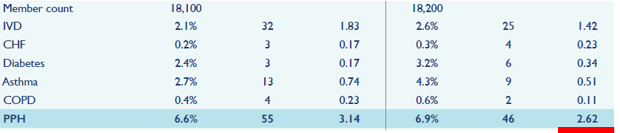
That same page (23) of that same report lists the episode costs of a PPH at $22,500.

The product of those two components? About $59,000 per 1000 people, or $59/person.
And alas you can forget about adding other healthcare cost savings from wellness to that $59. That’s wishful thinking. The Goetzel crowd not only admits they don’t decrease, but says they are likely to increase (p.22)
The Cost of Wellness
Against that $59, what is the cost of a wellness program? $150/employee, according to Ron Goetzel. (Your cost could be higher or lower, obviously. Wellness vendors collect about $7 billion by prying, poking and prodding about 70 million people, so typical vendor fees are about $100.)
Therefore even a wellness program that eliminates every potentially preventable hospitalization without increasing doctor visits or those other listed expenses would lose money–$91, if Mr. Goetzel’s advice is taken.
And this is according to the wellness industry’s own cost figures, which of course are highly suspect, largely because their costs count vendor fees only. Our figures would add in all the other costs of wellness. Though the HERO Report ignored these other costs in its own calculations, it nonetheless listed them on p 11. (This list overlooks the hefty consulting fees involved in making up positive outcomes figures to show to the C-Suite. This is no surprise given that Mercer was a co-sponsor of this report.)

Want proof that Quizzify is more fun & smarter than any wellness program? Take the quiz.
Also remember that this $91 loss is for a perfect wellness program –one that eliminates all $59 in spending with no added preventive services cost. Coming soon is the second half of the proof, showing that wellness programs are anything but perfect.
Share this:

Expose of Corporate Weight-Shaming Programs Among Year’s Top Articles

We published “Employers Should Disband Corporate Weight Control Programs,” in the peer-reviewed American Journal of Managed Care, in February. We recently learned that it is trending close to #1 for the year among articles in this and related journals. Its findings have never been challenged, with no critical comments or letters to the editor by wellness vendors or consultants.
If you struggle with weight, you are probably wondering why your employer appears to be discriminating against you by weight-shaming you. The answer is that while a company would certainly want to facilitate employees’ desires to become healthier on their own, there is no economic basis for fining employees or withholding incentives based on weight.
It’s not just that the threat of financial forfeiture (penalties or lost incentives) doesn’t help people lose weight. Here are highlights from the rest of the article:
(1) As ShapeUp has shown when confronted with the invalidity of its data (and being fired by Highmark as a result of it), vendors’ weight-loss figures are basically fabricated. Here is an article showing how that fabrication takes place, the “Last Man Standing” fallacy.
(2) Weight generally does not affect job performance. At the CEO level, this is generally known. That’s why when new factories are built, they tend to go up in states with lower wages and motivated (and non-union) workforces. Those states also have the highest obesity rates, but that doesn’t matter when major corporate decisions are made. CEOs, voting with their own dollars, have determined that these higher obesity rates have no noticeable effect on productivity.
(3) Weight also has only a trivial effect on healthcare expenses. Extra spending that was once attributed to weight turns out to be due to age, as people get naturally heavier over time and naturally tend to spend more on healthcare. Those two variables correlate but the actual causality is attributable to other factors. Among older people, some extra weight may be protective, as well.
So three things need to be true for these discriminatory programs (age discrimination and class discrimination) to justify their existence. The programs need to get people to lose weight, and weight has to matter somehow, in productivity and/or health spending. Instead, none of those things are true. So why engage in an activity that isn’t going to work, that embarrasses your employees?
We’d encourage you to read the article or at least the abstract, and pass it along to decision-makers. And send us your stories–how has corporate weight-shaming affected your job performance, or the performance of people you know?
PS And if Aetna comes a-knockin’ with the industry’s most expensive and most dangerous anti-obesity “wellness” jihad, don’t answer the door. Here’s what will happen if you do.
Good health is not about weight-shaming. It’s about education.
Share this:

Koop Award Committee-meets-Sergeant Schultz
Ever wonder why no one notices that wellness results are completely made up?
Wonder no longer. it all starts with The Health Project, which gives out the C. Everett Koop Award. This month is award season, meaning some of the award’s sponsors or committee members gets to ingratiate themselves with customers. In honor of this month, let’s review previous years’ awards, and see the self-invalidating, but somehow unnoticed, details that call to mind the immortal words of the great philosopher Sergeant Wolfgang Schultz: “I know nothing. I see nothing. I hear nothing.”
To that iconic phrase, the Koop Committee adds: “I notice nothing.”

2014: British Petroleum (BP America)
Last year, the award went to British Petroleum. BP’s candidacy wasn’t exactly a longshot, since both its vendor (Staywell) and its consultant (Mercer) are on the Committee AND are “sponsors” of this volunteer committee. By the way, if you’re looking for any disclosure on the award announcement of those connections when you click through on the first sentence above, you’ll need x-ray vision, since there is none. No one seems to have noticed this omission.
Besides not understanding ethics, apparently Mercer and Staywell don’t understand arithmetic: their “rigorous analysis” claimed almost $20,000/person in savings for active participants who reduced a risk factor. Besides being mathematically impossible, clinically laughable, unchecked for plausibility in violation of their own HERO guidelines, and not adjusted for dropouts and non-participants, this figure, as the screen shot below shows, is over 100 times more than Staywell itself says is possible. Once again, no one seems to have noticed this glaring contradiction.

2013–GRACO (honorable mention)
Ron Goetzel has written at length about Graco, as have we and others. By starting the measurement in 2009, the year after the program started (as opposed to starting the measurement two years before the program started — see the 2011 award winner, Eastman Chemical), and “forgetting” to count revenues added by an acquisition. Mr. Goetzel was able to tie the growth in Graco’s revenues to the “bottom line performance” of its wellness program. Of course, when you actually start measuring the year the program actually started (2008) — which coincidentally was also the year before the recession knocked 29% out of Graco’s revenues — and then adjust for the 2012 acquisition’s added revenues, Graco organically grew at about the same rate as everyone else. Wellness had nothing to do with it. Graco’s salespeople did not exceed their quotas because they ate more broccoli.

Here’s what else didn’t happen due to its wellness program: savings. As our post showed, Mr. Goetzel didn’t notice that the cost trend for children (none of whom were in the wellness program) outperformed the cost trend for wellness participants. This means, of course, that the favorable trend among participants couldn’t be attributed to wellness, since the trend for a cohort without access to wellness was even more favorable. It’s all right here.
Oh, yes, and it also turns out that Graco’s insistence on making its employees go to the doctor was more likely to harm them than benefit them. That’s not us–that’s the New England Journal of Medicine.
2012: The State of Nebraska
We’ve already chronicled this one at length. There were quite a number of glaringly obvious rookie mistakes that escaped the notice of the award committee, either due to incompetence or perhaps the fact that the state’s vendor, Health Fitness Corporation (HFC), was also a sponsor of the award. See if you can find that sponsorship disclosure in their press release “congratulating” the State and LL Bean (the other winner, also a customer of HFC). You’ll need an electron microscope to go with your x-ray vision.
HFC actually admitted lying about saving the lives of cancer victims who as it turned out didn’t have cancer, but still got the award because, according to Ron Goetzel at the 2014 Datapalooza conference, apparently this particular lie didn’t count because it wasn’t on their application, just everywhere else. It was impossible to miss, but Ron said he didn’t notice. Is this a great country or what?
2011: Eastman Chemical
Another HFC customer. (HFC is really getting its money’s worth out of its sponsorship.) This was the one where — unlike 2013’s Graco, which started measuring outcomes the year after the program started in order to maximize the results — HFC started measuring outcomes two years before the program started in order to maximize the results. They separated participants and non-participants in 2004 but didn’t start the program until 2006. By 2005 the would-be “participants” were already 9% ahead…and by the time the program got underway in 2006, they were almost 20% lower-cost than the non-participants.

Once again, all this information was perfectly obvious at the time of the award submission, as well as highlighted in all of my books. It was also re-printed and re-presented multiple times, but somehow no one on the Koop Committee noticed until late 2014, when it was in Health Affairs. At that point, the light being shined on him being too glaring to hide from, Mr. Goetzel had to respond. Employing the passive voice to great advantage, Ron said the slide was “unfortunately mislabeled.”

Read that carefully. If it’s hard to read, here is the source. It’s towards the bottom. He says this slide and other data “convinced” the Koop Committee to give them an award. That’s his story and he’s sticking to it.
Recently, for the second time, he went back into the Koop Award submissions and rewrote history. Compare the original Koop submission screen shot with the photoshopped version. Note the missing X-axis:
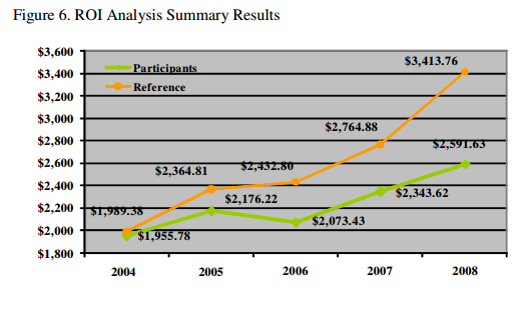
The original was:

His explanation didn’t indicate who mislabeled this slide, why he didn’t notice until now, why he snuck into the old files to relabel it, what the labels should have read — or why HFC never apologized, as others outside the wellness industry do when mistakes are made.
I can explain the last — just look at the wellness industry motto, on YouTube: “A Koop Award means never having to say you’re sorry.”
2010: Pfizer
None of Pfizer’s outcomes figures stand up to even the slightest scrutiny, and Mercer did the analysis — making Pfizer a shoo-in for this award. By their own admission only 4% of people moved out of high-risk status. (Naturally this tally excludes non-participants and dropouts, who likely increased risk factors at a faster rate than participants reduced them.) In other words out of 30,000 employees, 1200 reduced a risk factor. And yet somehow Pfizer saved $9.4 million, almost $9000 per risk factor. So if everyone at Pfizer reduced a risk factor, they’d easily wipe out all their healthcare spending.
They did some secure messaging, but only about a quarter of the at-risk population even opened their messages…and only about a quarter of them clicked through to the messaging.
Smokers self-reported at 6% before the program and 3% after it. No one hazarded a guess that perhaps some employees were, oh, I dunno, lying?
However, no one can accuse Pfizer of lying about their weight loss results. In particular check out this comparison, which was offered with a straight face, of employees who read their weight-loss messages vs. employees who didn’t.
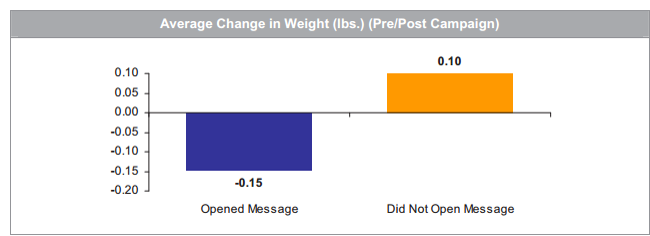
Over the course of the study, people who didn’t read their messages gained 1.6 ounces while employees who did lost 2.9 ounces. You could practically attribute that differential performance to the calories required to open the emails.

 They Said What?