
Home » Posts tagged 'Angioscreen'
Tag Archives: Angioscreen
To screen or not to screen: the most coherent answer ever
I am a mere supplicant at the feet of the true experts in the field of screening.
Linked here is the single most coherent article on the subject I’ve ever seen, just came out today. Basically, it says: “Screen according to guidelines.” That simple sentence is the source of a great battle pitting Quizzify and the Welligentsia against the Wellness Ignorati and most of the screening industry (excluding It Starts with Me, Limeade, and US Preventive Medicine, all of which offer screening programs more or less aligned with guidelines), whose livelihood depends on employers not screening employees according to guidelines, and finding some of the wackiest tests in the world to foist onto unsuspecting employees.

Highlights of the article:
- Many people are overscreened and massive numbers of people get tests they don’t need
- Many people are underscreened
- Do not purchase B-to-C screenings like Star Wellness, the subject of a recent profile here, offers.
Specifically as to the third point, they called out AngioScreen as an example of companies trying to circumvent doctors by offering inappropriate screenings. AngioScreen is unique in that right on their website they acknowledge that their entire business model is built on an a screen the US Preventive Services Task Force calls inappropriate.
They also list an outfit called Matrix Medical Network as an example of a company offering inappropriate screens. Matrix Medical Network…hmmm…where have I heard that name before…oh, that’s right! I founded Matrix Medical Network. (Actually, co-founded and was an original board member and investor. And, yes, unlike wellness vendors, irony is not lost on me. See “Ironically, the wellness industry does not understand irony.“)
One way or the other, this article is worth a read because it truly draws a thoughtful line between appropriate and inappropriate screenings.
Share this:

Is there ever a good reason to flout US Preventive Services Task Force guidelines?
This is the second part in the series on wellness vendors and the US Preventive Services Task Force (USPSTF).
Q: Why do vendors ignore or flout the USPSTF?
There are five reasons, three of which are unfortunate:
- Many vendors don’t understand the entire concept of screening, neither the science nor the arithmetic described in Part 1. Healthcare is hard, and the USPSTF can’t be expected to dumb themselves down so that wellness vendors, for whom simple math is a challenge and who don’t have to meet any educational or licensing requirements other than eight days of training, can understand it.
- Obviously, the more vendors screen, the more money they make. Guidelines propose infrequent screening for fewer blood values than most vendors do. That means vendors who abide by guidelines can collect much less money from employers than those who charge what the market will bear. Examples of companies screening the stuffing out of employees include Total Wellness, Interactive Health, Star Wellness, Healthfair, and Healthfairs USA. Needless to say they make a lot of money. (Quizzify is very jealous! Doing the right thing and guaranteeing savings isn’t remotely as profitable as ripping off employers.)
- Many wellness vendors are dishonest. We’ve already pointed out that Wellsteps bragged about how they screen every Boise employee every year for everything, with no mention of USPSTF guidelines. But after they got caught, they admitted they knew that the guidelines say the opposite. And Optum’s Seth Serxner insisted — out loud, on tape, that they would be happy to screen according to guidelines, if only employers would let them. And yet, here is Optum’s ad, saying exactly the opposite: if you want us not to raise your rates as much on insurance, it’s a “requirement” to pay us even more than you would save on insurance, to do annual screens. (Naturally they are quoting two sources that they know to be false as well.)

Q; Those are three bad reasons. What are the two good reasons?
I would like to credit Pete Arens for bigly influencing my answer on this. It’s rare that someone does that, and even rarer that I admit it. However, in this case, huge credit where credit is due. Pete’s the man.
USPSTF publishes guidelines, not requirements. It is perfectly OK not to follow them — as long as you have a good reason. The reasons above — ignorance, dishonesty and greed — would clearly not qualify. However, here are some excellent examples of reasons that would:
- You work in a high-stress environment, like a law firm. Making blood pressure screening available easily and much more frequently than once a year, even having some discreetly placed cuffs, might be a good idea. (Some maintain that stress doesn’t cause high blood pressure. Perhaps not, but to them I say, watch Episode 5 of The People vs. OJ Simpson.)
- Your workforce is largely outdoors. Skin cancer and Lyme Disease screens might be indicated.
- You have alternatives to screening (like Quizzify) for younger employees, but encourage and educate older employees and other employees at high risk to get screened. The USPSTF doesn’t say, “no screens.” It says screens should be age- and risk-appropriate. You offer both to everyone (that’s the law) but steer some employees one way and some the other.
- Your company is in the chemical dye or railroad industries. A bladder cancer screen or at least educational session to raise awareness might be advisable. (Bladder cancer can be identified and easily treated very early.)
Mr. Arens raised the question specifically of obesity screens. Are they appropriate at all, especially in a workplace? And that brings us to the other good reason to flout the guidelines: you think they’re wrong. In that situation, make your case. But it has to be a real case, and obesity screening could very well be such a case:
- The Employee Health and Wellness Code of Conduct specifically says, don’t embarrass or single out employees. This would be a perfect example doing exactly that;
- You are unable to find any meaningful literature or technique that is even remotely shown to successfully address obesity for more than a short, clinically meaningless period of time, so why screen for something you can’t address?
- To the extent you, in a corporate setting, do want to make your workplace healthier, you don’t need screens to do that. Encouraging exercise and avoidance of sugary foods at work would have the same impact.
Read carefully: we aren’t saying specifically you have to pass on obesity screens for those reasons. We are saying that if you differ with USPSTF on any screen, disclose the reasons and/or cite the literature, so it looks like a thoughtful decision. This is an example in which we would differ with guidelines.
Q: What would be a funny example of a vendor who tries to attack the USPSTF but falls on its sword?
Glad you asked. That would be Healthmine, whose credibility, um, collapsed as a result. Rule of thumb: to attack USPSTF credibly, a good start would be spelling their name right. We’re just sayin’…
Q: What would be a funny example of a vendor who flouts the USPSTF recommendations?
You’re asking all the right questions. That would be Angioscreen. The only screen they offer, for carotid artery disease, is D-rated by USPSTF.

Q: I don’t see what’s so funny about that. Stupid, yes. Harmful, yes. Expensive, yes. But what makes them so funny?
They admit right on their website that employees shouldn’t get these screens.

Honestly, I’m not sure which of those two things is dumber — offering the screen or admitting working-age people shouldn’t get it. But at least no one can accuse them of lying.
Q: They also can’t spell “New England Journal of Medicine.”
Good point. I didn’t even notice that until you brought it up. Maybe their head of their advisory board can help them with spelling, since “quality control is extremely important” to them.

Q: What does the USPSTF think of the wellness industry?
Their guidelines are intended for use by real doctors and medical practitioners. My guess is that they are horrified by the idea of an entire industry, unsupervised and uneducated, “playing doctor” with employees. Meanwhile, the National Business Group on Health, a vendor-fest if ever there was one, lobbies against the USPSTF for not understanding the importance of screening the stuffing out of employees.
Q: Why do employers go along with overscreening?
That’s a great question. They need only look at their own hospitalization rates to see that hospitalizations from diseases they are trying to prevent by screening, like diabetes and heart attacks, are already ridiculously low. However, rather than look at their own data, they prefer to spout the “86% of illness is caused by chronic disease” meme, which was already discredited when it was 75%, before the CDC decided to jump it up to 86%.
Anybody who reads that article can see that either is an impossibly stupid statistic. Most hospitalizations at most employers have something to do with birth events, and most expense at most employers can be traced to one-time items not addressable through eating more broccoli (neonates, transplants, cancer) or employees who either have a rare disease or more likely have a dependent with a rare disease.
Q: Maybe This isn’t fair, and vendors screen more than guidelines because they don’t think cost should be an issue and that employees should get all the prevention they can possibly use regardless of price
Actually, the USPSTF specifically does not include cost in its analysis. It balances harms and benefits, not costs and benefits. Screening according to guidelines will therefore lose money, as Ron Goetzel just admitted, even if over the long run more employees may benefit from screens than are harmed.
Quite the opposite. Tons of vendors obsess with hyperprevention because they are totally ignorant of the science and math involved. Our favorite is one called: “HEALTHIER is WEALTHIER and ASSOCIATES.” Along with the usually assortment of wellness industry THC-infused folderol (“our program, if followed diligently for a year, will decrease your employee health cost by as much as $24 for every pound of weight loss, an amount quoted by Dr Michael Roisen [sic] MD, Chief Wellness Officer and Chairman, Cleveland Clinic Wellness Institute”), they want to screen employees every three months. Don’t believe us?

Stay tuned for Part 3: Vendors who understand the USPSTF
Share this:

First, Do Harm: The Ten Most Dangerous Wellness Vendors
If corporate wellness didn’t already exist, no one would invent it. In that sense, it’s a little like communism, baseball, pennies, or Outlook.
After all, why would any company want to purchase programs that damage morale, reduce productivity, drive costs up…and don’t work 90%-95% of the time? And that’s according to the proponents. What the critics say can’t be repeated in a family publication such as ours.
Still, those are the employers’ problems. However, the employers’ problems become the employees’ problems when employees are “voluntarily” forced to submit to programs that are likely to harm them. (As the New York Times recently pointed out, there is nothing voluntary about most of these programs.)
Recently, the head of United Healthcare’s (UHC) wellness operations (Optum), Seth Serxner, admitted that Optum’s programs consciously ignore US Preventive Services Task Force (USPSTF) screening guidelines. Lest anyone was expecting a wellness vendor to actually apologize for bad behavior, Mr. Serxner went on to blame employers for insisting on overscreening and overdiagnosing their own employees…and (by implication) overpaying for the privilege of doing so. “Our clients make us do it,” were his exact words.
Funny thing, we first asked our own clients who use Optum about why they turned down Optum’s generous offer to do more appropriate screenings at a lower price. None of them remember receiving this offer. Go figure. Then a UHC executive wrote and said we were making them look bad. I softened some of the language (like the paragraph below), and said I would happily retract the whole thing if indeed they could introduce me to just one customer — one out of their thousands — who recalls insisting on overscreening and overpaying. Never heard back…
United Healthcare isn’t alone in harming employees. They are just the first company to admit it, and far from the worst offender, as the harms of overscreening for the usual suspects (glucose, cholesterol etc.) don’t hold a candle to some of the more creative ideas listed below. Here, in order, are the ten vendors most likely to harm employees in the name of wellness.
#10 Healthmine
Healthmine’s CEO, Bryce Williams, isn’t blaming the victim like United did. He has publicly announced that Healthmine flouts clinical guidelines. He says he is right and everyone else — specifically including the “US Preventative [sic] Services Task Force” — is wrong. A real doctor acting on this pronouncement might be risking his or her license. Fortunately for Mr. Williams, being a wellness vendor doesn’t require a license, so regardless of the harms a wellness vendor inflicts on employees, no one can confiscate it because there is nothing to confiscate..
In addition to not misspelling the name of the group he is attacking, we might also recommend that he not misquote the sources on which his faulty argument is based. We’re just sayin’…
For starters Mr. Williams declares: “One out of every two people in America has at least one chronic condition according to the CDC…”
Here’s what the CDC really said: “One out of every two adults has at least one chronic condition.” And if you dig deeper, you’ll see that this list of chronic conditions cited by the CDC includes arthritis, mental illness, eye disorders and asthma, none of which Healthmine’s hyperscreening is going to reveal.
He also claims that “chronic diseases account for $3 out of every $4 spent on healthcare.” Here’s what the CDC really said: $3 out of every $4 “is spent on people with chronic conditions.” That is a much broader statement. It would include someone with borderline hypertension giving birth. In any event, we long ago eviscerated Mr. Williams’ cherished myth and just this week showed that essentially none of the top 25 hospital admissions has anything to do with screening, broccoli, or Fitbits.
#9 Cerner
The employee who recorded this blood pressure is essentially dead. Cerner’s diagnosis? Blood pressure “higher than what is ideal.” Cerner’s recommendation? “Talk to your healthcare provider.” A real doctor’s recommendation? “Call an ambulance. The guy barely has a pulse.”
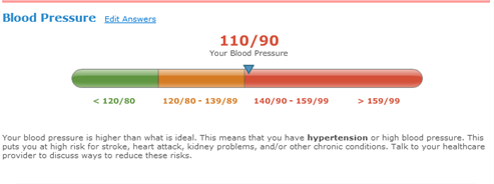
This is not a random mistake. This is the front cover of their brochure.
#8 Nebraska/Health Fitness Corporation
USPSTF Screening age recommendations aren’t minimums. They are optimums, the ages at which screening benefits might start to exceed harms, even if they still fall far short of costs. Otherwise you are taking way too much risk. This is especially true for colonoscopies, one of this program’s favorite screens — complications from the test itself can be very serious.
Your preventive coverage is not supposed to be “greater than health care reform guidelines.” That’s like “rounding up twice the number of usual suspects.” And you aren’t supposed to waive “age restrictions.” That’s like a state waiving minimum “age restrictions” to get a driver’s license.

Yet despite or perhaps because of this and other examples of total cluelessness and pure dishonesty, this program won a C. Everett Koop Award for excellence in wellness, not to mention the unwavering support and admiration of leading wellness apologist Ron Goetzel.
#7-#6 (tie) ShapeUp and Wellness Corporate Solutions
Both these outfits pitch exactly the opposite of what you are supposed to do in weight control: unhealthy crash dieting. Attaching money to this idea and setting a start date makes it even worse: along with crash-dieting during these eight weeks, you’re incentivizing employees to binge before the initial weigh-in.
Here is ShapeUp:

Here is Wellness Corporate Solutions:
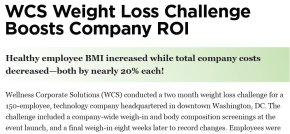
Both also made up outcomes. In ShapeUp’s case they had to rescind their “findings” after their customer, Highmark, skewered them in the press. And neither seems to care that corporate weight control programs are proven not to work.
In addition to its dystopian wellness program that collects employee DNA (partnered, ironically, with a company called Newtopia) and then makes up savings, Aetna owns the distinction of launching the only wellness program whose core drugs are specifically editorialized against in the Journal of the American Medical Association. This would literally be the most harmful wellness program ever, except that the only employees being harmed are (1) obese employees who (2) answer the phone when their employer’s health plan calls them to pitch these two drugs; (3) have a doctor who would willingly prescribe drugs that almost no other doctors will prescribe due to their side effect profile; and (4) not google them. Presumably in combination this is a very low percentage of all employees.
The good news is that these drugs, Belviq and Qsymia, should be off the market in a couple of years because almost no one wants to take them, so the harms of this Aetna program should be self-limited.
Star Wellness offers a full range of USPSTF D-rated screens. “D” is the lowest USPSTF rating, and means harms exceed benefits. Star gets extra credit for being the first wellness vendor to sell franchises. All you need is a background in sales or “municipal administration” plus $67,000 and 5 days of training and you too can poke employees with needles and lie about your outcomes. Is this a great country or what?
Also, their vaccination clinic features Vitamin B12 shots. We don’t know which is more appalling–routinely giving employees Vitamin B12 shots, or thinking Vitamin B12 is a vaccine.

Angioscreen doesn’t have the most USPSTF D-rated screens. In fact, it offers only one screen in total, for carotid artery stenosis. That screen gets a D grade from USPSTF, giving Angioscreen the unique distinction of being the only vendor 100% guaranteed to harm your workforce.
Angioscreen’s other distinction is that they admit right on their website that this screen is a bad idea. This is probably literally the only non-tobacco company in America to admit you are better off not using their product.
Total Wellness loses the wellness industry’s race to the bottom only because the winner, HealthFair, has out-stupided them. However, in addition to the usual assortment of D-rated tests, they offer screens that the USPSTF hasn’t even rated, because it never, ever occurred to them that anyone would ever use these tests for mass screening of patients or employees. Criticizing the USPSTF for not rating these “screens” (CBCs and Chem-20s) would be like criticizing Sanofi-Aventis for not warning against taking Ambien after parking your car on a railroad crossing.
#1 HealthFair
Let’s leave aside for a fact that the majority of their other screens are harmful too, and focus on their screening for H.pylori, the strain of bacteria associated with ulcers. To say it is a stupid idea would be an understatement. As Clarice Starling replied when asked if Hannibal Lecter was a sociopath: “They don’t have a word for what he is.”
Likewise, this idea is too stupid for words, certainly for the small number of words we can allot to this overview blog. Visit our full treatment here. In a nutshell, the majority of us harbor H.pylori–without symptoms. It may even be beneficial. The screening test is expensive and notoriously unreliable, and the only way to get rid of it is with some very powerful antibiotics, a treatment rarely even used on patients with symptoms due to its inconvenience, ineffectiveness and potential long-term side-effects.
A Modest Proposal
So how should we as a country protect employees from these harms? Our policy recommendation is always the same, and very non-intrusive. We aren’t saying wellness vendors shouldn’t be allowed to harm employees. That would be too radical to ever pass Congress. If it did, the Business Roundtable would pressure the White House again, to preserve their hard-earned right to medicalize the workplace, and literally and figuratively, show employees who’s boss.
Instead, we recommend merely a disclosure requirement. The harms of screens or (in United Healthcare’s case) screening intervals that don’t earn at least a “B” from USPSTF should be disclosed to employees, and employees should get a chance to “opt out” into something that isn’t harmful (like Quizzify, perhaps?) without suffering financial consequences. Call us cockeyed optimists, but we don’t think employers should be able to force employees to choose between harming themselves and paying fines.

 They Said What?