
Home » Posts tagged 'Healthfair'
Tag Archives: Healthfair
First, Do Harm: The Ten Most Dangerous Wellness Vendors
If corporate wellness didn’t already exist, no one would invent it. In that sense, it’s a little like communism, baseball, pennies, or Outlook.
After all, why would any company want to purchase programs that damage morale, reduce productivity, drive costs up…and don’t work 90%-95% of the time? And that’s according to the proponents. What the critics say can’t be repeated in a family publication such as ours.
Still, those are the employers’ problems. However, the employers’ problems become the employees’ problems when employees are “voluntarily” forced to submit to programs that are likely to harm them. (As the New York Times recently pointed out, there is nothing voluntary about most of these programs.)
Recently, the head of United Healthcare’s (UHC) wellness operations (Optum), Seth Serxner, admitted that Optum’s programs consciously ignore US Preventive Services Task Force (USPSTF) screening guidelines. Lest anyone was expecting a wellness vendor to actually apologize for bad behavior, Mr. Serxner went on to blame employers for insisting on overscreening and overdiagnosing their own employees…and (by implication) overpaying for the privilege of doing so. “Our clients make us do it,” were his exact words.
Funny thing, we first asked our own clients who use Optum about why they turned down Optum’s generous offer to do more appropriate screenings at a lower price. None of them remember receiving this offer. Go figure. Then a UHC executive wrote and said we were making them look bad. I softened some of the language (like the paragraph below), and said I would happily retract the whole thing if indeed they could introduce me to just one customer — one out of their thousands — who recalls insisting on overscreening and overpaying. Never heard back…
United Healthcare isn’t alone in harming employees. They are just the first company to admit it, and far from the worst offender, as the harms of overscreening for the usual suspects (glucose, cholesterol etc.) don’t hold a candle to some of the more creative ideas listed below. Here, in order, are the ten vendors most likely to harm employees in the name of wellness.
#10 Healthmine
Healthmine’s CEO, Bryce Williams, isn’t blaming the victim like United did. He has publicly announced that Healthmine flouts clinical guidelines. He says he is right and everyone else — specifically including the “US Preventative [sic] Services Task Force” — is wrong. A real doctor acting on this pronouncement might be risking his or her license. Fortunately for Mr. Williams, being a wellness vendor doesn’t require a license, so regardless of the harms a wellness vendor inflicts on employees, no one can confiscate it because there is nothing to confiscate..
In addition to not misspelling the name of the group he is attacking, we might also recommend that he not misquote the sources on which his faulty argument is based. We’re just sayin’…
For starters Mr. Williams declares: “One out of every two people in America has at least one chronic condition according to the CDC…”
Here’s what the CDC really said: “One out of every two adults has at least one chronic condition.” And if you dig deeper, you’ll see that this list of chronic conditions cited by the CDC includes arthritis, mental illness, eye disorders and asthma, none of which Healthmine’s hyperscreening is going to reveal.
He also claims that “chronic diseases account for $3 out of every $4 spent on healthcare.” Here’s what the CDC really said: $3 out of every $4 “is spent on people with chronic conditions.” That is a much broader statement. It would include someone with borderline hypertension giving birth. In any event, we long ago eviscerated Mr. Williams’ cherished myth and just this week showed that essentially none of the top 25 hospital admissions has anything to do with screening, broccoli, or Fitbits.
#9 Cerner
The employee who recorded this blood pressure is essentially dead. Cerner’s diagnosis? Blood pressure “higher than what is ideal.” Cerner’s recommendation? “Talk to your healthcare provider.” A real doctor’s recommendation? “Call an ambulance. The guy barely has a pulse.”
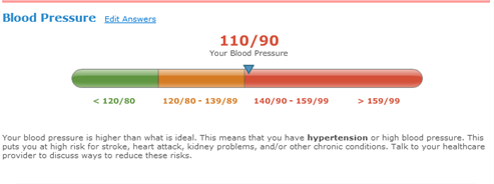
This is not a random mistake. This is the front cover of their brochure.
#8 Nebraska/Health Fitness Corporation
USPSTF Screening age recommendations aren’t minimums. They are optimums, the ages at which screening benefits might start to exceed harms, even if they still fall far short of costs. Otherwise you are taking way too much risk. This is especially true for colonoscopies, one of this program’s favorite screens — complications from the test itself can be very serious.
Your preventive coverage is not supposed to be “greater than health care reform guidelines.” That’s like “rounding up twice the number of usual suspects.” And you aren’t supposed to waive “age restrictions.” That’s like a state waiving minimum “age restrictions” to get a driver’s license.

Yet despite or perhaps because of this and other examples of total cluelessness and pure dishonesty, this program won a C. Everett Koop Award for excellence in wellness, not to mention the unwavering support and admiration of leading wellness apologist Ron Goetzel.
#7-#6 (tie) ShapeUp and Wellness Corporate Solutions
Both these outfits pitch exactly the opposite of what you are supposed to do in weight control: unhealthy crash dieting. Attaching money to this idea and setting a start date makes it even worse: along with crash-dieting during these eight weeks, you’re incentivizing employees to binge before the initial weigh-in.
Here is ShapeUp:

Here is Wellness Corporate Solutions:
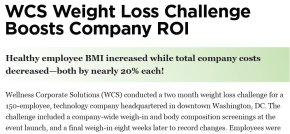
Both also made up outcomes. In ShapeUp’s case they had to rescind their “findings” after their customer, Highmark, skewered them in the press. And neither seems to care that corporate weight control programs are proven not to work.
In addition to its dystopian wellness program that collects employee DNA (partnered, ironically, with a company called Newtopia) and then makes up savings, Aetna owns the distinction of launching the only wellness program whose core drugs are specifically editorialized against in the Journal of the American Medical Association. This would literally be the most harmful wellness program ever, except that the only employees being harmed are (1) obese employees who (2) answer the phone when their employer’s health plan calls them to pitch these two drugs; (3) have a doctor who would willingly prescribe drugs that almost no other doctors will prescribe due to their side effect profile; and (4) not google them. Presumably in combination this is a very low percentage of all employees.
The good news is that these drugs, Belviq and Qsymia, should be off the market in a couple of years because almost no one wants to take them, so the harms of this Aetna program should be self-limited.
Star Wellness offers a full range of USPSTF D-rated screens. “D” is the lowest USPSTF rating, and means harms exceed benefits. Star gets extra credit for being the first wellness vendor to sell franchises. All you need is a background in sales or “municipal administration” plus $67,000 and 5 days of training and you too can poke employees with needles and lie about your outcomes. Is this a great country or what?
Also, their vaccination clinic features Vitamin B12 shots. We don’t know which is more appalling–routinely giving employees Vitamin B12 shots, or thinking Vitamin B12 is a vaccine.

Angioscreen doesn’t have the most USPSTF D-rated screens. In fact, it offers only one screen in total, for carotid artery stenosis. That screen gets a D grade from USPSTF, giving Angioscreen the unique distinction of being the only vendor 100% guaranteed to harm your workforce.

Angioscreen’s other distinction is that they admit right on their website that this screen is a bad idea. This is probably literally the only non-tobacco company in America to admit you are better off not using their product.
Total Wellness loses the wellness industry’s race to the bottom only because the winner, HealthFair, has out-stupided them. However, in addition to the usual assortment of D-rated tests, they offer screens that the USPSTF hasn’t even rated, because it never, ever occurred to them that anyone would ever use these tests for mass screening of patients or employees. Criticizing the USPSTF for not rating these “screens” (CBCs and Chem-20s) would be like criticizing Sanofi-Aventis for not warning against taking Ambien after parking your car on a railroad crossing.
#1 HealthFair
Let’s leave aside for a fact that the majority of their other screens are harmful too, and focus on their screening for H.pylori, the strain of bacteria associated with ulcers. To say it is a stupid idea would be an understatement. As Clarice Starling replied when asked if Hannibal Lecter was a sociopath: “They don’t have a word for what he is.”
Likewise, this idea is too stupid for words, certainly for the small number of words we can allot to this overview blog. Visit our full treatment here. In a nutshell, the majority of us harbor H.pylori–without symptoms. It may even be beneficial. The screening test is expensive and notoriously unreliable, and the only way to get rid of it is with some very powerful antibiotics, a treatment rarely even used on patients with symptoms due to its inconvenience, ineffectiveness and potential long-term side-effects.
A Modest Proposal
So how should we as a country protect employees from these harms? Our policy recommendation is always the same, and very non-intrusive. We aren’t saying wellness vendors shouldn’t be allowed to harm employees. That would be too radical to ever pass Congress. If it did, the Business Roundtable would pressure the White House again, to preserve their hard-earned right to medicalize the workplace, and literally and figuratively, show employees who’s boss.
Instead, we recommend merely a disclosure requirement. The harms of screens or (in United Healthcare’s case) screening intervals that don’t earn at least a “B” from USPSTF should be disclosed to employees, and employees should get a chance to “opt out” into something that isn’t harmful (like Quizzify, perhaps?) without suffering financial consequences. Call us cockeyed optimists, but we don’t think employers should be able to force employees to choose between harming themselves and paying fines.
Share this:

HealthFair Wins Wellness Industry’s Race to the Bottom
Ever wonder why students don’t just grade themselves? For your answer, look no further than HealthFair.com’s self-assessed grade:

And yet by any standard other than their own, HealthFair completely flunks the test. Literally, their “basic package” proposes more “D”-rated tests (and “D” is a failing grade by US Preventive Services Task Force standards) than any vendor we’ve ever seen. They would lose their wellness vendor license tomorrow, except for the fact that wellness vendors don’t need licenses.

The first four all get “D”s. Here are the screenshots if you don’t believe that any vendor could possibly offer so many inappropriate tests at all, let alone in the “basic” package.
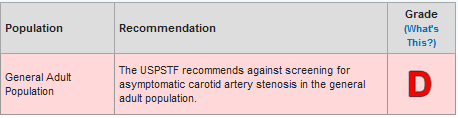
The abdominal aortic ultrasound test is such a stupid (where “stupid” is synonymous with “profitable”) idea for the non-elderly population that the USPSTF doesn’t even bother to say no:

Along with their “D” as a general screening tool, The EKG gets a whopping “I” for individuals at risk, but since HealthFair’s basic package includes no basic tests to see who is at risk, and by law they can’t ask about history, they would still have to screen everyone whether or not they are at risk:

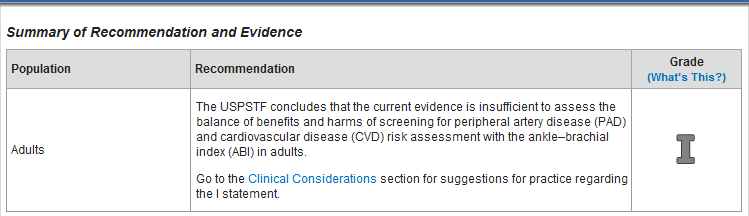
By earning another “I”, the peripheral artery disease test does well by HealthFair’s standards. The USPSTF concludes that researchers don’t know enough about it to recommend it, which doesn’t stop HealthFair.
As for “hardening of the arteries,” the USPSTF doesn’t bother to grade it due to the fact that no one uses this test as a screen…except wellness vendors. But even the American Heart Association, not exactly shy when it comes to screening people for cardiac disease whose treatment can enrich their members who treat it, disses this test:

Speaking of D-Rated tests, sorry, guys. If you want a D-rated PSA screen — a screen not even recommended by its own inventor — you have to insist that your employer buy HealthFair’s “advanced” package:


Give your employees wellness that always earns an “A”
That brings us to the H Pylori screen, Healthfair’s groundbreaking, earth-shattering, pushing-the-envelope leap forward in the wellness vendor competition to out-stupid one another.
Where to start…
First, the US Preventive Services Task Force doesn’t bother to offer a recommendation on it, largely because no self-respecting doctor would ever screen patients for this. Shame on the USPSTF for consistently failing to anticipate all the ways in which wellness vendors can misunderstand basic clinical science!
Second, most of us who harbor H Pylori have no symptoms. So why screen for something that’s not causing problems? That’s why this is a test, not a screen. If you have an ulcer or symptoms that suggest an ulcer, go to the doctor. Even then, the doctor probably won’t even bother to test you, since most people get relief simply from well-tolerated, commonly used, proton pump-inhibitor medications–some of which don’t even require a prescription. It is only if the first-line medications fail that most doctors will even test you.
Third, there is a significant school of thought that says H. Pylori is beneficial. Screening us for something we’re better off having in our bodies represents a new frontier in the wellness industry’s answer to overdiagnosis, which we call hyperdiagnosis.
Fourth ironically, given the wellness industry’s obsession with employees’ weights, it is even slightly possible that killing off H. Pylori contributes to weight gain.
Fifth, what exactly are we supposed to do, if it turns out we harbor H. Pylori? Get a course of antibiotics to clear the bacteria out of our system? That’s a great idea. We’ve always maintained that one of the problems with America’s healthcare system is that patients don’t get to take enough antibiotics.
The good news for the pharmaceutical industry is due to the nature of H Pyroli, hiding in our stomach mucus, it takes a lot of antibiotics to ferret it out, plus a bunch of other pills. Is this a great country or what?
Sixth, the H Pylori tests themselves are among the most complex, unhelpful and inaccurate commonly used tests in existence.
Finally, half the world’s population has it. Given the expense and inaccuracy of the test and the prevalence of the bacterium, why not eliminate the middle step and just put all your employees on antibiotics?
One of us is a screaming libertarian. And even he thinks the cowboys that populate the wellness industry need to be reigned in with some regulation, before they screen the American workforce to death. The regulation would be very straightforward: employers and vendors must disclose the USPSTF recommendations to employees before making them take these tests. If after this disclosure, a few employees still insist on getting these D-rated or off-the-charts-inappropriate screens, congratulations! Your screening program will have just done something useful: identified employees who are totally incapable of making an intelligent decision.
To those of you who are reading this and thinking: “Haven’t I heard this song before?”, the answer is, you have. HealthFair is the “Intel Inside” for the screening jihad offered by SSM Healthcare, the Sisters of Saint Mary health system we “profiled” a few weeks ago, thus once again proving that wellness mantra: great minds aren’t the only ones that think alike.

 They Said What?