
Home » Posts tagged 'Wellsteps' (Page 6)
Tag Archives: Wellsteps
Eureka! Someone who thoughtfully disagrees with me…and has good points!
Usually a tease like that leads to exactly the opposite content, as in Wellness Corporation Solutions Gives Us A Dose of Much-Needed Criticism, which of course turned into the poster child for our observation that “in wellness you don’t have to challenge the data to invalidate it. You merely have to read the data. It will invalidate itself.”
This is not that situation.
Michael Prager points out on his blog that I overstated the wellness-programs-as-fat-shaming case. Note he doesn’t say I’m wrong, but he does say I overplayed my hand, which I did. Many wellness programs fit my thesis…but some don’t. If a company’s program is all about offers rather than threats, about creating an environment conducive to health improvement instead lecturing people on their weight, about doing wellness for employees instead of to them, and about leaving people alone who don’t want to or can’t lose the weight, then I’m all for it. I should have been clearer about that.
If anyone would like to nominate an employer who has such a program, I would be happy to write it up.
And as you can see, we are also open to criticism of our positions, as long as the person writing the critique has a good point. Naturally, this industry is overflowing with vendors and consultants who probably have never had a good point in their lives…and naturally Wellsteps is leading the way. When we observed that Wellsteps’ most recent outcomes report showed costs going up and down at the same time, here is their (Troy Adams) rebuttal: We are full of “hot air.”

Share this:

Albert Einstein Meets the C. Everett Koop Wellness Award

Quizzify’s unified theory of healthcare: smarter employees use less
One of Albert Einstein’s great regrets was never having developed a “unified theory,” a consistent set of calculations that could explain the universe. That’s the bad news. The good news is that he did give us the word “Einstein” as in: “Ron Goetzel’s Koop Committee members are the biggest bunch of Einsteins in all of wellness, no easy feat considering the competition from WELCOA, HERO and others.”
Past postings have easily invalidated all the Koop awards since 2010. This did not require breaking a sweat. Rather, as Surviving Workplace Wellness observes: “In wellness, you don’t have to challenge the data to invalidate it. You merely have to read the data. It will invalidate itself.”
Previously, we’ve had to content ourselves with pointing out the plethora of individual rookie mistakes in each award. Now, however, we have a Unified Theory of Koop Award Ludicrous Impossibility. It reveals a remarkably consistent set of ludicrously mathematically impossible outcomes across all this decade’s award-winners. Not just any old ludicrously mathematically impossible outcomes but — and this is what excites my Inner Nerd — the same ludicrous mathematical impossibility pervades every award-winning outcome.
In each case the award winner has documented a small risk reduction among active participants. (They have also shown that willingness to participate, rather than the actual program, is what generates the savings, of course, but choose to ignore their own findings.) And in each case that small risk reduction generates what we thought were fairly random claims of savings. But it turns out that in 5 of the last 6 awards, the claims savings weren’t random at all but rather were essentially the same, using the same simple formula comparing risk reduction to claims savings. (The missing year is 2013. We can’t do Dell because we don’t want to embarrass them due to our relationships.)
The Unified Theory of Koop Award Ludicrous Impossibility Revealed
In the real world, trivial reductions in risk among participants — excluding non-participants because they increase in risk — have no impact on spending discernible in the white noise of random claims variation. And if we could discern an impact, it would be even more trivial than the risk reduction, because risk-sensitive medical events are a small percentage of total events. For instance, if risk-sensitive medical events comprise the typical 5% of total spending, and risk declines by 1%, the reduction in total spending would be 1% of 5%, or 0.05%. And that’s before subtracting fees.
However, on Ron Goetzel’s planet — also inhabited by fellow Einsteins like Optum’s Seth Serxner, Wellsteps’ Steve Aldana, and Staywell’s David Anderson, and obviously Mercer and Milliman — the opposite is true: a trivial reduction in risk generates massive cost savings. For example, McKesson saved $13 million via a 1% overall risk reduction. At that rate of savings and their rate of spending, their entire health spend could be wiped out if risk factors fell 14%. Not just their spending on wellness(risk)-sensitive medical events, but their total spending spending on healthcare. Wiped out. Gone. Obliterated.
A simple example can demonstrate how the Unified Theory works. Suppose the Koop Award goes to an outfit that claims to have achieved a 10% cost savings by reducing risks 2%. Then it follows that a 100% cost savings (10 times the claimed amount) could be achieved if risks fell 10 times the claimed 2%, or 20% in total.
To give credit where credit is due, we shall call this resulting figure — 20% in this hypothetical — the Goetzel Factor. The Goetzel Factor is specifically defined as: “The percentage decline in risk factors projected to wipe out spending according to the Koop Award Committee validations of risk and cost savings.”
The Evidence
Let’s review the last five awards (leaving out 2013) using this formula to estimate a Goetzel Factor. Note that the risk reduction is cross-sectional, meaning it is averaged across the entire population, not just participants. So if the stated or calculated risk reduction is 2%, as with McKesson, and half the employees participate (ditto), the figure in the table below for McKesson would be 1% (half of 2%).
Conclusion: the range of Goetzel Factors is remarkably tight–13% to 16%. Given the ludicrous impossibility of wiping out spending by reducing a small minority of risk factors, the consistency of the result is amazing: the Goetzel Factor reveals almost exactly the same ludicrous impossibility every time!
There are a few asterisks in this Unified Theory. In some cases, the award application itself wasn’t specific on some things, like total spending. So we made assumptions and “showed our work” as they say in fifth-grade math. Or, in the case of British Petroleum, we defaulted to their article in JOEM, which had much more detail. In any case, the spreadsheet calculations and sources are available to all legitimately qualified researchers, meaning those excluded from the Koop Award Committee because they aren’t Einsteins.

Koop Award Shmoop Award!
Share this:

Mr. Goetzel Covers Up his Cover-Up: The latest on the Nebraska Koop Award
To our new readers, while 2016 was the first time a Koop Award ever went to a company that harmed employees, 2016 wasn’t the first Koop Award ever to go to a company whose own data showed they fabricated results. Below is a history of one of the Koop Award’s Greatest Hits.
For those of you who haven’t been following the saga of the Nebraska state employee wellness program, here is a crash course, aka “Lies, Damn Lies, and the Nebraska State Wellness Program.” If you have been following it, you can skip to the end for the latest installment, Mr. Goetzel’s cover-up of his cover-up.
By way of background, this program is called “wellnessoptions” (imagine e.e. cummings-meets-poking employees with needles-meets-a sticky spacebar). They used to say the Holy Roman Empire was neither Holy nor Roman nor an Empire. Likewise, wellnessoptions is neither optional, if you want a decent deal on healthcare, nor wellness. Instead of wellness, it features a hyperdiagnostic anti-employee jihad in which Health Fitness Corporation (HFC) diagnoses employees but does nothing about the diagnosis except take credit for it.
TIMELINE — PART ONE: HFC’S TROUSERS COMBUSTED
September 24, 2012, 2:00 PM
I read Health Fitness Corporation announcement that its customer, the state of Nebraska, won Ron Goetzel’s C. Everett Koop Award for program excellence.
September 24, 2012, 2:01 PM
I recognize that the cancer outcomes were obviously made up. Until then, I hadn’t been following the Koop award closely enough to realize that making up outcomes was apparently one of the award criteria, as I later came to learn.
October 2012
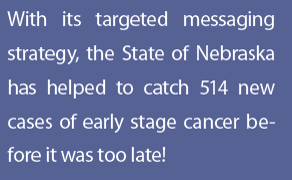
I read the full write-up on the program and realize that not only were most of the other outcomes made up, but they had actually lied about saving the lives of cancer victims. If you screen a few thousand people for colon cancer, you don’t find 514 cases of cancer, and you certainly don’t save their lives, as HFC was claiming. And you absolutely don’t save money, as they were also claiming. All this is even more true when you waive age-related guidelines and let anyone get screened, and encourage overscreening by sending out 140,000 letters to state employees graced with the picture of a beautiful young model way too young to be getting a colonoscopy.

How this invalid nonsense ever got by all the eagle-eyed Koop Committee members would be a mystery, except that HFC is a sponsor of the Koop Committee.
December 2012
I review the entire application and all the marketing materials. It becomes obvious that the entire thing was made up, not just the cancer part. They claimed to save $4.2 million because 161 of their roughly 6000 participants reduced a risk factor.
The math is quite self-evident. Suppose you doubled the number of participants who reduced risks to 312. It stands to reason that you could save $8.4-million. Double it again to 624 and you save $16.8.
Now double it one more time. If 1,248 people out of those 6000 reduced one single risk factor, you’d save $31.6-million, which is about equal to the entire spending for all 6000 participants. And of course most medical spending has nothing to do with identifying previously unrecognized risk factors, so this would be quite a feat. (Do you even know anyone under 65 who had a heart attack that could have been avoided by one more workplace screening?)
I later learn that all the Koop Award-winning program outcomes are made up, using exactly the same math.
November 2012 to June 2013
I try to contact the authorities, like Roger Wilson, who allegedly runs this program for the state, but no one seems to care. The rule of thumb in the wellness industry is that what you say counts. What you do is pretty irrelevant.
June 20, 2013
Breakthrough: The Wall Street Journal editors decide that I am correct, and that the outcomes were made up. Vik and I are allowed to publish this on their op-ed page.
July 14, 2013
Breakthrough again: Another very well-read blogger professes shock-and-awe that any vendor could lie so blatantly and apparently get away with it.
July 15, 2013
Breakthrough yet again: Ace reporter Martha Stoddard of the Omaha World Herald gets Dennis Richling of Health Fitness Corporation to admit that the outcomes — at least the “life-saving catches” of “early stage cancer” outcomes — were indeed made up. Richling tries to spin his gaffe by calling the difference between “life-saving catches of early-stage cancer” and saying someone might possibly get cancer in the future “semantics.” So, according to Richling, having cancer and not having cancer are the same thing.
February 1, 2014
The hilarious wellness industry smackdown Surviving Workplace Wellness is published. Since the HFC Nebraska program had too many lies to fit on a page or two, it gets its own chapter. Here’s the opening paragraph, which in all modesty I must admit is one of my favorite in the book.

February 23, 2014
Nebraska political blogger ReadMoreJoe picks up the scent. He points out that this wellness program is an obvious fraud. The problem is that the same posting is also exposing several other equally obvious frauds, so this one gets overlooked.
TIMELINE–PART TWO: GOETZEL STRIKES BACK
Ron Goetzel isn’t about to sit back and let his friends/sponsors/clients be pilloried for a little white lie about saving the lives of cancer victims who didn’t have cancer.
June 2, 2014
At the Health Datapalooza conference, Ron Goetzel, while admitting the Nebraska cancer outcomes data was made up, claims they/HFC still deserve the Koop Award because he somehow didn’t realize the data was made up at the time the award was granted. And it is true that HFC didn’t actually announce they had made up the outcomes. Ron would have had to actually read the materials to figure it out, same as I did.
September 2014
Ron Goetzel calls the Nebraska program a “best practice” in the Journal of Occupational and Environmental Medicine but refuses to answer any questions about the obvious mistakes and inconsistencies in the article.

November 2014
After knowing for 16 months that they had lied, Ron Goetzel, writing in Employee Benefit News, finally drops Nebraska from his list of best-practice programs:

Being a fair-minded person, I take it upon myself to congratulate him on his newfound sense of ethics. I don’t specifically agree that what he did was ethical, because the ethical thing would have been to admit complicity, apologize, and revoke their Koop Award. But I do say that Nebraska being dropped from the list of best practices means ethical “progress is definitely being made,” albeit from a low base.

Only 29 minutes elapses before Ron erases all my illusions about his honesty and re-adds Nebraska to the list of “best practice organizations.”

He also adds PepsiCo to the list. I guess losing only $2 for every $1 you spend qualifies as such in wellness, where most organizations lose much more.
May 2015
In a rally-the-base invitation-only webinar, we are told that Ron has promoted the Nebraska program from “best practice” to “exemplar.” It seems like the more obvious it becomes that the whole thing was fabricated, the more Mr. Goetzel worships its outcomes.
TIMELINE–PART THREE: RON STANDS ALONE
September 2015
WELCOA finally takes the fabricated case study of Nebraska’s outcomes off their website, 26 months after the fraud was admitted. Perhaps some pressure is being put on them to come clean, given that this is Nebraska’s program and they themselves are based in Omaha.
Just for the record, I’m not saying that an organization founded by all-you-can-eat cafeteria magnate “Warren Buffet” knowingly kept a false document on their site for those 26 months. History suggests they might just be slow learners. [2016 update: WELCOA is under new management, and they appear to be doing a great job, as exemplified by their development of the Employee Health Program Code of Conduct.]
This means Ron Goetzel is literally the only person left who thinks it’s perfectly OK — indeed, a “best practice/exemplar” — to lie about saving the lives of cancer victims. Good luck with that in the upcoming debate. It’s him against the world.
Or, as he sees it, everybody’s out of step but Ronnie.
October 2015
Nebraska tentatively re-awards the wellness contract to Health Fitness Corporation. I am looking over the precipice towards utter humiliation.
TIMELINE–PART FOUR: THE ORIGINAL DATA DISAPPEARS
November 2, 2015–the original cover-up, on the morning of the Great Debate
At our urging (and we must confess to delighting in creating this “Sting” operation), a third party alerted Mr. Goetzel to the fact that, his protestations to the contrary, the Koop Award Committee did know (even if they had somehow not seen the marketing materials quoted above) that Health Fitness Corporation was making fictitious claims about saving the lives of cancer victims. It was right in the award application. The original award application from Nebraska had originally stated (underlining is ours):
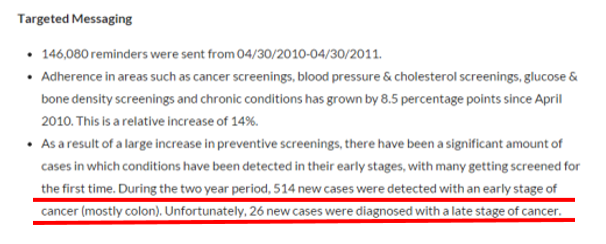
But then, a hour following the call from this third party the morning of the debate, the original award application suddenly read:
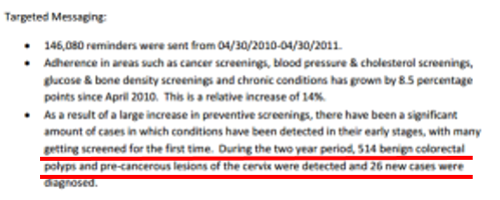
In the original application, this excerpt appears in a letter from the Governor of Nebraska. Only now the Governor’s letter says the opposite what he actually wrote. In the real world, this would be considered forgery. In wellness, a forged cover-up of a blatant and admitted lie about saving the lives of cancer victims who didn’t have cancer is considered business as usual. Johns Hopkins and Truven (Ron’s employers) don’t seem to mind either.
April 2016
The state is rescinding its award to Health Fitness and terminating its wellness program. In the immortal words of the great philosopher Stewey Griffin, victory is mine.
September 2016: The cover-up of the cover-up
Mr. Goetzel finally acknowledges that Health Fitness Corporation told a whopper, and the Koop Committee accidentally overlooked it. He now calls this an “erratum.” The technical term for it is a “lie-um.” You can’t forge official state documents and then call the whole thing an “erratum.” Is a robber allowed to give the money back after he gets caught and just uncommit the crime?

So now, having admitted that the award-winning vendor told the biggest lie in wellness history (once again, quite a feat), and knowing that all the obviously fabricated outcomes were mathematically impossible, and that waiving age restrictions for screening is akin to waiving age restrictions for buying beer, the Koop Committee finally, after 4 years, rescinded the Nebraska award.
Haha. No one falls for that line any more. Quite the opposite, they are doubling down. They say that whopping lies like this one don’t matter, if you are an award sponsor. You get to keep your award.
Ditto, if your entire claim of “separation” between participants and non-participants is shown to be false but you are sponsor, Ron merely doctors the data and you get to keep your award.
Also, if it turns out you lied about your savings because there was no change in the biometrics to attribute the savings to, but Ron was a consultant on your project, you get to keep your award.
Likewise and as was confirmed in 2016, if you are a committee member, as Wellsteps’ CEO was until recently, despite your own data showing that you actually harmed employees, you get to keep your award.
Bottom line: as a friend-of-Ron, you might get to keep your award even if you shoot someone on Fifth Avenue.
Share this:

Prediction: Wellsteps-Boise School District wins 2015 Koop Recognition
We are going to make a prediction. We might be wrong, though, because in the immortal words of the great philosopher Yogi Berra, “It’s tough to make predictions, especially about the future.” We predict that the Boise School District, a Wellsteps customer, is going to win the 2015 Koop Award. At a minimum, they will get an honorable mention.
We base this prediction on three insights. First, as our previous posting shows, the award tends to go to the program that spews the most nonsense. Specifically, to the one that ignores both biostatistics and fifth-grade math most creatively. Obviously, Wellsteps misunderstands the statistical concept of regression to the mean. Misunderstanding biostatistics is a requirement for being a wellness vendor. What’s more surprising is that they were absent that day in third grade when the teacher explained the law of math that numbers can’t increase and decrease at the same time. Laws of math tend to be strictly enforced.
In all fairness, it is possible that both Wellsteps’ claims are true: total costs may very well have declined even as cost/person increased. The Boise School District might simply employ or insure fewer people in 2014 than in 2011. Or maybe the Wellsteps program was so unpopular and worthless that employees opted to get insurance through their spouses. But even the most dishonest wellness vendor with the most clueless customer wouldn’t claim credit for a reduction in costs due to fewer people being insured. And even the ethically challenged Koop Committee isn’t dishonest enough to endorse a claim that blatantly specious.
Second, the award almost always goes to a client or customer of a Koop Award Committee member, or to a client or customer of a sponsor of the Committee. Wellsteps’ Steve Aldana sits on the Committee. All the other vendors and sponsors on this Committee have already been graced with an award for one of their customers. So now it’s Wellsteps’ turn, as they have yet to win one for a customer of any size. (This partly reflects their lack of customers of any size.)
After all, why even bother being on this C.Everett Koop Award committee if you can’t give a C. Everett Koop Award to yourself? Isn’t that what Dr. C. Everett Koop was all about — self-dealing, cronyism and corruption? (not)
Third, the timing of the “White Paper” Wellsteps just published is quite fortuitous. Sort of like in World War I, when one side knew an infantry attack was coming because it was preceded by an artillery bombardment by the other side, Wellsteps is preparing us for more “over the top” claims of success in a program that — by their own admission — was a total failure at controlling costs through 2013, and only did OK in 2014 because the cost of non-participants declined precipitously.
Fourth, if the Committee was at all on the fence, our posting last month would have helped them decide in favor of Wellsteps. One thing this Committee enjoys doing is showing us that facts and math doesn’t matter because their customers don’t read our material. The more outrageous their claims, the more they like to rub our faces in the reality that very few people in human resources care what we have to say.
This isn’t because they have, to use Mr. Aldana’s hilariously misinformed term, I-don’t-care-itis. Instead it’s because most HR executives don’t hear what we have to say, as we are blocked from most linked-in groups run by members of the wellness ignorati.
We are actually quite proud of the enemies we’ve made…but even so would appreciate if you could re-post this.
Update: it is also possible that Wellsteps didn’t get their act together in time to apply for this award–applications were due in May and their White Paper just came out last month. In that case, we’ll look forward to revisiting this post next year.
Share this:

Wellsteps Stumbles Onward: Costs Go Up and Down at the Same Time
As our regular readers know, we have often had a very slight issue with Wellsteps’ math Nothing major. Just the fact that it’s completely made up.
So it’s no surprise that they’re at it again. Before we get to the math they’ve done for the Boise School District to justify costing taxpayers as much as adding a number of extra teachers, there is another little tidbit. They decided to use the classic fallacy of listing the improvements in the highest-risk sliver only –“those with the worst health behaviors.” These “improvements” of course, omit dropouts, and — more importantly — the deterioration in risk factors among the overwhelming majority, the ones who didn’t have the “worst health behaviors” to begin with. As the paper says: “There was consistent risk reduction among those who had the unhealthiest numbers at baseline.”

It’s not just us (and common sense) saying that. Dee Edington’s “natural flow of risk” model showed that the cohort with the worst health risk behaviors always improves, even in the absence of a program. (In this version below, Dee circled the low-risk bucket to make a different point. The point for Wellsteps is that a very significant portion of the 4691 initially high-risk people decline on their own, and are replaced by others whose risk is increasing. Wellsteps isn’t showing us the replacement people, just the cohort that declined on its own.)

There is a bit of irony in that this Wellsteps White Paper cites him several times…but somehow “forgot” to take account of Dr. Edington’s most important finding, which coincidentally disqualifies their own.
Fuzzy Math
Saving the best for last, Wellsteps once again demonstrates our mantra from Surviving Workplace Wellness: “In wellness you don’t have to challenge the data to invalidate it. You merely have to read the data. It will invalidate itself.”
On one page, they show a declining overall cost trend by roughly 15% since the start of the Wellsteps program:

Now, compare that chart of the “actual” cost decrease among the entire population (participants + nonparticipants) since 2011 (“Wellsteps Begins”) to the chart below of cost/person, which shows a dramatic cost increase over the 2011-2013 period among the entire population (participants + non-participants):*

So which is it? Did overall population costs go up or down? Even using wellness math, which Wellsteps excels at, overall population costs can’t have both gone up and gone down at the same time.
There are four possible explanations for this, all of which are plausible given Wellsteps modus operandi:
(1) They are stupid;
(2) They are lying;
(3) Their program is so unappealing that employees are switching to their spouses’ coverage simply to avoid it;
(4) The number of employees in the school district declined, making it possible for total costs to decline even as costs/employee jumped. However, even the most dishonest wellness vendor wouldn’t claim credit for that, and even the most gullible customer wouldn’t let them if they did.
One explanation we can rule out: Wellsteps is doing a great job and telling the truth about it. But anyone who knows this outfit could have ruled out that possibility before we even posted this.
As of this writing, Wellsteps has now “rebutted” these findings. They say these dueling trendlines are “rock solid” and that we are full of “hot air.”

(Postscript: In 2014, for some undisclosed reason, non-participants costs dropped almost 40% while participant costs increased. No one has any idea why, and whatever the reason is has nothing to do with wellness. Total costs were still up from the start of the program.)
*Wellsteps didn’t mention the participation rate, so we are inferring a participation rate to the vector of this arrow based on them saying 60% were overweight of 3269 employees, but the number of overweight people listed in their report as participants is 1421.
Share this:

Finally–a Free Wellness ROI Tool That Isn’t Made Up
We are pleased to present a free wellness ROI estimation model, as we promised about 3 months ago. This is the only tool of its kind in the industry. (Wellsteps has one, but let’s just say the good news is that NASA employees don’t have to worry about job security, because these people aren’t rocket scientists. If you zero out inflation, no matter what other variables you enter, the Wellsteps model always shows savings of $1359.)
You can also use this to compare two wellness programs, to determine whether your vendor is lying (they are — and we are happy to help you get your money back from them), and to pressure-test Quizzify.
Quizzify, where facts are your friend, and they’re fun, too
Share this:

Dan Ariely on how the Wellness Industry Crowdsources Reality
 We recommend that everyone listen to Dan Ariely’s interview on NPR and TED talk “Why We Lie.” It explains exactly why the Wellness Ignorati could decide to collectively self-publish an entire guidebook full of misinformation and disinformation designed specifically to increase the revenues of wellness vendors.
Here are our take-aways from Professor Ariely’s TED Talk.
Like Walter White in Breaking Bad, the Ignorati started out honest. They genuinely believed that wellness saved money and that they were doing good. It was very counter-intuitive to believe otherwise. If you look at page 201 of Why Nobody Believes the Numbers, you’ll see I even mildly supported biometric screens. I hadn’t done the math. I just assumed early detection was a good thing and that Ron Goetzel and others was telling the truth, for which on page 83 I professed my admiration. As another example, ShapeUp’s CEO Rajiv Kumar would never have attacked us (largely for refusing to believe Kate Baicker, who even RAND now dismisses and who herself no longer appears to believe her own claim) if he had realized his own outcomes claims were false.
Like Walter White, it was easy to justify the first transgressions. Since the Wellness Ignorati genuinely believed in what they were doing, when the numbers didn’t add up, they either justified to themselves that it was OK to fudge them (like ShapeUp’s now-retracted claims about Highmark) or ignored glaring invalidating mistakes. The best example of the latter: Ron Goetzel finally recanting Health Fitness Corporation’s infamous participants-vs-non-participants self-immolation after years of ignoring it.
Or wellness vendors create a parallel universe where numbers don’t have to add up (like Keas), or completely misquote industry experts saying the opposite (like Vitality).
Like Walter White, they don’t actually believe they are bad people. Ariely calls this a “personal fudge factor.” With the possible exception of Wellsteps’ Steve Aldana (who may be honest but simply unable to recognize that no matter what numbers you enter into his model you get the same answer), they really think what they are doing is OK—even though the math clearly dictates otherwise.
Also like Walter White, they kept getting drawn deeper in. The more they lied, the more they have to keep lying. They needed to continue to defend what was looking increasingly indefensible. After giving Nebraska’s program a much-publicized and ironically named C. Everett Koop Award, it’s hard for Ron Goetzel and his committee to say “We goofed—we need to take it back because they made up the data and defrauded the state” even after the vendor, Health Fitness Corporation, admitted it.

Quizzify…truth serum for wellness.
Like Walter White, the Wellness Ignorati “suspend reality” (to use Ariely’s term) and “buy into a new reality.” Essentially the Ignorati crowdsource reality. They peer-review one another’s work, give themselves awards, and decide (to use Michael O’Donnell’s term) that anyone who challenges them lacks the “credentials” to do so. Or, as Ariely says: “If you were getting well-paid by Enron, wouldn’t you want to see reality as they present it?”
Avoiding the media is an excellent strategy. Once again, like Walter White, the Wellness Ignorati want to keep a low profile. Exposure is bad if the facts all go the other way. That explains Ron Goetzel’s refusal to debate, ever, and the Ignorati’s characterization of us as name-calling bullies when all we do is ask questions.
Yep, you can read this site up, down and sideways. The fact is no names are called other than the “Wellness Ignorati.” We’ve offered them the opportunity to propose a different name for their practice of denying facts, which they’ve declined. We do use the term “pretzel” to describe the very impressive twists and turns that Mr. Goetzel uses to wriggle out when he’s been caught calling failed or fraudulent programs “best practies” because they are run by friends, sponsors or clients. The alternative word for what one would be called when all your claims are made up is less flattering, and we’ve never used it with respect to Ron.
This explains why the Ignorati steadfastly refused to answer questions for a $1000 honorarium. Once again, like Walter White, they have so much as stake that $1000 is chicken feed. At Enron, if you questioned Ken Lay at an analyst conference, he would accuse you or not understanding their business, and cut you off from future meetings, rather than answer the question. We of course were not invited to participate in or even listen to the “discussion” about the HERO report.
Like Walter White, at some point the Wellness Ignorati needed to commit to their chosen path. The Wellness Ignorati have gone too far in their insistence that wellness saves money. There is no turning back. The existence of this site makes turning back even harder because retracting their lies means acknowledging them. And as soon as they do that, we do what we do best other than invalidate the Ignorati’s misstatements, which is: gloat.
Like Walter White, they are now doubling down. Examples: Ron Goetzel calling Nebraska a best practice after they admitted lying about saving the lives of cancer victims, in order to justify his original award to them. Steve Aldana can’t create a real ROI model now without admitting that his original model was not “based on every ROI study ever published” as he has maintained, but rather always yields a savings of $1359/employee no matter what inflation-adjusted figures you enter.
As the house of cards collapses, people on the fringes who were sucked in (in this case HR and some brokers and consultants) wake up and ask: “How could I have believed what these people were saying?” Many major and mid-level figures connected with Enron did exactly this. We see this every week in wellness, as people come to us and say: “I get it. I can’t believe I fell for this.”
So thank you to Dan Ariely. In one 8-minute TED talk, he explained the entire alternative crowdsourced reality of the Wellness Ignorati – without once even mentioning them by name. But I’m sure the Ignorati nonetheless think he bullied them.
As a hot-off-the-presses example of what Professor Ariely is talking about, Wellsteps just updated their model so that now instead of saving $1359 per person in 2019, they save $1359 per person in 2020. As with previous iterations of their model, the success of the wellness program is irrelevant to the outcome of the model. Just enter a 0% inflation rate and “1” for covered people (“1” so you can see the $1359 reveal itself without having to do division) — and then whatever figures you want to enter for spending, obesity and smoking.
Here you started out with astronomical healthcare costs and got a 99% reduction in smoking and obesity…and saved $1359
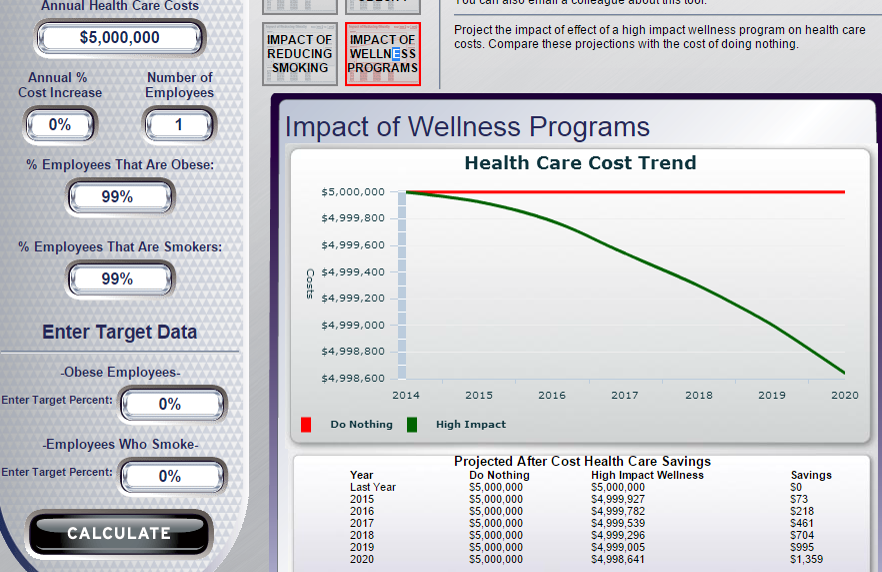
Here you save $1359 without changing smoking or obesity at all:

And here you saved $1359 even though there was nothing to save. The costs are as low as the model will allow you to enter (until they got caught, you could enter figures low enough that they model would calculate negative costs), and there was no smoking or obesity to reduce:

Naturally, Wellsteps is prominent both on the Koop Award Committee and the HERO Report Committee. Wellsteps’ “back story” is here.
Share this:

Ron Goetzel’s “Dumb and Dumber” Defense Deflects Latest Koop Award Ethical Scandal
By Al and Vik
Oh, the twists and turns as Ron “The Pretzel” Goetzel tries to wriggle out of all his ethical stumbles.
This time around, we thought we had nailed both him and his cabal handing out the ironically named C. Everett Koop Award to themselves and their friends based on made-up outcomes. Specifically, this time they gave their sponsor (Health Fitness Corporation, or HFC) an award based on data that was obviously made up, that no non-sponsor could have gotten away with submitting. This was the third such instance we’ve uncovered of a pattern of giving awards to sponsors for submitting invalid data while making sure that the award announcement contains no reference to the sponsorship. (There are probably others; we’ve only examined 3, which might explain why we’ve only found 3.)
How obviously was the data made up? Well, take a looksee at this slide, comparing participants to non-participants. This is the classic wellness ignorati ruse: pretending that non-motivated inactive non-participants can be used as a valid control for comparison to active, motivated participants. The wellness ignorati would have us believe that any healthcare spending “separation” between the two groups can be attributed to wellness programs, not to inherent differences in motivation between the two groups. Unfortunately for the ignorati, their own slide invalidates their own argument: in 2005, the label “Baseline Year” shows there was no program to participate in, and yet – as their own slide shows – participants (in blue) significantly underspent non-participants (in red) nonetheless. In Surviving Workplace Wellness, we call this “Wellness Meets Superman,” because the only way this could happen is for the earth to spin backwards.
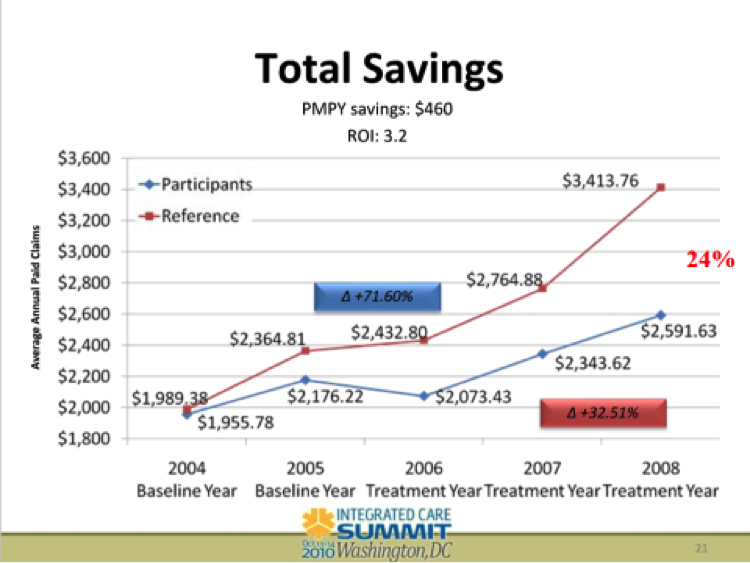
Given that the 2005 baseline label was in plain view, we just assumed that HFC did not indeed have a program in place for this customer (Eastman Chemical) in 2005, which is why they called 2005 a “Baseline Year” instead of a “Treatment Year.” Not actually having a program would logically explain why they said that didn’t have a program, and why they used that display or variations of it like the one below for 4 years with the exact same label. Presumably if they had had a program in 2005, someone at HFC would have noticed during those 4 years and relabeled it accordingly.
Originally we thought the Koop Award Committee let this invalidating mistake slide because HFC — and for that matter, Eastman Chemical — sponsor the awards they somehow usually win. But while trying to throw a bone to HFC, the Koop Award luminaries overlooked the profound implication that the year 2005 separation of would-be participants and non-participants self-invalidated essentially the entire wellness industry, meaning that is is an admission of guilt that the industry-standard methodology is made up.
 Goetzel the Pretzel to the rescue. He painstakingly explains away this prima facie invalidation. Apparently the year 2005 was “unfortunately mislabeled.” Note the pretzelesque use of the passive voice, like “the ballgame was rained out,” seemingly attributing this mislabeling to an act of either God or Kim-Jung-Un. He is claiming that instead of noticing this invalidator and letting this analysis slide by with a wink-and-a-nod to their sponsor, none of the alleged analytical luminaries on the Koop Committee noticed that the most important slide in the winning application was mislabeled — even though this slide is in plain view. We didn’t need Edward Snowden to hack into their system to blow up their scam. They once again proved our mantra that “in wellness you don’t need to challenge the data to invalidate it. You merely need to read the data. It will invalidate itself.”
We call this the “Dumb and Dumber” defense. Given two choices, Goetzel the Pretzel would much prefer claiming sheer stupidity on the part of himself, his fellow Koop Award committee members like Staywell’s David Anderson and Wellsteps’ Steve Aldana, and his sponsor HFC, rather than admit the industry’s methodology is a scam and that they’ve been lying to us all these years to protect their incomes.
Still, the Dumb-and-Dumber defense is a tough sell. You don’t need Sherlock Holmes, Hercule Poirot or even Inspector Clouseau to detect a few holes in the Pretzel’s twisted logic:
- How could no one – no member of the Koop Award Committee or employee of Health Fitness Corporation (which used this as its “money slide” for years) – have noticed this until we pointed it out for the third time (the first two times not being as visible to the public)?
- In early 2012, this slide was reproduced–with the permission of Health Fitness Corporation–right on p. 85 of Why Nobody Believes the Numbers, with the entire explanation of its hilarious impossibility. We know Mr. Goetzel read this book, because he copied material out of it before the publisher, John Wiley & Sons, made him stop. So we are curious as to why it has taken until now for him to notice this “unfortunate mislabeling.” Hmm…would the fact that it was just exposed to the world in Health Affairs have anything to do with this sudden epiphany? We’re just sayin’…
- If indeed it was just an “unfortunate mislabeling,” how come HFC has now expunged all references to this previously highlighted slide from their website, rather than simply change the label?
As regards the third point, we would recommend that next time Mr. Goetzel invokes the Dumb-and-Dumber defense, he coordinate his spin with his sponsor.
But let’s not overlook the biggest point: the entire Koop Committee – including “numbers guys” like Milliman’s Bruce Pyenson and Mercer’s Dan Gold — is apparently incapable of reading a simple outcomes slide, as they’ve proven over and over.
So, as a goodwill gesture, we will offer a 50% discount to all Koop Committee members for the Critical Outcomes Report Analysis course and certification. This course will help these committee members learn how to avoid the embarrassing mistakes they consistently otherwise make and (assuming they institute conflict-of-interest rules as well to require disclosure of sponsorships in award announcements) perhaps increase the odds that worthy candidates win their awards for a change.
Share this:

Wellsteps ROI Calculator Doesn’t Calculate ROI…and That’s the Good News
Wellsteps
Short Summary of Intervention:
“At Wellsteps, we’ve created a series of research-based ROI calculators to help you estimate the effect of well-designed wellness programs on health care costs, absenteeism, and presenteeism. Each of the three ROI calculators will examine a different employee expense and will help you determine whether investing in wellness strategies makes sense for your company. A well-designed wellness program is one that changes the health behaviors of employees, spouses, and dependents, and lowers health risks, reduces chronic disease, and helps worksites create a culture of health. The design of the WellSteps turnkey wellness solution was based partly on this body of evidence.”
Materials Being Reviewed:
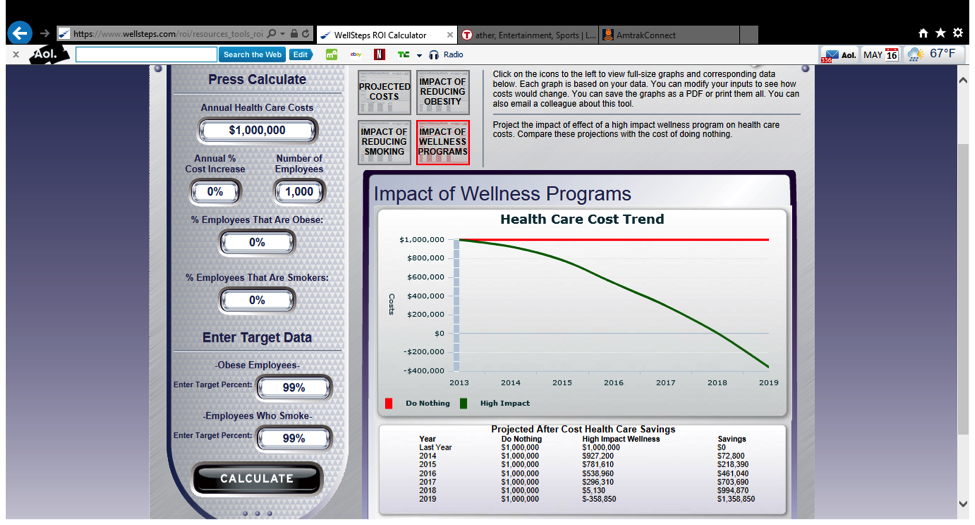
Wellsteps ROI Calculator . You input your number of employees, health spending, and goals for obesity and smoking cessation. The calculator will tell you how much money you can save through the Wellsteps program.
Summary of key figures and outcomes:



Questions for Wellsteps:
In the first example above, your model calculated massive savings even with no change in obesity and smoking. In the second example, your model calculated the same massive savings even with a huge increase in obesity and smoking. It seems that no matter what smoking and obesity data we enter once we factor out inflation itself, your ROI calculator reduces healthcare costs to a level below zero by 2019. How is this possible?
ANS: Refused to answer
Shouldn’t a spike in smoking and obesity rates from 0% to 99% increase healthcare spending rather than reduce it?
ANS: Refused to answer
Your May 2014 email blast, sent out a few days after The Health Care Blog exposed your ROI model as being invalid, says your model is supported by “every wellness ROI study ever published” (a step up from being “research-based” on a “body of evidence” as your website says). We recognize that asking you to list “every wellness ROI study ever published” would be burdensome, but could you direct us to just one study that says increasing smoking and obesity can improve workforce health and/or reduce healthcare costs to below zero?
ANS: Refused to answer
Does “every wellness ROI study ever published” include the RAND studies in Health Affairs that have found negative ROIs?
ANS: Refused to answer
How are you able to “guarantee” this ROI, since it is impossible to reduce spending to a negative number?
ANS: Refused to answer
Since you’ve known that the Wellsteps ROI Calculator is invalid since this fact was pointed out to you in October 2013 and you have updated your model twice since then, how come you have elected to continue to overstate savings by a mathematically impossible figure?
ANS: Refused to answer
You lead your marketing blast by saying that “11,000 brokers and consultants” have used this ROI model? Are we the first of those 11,000 people to observe negative savings?
ANS: Refused to answer
Do you see any irony in publicly accusing one of the principals of this website, Al Lewis, of acting like a “tobacco executive lying to Congress” when even tobacco executives wouldn’t claim that smoking reduces healthcare costs like your model says it does?
ANS: Refused to answer
Where in your “ROI Calculator” can I find the ROI?
ANS: Their ROI Calculator doesn’t calculate an ROI so there was no point in even asking them to answer this question. The good news about Wellsteps is that NASA employees don’t have to worry about job security because these people are not rocket scientists.
Update: July 16, 2014
Addendum: Wellsteps accusation that I “entered false data” into the ROI calculator was posted on the “Wellness Is a Business Strategy” Linkedin Group
“It has come to our attention that an outspoken critic has entered false data into these calculators in order to make a point. We certainly support free speech; however, we wonder how valid the point can be when it is based on false data?”
“Use valid estimates for the percent of the current obese and smokers in an employee population. We provide the estimated default numbers based on national data of 33% and 20% respectively in all three calculators. In our combined 50 years of academic and consulting work, we cannot think of one employer with a 0% obesity AND 0% smoking rate. Again, valid estimates work best.”
Actually, we ran every combination of data from a reduction of 99% in smoking and obesity rates to an increase of 99% in smoking and obesity rates. Some of that data might have been “false” (whatever that means), but the result was always the same: $1358.85 in savings/employee by 2019. Here are two more examples, this time using the default numbers they recommended. The first is @$5000/employee in annual costs, with no change in smoking or obesity. The second is @50,000/employee. The answer is still the same.


How come, regardless of what assumptions get entered (and we have now entered many vastly different combinations of cost and success), the answer is always that by 2019, you save $1,358.85 per employee once you zero out inflation?
ANS: Refused to answer
Would you now admit that entering $5000/employee in spending and 33% obesity and 20% smoking (the national averages) constitute, in your words, “valid estimates that work best” ?
ANS: Refused to answer
Following my exposé, your model no longer allows a user to enter increases in smoking and obesity. Is this to prevent users from figuring out that even if the rates of smoking and obesity increase, the math underlying your model based on “every ROI study ever published” will still show a reduction of $1,358.85/employee in 2019?
ANS: Refused to answer
How come the model shows that very same $1358.85 (now finally “rounded” to $1359) potential savings from reducing obesity and smoking even if I start out with no smokers or obese employees?

Update–May 1, 2015: Wellsteps Doubles Down on Dishonesty
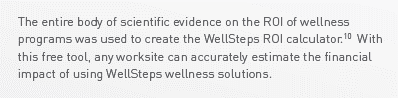
Two people forwarded us this, a sequel to their email that their ROI model is “based on every ROI study ever published”:
Update–September 10, 2015: Wellsteps Triples Down on Dishonesty
Somehow they reported costs going up and down at the same time. Even wellness industry math doesn’t allow that.

 They Said What?