
Home » 2015 (Page 8)
Yearly Archives: 2015
HealthFair Wins Wellness Industry’s Race to the Bottom
Ever wonder why students don’t just grade themselves? For your answer, look no further than HealthFair.com’s self-assessed grade:

And yet by any standard other than their own, HealthFair completely flunks the test. Literally, their “basic package” proposes more “D”-rated tests (and “D” is a failing grade by US Preventive Services Task Force standards) than any vendor we’ve ever seen. They would lose their wellness vendor license tomorrow, except for the fact that wellness vendors don’t need licenses.

The first four all get “D”s. Here are the screenshots if you don’t believe that any vendor could possibly offer so many inappropriate tests at all, let alone in the “basic” package.
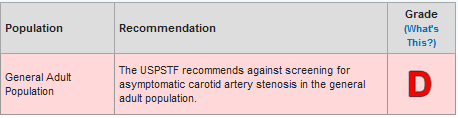
The abdominal aortic ultrasound test is such a stupid (where “stupid” is synonymous with “profitable”) idea for the non-elderly population that the USPSTF doesn’t even bother to say no:

Along with their “D” as a general screening tool, The EKG gets a whopping “I” for individuals at risk, but since HealthFair’s basic package includes no basic tests to see who is at risk, and by law they can’t ask about history, they would still have to screen everyone whether or not they are at risk:

By earning another “I”, the peripheral artery disease test does well by HealthFair’s standards. The USPSTF concludes that researchers don’t know enough about it to recommend it, which doesn’t stop HealthFair.
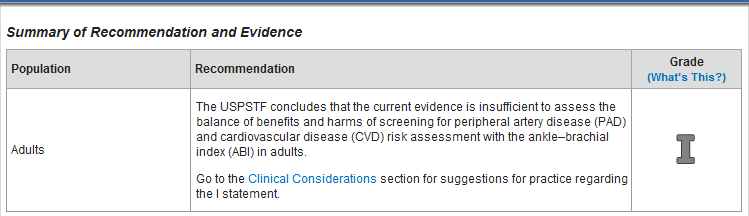
As for “hardening of the arteries,” the USPSTF doesn’t bother to grade it due to the fact that no one uses this test as a screen…except wellness vendors. But even the American Heart Association, not exactly shy when it comes to screening people for cardiac disease whose treatment can enrich their members who treat it, disses this test:

Speaking of D-Rated tests, sorry, guys. If you want a D-rated PSA screen — a screen not even recommended by its own inventor — you have to insist that your employer buy HealthFair’s “advanced” package:


Give your employees wellness that always earns an “A”
That brings us to the H Pylori screen, Healthfair’s groundbreaking, earth-shattering, pushing-the-envelope leap forward in the wellness vendor competition to out-stupid one another.
Where to start…
First, the US Preventive Services Task Force doesn’t bother to offer a recommendation on it, largely because no self-respecting doctor would ever screen patients for this. Shame on the USPSTF for consistently failing to anticipate all the ways in which wellness vendors can misunderstand basic clinical science!
Second, most of us who harbor H Pylori have no symptoms. So why screen for something that’s not causing problems? That’s why this is a test, not a screen. If you have an ulcer or symptoms that suggest an ulcer, go to the doctor. Even then, the doctor probably won’t even bother to test you, since most people get relief simply from well-tolerated, commonly used, proton pump-inhibitor medications–some of which don’t even require a prescription. It is only if the first-line medications fail that most doctors will even test you.
Third, there is a significant school of thought that says H. Pylori is beneficial. Screening us for something we’re better off having in our bodies represents a new frontier in the wellness industry’s answer to overdiagnosis, which we call hyperdiagnosis.
Fourth ironically, given the wellness industry’s obsession with employees’ weights, it is even slightly possible that killing off H. Pylori contributes to weight gain.
Fifth, what exactly are we supposed to do, if it turns out we harbor H. Pylori? Get a course of antibiotics to clear the bacteria out of our system? That’s a great idea. We’ve always maintained that one of the problems with America’s healthcare system is that patients don’t get to take enough antibiotics.
The good news for the pharmaceutical industry is due to the nature of H Pyroli, hiding in our stomach mucus, it takes a lot of antibiotics to ferret it out, plus a bunch of other pills. Is this a great country or what?
Sixth, the H Pylori tests themselves are among the most complex, unhelpful and inaccurate commonly used tests in existence.
Finally, half the world’s population has it. Given the expense and inaccuracy of the test and the prevalence of the bacterium, why not eliminate the middle step and just put all your employees on antibiotics?
One of us is a screaming libertarian. And even he thinks the cowboys that populate the wellness industry need to be reigned in with some regulation, before they screen the American workforce to death. The regulation would be very straightforward: employers and vendors must disclose the USPSTF recommendations to employees before making them take these tests. If after this disclosure, a few employees still insist on getting these D-rated or off-the-charts-inappropriate screens, congratulations! Your screening program will have just done something useful: identified employees who are totally incapable of making an intelligent decision.
To those of you who are reading this and thinking: “Haven’t I heard this song before?”, the answer is, you have. HealthFair is the “Intel Inside” for the screening jihad offered by SSM Healthcare, the Sisters of Saint Mary health system we “profiled” a few weeks ago, thus once again proving that wellness mantra: great minds aren’t the only ones that think alike.
Share this:

Johnson & Johnson accepts our analysis that wellness loses money
Newsflash: Someone from Johnson & Johnson named Michael Schmidt responded to our posting that the HERO Report shows wellness loses money. This is the first time anyone associated with HERO has strayed from the tried-and-true Wellness Ignorati strategy of ignoring us. We were concerned that he might have found a mistake in our math, which no one has ever done.
Fortunately, our math is OK with Mr. Schmidt, and — by implication, since he is writing on their URL — J&J itself. His point is different. He argues that we write these columns to do the following: generate business. Touche!
He also says that the headline is inflammatory and that we will turn off more people than we turn on. That is probably accurate. However, the people we would turn off — traditional “pry, poke, prod and punish” wellness vendors such as Johnson & Johnson — have had and would have no interest in paying us to find out that wellness is worthless.
In any event the headline “The Wellness Wars Are Over. Wellness Lost” captures exactly what the HERO report says — and was edited by the ITL editor. Headlines, as Mitt Romney found out when his New York Times op-ed was entitled “Let Detroit Go Bankrupt,” are the purview of the editor, not the author.
The curious thing is, Johnson & Johnson is listed as one of the “endorsers” of the HERO report. So as an endorser of the report, Johnson & Johnson is tacitly nonetheless acknowledging that the report is right–wellness loses money.
In case there is some ambiguity, here is the screenshot of the first set of comments

Share this:


Star Wellness Illuminates the Health Hazards of Wellness
 Once in every great while, when we’re least expecting it, a company comes along that makes us reconsider our viewpoint–and ponder the possibility that maybe we’re wrong about wellness. Maybe, finally, we’ve discovered a company that will motivate employees to get well. Maybe a company that adheres to screening guidelines. Maybe even a company that will solve America’s healthcare crisis.
Star Wellness is not that company.
Quite the contrary: If you are an employee of an organization that has retained this outfit, your best course of action is simply to pay the fine and have nothing to do with these people. Or take the tests to secure your money, and then don’t open the envelope with the results in them, because due to false positives, you are equally or more likely to be harmed than helped by taking their full panel of tests.
Star Wellness says doctors “typically order these tests during a routine physical.” If you find a doctor that does so, please contact the licensing authorities because for many of these screenings, a doctor would be sanctioned for routinely ordering and billing for these tests on all patients. However, this being the wellness industry, there are no authorities…but there are plenty of tests. Not being doctors, wellness vendors are allowed to harm employees up to the limit of HR’s willingness to pay them to do so–and, being wellness vendors, they take full advantage of this budget. (Among other things, the higher the budget, the more vendors can pay the employers’ brokers–and hence the more likely they are to keep the account.)

Leaving aside all the tests they do that the United States Preventive Services Task Force (USPSTF) does not recommend doing annually if at all (which is to say, most of them), let’s focus on the ones the USPSTF specifically recommends not doing. In each case, we’ll use screen shots because otherwise no one would believe that any preventive services vendor could possibly be this out of touch with preventive services guidelines.
PSA screens for prostate cancer. Perhaps Star Wellness’s internet connection is down because nobody does these any more. Even the guy who invented the test recommends not doing it.

Carotid artery screening. Seriously? Even the Highmark/Goetzel Penn State program, the industry’s most coercive and ill-conceived program ever, didn’t recommend those.

Our favorite is abdominal aorta screening. These screens are so not-recommended for the <65 population that the USPSTF assumes nobody,no matter how stupid or dishonest, would ever do them. So they don’t even bother to waste valuable electrons posting non-recommendations of this screen for the <65 population. It would be like recommending not parking your car on a railroad crossing. Instead, all of their recommendations start with the assumption that people being considered for these tests (tests on individuals, not screens on everyone, by the way) are over 65 to begin with.


Even their basic tests are mostly USPSTF not-recommended as screens (and certainly not annual screens), but more interesting is some of the misinformation they’ve piled on top of these tests.
They say these tests are a “$350 value.” Since a checkup including tests costs $200 or less, the whole PCP profession would be going bankrupt if their math was right — and if doctors were actually doing these screens.
Of course they also make up their savings figures (all this overscreening somehow saves $250/employee net of the costs of the overscreening itself), but lying about outcomes is embedded in wellness vendor DNA. We can’t fault them for that. It isn’t possible to compete in this field without making up outcomes.

But they did make up at least one other statistic. As noted above, they said that 75% of Americans are deficient (or, more specifically, DEFICIENT!) in Vitamin D and need supplementation. However, the CDC and the rest of the triple-digit IQ grownup crowd say the opposite. The CDC notes that only 8% of Americans are deficient, while the Journal of the American Medical Association and the USPSTF also don’t recommend screening and supplementation.

In addition to not understanding preventive medicine guidelines, Star Wellness appears to not understand the (very few) regulations putting even the slightest of constraints on the wellness industry’s overdiagnosis-today-overdiagnosis-tomorrow-overdiagnosis-forever ethos. One of those very few constraints (ironically, a misguided one) is: wellness vendors can’t ask about family history. And yet, here they are…asking about family history. Now it’s possible they aren’t asking about family history and they mis-stated their own position, in which case by their own admission, they are doing this screen on people without a family history, people who shouldn’t get the screen at all. Their other screen on this slide, C-Reactive Protein, is also not recommended by USPSTF.

Not all the news about Star Wellness is bad. We always try to end on good news, and the good news is – if Star Wellness is to be believed – their needles are among the least contaminated in the entire industry!

A postscript
Sal, Wyoming’s not a country.

Star, Vitamin B12 is not a vaccine

While we’re on the subject of vaccines, according to the CDC, the biggest categories of people who are supposed to get Hepatitis A/B vaccines include toddlers and street drug users. If you are routinely hiring enough people fitting those criteria to be considering an on-site vaccination clinic, I’d say wellness isn’t your biggest problem.
Share this:


Is Wellness-Driven Life Insurance Hancock’s New Coke?
 John Hancock Insurance recently announced a plan to sell life insurance based on healthy behaviors. You get a discount on life and disability insurance for exercising and reporting good blood values on an ongoing basis, not just once when you sign up.
While we have been quite vocal in saying wellness is a waste of money and potentially injurious to health and morale (and lately the two wellness trade associations themselves have candidly supported that position), we find Hancock’s strategy to be a shockingly good idea.
There are many distinctions between Hancock’s offering and health insurance. First, life and disability insurance are opt-in products. No one is forcing you to buy them in order to get health insurance at work, or fining you if you don’t. No one is violating USPSTF guidelines, screening the entire workforce, or making you get checkups that are worthless at best.
Second, the same numbers that don’t remotely add up for wellness add up quite elegantly for life and disability. Cut 50% out of your heart attack rate for the latter and you probably reduce overall claims payout by 5%. Cut 50% out of your heart attack rate for health insurance and you reduce overall claims payout by less than 1%. Additionally, Hancock can possibly accomplish that goal through underwriting. An employer doesn’t have that option. So besides being worth more, a 50% reduction is achievable.
Finally, they should be able to generate some good self-selection into this product. People have to be willing to give up some privacy, and our colleague Anna Slomovic is quoted on this topic in the article in the New York Times, but as long as you know what risk you are taking and as long as there is some recourse, it isn’t the same thing as being forced to reveal personal information for a wellness program.

Declare your independence from wellness intrusion. Quizzify.
One asterisk: the article says they are relying on Vitality to come up with the risk adjustments. I doubt seriously that is the case. Hancock has real grownup actuaries whose job it is to price these risk adjustments. We assume the article is wrong — Hancock isn’t going to rely on a vendor that can’t even quote Dee Edington correctly and doesn’t understand how to design a study.
Absent that asterisk, we are confident that they will be successful and wish them the best of luck.
Share this:

HERO (Health Enhancement Research Organization) Crowdsources Arithmetic
This is the third in a series deconstructing the Health Enhancement Research Organization’s (HERO) attempt to replace the basic outcomes measurement concepts presented to the human resources community in Why Nobody Believes the Numbers with a crowdsourced consensus version of math. The first installment covered Pages 1 to 10 of their outcomes measurement report, where HERO shockingly admitted wellness hurts morale and corporate reputations. The second installment jumped ahead to page 15, where HERO shockingly admitted wellness loses money. This report covers pages 11-13. Next week we shall be covering Page 14.

4 out of 5 wellness vendors don’t get this
Spoiler Alert: The wellness industry believes that math is a popularity contest. (We have a million-dollar reward if they can show that’s true. More on that later.)
All the luminaries in the wellness industry got together to crowdsource arithmetic, and put their consensus (a word they use 50 times) in an 88-page report. Unfortunately, math is not a consensus-based discipline, like democracy. It is not even an evidence-based discipline, like science. It is a proof-based discipline. A methodology that doesn’t work in hypothetical mathematical circumstances is proven wrong no matter how many votes it gets.
The pages in question list 7 “methodologies” for measuring outcomes. To begin with, consider the absurdity of having 7 different ways to measure. Imagine if you asked your stockbroker how much money you made last year, and were told: “Well, that all depends. You could measure that seven different ways. And by the way, six of those ways will overstate your earnings.” Math either works or it doesn’t. There is only one right answer.
Methodology #1: “Cost Trend Compared with Industry Peers”
This methodology “may require consulting expertise.”
As a sidebar, one of the many ironies of this HERO report is that most of these methodologies emphasize the need for actuarial or consulting “inputs” or “analytic expertise”…and yet no mention was made on Page 10 of the cost of this expertise when all the elements of cost were listed. While not mentioned as a cost element, consulting firms are very expensive And even if consulting were free, we generally recommend hiring only consultants to do outcomes report analysis who are certified in Critical Outcomes Report Analysis by the Validation Institute.
By contrast, Staywell and Mercer offer an example of what happens when you as a buyer use non-certified “consulting expertise” to evaluate a vendor. Here’s what happens: the vendor wins. Needless to say, Staywell showing savings 100x greater than what Staywell itself said was possible simply by reducing a few employees’ risks raises a lot of questions. But despite repeated requests and offers of honoraria to answer these questions, Mercer wouldn’t answer and the only response Staywell gave us was to accuse us of bullying them. Staywell and Mercer held firm to the Ignorati strategy of not commenting—even though Mercer was representing the buyer (British Petroleum), not the vendor. Oh, yes—both Staywell and Mercer are represented on the HERO Steering Committee.
To HERO’s credit, they do admit the obvious for Methodology #1: If all your peers are using the same vendors, who recommend the same worthless annual checkups, the same overscreening/overdiagnosis, the same lowfat(!) diets, and the same consultants to evaluate all the phony savings attributable to these checkups, diets, and biggest-loser contests, obviously you’ll get the same results. And since trend is going down everywhere (including Medicare and Medcaid, which have no wellness), everyone gets to “show savings.”
Methodology #2: “Inflection on expected cost trend.”
Mercer has been a big proponent of this methodology, as in the previous Staywell example. At one point they used “projected trend” to find mathematically impossible savings for the state of Georgia’s program even though the FBI(!) later found the program vendor, APS, hadn’t done anything. In North Carolina, they projected a trend that allowed them to show massive savings in the state’s patient-centered medical home largely generated, as luck would have it, by a cohort that wasn’t even eligible for the state’s patient-centered medical home.
Comparing to an “expected” trend is one of the most effective sleight-of-hand techniques in the wellness industry arsenal. Every single published study in a wellness promotional journal comparing results to “expected trend” has found savings. And have you ever hired a consultant or vendor to compare your results to “expected trend” who hasn’t found “savings”? We didn’t think so.
QED.
Methodology #3: “Chronic vs. non-chronic cost trend.”
The funny things about this methodology are twofold.
First, the HERO Committee already knows this methodology is invalid because it was disproven in Why Nobody Believes the Numbers (and I offered an unclaimed $10,000 reward for finding a mistake in the proof). We know that people on the Committee have read my book because at least one of them – Ron Goetzel – used to copy selected pages from it until the publisher, John Wiley & Sons, made him stop. Methodology #3 was the fallacy on which the entire disease management industry was based. I myself made a lot of money measuring outcomes this way, until I myself proved I was wrong. At that point, integrity being more important to me than money, I changed course abruptly, as memorably captured by Vince Kuraitis’ headline: Founding Father of Disease Management Astonishingly Declares: “My Kid Is Ugly“. (Naturally the benefits consulting industry filled the vacuum created by my withdrawal from this market, and plied their clients with worthless outsourced programs that more than coincidentally generated a lot of consulting fees.)
If you had perfect information and knew who had chronic disease (before the employees themselves did) and everyone stayed put in either the non-chronic or chronic categories, you could indeed use non-chronic trend as a benchmark, mathematically (though the epidemiology is still very squirrelly). The numbers would add up, at least in a hypothetical case.
But we can’t identify anywhere near 100% of the employees who have chronic disease. Absent that perfect information, any fifth grader could understand the proof that this methodology is fabricated, as follows. Assume that 10 people with a chronic disease cost $10,000 apiece both in the baseline and in the study period. Their costs are therefore flat. The program did not reduce costs between periods.
Now add in 10 people with undetected chronic disease as the “non-chronic benchmark.” Maybe they are ignoring their disease, maybe they don’t know they have it, maybe they are misdiagnosed, maybe the screen was wrong (vendor finger-pricks are very unreliable). Assume these 10 people cost $5000 in the baseline…but they have events in the study period so their costs become $10,000.
That makes the “non-chronic trend” 100%! Suddenly, the program vendor looks much better because they kept the costs of the chronically ill cohort constant even though the “benchmark” inflation was 100%.

At Quizzify, wellness results always add up.
Second, Why Nobody Believes the Numbers has already shown how to make this methodology valid mathematically (though the epidemiology applied to that math might still be squirrelly, and there could still be random error in non-hypothetical populations). You simply apply a “dummy year analysis” to the above example. So do exactly what is described above, but for a year-pairing before the program. Then you’ll know what the regression-to-the-mean bias is, and apply that bias to the study years. So If in fact the “non-chronic trend” is always 100% due to the people with unrecognized chronic disease, you would take this trend out of the benchmark non-chronic population before applying that trend to the chronic population. In this case, as in every case, the bias is eliminated. This is called the Dummy Year Adjustment. (Chapter 1 of Why Nobody Believes the Numbers offers several examples of the DYA.)
Proofs are best understood to be proofs if accompanied by rewards, since only an idiot would monetarily back a proof that wasn’t a proof. So here’s what we propose for this one: I’ll up my $10,000 reward to $1,000,000. A panel of Harvard mathematicians can decide who is mathematically right. The HERO Committee escrows a $100,000 nuisance fee for wasting my time and paying for the panel if they are wrong. (We’ll pay if we lose.) They present Methodology #3. We lose the $1,000,000 if the panel votes that this HERO methodology is valid without our “Dummy Year Adjustment.”
My challenge: Either collect your $1,000,000, or publicly apologize for proposing a methodology which you know to be made up. Or is offering you a million dollars “bullying,” a word defined very non-traditionally in this field? Our bad.
Yes, we know this sounds like a big risk but you might remember the old joke:
Science teacher: “If I drop this silver dollar into this vat of acid, will it dissolve?”
Student: “No, because if it would, you wouldn’t do it.”
Methodologies 4 and 5: The Comparison of Participants to Non-Participants
Besides not making any intuitive sense that active motivated engaged participants are somehow equivalent to inactive unmotivated non-participants, Ron Goetzel already admitted this methodology is invalid. Health Fitness Corporation, accidentally proved that on the slide below.

Note that they “matched” the participant (blue) and reference (red) groups in the 2004 “baseline year” but didn’t start the “treatment” until 2006. However, in 2005, they already achieved 9% savings vs. the “reference group” even without a program. This “mistake” was in plain view, and was pointed out to them many times, politely at first. Page 85 of Why Nobody Believes the Numbers showed it, but as the screenshot below shows, I was too polite to mention names or even to call it a lie, figuring that as soon as Health Fitness Corporation or Ron Goetzel saw it, they/he would be honest enough to withdraw it.
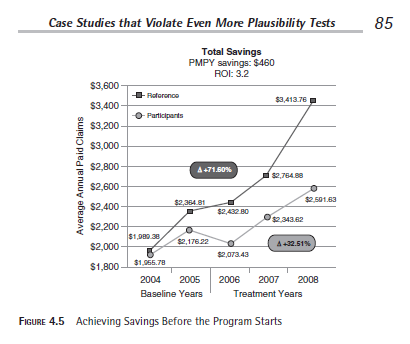
Not knowing the players well, I naively attributed the fact that HFC used this display to a rookie mistake, rather than dishonesty. That was plausible because rookie mistakes are the rule rather than the exception in this field. (As we say in Surviving Workplace Wellness, the good news about wellness vendors is that NASA employees don’t need to worry about their job security because these people aren’t rocket scientists.)
On the advice of colleagues more familiar with the integrity of the wellness industry true believers, I also tried a test of the rookie-mistake hypothesis: I strategically placed the page with this display next to the page that I knew Ron Goetzel would be reading (and copying), a page whereon I complimented him on his abilities. I might the the world’s only bully who publicly compliments his victims and offers to pay them money:

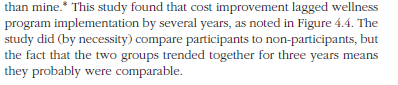
That way, I would know that if Mr. Goetzel and his Koop Committee and their sponsors HFC didn’t remove this display, it was due to a deliberate intentiion to mislead people, not an oversight or rookie mistake.
Sure enough, that display continued to be used for years. Finally, a few months ago, faced with the bright light of being “bullied” in Health Affairs, HFC withdrew the slide. Ron “the Pretzel” Goetzel earned his moniker, twisting and turning his way around how to spin the fact that this “mistake” was ignored for so long despite all the times it had been pointed out. He ending up declaring the slide “was unfortunately mislabeled.” He gave no hint as to who did the unfortunate mislabeling, despite being repeatedly asked. We suspect the North Koreans. The whole story is here.
Summary and Next Steps
The first five of these methodologies in Pages 13-14 have several things in common:
- They all contradict the 6th methodology;
- They contradict the statement on page 15 that the only significant savings is in reducing admissions. Of course, self-contradiction is embedded in Wellness Ignorati DNA. To paraphrase the immortal words of the great philosopher Ned Flanders, the Wellness Ignorati “believe all the stuff in wellness is true. Even the stuff that contradicts the other stuff.”
- They call for megadoses of consulting and analytic expertise, contradicting the list on Page 10 that omits the cost of outside expertise.
Speaking of Methodology #6, our next installment will cover it. It’s called event-rate based plausibiltiy testing. I would know a little something about that methodology, since I invented it. I am flattered that the Wellness Ignorati, seven years later, are finally embracing it. I am even more flattered that they aren’t attributing authorship to me. No surprise. That’s how the Wellness Ignorati got their name – by ignoring inconvenient facts. Ignoring facts means they cross their fingers that their customers don’t have internet access. Customers who do can simply google on “plausibiltiy test” and “disease management” and see whose name pops up.
Share this:

Total Wellness’s Total Package of Totally Inappropriate Tests
Total Wellness is very concerned about “fostering a positive culture in your office.”

And what better way to “foster a positive culture,” and “recruit talented employees to your workforce” so that they can “improve relationships with one another” than by screening the stuffing out of them?
To start with, don’t just ask your “talented employees” that you just “recruited” if they smoke. That would be too easy and obviously they would all lie, right? Isn’t lying exactly what talented employees do the day after you hire them? Of course! And isn’t deceit what a positive culture is all about? Of course! That’s why you have to test their nicotine 7 ways to Sunday.
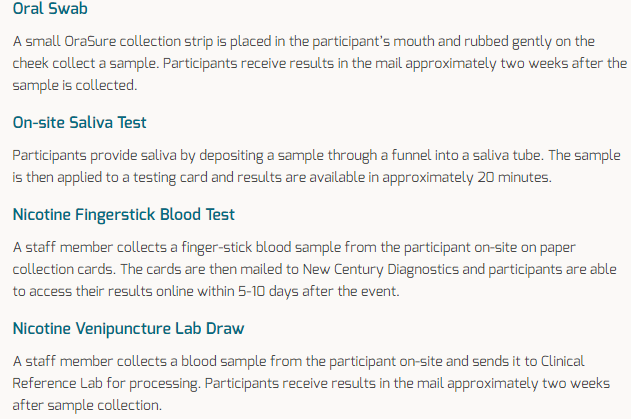
And if those tests are too easily gamed, here’s another one — just in case a few of those lying, cheating employees manage to pass the first set of tests, a la Lance Armstrong. And we wouldn’t put it past them to game the test. After all, they are “talented.”

When you’re done with nicotine, screen them for body fat. Nothing spells “talented employee” like an absence of body fat.

But wait…there’s more. Total Wellness offers a package of seven additional tests that aren’t recommended by the US Preventive Services Task Force. Now how much would you pay?
A lot, as it turns out (not even including follow-up from false positives). The more inappropriate tests you authorize, the more money they make.
Total Wellness is able to do this through their “partnership with Clinical Reference Laboratory.” Translation: they charge you, send some of the money to this other outfit, and keep the rest.
Let’s go test by test down their list.
First are two sets of tests that the USPSTF doesn’t even bother to evaluate because it would never occur to them that anyone, even a doctor, would use them as a screen.


Chem-20s aren’t even recommended as screens by the doctors who get paid to do them.
No one bothers to recommend against CBC screens…because CBC tests aren’t screens. A CBC is a test that actual doctors, not wellness vendors, order for patients who are not feeling well. Get it? As has been well-established for two decades, it’s not a screen. it’s a test. It’s useful for finding the sources of symptoms in a patient who presents in an actual doctor’s office, not for telling healthy people they’re sick. By analogy, if you think you broke your arm, the doctor might x-ray it. That’s a test. But even the dumbest wellness vendor wouldn’t propose X-raying all your employees as a screen to see if their arms are secretly broken.

Helping employees achieve health shouldn’t include lying to them. Quizzify them instead.
Assuming a CBC were used as a screen, it would be much more potentially hazardous than if a doctor were to do the test. Since apparently Total Wellness doesn’t understand the concept of false positives anyway (a prerequisite for being in the screening business is not understanding false positives), they would likely misinterpret the results.
How did Total Wellness manage to get a license as a wellness vendor without knowing the difference between a screen and a test? Simple — you don’t need a license to be a wellness vendor. That means wellness vendors are allowed to charge employers to perform screens on employees that would get doctors in a lot of trouble if they tried to bill insurers for them.
We’d encourage you to visit their site to see a few more proposed screens that the USPSTF doesn’t recommend doing, like TSH, homocysteine, CRP. But let’s end with the mother lode of the screening industry: screens that the USPSTF specifically recommends not doing, but are very profitable for vendors.

The good news is, Total Wellness isn’t overselling this test. They say it is “possibly an indicator of ovarian cancer cells,” which makes the test literally less than useless, due to the overwhelming number of false positives and false negatives from such a test. That’s why no grownup doctors use it as a screen and that’s why the USPSTF says:
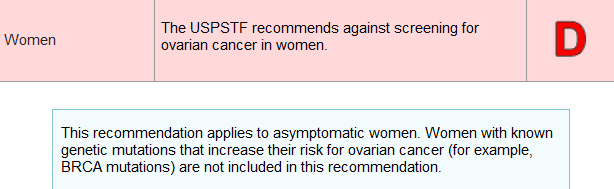
You may say: “Yes, but this ‘D’ recommendation doesn’t apply to women with the BRCA mutation.” Alas, by law, wellness vendors aren’t allowed to ask an employee whether she has a BRCA mutation or any other family history question, dramatically the reducing the already abysmal odds that a screening vendor might do something useful.
Let us close with my favorite test:
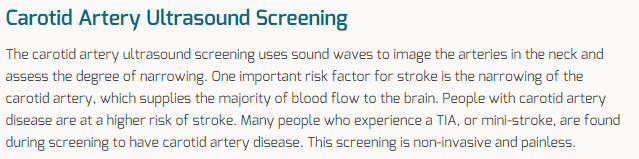
Ask vendors why they do it and they’ll say exactly what this one says: this test is “non-invasive and painless.” Sure. In that respect it’s not unlike palm-reading. The more relevant adjective that applies to both: useless.
If you want to get technical, “D” means less-than-useless.
We do like to close on a high note. Total Wellness is right in that this screening program would indeed help your employees “improve relationships with one another.” Forcing your employees to participate in this costly and misanthropic jihad might lead them to use their “talents” to all get together and revolt–just like at Penn State.
Share this:


We Concede the HERO Report is right–wellness does lose money
The HERO Report concludes that wellness loses money. We agree. We also think it loses much more money than they will admit to, but the news here is not about us. The news is that more than 3 dozen self-described experts and industry leaders representing more than 2 dozen companies have reached consensus that their industry loses money. 
Count us more shocked now than we were by the report’s admission that wellness adversely impacts morale, (This is covered in Installment 1.)
Together, the HERO findings — and our broad consensus with those findings — have serious Affordable Care Act policy implications. The entire basis for the ACA “Safeway Amendment” allowing large fines for (among other things) failure to lose weight is that the cost savings from skinnier employees merits invading their privacy, dignity and automony through medicalizing the workplace (“companies playing doctor” as some have called it). Senate committee hearings, proposed new legislation, and EEOC lawsuits around this provision have all been based on the assumption that wellness saves money. The Senate committee never even lobbed a softball question about that assumption, and even the more hostile witnesses didn’t challenge it.
Recently there was even an eyeball-to-eyeball encounter between the Business Roundtable’s (BRT) Gary Loveman and President Obama. Even though his company (Caesar’s) went bankrupt while embracing wellness as essential to their profitability, Mr. Loveman argued that corporations should be allowed to fine workers who don’t lose weight because the benefit to corporate bottom lines would trump both privacy concerns and the substantial health hazards of these programs.

Gary Loveman, Business Roundtable
Apparently, though, Mr. Loveman’s company went bankrupt slightly faster because of wellness. Yes, along with employees, employers would be better off without forced (highly penalized or incentivized) workplace medicalization. If you fire your wellness vendor, everyone benefits.
Everyone, that is, except the wellness industry denizens who make their money off this. That’s why we think HERO spoke the truth unintentionally. Very few people (I was one of them, having switched sides in 2007 when I saw that data failed to support wellness/disease management) willingly undermine their own incomes for integrity’s sake. So this posting will proceed on the basis that is was a gaffe on their part.
Curiously, this is the second time in recent months wellness industry leaders have accidentally admitted wellness loses money, and the third time they’ve accidentally told the truth and had to walk it back.
Equally curiously, wellness economics information disseminates very slowly if at all — testament in large part to the absolutely brilliant and flawlessly executed strategy by the Wellness Ignorati of ensuring that facts get ignored (hence their name). So even as the vendors are admitting that wellness loses money, benefits consultants and HR executives have once again pushed participation incentives/penalties to new highs, a whopping $693/employee/year, according to a new report.
As for the figures themselves, we are also attaching a spreadsheet so that you—as an employer—can figure this out on your own in your own population, rather than just take HERO’s word for it that wellness loses money.
The costs, according to the HERO report’s own screenshots
First, review the screenshot from the first installment, showing the costs of wellness. The list of cost elements is fairly exhaustive –down to the level of a space allocation for a health fair — though the Committee conveniently left out consulting fees. No surprise there, given that Mercer consultants sit on the committee.

Then, compare the list of costs in that screenshot to costs in this second screenshot, from Page 15 of the HERO Report. That comparison won’t take long because only one program cost is listed: “$1.50 — Cost of EHM [Employee Health Management] PMPM fees.”

The two lists of costs are totally inconsistent. Suddenly, when it comes time to measure ROI on page 15, most of the costs on Page 10 have disappeared…
The reason for that? The savings from wellness – in the HERO committee’s own words below – are so trivial that in order for wellness to produce savings, the second screenshot has to ignore most of the costs listed on the first one. Whereas the first screenshot listed three categories of costs covering 12 different line items (13 if you count the AWOL consulting expenses), the second screenshot says you should only count one item: vendor fees.
And by the way, the vendor fees themselves self-invalidate. At about $40 per employee per year, biometric screening fees alone cost more than the stated $1.50 per person per month, or $18/year. Yet $18/year is the total they list for all fees combined, including the $40 screenings.
Rather than point out the many cost elements on the first screenshot missing from the second, we’ll invite you to use our spreadsheet and enter your own data instead of theirs. Simply fill in your own direct costs of wellness.
Whatever number you get will dramatically understate your true costs because there are three elements of cost that we aren’t counting on this spreadsheet:
- What their spreadsheet call the “indirect” costs, which we have listed as “$0”,
- What their spreadsheet calls the “tangential” costs of damaged reputations and employee morale—ask Honeywell whether they brag about their wellness fines and lawsuit in their recruiting (and, ironically, I just returned from a consult for Penn State itself, where the adverse morale impact still overhangs employee relations);
- The massive costs of overscreening, overdiagnosis, and overtreatment generated by biometric screens – all of which are conducted far more often than the USPSTF recommends and most of which (as in the examples we occasionally post on this site) include screens that no one other than a wellness vendor or consultant would ever propose.
The financial benefits
Against those costs are the benefits. Page 15 lists some alleged benefits of wellness that leave us scratching our heads.
Generic substitution? How does that have anything to do with wellness? Quite the contrary, obsessing with wellness might take your eye off the generic substitution ball, and cause you to miss some tiering opportunities. (The company that is best at tiering its pharmacy benefit, Procter & Gamble, is also known for its current employee-friendly wellness program, sort of the anti-Honeywell.) And has anyone ever seen one health risk assessment (HRA) or participated in one health screen that even mentioned generic substitution?
Outpatient procedures? Try to find one person in your organization whose outpatient procedure could have been prevented by eating more broccoli.
ER visits? Maybe they decline. But maybe they increase, due to sports injuries sustained by newly activated employees. And someone who really is eating more broccoli might slice their finger chopping the crowns off the stalks. (Anybody who voluntarily eats the crowns with the stalks still attached doesn’t need a wellness program.)
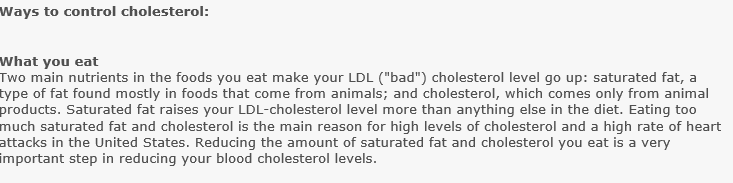
And then the catch-all: savings through “overall wiser use of healthcare.” Come again? This is an industry that — as well documented by their own words captured on this website — makes its living telling employees to do exactly the opposite: go get checkups you don’t need and won’t benefit from, submit to screens far in excess of USPSTF guidelines so that vendors can brag about how many sick people they find, yo-yo diet for “biggest loser contests” and weigh-ins, like ShapeUp’s get-thin-quick 8-week crash-diet programs, and avoid eating fat and cholesterol and load up on carbs instead.
Perhaps what the HERO committee intends is that since employees largely don’t trust their employers, they will do the opposite of the recommendations.
The savings from wellness

When wellness doesn’t add up, Quizzify does
We are going to leave out respiratory savings. To capture those, charge a smoking differential and make smoking cessation available. Done. You don’t need an intrusive and expensive wellness program for that. (We are big believers in a “smoking differential” for employee-paid premiums. It makes sense for all the reasons weight loss and other wellness programs don’t.)
Instead let’s focus on people who have cardiometabolic issues. In order to lose weight and reduce their risk, they need to switch to a low-fat, low-cholesterol diet.
Oh, my bad! That is sooo 2014! While most of us not in the wellness business already knew the dangers of eating too many simple carbohydrates long before now, even the most ardent card-carrying member of the Wellness Ignorati learned in March that all their dietary advice has been wrong — to go along with their incorrect screening and checkup advice. Yet recommending exactly the wrong things hasn’t stopped most vendors from claiming massive savings. See “On the (Even) Lighter Side” and The Smoking Guns for examples.
Now let’s look at all the hospitalizations that can be avoided through wellness – heart attacks, angina, hypertension, and…um, hmm…did we mention heart attacks? You’re thinking: “What about diabetes events?” OK, we’ll add diabetes, only because the HERO report lists it and we want to be true to the report. But diabetes complications admissions (like CHF, which they also list) are a disease management issue, not a wellness issue — you can’t prevent or manage diabetic neuropathy or left-ventricular heart failure by eating more broccoli. The $1.50 PMPM price would not be high enough to also include disease management, and in any event what one does in disease management for complex cases is much different from a typical “pry, poke, prod and punish” wellness program.
And “straight” diabetes admissions are usually the result of diabetic employees pushing their blood sugar too low by over-medicating themselves—often in a good-faith effort to hit Hba1c “targets” that your wellness program set, no doubt on the advice of your consultants. Low blood sugar won’t do much for productivity either. Without the advice of a company specializing in diabetes, you’re likely to get this result. (And if this is the first you are hearing about the likely causes of “straight” diabetes ER visits and admissions, you should consider such an option.)
So we are now adding all ischemic and hypertensive heart events and diabetes as what they call “potentially preventable hospitalizations.” How many of your hospitalizations are for those items? Simply run the primary codes for those events, being careful not to double-count professional fees, to see how many you had. Here’s what happens when you do it for the United States as a whole.

Next, divide the relevant figure (Private insurance, 432,065) by the total number of privately insured discharges in the US (7,360,684)

So—using the HERO Committee’s own acknowledgment of the undeniable fact that wellness can only impact wellness-sensitive medical events (WSMEs) and using the diseases that the report says to use — less than 6% of admissions are WSMEs. If your non-birth-event admit rate is, as the report says, 45 per 1000, then you have 2.6 admissions per 1000 in non-smoking-related WSMEs. Once again, don’t take our word for this. Run this analysis on your own admissions. You won’t be surprised by how few there are. Do you even know anyone admitted to the hospital for these things, especially where the admissions could have been prevented with a few more screens, HRA and servings of broccoli?
Shameless plug: We are happy to do this WSME analysis for you. We do these all the time. It’s $4000. We can also tell you your savings, ROI, trend, comparison to others over time, and more. We also adjust for the major secular decline in cardiac events that has been taking place anyway for decades that the Committee seems to be unaware of, sort of surprising given their alleged expertise in cardiac risk reduction.
Let’s say you run this analysis with or without our help, and a rate/1000 similar to the US average pops up. The HERO report says you need to reduce this rate by “only 1 or 1.25 admissions.” But that’s almost half of your total 2.6/1000 WSMEs! And in any event, you’ve probably seen by now – if you downloaded the spreadsheet – that Page 15 seriously underestimates your wellness program expenses, meaning your breakeven reduction needs to be much higher than “only 1 or 1.25.” It’s probably higher than the number of admissions you have available to be reduced.
You can enter both your admissions per 1000 and the reduction in that figure you achieved directly into the spreadsheet.
But for now let’s very generously assume their expenses are right, and you only need to reduce admissions by 1 to succeed. How hard would it be to go from 2.6 to 1.6 WSMEs per 1000, a reduction of 39%? Here are five things to keep in mind:
- Your true engagement rate itself is probably much lower than that aforementioned 39%, not including people who simply participate for the money, and the people who are engaged generally aren’t the ones who would crash anyway;
- A big chunk of all heart attacks can’t be predicted at all, and certainly not now that law prohibits asking about family history;
- Even events that can be generally predicted can’t necessarily be prevented (we all know people who are “walking heart attacks” and have been ignoring advice for years);
- “Straight” diabetes admissions are more likely to be for over-control than under-control;
- In 7 years of measuring this, we have never seen a reduction in WSMEs remotely approaching 39% after adjusting for secular declines in cardiac events that take place even without a wellness program (which the report overlooks)
See The Million Dollar Workplace Wellness Heart Attack Screen in Health Affairs for a more in-depth view of the math. But the entire committee writing this HERO report insists wellness saves money, right? So, it’s us against them, right? A he said-she said? Wrong. Here’s the denouement. On Page 23, the report’s own example shows that wellness only saves $0.99 PMPM! That figure, by the way, is grossly overstated for reasons we will get to when we deconstruct Page 23. But for the time being, here it is.

So even their own comparison of their own overstated savings estimates to their own understated cost estimates reveal: wellness is a loser financially. They have already admitted it is a loser for employee relations. Funny — if we had made these two arguments, they would attack us. But they are making these two arguments themselves.
Once again, the Surviving Workplace Wellness mantra applies: “In wellness, you don’t have to challenge the data to invalidate it. You merely have to read the data. It will invalidate itself.”
Where does this leave us?
To summarize, pages 10, 15 and 23 combined tell us:
- Even before adding page 10’s cost categories back to page 15, costs are $1.50 PMPM;
- Savings are only $0.99 PMPM, meaning wellness loses $0.51 PMPM;
- The first two points are not our estimates — they’re their estimates and are far more optimistic than ours;
- Adding back the cost elements on page 10 to page 15, and then on Page 23 removing the respiratory savings, adjusting for secular decline in WSMEs, and adding in all the extra doctor visits would create a much larger loss from wellness;
- And they have already admitted that “pry, poke, prod and punish” programs are bad for morale.
Now you see why RAND’s PepsiCo study showed a negative ROI from wellness: It’s because there is a negative ROI from wellness, which no one disputes any more.
And you see the reason we asked the question in the last installment: Why would any company “do wellness” if the biggest proponents of wellness – people who make their living off it – admit that it’s a waste of money that adversely impacts morale?
Likewise, now you see why wellness vendors and consultants get “outed” all the time on this site, advocate savings methodologies designed to obfuscate rather than enlighten, and try to prevent you from learning that we exist. We are not saying they are sociopaths. Sociopaths lie for no reason. Conversely, wellness vendors and consultants are just trying to keep their jobs. Bleeding customers or clients dry is only a good job security plan if indeed the customers or clients never find out about it.
But now customers know how their own vendors and consultants really feel. And we can all work together to dismantle these programs and start doing wellness for employees instead of to them.
Poll: Cue the Wellness Industry Response…
We have a little dispute with RAND’s Soeren Mattke. He says the wellness industry modus operandi is, whenever one claim is disproven, to switch to another claim.
We say the reason they are known as the Wellness Ignorati is, their strategy is to ignore facts, including ones they admit, and they will simply just ignore this posting so as not to create a news cycle, rather than switch claims.
There is also the chance that they admit that their own financial model is accurate. This would demonstrate integrity, a quality historically in short supply in this field.
So vote early (but not often)…
While we aren’t deconstructing this as a sales tool for Quizzify. But as it happens, Quizzify is literally the only wellness program that does pay for itself. Don’t take our word for it. Quizzify is 100% guaranteed to save money and improve morale/engagement–exactly the opposite of what the HERO report says usually happens. No other wellness program is either, let alone both.

Quizzify: the antidote to poke-prod-pry-punish wellness
Share this:

Health Advocate Caught in the Act…
…Of getting it right!
Proof that wellness can be both useful & fun.
People think this site is all about “outing” scoundrels, but we’re just presenting facts, usually in the form of screen shots, that can’t be denied. That’s why none of the organizations or people “profiled” have ever sued us, despite our entreaties. However, sometimes the facts are actually good, and we want to recognize that too.
For this posting let’s set aside policy/economics issues and just focus on on-site execution of screenings. I attended a Health Advocate biometric screening which was being held in my neighborhood, to attract potential customers, meaning the attendees were comped but had been invited on the hopes that they would set up a screening event. The first thing they got right was the list of tests. The manager on site, Rich Prall, listed the usual tests. I then asked what other tests they had available. As you know, many vendors “profiled” on this site push completely inappropriate tests, that even if they were free would cause more harm than good. We have three more vendors in the queue too, each worse than the previous one in pushing tests that the US Preventive Services Task Force specifically says not to do.
Mr. Prall listed the same bunch of tests that the USPSTF recommends not doing, but then volunteered without being prompted that the right answer was indeed for an employer not to do them. (“If you do them at all, it should be at the doctor’s office. What’s an employer going to do about your potassium level, anyway?”) So Mr. Prall was willing to sacrifice revenues for integrity. Literally, this is the first time we’ve seen that happen. What Mr. Prall was appropriately shying away from, other vendors call their “Gold” or “Platinum” packages.
Next, I did some height/weight stuff. They had a device that measures body fat (and BMI, which of course is a bit squirrelly as a measure, but leave that aside for now). The body fat measurement was almost 20%. I am usually 2-3 points lower. It could have been the inaccuracy of the machine or perhaps because this winter’s weather has crimped my workout routine, but I expressed a little concern. The screener said: “Actually as you get older (I’m 59), you want to have a little body fat.” That is, once again, the right answer,an answer which shockingly few vendors are aware of.
Finally, I did the fingerstick. The screener explained it all very thoroughly, understood the distinction between fasting and non-fasting, and did everything quite well. Unlike Vik’s experience with Provant’s six-week delay, he ran the numbers right on the spot.
Even though a finger-stick is not particularly accurate, my values were what they usually are, except cholesterol. My cholesterol, at 127, was 30 points lower than usual. I expressed concern that a cholesterol value could be too low, and the screener said he didn’t know what too low was, but didn’t think it was an issue at 127.
So I googled it, and indeed there is a “too low,” but it is south of 127. Apparently people with too-low cholesterol tend to do impulsively self-destructive things, like attempt suicide or drive recklessly. I’ve never done anything particularly impulsive/self-destructive, unless one counts running this blog. So, once again, the Health Advocate person was right. That was 3 in a row, which might be a record for wellness vendors.
I could have talked to a counselor about the numbers but there was a bit of a line to get into these private areas, and in any event, I was so pleased with these guys that I didn’t want to risk bursting my balloon with one more conversation. (Nor have I visited their website to see if they make wacky ROI claims. Let me just live the moment, please…)
So I idenitifed myself (I hadn’t misrepresented myself earlier–remember, Vik and I are in the “integrity segment” of the market — but I just hadn’t given the full story) and congratulated them on best-in-class job of screening.
Literally every other vendor on this site could learn a lot from Health Advocate. I know I did.
Share this:

Apologies to HERO and the Wellness Ignorati!
(March 18) Due to vacation schedules, we are taking a brief time-out from both our “profiles” of vendors and our serial analysis of the HERO report (Part 1 was our most popular posting ever — don’t forget to “Follow” us so as not to miss a single installment.).
Knowledge + fun + respect = happiness + health
This posting is to apologize to the HERO Wellness Ignorati. A comment our posting on the HERO report said we shouldn’t call the Wellness Ignorati “ignorant.” We aren’t calling them ignorant and we apologize if we were misunderstood. Since it has sold almost 6000 copies despite Wiley’s decision to price it to finance their retirement accounts, we thought by now most people had read Cracking Health Costs. That was the book in which the term was coined. It emphatically does NOT mean “ignorant.” We would never call them “ignorant” and the Ignorati are anything but. Quite the contrary, they are smart enough to realize that facts are their worst nightmare.
Or as Tom Friedman said in today’s New York Times, “We wouldn’t be human if we didn’t outright ignore facts that make a laughingstock of our hopes.” (I actually did the opposite. See the blog post: Founding Father of Disease Management Astonishingly Declares: “My Kid Is Ugly.” Dee Edington did something very similar. Both of us were simply not willing to sacrifice our integrity for filthy lucre.)
The Wellness Ignorati are more than smart. They are brilliant. They have elevated fact-ignoring to an art form.
They realize that enough people seeing this site will derail their HR-financed gravy train, so they keep to a strict strategy of not even acknowledging that facts exist. Example: us. Not a mention of our existence in their entire report. A brilliant strategy for them, and one that flatters us immensely. Obviously, in the massive tome they just published, if they thought we were wrong, they could have said: “They Said What and its authors offer a competing view, but it’s wrong because…”
Fact suppression is of course the opposite of what we do — we want facts to be front-and-center. We welcome transparency and debate, though the latter is tough because people either repeatedly decline (Ron Goetzel) or, after the debate, wouldn’t agree to release the recording (Michael O’Donnell).
Instead they simply disappear us. This is despite the fact that the two of us (plus our colleagues like Jon Robison and Tom Emerick) have sold more books, been interviewed in more major publications, authored more articles in high-impact journals than all the Ignorati combined.

Do you employees know when to just say “no” when it comes to medical care?
I’ll close with a f’rinstance. We copied a screenshot from that report showing that the Ignorati finally admitted that “pry, poke, prod and punish” programs damage morale. This guy looked at that screenshot, and put a comment on our post that this screenshot didn’t exist, but rather it was our propaganda. Someone else said the screenshot was out of context, so we invite everyone to read the context.
The bottom line is, of course the HERO Report is correct about the cost of morale damage. Coincidentally, I am writing this from State College, Pennsylvania. I am here as an honored guest of the Penn State Faculty Benefits Committee, feted for my role in helping to free them from the Goetzel/Highmark forced wellness program (featuring those immortal testicle checks). Try telling Penn State there’s no morale impact. (For those of you thinking of sending your kids here, do it! I’ve never been to a university where the professors were more passionate about teaching their students than PSU–despite what happened to them in 2013.)
“Everyone is entitled to their own opinions, but not to their own facts.”
–Daniel Patrick Moynihan
Share this:

A Short Painless Primer on the Value of Screening
At the risk of knocking our second-most-widely viewed posting (the first of several analyses of the HERO report) off our front page, this is a brief and amusing lesson on the value of screening
If you like this, you’ll love this–it will also tickle your funny bone.

 They Said What?