Home » 2016 (Page 7)
Yearly Archives: 2016
This Is a Little Embarrassing But…
…Apparently a “Pulse” in which I tell people not to read my books Why Nobody Believes the Numbers, Cracking Health Costs, and Surviving Workplace Wellness is on its way to becoming my most popular. (Judging from our sales figures for Surviving, the marketplace seems to have reached that same conclusion on its own.)
However, it is the case that Unaccountable: What Hospitals Won’t Tell You and How Transparency Can Revolutionize Health Care presents what amounts to the business case for Quizzify, and ultimately Quizzify is how we keep the lights on to write They Said What? so far be it from me to discourage you from buying anything that makes you more likely to sign up for Quizzify.
Share this:

Is Katherine “3.27-to-1” Baicker Coming in from the Dark Side?
In the workplace wellness epidemic, Harvard School of Public Health Professor Katherine Baicker is Patient Zero. However, she may soon come up with the cure for the disease she spread. This would be like when the inventor of the PSA test said it shouldn’t be used.
By way of background, her original dalliance with wellness in Health Affairs–timed and designed to get the Business Roundtable’s “Safeway Amendment” allowing a 30% to 50% clawback of insurance premiums into the Affordable Care Act–introduced the infamous “3.27-to-1 ROI” into wellness vendor vernacular. That was almost seven years ago, but wellness vendors continue to cite this figure as gospel even though RAND demolished it and Professor Baicker herself walked it back four times.
For good reason, as it turns out — this Pulse posting says it all. The 10-to-30-year-old studies comprising her meta-analysis are even more amusing in retrospect. Lots of overcreening, overreliance on now-discredited BMIs, and of course recommendations for low-fat diets–even for employees with metabolic syndrome. Most published in third-tier journals, by the Wellness Ignorati and their friends.
And almost every one of them compared active motivated participants to non-participants. 6 years ago we suspected that design was invalid. Today we know for certain, thanks to Health Fitness Corporation and Aetna. Two more elegant studies to prove that point could not be imagined. No “investigator bias” or “publication bias” there, since both were hoping for the opposite finding.
However, mindful of her reputation, Professor Baicker recently announced (in as many words) that she is going to redeem herself.
Wellness Workdays
Her protestation that she is no longer interested in wellness appears to have taken a backseat to her desire to remove this one blot–granted, a blot of Lady MacBeth proportions–on an otherwise excellent curriculum vitae.
She is going to do a study for BJ’s Wholesale Club, in conjunction with an outfit called Wellness Workdays. Wellness Workdays is a classic wellness vendor. That is to say, they won’t be winning a Nobel Prize anytime soon, or even a spelling bee. Let’s start by examining their analytic and clinical prowess.
To start with, their “White Paper” doesn’t just quote the infamous 3.27-to-1. They’ve upped the ante to 6.00 to 1, maintaining the two significant digits while almost doubling the savings. How? They’ve added the 3.27-to-1 for healthcare savings to the 2.73-to-1 for absenteeism reduction from that same 2010 study. Those two separate conclusions were reached from almost totally different studies. Anyone can tell that from reading the original. Anyone, that is, except Wellness Workdays.
Their analytic qualifications are matched only by their clinical qualifications. One member of their medical advisory board is Chief of Allergy and Clinical Immunology at the Indian River Medical Center in Vero Beach, Florida. While this expertise is not exactly central to the mission of the pry,poke, and prod industry, in all fairness it should be noted that the Indian River Medical Center runs one of the best allergy programs in all of Vero Beach.
Another is an OB-GYN in Colorado. Perhaps this advisor will develop a protocol for employees who want to be screened and induced at the same time. A third consults to orthopedists at “Lennox Hill Hospital,” a role that probably doesn’t require too much heavy lifting, because there is no hospital by that name.

This guy is also an expert on steroids and other performance-enhancing products, and has “published rseveral esearch studies.”

So they can’t spell, can’t proofread, can’t understand study design, and can’t cobble together a qualified advisory board. In other words, to paraphrase the immortal words of those great philosophers Gilbert & Sullivan, they are the very model of a modern clueless wellness vendor.
Katherine Baicker’s proposed study design
We are confident she is going to get it right this time and “discover” that wellness loses money. By selecting a vendor of the caliber of Wellness Workdays, she isn’t leaving anything to chance.
Having learned her lesson — and I’ve been pretty conscientious about forwarding helpful study design materials to guide her — she will certainly tally wellness-sensitive medical events across the entire population. More importantly, here’s what she is not going to do with this study:
- “Match” volunteer participants to — you guessed it — non-participants. This nonsense that keeps the wellness industry afloat, and Professor Baicker no doubt sees right through it;
- List the “unobservable differences” between participants and non-participants as a “limitation.” It’s not a limitation. It’s a baldfaced lie. It is now known that this face-invalid study design is truly invalid. She wouldn’t lie, right? That would damage the reputation of the entire Harvard School of Public Health in what will certainly be a high-profile study;
- Show a high ROI even though the change in health risk factors is trivial. This of course is the stock-in-trade of the Koop Award committee, but a real academic researcher would know better;
- Compare the costs to “trend” and say “costs were projected to rise by [this amount] but they only rose by [this lower amount], and therefore a huge pile of money was saved”;
- Attribute all cost differences to the program, whereas a real researcher would look only at utilization differences that could actually be attributed to urging employees to eat more broccoli. (By contrast, one of the studies in her previous meta-analysis credited the wellness program with a reduction in cat scratch fever.)
How do we know she isn’t going to make up phony outcomes again? She “tipped her hand” with the Oregon Medicaid lottery study. A terrific natural experiment, her study emphasized the value of a “lottery control,” meaning every subject had the same intent-to-treat. Exactly the opposite of the wellness participants-vs-non-participants study design.
Further, who wants to be known as the Typhoid Mary of workplace wellness? The Oregon study was an excellent one, so naturally it showed exactly the opposite of what wellness studies show. Specifically, facilitating access to care doesn’t reduce the cost of care or improve physical health status. And that was for people — newly minted Medicaid recipients — who didn’t have any insurance to begin with. Wellness, of course, takes employees who already have plenty of access to care and drown them in even more, unwanted and largely unneeded, screenings and checkups.
As for BJ’s Wholesale Club, I suspect they got suckered into this. Who volunteers to become the next Pepsico, a case study of how wellness programs fail? BJ’s obviously isn’t studying their own competitors: Target has one of the best programs in the country — precisely because they are far too smart to use a vendor like Wellness Workdays.
In any case, we look forward to her research study. Or perhaps, since this is in conjunction with Wellness Workdays, to rseveral esearch studies.
Share this:

Bad News: More Good News about Wellness
It is with a heavy heart that I report WELCOA’s new management appears to be competent and honest.
WELCOA has apparently joined the “integrity segment” of the industry. Alas, this is the third time in a month I’ve had to say something nice about wellness, and if this keeps up I will run out of scoundrels to expose.* My carefully cultivated Larry David-meets-Erin Brockovich image could morph into Dale Carnegie-meets-Mary Poppins.
By all accounts, their new executive director, Ryan Picarella, is not only competent and honest. As an added bonus, he even knows how to spell.
This last item may not sound like a ringing endorsement, sort of like Benjamin telling Mrs. Robinson he considers her to be among the most attractive of all of his parents’ friends. However, at WELCOA it represents a huge improvement, because the previous ED, David Hunnicutt, was both grammatically and phonetically challenged. Alert readers may recall that Mr. Hunnicutt claimed that WELCOA was founded by the inventor of the all-you-can-eat self-service restaurant, Warren Buffet. And our “This Is Your Brain on Wellness” feature would almost not be possible without some of Mr. Hunnicutt’s wellness-meets-Yogi Berra sentence constructions.

Here are the four datapoints behind my read of the tea leaves that WELCOA is joining what is becoming a slightly crowded integrity segment.
First, if you google Mr. Picarella, you’ll find that he comes from outside the wellness industry. People outside the wellness industry are more likely to actually review the data than industry insiders. And as invariably happens when someone with a triple-digit IQ reviews the data on “pry, poke and prod,” they realize most of it is made up.
Second, the WELCOA website has a new look, reflecting the pivot to the integrity segment. It is about wellness culture now, with “pry, poke and prod” finally banished to the attic with the crazy aunt and the Koop Award committee. WELCOA is positioning for the next generation of doing wellness for employees instead of to them. Or as we say in Cracking Health Costs, “Would a general leading an army into battle rather have troops with low morale, or troops with low cholesterol?”
Third, if you follow this industry carefully, you’ll see WELCOA has distanced itself from the American Journal of Health Promotion, the wellness industry trade rag featured in previous columns here for accidentally telling the truth on two occasions, one of which they walked back when they realized they had made a true statement.
Fourth and most importantly, they have removed David Hunnicutt’s Nebraska/Health Fitness Corporation (HFC) write-up from the WELCOA website. As word of “Cancergate” and Ron Goetzel’s botched data falsification and cover-up spreads — the state of Nebraska recently fired HFC — WELCOA apparently wants to be on the right side of this scandal. We applaud them for that.
Never thought I’d be using “WELCOA” and “applaud” in the same paragraph…
Finally, I do hear a lot of buzz in this field, and the buzz around WELCOA is distinctly positive these days. Members of the Welligentsia, who used to send me anecdotes for inclusion in “This Is Your Brain on Wellness” now routinely tell me what a great job they are doing.
And for that, I swallow hard and very reluctantly wish them well.
*Fortunately, as I learned a few weeks ago, I can still count on Ron Goetzel and his cronies to come through in the clutch when I need new material. For instance, they recently doubled down on dishonesty by attempting to circulate a poison pen” letter about me to the media and somehow thinking it wouldn’t be exposed. After it did get exposed, they admitted it had no basis in fact.
Mind you, I’m not calling anyone liars here. I’m just saying that a beam of light leaving “honesty” wouldn’t reach this cabal for several seconds. And I love being the subject of their innumerate rants. It is the closest I will ever come to realizing my childhood dream of being on Nixon’s enemies list.
Or it may be they aren’t consciously lying, in which case their math skills couldn’t get them a job as the “before” muppet on Sesame Street.
Share this:

A great big “thank you” to Employee Benefit News
Occasionally our posts are totally pukey and I’m afraid this is one of them.
Employee Benefit News just listed Cracking Health Costs as one of their must-reads for benefits professionals for Summer 2016. So we have to do the thing which we hate doing most on They Said What, which is be polite. So, thank you to Employee Benefit News. (Cracking Health Costs, along with its companion, the trade-bestselling Why Nobody Believes the Numbers, can be purchased on Amazon by clicking through on the titles.)
As long as we are thanking Employee Benefit News and purging our system of excess politeness, we gotta give them two thumbs up for publishing “Why Employers Should Ditch Biggest Loser Contests.” We received about 28 inquiries from that one. This is helpful for the unique Quizzify sales strategy, which is to strategically sit around and wait for the phone to ring. And it did. And it does. (Not throwing a lot of money at sales and marketing allows us to keep costs and prices down.)
And we are very grateful to everyone who has been contacting us both from that article and others…but not half as grateful as you will be when you implement a program that employees actually like so much that they don’t call you to whine about it.
That may not appear to be a resounding statement of confidence in our own offering. However, we are in the “integrity segment,” which means we can’t lie. Plus, in the wellness field, no other company can claim ALL of the following: decent participation with modest incentives, good feedback, few/no complaints, the moniker of the leading medical school (Harvard), and the Validation Institute-validated guaranteed certainty of actual savings.
Actually no other company can claim more than one or two of those. But that doesn’t stop them.
Share this:
Wall Street Journal: RIP to “Biggest Loser” Programs?
Two separate reports confirm that employers have finally connected their computers to the internet.
First, the Wall Street Journal just reported that employers are cutting back on wellness programs. This especially includes the very same crash-dieting contests that we just invalidated in Employee Benefit News on Thursday. Those Virgin Pulse/HealthyWage abominations should be right up there with the Pontiac Aztek, New Coke, DDT, hair-in-a-can, and hands-free toilet paper on Time’s list of 50 inventions that never should have been invented. Here is an excerpt:
As employers begin to analyze return-on-investment and participation data, they “may be taking a step back,” said Evren Esen, director of survey programs at SHRM, the world’s largest society for human-resources professionals.
Employers “may be taking a step back”? As an understatement, that ranks with Lyndon Johnson’s 1965 comment that “killing, rioting, and looting are contrary to the best traditions of this country.” (And you thought we only dissed GOP politicians like Donald “Boom Boom” Trump. Quite the contrary. We are equal opportunity jerks.)
Second, after years of steady and hefty increases in employee incentives/penalties, the average non-participation forfeiture for wellness programs fell in 2015, from $693 to $651, according to the National Business Group on Health. So now it is only about ten times the total that employers spend on wellness-sensitive medical events (about $60 PEPY).
This decline was reported three months ago. It took a while for me to post it because it took a while for me to dig it up. Whereas previous NBGH annual surveys — showing the aforementioned massive increases — received a great deal of coverage in the media, NBGH buried the results of this year’s study, due to the decline in incentives. Publicizing facts is contrary to the best traditions of the wellness ignorati, of which NBGH is a founding member.
The bad news in the NBGH report is that even as average incentives declined, median incentives continue to rise. The good news is that NBGH actually understands the difference between the two words “average” and “median.” Quite an impressive feat, by their standards. It could be that they’ve finally taken my advice and hired a smart person.
If employers and consulting firms start taking that same advice, it could be the end of “pry, poke and prod,”…and a great shot in the arm for Quizzify.
Actually, just to clarify, we are quite supportive of screening according to actual clinical guidelines. Within the next month or two, Quizzify will be executing several partnership agreements with vendors to offer screening according to guidelines…and to use Quizzify for employees who are not due for screenings. If you are a vendor and would like to offer a similar program or an employer and would like to buy one, just reach out to us with an email to info@quizzify.com.
We promise that a smart person will follow up.
Share this:
Wellness Industry Leaders Help the CDC Build a Maginot Line Against Disease
If you listen to the Centers for Disease Control and Prevention (CDC), you would think chronic disease is the main health problem we face, and workplace wellness is the main weapon we have to face it with. I know what you’re thinking (at least for the former): isn’t it?
Nope. The country’s main health problem — at least among those addressable by the CDC as opposed to by Congress — is something else altogether, essentially the opposite of what the Wellness Ignorati say it is. But before we reveal the answer, let’s review the CDC’s chronic disease talking points, which naturally are hilarious, as most talking points in support of wellness tend to be.
First, in the screenshot below, they quote the “arresting” statistic that “7 out of 10 deaths are due to chronic disease.” Um, that is called civilization, folks. Countries where 7 out of 10 deaths are due to causes other than chronic disease would love to have this arresting statistic. In case anyone doesn’t believe that the CDC — or indeed, that any human being other than a wellness vendor — could possibly be so stupid as to think civilization is a problem that needs solving, here is the screenshot, and here is the link.

Second, they recently bumped the “75% of costs are due to chronic disease” urban legend in the first line of the screenshot to a mind-boggling 86%. Surely even the dumbest CDC employee can’t believe this. Surely they can back-of-the-envelope an estimate that birth events, preventive care, and trauma alone account for much more than 14% of spending. Birth events by themselves account for about 16% of all hospital discharges.
Meanwhile, wellness vendors are now flogging those “7 of 10 deaths” and “86% of the nation’s healthcare cost” statistics to lobby Congress for wellness subsidies. Congress had wisely stopped funding one of the CDC’s many wellness boondoggles (Work@Health). That didn’t sit well with the industry, so they are starting a lobbying campaign. Fortunately, if their lobbying prowess is anything like their wellness prowess, the budget deficit is not likely to increase anytime soon. The letter reads:

Here is the real problem
This would all be very amusing, as the CDC and wellness vendors converge on these two statistics like monarch butterflies of innumeracy, except that our health is stake. And that (finally) brings me to the title of this posting.
The Maginot Line, as you might recall, proved about as worthless combating the Nazis as the CDC’s wellness obsession is today in combating the real healthcare problem: a massive explosion in blood-borne infections, or septicemia. While the CDC, wellness vendors, and of course the Health Enhancement Research Organization are all atwitter about diabetes and heart attacks (which none of these people can prevent and whose admissions in combination have been in check in all subpopulations for many years), consider ICD-9 038.9, Septicemia. There were 928,000 inpatient cases in 2013, the last year available.

It’s not just that it’s huge, almost twice as costly as the next most costly ICD9. It’s also exploding:

- has increased almost sevenfold;
- is now the by far the largest single diagnosis code;
- twice as costly as the second-largest…
- …and its growth is accelerating?
More importantly, why doesn’t anyone at the CDC seem to care about pathogens? This is what they are supposed to do–identify pathogens and prevent, contain or eradicate them.
Literally anyone (almost 1 in 300 people annually) could get a cut or injury or infection in the hospital, get septicemia, and, 13% of the time, die. Yet the CDC is blissfully unaware of this. If you’ve heard this “blissfully unaware” song before, the CDC’s Wellness Watchdogs also completely missed the workplace opioid epidemic. That happened right under their noses. The drugs were legal, prescriptions were filled, and PBMs paid for them.
Where was the CDC when this was happening? The same place the wellness industry was: nowhere. Most health risk assessments queried about illegal drug use and alcohol, but abuse of legal opioids? Off the table.
We can’t let the CDC overlook this epidemic too, due to their singularly misguided wellness obsession. We need to embarrass them into action–please send this note around to as many people as possible.
And if you’re wondering how the CDC (with the very notable exception of NIOSH!) has dumbed down so fast, so was I. These were, after all, the people who rid the US of malaria and rid the world of smallpox. So I did a little search on their site.
The first thing I noticed was that their workplace wellness information is “science-based.” That was the giveaway. In wellness, the phrase “science-based” means “not science-based.” To use one example, Wellsteps’ claim that their ROI model is “based on every ROI study ever published.” This translates as: “We made the whole thing up.”
Additionally, the references the CDC relied upon should look familiar. Besides being comprised of the usual serial liars, serial cheaters, and serial idiots, the list of references ends with Katherine Baicker, truly the Typhoid Mary of the workplace wellness epidemic–and hence one of the people most responsible for advising the CDC to create the Maginot Line that failed to prevent or event identify the opioid and bacteria epidemics that have taken millions more lives than workplace wellness has ever saved.
By the way, while you were reading this and the links, 6 to 12 more people (depending on how fast you read) just contracted a hospital-acquired infection, with probably 1 or 2 people dying from it.
To put that in perspective, the comparable statistics for wellness would be that 6 to 12 vendors just lied to their prospects, with 1 or 2 prospects believing them.
Share this:

Employee Benefit News Essay: To Call Corporate Crash-Dieting Contests a “Joke” Is an Insult to Jokes
The first line in this Employee Benefit News essay says it all. And yet these contests still exist, thus showing that some corporate IT department directors should be fired, for failing to connect their organizations to the internet.
And, as our recent HealthyWage-Schlumberger write-up showed, the results are fabricated anyway. The odds that the HealthyWage results were legitimate are about the same as the odds of winning the lottery 1000 times.
Share this:
In wellness, stupid is the new black.
A young friend of mine participated in his first wellness program recently. Being too young and idealistic to understand how the wellness industry works, he actually thought he would learn something, so he didn’t lie on the health risk assessment. (I am not allowed to use the name of his company. He is not so young or idealistic not to realize that dissing his company’s eminently dissable wellness program could get him fired.)
Since he listed “diabetes” as his disease, he got a call from a coach to “help” him with it. He was young and idealistic, so he answered the phone. She was very impressed with how well he managed it. His BMI is about 22, and his hobbies include basketball, which he played at the college level, and swimming. She said if he kept this up, he might be able to get off insulin.
“Off insulin? I can’t get off insulin,” he replied.
“I’ve seen many people get off insulin,” she said.
It turned out that his diabetes coach had never heard of Type 1 diabetes. He spent the next 15 minutes explaining to her the difference between Type 1 and Type 2 diabetes. “Al, my company is billing out my time at $500/hour, I’m putting in 60-hour weeks…and spending my time explaining to diabetes coaches how diabetes works.”
If the people who run Schlumberger’s wellness program were actually producing drilling equipment, oil slicks would cover most of North Dakota by now.
Recently we observed what a fabulously stupid, pointless, counterproductive and harmful idea it was to run a crash-dieting contest. We used HealthyWage as an example of a company that does this, and should be avoided. We recommended doing wellness for employees instead of to them, by –to use one example — subsidizing gym memberships.
Schlumberger somehow interpreted this advice in a way which was the opposite of what was written. They signed up for an inter-corporate crash-dieting contest run by HealthyWage–which they financed by cancelling the employee gym membership subsidy.
A team from Schumberger was able to crash-diet their way to a highly precise 16.59% weight loss. That put them in a 6-way tie. Yes, 5 other teams also crash-dieted their way to a 16.59% weight loss.
The odds of 6 teams losing precisely the same amount of weight? Suppose that a team can crash-diet its way to between a 10% and 20% weight loss. As measured to 2 digits to the right of the decimal point, there would be a 1-in-1000 chance that two winning teams would achieve the same exact 16.59% weight loss. But six did. That’s a 1-in-1 quadrillion shot.
That means the odds of winning Powerball are about 1000 times better than the odds that HealthyWage knows how to read a scale.
Share this:
From the Special Reserve Collection: A Look at Some of the Wellness Industry’s Defining Moments
No new postings for a few days, for personal family reasons. Yes, I know it’s not always about me but my daughter’s getting married Saturday. Your reward for scrolling through this pukey proud-father’s-pictures-of-daughter stuff is that you can then be regaled with one of the wellness industry’s greatest hits.




And now, as promised, a gem from my Special Reserve Collection: A blogger talking about how bad wellness is, how his colleagues roll their eyes when he mentions it, how it’s “low-value care,” etc.
You might say, “So what else is new?”
New? New? You want new? Here’s what’s new: This blogger’s organization (Altarum Institute) is represented on Mr. Goetzel’s Koop Award Committee. Or they were, but no longer. The problem that apparently Mr. Goetzel hadn’t considered is, when you invite an organization into your little cabal known for its integrity, there is always the chance that they will display integrity.
So needless to say, the two organizations had a parting of the ways, because while integrity Altarum’s hallmark, it’s one of the Koop Award Committee’s five worst nightmares. In case you’re keeping score at home, the other four are:
Share this:

The Most Likely “Answer” to the Nutrition Debate
For years, people have been arguing:
(1) Whether you should limit your saturated fat or limit your carbs and not worry about the saturated fat;
(2) How much salt you should consume.
On the first, if we had to pick, we would choose the Gary Taubes/Nina Teicholz side, which is that poor quality carbs (refined flour, white rice, and sugar), not fats or even saturated fats, are the bad guys for most people. On the second, we quite firmly believe that for most people without high blood pressure, salt is fine in moderation.
However, we have two perspectives, overall, that get very little attention.
Perspective #1: the lack of clear evidence is, by itself, evidence
If indeed the impact were large one way or the other on either fats/carbs or salt/no salt, we would know it by now. There is a rule of thumb in epidemiology that big effects require only small sample sizes to reveal themselves. For example, the Freis study (which, by the way, I found a mistake in–and if anyone doesn’t believe me I’ll send them the thank-you note from NIH) required only 573 veterans to conclude that very high blood pressure caused strokes. And doctors and tobacco companies knew smoking caused lung cancer way back in the 1940s, after observing only a few hundred cases.
By contrast, tens of millions of people have been observed, hundreds of thousands have participated in (usually loosely) controlled trials…and yet there is no consensus, no clear direction of the evidence. There may be a diet that is better than other diets–but for most people the composition of the diet probably doesn’t matter much within reason, beyond avoiding junk food.
Consider three things that DO matter: exercise, smoking, and sugar. (We say “sugar” as opposed to carbs generally. Carbs generally probably do matter for most people, but that statement would take us out of certainty into opinion.) The evidence is quite overwhelming on all three of those things. If you exercise, don’t smoke, and partake of a generally healthy diet low in sugar, you’ve achieved the “80-20 rule” for good health…and we don’t know what the other 20 is.
And even this 80-20 rule (except for smoking) is likely overwhelmed by factors that are beyond your control, like family history. We all know smokers who lived forever, people who “did everything right” who died young etc.
Perspective #2: Why do we assume that the answer is the same for everybody?
Note that we said “for most people” several times above. That was not an accident. One size probably does NOT fit all. (Coincidentally, another blogger wrote on this exact topic this morning, related to obesity.)
Humans differ in many ways. Why do we assume there is a “right answer” in the case of diet? Isn’t it possible that people whose ancestors evolved in the tropics react differently to different foods than people who evolved in very cold climates? It’s certainly true for salt. Ethnic groups and races evolving in climates with cold winters needed to salt their foods to preserve them. They ended up consuming far more salt than we do today. Salt was the world’s most important traded commodity for centuries. Invading armies would take over the salt works. “Salzburg” was even named after salt. Conversely, ethnic groups and races from the tropics had year-round access to food, preservation wasn’t an issue…and now African-Americans in particular have high rates of hypertension.
Likewise, dairy. Lactose intolerance varies widely by global region. For example, people of Northern European descent have evolved to have a much lower likelihood of lactose intolerance than people of Asian descent, which has implications for nutrition status and hydration status. However, even amongst people who suffer from lactase deficiency, many can still drink milk in small amounts and consumption of fermented milk products, such as yogurt and buttermilk, can help them get the benefits of milk without the discomfort.
So why wouldn’t variations like this be true for many other dietary components? Why wouldn’t some people fare better on a high-fat diet while others do better with more carbs? Why wouldn’t it be true that as long as overall diet quality and calorie content are within generally healthy parameters there are quite possibly millions, even tens of millions, of healthy ways to eat? John P. Ioannidis of Stanford, easily the leading thinker on medical research today, makes this point exactly in his piece published this week in the American Journal Of Clinical Nutrition, in which he criticizes not only the conduct of nutrition research, but the flawed conclusions that all too many people draw from this stilted and often irrelevant body of literature.
Where does this take us?
Naturally, these conclusions invalidate the business model of most of the wellness industry. Vendors tend to demonize one type of food or another. For years they were advocating low-fat diets (and finding huge savings). Now they are advocating low-saturated fat or low-carb diets. It doesn’t matter which, because the savings are always huge, in wellness. (The irony, of course, is that in the working-age population, most medical spending is unrelated to diet.)
There is ONE THING that OVERWHELMS the impact of everything else on health, that is NOT OPEN TO CONTROVERSY. That, of course, is exercise. A little is better than none, some is better than a little, and within reason a lot is better than some. But many wellness vendors would have us believe there are shortcuts to good health, that coincidentally are profitable for them. Crash-dieting contests, like HealthyWager’s, are one example. Other vendors advise us to micromanage our diets, often with a level of blatantly incorrect certitude, as in this Cerner example:
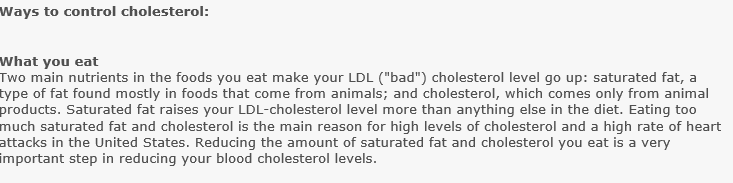
These distractions have employees and HR people believing there are automatic shortcuts to good health, when there are none. Exercise is a commitment, not a shortcut. but it is a way to good health. Just not one that is likely to make wellness vendors a lot of money.
Worse, once the wellness apologists admit that all this lowfat/crash-dieting stuff is nonsense, it means their entire history of savings claims based on those initiatives becomes one big lie. So you can bet that crash-dieting contests and bad diet advice will remain staples of the wellness industry, right up there with annual checkups and overscreening.

 They Said What?