
Home » Uncategorized (Page 25)
Category Archives: Uncategorized
Congressional Committee Okays Forced Genetic Testing for Employees
We are still a few weeks shy of April Fool’s Day, but Congress is celebrating it early. Using all the fuss about real-and-replace as a smokescreen, the Business Roundtable has gotten its allies in Congress to sneak in a bill allowing employers to require genetic testing in their wellness programs. This will shock people, but genetic testing loses tons of money for employers, and vendors (in this case, specifically Aetna) lie about savings.
This article isn’t about the lies and the numbers, though. It’s about Congress giving employers basically unfettered rights to collect employee genetic information. You might recall there is a law that says employers can’t genetically test employees, or discriminate against employees on the basis of genes. The idea of this new legislation is that law wouldn’t apply in the case of voluntary wellness programs. As we learned last year, the Business Roundtable “convinced” the Equal Employment Opportunity Commission that “required” and “voluntary” are synonyms. Consequently, employers can simply demand that employees submit to this or get fined.
The article, by intrepid reporter Sharon Begley (who also exposed the Wellsteps debacle with Boise), can be accessed here. Add comments to that article, since it is likely to be passed around more than TSW is.
Share this:

Catasys wants you to buy their stock. (In other words, I’m ba-ack!)
Last week I posted linkedin comments praising three very fine (and honest) vendors: Limeade, Redbrick, and Imagine Health. I was concerned this flurry of distinctly out-of-character activity might cause people to worry that pods had taken over my body. I then posted an assurance that was not the case. However, as someone subsequently pointed out, if pods had taken over my body, it’s quite unlikely they would admit it.

Point well taken.
Since my own protestations would therefore go for naught, the only way to put people’s minds at ease that I’m not a “pod person” would be to profile another vendor–in this case, Catasys. Catasys is in the depression wellness/disease management business. Here’s the way that business works: if you are a health plan customer of theirs, you round up your depressed members and try to convince them to use Catasys’ therapy.
If I were depressed, I doubt the first thing to come to my mind would be: “How can my health plan arrange some therapy for me with a vendor?” But maybe that’s just me. And I also doubt I would insist that said vendor be nearly bankrupt. (Once again, a preference for working with viable entities might just be a personal foible.)
The reason I know they are nearly bankrupt is that they say so in their 10-K (“substantial doubt as to our ability to continue as a going concern”). Yes, they file with the SEC because, yes, they are publicly traded — and that is what provides the inspiration for this post.
Specifically, one of their executives recently pitched their stock on Linkedin. You don’t see executives pitch stock on Linkedin in their own companies very often, or for that matter at all. Indeed, after I posted my comments, she removed “If you’re looking into investing in Catasys” from her post. Instead the posting now says only:

The $CATS got her tongue maybe because, oh, I dunno, it’s illegal for company insiders to solicit marks on Linkedin to buy their stock? Just a guess…
Nonetheless I decided to take her up on the offer. What I “learned” was that they still have a market value of $60MM, even though the stock has fallen about 2/3 from its IPO price. Notwithstanding this decline, shares sell at about 10x revenue, which, though so high as to be ridiculous, is not unusual in this field, where ridiculous is the new stupid. What is unusual is that for every dollar in revenue, they lose about $5. You can’t make that up in volume–and indeed, the more they’ve reported in revenues every year, the more they’ve lost every year.
Consequently, in order to claw their way to $5 million in annual revenue after 12 years in business, they’ve lost a cumulative $278 million dollars, a figure exceeding the GDP of several Pacific Island nations. The latter at least have the excuse that they are now largely underwater, though I guess that’s true of Catasys as well.
Don’t believe anyone could lose that much in this field? Here is the screenshot, keeping in mind that these quantities are expressed in $000:

As for their offering, naturally all their savings figures are made up. When they tried to pitch a client of mine several years ago, I checked them out, as is my wont when representing potential prospects against vendors. (It’s a strategy that benefits consultants should try someday. Oh, I know it sounds crazy but it just might work.)
I concluded that they must have read Why Nobody Believes the Numbers backwards, in order to learn how to use every sleight-of-hand measurement technique to create the appearance of saving money.
Their business model is to find the members with the highest claims that include depression or substance abuse and see if they are interested in participation. If they are, Catasys then interviews them to decide who is likely to improve the most through their intervention. Lucky depressed members who survive the interview qualify for the 52-week intervention. Some fraction of those lucky depressed survivors make it all the way through the program.
And that, finally, is the subset on which Catasys measures and reports savings.
Sure enough — leaving nothing to chance through regression to the mean, favorable selection bias and self-selection bias, and ignoring dropouts — Catasys shows savings of 50%. (What’s amazing, given all those biases, is that their alleged savings is only 50%.)
So next time someone approaches you with an offer to “learn” how to invest in Catasys, here is my recommendation:

However, there is a way to make some money on the stock.
The way the rules work is, you can lie about savings all you want to benefits consultants, brokers and prospects, but here’s where you can’t lie: in SEC filings. And yet, right on page 3 of the 10K:

Lying on SEC filings can get you sent to jail — if the lies aren’t disclosed. Disclosing “risk factors” solves just about every problem there is, for public companies. For instance, if your company’s C-Suite consists totally of convicted embezzlers, shareholders can’t sue you and you can’t go to jail if indeed your 10K discloses “hiring convicted embezzlers” as a “risk factor.”
Catasys’ 10K lists a whopping thirty-seven risk factors, many of which are pretty scary, including fee-splitting. Having read these risk factors, were I a shareholder, I’d be spooked enough to swap ’em all for a few swindlers for the corner offices.
And yet nowhere in this extensive “Risk Factors” section does it say anything like:
Our savings claims are the result of totally hilariously obvious fallacies. We know this because we were on the conference call when Al Lewis showed our half-witted Milliman consultant who had “validated” us exactly how and why our savings were total crap, but we chose to keep measuring this way anyway in order to look good. So a risk factor is that Mr. Lewis might blog about us if his panties get sufficiently in a bunch.
Back to the money-making part. You short the stock, announce that you are shocked, shocked that all their savings are fabricated, and then inform the SEC, which presumably will be equally shocked…
…and whose investigation will send shareholders running for the exits:

Share this:

Come heckle Al Lewis.
Here is a clip-and-save posting with some of my presentations open to the public this year, starting next month. T
Because all will offer extensive Q&A, they provide a chance for the wellness empire to strike back, but if history is any indication, the only direction in which they will strike is out. (There are, of course, exceptions, some great wellness vendors, that we will highlight in upcoming postings.)
March 27th, Philadelphia, PA.
17th Annual Population Health Colloquium. This interactive workshop will provide the opportunity to not just listen to me drone on, side by side with Linda Riddell, but also to tackle some squirrelly outcomes reports (is there any other kind?) yourselves, in a team-building exercise like no other. I’ll play the role of the vendor, and you play the role of me and demonstrate how dishonest my reports are. In this roleplay, you’ll point out why I should be completely ashamed of myself for lying. But, since I’m playing the vendor, I won’t apologize even after I’ve been caught.
This session also provides the most cost-effective near-term opportunity for earning Critical Outcomes Report Analysis certification from the Validation Institute.
And stay tuned for more upcoming opportunities…
May 18, Canton Ohio. the Employers Health Coalition is hosting its annual symposium. I’ll be doing “Wellness Outcomes for Dummies…and Smarties.”
September 12, also in Philadelphia as luck would have it, for the Greater Philadelphia Business Coalition on Health’s Annual Wellness Summit. (Philadelphia is apparently a hotbed of validity.) Watch this space. This will be an entertaining event, featuring a healthcare trivia contest and possibly a wellness presentation as well.
September 27th. The Rock Stars of Health Summit. This is going to be an amazing show, featuring an appearance by a guy who should be and probably will be in the Rock and Roll Hall of Fame, to be held at the picturesque campus of the University of Montana, in Missoula. I’ll be doing both a complete long-version Wellness Outcomes for Dummies…and Smarties workshop as well as a Quizzify trivia contest-and-presentation. If you really want to heckle me, this is the place, because Montana is open-carry.
October 2 and October 3, Los Angeles, CA. The Employee Healthcare and Benefits Congress, courtesy of the Corporate Health and Wellness Association. Those who attended last year’s conference in DC were treated to a great show. (Plus if you played your cards right all your meals were free.) Once again, it appears there’s going to be a twofer — both a trivia contest and a (possible) in-depth precon on wellness outcomes measurement.
Share this:
Ron Goetzel proves, definitively, that screening loses money–and lots of it.
There is a saying: “In wellness, you don’t have to challenge the data to invalidate it. You merely have to read the data. It will invalidate itself.” Indeed, if there is one thing you can take to the bank in this field, it’s that articles intending to prove that wellness works inevitably prove the opposite. Another saying is that the biggest enemies of Ron Goetzel and his friends are facts, data, arithmetic, and their own words.
And Mr. Goetzel, writing in this month’s Health Affairs, [behind a paywall] is Exhibit A in support of the paragraph above. The “overscreening today, overscreening tomorrow, overscreening forever” gravy train of the wellness industry is officially dead. He killed it, not me. In one article he managed to do what I’ve been trying to do for five years. (It can now be replaced with a health literacy tool such as, to use one random example, Quizzify. No one will ever invalidate health literacy. And we still support screening according to US Preventive Services Task Force guidelines, even though it won’t save money.)
No, not because of his conclusion that companies with lower risk factors spend more than companies with higher risk factors. That by itself would be worthy of a headline, of course, since it’s quite at variance with the massive savings shown in the Koop Awards he gives to his friends. But there is much, much bigger news, though in this case he “buried the lead,” in a sleight-of-hand that he knew Health Affairs‘ peer reviewers wouldn’t notice.
The Death of the Wellness Industry is Not Exaggerated At All
Here’s what he did — very clever, but not clever enough not to get caught. He and his co-authors pegged average spending on cardiac at a perfectly plausible $329 per employee per year. However, they decided not to split that average of $329 out into “bad” spending (specifically, spending on events, like heart attacks), vs. “good” spending (prevention expense — things being done to avoid heart attacks).

How big a rookie mistake is combining these two opposites, prevention expense with event expense and calling it “average payment for all CVD claims”? It would be like saying the average human is a hermaphrodite.
If they had split that average out into its two opposite components, they would have been forced to reveal that spending on actual avoidable events is less than spending on wellness programs to avoid those events. That, of course, is exactly right, and was what we showed about 14 months ago.
Let’s do the math
How much do employers spend on heart attacks? Well, here is the number of heart attacks. I’m spelling it out so that people can replicate this using the HCUP database for 2014, for all the heart attack DRGs:
- DRG 280 — 12,825
- DRG 281 — 15,404
- DRG 282 — 18,365
- DRG 283 — 1,800
- DRG 284 — 275
- DRG 285 — 160
This totals to 48,829. There are about 100,000,000 adults 18-64 insured through their employers, meaning that about 1 in 2000 will have a heart attack in any given year. I had thought it was 1 in 1000, and my own data — from roughly 30 commercial health plans and large employers for which I measure event rates — backs that up, so let’s totally give Ron the benefit of the doubt (the wellness industry’s business model is based on being given the benefit of the doubt) and double the HCUP figure, to 1 in 1000.
Now assume $50,000 per heart attack all-in. That is high, but once again, benefit of the doubt. So of the $329 PEPY that Ron calculated for prevention and events combined, only $50 is events. The rest is prevention and management expense, like putting people on statins, diuretics etc., doctor visits, lab tests etc. Not avoidable, and not even reducible through wellness. Just the opposite– these wellness people are always wanting to close “gaps in care” by doing more of this stuff.
How this invalidates screening
According to Mr. Goetzel’s own data, a wellness program — health risk assessments, screening, portals etc. — costs about $150 per employee per year. An industry that spends $150 PEPY to get what Ron estimates to be a 1% to 2% reduction in a $50 PEPY expense can’t survive on merit, which explains all the lying about savings, not to mention lying about me.
Anyone care to claim the $2-million reward I’m offering for showing wellness saves money? I didn’t think so…
Share this:

Breaking News: Is Ron Goetzel about to admit wellness loses money?
Rumor has it that within the next couple of days Health Affairs is going to release a paper in which Ron Goetzel admits that — even with his finger on the scale as it always is (along with the other nine and all his toes) — wellness loses money. This is total vindication for the years in which he has preferred to simply fabricate large savings, based on trivial risk impact, and then accuse me of “outrageous inaccuracies” and other such fanciful tales for observing — accurately, as it turns out — that all his savings are made up.
Yes, I know I’ve said he has admitted wellness loses money several times before, like in his HERO Guidebook, or in STATNews, or in the Chicago Tribune. But those were all gaffes. (A gaffe is defined as “accidentally telling the truth.”) The difference is, this time it’s deliberate.
And, no, he hasn’t sworn off lying. Lying is a thing these days. He was way ahead of the curve on that. Mind you, I have not seen the article, and I wasn’t allowed to peer review it. (Health Affairs allows authors to rule out certain peer reviewers, so he ruled me out — despite admitting not too long ago that I am the best peer reviewer in the field.) However, I anticipated that, given his level of integrity, he would use the completely invalid participants-vs-non-participants methodology, and so I invalidated it for him ahead of time, not that he didn’t already know.
Despite admitting losses, he still holds to the fiction that somehow risk factors decline, a claim which I intend to examine once I see the article. I suspect he didn’t plausibility-test the outcomes (even though his HERO guidebook says to do that) and/or he didn’t count dropouts and non-participants. But we’ll know soon enough.
However, by admitting wellness loses money even if risk factors improve, he just invalidated every single Koop Award he has ever bestowed on any of his buddies. The reason is that in those award-winning situations, risk factors either only improve a trifle (Staywell, 2014 and Nebraska, 2012), don’t decline at all (McKesson, 2015), or increase (Wellsteps and Boise, 2016). None of these non-improvements acknowledges dropouts, of course.
Stay tuned…
PS Remember my $2-million reward for showing wellness saves money? Let’s make it $3-million.
Share this:
Official Rules for Acacia $100,000 Validity/Outcomes Challenge
Congratulations to Radial Health for achieving the highest level of validation from the Validation Institute. That comes with a $100,000 Credibility Guarantee.
In rare cases, such as Virta Health or Sera Prognostics or Ault International Medical Management, I add my own guarantee.
Any mental health vendor mentioned in the Peterson Report (I’m lookin’ at you, Lyra) can challenge my statement that Radial (nee Acacia) has the most validly measured good outcomes. Here are the terms to earn the $100,000.
Terms and Conditions of Challenge
Selection of Judges
There will be five judges, selected as follows:
- Each side gets to appoint one, drawn from the Healthcare Hackers listserve with 1000 people on it, from all walks of healthcare.
- Two others are appointed objectively. That will be whichever health services researchers/health economists are the most influential at the time the reward is claimed. “Most influential” will be measured by a formula: the highest ratio of Twitter followers/Twitter following, with a minimum of 15,000 followers.
- Those four judges will agree on the fifth.
Using the criteria below, judging will be based on validity of the measurement. Measurements deemed invalid, such as those described on the Validation Institute site, would be a disqualifying factor, i.e., any challenge by a vendor that is not validated by the Validation Institute.
If the challenging party/vendor is deemed by the judges to have an equally valid metric as Client, the decision is made on the impact of the program in outcomes for people with treatment-resistant OCD.
Written submissions
Each side submits up to 2,000 words and five graphs, supported by as many as 20 links; the material linked must pre-date this posting to discourage either side from creating linked material specifically for this contest.
Publicly available materials from the lay media or blogs or the Validation Institute may be used, as well as from any academic journal that is not open-access.
Each party may separately cite previous invalidating mistakes made by the other party that might speak to the credibility of the other party. (There is no limit on those.)
Oral arguments
The judges may rule solely on the basis of the written submissions. If not, the parties will convene online for a 2.5-hour recorded virtual presentation featuring 10-minute opening statements, in which as many as 10 slides are allowed. Time limits are:
- 30-minute cross-examinations with follow-up questions and no limitations on subject matter;
- 60 minutes in which judges control the agenda and may ask questions of either party based on either the oral or the written submissions;
- Five-minute closing statements.
Entry process
The entry process is:
- Challenger and TheySaidWhat deposit into escrow the amount each is at risk for ($100k for the Challenger, and $100k for TheySaidWhat). Each party forwards $10,000 to the judges as well, as an estimate of their combined fees and/or contributions to their designated nonprofits.
- If the Challenger or Service Provider pulls out after publicly announcing an application, the fee is three times the amount deposited.
- The escrow is distributed to the winner and the judges’ fees paid by the winner are returned by the judges to the winner, while the judges keep the losers’ fees.
Other
The competition is open to any mental health vendor outcomes claim which was made in the Peterson Report.
Share this:
News flash: wellness needs an ROI, and here’s why
A rising chorus of people (the usual suspects — Goetzel, O’Donnell etc.) say you don’t need an ROI from wellness, but here is an essay in Employee Benefit News pointing out why you do, citing three distinct reasons, each sufficient on its own.
By contrast to these three strong arguments in favor of demanding an ROI, the best argument against demanding an ROI from wellness is that you can’t get one, which explains the opposition from those usual suspects. They were all about ROIs before it was proven that you can’t get one, but that was then and this is now.
Here is one thing that doesn’t need an ROI: screening according to US Preventive Services Task Force guidelines. Ironically, that’s also the one thing that those very same usual suspects are opposed to. For them, it’s overscreening today, overscreening tomorrow, overscreening forever.
Share this:
And the envelope please. The best outcomes evaluator in wellness is…
The best outcomes evaluator in the wellness field is Dr. Iver Juster.*
*Among the subset of males not affiliated with They Said What.
Why Dr. Juster’s Case Study Is the Best Case Study Ever Done in This Field
Chapter 2 of the HERO Guide is a great study and deserves high praise. But before we get into the salient points of what makes this absolutely the best case study analysis ever done in this field, be aware the provenance is not a coincidence. Dr. Juster is very skilled at evaluation. Indeed he was the first person to receive Critical Outcomes Report Analysis (CORA) certification from the Disease Management Purchasing Consortium. (Dr. Juster very graciously shares the credit, and as described in his comments below would like to be listed as “the organizer and visible author of a team effort.”)
Note: the CORA course and certification are now licensed for use by the Validation Institute, which has conferred honorary lifetime certification on Iver gratis, to recognize his decades of contribution to this field. (Aside from the licensure, the Validation Institute is a completely independent organization from DMPC, from They Said What, and from me. It is owned by Care Innovations, an subsidiary of Intel. If you would like to take the CORA Certification course live, it is being offered next in Philadelphia on March 27. You can take it online as well.)
Early in the chapter, Iver lists and illustrates multiple ways to measure outcomes. He dutifully lists the drawbacks and benefits of each, but, most importantly, notes that they all need to be plausibility checked with an event-rate analysis, which he provides a detailed example of–using data from his own work. In an event rate analysis, wellness-sensitive medical events are tracked over the period of time in question.
Wellness has never been shown to have a positive impact on anything other than wellness-sensitive events. Consequently, there is no biostatistical basis for crediting, for example, “a few more bites of a banana” with, to use our favorite example, a claimed reduction in cost for hemophilia, von Willibrand’s Disease and cat-scratch fever.
By contrast, real researchers, such as Iver, link outcomes with inputs using a concept called attribution, meaning there has to be a reason logically attributable to the intervention to explain the outcome. it can’t just a coincidence, like cat scratch fever. As a result, he is willing to attribute only changes in wellness-sensitive medical events to wellness.
Event-Rate Plausibility Analysis
Event rates (referred to below as “PPH” or “potentially preventable hospitalizations”) are laid out by disease on page 22 of the HERO Report. Note the finding that PPH are a small fraction of “all-cause hospitalizations.” Though the relative triviality of the magnitude of PPH might come as a surprise to people who have been told by their vendors that wellness will solve all their problems, Iver’s hospitalization data sample is representative of the US as a whole for the <65 population, in which chronic disease events are rare in the <65 population.
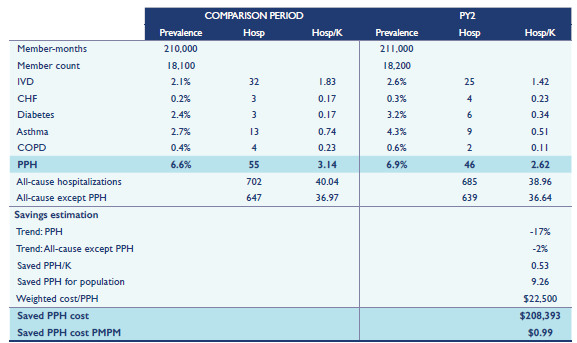
Gross savings total $0.99 per employee per month. This figure counts all events suffered by all members, rather than excluding events suffered by non-participants and dropouts. Hence it marks the first time that anyone in the wellness industry had included those people’s results in the total outcomes tally — or even implicitly acknowledged the existence of dropouts and non-participants. He also says, on p. 17:
For example, sometimes savings due to lifestyle risk reduction is calculated on the 20% of the population that supplied appropriate data. It’s assumed that the other 80% didn’t change but if some of the people who didn’t supply risk factor data worsened, and people who got worse were less likely to report their data, that model would overestimate savings.
Note that the PPH declined only in cardiac (“IVD”) and asthma. Besides the event rates themselves being representative of the employed population in the US as a whole as a snapshot, the observed declines in those event rates are almost exactly consistent with declines nationally over that same period. This decline can be attributed to improvements in usual care, improvements that are achieved whether or not a wellness program was in place. The existence and magnitudes of the declines, coupled with the slight increase in CHF, diabetes and COPD combined (likewise very consistent with national trends), also confirm that Iver’s analysis was done correctly. (Along with attribution, in biostatistics one looks for independent confirmation outside the realm of what can be influenced by the investigator.)
It is ironic that Ron Goetzel says: “Those numbers are wildly off…every number in that chapter has nothing to do with reality” when I have never, ever seen a case study whose tallies — for either total events or event reduction, let alone both — hewed closer to reality (as measured by HCUP) than this one.
Another factor that conveniently gets overlooked in most wellness analyses is that costs other than PPHs rise. By contrast, Iver is the first person to acknowledge that:

The implication, of course, is that increases in these costs could exceed the usual care-driven reductions in wellness-sensitive medical events. Indeed, Iver’s acknowledgement proved prescient when Connecticut announced that its wellness program made costs go up.
The $0.99 gross savings, and Connecticut’s healthcare spending increase, exclude the cost of the wellness program itself, of course. Factor in Ron Goetzel’s recommendation of spending $150/year for a wellness program and you get some pretty massive losses.
The old Al Lewis would close by making some reference to the dishonesty and cluelessness of the Health Enhancement Research Organization’s board. The new Al Lewis will do just the opposite. In addition to congratulating Iver Juster (and his co-author, Ben Hamlin) on putting this chapter together, I would like to congratulate the Health Enhancement Research Organization, for what Iver describes as the “team effort” in publishing it — HERO’s first flirtation, however fleeting and inadvertent, with integrity and competence.
Iver Juster Comments on the article
Iver reviewed this article and would like to add several points. I am only adding a couple of my own points, noted in indented italics:
- It’s important to credit the work to a larger group than just myself. I was the ‘lead author’ on the financial outcomes chapter of the HERO/PHA measurement guide, but the work entailed substantial planning and review in collaboration with the chapter’s coauthor (Ben Hamlin from NCQA) and members of the group dedicated to the chapter (as well as the HERO/PHA authoring group as a whole).
- Yes, I am more than happy to credit the entire group with this study, especially Ron Goetzel, Seth Serxner and Paul Terry.
- Nonetheless the work does reflect my perspective and approach on the topic – the important points being (a) select metrics that are impactible by the intervention or program; (b) be transparent about the metric definitions and methodology used to measure and compare the; (c) assiduously seek out potential sources of both bias and noise (in other words, exert the discipline of being curious, which is greatly aided by listening to others’ points of view); (d) understand and speak to the perspective of the study—payer, employee/dependents, clinician/healthcare system, society.
- Be particularly sensitive to the biologically-plausible timeframes in which your outcomes ought to occur, given the nature of the program. Even if optimally implemented with optimal uptake and adherence, we might expect ‘leading indicators’ like initial behavior changes to improve quickly; program-sensitive biometrics (lipids, A1C, blood pressure, BMI) and medication adherence to change in a matter of months; and a few program-sensitive ER/inpatient visits (like worsening heart failure or asthma/COPD exacerbations) to improve within several months (again, assuming the program is designed to address the causes of these events). Longer-term events like kidney failure, heart attack and stroke and retinopathy take much longer to prevent partly because they require sustained healthy behavior, and partly due to the underlying biology.
- This is one excellent reason that the measured event rate decline mirrored the secular decline in the US as a whole over the period, meaning the program itself produced no decline over that period. Possibly they might decline in future years if Iver is correct. Ron Goetzel would take issue with Iver’s assertion — Ron says risk factors decline only 1-2% in 2-3 years.
- Event rate measurement in any but the largest Commercially-insured populations is subject to considerable noise. Though a challenge, estimating ‘ confidence intervals should at least shed light on the statistical noisiness of your findings.
- No need this time because your results hewed so closely to secular trend, reflecting the quality of the analysis.
- It is very likely that the program used in the illustration did affect more than the events shown because it was a fairly comprehensive population health improvement initiative. For example, ER visits were not counted; and collateral effects of ‘activation’ – a very key component of wellness – were not included in this analysis. Assuming the 99 cents is an accurate reflection of the program’s effect on the events in the chart, I’d be willing to increase the actual claims impact by 50 to 75%.
- If your speculation is accurate, that would increase gross savings to $1.49 to $1.73/month–before counting preventive care increases indicated on Page 22.
- Nonetheless, to get effect from an effective program you have to increase both the breadth (number of at-risk people) and depth (sustained behavior change including activation) – but at a cost that is less than a 1:1 tradeoff to the benefit. In other words, you must increase value = outcomes per dollar. This cannot be done through incentives alone – as many researchers have shown, if it can be done at all, it must be the result of very sustained, authentic (no lip service!) company culture.
- We are beginning to pay attention to other potential benefits of well-designed, authentic employee / workplace wellness programs (of which EHM is a part) on absenteeism, presenteeism, employee turnover and retention – and, importantly, company performance (which is after all what the company is in business to do). It’s early days but it’s possible research will show that companies that are great places to work and great places to have in our society will find financial returns that far outstrip claims savings. The jury’s still out on this important topic but let’s help them deliberate transparently and with genuine curiosity.
- Did Ron really say you have to spend $150 per year PER MEMBER on a wellness program? I’d be thinking a few dollars (unless he’s including participation incentives)
- (1) Yes, he did say that; (2) no, he’s not including participation incentives; and (3) welcome to my world.
Share this:

Support our colleague Jon Robison by supporting MS research…and win a prize
Our esteemed colleague and co-creator of the Employee Health Program Code of Conduct has had multiple sclerosis (MS) for several decades. MS is one of the approximately 30,000 diseases known to mankind that can’t be prevented or alleviated by “eating one more bite of a banana,” as Wellsteps would have us believe is true for most chronic diseases, such as chronic banana deficiency-itis. And Jon exercises quite a bit too, as this picture shows, so “taking a few more steps a day” (another Wellsteps alternative fact) isn’t going to help cure his MS either.

Here are two ways to support Jon and MS.
First, I will match contributions to the Climb to the Top, a race to the pinnacle of the Hancock Clarendon Tower, here in Boston on March 4, to support MS research. (There is some irony in my climbing to the top while the wellness industry is racing to the bottom.)
This is the building. After you look at the picture, you can also hazard a guess (by commenting below) as to how long it will take me to reach the 63rd floor. (If it helps, I’ll be turning 61 that day.) The closest guess by a contributor wins a copy of one of my books, Surviving Workplace Wellness, Cracking Health Costs, or Why Nobody Believes the Numbers.

Second, you can “support” Jon Robison (and his colleague Rosie Ward– and, most importantly, yourself!) by joining their program, a great opportunity to apply practical skills to transform workplace cultures where both the organization and the people within them can thrive. Past participants have even called their program “life-changing”. More information and a link is included below. I also have been provided a discount code I can pass on to you that provides a $200 discount; just use BEWELL17 at checkout.
There are just a few spots left in the Salveo Partners Thriving Workplace Culture Certificate™ (TWCC) online training program. Get all the tools, templates, and support you need to create a lasting impact on workplace wellbeing while earning continuing education credits! Get more information and register at https://salveopartners.com/products-services/twcc/ It’s starting quite soon, so don’t dawdle like I do when I have to send someone money.
Here are a couple of named testimonials so you know I don’t make this stuff up — which I don’t because we here at TSW are in the “integrity segment” of the market.
I don’t think I’ve ever read a book or taken a class or attended a conference that was so challenging (and helpful) for me in my professional development. This course has been extremely awesome… while putting my world in upheaval and at times exhausting me mentally… but I wouldn’t have it any other way! I’m so glad I took this and have so much material to work with and apply in the future. Thanks Jon and Rosie!
– Nathan Taylor
Each week I looked forward to the 90 minutes of training. It is so inspiring to be part of the evolution of the employee wellness field. Both Jon and Rosie are fantastic leaders for this training and in the field as well. I am thankful that my organization allowed me to complete this training and I am looking forward to the future of wellness!
– Megan Matuszeski
Share this:

Schlumberger’s program confirms that in wellness, harming employees is the new black.
Silly us. We thought Wellsteps’ wellness program was an outlier when it came to harming employees. But Wellsteps has nothing on Schlumberger. Almost immediately after reading last year’s post on the harms of crash-dieting contests run by Healthywage, Schlumberger instituted — hang on to your hats — a crash-dieting contest run by Healthywage. They even included some decent-size prizes — $1000 per winning participant. How did they finance those prizes, with sales of their drilling equipment falling by about half from its peak? Simple. They canceled their employee gym membership subsidy.
Then, as some may remember, it turned out that Healthywage’s understanding of arithmetic rivaled their understanding of obesity. In their contest, somehow five teams lost exactly 16.59% of their body weight. This is clearly alternative math, since the chances of that coincidence using real math are about 1 in 4 quadrillion, meaning that the odds of winning the lottery are about 1000 times better than the odds that Healthywage’s executives are not a bunch of idiots.
So Schlumberger harmed employees, wasted money, and got ripped off by alleged weight control experts who can’t read a scale. What does a company do in situations like this? Double down, of course. Literally. Yes, this year, they’re back partnering with Healthywage…with twice the prize money — $2000 apiece for the five members of the winning team.

They gave employees a week’s advance notice, so that they could pack on some pounds that they can take off later. Plus they could time their consumption of salt tablets, and concoct other ways to bloat up, before the contest began. Basically they needed to figure out how to become as unhealthy as possible, before starting the unhealthy process of crash-dieting. (As an aside, several teams apparently tried to recruit pregnant women whose due dates fall during the contest period.) And now that they contest is underway, who wouldn’t pop a few OTC diet pills to make $2000?
The difference is that this year, several concerned employees wrote to me and urged me to inform their benefits department of the indisputable facts that:
- Crash-dieting is a stupid idea;
- Offering prizes for crash-dieting is an even stupider idea.
I wrote the requested letter to Schlumberger, and explained all this to them, not that anyone with an internet connection should need an explanation of why crash dieting contests don’t work, or, more basically, why being stupid is a bad idea.
Their response? The benefits department appears to have tried to determine who sent me the announcement, presumably in order to get them fired. It was actually multiple people since I have family in Texas in the oilfield services industry. I had anticipated this, so I un-linkedin with all of them before writing to Schlumberger. I’ve learned through experience that in wellness, you need to anticipate the most inappropriate and misanthropic reaction to any helpful offer, because that is the reaction you will get. (For instance, rather than being concerned about Wellsteps harming their employees, the Boise School District wellness program coordinator told Wellsteps I was blowing the whistle on them for harming their employees.)
Update: Healthywage presents alternative math, Volume 2. If the rule is (as stated) that you must sign up in teams of five, what is wrong with this picture?

And just as I was about to click “publish,” I noticed alternative math, Volume 3. Apparently Healthywage thinks you can lose a high percentage of your total weight even if “you only have a little weight to lose”:

And that brings us back to the main, decidedly unfunny, point: crash-dieting contests, especially with big prizes, are a very bad idea…and companies like Healthywage ought to be ashamed of themselves for making a business out of harming employees.

 They Said What?