They Said What?

Home » Uncategorized (Page 28)

Category Archives: Uncategorized

Quizzify, The Employee Health Code of Conduct, and Fabricated Savings

The three hottest topics in all of wellness. Or if not, they should be.

And they are all covered in Dr. James Kelley’s new podcast.  You’ll have to download the iTunes app to hear it, but if I can do it, how hard can it be?


Ever wonder what it’s like to actually participate in a wellness program?

Do you know anyone who is actually in a “pry, poke and prod” wellness program run by one of the 50 vendors “profiled” on this site?  If so, try asking them what they think…and then compare those opinions to what the vendors want them to think. A few tidbits of the latter are listed below:

But none of these vendors ever ask the flesh-and-blood employees how they feel. Turns out there’s an excellent reason for that: employees hate “pry, poke and prod” programs. Here are four sets of vignettes to that effect.

  1. Last month, we collected some comments from an article in Slate about wellness. Just when we thought the news cycle on that article had run, more employees weighed in.  Still, those are just comments, not in-depth experiences.
  2. Getting into the belly of the beast, Vik Khanna posted a ten-part series on the Provant program he and his wife were forced to submit to subject to a major forfeiture. This program sucked up 6 hours of his time and provided tidbits like “drink 8 glasses of water a day,” which of course is a total myth . This myth dates from a misinterpreted finding from 1945. It is now perpetuated only by some wellness vendors (not all of them — incredibly a few have now procured internet connections), as well as presumably Poland Spring, Aquafina, Dasani, Kohler and American Standard.  Obviously if the human race were that dehydrated we would have gone extinct long ago.   Provant water
  3. In addition to Vik’s regular journal entries, every now and then, someone writes in detailing their own experience in being forced to submit to one of these programs. Here is one of our favorites, someone complaining about Optum’s program. No wonder Optum is so opposed to the Employee Health Code of Conduct. I’d be opposed too, if I offered Optum’s program.
  4. Finally, here is the program du jour.  In their alleged attempts to create a culture of health, these vendors are creating cultures of resentment, distrust, and deceit.  We’re copying-and-pasting the opening paragraphs of this rant, but would encourage you to click through to the whole thing.

News Flash, The Dodo Bird is Still Alive

Well another year has rolled around and I was talking to the person who’s experience with their wellness program I had discussed below. Lo and behold, the problems I had originally documented continue unabated. This is a common example, and explains why so many wellness programs should be discontinued.

It was time for next years enrollment period for her insurance and she needed to get a number of points, schedule a coaching visit and get her biometrics and lab work completed to qualify for the premium differential.

The lab work requirement upset her as she had just gotten all the lab work done by her PCP the month earlier, but no, those lab results couldn’t be used. So the vendor repeated all the lab work her PCP had done and more, most of which were absolutely unnecessary based upon USPSTF guidelines. But hey let’s go ahead and waste some money and do a few unnecessary tests.  That’s become the norm for many a wellness program.

The story continues here.

$2-million reward to show wellness works

In 2015 I offered a million-dollar reward to show wellness works. Or, more accurately, to show that it isn’t a complete failure. I got no takers.  I guess when you snooker employers as successfully as they do, a million dollars is pocket change. Not worth their attention, like a penny on the sidewalk.

So now it’s a $2-million reward.  The rules are posted at Insurance Thought Leadership.  And, yes, the rules are legally binding. All you have to do is prove wellness isn’t an epic fail. Not Kate Baicker’s THC-infused 3.27-to-1 ROI.  Not even a standard 2-to-1 ROI. Just that it breaks even. How hard is that?  Name any other industry that doesn’t break even.  And that it doesn’t harm employees. How how is it to show that an industry devoted to employee health doesn’t harm them?

Oh, yeah, one rule is that you have to pass a lie detector test (as do I). This is a risk on my end: few people can lie well enough to beat a polygraph, but then again few people have as much lying experience as these self-anointed wellness industry leaders do.

When I was in high school a teacher had a vat of concentrated hydrochloric acid with a pH of 4, and a silver dollar. (Smaller coins were mostly copper, of course.) He asked if the acid would dissolve the silver dollar when he dropped it in, or if not, why not?  Other kids were peeling through their notes.

I raised my hand and said: “It won’t dissolve, because if it would, you wouldn’t drop it in,” which of course was the correct answer. (A pH of 4 is not much different from acid rain.)

So don’t expect to see me living under a bridge eating squirrel anytime soon. (They say it tastes like chicken.)


The Wellsteps Empire strikes back! CEO defends its harms to Boise employees

Steve Aldana, CEO of Wellsteps, finally defended his program for the Boise School District. It took him a while presumably because he had to retain a team of biostatistical consultants to discern the flaws in critics’ arguments against it.  After analyzing all the data, these biostatisticians were finally able to compile a list of the mathematical and clinical flaws in our apparently erroneous conclusion that Wellsteps harmed Boise employees and fabricated savings and raised lying to an art form.

I apologize in advance to those lay readers without a strong background in biostatistics. You may have trouble understanding the mathematical subtleties in Mr. Aldana’s arguments.  But I’ll repeat them verbatim nonetheless. According to Mr. Aldana, wellness critics are:

  • “Great at writing click bait”
  • “Great at creating BS out of thin air”
  • “liers”

Leave aside his creative spelling and his mixing of cliches. Focus instead on his novel interpretation of Lavoisier’s law of conservation of mass, which states that nothing can be created out of thin air. Notwithstanding Mr. Aldana’s claim to the contrary, this law would seem to particularly apply to bovine excrement, the end result of a complex biochemical and physiological process, one which he would seem to have great familiarity with, as we’ve noted multiple times in this website. However, we encourage Mr. Aldana to try to undertake this endeavor, because at least his efforts won’t harm anyone, which is more than can be said for his wellness program.

Kudos to Dave Chase for posting the STATNews expose of the Wellsteps program, so that Mr. Aldana could respond. Mr. Chase, who is producing a documentary called The Big Heist on wellness and other healthcare ripoffs, is obviously goading Mr. Aldana into writing some material for him, and Mr. Aldana obliged.  Rather than create a news cycle, where the Wellness Ignorati inevitably lose, he should have followed the lead of Ron Goetzel and simply ignored me.  Indeed, if there is one thing that Ron Goetzel excels at, other than doctoring data and lying about outcomes, it’s ignoring me.

In addition to calling me a lier, he also called the author of the STATNews expose, Sharon Begley, a lier.  I won’t question the wisdom of alienating the media, but I would question whether someone of Ms. Begley’s impeccable credentials (listed here on her Wikipedia page) could possibly have received all the accolades and awards she has amassed for health/science reporting if indeed she couldn’t find all the obvious flaws in a Koop Award application.

The linkedin thread is pasted below and I’d encourage reading it.  Don’t make me beg.

wellsteps-calling-sharon-begley-a-liar

What Trump’s election means for workplace wellness

Assume that one reason voters, rightly or wrongly, elected Donald Trump was because they feel big business and government are in bed together. To the degree that is the case, workplace wellness is their sex toy.

Indeed, nothing in healthcare more embodies the complete disdain for the average worker than the joined-at-the-hip partnership between big business and government known as workplace wellness.

There is an entire posting on this topic right over at Insurance Thought Leadership.

I won’t repeat the entire posting here but would encourage you to click though and learn how the Business Roundtable and US Chamber of Commerce, two pro-business lobbying groups, glommed onto wellness as a way to reduce employer contributions to employee insurance — and bought Congress, and threatened the Obama Administration into supporting this agenda.

Wellness industry leaders became their “useful idiots” to translate the goal of reduced contribution into reality. If you aren’t familiar with that term, Wikipedia defines “useful idiots” as “people used for a cause whose goals they are not fully aware of, and who are used cynically by the leaders of the cause.”  The raison d’etre of the Roundtable and Chamber isn’t to get employees to eat more broccoli. It’s to reduce employer insurance contribution, the sooner the better, by making wellness programs so unattractive that employees would rather be fined than participate.

One vendor accidentally tipped its hand before I pointed out that their dogwhistle to corporations was a bit too loud. They then removed the explicit language from their website.

bravo

Obviously, this isn’t the case for all vendors and all employers. Quizzify, of course, is one example of a wellness program that doesn’t need to threaten employees with big forfeitures in order to be successful.  But Quizzify is the exception. There is a reason why the Fortune 100 has by and large created massive non-participation forfeitures far in excess of spending on wellness-sensitive medical events, and has by and large chosen the same handful of major wellness vendors to play the role of the useful idiots.  We already knew these vendors excel at the latter 50% of that job description. The former wouldn’t be a stretch.

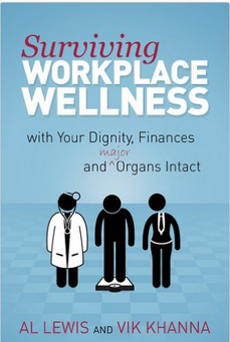
Go to Insurance Thought Leadership and read why, whatever your view of the election, you should hope that under the new administration, employees really will have a chance to do exactly what the title of our book says:

survivingcover

The Great Debate Part 7: Penn State Strikes Back…Goetzel Runs Away

If you are just joining us now, you can start at Part 1, where you can also easily download the audio.  The entire commentary thread can be found by clicking on “The Great Debate” on the home page. 

As we delve into the Q&A, a parade of questioners demand to know why their own employers’ programs are so bad.  They are far from alone, as most employees hate “pry, poke and prod” wellness, which is why bribes and fines have to keep rising.

Of those questioners, the most dramatic was a Penn State professor. Those with long memories may recall the Goetzel/Highmark wellness program that was being imposed on Penn State faculty and staff made the national news in 2013, due to its shocking invasions of privacy and general overall cluelessness. I covered in a Harvard Business Review essay entitled The Dangers of Wellness Programs: Don’t Become the Next Penn State.


1:16

Penn State Professor Matthew Woessner takes the mike. First he undercuts Ron’s previous answer by observing that my pointing out errors is a key part of peer review.

Then the fun starts, as he talked about the “terrible damage” the wellness program did there.  It “destroyed morale.”  Ron agrees that Penn State was “an awful program” but says he had nothing to do with it “in any way” even though he was in the room during their press conference in which they “took [the] offensive” in this.

goetzel penn state

Are we seeing a pattern here?

  • He ran away from Steve Aldana and Wellsteps, even though they’re on the Koop Award Committee and he just gave them an award for harming employees and lying about it
  • He ran away from the HERO report even though he’s on the board of HERO and wrote his famous letter supporting it.
  • He’s running away from Penn State even though he was right there as a core member of the team when they called a press conference.

1:20

The moderator, again coming to Ron’s aid to prevent this debate from becoming a rout, observes that just because one college complains, not all college programs are bad. There are thousands of colleges and only one complained. Therefore, all other colleges must have good programs, according to “4th grade math.”

Professor Woessner jumped on that comment. He pointed out that the faculty at his alma mater, Ohio State, also hate their wellness program.  The faculty is “livid” at Ohio State.

This was one of the biggest smackdowns of the afternoon, thanks to Prof. Woessner. It was a far better retort than anything I could have or did come up with.


1:22

Vik Khanna gets a question in. He points out that his wife’s employer’s program, where the vendor is Provant, is also awful.  (Noticing a trend here?) Vik did an 8-part series last year on this Provant program.   It involves checkups (that are more likely to harm you than benefit you, according to the New England Journal of Medicine), annual cholesterol tests (that healthy people are also not supposed to get according to the USPSTF guidelines), and a bunch of other stuff, like telling employees to drink 8 glasses of water a day, which is yet another myth.

Provant water

Ron says Provant has a bad program because it doesn’t adhere to USPSTF guidelines, though none of the Koop Award winners adhere to those guidelines either. He repeats one of his themes of the debate: “There are a lot of lousy programs out there, including the one you’re part of.”


1:23

I point out that Ron gave an award to Nebraska, which was decidedly a lousy program. They had admitted lying about saving the lives of alleged cancer victims who never had cancer in the first place.


1:24

Ron says Nebraska won the award because they had “solid evidence they improved the health risk profile of the population.” Yet, according to their own figures, a mere 161 out of 19,000 state employees (<1%) shed a risk factor.  He calls their evaluation methods “excellent.” This means in wellness it is “excellent” to claim $4.2-million in savings when 161 people reduce a risk factor and you admit lying about cancer.  This entire lying-about-cancer thing has now morphed into a rewriting of history, as noted on an earlier installment.

Though just a sidelight in this debate, Ron Goetzel just admitted that he has no idea how to evaluate outcomes. This program accomplished nothing, according to their own data, and yet claimed massive savings. Somehow in Ron’s universe, this is award-worthy because his colleagues ran the program.

By the way, this program was awful, whether Ron says so or not.  (The vendor is a sponsor of the Koop Award, so Ron won’t admit it.)  Surviving Workplace Wellness devoted an entire chapter to it. Here is a snippet:

sww nebraska chapter


1:26

Yet another employee subjected to yet another worthless wellness program complains to Ron about it, “suffering through 4 sessions with my health coach.”  He blames her and her program for being bad and says she needs to change her behavior.

Shame on you for being a bad employee!  You need to take a time-out.  (You and most of the rest of the country.)


1:28

The AARP lobbyist, Debbie Chalfie, adds AARP to the list of organizations that have multiple concerns about wellness.  Ron adds programs with surcharges to the long list of programs he doesn’t like, even though Bravo hired him to allege massive, self-invalidating, savings at Graco by doing surcharges. If the name “Bravo” rings a bell, it’s because that was the outfit that used to brag about how they could generate immediate savings by surcharging employees until we pointed out it probably wasn’t a wise idea to boast about that.

I use one of my prepared zingers here. If all these programs fail — Ron’s colleague Michael O’Donnell says the figure is 95% — “that’s not an industry. It’s a lottery.” Literally, excluding oil producers, no organization in the US would undertake any investment whose biggest promoters admit a 95% chance of failure. And yet, due to the lies told by wellness vendors and their consultants, lots of companies do.


Ron wraps up this section of the debate with yet another admission that wellness doesn’t work: he says “programs are very hard to implement effectively.” On this point we would agree. But as a former corporate CEO of a NASDAQ company, there’s no way I’d devote more than $100/employee to a program that probably wouldn’t have worked, had no evidence in favor of it other than what wellness vendors say, and could easily have backfired like every program described in this debate so far.

Further, we have a great culture at Quizzify, one that I have posted about on Linkedin.  A great way to wreck that culture would be to start pestering employees about stuff that is none of my business and doesn’t affect me, the customers, or the shareholders.


Right-wing media attacks “pry, poke and prod” programs

Who says the country is hopelessly divided along partisan lines?  Yes, the liberal lamestream media attacks wellness. (Most recently Slate.) That is to be expected. Sheesh!  But here is Laura Ingraham’s blog taking on wellness.

The author, Pat Barone, observes the discrimination, invasion of privacy, and lack of regulation and oversight — along with the total hypocrisy of relabeling “forced” as “voluntary.” This is easily the best of the AARP lawsuit articles, because it puts the lawsuit in the context of “pry, poke and prod” programs generally.  As one member of the TheySaidWhat? Nation, Mitch Collins, often writes: “This should be required reading in HR departments.”

This is not the only example of the right-wing media attacking wellness. Newsmax, the Federalist and others have done so as well. A complete listing of all media coverage of wellness is here.

It’s nice to know that the two sides are willing to reach across the aisle on this one, if only to strangle the legislators of both parties who have been bought off by the Business Roundtable.

In workplace wellness, fat-shaming is the new black.

This posting is a request to self-anointed wellness industry leaders to pleeease stop picking on people because of their weight.  It’s like you’re still in kindergarten, no offense intended.*


2016 was the year in which weight-shaming, weight discrimination and a generally dismissive and outright misanthropic attitude towards two-thirds of the country’s employees became a wellness industry thing.  This started in January at Davos, where the head of a wellness vendor named Vitality announced what quickly became known as the Fat Tax.

Here’s how the Fat Tax would work.  Companies would tell shareholders how many fat people they employed. Employers, presumably feeling shame over this disclosure, would be motivated to pay a “tax,” in the form of a fee to a wellness vendor — such as, coincidentally, Vitality — for screening and weight loss programs.

In addition to the out-of-pocket fee, employers would pull employees off the job for an hour too, to obtain this screening. In addition, there would be all the administrative time — making the rules and exceptions, catching cheaters (see below), getting the auditors involved, and so on.

All this for what, again?

J&J would have people believe that shareholders are demanding thinner employees. In reality, of course, shareholders could care less about the weight of employees, for the simple reason while weight makes no difference to most businesses (as we’ve proven), the cost impact described above of mass weigh-ins and disclosures would be quite high.

More important is the morale impact. Suppose an employee owns shares and the stock price is down. Next, suppose that shareholders have just been informed how many employees are overweight…and the guy in the next cubicle is obese. Suddenly, that employee can start blaming his co-worker for the loss in value of his 401K.

Your stock price is down, you need to rally the troops. Instead, the troops are turning on one another.

Incredibly, this idea did originally have momentum: along with a few drug companies that make obesity drugs that saw a potential market opportunity in the Fat Tax, IBM and even Pepsico were willing to put their names on it.  The Fat Tax cabal also knows the value of the Harvard name: they paid a little-known instructor at the Harvard School of Public Health (HSPH), so that they could co-opt that moniker, just like the sugar industry used to do.  Only the latter had a big enough budget to bribe two full professors rather than one lowly instructor.

However, the momentum quickly died once word leaked out that the very same Vitality that wants to collect money from others to administer weight loss programs couldn’t even get their own employees to lose weight.

Oh, and if you guessed that Ron Goetzel’s fingerprints were all over this one — just like almost every other debacle since Penn State — you obviously know the way the wellness industry works.

Ah well, as management guru Peter Drucker said, the only thing worse than a poorly conceived idea is a poorly conceived idea that is poorly executed.

Actually he never said that, likely because he was never enrolled in Vitality’s program.


Possibly because of the initial exposure the Fat Tax idea got, hazardous crash-dieting competitions came back into vogue this year.  Crash-dieting competitions are the type of thing that gives idiocy a bad name. Let’s leave aside the fact that employees cheat, as this article shows. They don heavy clothes, fill their pockets and down bottles of water before the initial weigh in, and do the opposite before the final one.

And leave aside the fact that vendors can’t read scales. How hard is it to figure out that it is not possible for the majority of your crash-dieting teams to lose exactly 16.59% of their body weight? The odds of winning the lottery are about 1000 times better.

But the biggest problem is that corporate crash-dieting contests are much more likely to harm employees than benefit them.  Money is on the line for successfully bingeing before the first weigh-in and starving oneself before the last.  Companies are paying their employees to yo-yo diet. Jon Robison has recommended, and I agree, that crash-dieting contests (and other corporate weight-loss programs) should carry a label warning of potential harms.

These harms are fairly self-evident, but just to be on the safe side, Rebecca Johnson laid out the health hazards quite thoroughly in Corporate Wellness, in case anyone needs a refresher course, which apparently Omada does.

Yes, despite the perverse incentives and physical hazards of paying people to lose weight, Omada Health is proposing that health plans do just that. According to Omada, a health plan can save “billions of dollars” — that’s “billions” with a “b”, not “millions” with an “m” or “stupid” with an “s” — by trying to prevent diabetes, including paying members to lose weight. A health plan that offered members this pay-to-diet option would soon find itself deluged with enough takers to require a rate increase for everyone else.

In case anyone is wondering about Omada’s math, the median-sized health plan can’t save billions of dollars by getting people to lose weight because the median-sized health plan doesn’t even spend “billions of dollars.” And I don’t mean on diabetics, I mean in total.


Next, it appears that this year’s presidential campaign has made fat-shaming great again.  One of the first vendors to jump on that bandwagon was Wellsteps, with the immortal words: “It’s fun to get fat. It’s fun to be lazy.” Eventually they took those words down, if only because a number of comments embarrassed them into it.

However, as Maya Angelou said, if someone shows you who they really are, believe them.


Finally, with his editorial in the American Journal of Health Promotion, Michael O’Donnell has out-stupided Vitality, Omada and Wellsteps: He is calling for employers to make employees pay for their health insurance per pound, sort of like buying lobster or sending packages. People say we make fun of the ideas the Wellness Ignorati come up with, but really all we do is repeat them — and occasionally illustrate them so that even the dumbest wellness industry leader can follow along:

lobsterpackagesurviving cover with no promotionajhp


So what is the “answer”?  Clearly calories in-calories out influences weight gain and loss. But it’s nowhere near as simple as that. Neuroscientists are discovering and researching all manner of poorly understood biochemical pathways, possibly influenced by environmental factors, that govern or at least influence what and how much different people eat, and what and how much weight different people gain or lose by doing so.
While these researchers don’t know what works, they certainly know what doesn’t work, which is to say any wellness industry scheme involving money. As Vitality, Wellsteps, and McKesson have shown, there is even some likelihood that these schemes will actually fatten employees, though in terms of fattening things, the greatest likelihood of all is that these schemes will fatten the vendors’ bottom lines.

*No offense intended to kindergarteners, that is, most of whom have better manners than this.

The Great Debate, Part 6: Goetzel Throws HERO under the Bus

The question-and-answer period is now underway.  

If you are just joining the thread, this is Part 6 of The Great Debate, a November 2015 exchange between Ron Goetzel and me, at the Population Health Alliance Annual Leadership Forum. Part 5 is here.  You can download the audio here


1:09:00

To the question: “What would you do to reduce healthcare costs?” Ron replies that he is “focused on prevention.” And that’s the issue.   I point out that “too much of anything is bad for you, ours is already the most over-prevented society on earth, and these programs are all out of compliance with guidelines.”  All these programs screen everybody far more than guidelines advise. Here are the guidelines. Find anything other than blood pressure where the wellness industry’s obsessive annual screens are recommended.

[Postscript: after the debate, the Connecticut study came out, showing that overprevention through wellness increases costs, as one would expect.]


1:12:20

The moderator asks how can Quizzify be the most effective company in employee health education.  He challenges our 100% guarantee of savings. This is ironic. No wellness company offers any meaningful guarantee of savings, for the simple reason that it is mathematically impossible to save money in wellness.

Somehow in wellness, guaranteeing savings is a bad thing but losing money is a “good thing.” (Really, a direct quote — click on it.)  It’s curious to challenge someone’s own willingness to guarantee their own results as part of their own business.  Obviously, if my business judgment is wrong, Quizzify will fail. And what I didn’t say because I didn’t want to brag, is that people questioned my last business venture too, Matrix Medical. Fast forward: Matrix is now the most valuable population health company start-up of this millennium.  (Before you ask me to lend you money, we mostly sold out on the “cheap” in 2013 to a private equity firm named Welsh Carson.)


1:13:40

Ron Goetzel endorses Quizzify. He went on the website and played the game. “It was a lot of fun. Very clever.”  Then he asks — quite justifiably — how Quizzify can make problems like obesity and smoking go away.  The answer, of course, is that Quizzify isn’t going to make obesity and smoking go away any more than wellness does.  For example, consider McKesson’s Koop Award-winning program, where both weight and smoking went up.  We can’t do worse than that. If we did, we could win a Koop Award.

Instead, Quizzify guarantees reductions in overall healthcare spending on “low value care.” As you can see from the demo on the website, we also educate people on hidden sources of sugar, of which there are more than you can count, but we don’t expect immediate savings from this and other nutrition/smoking education questions. Immediate savings are provided by our emphasis on avoiding low-value care.


1:15:00

Consistent with his theme of running away from his own work, Ron now runs away from his own HERO Report.  Keep in mind two things as you listen to this section:

  • Ron is disowning his own report. He is on the board of HERO, a tidbit which he overlooks in this hasty retreat;
  • Within days of this debate, he was circulating his famous poison pen letter to the media completely owning it, and accusing me of reading it too carefully.

The moderator (who otherwise moderated fairly) for some reason jumped in and said Ron and the HERO Guidebook just used an allegedly hypothetical example to show losses.  Since their “example” costs were $18/employee/year as opposed to the more typical $100 AND since the HERO example failed to control for the countrywide decline in wellness-sensitive medical events, the HERO example grossly underestimated losses from wellness.

Ron says “those numbers in [my HERO Guidebook] are wildly off,” and “have nothing to do with reality.”  He says I “misrepresented and misinterpreted” these figures.  But they are right there: A program costs $1.50 PEPM and saves $0.99.  What’s to misinterpret?   Ron apparently hadn’t noticed that his little Guidebook accidentally told the truth until I pointed it out — exactly like he hadn’t noticed that Eastman Chemical/Health Fitness self-invalidated. In both cases if fell upon me to point it out to these Einsteins.

Here is a posting showing what happens when you adjust those HERO figures for Mr. Goetzel’s alternative “reality” — losses skyrocket, just like Health Affairs showed in the Connecticut study.

Perhaps HERO would have more credibility telling us that wellness saves money if their own allegedly* “fabricated” example and any of the legitimate literature supported that claim. I’m just sayin’…


*The word “allegedly” is used because the example in the HERO guidebook is not a “fabricated” or “hypothetical” example. The words “fabricated” or “hypothetical” do not even appear in the chapter. Instead the example is an actual report. That’s why the Guidebook says it’s a report, and gives very specific details of the report–in the past tense, no less, as you would for a completed report. A “hypothetical” would use the present tense throughout, along with saying that it’s a hypothetical.

heroreportp22language-on-report

And like:

hero-report-language-p-23

So Ron’s whole argument about this being somehow a hypothetical is shot, just like all his other arguments, by showing his own data.


To summarize Ron’s view so far in this debate: everyone who thinks wellness is a total waste of money — including RAND, basically all the media and every economist who has looked at it in the last six years — is wrong.  Every time his own materials accidentally tell the truth and say wellness loses money, they’re wrong.  

And as we’ll see in the next installment, every employee who hates their company’s wellness vendor is either in a bad program or they are a bad employee.

Basically everyone is out of step but Ronnie.


The Great Debate, Part 5: Ron Goetzel “endorses” me…by mistake.

We are now in Ron’s wheelhouse, which is publishing peer-reviewed articles in third-tier wellness trade journals. Let’s see how he does.

For those who are new to this thread, Part 4 is here, and links to earlier installments. The recording is here. Time stamps roughly synch up.


53:30

Ron says he is a researcher, and publishes in peer-reviewed journals.  He “applauds” me again for giving them the “opportunity” to correct their many errors, and says the comments I make are often “right on the money.”

It is indeed a creative use of the word “opportunity,” as in: “Last year the IRS gave me the opportunity to be subject to an audit.”

He says “that’s what the scientific method is all about, having peer reviewers critique your work and find problems.” And yet, I’ve never, ever been asked to peer review anything that he and his cronies have ever published. Go figure.

He would like “us” (meaning him and his cronies) to be able to review my work, even though I’m not allowed to peer-review theirs.  He says he has “never seen an article by Al Lewis…to review.”

Hmmm…perhaps his internet is down?

Since all my work is right on this site (including links to other work, in “In the News” to Health Affairs, Harvard Business Review etc.) he is free to review it anytime, and we publish all comments.  There isn’t really any need to for him to look at our material because mostly it’s his own and his cronies’ material. And you know the mantra from Surviving Workplace Wellness: “In wellness, you don’t have to challenge the data to invalidate it. You merely have to read the data. It will invalidate itself.”

As in his opening remarks and in his “secret” letter to the media, he once again criticizes my stuff as being “out there…outlandish,” but gives zero examples.


55:30

Ron, in the process of saying something he knows not to be true for a change, accidentally endorses me.

“Ron, would you say I am the most qualified person in peer review in terms of finding the most mistakes?”

“No.”

“Well, who has found more mistakes than I have?”

[Silence and nervous laughter from the audience.]

I point out that — despite his tacit endorsement just now that I am the best peer reviewer — none of his friends’ wellness trade journals have ever asked me to peer review anything.

And he still refuses to say why he hasn’t claimed the million-dollar reward.


57:00

Peer reviewed or not, numbers need to add up, and Ron’s don’t.  In one award-winning example, Eastman Chemical, $900/person in savings was shown — with risk factors changing by only 0.17 per person, excluding dropouts.

Ron did not rebut this. Eastman was one of the two Koop Award applications he had doctored when it turned out the applicant had accidentally told the truth but no one on the award committee noticed.


58:30

Ron has already run away from most of the industry’s claims, as earlier installments of this debate have observed. Now is he running away from Wellsteps’ Steve Aldana, whom he has co-presented and co-authored with and who naturally is on his Koop Award committee. Aldana recently wrote that I was “sick” because a colleague posted my Harvard Business Review article on his linkedin group and asked what people thought of it.

[2016 Update: Ron is now embracing Steve Aldana and Wellsteps, the first company to admit to harming employees.]


59:00

Ron is turning his blacklisting of me into my “plea” to do peer review in his trade journals. I have never “pled” to do peer review in his trade journals, which are mostly useful as punchlines. I merely observe that I’ve never been asked. “You’re very good at calling out mistakes, but you’re not very good at publishing your own research studies.”

He then cites the Johnson & Johnson study (that’s the same Johnson & Johnson that just proposed the Fat Tax). That is the only study he’s ever done that I’ve not been able to invalidate on its face, so he gets his first point of this round here. Not because the study is valid.  There wasn’t enough data in it for me to automatically prove that it was invalid, which is a very high standard, but that’s my standard–“face invalidity.”

So there you have it: one company in the entire universe that might possibly have saved money on wellness. And as coincidence would have it, they also sell wellness services. No publication bias there…


November 4, 2016 Update: I just found this J&J study. It is even worse than the others.  Employees lying on HRAs, trivial risk reductions…and of course massive savings. It appears that all they did was increase the deductible and then give employees $500 to do wellness, thus shifting the money out of the healthspend into the incentives account, which is not included in the “savings.”


1:00:00

I point out that even though I’m apparently not qualified enough to peer review for his friends who run low-impact journals, I do get called upon to peer review for Health Affairs and other high-impact journals. And most importantly, while I’ve done only two peer-reviewed articles, one led to the dismantling of the North Carolina Medicaid medical home. The other was #1 for 2015 in the American Journal of Managed Care and continues to be cited widely.  My award-winning book was peer-reviewed by some of healthcare’s leading figures: Stuart Altman, James Prochaska, Tom Scully, Leah Binder, Bob Galvin, Regina Herzlinger, and Nortin Hadler (the same Nortin Hadler who apologized for poor peer review by one of Ron’s favorite trade journals).

Most importantly, speaking of peer review, Quizzify is the only population health company that may publicly say “our content is reviewed by doctors at Harvard Medical School.”


1:02

Ron — whose entire industry loses money and can’t even guarantee not losing money — is now lecturing me on Quizzify’s guarantee of savings and how it needs to be peer-reviewed.  I was not expecting to be attacked for offering an incredible, unique, value proposition, so I didn’t have a good answer. Only in wellness is saving money for customers considered a bad idea.


1:02:30

He continues to harp on peer review by his friends-and-relations, but I won the round with one simple observation: “We are not here today because of Ron’s peer-reviewed articles. We are here today because of my non-peer-reviewed articles.”


I could fill a blog with all the nonsense that Ron’s friends who run so-called “peer-reviewed journals” have published. Come to think of it, I have. Examples:

AJHP’s proposal to tie insurance premiums to weight, like ordering lobster or mailing packages

AJHP’s proposal to use wellness to dramatically reduce productivity

JOEM’s Aetna debacle

JOEM’s failure to understand how to do stock price analysis

AJHP’sRandomized control trials show negative ROIs.” (I didn’t have to post anything here–this spoke for itself.)

JOEM’s fabricated evidence of savings