
Home » Posts tagged 'Ron Goetzel' (Page 6)
Tag Archives: Ron Goetzel
We called it! We predicted the combination of invalidity and cronyism would win Wellsteps a Koop Award!
We cannot, cannot make this stuff up.
Wellsteps, which could take lessons in integrity from the presidential candidates, was obviously fabricating the outcomes for its Boise School District. How do we know this? Simple. Costs can’t rise and fall at the same time, even using wellness industry math. And yet Wellsteps claimed they did.
As soon as we saw how obviously, hilariously invalid their result was, we predicted that Wellsteps would win a Koop Award for the Boise School District. We based this prediction on the combination of data fabrication, cronyism, nonsense, and cluelessness which are the DNA of both that award and of Wellsteps’ phony outcomes. Our only mistake was thinking they would win in 2015, but you’ll see at the end, we said that if they didn’t win in 2015, it was because they were late, and would win in 2016, which is what they just did.
Note when you compare Wellsteps Stumbles Onward: Costs Rise and Fall at the Same Time to their current press release, you’ll see there is something missing from the latter. They removed the “smoking gun,” which invalidates the entire program. In both documents, they said costs absolutely declined across the whole population, including non-participants…

…but on a per capita basis the costs of both participants and non-participants increased, at least in their initial writeup. This slide below has now been conveniently disappeared from their press release. I suspect this is not an accident. Here it is:

Participants’ cost rose just a little while non-participants’ cost rose a lot. This separation is due to the proven fallacy of the participants-vs-non-participants methodology. Even so, the line graph says the whole enchilada at Boise declined, not just the participants.
The only way per capita costs could increase AND total costs decline is if the program is so bad that employees prefer to join their spouse’s health plan, or if the number of employees declines. But even the most dishonest wellness vendor wouldn’t credit either of those changes to their wellness program, and no member of the Koop Award Committee could “overlook” that impossibility.
Or would they?
Be sure to read the second installment, where we dive even deeper into the Wellsteps doodoo.
Share this:

Wake the neighbors. Phone the kids. Goetzel admits wellness loses money (again).
If Ron Goetzel keeps telling the truth, at some point we need to believe him.
The July 20 Chicago Tribune quotes Mr. Goetzel as saying that wellness can reduce risk factors by 1% to 2%. Yikes! He’s right. Mr. Goetzel is finally telling the truth. Or, in the immortal words of the great philosopher Rick Perry, even a stopped clock is right once a day.
More importantly, the debate on savings is over (again). We have learned, also in the immortal words of the great philosopher Rick Perry, whether or not who is right.
Let’s see what happens if Mr. Goetzel is right…
That 1% to 2% reduction, by the way, are outcomes from the allegedly best wellness programs, the ones that have won his Koop Awards. Here is a list of winners, along with the risk factor reduction. The risk factor reduction doesn’t count failures, meaning dropouts and non-participants . Not counting people who fail is a wellness industry tradition. Imagine if they counted that way in education. Every school would have a 100% graduation rate. But let’s cut Mr. Goetzel some slack and agree to assume that his 1% to 2% reduction in risk factors is correct.
Let’s apply this assumption to the HERO guidebook chapter that says wellness-sensitive medical events constitute about 5% of total events. (This proportion is higher if you include disease management-sensitive events. This 5% estimate includes only events from conditions people don’t know they might possibly have until they get screened and find out how sick they are, a revelation which will certainly increase their productivity and focus on the job.)
Since hospitalizations comprise roughly 40% of cost, that means 2% of all costs can be addressed with pry, poke and prod programs. Reducing that 2% by the upper bound of Ron’s risk-reduction estimate of 2% yields a grand total of 0.04% reduction in costs.
What is that in dollars? If an average covered person costs an employer $6000, Mr. Goetzel says wellness could save $2.40. This figure excludes the extra doctor visits, drugs and follow-on tests that might be ordered after the initial screen.
So what is the ROI for wellness, assuming Mr. Goetzel’s savings figures are correct? Mr. Goetzel says that a typical wellness program costs $150/employee/year. (That, by the way, is a large multiple of what Quizzify costs, so Quizzify can get immediate savings simply by not being a wellness program.)
And the envelope please…
Using Ron Goetzel’s very own assumptions for both the benefits and the costs, the ROI is: $2.40/$150, or 0.016-to-1. This is not a misprint: for every dollar spent, a company loses almost 99 cents. No wonder, as he says, most programs fail. Yikes! He’s right again. Looks like Mr. Perry better check his clock.
Share this:

Wellness Industry Leaders Help the CDC Build a Maginot Line Against Disease
If you listen to the Centers for Disease Control and Prevention (CDC), you would think chronic disease is the main health problem we face, and workplace wellness is the main weapon we have to face it with. I know what you’re thinking (at least for the former): isn’t it?
Nope. The country’s main health problem — at least among those addressable by the CDC as opposed to by Congress — is something else altogether, essentially the opposite of what the Wellness Ignorati say it is. But before we reveal the answer, let’s review the CDC’s chronic disease talking points, which naturally are hilarious, as most talking points in support of wellness tend to be.
First, in the screenshot below, they quote the “arresting” statistic that “7 out of 10 deaths are due to chronic disease.” Um, that is called civilization, folks. Countries where 7 out of 10 deaths are due to causes other than chronic disease would love to have this arresting statistic. In case anyone doesn’t believe that the CDC — or indeed, that any human being other than a wellness vendor — could possibly be so stupid as to think civilization is a problem that needs solving, here is the screenshot, and here is the link.

Second, they recently bumped the “75% of costs are due to chronic disease” urban legend in the first line of the screenshot to a mind-boggling 86%. Surely even the dumbest CDC employee can’t believe this. Surely they can back-of-the-envelope an estimate that birth events, preventive care, and trauma alone account for much more than 14% of spending. Birth events by themselves account for about 16% of all hospital discharges.
Meanwhile, wellness vendors are now flogging those “7 of 10 deaths” and “86% of the nation’s healthcare cost” statistics to lobby Congress for wellness subsidies. Congress had wisely stopped funding one of the CDC’s many wellness boondoggles (Work@Health). That didn’t sit well with the industry, so they are starting a lobbying campaign. Fortunately, if their lobbying prowess is anything like their wellness prowess, the budget deficit is not likely to increase anytime soon. The letter reads:

Here is the real problem
This would all be very amusing, as the CDC and wellness vendors converge on these two statistics like monarch butterflies of innumeracy, except that our health is stake. And that (finally) brings me to the title of this posting.
The Maginot Line, as you might recall, proved about as worthless combating the Nazis as the CDC’s wellness obsession is today in combating the real healthcare problem: a massive explosion in blood-borne infections, or septicemia. While the CDC, wellness vendors, and of course the Health Enhancement Research Organization are all atwitter about diabetes and heart attacks (which none of these people can prevent and whose admissions in combination have been in check in all subpopulations for many years), consider ICD-9 038.9, Septicemia. There were 928,000 inpatient cases in 2013, the last year available.

It’s not just that it’s huge, almost twice as costly as the next most costly ICD9. It’s also exploding:

- has increased almost sevenfold;
- is now the by far the largest single diagnosis code;
- twice as costly as the second-largest…
- …and its growth is accelerating?
More importantly, why doesn’t anyone at the CDC seem to care about pathogens? This is what they are supposed to do–identify pathogens and prevent, contain or eradicate them.
Literally anyone (almost 1 in 300 people annually) could get a cut or injury or infection in the hospital, get septicemia, and, 13% of the time, die. Yet the CDC is blissfully unaware of this. If you’ve heard this “blissfully unaware” song before, the CDC’s Wellness Watchdogs also completely missed the workplace opioid epidemic. That happened right under their noses. The drugs were legal, prescriptions were filled, and PBMs paid for them.
Where was the CDC when this was happening? The same place the wellness industry was: nowhere. Most health risk assessments queried about illegal drug use and alcohol, but abuse of legal opioids? Off the table.
We can’t let the CDC overlook this epidemic too, due to their singularly misguided wellness obsession. We need to embarrass them into action–please send this note around to as many people as possible.
And if you’re wondering how the CDC (with the very notable exception of NIOSH!) has dumbed down so fast, so was I. These were, after all, the people who rid the US of malaria and rid the world of smallpox. So I did a little search on their site.
The first thing I noticed was that their workplace wellness information is “science-based.” That was the giveaway. In wellness, the phrase “science-based” means “not science-based.” To use one example, Wellsteps’ claim that their ROI model is “based on every ROI study ever published.” This translates as: “We made the whole thing up.”
Additionally, the references the CDC relied upon should look familiar. Besides being comprised of the usual serial liars, serial cheaters, and serial idiots, the list of references ends with Katherine Baicker, truly the Typhoid Mary of the workplace wellness epidemic–and hence one of the people most responsible for advising the CDC to create the Maginot Line that failed to prevent or event identify the opioid and bacteria epidemics that have taken millions more lives than workplace wellness has ever saved.
By the way, while you were reading this and the links, 6 to 12 more people (depending on how fast you read) just contracted a hospital-acquired infection, with probably 1 or 2 people dying from it.
To put that in perspective, the comparable statistics for wellness would be that 6 to 12 vendors just lied to their prospects, with 1 or 2 prospects believing them.
Share this:

From the Special Reserve Collection: A Look at Some of the Wellness Industry’s Defining Moments
No new postings for a few days, for personal family reasons. Yes, I know it’s not always about me but my daughter’s getting married Saturday. Your reward for scrolling through this pukey proud-father’s-pictures-of-daughter stuff is that you can then be regaled with one of the wellness industry’s greatest hits.




And now, as promised, a gem from my Special Reserve Collection: A blogger talking about how bad wellness is, how his colleagues roll their eyes when he mentions it, how it’s “low-value care,” etc.
You might say, “So what else is new?”
New? New? You want new? Here’s what’s new: This blogger’s organization (Altarum Institute) is represented on Mr. Goetzel’s Koop Award Committee. Or they were, but no longer. The problem that apparently Mr. Goetzel hadn’t considered is, when you invite an organization into your little cabal known for its integrity, there is always the chance that they will display integrity.
So needless to say, the two organizations had a parting of the ways, because while integrity Altarum’s hallmark, it’s one of the Koop Award Committee’s five worst nightmares. In case you’re keeping score at home, the other four are:
Share this:

Ironically, the wellness industry doesn’t understand irony.
The wellness industry is about nothing if not irony. Ironically, wellness vendors and consultants don’t understand irony, so they keep doing and saying things they think are being taken seriously. Ironically, they are being taken seriously, but only by students of irony.
For example, these wellness people don’t understand that it is ironic that employees can be forced to submit to “voluntary” wellness programs, or face fines of thousands of dollars. They say this unabashedly. Whereas when we make an ironic comment, such as: “Wellness vendors make employees happy whether they like it or not,” we do it deliberately.
The May issue of Managed Care displays a cornucopia of unintended irony, in a debate between myself and Harris Allen, of Navistar fame, on the effectiveness of wellness programs in preventing diabetes.
Speaking of Navistar, Mr. Allen was already famous for irony before this debate. He showed Navistar how to claim a wellness ROI of 400-to-1, later reduced to 40-to-1, before jumping again to 400-to-1. That by itself — adding/removing extra zeros in your ROI but claiming it’s real the whole time — is ironic, but that’s not even the ironic part. The irony is that he was concocting these figures even as Navistar itself was making up $4-billion of phony shareholder equity, perhaps including these wellness savings. A lot of the perps (excluding Harris) are ending up in jail over this caper. Ironically, despite his pride in his work on wellness for Navistar, he didn’t cite their results in his counterpoint.
Not being Navistar shareholders ourselves, we found this whole escapade highly amusing, so it is recounted in This Is Your Brain on Wellness, our humor column.
Back to the debate irony. The irony is that, in his attempt to justify wellness, he cited two examples that lead to the opposite conclusion. First, he cited US Preventive Medicine (USPM). USPM did indeed achieve an excellent result, and it is validated by and displayed by the Validation Institute. On that everyone can agree. I myself just wrote a column praising their performance. The thesis of the column: “See, not every wellness vendor fails.”
He cites that exact same company and exact same validation to conclude: “See, wellness vendors can succeed.” Yeah, one wellness company has succeeded while the staggering number of failures — companies that couldn’t get validation or didn’t even bother to apply — is in the thousands, a statistic I noted just yesterday.
Using the same logic as Mr. Allen, one might profile Powerball winners and say: “See? Powerball works.”
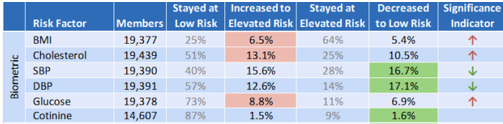
The other irony is that he cited the Koop Award-winning companies as examples of successes in preventing diabetes, when — according to their own applications — they basically failed. Ironically, I also cited that very same award in my argument. Specifically, McKesson won an award for preventing diabetes even though its employees’ glucose and BMIs increased. Mr. Goetzel’s and his Koop Award committee cronies never been much for fact-checking, even when the facts are right on the application itself:
The final irony is that Mr. Harris ends his argument with a call for “evidence-based” wellness programs. Ironically, the “evidence” is overwhelming…in the other direction: wellness programs have not avoided a single wellness-sensitive medical admission, according to US government figures. The green line below represents the wellness-exposed population while the red line represents the rest of the country. There is no separation, meaning that the wellness-exposed population has achieved zilch.
Actually, there is slight separation –but ironically it goes the other way. You’d statistically be better off not being exposed to wellness.
This graph is part of my proof of the ineffectiveness of wellness vendors, and allows me to offer a million-dollar reward to anyone who can show wellness doesn’t lose money.
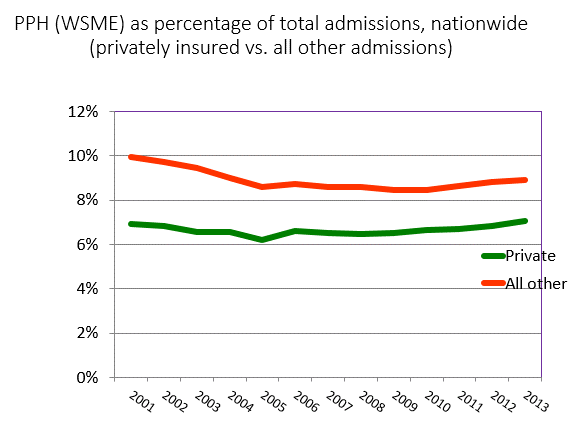
Where did the government get the data for this graph? It was compiled by Truven Health, the division of IBM that — you guessed it, ironically — employs Mr. Goetzel.
Share this:

NIOSH Publishes Groundbreaking “Total Worker Health” Agenda
NIOSH is the National Institute for Occupational Safety and Health. It is part of the Centers for Disease Control and Prevention. Their charter is the opposite of the wellness industry’s, and can best be described as a focus on the health of workers, rather than on the health of workplace wellness vendors. That puts me and them (meaning NIOSH) in total alignment.
They recently published their workplace safety and health agenda for the next 10 years. Readers can either read these highlights, a longer summary, or the actual report, entitled: A National Agenda to Advance Total Worker Health® Research, Practice, Policy, and Capacity.
By way of background, since the federal government became actively involved in workplace safety 43 years ago, deaths in the workplace have fallen by about two-thirds, while the size of the workforce has doubled–meaning the death rate is down about more than 80%. To put this in perspective, the entire age-adjusted death rate overall during this period has fallen by less than half. Plus, the reductions in the latter rate are concentrated among the very young and very old, not so much working-age people.
Lately, of course, death rates in one of NIOSH’s target populations have been rising–making the workplace mortality improvement even more striking.
The improvement is multi-factorial. Yes, NIOSH and OSHA regulations, oversight, inspections and penalties are partly responsible. But reputation, safety features, technology, offshoring of “dirty” work, and fewer inherently dangerous jobs (like coal mining) also contribute. Note that the improvement in the overall age-adjusted death rate has also benefited from similar major favorable trends. Yet the workplace death rate reduction has far outpaced the general decline.
On the other hand, there remain 3-million workplace-related injuries and illnesses/year, meaning the task is still at hand. And unlike heart attacks and diabetes, many of these injuries and illnesses can actually be prevented by the employer.
The centerpiece of the NIOSH Total Worker Health agenda is that the workplace should be a safe and healthy place. Employees should be safe from accidents, hazards, chemicals, bullying and other “risk factors in the workplace that contribute to common health problems previously considered unrelated to work.”
The report calls for “risk assessment and risk management” in the workplace. That is, of course, exactly the opposite of what’s done by the wellness industry, which could never be confused with MENSA. They (meaning the wellness industry) continue to flog the same discredited, worthless “biggest loser” and “pry, poke and prod” programs despite the overwhelming evidence that these programs contribute to, rather than ameliorate, risks and hazards and stress in the workplace–and of course lose money.
As a wellness professional, you should read the section: “Issues Relevant to Advancing Worker Well-Being through Total Worker Health.” That, my friends, (plus Quizzify, which does address worker health) should be your agenda for the next 10 years, just like it’s theirs.
The report goes on to specify how NIOSH and their collaborators are going to address this agenda, but the gist is in that one section.
Along with what the NIOSH report does advocate in its 10-year agenda, it’s important to note what it doesn’t advocate: conventional “pry, poke and prod” wellness.
One can only imagine the political pressure NIOSH had to withstand in order to avoid turning this outstanding document into a paean to wellness, or at least including a section on wellness–or at least a few passing mentions of the word, which doesn’t appear once. Likewise “screenings,” “health risk assessments,” and any form of crash-dieting weight-loss initiatives are also omitted.
Why do I infer “political pressure”? Because NIOSH’s overlords are the CDC. Having allowed Ron Goetzel to paint them into the wellness corner, they are doing exactly the opposite of NIOSH: in order to try to prop up their wellness friends, they are doubling down on demonizing chronic disease. Using a round-up-twice-the-number-of-usual-suspects approach to biostatistics, they recently and inexplicably bumped their previous mantra of 75% of healthcare spending being on people with chronic disease up to 86%.
How? Simple: among other things, that figure includes someone with allergies having a baby or breaking a leg. Naturally vendors take advantage of their trademark innumeracy to further misinterpret the CDC’s already-fictional figure as “86% of spending is due to chronic disease.” Neither 86% nor even 75% makes any sense whatsoever as a practical matter, and long ago we debunked the 75% as healthcare’s biggest urban legend.
This isn’t the first time the CDC’s numbers haven’t added up. These are also the people who are horrified both that “7 out of 10 deaths are due to chronic disease” (that’s called “civilization,” folks) and that a shocking 20% of children are at or above the 95th percentile for weight.*
And yet, these are the same people who wiped out malaria in the US, smallpox worldwide, (eventually) helped contain the spread of AIDS, and possibly prevented a domestic Ebola mini-epidemic.
So here’s a modest four-part proposal. The CDC should:
- Let NIOSH take the lead on total worker health;
- Let me take the lead on fifth-grade arithmetic;
- Let Mr. Goetzel take the lead on delaying the wellness industry’s asymptotic decline into irrelevance; and instead
- Do the one thing they know how to do very well, which is keeping people alive.
*Yes, we know what they meant. The growth charts were developed in 1979 (as it happens my very own uncle, Dr. Michael Lane, led the project, after he led the smallpox eradication project). They meant to say that 20% of today’s kids would be at or above 1979’s 95th percentile. But that’s not what they did say.
Ironically given the Chicken Little-esque histrionics in the CDC’s other bogus claims, this particular observation would have actually been both dramatic and compelling — if they had only managed to get it right.
Share this:
Harvard Business Review: Wellness Vendors Make Employees Worse
As our more alert readers may possibly have noticed just a little bit, there is a battle taking place between advocates of doing wellness to employees (wellness vendors) vs. advocates of doing wellness for employees (the rest of the inhabited solar system). There are also those who want to do both, what my colleague Jon Robison calls “paradigm straddling”. This latter group consists of vendors who want to check off the culture-of-wellness box so they sound relevant and supportive and au courant, while continuing to charge employers large sums to screen the stuffing out of their employees. The most hilarious example of the last is Total Wellness. If you haven’t already read their “profile,” it’s well worth the wear and tear on your keypad to click through.
Now, along comes Stanford University’s Emma Seppala, writing “Good Bosses Create More Wellness than Wellness Plans Do” in Harvard Business Review, to draw a bright-line distinction between the two approaches.
Her first paragraph:
In the name of employee wellness, and in response to insurance company demands, corporations are offering well-being initiatives with financial incentives. Complete this cholesterol screening, say, and you’ll get $100 added to your paycheck; participate in some number of wellness programs, and you’ll receive another bonus. In this quest to increase employee wellness, however, organizations are often unwittingly making things worse. Is it any surprise that initial studies on wellness programs are showing they don’t lead to any visible results?
As an aside, even our less alert readers may recall that I got in a lot of trouble with the HERO crowd (Ron Goetzel, Staywell, and Seth Serxner) just for the crime of noticing that their own numbers in their own guidebook showed wellness loses money. Apparently, Ms. Seppala noticed the same thing, because the link in her article in support of the “wellness programs don’t lead to any visible results” comment goes directly to their report. I guess she’s going to be placed on their Enemies List as well, and she can probably also expect them to circulate a “poison pen” letter about her as well, perhaps using the one they wrote about me as a template. Congratulations, Emma! You’ve arrived.
These programs “can actually cause more stress,” she writes. And she notes that those employees who do take time off for the corporate yoga class etc. get dirty looks from colleagues who need to pick up their slack.
What to Do Instead
It won’t surprise even our least alert readers that Ms. Seppala advocates a Dee Edington-type “culture of wellness,” starting with the work environment itself:
A workplace characterized by humanity. An organizational culture characterized by forgiveness, kindness, trust, respect, and inspiration… Leaders set the tone for their organization, and their behavior determines whether interactions in their organization are characterized by trust, forgiveness, understanding, empathy, generosity, and respect.
I’ll leave the rest for you to read.
Where Does This Leave the Wellness Industry?
You’ll see a lot more paradigm-straddling. Once again, the wellness industry comes through with the quintessential example: a Pulse post from a wellness vendor called Dacadoo. (There are so many wellness vendors that I guess all the other names have been taken.)
Talking about all the “fun things” that a wellness culture can provide, Dacadoo writes:
[Health fairs] are professionally run events that are designed to provide education and basic medical screening at usually little cost or no cost for the employees. At these fairs employees can undertake some screening tests such as blood pressure, glucose cholesterol, height and weight, anemia, etc.
Speaking of the solar system, anyone from another planet would interpret this passage as employees thinking: “Wow, my employer can weigh me and test me for both ‘glucose cholesterol’ and anemia! At little or no cost to me? How cool is that?”
And I bet if employees are willing to pay them just a tiny bit more, Dacadoo will also allow them to paint their fence.
Share this:
Nebraska’s Award-Winning Wellness Program Meets an Ignominious Demise
No program epitomized conventional “pry, poke and prod” wellness more than Nebraska’s state employee wellness program. And by that of course I mean no wellness vendor has ever lied about outcomes more blatantly or won more awards than Nebraska’s state employee wellness program vendor, Health Fitness Corporation. (Blatantly lying about outcomes and winning Koop Awards, in the immortal words of the great philosopher Frank Sinatra, go together like a horse and carriage.) Their big mistake was admitting it. (See the timeline link.)
Not to mention the cover-up of the lies, that Ron Goetzel and his Koop Committee friends botched so badly that the state’s HR team and procurement department could no longer do the Sergeant Schultz thing. I guess now, finally, Mr. Goetzel will stop referring to this program as a “best practice.”
Now, the program is officially dead. It was close. On October 1, we thought we had lost:
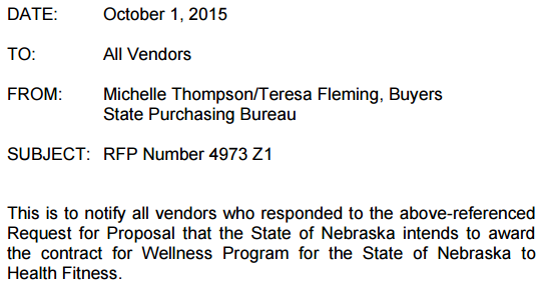
But then last week, following a number of behind-the-scenes conversations and finally a bit of googling by the state:

In other words:

Share this:

Say “Goodbye” to the Wacky Notion of Disclosing Employee Weight to Shareholders
Corporate Wellness just eviscerated the proposal that employers should disclose employee weight to shareholders.
The thing about this head-scratching proposal — and if you guessed that it originated with Ron Goetzel as a way to justify the existence of wellness vendors, you get how this industry works — is that it is such a bad idea that I didn’t even have to criticize it. I merely questioned it. Just reading the questions in this article would be enough for 99.9% of CEOs to decide they want nothing whatsoever to do with it. (The other 0.1% run wellness companies.)
And no HR executive, upon reading these questions, would even dare breach the notion with the C-suite, fearing these questions would be asked and knowing these questions are unanswerable.
Further, the format of just asking questions fit Corporate Wellness needs. They were kind enough to allow me to write an article for them knowing that many vendors get apoplectic at the mere mention of my name, let alone my appearance in their widely read publication. I reciprocated this kindness by writing an unopinionated article.
By the end, though, I couldn’t hold back. In an industry known for its dumb ideas, this proposal to disclose employee health metrics to shareholders is one of the dumbest. And the dumbest of all metrics included in this proposal would be depression. In this case I did offer an opinion:
Just say no. It would be impossible to estimate the number of depressed employees in a manner accurate enough to withstand an audit. [And review by outside auditors is a key part of this proposal.] The task of determining who is depressed would involve highly intrusive and costly assessments by others, or else self-assessments that almost beg to be completed with misinformation. Many employees who are depressed don’t know it and others aren’t going to admit it.
I personally find it depressing that this proposal would even be on the table. After you read about it, I think you’ll agree.
Share this:
HERO’s Paul Terry, Ron Goetzel, and Optum’s Seth Serxner Admit to Fabricating Data
Update: It turns out that, notwithstanding the protestations of these three very stable geniuses to the contrary, their data that they claim (three times, below) to have “fabricated” was actually real…and the three of them reviewed it before it was published.
How do I know this? In addition to the chapter actually saying it was real data, and the guidebook saying each chapter was reviewed multiple times by multiple people, I simply asked the author. He confirmed both that the data was real (“If I had made it up, I would have said so”) and that it was indeed reviewed multiple times by multiple people on the HERO board.
When I re-read the chapter, I thought: “This can’t have been written by someone at HERO. This is actual analysis and they don’t know how to do actual analysis.” Sure enough — the actual author is Dr. Iver Juster, who has taken all my courses and read all my books and has the advanced level of Critical Outcomes Report Analysis certification.
In other words, to quote a rapper whose name escapes me, they lied about the lies they lied about.
In an earlier column we indicated that we had gotten wind of a “poison pen” letter that the Health Enhancement Research Organization (HERO) board members (Paul Terry, Johns Hopkins’ Ron Goetzel and Optum’s Seth Serxner, among others) sent around to members of the media. We just weren’t sure to whom it was sent or what exactly it said.
Eventually my attorney pried it out of them, after they first refused to admit this letter existed.
My attorney said he had never had a client who wanted to republish a defamatory letter written about him. I replied: “In the wellness industry, a defamation from HERO is, in the immortal words of the great philosopher Kenny Banya, ‘Gold, Jerry. Gold.’” Indeed, this letter is the closest I’m ever going to come to achieving my boyhood dream of appearing on Nixon’s Enemies List.
Here are a few excerpts–along with my annotations in italics.
“The featured variables from the HERO report that these authors cites [sic] as ‘evidence’ begin with a statement that ‘HERO calculates gross wellness program savings of $0.99.’ As is obvious to even the most uninitiated reader of our report, the $0.99 amount is taken from page 23 of an 87 page report in a section which is clearly labeled as one example wherein the sum savings derives from a fabricated scenario…The authors go on to suggest that the HERO report provides ‘evidence’ of a negative return on investment from wellness programs because our ‘report estimates wellness programs costs at $1.50 pmpm.'”
Our math (meaning your own math in your “fabricated scenario”) is correct. True, we never in a million years realized that wellness economics are so hilariously poor that even when you “fabricate a scenario” in your own guidebook, you still manage to lose money. And in any event, even though you never asked us to, we did correct that inaccuracy—by showing how much more money wellness loses if we substitute real numbers from HERO Committee members’ own writings for the “fabricated” ones.
“This variable is taken from page 15 of our report and the report’s authors in no way associated the two numbers. Furthermore, the cost number is again derived from a fabricated illustrative example…”
So you’re saying that your report’s authors put these two numbers (costs=$1.50 PEPM and savings=$0.99 PEPM) in the very same chapter but readers aren’t supposed to compare them? Bad readers! Shame on you for being discerning!
By the way, the example isn’t “fabricated.” Messrs. Goetzel, Serxner and Terry are now, in the immortal words of the great philosopher LL Cool J, lying about the lies they lied about. This is not a “fabricated illustrative example.” It is a reproduction of an actual report, which is why Page 22 calls it a report and describes what it shows:

“The authors seem to indicate that their findings from these distinctly unassociated variables is an inventive disclosure of a negative ROI for wellness on their part by writing that ‘this loss was not an intentional finding in this document.'”
Leaving aside that both these “distinctly unassociated variables” appear in the exact same chapter, how can costs be “distinctly unassociated” with revenues? Isn’t that what business is all about, associating revenues and costs? Example: Suppose your revenues are $2. That’s GOOD if your costs are $1 but BAD if your costs are $3.
I’ll use a sports analogy so that even the dumbest member of the HERO board can follow the logic. If my team scores 5 runs, we WIN the game if your team scores 4 runs. But we LOSE the game if your team scores 6. It doesn’t do any good just to know my team scored 5 runs. The number we score MUST be “distinctly associated” with the number you score to get a meaningful result.
Am I going too fast for you, Mr. Goetzel? You did refer to yourselves in this letter as “among the most credible and conscientious scientists and practitioners working in corporate wellness today,” so hopefully the information above is not too technical for you. I tried to use short words where possible.
“We are confident that any discerning reader of our report would instead conclude that associating the variables as they were in this blog post was an absurd, mischievous and potentially harmful misrepresentation of our data.”
We took screenshots of your figures. I’m not quite sure how we could misrepresent screenshots. In any event, we don’t have to “misrepresent your data.” As Yogi Berra might say, you misrepresented it just fine all by yourselves. A trade association dissing its own product, and now bragging about fabricating data? One doesn’t see that very often.
“A cursory vetting of these authors would have revealed a litany of inaccurate and outrageous writings over several years.”
Yikes! We apologize! We had no idea that we’ve been publishing “a litany of inaccurate and outrageous writings.” We have published about 450,000 words — more than all of Shakespeare’s tragedies combined. Possibly a few inaccurate words slipped in. Surely in order to make such an otherwise libelous statement, you have a list of these “inaccurate and outrageous writings.” A cynic would say you’re deliberately lying, but all we’d like to know is…

Since we are in the “integrity segment” of wellness, we would like to see this list, so we can acknowledge and correct any errors.
Alternatively, if there are no inaccuracies, then you are endorsing the accuracy of our work, which we will announce in an upcoming post. So please get back to us within seven days with the list. Otherwise, we thank you very kindly for your endorsement of our accuracy. Additionally, we would like a written apology if you want to avoid a lawsuit.

 They Said What?