
Home » Posts tagged 'Ron Goetzel' (Page 9)
Tag Archives: Ron Goetzel
Koop Award Committee-meets-Sergeant Schultz
Ever wonder why no one notices that wellness results are completely made up?
Wonder no longer. it all starts with The Health Project, which gives out the C. Everett Koop Award. This month is award season, meaning some of the award’s sponsors or committee members gets to ingratiate themselves with customers. In honor of this month, let’s review previous years’ awards, and see the self-invalidating, but somehow unnoticed, details that call to mind the immortal words of the great philosopher Sergeant Wolfgang Schultz: “I know nothing. I see nothing. I hear nothing.”
To that iconic phrase, the Koop Committee adds: “I notice nothing.”

2014: British Petroleum (BP America)
Last year, the award went to British Petroleum. BP’s candidacy wasn’t exactly a longshot, since both its vendor (Staywell) and its consultant (Mercer) are on the Committee AND are “sponsors” of this volunteer committee. By the way, if you’re looking for any disclosure on the award announcement of those connections when you click through on the first sentence above, you’ll need x-ray vision, since there is none. No one seems to have noticed this omission.
Besides not understanding ethics, apparently Mercer and Staywell don’t understand arithmetic: their “rigorous analysis” claimed almost $20,000/person in savings for active participants who reduced a risk factor. Besides being mathematically impossible, clinically laughable, unchecked for plausibility in violation of their own HERO guidelines, and not adjusted for dropouts and non-participants, this figure, as the screen shot below shows, is over 100 times more than Staywell itself says is possible. Once again, no one seems to have noticed this glaring contradiction.

2013–GRACO (honorable mention)
Ron Goetzel has written at length about Graco, as have we and others. By starting the measurement in 2009, the year after the program started (as opposed to starting the measurement two years before the program started — see the 2011 award winner, Eastman Chemical), and “forgetting” to count revenues added by an acquisition. Mr. Goetzel was able to tie the growth in Graco’s revenues to the “bottom line performance” of its wellness program. Of course, when you actually start measuring the year the program actually started (2008) — which coincidentally was also the year before the recession knocked 29% out of Graco’s revenues — and then adjust for the 2012 acquisition’s added revenues, Graco organically grew at about the same rate as everyone else. Wellness had nothing to do with it. Graco’s salespeople did not exceed their quotas because they ate more broccoli.

Here’s what else didn’t happen due to its wellness program: savings. As our post showed, Mr. Goetzel didn’t notice that the cost trend for children (none of whom were in the wellness program) outperformed the cost trend for wellness participants. This means, of course, that the favorable trend among participants couldn’t be attributed to wellness, since the trend for a cohort without access to wellness was even more favorable. It’s all right here.
Oh, yes, and it also turns out that Graco’s insistence on making its employees go to the doctor was more likely to harm them than benefit them. That’s not us–that’s the New England Journal of Medicine.
2012: The State of Nebraska
We’ve already chronicled this one at length. There were quite a number of glaringly obvious rookie mistakes that escaped the notice of the award committee, either due to incompetence or perhaps the fact that the state’s vendor, Health Fitness Corporation (HFC), was also a sponsor of the award. See if you can find that sponsorship disclosure in their press release “congratulating” the State and LL Bean (the other winner, also a customer of HFC). You’ll need an electron microscope to go with your x-ray vision.
HFC actually admitted lying about saving the lives of cancer victims who as it turned out didn’t have cancer, but still got the award because, according to Ron Goetzel at the 2014 Datapalooza conference, apparently this particular lie didn’t count because it wasn’t on their application, just everywhere else. It was impossible to miss, but Ron said he didn’t notice. Is this a great country or what?
2011: Eastman Chemical
Another HFC customer. (HFC is really getting its money’s worth out of its sponsorship.) This was the one where — unlike 2013’s Graco, which started measuring outcomes the year after the program started in order to maximize the results — HFC started measuring outcomes two years before the program started in order to maximize the results. They separated participants and non-participants in 2004 but didn’t start the program until 2006. By 2005 the would-be “participants” were already 9% ahead…and by the time the program got underway in 2006, they were almost 20% lower-cost than the non-participants.

Once again, all this information was perfectly obvious at the time of the award submission, as well as highlighted in all of my books. It was also re-printed and re-presented multiple times, but somehow no one on the Koop Committee noticed until late 2014, when it was in Health Affairs. At that point, the light being shined on him being too glaring to hide from, Mr. Goetzel had to respond. Employing the passive voice to great advantage, Ron said the slide was “unfortunately mislabeled.”

Read that carefully. If it’s hard to read, here is the source. It’s towards the bottom. He says this slide and other data “convinced” the Koop Committee to give them an award. That’s his story and he’s sticking to it.
Recently, for the second time, he went back into the Koop Award submissions and rewrote history. Compare the original Koop submission screen shot with the photoshopped version. Note the missing X-axis:
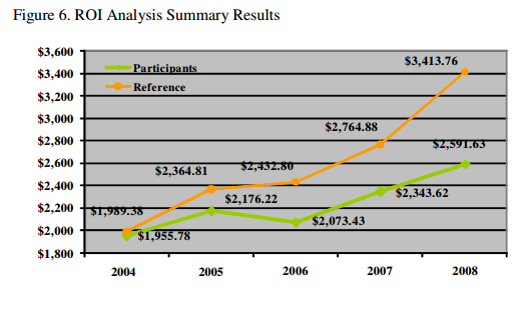
The original was:

His explanation didn’t indicate who mislabeled this slide, why he didn’t notice until now, why he snuck into the old files to relabel it, what the labels should have read — or why HFC never apologized, as others outside the wellness industry do when mistakes are made.
I can explain the last — just look at the wellness industry motto, on YouTube: “A Koop Award means never having to say you’re sorry.”
2010: Pfizer
None of Pfizer’s outcomes figures stand up to even the slightest scrutiny, and Mercer did the analysis — making Pfizer a shoo-in for this award. By their own admission only 4% of people moved out of high-risk status. (Naturally this tally excludes non-participants and dropouts, who likely increased risk factors at a faster rate than participants reduced them.) In other words out of 30,000 employees, 1200 reduced a risk factor. And yet somehow Pfizer saved $9.4 million, almost $9000 per risk factor. So if everyone at Pfizer reduced a risk factor, they’d easily wipe out all their healthcare spending.
They did some secure messaging, but only about a quarter of the at-risk population even opened their messages…and only about a quarter of them clicked through to the messaging.
Smokers self-reported at 6% before the program and 3% after it. No one hazarded a guess that perhaps some employees were, oh, I dunno, lying?
However, no one can accuse Pfizer of lying about their weight loss results. In particular check out this comparison, which was offered with a straight face, of employees who read their weight-loss messages vs. employees who didn’t.
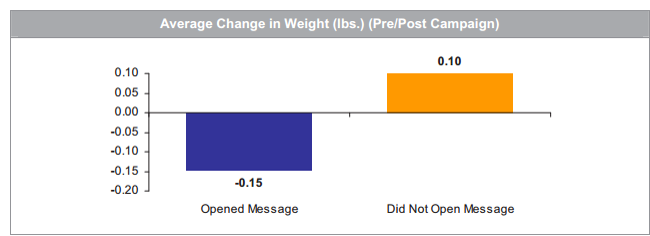
Over the course of the study, people who didn’t read their messages gained 1.6 ounces while employees who did lost 2.9 ounces. You could practically attribute that differential performance to the calories required to open the emails.
Share this:

Lincoln-Douglas, Ali-Frazier, Roadrunner-Coyote…and now: LEWIS-GOETZEL
The pundits said it would never happen. The oddsmakers had it at 100-to-1 against. Nate Silver predicted it could never come to pass. And yet, LEWIS AND GOETZEL WILL BE DEBATING WELLNESS ECONOMICS ON NOVEMBER 2 in WASHINGTON DC
It’s at the Population Health Alliance Annual Forum. It’s not officially announced yet but save the date. More details to follow.
PS Feel free to add your own choice to the poll. We’ll award a free pdf of Surviving Workplace Wellness to the most creative proposed answer
Share this:

The Graco-Goetzel-Bravo plot thickens…more twists and turns
The Graco-Goetzel-Bravo-Hopkins case study is turning into another Nebraska fiasco. As with Nebraska, the numbers all contradict one another. But unlike Nebraska, there has as yet been no admission of deliberate lying in the Graco case study. That’s why Graco only earned an honorable mention in the Koop Awards, instead of winning one outright like Nebraska did.
Consider Bravo’s case study on Graco covering the exact same population over the same period as Ron Goetzel’s study. Let’s assume Ron Goetzel is right in that the wellness program should be measured from 2009 rather than 2008, when the program started. (Bob Merberg’s brilliant analysis points out the cherrypicking of the date has a huge impact on claimed success, but let’s concede this start date choice to Ron, and use 2009 according to his wishes.)
Bravo’s case study displays the PMPM costs by year. The first thing to note is, they list employee healthcare costs at $328 PMPM, which actually makes sense, instead of the $190 PMPM in the Hopkins report. I don’t know why these two figures, purporting to cover the exact same population in the exact same period, are completely inconsistent, but I do know that $190 PMPM is an impossible figure, as any population health expert knows. (“Plausibility checking” would have caught that error but Ron has never taken our course in Critical Outcomes Report Analysis, which would have covered plausibility-testing and likely prevented him from making such a rookie mistake.)
Second, Bravo lists children’s healthcare costs in this report as well. Funny thing: over the same exact period in which Mr. Goetzel was claiming that the wellness program was responsible for controlling employee participant costs, children’s healthcare costs trended better than wellness participants’ costs. Mr. Goetzel obviously had access to this children’s cost trend data (we had no trouble finding it, thanks to Bob Merberg) but elected to — get ready to fall out of your seats — ignore it. The wellness ignorati rarely step out of character.
This children’s cost trendline appears to invalidate the entire Goetzel-Johns Hopkins conclusion that the healthcare cost trend was due to the wellness program, since not one single child participated in the wellness program.

For some reason Graco’s spouses cost about $7000 apiece a year. We’ll leave that for someone else to dissect.
As an aside, if anyone thinks they recognize the name “Bravo Wellness” from an earlier posting, it’s because they do. Bravo is the outfit that brags about their ability to save employers money by fining employees. Their website is disproportionately about their appeals process when those fines are levied. This sounds like a company that does wellness to employees instead of for them.
Not sure how bragging about fining employees is consistent with the positive culture that Mr. Goetzel says Graco has, but maybe I’m missing something here.
Share this:

Britney Spears Meets Ron Goetzel’s Institute for Health and Productivity Studies
 In the immortal words of the great philosopher Britney Spears, oops, they’re at it again.
How this “study” gets published and why Johns Hopkins would allow its name to be used on it is anyone’s guess. In our last posting, we pointed out that in one place Graco’s employees cost $11,100 apiece to insure, just like other companies that offer competitive benefits. Yet later on in the story we see that employees only cost $2280. No mention of how these figures could be so inconsistent.
We let the rest of the study go, figuring we had already found the Macguffin. Ace reporter Bob Merberg, though, was not so easily convinced.
We’d urge reading his blog. Among the claims made by Mr. Goetzel was “revenues have doubled since 2009.” Well, yeah, but:
(1) it turns out Graco made a sizable acquisition in 2012, which might have had a teeny-weeny effect on revenues;
(2) revenues had plummeted in 2009, the year after the wellness program was introduced.
If you (a) measure from 2008, the year the wellness program was introduced, instead of cherrypicking the baseline year to give the best result, and (b) factor out the acquisition, revenues over the 2008-2014 period have pretty much tracked the economy as a whole. So nothing happened.

Try the Quizzify demo and see how many you get right.
We can’t make this stuff up. Fortunately we don’t have to.
Share this:


News flash: The Wellness Ignorati are ignoring facts for a change

There has to be a limit, even to deception
The Wellness Ignorati got their name by ignoring facts. Facts, of course, are the wellness industry’s worst nightmare. They ignore them In order to avoid creating news cycles that might reach human resources departments despite the best efforts of their consultants and vendors to shield them from actual information.
And they’re at it again.
First, Atul Gawande wrote a scathing article in the New Yorker about massive overscreening earlier this month. As Mitch Collins noted in The Health Care Blog, not a peep in response from the perpetrators of those hyperdiagnostic jihads. Nor has their been any response to Mitch’s article itself. Literally, no one defends wellness industry practices. And yet somehow all the laws are on their side.
Speaking of which, Mitch mentioned the famous Nebraska debacle, in which the vendor, Health Fitness Corporation, lied about making “life-saving catches” of “early-stage cancers.” Since HFC was a sponsor of Ron Goetzel’s Koop Award, Ron naturally gave them that prize for these lies.
However, we’ve thrown down the gauntlet. HFC, come on out and fight. Give us your side of the story. How was this not a deliberate lie designed to score political points in Nebraska? If it was a mistake, why didn’t you change it and apologize? How do those 514 cancer non-victims feel? And Mr. Goetzel, why do you not only keep defending HFC, but have even upped the ante? They’ve been promoted from “best practice” to “exemplar” in your most recent webinar.
As long as wellness vendors are silent, we won’t shut up.
Speaking of non-responses from Mr. Goetzel, where is the correction of or explanation for the massive mistake in Mr. Goetzel’s most recent wellness program evaluation? All those readers have been misled by his blog into thinking Graco’s costs/employee are $2280/year when in reality the cost per employee contract holder — according to Mr. Goetzel’s own blog — is about $11,100, like almost every other company. (That includes spouses and dependents but any reasonable dependent ratio would yield more like a typical $5000 to $6000 per employee rather than $2280.) I know he knows about this mistake because I’ve submitted a comment to his blog, which shockingly hasn’t been posted.
So, please, could someone actually respond for a change, even if it’s just to accuse us of bullying.
Share this:

Ron Goetzel reports on Graco, the company with the country’s most expensive spouses
Talk about “burying the lead.”

Need we say more?
Ron Goetzel just reported on a company called Graco, where employees were subjected to a “pry-poke-prod-and-punish” wellness program. These are line employees in an “old economy” company–exactly the type of company where healthcare spending would be high. And it is high. According to the article, Graco spent $29,000,000 on healthcare for 2600 employees. That’s about $11,100 apiece, roughly what you’d expect. This estimate is with or without a wellness program, since as Ron’s recent HERO report noted, wellness programs have no positive impact on spending.
Yet later on in the article he writes:

In the immortal words of the great philosopher Rick Perry, oops.
$190 per member per month (and we assume that he meant just for employees, not members) is $2280/year/employee. Here are the possibilities:
(1) Graco has the country’s mot expensive spouses, costing about $18,000/year (to bring the average spend to $11,000 per employee contractholder per year) but hasn’t noticed
(2) Graco has some magical special sauce that kept costs way below average even before the wellness program started that Ron failed to tell us about (hence “buried the lead”)
(3) Ron Goetzel made yet another rookie mistake in his math, thus invalidating the entire study, just like most of his Koop Awards.
You can rule out that this $190 had anything to do with the wellness program. Smoking rates (the only thing that really affects spending) remained unchanged, and obesity only fell a few points. And a company can’t save money by overscreening people, paying for their drugs, and making them get unnecessary checkups. In any event, it wasn’t $190/month. It was $11,100/year.
$2280 vs. $11,100… We look forward to Mr. Goetzel’s explanation of how both these figures could be true, since it appears they are completely at odds with each other. In the immortal words of the great philosophers Dire Straits, if two men say they’re Jesus, one of them must be wrong.
And once again, the mantra of Surviving Workplace Wellness holds true: In wellness, you don’t have to challenge the data to invalidate it. You simply have to read the data. It will invalidate itself.
Here’s a Quizzify number that adds up: a 100% guarantee you’ll save money
We will no doubt be accused of “bullying” him for invalidating this study, which he obviously spent a lot of well-compensated time on. So just to show our good intentions, we will offer him our course and certification in Critical Outcomes Report Analysis gratis. It seems he could learn a lot from it and we look forward to announcing his successful completion.
Update: Ron apparently “forgot” to include the actual data in his writeup, which showed that, um, how to put this tactfully, his entire conclusion is wrong. Looks like kids (who had no access to wellness) trended better than the adults who did have access. We added this as the second installment.
Share this:

Dan Ariely on how the Wellness Industry Crowdsources Reality
 We recommend that everyone listen to Dan Ariely’s interview on NPR and TED talk “Why We Lie.” It explains exactly why the Wellness Ignorati could decide to collectively self-publish an entire guidebook full of misinformation and disinformation designed specifically to increase the revenues of wellness vendors.
Here are our take-aways from Professor Ariely’s TED Talk.
Like Walter White in Breaking Bad, the Ignorati started out honest. They genuinely believed that wellness saved money and that they were doing good. It was very counter-intuitive to believe otherwise. If you look at page 201 of Why Nobody Believes the Numbers, you’ll see I even mildly supported biometric screens. I hadn’t done the math. I just assumed early detection was a good thing and that Ron Goetzel and others was telling the truth, for which on page 83 I professed my admiration. As another example, ShapeUp’s CEO Rajiv Kumar would never have attacked us (largely for refusing to believe Kate Baicker, who even RAND now dismisses and who herself no longer appears to believe her own claim) if he had realized his own outcomes claims were false.
Like Walter White, it was easy to justify the first transgressions. Since the Wellness Ignorati genuinely believed in what they were doing, when the numbers didn’t add up, they either justified to themselves that it was OK to fudge them (like ShapeUp’s now-retracted claims about Highmark) or ignored glaring invalidating mistakes. The best example of the latter: Ron Goetzel finally recanting Health Fitness Corporation’s infamous participants-vs-non-participants self-immolation after years of ignoring it.
Or wellness vendors create a parallel universe where numbers don’t have to add up (like Keas), or completely misquote industry experts saying the opposite (like Vitality).
Like Walter White, they don’t actually believe they are bad people. Ariely calls this a “personal fudge factor.” With the possible exception of Wellsteps’ Steve Aldana (who may be honest but simply unable to recognize that no matter what numbers you enter into his model you get the same answer), they really think what they are doing is OK—even though the math clearly dictates otherwise.
Also like Walter White, they kept getting drawn deeper in. The more they lied, the more they have to keep lying. They needed to continue to defend what was looking increasingly indefensible. After giving Nebraska’s program a much-publicized and ironically named C. Everett Koop Award, it’s hard for Ron Goetzel and his committee to say “We goofed—we need to take it back because they made up the data and defrauded the state” even after the vendor, Health Fitness Corporation, admitted it.

Quizzify…truth serum for wellness.
Like Walter White, the Wellness Ignorati “suspend reality” (to use Ariely’s term) and “buy into a new reality.” Essentially the Ignorati crowdsource reality. They peer-review one another’s work, give themselves awards, and decide (to use Michael O’Donnell’s term) that anyone who challenges them lacks the “credentials” to do so. Or, as Ariely says: “If you were getting well-paid by Enron, wouldn’t you want to see reality as they present it?”
Avoiding the media is an excellent strategy. Once again, like Walter White, the Wellness Ignorati want to keep a low profile. Exposure is bad if the facts all go the other way. That explains Ron Goetzel’s refusal to debate, ever, and the Ignorati’s characterization of us as name-calling bullies when all we do is ask questions.
Yep, you can read this site up, down and sideways. The fact is no names are called other than the “Wellness Ignorati.” We’ve offered them the opportunity to propose a different name for their practice of denying facts, which they’ve declined. We do use the term “pretzel” to describe the very impressive twists and turns that Mr. Goetzel uses to wriggle out when he’s been caught calling failed or fraudulent programs “best practies” because they are run by friends, sponsors or clients. The alternative word for what one would be called when all your claims are made up is less flattering, and we’ve never used it with respect to Ron.
This explains why the Ignorati steadfastly refused to answer questions for a $1000 honorarium. Once again, like Walter White, they have so much as stake that $1000 is chicken feed. At Enron, if you questioned Ken Lay at an analyst conference, he would accuse you or not understanding their business, and cut you off from future meetings, rather than answer the question. We of course were not invited to participate in or even listen to the “discussion” about the HERO report.
Like Walter White, at some point the Wellness Ignorati needed to commit to their chosen path. The Wellness Ignorati have gone too far in their insistence that wellness saves money. There is no turning back. The existence of this site makes turning back even harder because retracting their lies means acknowledging them. And as soon as they do that, we do what we do best other than invalidate the Ignorati’s misstatements, which is: gloat.
Like Walter White, they are now doubling down. Examples: Ron Goetzel calling Nebraska a best practice after they admitted lying about saving the lives of cancer victims, in order to justify his original award to them. Steve Aldana can’t create a real ROI model now without admitting that his original model was not “based on every ROI study ever published” as he has maintained, but rather always yields a savings of $1359/employee no matter what inflation-adjusted figures you enter.
As the house of cards collapses, people on the fringes who were sucked in (in this case HR and some brokers and consultants) wake up and ask: “How could I have believed what these people were saying?” Many major and mid-level figures connected with Enron did exactly this. We see this every week in wellness, as people come to us and say: “I get it. I can’t believe I fell for this.”
So thank you to Dan Ariely. In one 8-minute TED talk, he explained the entire alternative crowdsourced reality of the Wellness Ignorati – without once even mentioning them by name. But I’m sure the Ignorati nonetheless think he bullied them.
As a hot-off-the-presses example of what Professor Ariely is talking about, Wellsteps just updated their model so that now instead of saving $1359 per person in 2019, they save $1359 per person in 2020. As with previous iterations of their model, the success of the wellness program is irrelevant to the outcome of the model. Just enter a 0% inflation rate and “1” for covered people (“1” so you can see the $1359 reveal itself without having to do division) — and then whatever figures you want to enter for spending, obesity and smoking.
Here you started out with astronomical healthcare costs and got a 99% reduction in smoking and obesity…and saved $1359
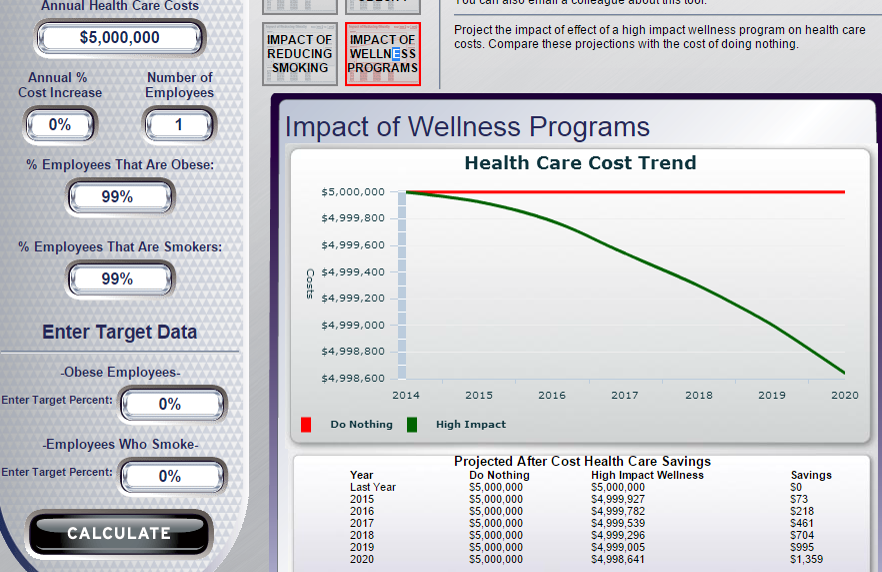
Here you save $1359 without changing smoking or obesity at all:

And here you saved $1359 even though there was nothing to save. The costs are as low as the model will allow you to enter (until they got caught, you could enter figures low enough that they model would calculate negative costs), and there was no smoking or obesity to reduce:

Naturally, Wellsteps is prominent both on the Koop Award Committee and the HERO Report Committee. Wellsteps’ “back story” is here.
Share this:

7 Take-Aways from the HERO-Goetzel Webinar in Defense of Wellness
This is the sixth in a series on the HERO disinformation campaign around wellness ROI. The other six installments can be found here.

They said what?
This afternoon HERO and Ron Goetzel conducted an entire Groundhog Day-type webinar as though They Said What, the entire media, and 2015 don’t exist.
They talked about the “confusion in the marketplace” (to quote their invitation) without once even mentioning the source (us) of the confusion in the marketplace. Actually all we did was point out that they contradicted themselves in their own report. They created the confusion by inadvertently telling the truth.
Time to make the pretzels
Here are some of the things they are still saying, that they know to be somewhere between misleading and lies. Apparently Mr. Goetzel lived up to his billing as Goetzel “the Pretzel” by basically twisting “wellness loses money” into wellness makes money,” though he admitted to some “controversy” around the latter point.
First, he is still quoting the Kate Baicker 3.27-to-1 ROI, that he knows to have been thoroughly discredited. We’ve blogged about that extensively–this link will take you to a series of other links. To wit:
- She’s walked it back 4 times.
- RAND’s Soeren Mattke has attacked it (and those of you who know Soeren–he is a very thoughtful and polite guy–you really have to be way off-base to get his dander up).
- Another researcher has pointed out that many of the studies in her meta-analysis were basically made up.
- Many of these studies were claiming reductions in diabetes expense and obesity at the same they were telling people to eat more carbs and less fat, exactly the opposite of what would reduce diabetes incidence and possibly obesity. And yet somehow money was saved…
Second, the Ignorati are still quoting the American Journal of Health Promotion meta-analysis and Mr. Goetzel pretzeled his way around the accidental conclusion of that paper that high-quality studies show a negative ROI.
Third, Mr. Goetzel strongly criticized the Penn State fiasco. Hmm…maybe we’re mis-remembering this, but we seem to recall he was one of the leaders of that jihad. Here is a article about a meeting in which he and several others “take the offensive” in the controversy. Or maybe that was another Ron Z. Goetzel.

Fourth, he said: “There’s some healthy debate going on.” But the irony is, there is no debate. Partly this is because they are steadfastly refusing to debate. And partly this is because there is nothing to debate–they admitted “pry, poke, prod and punish” wellness loses money and damages morale. The only places we disagree are how much money gets lost and how badly morale is damaged.
Fifth, he is still comparing participants to non-participants, as though he hadn’t been forced — by the existence of a “smoking gun” slide — to basically admit that participants significantly outperform non-participants even in the absence of a program.
Sixth, he pretzeled RAND’s Pepsico analysis in Health Affairs, overlooking the fact that the study concluded wellness loses money. Obviously we wouldn’t have congratulated Dr. Mattke on his huge success with that article (#2 article of the year in Health Affairs) if it had reached the conclusion Mr. Goetzel said it did.
Finally, the most notable feature was the dog-not-barking-in-the-nighttime. Not once was there any rebuttal to our observations. The Wellnes Ignorati have placed themselves in a difficult position. In order to rebut us, they would have to acknowledge our existence. But ignoring our existence — and the existence of facts generally — is the core component of the Ignorati strategy.
By the way, our source, expecting a spirited rebuttal, instead got supremely bored by the insight-free recycled and invalid material in the presentation, and dropped off before the slam-bang conclusion to the webinar. We doubt there were any other members of the Welligentsia on that webinar but if there were–and you have something to share about the closing minutes that you don’t see mentioned in here — please do.

No pretzels here
Share this:

HERO (Health Enhancement Research Organization) Crowdsources Arithmetic
This is the third in a series deconstructing the Health Enhancement Research Organization’s (HERO) attempt to replace the basic outcomes measurement concepts presented to the human resources community in Why Nobody Believes the Numbers with a crowdsourced consensus version of math. The first installment covered Pages 1 to 10 of their outcomes measurement report, where HERO shockingly admitted wellness hurts morale and corporate reputations. The second installment jumped ahead to page 15, where HERO shockingly admitted wellness loses money. This report covers pages 11-13. Next week we shall be covering Page 14.

4 out of 5 wellness vendors don’t get this
Spoiler Alert: The wellness industry believes that math is a popularity contest. (We have a million-dollar reward if they can show that’s true. More on that later.)
All the luminaries in the wellness industry got together to crowdsource arithmetic, and put their consensus (a word they use 50 times) in an 88-page report. Unfortunately, math is not a consensus-based discipline, like democracy. It is not even an evidence-based discipline, like science. It is a proof-based discipline. A methodology that doesn’t work in hypothetical mathematical circumstances is proven wrong no matter how many votes it gets.
The pages in question list 7 “methodologies” for measuring outcomes. To begin with, consider the absurdity of having 7 different ways to measure. Imagine if you asked your stockbroker how much money you made last year, and were told: “Well, that all depends. You could measure that seven different ways. And by the way, six of those ways will overstate your earnings.” Math either works or it doesn’t. There is only one right answer.
Methodology #1: “Cost Trend Compared with Industry Peers”
This methodology “may require consulting expertise.”
As a sidebar, one of the many ironies of this HERO report is that most of these methodologies emphasize the need for actuarial or consulting “inputs” or “analytic expertise”…and yet no mention was made on Page 10 of the cost of this expertise when all the elements of cost were listed. While not mentioned as a cost element, consulting firms are very expensive And even if consulting were free, we generally recommend hiring only consultants to do outcomes report analysis who are certified in Critical Outcomes Report Analysis by the Validation Institute.
By contrast, Staywell and Mercer offer an example of what happens when you as a buyer use non-certified “consulting expertise” to evaluate a vendor. Here’s what happens: the vendor wins. Needless to say, Staywell showing savings 100x greater than what Staywell itself said was possible simply by reducing a few employees’ risks raises a lot of questions. But despite repeated requests and offers of honoraria to answer these questions, Mercer wouldn’t answer and the only response Staywell gave us was to accuse us of bullying them. Staywell and Mercer held firm to the Ignorati strategy of not commenting—even though Mercer was representing the buyer (British Petroleum), not the vendor. Oh, yes—both Staywell and Mercer are represented on the HERO Steering Committee.
To HERO’s credit, they do admit the obvious for Methodology #1: If all your peers are using the same vendors, who recommend the same worthless annual checkups, the same overscreening/overdiagnosis, the same lowfat(!) diets, and the same consultants to evaluate all the phony savings attributable to these checkups, diets, and biggest-loser contests, obviously you’ll get the same results. And since trend is going down everywhere (including Medicare and Medcaid, which have no wellness), everyone gets to “show savings.”
Methodology #2: “Inflection on expected cost trend.”
Mercer has been a big proponent of this methodology, as in the previous Staywell example. At one point they used “projected trend” to find mathematically impossible savings for the state of Georgia’s program even though the FBI(!) later found the program vendor, APS, hadn’t done anything. In North Carolina, they projected a trend that allowed them to show massive savings in the state’s patient-centered medical home largely generated, as luck would have it, by a cohort that wasn’t even eligible for the state’s patient-centered medical home.
Comparing to an “expected” trend is one of the most effective sleight-of-hand techniques in the wellness industry arsenal. Every single published study in a wellness promotional journal comparing results to “expected trend” has found savings. And have you ever hired a consultant or vendor to compare your results to “expected trend” who hasn’t found “savings”? We didn’t think so.
QED.
Methodology #3: “Chronic vs. non-chronic cost trend.”
The funny things about this methodology are twofold.
First, the HERO Committee already knows this methodology is invalid because it was disproven in Why Nobody Believes the Numbers (and I offered an unclaimed $10,000 reward for finding a mistake in the proof). We know that people on the Committee have read my book because at least one of them – Ron Goetzel – used to copy selected pages from it until the publisher, John Wiley & Sons, made him stop. Methodology #3 was the fallacy on which the entire disease management industry was based. I myself made a lot of money measuring outcomes this way, until I myself proved I was wrong. At that point, integrity being more important to me than money, I changed course abruptly, as memorably captured by Vince Kuraitis’ headline: Founding Father of Disease Management Astonishingly Declares: “My Kid Is Ugly“. (Naturally the benefits consulting industry filled the vacuum created by my withdrawal from this market, and plied their clients with worthless outsourced programs that more than coincidentally generated a lot of consulting fees.)
If you had perfect information and knew who had chronic disease (before the employees themselves did) and everyone stayed put in either the non-chronic or chronic categories, you could indeed use non-chronic trend as a benchmark, mathematically (though the epidemiology is still very squirrelly). The numbers would add up, at least in a hypothetical case.
But we can’t identify anywhere near 100% of the employees who have chronic disease. Absent that perfect information, any fifth grader could understand the proof that this methodology is fabricated, as follows. Assume that 10 people with a chronic disease cost $10,000 apiece both in the baseline and in the study period. Their costs are therefore flat. The program did not reduce costs between periods.
Now add in 10 people with undetected chronic disease as the “non-chronic benchmark.” Maybe they are ignoring their disease, maybe they don’t know they have it, maybe they are misdiagnosed, maybe the screen was wrong (vendor finger-pricks are very unreliable). Assume these 10 people cost $5000 in the baseline…but they have events in the study period so their costs become $10,000.
That makes the “non-chronic trend” 100%! Suddenly, the program vendor looks much better because they kept the costs of the chronically ill cohort constant even though the “benchmark” inflation was 100%.

At Quizzify, wellness results always add up.
Second, Why Nobody Believes the Numbers has already shown how to make this methodology valid mathematically (though the epidemiology applied to that math might still be squirrelly, and there could still be random error in non-hypothetical populations). You simply apply a “dummy year analysis” to the above example. So do exactly what is described above, but for a year-pairing before the program. Then you’ll know what the regression-to-the-mean bias is, and apply that bias to the study years. So If in fact the “non-chronic trend” is always 100% due to the people with unrecognized chronic disease, you would take this trend out of the benchmark non-chronic population before applying that trend to the chronic population. In this case, as in every case, the bias is eliminated. This is called the Dummy Year Adjustment. (Chapter 1 of Why Nobody Believes the Numbers offers several examples of the DYA.)
Proofs are best understood to be proofs if accompanied by rewards, since only an idiot would monetarily back a proof that wasn’t a proof. So here’s what we propose for this one: I’ll up my $10,000 reward to $1,000,000. A panel of Harvard mathematicians can decide who is mathematically right. The HERO Committee escrows a $100,000 nuisance fee for wasting my time and paying for the panel if they are wrong. (We’ll pay if we lose.) They present Methodology #3. We lose the $1,000,000 if the panel votes that this HERO methodology is valid without our “Dummy Year Adjustment.”
My challenge: Either collect your $1,000,000, or publicly apologize for proposing a methodology which you know to be made up. Or is offering you a million dollars “bullying,” a word defined very non-traditionally in this field? Our bad.
Yes, we know this sounds like a big risk but you might remember the old joke:
Science teacher: “If I drop this silver dollar into this vat of acid, will it dissolve?”
Student: “No, because if it would, you wouldn’t do it.”
Methodologies 4 and 5: The Comparison of Participants to Non-Participants
Besides not making any intuitive sense that active motivated engaged participants are somehow equivalent to inactive unmotivated non-participants, Ron Goetzel already admitted this methodology is invalid. Health Fitness Corporation, accidentally proved that on the slide below.
Note that they “matched” the participant (blue) and reference (red) groups in the 2004 “baseline year” but didn’t start the “treatment” until 2006. However, in 2005, they already achieved 9% savings vs. the “reference group” even without a program. This “mistake” was in plain view, and was pointed out to them many times, politely at first. Page 85 of Why Nobody Believes the Numbers showed it, but as the screenshot below shows, I was too polite to mention names or even to call it a lie, figuring that as soon as Health Fitness Corporation or Ron Goetzel saw it, they/he would be honest enough to withdraw it.
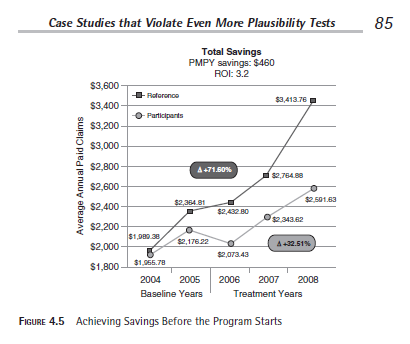
Not knowing the players well, I naively attributed the fact that HFC used this display to a rookie mistake, rather than dishonesty. That was plausible because rookie mistakes are the rule rather than the exception in this field. (As we say in Surviving Workplace Wellness, the good news about wellness vendors is that NASA employees don’t need to worry about their job security because these people aren’t rocket scientists.)
On the advice of colleagues more familiar with the integrity of the wellness industry true believers, I also tried a test of the rookie-mistake hypothesis: I strategically placed the page with this display next to the page that I knew Ron Goetzel would be reading (and copying), a page whereon I complimented him on his abilities. I might the the world’s only bully who publicly compliments his victims and offers to pay them money:

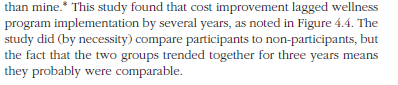
That way, I would know that if Mr. Goetzel and his Koop Committee and their sponsors HFC didn’t remove this display, it was due to a deliberate intentiion to mislead people, not an oversight or rookie mistake.
Sure enough, that display continued to be used for years. Finally, a few months ago, faced with the bright light of being “bullied” in Health Affairs, HFC withdrew the slide. Ron “the Pretzel” Goetzel earned his moniker, twisting and turning his way around how to spin the fact that this “mistake” was ignored for so long despite all the times it had been pointed out. He ending up declaring the slide “was unfortunately mislabeled.” He gave no hint as to who did the unfortunate mislabeling, despite being repeatedly asked. We suspect the North Koreans. The whole story is here.
Summary and Next Steps
The first five of these methodologies in Pages 13-14 have several things in common:
- They all contradict the 6th methodology;
- They contradict the statement on page 15 that the only significant savings is in reducing admissions. Of course, self-contradiction is embedded in Wellness Ignorati DNA. To paraphrase the immortal words of the great philosopher Ned Flanders, the Wellness Ignorati “believe all the stuff in wellness is true. Even the stuff that contradicts the other stuff.”
- They call for megadoses of consulting and analytic expertise, contradicting the list on Page 10 that omits the cost of outside expertise.
Speaking of Methodology #6, our next installment will cover it. It’s called event-rate based plausibiltiy testing. I would know a little something about that methodology, since I invented it. I am flattered that the Wellness Ignorati, seven years later, are finally embracing it. I am even more flattered that they aren’t attributing authorship to me. No surprise. That’s how the Wellness Ignorati got their name – by ignoring inconvenient facts. Ignoring facts means they cross their fingers that their customers don’t have internet access. Customers who do can simply google on “plausibiltiy test” and “disease management” and see whose name pops up.
Share this:

WELCOA: In the Belly of the Belly of the Beast
First, a little background. For those of you unfamiliar with the Wellness Council of America, or WELCOA, this organization, based in Omaha, Nebraska, was founded by the inventor of the all-you-can-eat self-serve restaurant.

Hey, it’s an honest mistake! Anyone could misspell their founder’s name on their home page, especially when it’s one of those long foreign-sounding unpronounceable names of somebody no one’s heard of. Besides, WELCOA in particular can’t be expected to know how to spell “Warren Buffett.” I mean, it’s not like they’re both based in the same city or anything.
WELCOA is wellness’s perfect storm, exemplifying the standards for literacy, numeracy and integrity that have endeared the wellness industry to us humor writers. Along with Ron Goetzel’s Koop Award Committee (chronicled at length in these pages and never shy about coming back for more), WELCOA truly does put the “Ig” in “Wellness Ignorati.”
Fun + facts = smarter, happier employees
In general, the modus operandi of the Ignorati — and especially WELCOA — is to suppress facts, because facts are their worst nightmare. If facts are their worst nightmare, we’re their Night of the Living Dead. We are tickled pink that we are considered so threatening that nowhere on their site is there the slightest hint that we — or any wellness skeptics — even exist. For instance, the first time ever that the entire wellness industry (as opposed to individual debacles, like Penn State) was newsworthy enough to be covered by Health Affairs, LA Times, Incidental Economist, Chicago Sun-Times, All Things Considered, Huffpost, the Federalist etc., WELCOA’s lead “news” story was: “How to Jump-Start Your Wellness Program with Big Data.” (This editorial choice echoed the New York Post, which, on the day the hostages were freed and Reagan was inaugurated, led with “Joan and Ted to Split.”)
By contrast, we embrace transparency, and urge you to read the entire WELCOA site, especially the “premier providers,” who are kind enough to pay WELCOA for the privilege of having their creative approaches to grammar and math become TSW? fodder. (We have a source inside WELCOA who brought our attention to the comedic potential of this material.)
One of our favorite WELCOA premier providers is Trotter Wellness, which gets its own entry in “On the (Even) Lighter Side.“.

Remember that scene in Catcher in the Rye when Stradlater gets Holden to write his English composition but tells him not to put all the commas in the right places so the teacher won’t suspect he wrote it? The good news is, WELCOA could never be confused with JD Salinger. In their ad for Trotter Wellness, WELCOA didn’t put any of the commas in the right places.

Frankly, we’re not sure WELCOA has ever put a comma in the right place…
At the risk of ruining a joke by explaining it, it’s not just that all the punctuation is missing from the descriptor. It’s that the exact spot WELCOA’s crack grammarians decided to place a comma is also the exact spot they shouldn’t have placed a comma, according to Trotter’s own website screenshot right above this screenshot. That gives WELCOA both a false-positive and a false-negative rate of 100%, which even in wellness is a bit on the high side.
Along with Ron Goetzel’s Koop Committee and Health Fitness Corporation, they were a co-conspirator in the Nebraska workplace wellness fraud, thus proving that great minds aren’t the only ones that think alike. It was actually their website that claimed the famously fictitious “life-saving catches” of the 514 victims of “early stage cancer.”


What boggles the mind, even by the uniquely gauzy ethical standards of the wellness industry is that they still make that claim, albeit on someone else’s website. We’ll readily admit they posted the claim originally because they didn’t realize that HFC was lying (again), and that screening about 5000 people wouldn’t yield 514 cases of cancer. (While Ron Goetzel’s Koop Committee was also snookered, It took us about 2 minutes to figure out that the alleged rate of cancers would have been roughly 50-100 times that of Love Canal. You could come up with this insight too, using ingredients you already have in your kitchen: an internet connection, a calculator, and a triple-digit IQ.)
But two years later – after (1) we told them this was wrong; (2) we “outed” them in the Wall Street Journal; and (3) HFC admitted right in the Omaha World Herald they made up the claim – this statement is still being made. We must now reluctantly conclude WELCOA is deliberately lying, because nobody, not even WELCOA, could be this stupid accidentally.*
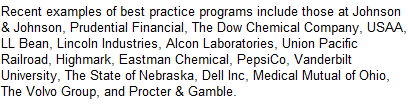
Even Ron Goetzel briefly stopped defending WELCOA and HFC. He claimed at the Datapalooza conference in June 2014 that the reason they won his award was due to a technicality. Apparently, because they had only disclosed this particular lie on their website and not in their award application itself, it didn’t count against them. Even so, a few months later, the Datapalooza conference being a distant memory, Ron once again declared that WELCOA/HFC/Nebraska was a “best practice”:

Just because it’s healthcare doesn’t mean it’s good for you
There is too much to say about WELCOA for a single posting, so we would direct you to two places. First, in This Is Your Brain on Wellness, WELCOA merits its own entry, of course. But WELCOA, truly a target-rich environment, also proffered screenshots for Midland Health, Bravo, Balance, Well Nation, the Healthy Company Alliance, Trotter, and Star Wellness.
Second, you can find Chapter 7 of Surviving Workplace Wellness right here. Even in the target-rich environment of the wellness industry, getting one’s own chapter is quite a feat. Just to get you in the mood, here is the first paragraph of that chapter:

Now that we have your attention, you can click on this link and download Chapter 7, with our compliments.
*Our bad! It turns out WELCOA may very well be this stupid accidentally. You see, when we pointed out in Surviving Workplace Wellness that they had misspelled the name of their founder, they fixed it on their home page. (Apparently, while many people can spell and many people have visited their home page, the intersection set consists only of us.) But it never occurred to them to do a find-and-replace. You’d think that someone there would have thought: “You know, since we didn’t spell Buffett correctly on our home page, perhaps there are other places we didn’t spell it correctly either. If only there were some way of testing that hypothesis…”
And that one of WELCOA’s other luminaries maybe couldn’t spell “Buffett” either but had studied the intricacies of Word’s find-and-replace function. And that maybe — just maybe — these two folks would have bumped into each other, like in those old Reese Cup commercials, and collectively come up with the insight that the “answer” was: run the find-and-replace function on “Buffet.”
But no such luck. Hence to this very day, the original spelling still appears on their website, in that very same Nebraska case study.

We’ve just spent 1350 words observing WELCOA’s foibles, but we do like to be balanced in our reporting, so we’ll close with some good news. The good news is, there is indeed one place where WELCOA is undeniably right: WELCOA truly has “helped influence the face of workplace wellness in the US”…
…By putting a great big smile on it.

 They Said What?