Home » Posts tagged 'Wellsteps' (Page 4)
Tag Archives: Wellsteps
Wellsteps Arithmetic for Dummies
Those of you with lives may not have noticed all the commotion yesterday. Wellsteps moved their post about our bullying from their own blog to Linkedin.
But then, sort of like Dukakis in his tank, once they did that, they realized that wasn’t such a good idea and took it all down, but it was too late. The problem was that on Linkedin, their rant attracted many comments from the triple-digit IQ crowd. So now, in order to find this post, you have to go to the Wellsteps blog. It is posted under: “Great Ideas from the Experts.” Among other highlights, they said we were extorting them. Here is the source for that: we offer $1000 and public apologies if we made a mistake in our writeups, and a $2-million reward for proving wellness breaks even, or that Boise saved money.
To them, and to all members of the Koop Committee that decided this Boise School District outcome was award-worthy, I say, “Find a mistake in my critique and collect the $1000. Or show I’m wrong about my ‘twisted facts’ and claim the reward. Instead of just criticizing me for ‘twisted facts,’ take my money. Sue me. Have me arrested for blackmail and extortion (their words). Anything. Don’t make me beg.”
This isn’t about that — postings on that topic, along with Sharon Begley’s brilliant smackdown in STATNews are easily findable elsewhere. Instead, all we want to do today is simply add up a column of Wellsteps’ own numbers. That is how Wellsteps defines “bullying” — adding up their own numbers. In this case, it is the improvements and deteriorations, year over year, in the Boise School District’s biometrics.
I’ve already done this once, as a service to Wellsteps, but apparently they had a really bad fifth-grade math teacher. So I’m doing it again — and this time color-coding it, so even the dumbest Wellsteps executives can find someone to explain it to them.
Here is the actual screenshot of the year-over-year biometrics, from their Koop Award application. Once again, these are their figures. They often ask why we don’t publish our own studies. We don’t have to — their numbers make our case better than we could make our own, with no “he said-she said” about whose numbers are right. So, we’ll admit it! Their numbers below are facts — they are right! (I guess graciously conceding that one’s adversary is correct is another form of bullying.)

We then twisted their columns of facts into totals, below. I can send the Excel sheet on request.

As you can see, the population deteriorated quite a bit–6397 readings got worse while 5293 improved. Oh, and one other thing: more than 40% of the “improved” values are glucose levels declining, in employees whose glucose was already normal. Attention, Wellsteps: there is no concept of “improving” normal glucose levels. That would be like “improving” on a 98.6 body temperature.
And who amongst us hasn’t felt draggy during a workday as our glucose falls, and eaten a snack to get our energy and productivity back? Excluding the 2134 glucose “improvements” in people who already had normal glucose, deteriorating biometrics outnumbered improving biometrics by 6397 to 3159. That’s more than 2 to 1!
We’re taking those out to be consistent with the word “normal.” Or, since we are very polite bullies, we could leave them in and stick with 6397 vs. 5293, if Wellsteps chooses. We are happy to do the latter because we understand that in Wellsteps’ lexicon, words and phrases mean the opposite. In addition to “normal” and “bullying,” that lexicon would include “extortion,” “blackmail,” “twisted facts,” and “great ideas from the experts.”
Share this:

Wellsteps: We don’t need your stinkin’ Code of Conduct.
Wellsteps has joined Michael O’Donnell, HERO and Optum in attempting to stonewall the Employee Health Code of Conduct, which started as a joint project among WELCOA, myself, and Salveo Partners and has attracted many hundreds of favorable responses. Quizzify and It Starts with Me have both received validation from the Validation Institute for (among other things) our embrace of this simple minimum standard. In both cases, we think the bar should be set much higher, but apparently “do no harm” is already too high a hurdle for HERO, Wellsteps and Optum. Hence their opposition. And Kudos to WELCOA, a very fine organization that Quizzify intends to support for 2017, for standing up to Mr. Aldana’s bullying.
There is some irony in that it was Wellsteps’ harms to Boise employees that inspired my participation in the code-writing. Vendors should not be given awards for harming employees. That doesn’t seem like too much to ask.
Here is the Code, in its entirety.
The Employee Health Program Code of Conduct: Programs Should Do No Harm
Our organization resolves that its program should do no harm to employee health, corporate integrity or employee/employer finances. Instead we will endeavor to support employee well-being for our customers, their employees and all program constituents.
Employee Benefits and Harm Avoidance
Our organization will recommend doing programs with/for employees rather than to them, and will focus on promoting well-being and avoiding bad health outcomes. Our choices and frequencies of screenings are consistent with United States Preventive Services Task Force (USPSTF), CDC guidelines, and Choosing Wisely.
Our relevant staff will understand USPSTF guidelines, employee harm avoidance, wellness-sensitive medical event measurement, and outcomes analysis.
Employees will not be singled out, fined, or embarrassed for their health status.
Respect for Corporate Integrity and Employee Privacy
We will not share employee-identifiable data with employers and will ensure that all protected health information (PHI) adheres to HIPAA regulations and any other applicable laws.
Commitment to Valid Outcomes Measurement
Our contractual language and outcomes reporting will be transparent and plausible. All research limitations (e.g., “participants vs. non-participants” or the “natural flow of risk” or ignoring dropouts) and methodology will be fully disclosed, sourced, and readily available.
What’s there not to like? Plenty, if you negatively impact employee health, as Wellsteps does, according to STATNews. Here is Wellsteps’ response to the code, complete with their signature name-calling.
The Wellness Bully Code of Conduct
Even though the wellness bullies claim that the wellness industry is a sham, they have announced a new code of wellness conduct. I’m very interested in improving the quality and effectiveness of wellness programs. I don’t know any wellness professional who would say otherwise. But I think I speak for all of us when I say that I have no interest in a code of conduct written by a gang of bullies. The wellness industry does not need a code of conduct, we have HIPAA and other laws to do that.
Share this:

How to cheat in a corporate weight loss contest (SPOILER ALERT: This gets gross)
2024 Update: This post, intended as humor for HR/benefits professionals, has now attracted 200,000 views, reaching employees intending to cheat their way to a high BMI. Not so much any more for crash-dieting contests and wellness “challenges,” but rather to qualify for weight loss drugs. Eight years later, it still appears on the first page of a Google search on “how to cheat in a corporate wellness program.”

Attention, employees who want to learn how to cheat in a corporate wellness contest: for the actual cheating hints, skim down to: “How to Cheat in a Crash-Dieting Contest.” The suggestions apply not just to corporate biggest loser contests, but to any corporate weigh-in where money is attached to weight. (This post is actually intended for your company’s HR people who for some reason think encouraging you to binge and then crash-diet is a good idea and don’t realize wellness is an obvious scam.)
Further, the law has changed and you can now sue your employer if they fine you (or give you a high-deductible plan and make you “earn the incentive”) for refusing to participate in biometric screens and other clinical wellness activities. You can contact us for more information.
If we were real journalists here, we’d have killed a lot of trees in the cause of exposing the massive amount of lying and cheating by wellness vendors. However, as mere bloggers, all we do is kill millions of defenseless electrons.*
And yet we’ve sacrificed nary a single electron to the cause of exposing the massive amount of lying and cheating by the employees themselves. And massive it is. My very own extended family members are swapping Fitbits around to increase their steps. Less for the money than for bragging rights about who can game the contest the best.
Indeed, these corporate “challenges” are really mental challenges, not physical ones, to see who can do the best job outsmarting the wellness vendor. Outsmarting wellness vendors, as past columns have shown, isn’t exactly a heavy lift: we have often observed that the good news about wellness is that NASA employees don’t have to worry about their job security because wellness vendors aren’t exactly rocket scientists.
To that end, the Wall Street Journal wrote an entire article about employees cheating in wellness programs. Apparently, employees are enlisting puppies, hamsters, even power tools and a ceiling fan in their quest to undermine their company’s wellness program. One enterprising employee posted a youtube showing how to cheat on these programs. A Midwestern cadre of truly dedicated employees took cheating a bit farther than most, and got themselves indicted for defrauding Kansas City out of $300,000 by lying on wellness programs.
There are entire blog posts on how to cheat in a wellness program, and even a gadget available online to help you do exactly that.
30-second shameless plug time
Of course, there is one surefire way to avoid the downside of cheating: design cheating into the program. And that’s exactly what Quizzify does. The way to cheat on Quizzify is to look up the answers and learn about health literacy — which is exactly what we want employees to do!
How to cheat in a crash-dieting contest
Employees especially like to cheat in crash-dieting contests, enough so that countermeasures are needed. For instance, a vendor named Healthywage is bragging about how it ferrets out “fraudulent participants.” I figured I’d see what the internet has to offer on corporate biggest loser program cheating, because, after all, these days almost every search generates tons of hits. I say “almost” because if you search on “honest wellness vendors” and “Wellsteps,” there is only one hit: my observation that the latter could never be confused with the former.
In particular, the search found a group called www.healthstatus.com, which has given this topic altogether too much thought, thankfully. In all fairness to the HealthStatus folks (who do seem very well-intentioned and on the level), before they list their recommendations, they provide a cigarette-type warning label, as these programs richly deserve:
It’s getting to be New Year’s resolution time and many companies will try and “encourage” weight loss with a “Biggest Loser” type contest. Frankly, this is really a bad idea, as it can create all kinds of bad habits and damaging activities by the participants, as they starve, dehydrate and supplement themselves in an effort to win.
Having gotten the grownup stuff out of the way, here are their “recommendations” for employees whose employers, like Schlumberger, somehow got the impression these contests are a good idea, perhaps because their mothers didn’t listen to enough Mozart when they were in the womb. A few recommendations are fairly harmless, like drink a lot of water starting 3 days early and don’t pee (or do number twosies) before your weigh-in. And, of course, wear heavy clothes, carry lots of change in your pockets etc. You know, your typical garden-variety dishonesty that is probably woven into the culture of any employer that sponsors these contests. (These employers think they are “creating a culture of wellness” when in reality they are creating a culture of deceit.)
By contrast, some of these other recommendations boggle our minds, and, having written exposes on the wellness industry for two years now, our minds are not easily boggled:
The day before the weigh-in, ideally about 17 hours or less before your weigh-in time, you want to get yourself a good salty snack. A bag of chips, you know the ones that if you eat too many your lips hurt from all the salt and a nice tray of cheese and crackers.
For your dinner meal you want to load up on the proteins and a big glass of whole milk, also, this is a day you want to skip the fiber. This is one day of eating like this, we don’t encourage it, but a binge day also sets up your metabolism to know that is not starving, and can help in when we start burning fat after the weigh-in.
The day of the weigh-in, minimize your activity, another big glass of whole milk with your breakfast that contains some salty options will help you retain more water.
“At this point,” they observe, “you should be a big bloated sloshing mess that needs to go to the bathroom really bad. This is the perfect time to get weighed and measured.” They also remind you to accentuate poor posture, since the long-since discredited Body Mass Index measure still preferred by most of these vendors is a height/weight ratio. (HealthStatus also offers hints for contests that use waist circumference.)
In other words, do all the wrong things — eat badly, slouch, and don’t exercise. Be as unhealthy as possible. So you’re already obsessing with your weight and abusing your body horrendously in the name of wellness…and the contest hasn’t even started yet!
I hate to leave everyone hanging but HealthStatus hasn’t published the rest of its recommendations yet, meaning advice on how to cheat during the contests themselves.
And a good thing because I don’t know how much more wellness a fellow can take.
Since self-abuse is actually a very serious topic, I would like to step out of character here and offer a few serious notes. First, no wonder Optum and HERO and other Wellness Ignorati are stonewalling the Employee Health Program Code of Conduct. Nothing violates it more than their cherished corporate crash-dieting contests. And a particular call-out of the biggest-loser worst offenders: Virgin Pulse (nee ShapeUp), Wellness Corporate Solutions and HealthyWages. You ought to be ashamed of yourselves, even relative to other wellness vendors like Wellsteps, which had just recently established a new plateau for harming employees, that you people are blasting right through.
*Just for the record, we know that writing blogs does not kill or even injure electrons. And while Keas might find that being used in blog posts stresses them out, we would disagree. Quite the opposite: if they enroll in wellness programs, they can live to be 100.
Share this:

The Wellsteps Empire strikes back! CEO defends its harms to Boise employees
Steve Aldana, CEO of Wellsteps, finally defended his program for the Boise School District. It took him a while presumably because he had to retain a team of biostatistical consultants to discern the flaws in critics’ arguments against it. After analyzing all the data, these biostatisticians were finally able to compile a list of the mathematical and clinical flaws in our apparently erroneous conclusion that Wellsteps harmed Boise employees and fabricated savings and raised lying to an art form.
I apologize in advance to those lay readers without a strong background in biostatistics. You may have trouble understanding the mathematical subtleties in Mr. Aldana’s arguments. But I’ll repeat them verbatim nonetheless. According to Mr. Aldana, wellness critics are:
- “Great at writing click bait”
- “Great at creating BS out of thin air”
- “liers”
Leave aside his creative spelling and his mixing of cliches. Focus instead on his novel interpretation of Lavoisier’s law of conservation of mass, which states that nothing can be created out of thin air. Notwithstanding Mr. Aldana’s claim to the contrary, this law would seem to particularly apply to bovine excrement, the end result of a complex biochemical and physiological process, one which he would seem to have great familiarity with, as we’ve noted multiple times in this website. However, we encourage Mr. Aldana to try to undertake this endeavor, because at least his efforts won’t harm anyone, which is more than can be said for his wellness program.
Kudos to Dave Chase for posting the STATNews expose of the Wellsteps program, so that Mr. Aldana could respond. Mr. Chase, who is producing a documentary called The Big Heist on wellness and other healthcare ripoffs, is obviously goading Mr. Aldana into writing some material for him, and Mr. Aldana obliged. Rather than create a news cycle, where the Wellness Ignorati inevitably lose, he should have followed the lead of Ron Goetzel and simply ignored me. Indeed, if there is one thing that Ron Goetzel excels at, other than doctoring data and lying about outcomes, it’s ignoring me.
In addition to calling me a lier, he also called the author of the STATNews expose, Sharon Begley, a lier. I won’t question the wisdom of alienating the media, but I would question whether someone of Ms. Begley’s impeccable credentials (listed here on her Wikipedia page) could possibly have received all the accolades and awards she has amassed for health/science reporting if indeed she couldn’t find all the obvious flaws in a Koop Award application.
The linkedin thread is pasted below and I’d encourage reading it. Don’t make me beg.

Share this:

Wellsteps Presents a Confederacy of Wellness Vendors
When a true genius appears, you can know him by this sign: that all the dunces are in a confederacy against him.
–Jonathan Swift
Wellsteps’ Steve Aldana has “endorsed” a confederacy of 25 wellness vendors, including his own company, Wellsteps. Alas, in the world of the Welligentsia, in which an increasing number of employers reside, an endorsement from Mr. Aldana earns about as many points in a vendor selection process as neat handwriting.
There are usually not enough hours in a week to both do my Day Job running a fast-growing company (Quizzify, which plenty of thought leaders have endorsed, so they don’t have to endorse themselves), and also play wellness-meets-whack-a-mole with the Ignorati. Fortunately, this week does have enough hours, thanks to the time change. (The wellness industry is lucky that “falling back” is not a regular occurrence.)

I haven’t heard of many members of this confederacy, but I’ve heard more than enough about the ones below. Each link takes you to our own “endorsements.”
Keas Meets Lake Wobegon: All Employees Are Above Average (in Stress). This is the best argument for requiring that wellness vendors attain a GED.
Provant: “In the Belly of the Beast” A nine-part series that one line can’t do justice to. We would simply note that you do not have to drink eight glasses of water a day. Indeed, you probably shouldn’t if you expect to get anything else done.
Staywell’s Wellness Program for British Petroleum is Spewing Invalidity. It wasn’t just that their savings claim was mathematically impossible. That’s just the threshold for wellness savings claims. Staywell also somehow saved BP 100x as much as Staywell’s own website says is possible. And because they have a “special relationship” with Mercer (meaning they pay them), Mercer “validated” this fiction for BP, at BP’s expense…
Staywell, Mercer, and British Petroleum Meet Groundhog Day. They won a Koop Award. Since Staywell and Mercer are both on the Koop Committee and their results are completely invalid and they are obviously lying, they satisfy all the award criteria.
Total Wellness’s Total Package of Totally Inappropriate Tests. They could lose their license for subjecting employees to this panoply of US Preventive Services Task Force D-rated quackery, except that in wellness the only license you need is a license to steal from unsuspecting HR directors. This leads to…
…Total Wellness: The Best Argument for Regulating the Wellness Industry. Total Wellness isn’t about to lose this Race to the Bottom without a fight. Watch as they try to out-stupid Star Wellness in their quest for that prize.
US Corporate Wellness Saves Money on People Who Don’t Cost Money. We call this Seinfeld-meets-wellness, because it’s about nothing: even if you have absolutely no risk factors, these Einsteins will still save you a fortune. And someone should also tell them you can’t reduce a number by more than 100% no matter how hard you try.
Virgin Pulse. This outfit acquired ShapeUp, which gives harmful crash-dieting programs a bad name. Don’t take our word for it. It’s in the Pittsburgh Post-Gazette.
Vitality’s Glass House: Their Own Program Fails Their Own Employees. These people might have more luck selling you a crash-dieting program if they could get their own employees to lose weight.
Wellness Corporate Solutions Gives Us a Dose of Much-Needed Criticism. We don’t want to spoil the punchline.
And that brings us to Wellsteps itself, which earns its “endorsement” from its own CEO by making so many appearances on this list that there is barely enough room for the rest of the confederacy. If you only have time for the Executive Summary, this is the one to read. But squeezing it all into one place requires sacrificing the laugh lines, and if there is one thing Wellsteps excels at, it’s providing laugh lines.
Wellsteps ROI Calculator Doesn’t Calculate an ROI…and That’s the Good News. Watch what happens when Wellsteps meets Fischer-Price. No matter what variables you enter in this model, you get the same result.
Wellsteps Stumbles Onward: Costs Go Up and Down at the Same Time. This isn’t possible even using wellness arithmetic. Eventually Wellsteps solved this problem by simply deleting one of the slides. But because we long ago learned that doctoring/suppressing data is one of the wellness industry’s signature moves, we took a screenshot before we did our expose.
Prediction: Wellsteps Wins Koop Award. In 2015, I went out on a limb to make this prediction, noting Wellsteps’ perfect Koop Award storm of invalidity, incompetence, and cronyism.
Wellsteps: “It’s Fun to Get Fat. It’s Fun to Be Lazy.” This one was penned by Dr. Aldana’s waterboy, Troy Adams, who apparently during his self-proclaimed “11 years of college” never learned that “fat” and “lazy” aren’t synonyms. Paraphrasing the immortal words of the great philosopher Bluto Blutarski, 11 years of college down the drain.
Does Wellsteps Understand Wellness? They are demonizing even the slightest consumption of alcohol, among many other misunderstandings. Shame on me for enjoying a glass of wine on a Saturday night!
The Back Story of the Scathing STATNews Smackdown of Wellsteps and the Koop Committee. This one leads to several other links.
The Koop Committee Raises Lying to an Art Form. It turns out Steve Aldana is not stupid: he apparently has heard of regression to the mean, but just pretended he hadn’t so he could take credit for it with the Boise Schools, who were not familiar with the concept.
if Wellsteps Isn’t Lying, I’ll Pay Them $1 Million but let’s just say I’m not taking out a second mortgage just yet.
An Honorable Mention goes to another vendor on this list, in the form of the Don Draper Award, for this advertising gem, aimed at ensuring that even the stupidest member of the Ignorati, and/or HERO Board members, can catch their name:

To quote the immortal words of the great philosopher Rick Perry, even a stopped clock is right once a day.* And, yes, on that Wellsteps list there is one standout vendor, US Preventive Medicine. It has validation from the Validation Institute. As you read their validation, note that while they show an enviable reduction in wellness-sensitive medical events, they don’t claim an ROI. This is testament to the integrity of both USPM and the Validation Institute.
*If you are a regular reader and didn’t find this quote amusing, read it again. If you are a wellness vendor, find a smart person to explain it to you.
Share this:

In workplace wellness, fat-shaming is the new black.
This posting is a request to self-anointed wellness industry leaders to pleeease stop picking on people because of their weight. It’s like you’re still in kindergarten, no offense intended.*
2016 was the year in which weight-shaming, weight discrimination and a generally dismissive and outright misanthropic attitude towards two-thirds of the country’s employees became a wellness industry thing. This started in January at Davos, where the head of a wellness vendor named Vitality announced what quickly became known as the Fat Tax.
Here’s how the Fat Tax would work. Companies would tell shareholders how many fat people they employed. Employers, presumably feeling shame over this disclosure, would be motivated to pay a “tax,” in the form of a fee to a wellness vendor — such as, coincidentally, Vitality — for screening and weight loss programs.
In addition to the out-of-pocket fee, employers would pull employees off the job for an hour too, to obtain this screening. In addition, there would be all the administrative time — making the rules and exceptions, catching cheaters (see below), getting the auditors involved, and so on.
All this for what, again?
J&J would have people believe that shareholders are demanding thinner employees. In reality, of course, shareholders could care less about the weight of employees, for the simple reason while weight makes no difference to most businesses (as we’ve proven), the cost impact described above of mass weigh-ins and disclosures would be quite high.
More important is the morale impact. Suppose an employee owns shares and the stock price is down. Next, suppose that shareholders have just been informed how many employees are overweight…and the guy in the next cubicle is obese. Suddenly, that employee can start blaming his co-worker for the loss in value of his 401K.
Your stock price is down, you need to rally the troops. Instead, the troops are turning on one another.
Incredibly, this idea did originally have momentum: along with a few drug companies that make obesity drugs that saw a potential market opportunity in the Fat Tax, IBM and even Pepsico were willing to put their names on it. The Fat Tax cabal also knows the value of the Harvard name: they paid a little-known instructor at the Harvard School of Public Health (HSPH), so that they could co-opt that moniker, just like the sugar industry used to do. Only the latter had a big enough budget to bribe two full professors rather than one lowly instructor.
However, the momentum quickly died once word leaked out that the very same Vitality that wants to collect money from others to administer weight loss programs couldn’t even get their own employees to lose weight.
Oh, and if you guessed that Ron Goetzel’s fingerprints were all over this one — just like almost every other debacle since Penn State — you obviously know the way the wellness industry works.
Ah well, as management guru Peter Drucker said, the only thing worse than a poorly conceived idea is a poorly conceived idea that is poorly executed.
Actually he never said that, likely because he was never enrolled in Vitality’s program.
Possibly because of the initial exposure the Fat Tax idea got, hazardous crash-dieting competitions came back into vogue this year. Crash-dieting competitions are the type of thing that gives idiocy a bad name. Let’s leave aside the fact that employees cheat, as this article shows. They don heavy clothes, fill their pockets and down bottles of water before the initial weigh in, and do the opposite before the final one.
And leave aside the fact that vendors can’t read scales. How hard is it to figure out that it is not possible for the majority of your crash-dieting teams to lose exactly 16.59% of their body weight? The odds of winning the lottery are about 1000 times better.
But the biggest problem is that corporate crash-dieting contests are much more likely to harm employees than benefit them. Money is on the line for successfully bingeing before the first weigh-in and starving oneself before the last. Companies are paying their employees to yo-yo diet. Jon Robison has recommended, and I agree, that crash-dieting contests (and other corporate weight-loss programs) should carry a label warning of potential harms.
These harms are fairly self-evident, but just to be on the safe side, Rebecca Johnson laid out the health hazards quite thoroughly in Corporate Wellness, in case anyone needs a refresher course, which apparently Omada does.
Yes, despite the perverse incentives and physical hazards of paying people to lose weight, Omada Health is proposing that health plans do just that. According to Omada, a health plan can save “billions of dollars” — that’s “billions” with a “b”, not “millions” with an “m” or “stupid” with an “s” — by trying to prevent diabetes, including paying members to lose weight. A health plan that offered members this pay-to-diet option would soon find itself deluged with enough takers to require a rate increase for everyone else.
In case anyone is wondering about Omada’s math, the median-sized health plan can’t save billions of dollars by getting people to lose weight because the median-sized health plan doesn’t even spend “billions of dollars.” And I don’t mean on diabetics, I mean in total.
Next, it appears that this year’s presidential campaign has made fat-shaming great again. One of the first vendors to jump on that bandwagon was Wellsteps, with the immortal words: “It’s fun to get fat. It’s fun to be lazy.” Eventually they took those words down, if only because a number of comments embarrassed them into it.
However, as Maya Angelou said, if someone shows you who they really are, believe them.
Finally, with his editorial in the American Journal of Health Promotion, Michael O’Donnell has out-stupided Vitality, Omada and Wellsteps: He is calling for employers to make employees pay for their health insurance per pound, sort of like buying lobster or sending packages. People say we make fun of the ideas the Wellness Ignorati come up with, but really all we do is repeat them — and occasionally illustrate them so that even the dumbest wellness industry leader can follow along:


*No offense intended to kindergarteners, that is, most of whom have better manners than this.
Share this:

The Great Debate, Part 5: Ron Goetzel “endorses” me…by mistake.
We are now in Ron’s wheelhouse, which is publishing peer-reviewed articles in third-tier wellness trade journals. Let’s see how he does.
For those who are new to this thread, Part 4 is here, and links to earlier installments. The recording is here. Time stamps roughly synch up.
53:30
Ron says he is a researcher, and publishes in peer-reviewed journals. He “applauds” me again for giving them the “opportunity” to correct their many errors, and says the comments I make are often “right on the money.”
It is indeed a creative use of the word “opportunity,” as in: “Last year the IRS gave me the opportunity to be subject to an audit.”
He says “that’s what the scientific method is all about, having peer reviewers critique your work and find problems.” And yet, I’ve never, ever been asked to peer review anything that he and his cronies have ever published. Go figure.
He would like “us” (meaning him and his cronies) to be able to review my work, even though I’m not allowed to peer-review theirs. He says he has “never seen an article by Al Lewis…to review.”
Hmmm…perhaps his internet is down?
Since all my work is right on this site (including links to other work, in “In the News” to Health Affairs, Harvard Business Review etc.) he is free to review it anytime, and we publish all comments. There isn’t really any need to for him to look at our material because mostly it’s his own and his cronies’ material. And you know the mantra from Surviving Workplace Wellness: “In wellness, you don’t have to challenge the data to invalidate it. You merely have to read the data. It will invalidate itself.”
As in his opening remarks and in his “secret” letter to the media, he once again criticizes my stuff as being “out there…outlandish,” but gives zero examples.
55:30
Ron, in the process of saying something he knows not to be true for a change, accidentally endorses me.
“Ron, would you say I am the most qualified person in peer review in terms of finding the most mistakes?”
“No.”
“Well, who has found more mistakes than I have?”
[Silence and nervous laughter from the audience.]
I point out that — despite his tacit endorsement just now that I am the best peer reviewer — none of his friends’ wellness trade journals have ever asked me to peer review anything.
And he still refuses to say why he hasn’t claimed the million-dollar reward.
57:00
Peer reviewed or not, numbers need to add up, and Ron’s don’t. In one award-winning example, Eastman Chemical, $900/person in savings was shown — with risk factors changing by only 0.17 per person, excluding dropouts.
Ron did not rebut this. Eastman was one of the two Koop Award applications he had doctored when it turned out the applicant had accidentally told the truth but no one on the award committee noticed.
58:30
Ron has already run away from most of the industry’s claims, as earlier installments of this debate have observed. Now is he running away from Wellsteps’ Steve Aldana, whom he has co-presented and co-authored with and who naturally is on his Koop Award committee. Aldana recently wrote that I was “sick” because a colleague posted my Harvard Business Review article on his linkedin group and asked what people thought of it.
[2016 Update: Ron is now embracing Steve Aldana and Wellsteps, the first company to admit to harming employees.]
59:00
Ron is turning his blacklisting of me into my “plea” to do peer review in his trade journals. I have never “pled” to do peer review in his trade journals, which are mostly useful as punchlines. I merely observe that I’ve never been asked. “You’re very good at calling out mistakes, but you’re not very good at publishing your own research studies.”
He then cites the Johnson & Johnson study (that’s the same Johnson & Johnson that just proposed the Fat Tax). That is the only study he’s ever done that I’ve not been able to invalidate on its face, so he gets his first point of this round here. Not because the study is valid. There wasn’t enough data in it for me to automatically prove that it was invalid, which is a very high standard, but that’s my standard–“face invalidity.”
So there you have it: one company in the entire universe that might possibly have saved money on wellness. And as coincidence would have it, they also sell wellness services. No publication bias there…
November 4, 2016 Update: I just found this J&J study. It is even worse than the others. Employees lying on HRAs, trivial risk reductions…and of course massive savings. It appears that all they did was increase the deductible and then give employees $500 to do wellness, thus shifting the money out of the healthspend into the incentives account, which is not included in the “savings.”
1:00:00
I point out that even though I’m apparently not qualified enough to peer review for his friends who run low-impact journals, I do get called upon to peer review for Health Affairs and other high-impact journals. And most importantly, while I’ve done only two peer-reviewed articles, one led to the dismantling of the North Carolina Medicaid medical home. The other was #1 for 2015 in the American Journal of Managed Care and continues to be cited widely. My award-winning book was peer-reviewed by some of healthcare’s leading figures: Stuart Altman, James Prochaska, Tom Scully, Leah Binder, Bob Galvin, Regina Herzlinger, and Nortin Hadler (the same Nortin Hadler who apologized for poor peer review by one of Ron’s favorite trade journals).
Most importantly, speaking of peer review, Quizzify is the only population health company that may publicly say “our content is reviewed by doctors at Harvard Medical School.”
1:02
Ron — whose entire industry loses money and can’t even guarantee not losing money — is now lecturing me on Quizzify’s guarantee of savings and how it needs to be peer-reviewed. I was not expecting to be attacked for offering an incredible, unique, value proposition, so I didn’t have a good answer. Only in wellness is saving money for customers considered a bad idea.
1:02:30
He continues to harp on peer review by his friends-and-relations, but I won the round with one simple observation: “We are not here today because of Ron’s peer-reviewed articles. We are here today because of my non-peer-reviewed articles.”
I could fill a blog with all the nonsense that Ron’s friends who run so-called “peer-reviewed journals” have published. Come to think of it, I have. Examples:
AJHP’s proposal to tie insurance premiums to weight, like ordering lobster or mailing packages
AJHP’s proposal to use wellness to dramatically reduce productivity
JOEM’s Aetna debacle
JOEM’s failure to understand how to do stock price analysis
AJHP’s “Randomized control trials show negative ROIs.” (I didn’t have to post anything here–this spoke for itself.)
JOEM’s fabricated evidence of savings
Share this:
Rocky, Bullwinkle, Wellness, and the American Journal of Managed Care
Some of you might remember the closing credits of Rocky and Bullwinkle. Due to copyright restrictions, we can display only a “fair use” snippet. (“Fair use” means you could use one question from Quizzify as an example without special permission as long as you cite the source, but if you tried to copy the whole thing, we’d get elected president, hire a special prosecutor, and throw you in jail.)
Rocky asks: “You got the credits, Bullwinkle?”
Bullwinkle replies: “All on this itty-bitty card…oops” and then it folds out:

(Source: Jay Ward Productions.)
So what does this have to do with wellness, besides nothing?
Simple –I just consolidated all the lies and harms of the Wellsteps/Koop Award into one itty-bitty posting for the American Journal of Managed Care blog. And it also folds out — with links to all the other “smoking guns” in this scandal. If you just want to forward one article around, that’s the one.
Kudos to American Journal of Managed Care for going where Health Affairs fears to tread, by posting the entire, unbowdlerized expose in all its sordid glory. Indeed one would think the latter publication would show some contrition for having started this “pry, poke and prod” mess, by publishing the original Baicker propaganda — with no disclosure of the authors’ conflicts of interest or funding sources…and apparently also no peer review. This thing has been cited 250 times. And that was after it was shown to have been made up. It has 549 citations in total.
Sadly, in addition to not being subject to any other regulations, wellness is not subject to Pottery Barn Rules. Health Affairs created this mess, but they don’t need to pay for it. Quite the contrary, the Health Affairs “impact factor” has probably been boosted more by this article’s 549 citations than almost any other article they’ve ever published. And guess who has to clean up after them?

(Source–you guessed it–Jay Ward productions. These are the closing credits to Mr. Peabody.)
Kudos also, by the way, to the perpetrators of the Wellsteps fraud — Steve Aldana, Ron Goetzel, Seth Serxner. They have the good sense not to take my bait by actually attempting to rebut. The one time they did, in Sharon Begley’s article, their “rebuttal” took the form of basically admitting they had made the whole thing up.
Abe Lincoln seems to be in the news a lot this week, and he put it best: “Better to be thought a fool and say nothing than to speak out and remove all doubt.” Words the Wellness Ignorati should live by. You’d think they would have learned that by now.
Share this:

If Wellsteps and the Koop Committee can show they aren’t lying, they can collect the $1-million reward
Those of you with long memories may recall our standing offer of a $1-million reward to anyone who can show that the wellness industry has broken even during this century. You need a long memory because no one ever claimed the reward. For all the bluster of Ron Goetzel and his cronies, apparently none of them actually believe what they say…or they would be $1-million richer.
Oh, wait, in the case of both Ron Goetzel and his cronies, maybe they haven’t claimed the reward because they do believe what they say.
The offer is legally binding. There are clear rules. There is an entry fee, but it is refundable to the claimant if they win.
We would now extend that offer specifically to Wellsteps and/or the Koop Award Committee, and we’ll throw in HERO too, since it’s all the same inbred crowd. All they have to show is what they have already claimed: that Wellsteps made Boise School District employees so much healthier — perhaps by reciting their mantra that “it’s fun to get fat and it’s fun to be lazy” — that the School District could, as a direct result of this enhanced employee health, reduce their healthcare benefit spending by roughly one-third after three years.
To make it extra easy for the these people, I’ll relax the requirements:
- They can submit the existing “This Is How You Win a Koop Award” self-congratulatory paean. That means both that they don’t have to do any extra work (besides adding to up 20 links at their option, as the rules allow), and that the word limit on the reward application is waived to accommodate the size of that posting.
- Any or all Koop Committee members can participate with you in the oral arguments, but I myself am not allowed to bring a second. This means they can gang up on me, by crowdsourcing their IQs.
And of course they already know what arguments I am going to make because I posted them. That’s like having the debate questions in advance.
They would have to file the entry fee, or formally request a month’s extension, by November 1. The only reason for the deadline is that when they ignore this offer, as they inevitably will, I can start saying they are admitting they’re lying as early as November 2.
As with the regular award, I am perfectly happy to offer it the other way around, where I pay the entry fee, and I have to prove they’re lying, as opposed to them proving they are telling the truth. That way they can’t say the game is rigged, since I’m willing to play either hand.
Since the Koop Committee members are all such civic-minded citizens, they need not personally collect the windfall if they win. I am perfectly willing to — indeed, would prefer to — donate a million dollars to the Boise School District, either as an unrestricted gift or to set up a fund to update, enhance, and increase employee (and student) access to their fitness facilities and equipment.
Surely, Mr. Aldana and Mr. Goetzel, if you truly care about the health and well-being of those employees, you will make the small effort required to secure this million-dollar contribution on their behalf.
And, Mr. Aldana, please don’t pretend you aren’t applying for the award because you are unaware of my work. For instance, you view my Linkedin profile with a regularity roughly halfway between obsessive and man-crush.*
*As recently as…

Share this:

How the 2016 Koop Award Raises Lying to an Art Form
If you were at the HERO conference, you witnessed a surreal experience. Executives from Johns Hopkins, Mercer, United Healthcare and elsewhere willing to risk their jobs by perpetuating what has now been exposed as a bald-faced, presidential candidate-level lie: that Wellsteps deserves an award for a program allegedly benefiting Boise teachers so dramatically that costs fell by a third. They will not mention the article in STATNews that came out yesterday showing that school district employee health deteriorated.
You read the article, so you know they are lying. And they know you know they are lying. And yet the whole thing just continues as though it is somehow all OK because no one is admitting it publicly.
Here is some more detail on the lies in question.
Sharon Begley’s article Wellness Award Goes to Workplace Where Many Health Indicators Got Worse does not lose anything in the re-reading. Quite the contrary, almost every quote in it is either a lie, or exposes the Wellsteps application as a lie. In each case, Wellsteps’ Steve Aldana, Johns Hopkins’ Ron Goetzel, United Health Care’s Seth Serxner, and all the other committee members know it’s a lie, because of the aforementioned article.
“Lie” might seem like a harsh term, but the alternative is to assume that Ron and his cronies have absolutely no idea how to read an outcomes report, even though I have already showed them how to read this report in particular.
True, one could argue that Ron has been known to use the “dumb and dumber defense” when giving his friends their awards, but in this case he can’t pretend he doesn’t know any better because he was quoted in the article. Another argument that these are lies: no one — not even a member of the Koop Committee — can possibly be this stupid accidentally.
Let’s go lie by lie. Let’s start with the last quote from Ron “the Pretzel” Goetzel, because it sets the stage for the others. He got his moniker because he has a way of twisting and turning words to make himself sound like he isn’t lying. In this case, he said if “an application said everything went exactly right,” it would certainly “raise eyebrows” on the Committee.
“Went exactly right”??? Ron, isn’t the entire point of wellness to make employees healthier? So if a program makes employees unhealthier, we say it didn’t go “exactly right”?
Using this definition, here are a few other things that did not “go exactly right”: New Coke, Yugos, the 1962 Mets, Vietnam, subprime loans, Yahoo, and the 2016 presidential nominating process. And for that matter, Begley’s article points out that McKesson’s 2015 award also wasn’t “exactly right,” in that the program didn’t do anything and the data self-contradicted. It’s not just McKesson. I have been tracking these Koop Award-winners for years, and they all self-invalidate. Each is more hilariously not “exactly right” than the other.
Yessirree, if there is one thing that shouldn’t keep Koop Committee members up at night, it’s the fear that one of their award applications might be exactly right. So the good news is that no Committee member has to worry about contracting an acute case of over-raised eyebrows.
Another lie exposed: It turns out the Koop Estate licenses the name to this cabal in order to make money, just like Dr. Koop licensed his name to make videotapes. The award is now admitted to be “industry sponsored.” This is the first time this provenance has been disclosed in print. It is basically a marketing scheme for the committee members and sponsors. They had claimed to be a “private-public” organization. That Orwellian Pretzel-speak is a lot different from being admittedly industry sponsored.
Next, Dr. James Fries — whose major wellness expert credential is writing an article finding massive population-wide savings against a phony control group by getting a few diabetics to eat less fat — called this “an exemplary program” that “showed improvements in health behavior” leading to cost reduction. Yes, a few self-reported behaviors improved. We suspect the Boise teachers lied, because they clearly lied when they self-reported their smoking (only 2.5% admitted it) and drinking (only 20%).
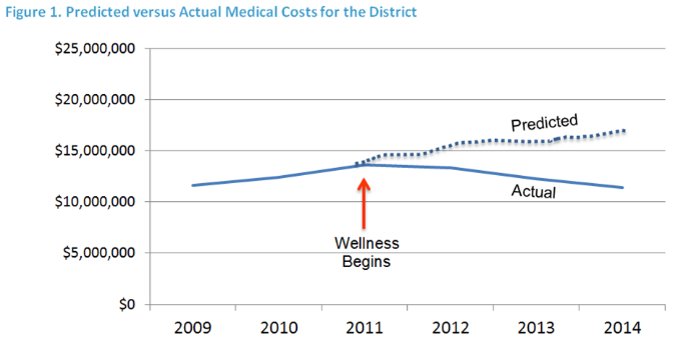
But let’s assume they didn’t lie–meaning somehow they are different from everyone else when they complete workplace health assessments. Exercising three more minutes a day and eating 0.11 more fruits and vegetables/day cannot reduce health care costs at all, let alone by a third, especially when the employees became unhealthier overall.
This statement would therefore qualify as a mistake, assuming Dr. Fries is not bright enough to already realize it is wrong. If Dr Fries doesn’t retract it now that he knows it’s wrong, it becomes a lie.
That brings us to Steve Aldana. He has been caught lying many times, including this example where he accidentally told the truth before retracting it. (He and his friends burn a lot of time trying to explain away instances in which have to explain why they accidentally told the truth but didn’t really mean it.)
His biggest lie is his discussion of regression to the mean. Compare his quote to his application. First, the quote, which shows he is actually familiar with the concept:
“In just one year, many employees will move from one [risk] group to the other,” he explained, “even though they did not participate in any wellness programs or any intervention whatsoever.” That movement, he continued, “reflects changes in health risks that occur naturally,” making it possible that some high-risk people become low risk “even though your program didn’t do anything.”
Contrast that to his application, in which he pretends he has never heard of regression to the mean, and instead attributes the “dramatic improvements” in the highest-risk Boise employees to the “program impact”:

He also contributed my favorite line of the article: even “one more bite of a banana” can make a difference in people’s health. This is true, of course, for the segment of the population that is starving to death. Otherwise, how dumb is this claim? Let’s just say that if a college taught him this, it could lose its accreditation.
And that brings us to his biggest lie of all: He says I didn’t understand the program benefits because I didn’t read the data. I did, of course. I even actually added up the datapoints, which no one on the Koop Committee did. I’ll give Committee members the benefit of the doubt and assume they failed to add the datapoints not because they didn’t want to expose the truth that Boise employees got worse in their friend’s program, but because calculators are not yet available in their cave.
Adding the data would have revealed to them — as it did to me — that they harmed employees. 6397 biometric indicators deteriorated, while only 5293 improved. This conclusion shared by both Ms. Begley and the Boise consultant, Kellie Wirth, who helped set up the program. Apparently, the law of averages caught up with the perpetrators of this Boise scheme, because Kellie Wirth is honest. She calls the biometric results “very disappointing” and says my concerns “are valid.”
The biggest lie of all: that these extra banana bites and trivial improvements in self-reported health behaviors — combined with statistically significant deteriorations in self-rated health and risk scores — could have any effect, let alone an effect of mind-boggling magnitude, on overall spending:
Funny thing, Ron Goetzel insists that “most programs fail” because they aren’t done right, and that getting to a 1-to-1 ROI is a heroic accomplishment, only achievable when employee health is improved:

And yet when it comes to giving his friends awards, failed programs harming employees but generating massive phony ROIs don’t seem to bother him at all. Let’s see him Pretzel his way out of this one.
One thing vendors love to do is play blame-the-victim. The Pretzel pioneered this approach by saying he had “absolutely nothing to do with Penn State,” when in fact he was in the room when they defended their program to the media.
Seth Serxner stood up, on camera, and basically declared United Health Care/Optum hates it when employees spend too much money on their screening programs, and typically begs to do less. United Healthcare complained that I was making them look bad, but then couldn’t produce a single name of a single employer who would admit to deciding to spend more money for the express purpose of screening inappropriately.
And now here comes Steve Aldana, blaming the Boise school administrators for insisting on throwing taxpayer money away and harming their employees, by flouting US Preventive Services Task Force guidelines. My suspicion is that their Boise customers have an alternative view, but — despite the presumably obvious pride they must be taking in this award — they are refusing to comment on it. One can only imagine the conversations taking place in Boise right now…and this is before the Idaho Statesman gets hold of this debacle.
And Ron wonders why the number of applications for the Koop Award was down by two-thirds this year…which brings us to yet another lie told by Mr. Goetzel in this article. He attributes the decline to the following:
the application process, including the requirement that wellness programs submit statistics and rigorous data analysis, has become so strict that fewer programs want to go through the process.
However, if you actually look at the application form, it is exactly the same now as it has been every year this century. And indeed the data submitted, if anything, was more comprehensive then. For instance, the 2000 winner, Fannie Mae, clearly documented all the prostate, pulmonary function and other USPSTF D-rated tests they forced employees to submit to.

 They Said What?