
Home » 2016 (Page 4)
Yearly Archives: 2016
The Great Debate, Part 4: Ron Goetzel Admits Doctoring Original Documents
In my rebuttal, I was finally able to introduce ethics into the debate. Along with arithmetic and facts, ethics would be one of the three categories that I have the greatest advantage over Ron. Quizzify and I are in the “integrity segment” of the market.
39.20
As is always the case in this debate and in general, I don’t need to cite my own data. His data is so obviously wrong (the New York Times had a few choice words, like “crap”) that I merely point out that his own data sets reveal wellness’s failures when read by an actual smart person, as opposed to, for example, a member of the Koop Award committee.
Citing his own data means we don’t get into he said-she said arguments over the validity of the data sets. We can both agree to use his data.
39:55
I eviscerate Ron’s old saw about 50% of people having chronic disease. As I always do when someone repeats that myth, I ask attendees to raise their hands if they have a chronic disease and maybe 3% of hands go up. This 50%-of-people-have-chronic disease is the biggest urban legend in healthcare, as we have noted. It’s somewhat true in the Medicare population, but we are talking about the employed population today. In the employed population, it is only true if the definition of “chronic disease” is expanded to cover, for example, back pain, tooth decay, dandruff, and Ring Around the Collar.
I got some good laughs in this hand-raising exercise (“To be compliant with HIPAA, close your eyes”).
40:30
I had anticipated that he would cite his Procter & Gamble study from a quarter-century ago (!) in defense of wellness. So I had checked with P&G, who are my clients, and no one there has any idea what he was talking about.
40:50
I get Ron to admit doctoring the evidence on the Koop Award site and then lying about it. He not only doctored the original, but said he didn’t doctor the original. The back story: showing their typical level of competence at reading graphs, Ron’s committee accidentally gave out an award to a program in which participants had outperformed non-participants for two years (2004 and 2005 below) before the program even started, so he changed the x-axis so it looks like the program had been in place during that period. Here is the “before” graph:

Here is the x-axis after he doctored it to remove the evidence that the whole thing was invalid:
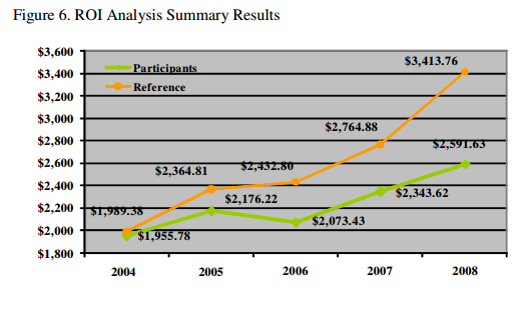
As he was doctoring the original application, he created the fiction that the original “application was online and subject to review.”

Even if the study had started in 2004 instead of 2006, the risk profile only improved by 0.17 on a scale of 5 (3%) by 2008, making the massive savings in 2008 completely impossible. (Until 2016, when they shed all pretense of integrity in order to give an award to their Wellsteps colleagues, the Koop Committee trademark was attributing massive savings to trivial reductions in risk.)
41:40
I point out that Aetna had just accidentally confirmed what should be obvious: participants-vs-non-participants is a totally invalid study design. They were trying to show the opposite, of course. This is classic wellness and confirms our mantra: “In wellness, you don’t need to challenge the data to invalidate it. You merely have to read the data. It will invalidate itself.” The most respected member of the journal’s editorial board, Dr. Nortin Hadler, apologized and said Aetna’s article never should have passed peer review. So much for the peer review process at Ron’s favorite journal.
I also observed that Ron had himself admitted the participants-vs-non-participants study design was invalid:

42:30
Ron responds to my observation that he had “doctored the information.” He admits that the chart in question was originally “mislabeled” on the x-axis. The label was unmistakably clear. To allow Health Fitness Corporation (HFC) to win an award for this non-attributable, invalid result either reflects the total inability of the vendors (Wellsteps, Staywell etc.) and actuarial consultants (Mercer, Milliman etc.) on this committee to recognize a screamingly obvious invalidity when it’s staring at them, or was a conscious decision to give the award to a Koop Committee sponsor. Or maybe both. Each year has seen the award go to someone connected with the Committee.
Ron at least gives me credit for being “sharp-eyed,” but, honestly, anyone who’s taken my course in Critical Outcomes Report Analysis would have seen that the X-axis clearly shows the program didn’t start until 2 years after the two groups were separated.
44:20
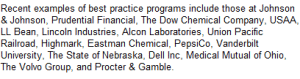
I sprung the trap I had set earlier, when Ron said I praised him in my book. I had reproduced that HFC graph in Why Nobody Believes the Numbers on the page following the page where I praised his own work, so that I knew he would see the graph in all its hilariously invalid glory. That juxtaposition was a test to see if he would retract that graph once the obvious invalidity was brought to his attention. He not only didn’t retract it then, but he called that program (listed below under “Eastman Chemical,” HFC’s customer) a “best practice” for two years after that–knowing full well the key graph showed no program impact.
45:40
I ask Ron if he’s doctored any other Koop Award application after my expose. He is completely silent. He did doctor another original application that very morning in preparation for the debate, not realizing I had saved a screenshot of the original original. The original and the doctored version are reproduced below, for the Nebraska application. But he was “saved by the bell.” The moderator jumped in and started asking the audience for questions, and I frankly forgot to bring this one up later. Compare the last line of each passage below. The first was before my expose of Nebraska. Ron had claimed the Koop Committee had no knowledge of Health Fitness Corporation’s lie about finding all those cancer victims in the Nebraska state employee population. However, it was right in the application…until Ron doctored the application before the debate.
Before doctoring:
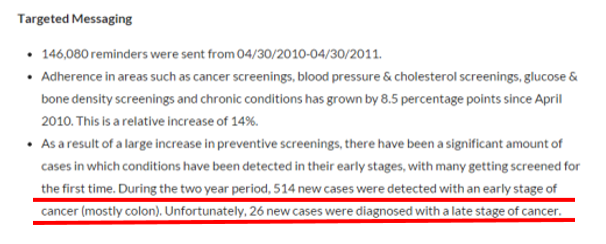
After doctoring:

While he has conceded many points so far in this debate, I have yet to concede that Ron and his cronies do anything well, so here’s the first: he excels at tampering with evidence.
Share this:

The Great Debate, Part 3: Ron Goetzel Reveals the Secret to Eternal Life
This is Part 3 of the November 2015 “Great Debate.” If you are just tuning in now, here are Parts 1 and 2.
Each of us delivers a rebuttal-cum-second statement. Ron uses his time to shore up his base — the “low information voters,” as they say in political science–with claims he knows to be inaccurate because he himself has said the reverse and/or the statements are invalid on their faces.
As a reminder, the time stamps for each section below roughly synch to this master recording.
36:30
Ron says “A large proportion of the diseases we suffer from are preventable.” Actually, excluding smoking-related illness (where there has never been disagreement), “preventable” events consume far fewer employer dollars than birth events, musculoskeletal issues, and general “worried well” medical concerns.
Employers also spend money on rare diseases, infections, catastrophic issues, sports injuries, trauma, drugs, and doctor visits for various things. Are you seeing a pattern here? None of these are preventable by wellness. Where does he get his ideas?
Tallying all spending according to Ron’s own co-authored report — and the HCUP database compiled by Ron’s own employer, Truven — the rate of “potentially preventable hospitalizations” is 2.62 per 1000. Their report uses $22,500 as the average cost/hospitalization. Doing the math with the $22,500, that’s $59/per person per year, out of $6000/person or so spent on healthcare. Meaning about 1% of claims would be preventable through “pry, poke and prod” programs. And that assumes these programs worked perfectly. As years of Koop Awards of demonstrated, they don’t work at all. The most carefully studied program is Connecticut’s. Connecticut‘s pry, poke and prod program actually increased state spending on health care.
So Ron’s premise is utterly false. Let me put it another way: have you ever had a medical event that could have been prevented by completing a health risk assessment or eating more broccoli?
At this point his strategy emerges: argument-by-cliche. “Most diseases are preventable,” is his favorite. That would mean health-conscious folks would be blessed with eternal life.
Also, “80% of money is spent treating chronic diseases.” He is off by a factor of 80 from the relevant figure of 1%. He would arrive at that 1% figure if he asked the right question: “What percentage of cost can an employer save with a perfect wellness program?” He knows that because his co-authored guidebook says it. We also long since debunked this 80% myth.
As a public service, at the end of this posting we list the top hospitalizations. Remind us, Ron, which of these your wellness programs are going to prevent?
36:00
Someone needs to tell Ron that “stroke” is not a chronic diseases, nor are most cancers. A stroke is about as acute as you can get — each minute without treatment raises the odds of ending up like the Kardashians. And if cancer were a chronic disease, we wouldn’t run in “Races for the Cure.” We’d run in “Races for the Control and Management.”
I am personally infuriated that he thinks my recurring bladder tumors were/are preventable. I was involuntarily exposed to a carcinogen in 1984. He’s right about one thing, though: bladder cancer is usually chronic. However, most cancers aren’t, contrary to his claim. When was the last time someone said to you: “My doctor says I have lung cancer, but we’re staying on top of it” ?
He also, ironically, lists “depression” as something that can be addressed by wellness without explaining how employers forcing employees to do something they hate — “playing doctor” by taking their blood — is going to cure their depression.
37:00
“You can improve population health in the workplace if you apply evidence-based programs,” he says. And yet, his own Koop Awards, presumably given to the best programs, go to organizations that made essentially no impact on population health — 1%, 2% or 3% reductions in risk factors –-but then made up clinically and mathematically impossible savings figures. [Postscript: I wrote that in 2015. Little did I know that in 2016, the Koop Award committee would give an award to a company that increased risk factors and admitted flouting evidence-based guidelines.]
Following the debate, Health Affairs put the total kibosh on Ron’s idea. They published a study showing that you can’t get employees to lose clinically or statistically significant amounts of weight. Not that it would matter because weight has only the most trivial impact on health spending in the <65 population.
Another irony (there’s that word again): all the evidence — the US Preventive Services Task Force etc — says you shouldn’t screen all adults every year for anything other than blood pressure. And yet these Ron and his buddies advocate exactly that.
37:50
Ron’s business model is to write up studies showing his friends and clients save money on wellness, so he rattles some off. He notably leaves out Nebraska, because their program and his award for it were shown to be complete lies. However, leaving that program off this list (though it appears on most of his other “best practice” lists) is an excellent debate technique. Listing it as a best practice would have allowed me to point out the results were admitted to have been made up.
He also claims: “some organizations can actually achieve a positive ROI,” As an endorsement, that’s right up there with Benjamin telling Mrs. Robinson that he found her to be among the most attractive of all of his parents’ friends.
It’s also a total walkback of his previous certitude, like:

38:00
Just like Gary Hart invited reporters to follow him to show he wasn’t sleeping around, Ron invited “everybody to go in and look at [the Koop Awards] to determine whether they are telling the truth or not.” And, just like Miami Herald reporter Tom Fiedler did with Gary Hart, I took him up on his offer…and found that almost every award over the last five years showed provably fabricated savings figures. [Postscript: once again, I wrote this in 2015, before the Wellsteps award this year, which raises fabrication of Koop Awards to a plateau that even presidential candidates can’t reach.]
So Ron managed to lose his own rebuttal round–even when, as with his opening statement, I didn’t say anything. The debate has pivoted badly for him…and it’s only going to get worse.
Postscript: At 37:28, he says people with “high biometric measures…are more expensive” than people without. This means he knows full well that Wellsteps is lying in their 2016 award when they show increased biometrics but massively reduced costs.
As a public service to Ron and his cronies, I am listing the top 25 hospitalizations in order of spending. See if you can find one or two that are “preventable” by eating more broccoli or being poked with needles.

Share this:

The Great Goetzel-Lewis Debate, Part 2: The Debate Ends Almost Before It Begins
This is Part 2, my opening remarks. These and all future annotations will be synched to the main debate tape, which is downloadable from the Population Health Alliance website. “Synched” meaning that the exchanges being annotated below can be found at the points in the tape noted in bold.
Click here if you haven’t already listened to/read Part 1.
20:40
I got a chuckle for my opening line but Ron clearly won the style points on opening lines.
You’ll note my opening statement contains no unsupported claims, whereas his entire opening statement was nothing but unsupported claims. I am all about proof and examples — all of which are in the public domain, easily sourceable, and on this site. Many come right from him and his cronies, in their multitudinous gaffes. Ron isn’t debating me as much as he is “debating” against his own industry. The walk-backs, disavowals, concessions etc. make my presence almost superfluous.
22:00
I review Penn State’s ill-fated wellness program. This is a layup. Worst program ever, and Ron’s fingerprints are all over it. I get some laughs for my riff on testicles, which were a major focus of the Penn State program, along with a disproportionate number of questions about ladyparts.
23:00
Ron interrupts (with my permission) to say: “I had absolutely nothing to do with Penn State.” I observed that he was in the room defending it, and gave chapter and verse , referring to the screenshot below and quoting the title. He must have assumed I didn’t see that article. But at the time many journalists contacted me, dumbfounded that Ron, Highmark’s Don Fischer and Penn State’s Susan Basso were still defending it.

The exact quote from that article, in which he was in the room, on the call:
23:40
I review Nebraska. Because I did not anticipate the pants-on-fire Wellsteps-Boise Koop Award in 2016 — the type of lying that gives lying a bad name — I call Nebraska “the most dishonest program ever” …and yet Ron gave them a Koop Award and steadfastly refused to rescind it (since the vendor was a sponsor of the award) even after they admitted lying following my expose of their lies. [Postscript: Ron has now completed the rewrite of the history of this program. Fortunately we took screenshots along the way, documenting each time he tampered with the original application.]
24:10
I quote Ron’s co-authored HERO guidebook — which of course, in a major gaffe (gaffe is defined as “accidentally telling the truth”) — admitted wellness loses money. If this debate were in a court of law, the case wouldn’t even get to the jury. It’s called estoppel. If you have said something on the record, you can’t turn around and say the opposite. So the debate is technically over, legally speaking.
His response (actually the moderator jumped in to defend him) was, that was just one data set. No, that data set was quite representative of the decline in events that takes place regardless of a program, and in any case, who deliberately plants an invalidating data set in their own propaganda? No, these people just didn’t notice that the costs on Page 15 exceeded the savings on Page 23. And they are the self-professed experts in measuring outcomes.
Costs ($1.50 PMPM):

Savings ($0.99 PMPM):

25:00
I reference two proofs. First, the one that says wellness can’t work. Next, my proof that the official government database shows quite literally no impact of workplace wellness on cardiometabolic inpatient admissions this century. Ron accepts this proof. He is caught. His own employer, Truven, holds the contract for managing this database. If he claims the data is flawed (it isn’t), he disses his own employer. So the debate is technically over, mathematically speaking. He just admitted wellness has been completely ineffective. Game, set and match to me. However, wellness apologists don’t understand fifth-grade math (hence this site), so few people in the room understood that the debate had ended.
25:45
I reference the million-dollar reward that we’ve offered to anyone who can show that wellness has broken even. Of course, Ron hasn’t claimed it. I offered the reward because even people who don’t understand mathematical proofs understand that someone who backs his claims with $1-million must believe them. By declining to collect the $1-million (the reward has rules and is a legally binding contract), Ron is admitting he and his cronies are lying about the effectiveness of wellness.
26:14
I point out that RAND and the New York Times are both on my side. The Times, I noted, “was laughing at you folks for how bad your analysis was.” I continue with many more examples of both the left wing and right wing media skewering wellness. “You guys are running out of wings.” Ron attempts no rebuttal even though I had offered to let him interrupt me if I said something inaccurate. But there’s nothing inaccurate about my portrayal of the mainstream media’s position on workplace “pry, poke and prod” wellness. It’s all here. They hate it.
[Postscript: You can now add Slate, STATNews, and many others to list of publications which have skewered wellness, all linked from here.]
27:25
I point out the many instances in which Ron’s own cronies have gone rogue. Altarum, Debra Lerner, and Michael O’Donnell (three times) are all examples of Koop Committee members who deliberately or accidentally dissed wellness. And I reiterate that the HERO Report, that Ron co-authored, admits wellness loses money. This report was signed by 60 wellness apologists. Basically the entire industry admitted failure, in the industry’s biggest-ever gaffe. See our 8-part critique of that ill-fated venture.
Thus ended the two prepared opening statements. By the way, a shout-out for Fred Goldstein, the moderator. In reviewing this tape I had clocked Ron’s “5-minute” opening speech at 9 minutes, but I was allotted the same length. The next installments will cover the rebuttals.
Share this:

The “Great Debate” now out on tape! Part 1: Where’s the Beef, Mr. Goetzel?
Background: Finally, the “Great Debate” tape has been released by the Population Health Alliance (PHA). One could imagine that there was pressure to squelch it, but honestly I don’t think so. True, the major tactic of Mr. Goetzel and his cronies is to send “secret” defamatory letters to the media urging them not to publish my material. (How’d that work out for ya, Ron?) and in general try to squelch my exposes. But I suspect the explanation for this delay was more that there were changes of leadership at PHA, and they needed to address other priorities. Sorry I can’t be more conspiratorial about this. I do like a good conspiracy, but at some point one has to concede that, like it or not, there is no evidence of a second gunman on the grassy knoll.
I don’t need to blame a conspiracy or a faulty mic or anything else, because I won this “Great Debate,” held November 2 in Washington, DC, at the 2015 Population Health Alliance conference. How do you know I won (besides this article in Employee Benefit News)? Because I’m the one publicizing the recording.
Today’s installment is Ron Goetzel’s opening remarks. Listen hard to see if you can hear him cite any examples to back up his thesis that I am inaccurate and, among other things, “bad for society.” If you hear any, let me know. Your timer for this tape should coincide with the minute-marks corresponding to the annotations below. I encourage you not to just look at the annotations but listen to the tape itself.
Before we start, a special shout-out to Fred Goldstein, who pulled this all together and moderated. He did a great job.
0:45
Quoting the compliments about him in my award-winning book Why Nobody Believes the Numbers, earns him a point for now…but stay tuned as we get further into the debate as the plot thickens. One irony: I am proud of my book, which, though written as a humor book, is used as a textbook in at least 5 graduate-level courses on population health. Ron also (co)authored a wellness guidebook…but we’ll hear later that he disavowed it after I observed that none of the numbers added up.
However, for the time being, he would win a point, quoting my book as saying he was one of two credible researchers in the field.
1:10
Ron is correct that I offered $1000 to anyone who could convince him to debate me, and deftly turns that into a solicitation for his Koop Committee. Since I wouldn’t want to be associated with characters who give out awards for defrauding states and who reward obviously falsified savings claims and vendors that harm employees, I did not take him up on that offer. Still, great debating technique. He’s on a roll.
3:40
Ron accuses me of spreading rumors and false and misleading information that is “harmful to society.” Starting a theme that will continue throughout the debate and into his “poison pen” media missive, he offers no examples. Then, he immediately concedes that I am right a lot of the time. This will be another theme–admitting my stuff is right. He did the same thing in that letter to the media. Lots of accusations of inaccuracy, but not a single example offered.
4:20
My ideas are “convoluted and just plain wrong…and harmful to you, me and all of society.” (Once again, no examples.) Then a brief diatribe on how my ideas harm people. (This is ironic given the number of wellness companies that do actually harm people.) Once again, no examples are given.
4:50
The first of many walk-backs by Ron. While I consistently maintain that “pry, poke and prod” programs (wellness done to employees instead of for them) are pure alchemy, Ron repeatedly concedes that many programs don’t work. His view is that “good programs work” though there are a lot of “bad/lousy/awful” programs that “stink.” This was, once again, a brilliant debating tactical retreat, making it impossible for me to cite the 50 or so vendors whose programs have been eviscerated on this site. He can just excuse the many failures of wellness — and he will on multiple occasions during this debate — “oh, well, that’s just a bad/lousy program.”
It was also a brilliant debating technique to avoid mentioning his most recent debacle, Graco, because I would have immediately invalidated it. He is also lucky this debate was held in 2015, and not 2016, after the scathing expose of the Koop – Wellsteps scandal, by award-winning journalist Sharon Begley in STATNews.
He knows how to debate. If he had even a single fact on his side, I’d be toast!
6:00
Once again, yet another unsupported attack: I “make erroneous, outlandish claims.” Um, where? All my claims are on this very site. No one has challenged any of them, ever. (We have corrected and admitted a few mistakes, this apology to HERO being my favorite.) In general, he and his Koop Committee cronies are the ones making the erroneous, outlandish claims. I merely show them how do simple arithmetic correctly.
6:30
Ron “applauds” me for going after “cheaters” who make “bombastic claims especially about ROI.” He is turning the lemon of the wellness industry and my ability to invalidate it into lemonade, by throwing “cheaters” — meaning many of close his colleagues, all detailed on this site — under the bus. [All the cheaters, that is, except his friends that he gives awards to, like Wellsteps.]
6:50
He concludes by accusing me of “bombastic opinions, sarcasm, and hyperbole.” (Ron: my literary style is called irony, not sarcasm. Irony is, to use a recent example, your Vitality friends saying companies should be required to make their employees do wellness when they themselves admit they can’t even make wellness work on their own employees. Or that your friend Steve Aldana’s Wellsteps ROI model, besides being made up, doesn’t actually calculate an ROI.)
Once again, no examples are offered. Clearly if he had even a single example, having attacked me three times, he would have offered it.
Where’s the Beef?
In 7 minutes, he cited zero examples to back up his assertions and accusations, but conceded three important points — that I am right sometimes, that many programs don’t work, and that he “applauds me” for calling out cheaters.
So I’m already ahead even before I speak.
Share this:

Rocky, Bullwinkle, Wellness, and the American Journal of Managed Care
Some of you might remember the closing credits of Rocky and Bullwinkle. Due to copyright restrictions, we can display only a “fair use” snippet. (“Fair use” means you could use one question from Quizzify as an example without special permission as long as you cite the source, but if you tried to copy the whole thing, we’d get elected president, hire a special prosecutor, and throw you in jail.)
Rocky asks: “You got the credits, Bullwinkle?”
Bullwinkle replies: “All on this itty-bitty card…oops” and then it folds out:

(Source: Jay Ward Productions.)
So what does this have to do with wellness, besides nothing?
Simple –I just consolidated all the lies and harms of the Wellsteps/Koop Award into one itty-bitty posting for the American Journal of Managed Care blog. And it also folds out — with links to all the other “smoking guns” in this scandal. If you just want to forward one article around, that’s the one.
Kudos to American Journal of Managed Care for going where Health Affairs fears to tread, by posting the entire, unbowdlerized expose in all its sordid glory. Indeed one would think the latter publication would show some contrition for having started this “pry, poke and prod” mess, by publishing the original Baicker propaganda — with no disclosure of the authors’ conflicts of interest or funding sources…and apparently also no peer review. This thing has been cited 250 times. And that was after it was shown to have been made up. It has 549 citations in total.
Sadly, in addition to not being subject to any other regulations, wellness is not subject to Pottery Barn Rules. Health Affairs created this mess, but they don’t need to pay for it. Quite the contrary, the Health Affairs “impact factor” has probably been boosted more by this article’s 549 citations than almost any other article they’ve ever published. And guess who has to clean up after them?

(Source–you guessed it–Jay Ward productions. These are the closing credits to Mr. Peabody.)
Kudos also, by the way, to the perpetrators of the Wellsteps fraud — Steve Aldana, Ron Goetzel, Seth Serxner. They have the good sense not to take my bait by actually attempting to rebut. The one time they did, in Sharon Begley’s article, their “rebuttal” took the form of basically admitting they had made the whole thing up.
Abe Lincoln seems to be in the news a lot this week, and he put it best: “Better to be thought a fool and say nothing than to speak out and remove all doubt.” Words the Wellness Ignorati should live by. You’d think they would have learned that by now.
Share this:

Now is your chance to fight back against intrusive, coercive wellness programs!
I hate to knock the HealthFairs USA posting off the front page, since it is still bringing in lots of hits and providing lots of laughs. (If you missed the addendum, their reference site is Wells Fargo.)
However, there is some time-sensitivity on this more serious one. My AARP friends (and, yes, I am old — that picture on linkedin is from 2006, and I wasn’t young even then) are the only ones brave enough to fight the good fight against the Business Roundtable and US Chamber of Commerce, whose goal is to make wellness programs so onerous that most employees will fail them…and the penalties will flow right to the bottom line of their member companies. (It is ironic that while both candidates talk about the forgotten working class, neither is actually willing to stand up to their overlords on the subject of forced wellness programs, one of the few places where there really is a simple solution that would help working people.)
Here’s what they have to say and have asked me to disseminate in real time:
Does your employer charge you more for health insurance if you don’t give your health information to the “wellness” program? AARP thinks participation in workplace wellness programs should be genuinely voluntary. If you must surrender your or your family’s health information to a wellness program in order to avoid paying higher insurance premiums, AARP needs to hear from you now! We are especially interested in hearing from AARP members who are being affected by wellness “incentives.” Please share your story, privately and confidentially, by contacting Brian Dittmeier at bdittmeier@aarp.org by no later than October 17, 2016.
Share this:
HealthFairs USA: A wellness program that defies description
The English language contains 450,000 words, the most of any language, but apparently it needs a 450,001st. Why? Because whoever invented the first 450,000 words had obviously not reviewed HealthFairs USA’s wellness program, which no existing word comes close to describing.
First, they test for cancer — with 99% accuracy! This precision may seem impossible but their claim is correct in that 99% of the words in the clipping below are indeed spelled accurately. (This is actually a better track record than the rest of their website, in which they describe their “unparallelled” customer service and how they “minimize your companies risk” and “build company moral.” They also advertise “less call-outs for sickness,” by which I suspect they mean “fewer absences.”)

Besides the slight problem that this statement is beyond absurd about a zillion different ways, Preventest lacks FDA approval (and — equally surprisingly given their accuracy — a Nobel Prize). That doesn’t stop HealthFairs USA from submitting claims to insurance companies and promising “no out of pocket cost” in most cases:

By the way, there is no FDA-approved genetic “check swab,” or test of any kind, let alone one with 99% accuracy, for any cancer. And few cancers on this list even have a genetic component. (Bladder cancer, for example, is 100% environmental.)
But wait…there’s more. Now how much would your insurance company pay? HealthFairs USA is selling worthless nutritional supplements and submitting insurance claims for those as well:

Let’s review what they’ve told us so far: they perform useless, non-FDA-approved tests and sell useless, non-FDA-approved supplements to employees who don’t need them, and then submit bills to third party payors. Can anyone spell insurance fraud? I doubt they can, since they can’t even spell “alleviates.” (So much for their 99% accuracy target.)
How does this benefit employees?
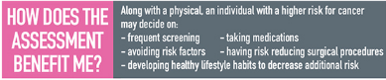
Lots of ways. Employees can submit to more frequent screenings. And I’ve always said the problem with the US healthcare system is that employees don’t get screened enough. (not!)
Or, they can take medications. It’s not clear which ones, and there aren’t any “medications” that are FDA-approved for preventing most cancers in any case. But whichever ones you take, I’m sure they’ll figure out how to bill the insurance company for them. Most importantly, you can “have risk reducing surgical procedures.” Let’s see…what word can describe a wellness vendor recommending surgery for employees tagged by non-FDA-approved cancer screens for a possibly elevated risk of cancer?
Hmm…maybe we need a 450,002nd.
Indeed, a true wellness program might consist of warning employees not to get anywhere near HealthFairs USA, so clearly these people don’t have any accounts of any sophistication, right? Right?
Wrong. Here are their accounts:

That means they are submitting insurance claims to their insurers on behalf of their employees, as directed and incentivized by their human resources department. I’m not a practicing attorney, but I am a practicing non-idiot, and as such my opinion would be that Coca-Cola and others look into this posthaste.
Plus, it’s not like they’re completely fraudulent. They have references from stellar companies with outstanding reputations:

Full disclosure: I’m not 100% sure that it is actually illegal to submit insurance claims for useless, unapproved, possibly harmful, USPSTF D-rated screens and useless, unapproved, probably harmful, supplements for employees who have no diagnosis, no recognized medical necessity and aren’t seen by a real doctor.
Quite the contrary, my opinion may only be 99% accurate.
Share this:

If Wellsteps and the Koop Committee can show they aren’t lying, they can collect the $1-million reward
Those of you with long memories may recall our standing offer of a $1-million reward to anyone who can show that the wellness industry has broken even during this century. You need a long memory because no one ever claimed the reward. For all the bluster of Ron Goetzel and his cronies, apparently none of them actually believe what they say…or they would be $1-million richer.
Oh, wait, in the case of both Ron Goetzel and his cronies, maybe they haven’t claimed the reward because they do believe what they say.
The offer is legally binding. There are clear rules. There is an entry fee, but it is refundable to the claimant if they win.
We would now extend that offer specifically to Wellsteps and/or the Koop Award Committee, and we’ll throw in HERO too, since it’s all the same inbred crowd. All they have to show is what they have already claimed: that Wellsteps made Boise School District employees so much healthier — perhaps by reciting their mantra that “it’s fun to get fat and it’s fun to be lazy” — that the School District could, as a direct result of this enhanced employee health, reduce their healthcare benefit spending by roughly one-third after three years.
To make it extra easy for the these people, I’ll relax the requirements:
- They can submit the existing “This Is How You Win a Koop Award” self-congratulatory paean. That means both that they don’t have to do any extra work (besides adding to up 20 links at their option, as the rules allow), and that the word limit on the reward application is waived to accommodate the size of that posting.
- Any or all Koop Committee members can participate with you in the oral arguments, but I myself am not allowed to bring a second. This means they can gang up on me, by crowdsourcing their IQs.
And of course they already know what arguments I am going to make because I posted them. That’s like having the debate questions in advance.
They would have to file the entry fee, or formally request a month’s extension, by November 1. The only reason for the deadline is that when they ignore this offer, as they inevitably will, I can start saying they are admitting they’re lying as early as November 2.
As with the regular award, I am perfectly happy to offer it the other way around, where I pay the entry fee, and I have to prove they’re lying, as opposed to them proving they are telling the truth. That way they can’t say the game is rigged, since I’m willing to play either hand.
Since the Koop Committee members are all such civic-minded citizens, they need not personally collect the windfall if they win. I am perfectly willing to — indeed, would prefer to — donate a million dollars to the Boise School District, either as an unrestricted gift or to set up a fund to update, enhance, and increase employee (and student) access to their fitness facilities and equipment.
Surely, Mr. Aldana and Mr. Goetzel, if you truly care about the health and well-being of those employees, you will make the small effort required to secure this million-dollar contribution on their behalf.
And, Mr. Aldana, please don’t pretend you aren’t applying for the award because you are unaware of my work. For instance, you view my Linkedin profile with a regularity roughly halfway between obsessive and man-crush.*
*As recently as…

Share this:

Why do employee wellness industry leaders hate employees so much?
I would like to express my gratitude to the editor of the American Journal of Health Promotion, Michael O’Donnell. He recently decreed that “despite common lore, I am not an idiot.” Coming from a man brilliant enough to singlehandedly create entire alternative universes of arithmetic and statistics, “not an idiot” is mighty praise indeed.

I’m unsure exactly what “common lore” he is disputing, unless he means that the Phi Beta Kappa committee at Harvard also thinks I am an idiot, relatively speaking, because they snubbed me until I was a senior.
I will return the compliment. Michael O’Donnell is not an idiot either. Quite the contrary, he and his Koop Committee buddies knew exactly what they are doing when they gave their friends at Wellsteps awards for harming employees. Bottom line is, these people simply hate employees, and happily throw them under the bus whenever it’s profitable to do so. While Boise is a great example, Penn State still reigns supreme.
While we could write a post about almost any member of that Committee, this post focuses only on one member, Mr. O’Donnell. Still, it’s hard to dislike the man given all the kudos he throws my way. For instance, in addition to not being an idiot, I am also praised above as: “close to being accurate.” Since we disagree on everything, he is therefore acknowledging that he himself is many light-years from accurate — as Wellsteps and every other Koop award demonstrates.
Michael O’Donnell’s Anti-Employee Jihad
Michael O’Donnell also said, as you can see above, that I am not a “misanthrope.” However, in this case, I can’t return the compliment. His new editorial is a misanthropic anti-employee jihad. First, he says prospective new hires should be subjected to an intrusive physical exam, and hired only if they are in good shape. OK, not every single prospective new hire — only those applying for “blue collar jobs or jobs that require excessive walking, standing, or even sitting.” Hence he would waive the physical exam requirement for mattress-tester, prostitute, or Koop Committee member, because those jobs require only excessive lying.
Second, he would fine people for not meeting “outcomes standards.” In an accompanying document, he defines those “outcomes standards.” He specifies fining people who have high BMIs, blood pressure, glucose, or cholesterol.
Finally, he wouldn’t hire smokers at all, because they are so unworthy and untalented. Meaning Humphrey Bogart never should have been cast in Casablanca. Ernest Hemingway and George Orwell should have piled up rejection letters. Roger Maris should get his asterisk back.* Rihanna, Simon Cowell, Adele, Brad Pitt, Obama, Churchill, Einstein. Sinatra, Twain, Kidman. Sheesh! I agree with you, Michael. What a bunch of losers.
And thank goodness Watson didn’t smoke or Moriarty would likely still be at large.

A Unique Way to Charge Employees for Health Insurance: By the Pound
Almost every nonsmoker would be caught in his dragnet too, as he would “set the standard for BMI at the level where medical costs are lowest.” Since people with very low BMIs incur higher costs than people with middling BMIs, Mr. O’Donnell would fine not only people who weigh more than his ideal, but also employees with anorexia.
If employees didn’t already have an eating disorder, what better way of giving them one — and hence extracting more penalties from them — than to levy fines based on their weight? Hopefully, he would allow people with wasting diseases like cancer to appeal their fines.
Employees above his ideal weight would pay per pound, sort of like they were ordering lobster or mailing packages.
Yes, I have a hard time believing anyone would disdain employees that much too, so here is the screenshot:
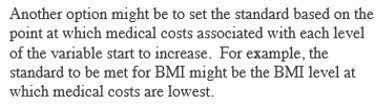
He claims that all these fines will “enhance morale” for employees, whether they like it or not.
How would Michael defend his anti-employee jihad?
The Wellness Ignorati don’t engage with me, for obvious reasons given their self-immolating comments when they do. So I’ll provide his rebuttal. It would be, as he said in the first screenshot above, that I am once again “creating controversy where it does not exist.” Clearly, his editorial and white paper are mainstream, and I’m just causing trouble again for no reason.
Michael wonders why, in his own words (echoed by Ron Goetzel), 90% to 95% of wellness programs fail. He says it’s because employers don’t spend remotely enough money on them. He recommends up to $300/employee/year…and what better way to reach that spending target than to make them go to the doctor, and set up expensive weigh-ins, inspections and fining procedures?
While Michael O’Donnell may not be an idiot, I’m not sure I could say the same about any CEO who takes his advice.
*Maris should get his asterisk back because, as a smoker, he still holds the record for “Most home runs by a player who never should have made the team.”
Share this:

How the 2016 Koop Award Raises Lying to an Art Form
If you were at the HERO conference, you witnessed a surreal experience. Executives from Johns Hopkins, Mercer, United Healthcare and elsewhere willing to risk their jobs by perpetuating what has now been exposed as a bald-faced, presidential candidate-level lie: that Wellsteps deserves an award for a program allegedly benefiting Boise teachers so dramatically that costs fell by a third. They will not mention the article in STATNews that came out yesterday showing that school district employee health deteriorated.
You read the article, so you know they are lying. And they know you know they are lying. And yet the whole thing just continues as though it is somehow all OK because no one is admitting it publicly.
Here is some more detail on the lies in question.
Sharon Begley’s article Wellness Award Goes to Workplace Where Many Health Indicators Got Worse does not lose anything in the re-reading. Quite the contrary, almost every quote in it is either a lie, or exposes the Wellsteps application as a lie. In each case, Wellsteps’ Steve Aldana, Johns Hopkins’ Ron Goetzel, United Health Care’s Seth Serxner, and all the other committee members know it’s a lie, because of the aforementioned article.
“Lie” might seem like a harsh term, but the alternative is to assume that Ron and his cronies have absolutely no idea how to read an outcomes report, even though I have already showed them how to read this report in particular.
True, one could argue that Ron has been known to use the “dumb and dumber defense” when giving his friends their awards, but in this case he can’t pretend he doesn’t know any better because he was quoted in the article. Another argument that these are lies: no one — not even a member of the Koop Committee — can possibly be this stupid accidentally.
Let’s go lie by lie. Let’s start with the last quote from Ron “the Pretzel” Goetzel, because it sets the stage for the others. He got his moniker because he has a way of twisting and turning words to make himself sound like he isn’t lying. In this case, he said if “an application said everything went exactly right,” it would certainly “raise eyebrows” on the Committee.
“Went exactly right”??? Ron, isn’t the entire point of wellness to make employees healthier? So if a program makes employees unhealthier, we say it didn’t go “exactly right”?
Using this definition, here are a few other things that did not “go exactly right”: New Coke, Yugos, the 1962 Mets, Vietnam, subprime loans, Yahoo, and the 2016 presidential nominating process. And for that matter, Begley’s article points out that McKesson’s 2015 award also wasn’t “exactly right,” in that the program didn’t do anything and the data self-contradicted. It’s not just McKesson. I have been tracking these Koop Award-winners for years, and they all self-invalidate. Each is more hilariously not “exactly right” than the other.
Yessirree, if there is one thing that shouldn’t keep Koop Committee members up at night, it’s the fear that one of their award applications might be exactly right. So the good news is that no Committee member has to worry about contracting an acute case of over-raised eyebrows.
Another lie exposed: It turns out the Koop Estate licenses the name to this cabal in order to make money, just like Dr. Koop licensed his name to make videotapes. The award is now admitted to be “industry sponsored.” This is the first time this provenance has been disclosed in print. It is basically a marketing scheme for the committee members and sponsors. They had claimed to be a “private-public” organization. That Orwellian Pretzel-speak is a lot different from being admittedly industry sponsored.
Next, Dr. James Fries — whose major wellness expert credential is writing an article finding massive population-wide savings against a phony control group by getting a few diabetics to eat less fat — called this “an exemplary program” that “showed improvements in health behavior” leading to cost reduction. Yes, a few self-reported behaviors improved. We suspect the Boise teachers lied, because they clearly lied when they self-reported their smoking (only 2.5% admitted it) and drinking (only 20%).
But let’s assume they didn’t lie–meaning somehow they are different from everyone else when they complete workplace health assessments. Exercising three more minutes a day and eating 0.11 more fruits and vegetables/day cannot reduce health care costs at all, let alone by a third, especially when the employees became unhealthier overall.
This statement would therefore qualify as a mistake, assuming Dr. Fries is not bright enough to already realize it is wrong. If Dr Fries doesn’t retract it now that he knows it’s wrong, it becomes a lie.
That brings us to Steve Aldana. He has been caught lying many times, including this example where he accidentally told the truth before retracting it. (He and his friends burn a lot of time trying to explain away instances in which have to explain why they accidentally told the truth but didn’t really mean it.)
His biggest lie is his discussion of regression to the mean. Compare his quote to his application. First, the quote, which shows he is actually familiar with the concept:
“In just one year, many employees will move from one [risk] group to the other,” he explained, “even though they did not participate in any wellness programs or any intervention whatsoever.” That movement, he continued, “reflects changes in health risks that occur naturally,” making it possible that some high-risk people become low risk “even though your program didn’t do anything.”
Contrast that to his application, in which he pretends he has never heard of regression to the mean, and instead attributes the “dramatic improvements” in the highest-risk Boise employees to the “program impact”:

He also contributed my favorite line of the article: even “one more bite of a banana” can make a difference in people’s health. This is true, of course, for the segment of the population that is starving to death. Otherwise, how dumb is this claim? Let’s just say that if a college taught him this, it could lose its accreditation.
And that brings us to his biggest lie of all: He says I didn’t understand the program benefits because I didn’t read the data. I did, of course. I even actually added up the datapoints, which no one on the Koop Committee did. I’ll give Committee members the benefit of the doubt and assume they failed to add the datapoints not because they didn’t want to expose the truth that Boise employees got worse in their friend’s program, but because calculators are not yet available in their cave.
Adding the data would have revealed to them — as it did to me — that they harmed employees. 6397 biometric indicators deteriorated, while only 5293 improved. This conclusion shared by both Ms. Begley and the Boise consultant, Kellie Wirth, who helped set up the program. Apparently, the law of averages caught up with the perpetrators of this Boise scheme, because Kellie Wirth is honest. She calls the biometric results “very disappointing” and says my concerns “are valid.”
The biggest lie of all: that these extra banana bites and trivial improvements in self-reported health behaviors — combined with statistically significant deteriorations in self-rated health and risk scores — could have any effect, let alone an effect of mind-boggling magnitude, on overall spending:
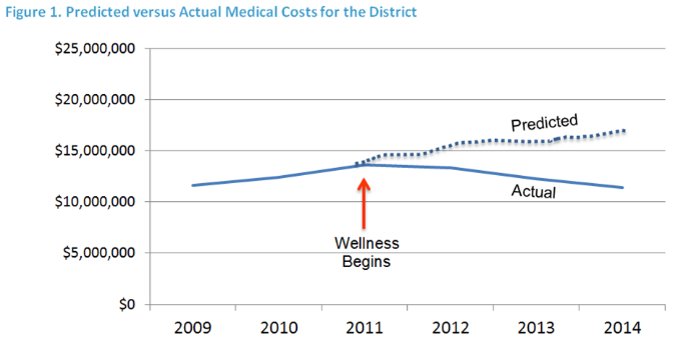
Funny thing, Ron Goetzel insists that “most programs fail” because they aren’t done right, and that getting to a 1-to-1 ROI is a heroic accomplishment, only achievable when employee health is improved:

And yet when it comes to giving his friends awards, failed programs harming employees but generating massive phony ROIs don’t seem to bother him at all. Let’s see him Pretzel his way out of this one.
One thing vendors love to do is play blame-the-victim. The Pretzel pioneered this approach by saying he had “absolutely nothing to do with Penn State,” when in fact he was in the room when they defended their program to the media.
Seth Serxner stood up, on camera, and basically declared United Health Care/Optum hates it when employees spend too much money on their screening programs, and typically begs to do less. United Healthcare complained that I was making them look bad, but then couldn’t produce a single name of a single employer who would admit to deciding to spend more money for the express purpose of screening inappropriately.
And now here comes Steve Aldana, blaming the Boise school administrators for insisting on throwing taxpayer money away and harming their employees, by flouting US Preventive Services Task Force guidelines. My suspicion is that their Boise customers have an alternative view, but — despite the presumably obvious pride they must be taking in this award — they are refusing to comment on it. One can only imagine the conversations taking place in Boise right now…and this is before the Idaho Statesman gets hold of this debacle.
And Ron wonders why the number of applications for the Koop Award was down by two-thirds this year…which brings us to yet another lie told by Mr. Goetzel in this article. He attributes the decline to the following:
the application process, including the requirement that wellness programs submit statistics and rigorous data analysis, has become so strict that fewer programs want to go through the process.
However, if you actually look at the application form, it is exactly the same now as it has been every year this century. And indeed the data submitted, if anything, was more comprehensive then. For instance, the 2000 winner, Fannie Mae, clearly documented all the prostate, pulmonary function and other USPSTF D-rated tests they forced employees to submit to.

 They Said What?