
Home » 2016 (Page 9)
Yearly Archives: 2016
A perfect example of doing wellness FOR employees and not TO them
I just posted a “financial wellness” opportunity that will reduce employee stress and increase their appreciation of their employer, doesn’t even require a budget and might actually be cash flow-positive for the employer.
It’ll be interesting to see if anyone actually does it.
Comments appreciated–might as well add them right on the posting so that someone sees them other than the usual suspects.
Share this:

The Bad News about the 2016 MBGH Annual Conference
The bad news is this: you’ll never want to sponsor, exhibit at, or even attend another conference after this one. The Midwest Business Group on Health just set the standard so high that any other show would be a letdown.
The regional business coalition shows–lately I’ve done Philly, Northeast, Pittsburgh, and South Carolina–have all featured excellent speakers and diverse attendees.
It turns out there is a specific reason for this: the regional coalition charters typically require that actual employers comprise the majority of the boards and attendees. Consequently, their conference agendas are not exclusively devoted to vendors breathlessly pitching their outcomes fantasies, punctuated by genuflections to the “Harvard Study” and its 3.27-to-1 ROI.
Instead, the speakers are edgy and controversial. (“Controversial” means “agree with me.”) I would even concede that one of them — Todd Bisping of Caterpillar — was more entertaining than I was. I made a mental note never to present directly after him.
The conference organizers, Larry Boress and Cheryl Larson and Mindy McBee, selected a great venue on the 80th floor of a Chicago skyscraper, designed the layout so that vendors would be in proximity to attendees but not in their faces, and provided some relaxation/meeting space as well. All the food offerings were delicious and, yes, healthy. (Plus, Zipongo was giving out goji berries.) There was just the right ratio of people to space, so that it felt energized but not crowded, and there was none of that feeling you get in large conference venues of endless walking in cavernous marble vestibules.
The whole thing ran very smoothly. It usually takes a lot of work to make something look easy, and I’m sure this was no exception.
And, yes, I know it’s not always about me but my presentation was very well-received. MBGH conducted one of those electronic polls, both before and after my slides, to see what people thought of wellness economics. Because this was a sophisticated audience, even the “before” picture showed that only 20% of attendees were pleased with their wellness program’s outcomes. 45 minutes later — same question–only 10% were.
Following my keynote was an expert reaction panel, featuring Bruce Sherman, Tom Ciccotti, Sandra Morris and Kim Dwyer. As a “reaction panel,” they were supposed to give me hell but really they only gave me heck, meaning mostly in agreement but bringing up a few issues I had overlooked or understated. Tom quite justifiably called me out on making sure I drew a bright line between “pry, poke and prod” programs vs. “wellness for employees,” a category that includes a lot of emerging programs that he has industry-leading expertise with. Bruce brought up the importance of stress and financial well-being programs, which I hadn’t mentioned but which are increasingly important, prevalent and, needless to say, preferred by employees over pry, poke and prod.
I had urged screening according to guidelines. Sandra pointed out that the USPSTF guidelines give skin cancer screening an “I”, meaning not enough information. Skin cancer would be one place where a company might recommend and fully cover screens above and beyond USPSTF, since USPSTF seems timid on this score. Skin cancer would seem to fit the bill for screening, as it is very common and the consequences of “false positives” are quite minimal.
As an aside, I have always maintained a company shouldn’t be wedded to the USPSTF–but if they deviate, they need a very good reason. “The employers make us do it,” the excuse offered by Optum’s Seth Serxner for overscreening, would be an example of a reason that does not fit that description. This is especially true when Optum’s PR person — after accusing me of making Optum “look bad” by quoting Mr. Serxner verbatim — was subsequently unable to identify a single employer willing to state: “Yes, we decided to overscreen employees despite Optum’s objections.”
Kim Dwyer disagreed with my overall assessment of wellness economics. She stated that her organization’s wellness program will pay off in reduced wellness-sensitive medical events in 2018-2020. I wish her the best in achieving that goal and as of this posting am now offering to measure those outcomes gratis.
The conference also featured a free vendor wellness screening that included checking the tightness of employees’ calves. Loosening employee calves is the key to reducing healthcare costs and increasing productivity, For example, suppose your wellness programs recommends drinking eight glasses of water a day.

If you get up from your desk too quickly because you really really really have to pee but your calves are tight, you could tear your Achilles heel.
Fortunately that won’t happen to me. This vendor stretched my calves out quite a bit. And they stayed loose, probably looser than they’ve ever been–until I was asleep, when the left one went into spasm.
Share this:

Does Today’s NY Times Spell the End of Corporate Weight Loss Programs?
They say: “Vivaldi didn’t write 400 violin concertos. He wrote 1 violin concerto 400 times.”
Whether you agree with that assessment or not (or whether, like us, you could care less because your idea of “classical music” is Meet the Beatles), the same is true of They Said What: the 200 seemingly different posts on this blog are really the same post 200 times, in that we always say the same thing, albeit a bit differently.
Actually ours are five different posts, an average of about 40 times each because we say five different things:
- Wellness is a waste of time and money that is now proven to make spending increase;
- Wellness can harm employees;
- Wellness vendors lie;
- You cannot pay, bribe, shame, fine, coax, cajole, threaten, browbeat or embarrass employees into losing weight;
- Even if you could, it won’t save you any money.
Today’s theme is #4. Obesity is a complex biochemical phenomenon that is poorly understood both by the finest minds and also by wellness vendors. The only thing the former agree on is that you can’t cure obese patients by with finances, so naturally that’s what the latter advocate, because, like Willie Sutton said about robbing banks, get-thin-quick contests are where the money is.
We have already called out ShapeUp, Wellness Corporate Solutions and HealthyWage for these worthless and hazardous programs. They all know better but in wellness, filthy lucre trumps integrity.
Still, these companies couldn’t sell this nonsense if you didn’t buy it, and now there is a terrific study in the New York Times (a preview of a study coming out in Obesity) on why you shouldn’t buy it. The study tracks what happens to “Biggest Loser” contestants after the show ends. It turns out [Warning: SPOILER ALERT] that…
…are you ready for this?…
These contestants have already gained most of their weight back.
Usually we point out that because corporate get-thin-quick contests count only active motivated willing participants and don’t count non-participants or dropouts, self-selection accounts for a large chunk of the alleged favorable outcomes. However, who could be more motivated and self-selected than a participant on a reality show, one that requires multiple rounds of auditions and that, for winners and runners-up, brings the promise of at least temporary wealth and fame? You can’t ask for more motivation than that.
And yet…
These contestants have already gained most of their weight back.
Are you noticing a theme here? We recommend reading the article in its entirety. It turns out that your body “fights very hard to gain the weight back,” as the article says. Contestants’ metabolisms consistently and significantly slowed following the initial weight loss, meaning that 13 of the 14 contestants are actually worse off than if they hadn’t been on the show in the first place. The measured change in metabolisms isn’t trivial — it’s many hundreds of calories a day.
The beauty of this study was how carefully these folks were tracked, and how motivated they were to stay thin. Biochemistry trumps motivation.
And of course, we are happy to help you get out of your contracts with these vendors and demand your money back. Then maybe you can spend that money on something with a higher benefit-to-cost ratio than get-thin-quick programs — like, as Dee Edington said a decade ago, flushing it down the toilet.
Or Quizzify. The effect of increasing one’s knowledge of the healthcare system does not “wear off” after the contest ends, and at the very least, employee metabolisms won’t slow down.
Update, May 3: It was pointed out that this study was only for morbidly obese people and they might have a malfunctioning metabolism to begin with. And it is uncontrolled. Both are of course true…and if this were a standalone study reaching a dramatically different result from others, those criticisms would carry weight. However, all this study does is confirm what other studies have already shown: for many reasons it is very hard to lose weight. The difference is that these subjects were highly motivated and totally self-selected to be successful at it…and yet…
Share this:
Harvard Business Review: Wellness Vendors Make Employees Worse
As our more alert readers may possibly have noticed just a little bit, there is a battle taking place between advocates of doing wellness to employees (wellness vendors) vs. advocates of doing wellness for employees (the rest of the inhabited solar system). There are also those who want to do both, what my colleague Jon Robison calls “paradigm straddling”. This latter group consists of vendors who want to check off the culture-of-wellness box so they sound relevant and supportive and au courant, while continuing to charge employers large sums to screen the stuffing out of their employees. The most hilarious example of the last is Total Wellness. If you haven’t already read their “profile,” it’s well worth the wear and tear on your keypad to click through.
Now, along comes Stanford University’s Emma Seppala, writing “Good Bosses Create More Wellness than Wellness Plans Do” in Harvard Business Review, to draw a bright-line distinction between the two approaches.
Her first paragraph:
In the name of employee wellness, and in response to insurance company demands, corporations are offering well-being initiatives with financial incentives. Complete this cholesterol screening, say, and you’ll get $100 added to your paycheck; participate in some number of wellness programs, and you’ll receive another bonus. In this quest to increase employee wellness, however, organizations are often unwittingly making things worse. Is it any surprise that initial studies on wellness programs are showing they don’t lead to any visible results?
As an aside, even our less alert readers may recall that I got in a lot of trouble with the HERO crowd (Ron Goetzel, Staywell, and Seth Serxner) just for the crime of noticing that their own numbers in their own guidebook showed wellness loses money. Apparently, Ms. Seppala noticed the same thing, because the link in her article in support of the “wellness programs don’t lead to any visible results” comment goes directly to their report. I guess she’s going to be placed on their Enemies List as well, and she can probably also expect them to circulate a “poison pen” letter about her as well, perhaps using the one they wrote about me as a template. Congratulations, Emma! You’ve arrived.
These programs “can actually cause more stress,” she writes. And she notes that those employees who do take time off for the corporate yoga class etc. get dirty looks from colleagues who need to pick up their slack.
What to Do Instead
It won’t surprise even our least alert readers that Ms. Seppala advocates a Dee Edington-type “culture of wellness,” starting with the work environment itself:
A workplace characterized by humanity. An organizational culture characterized by forgiveness, kindness, trust, respect, and inspiration… Leaders set the tone for their organization, and their behavior determines whether interactions in their organization are characterized by trust, forgiveness, understanding, empathy, generosity, and respect.
I’ll leave the rest for you to read.
Where Does This Leave the Wellness Industry?
You’ll see a lot more paradigm-straddling. Once again, the wellness industry comes through with the quintessential example: a Pulse post from a wellness vendor called Dacadoo. (There are so many wellness vendors that I guess all the other names have been taken.)
Talking about all the “fun things” that a wellness culture can provide, Dacadoo writes:
[Health fairs] are professionally run events that are designed to provide education and basic medical screening at usually little cost or no cost for the employees. At these fairs employees can undertake some screening tests such as blood pressure, glucose cholesterol, height and weight, anemia, etc.
Speaking of the solar system, anyone from another planet would interpret this passage as employees thinking: “Wow, my employer can weigh me and test me for both ‘glucose cholesterol’ and anemia! At little or no cost to me? How cool is that?”
And I bet if employees are willing to pay them just a tiny bit more, Dacadoo will also allow them to paint their fence.
Share this:
Wellness Vendor Definition of “Empathy”
Recently I pointed out how Wellsteps’ Troy Adams feels about overweight and obese employees and how they got that way: “It’s fun to get fat. It’s fun to be lazy.” Those who read that post may recall it received quite a number of comments, which I helpfully added right to the post.
While Mr. Adams is an extreme example, it came to my attention — and to Jon Robison’s attention — that other wellness vendors have been equally dismissive and disrespectful of employees, using words to describe them more appropriate to herding animals. Jon and I just posted a Linkedin Pulse on this topic.
PS I’m sure there are coaches — and I am pleased to know many of them — who would never say things like this about their clients. If you are one of those coaches, feel free to identify yourself as such on the Pulse.
Share this:
Nebraska’s Award-Winning Wellness Program Meets an Ignominious Demise
No program epitomized conventional “pry, poke and prod” wellness more than Nebraska’s state employee wellness program. And by that of course I mean no wellness vendor has ever lied about outcomes more blatantly or won more awards than Nebraska’s state employee wellness program vendor, Health Fitness Corporation. (Blatantly lying about outcomes and winning Koop Awards, in the immortal words of the great philosopher Frank Sinatra, go together like a horse and carriage.) Their big mistake was admitting it. (See the timeline link.)
Not to mention the cover-up of the lies, that Ron Goetzel and his Koop Committee friends botched so badly that the state’s HR team and procurement department could no longer do the Sergeant Schultz thing. I guess now, finally, Mr. Goetzel will stop referring to this program as a “best practice.”
Now, the program is officially dead. It was close. On October 1, we thought we had lost:
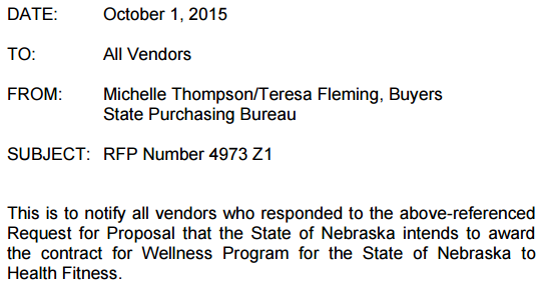
But then last week, following a number of behind-the-scenes conversations and finally a bit of googling by the state:

In other words:

Share this:

The Best-Ever Argument for Ending Corporate Weight Loss Challenges
You may be paying employees to do exactly the opposite of what you want them to do: you may be dramatically increasing their risk of heart attacks and dying, instead of reducing the odds, which are already very low.
Consumer Reports has discovered a dangerous drug, a molecule closely related to the banned ephedrine, in many weight-loss and performance enhancement supplements sold over the counter. Ephedrine was responsible for the death of a Baltimore Oriole, and has been implicated in other cases as well.
This drug is not found in most weight-loss supplements. The worst you can say about most weight-loss supplements (which don’t need FDA approval because they aren’t “drugs”) is they are worthless, but not harmful.
By contrast, these other supplements shouldn’t be allowed to be sold at all…and yet they are among the most popular of all weight loss aids. Why? Because they “work.”
The fact that they work is precisely why you shouldn’t be running weight-loss contests. Putting money on the line for weight loss is one excellent way to encourage people to do things — and in this case, take things — that they wouldn’t take if left to their own devices.
The obvious way to avoid this problem in the first place is simply not to hold weight-loss “challenges.” Regardless of what ShapeUp and Wellness Corporate Solutions say to protect their revenue streams, these contests are a fabulously stupid idea to begin with. “Weight-cycling” may be hazardous to health and is certainly not beneficial to it. However, if for some reason you feel compelled to run this type of contest — perhaps because a Healthywage salesperson sold you on it without mentioning the hazards — you need to ban drugs containing the specific ingredient(s) named in the report.
An if there is enough money on the line (and these days there needs to be, in order to get employees’ attention), naming the banned drugs may paradoxically increase their attractiveness. Therefore you would have to do blood tests to enforce this ban. And of course once you start paying for drug testing, on top of what you pay to HealthyWage or ShapeUp, the magnitude of your negative ROI is multiplied.
Which brings me back to the original point: why do these contests at all? Surely there is some wellness activity you can run that won’t harm employees and isn’t worthless. Not harming employees doesn’t seem like too high a hurdle for a wellness program.
Here is a random suggestion: try Quizzify instead. No one has ever been harmed learning how to avoid being harmed.
Share this:
The Story of an Employee Who Benefited from Wellness
It has, of course, been proven that corporate wellness has not accomplished anything, as measured by the consensus endpoint — one of the few things HERO and I agree on — of admissions for wellness-sensitive medical events.
Along with the lack of benefit, conventional wellness has a downside: occasionally we post stories of employees complaining about how bad their wellness program is — three complaining specifically about the Cleveland Clinic’s program just last week. Plus, Optum and others have admitted to deliberately flouting clinical guidelines, which is no way to improve employee well-being.
Yet it wouldn’t be fair to say employee wellness has benefited no one. An employee has stepped forward to say how much he benefited from none other than the much-maligned Penn State wellness program. That employee would be the none other than the employee who led the wellness revolt, Professor Matthew Woessner, this week elected Chair of the Penn State Senate.
Usually this would be big news at least locally, but Bernie Sanders held a rally on campus the same day, and so the Senate election news got fawcetted. (To be “fawcetted” is to have your news event bumped off the front page by a bigger news event, as when Farrah Fawcett died hours before Michael Jackson. I invented the word, and it’s really gone viral. Not.)
Though Matthew was already a member of the Penn State Senate at the time of the wellness revolt, he taught at and represented the Harrisburg campus. This was not exactly a high-visibility posting Most people — likely including some at Penn State itself and certainly including me — hadn’t even known there was a Harrisburg campus. So needless to say he didn’t exactly command a bully pulpit.
But when the University’s wellness program was announced–stealthily, in the summer of 2013, timed so that no one would be paying attention–Matthew and a few colleagues sua sponte sprung into action. Allied against the combined forces of the university administration, Highmark and Ron Goetzel (and with a soupcon of help from moi-meme), Matthew was able to get Penn State to rescind what would have been one of the worst programs in wellness history. Clearly his Senate colleagues–and the Penn State faculty as a whole–were quite appreciative, as this near-debacle remains fresh in their minds more than two years later.
The proposed Penn State program also flouted clinical guidelines, but that was just the beginning. For reasons that shall remain one of life’s little mysteries, like whether there was a second gunman on the grassy knoll or how they get the stripes into toothpaste, it laser-focused rather lasciviously on employees’ privates — prostate exams and testicle checks, plus a plethora of questions involving ladyparts. For instance, refusing to disclose pregnancy plans could cost a female employee $1200.
Ultimately, it was that last question that rallied the employee base. In a videotaped session, the Highmark representative said the reason for this fine was so Highmark could “help” employees who were planning on becoming pregnant. Jon Robison often refers to programs as “Wellness or else.” This was: “Let us help you or else.” As an analogy, imagine a Boy Scout threatening to mug a little old lady if she didn’t let him help her cross the street.
Ironically, if Highmark and Mr. Goetzel had given this pregnancy issue any thought, it would have occurred to them that by definition women who are planning pregnancies don’t need the “help.” It’s women who find themselves pregnant by accident who would benefit. So this question would have led to Highmark “helping” exactly the wrong women, while ignoring exactly the right women. Even in wellness, a 100% failure rate is a little on the high side.
Matthew’s contribution cannot be understated. Ohio State was going through the same issue at the same time. Their faculty and staff also hated their impending “pry, poke and prod” wellness program, but without a natural leader like Matthew, they were forced to cave. Who says you can’t have controlled experiments in wellness?
I know it’s not always about me, but Matthew also attended the “Great Debate” in November. (I will be finally be posting the tape of that soon. This being the wellness industry, with one shock-and-awe event after another, my debate posting keeps getting fawcetted.) Under withering criticism from Matthew and myself, Ron ran away from his Penn State program as fast as possible, until we pointed out he was in the room for the press conference on Penn State’s “taking the offensive in the wellness controversy,” unless that was a different Ron Z. Goetzel.
Penn State’s Culture of Health
You want culture of health? At the same time this program was being announced, the campus bakery announced an expanded selected of pastries and desserts for the upcoming academic year. Plus, the faculty, staff, and spousal access to fitness facilities was surprisingly constrained, given that the facilities were already in place. For less than the cost of the wellness program, the administration could easily have waived fees and other access restrictions.
The Future of Penn State’s Wellness Program
Academia being a highly deliberative and process-oriented field, there are a lot of steps between being elected and actually taking office. Matthew will be chair-elect for a year first. So it might take 12-24 months to effect any changes in this arena, but it wouldn’t surprise me if someday the university’s program is so good that I end up writing a major article highlighting exactly the opposite about Penn State vs. what I’ve posted in the past.
That is, assuming yet another wellness vendor debacle doesn’t fawcett it.
Share this:
Wellsteps: Employees are fat because “it’s fun to be fat”
Wellsteps may be best-known for insulting the intelligence of its customers, by writing outcomes reports that show costs going up and down at the same time, and creating “ROI Models” that anybody can see are blatantly fabricated. However, their customers deserve what they get. No one is forcing them to retain Wellsteps. For example, if the Boise School District can’t figure out they got snookered, they need to go back to school.
On the other hand, overweight and obese people, like perhaps 2/3 of Boise’s teachers, who find themselves forced to submit to these programs at the pain of significant financial forfeitures, don’t have the option of firing Wellsteps or even walking away from them. In order to avoid forfeiting money, they must agree to be coached by a company that just announced that the reason people can’t lose weight is that: “It’s fun to be fat. It’s fun to be lazy.”
And: “Not everyone likes the taste of fresh fruits and vegetables, they would prefer chocolate, soda, and Cheetos.”
These lines were penned by Wellsteps’ Troy Adams, who proudly asserts as his qualifications that he “spent 11 years in college as a student and another 20 years as a professor.”
Wellsteps Apologizes
After a while, Mr. Adams realized that letting employees know how they really feel was a bad idea, so he went back in and removed the first line. He then apologized for Wellsteps’ insensitivity and complete lack of understanding about wellness.
Haha, good one, Al.
Obviously they didn’t apologize. To paraphrase the immortal words of the great philosopher Ryan O’Neal or maybe it was Ali MacGraw (I wouldn’t know because about halfway through the movie, I had to leave the theater to go puke), being a wellness vendor means never having to say you’re sorry. They just did the Ron Goetzel thing where you go back in and quietly doctor the original once you realized how much trouble you could get into by leaving the original original up. (The difference is, Ron does that with other people’s originals. At least Wellsteps only did it with their own.)
The Comments Say It Best…
Wellsteps didn’t exactly have an epiphany. They removed the line following scathing comments to the post. Adele Hite wrote:
This is reminiscent of arguments that the unemployed just don’t want to work (it’s fun to be poor! sleep late every day!). I thought we gave that up for more enlightened thinking, but I guess I was wrong.
Another health educator, Erica Thomas, wrote:
This article is appalling. “Fun to be fat”, “fun to be lazy”?! How do you conduct business with that mindset?
A third wrote:
Dear Mr. Adams, Do you truly believe that getting fat is fun and pleasurable? Have you ever been around anybody in this culture who has gotten fat? Do you truly believe that will power is all there is to the issue of fat?
The Regulators Will Sanction Wellsteps (not)
Yes, of course the comments are right, but there’s nothing we can do about Wellsteps. They will remain prominent on the Koop Award Committee (where the key qualification is having no qualifications) and of course the Health Enhancement Research Organization. There won’t be any sanctions by regulators because this industry is completely unregulated. Wellsteps can continue to pitch this line to unsuspecting employers as long as they can get away with it, and as long as employers don’t care about the morale of the 2/3 of employees who are overweight or obese.
As for Mr. Adams, his total lack of contrition indicates that there is no chance he has learned anything from this episode. Ah, well, to paraphrase the immortal words of the great philosopher Bluto Blutarski, 11 years of college down the drain.
Share this:
One More Nail in the Wellness Industry Coffin
The wellness industry coffin already has enough nails in it to have created its own gravitational field, which sucks the intelligence and integrity out of all except a very few vendors.
All those nails need to make room for another one: the most egregious case of “publication bias” in the history of nutritional science, casting doubt on a great deal of corporate wellness dogma.
Bottom line: We can add vendor dietary advice to the ever-expanding list that includes PSA tests, annual checkups, BMIs, biggest-loser contests and a whole lot of other misinformation that vendors have been charging us for (yet somehow claiming savings on) lo these many years.
First a bit of background. A researcher named Ancel Keys was the founder of the saturated-fat-will-kill-you camp. As described in Nina Teicholz’s The Big Fat Surprise, he excelled at suppressing the findings of, and blacklisting, researchers whose conclusions opposed his. (This, of course, is exactly what the Health Enhancement Research Organization often tries to do to me–but not often enough as far as I am concerned.)
Dr. Keys was in a pickle. His own co-authored study — that rarity of rarities in nutrition, a controlled study over a long (54-month) period using a large sample size — found exactly what his critics had been saying: substituting polyunsaturated vegetable oils for animal fat increased, rather than reduced, the death rate.
Worse, the substitution also reduced cholesterol–meaning that use of cholesterol levels as a proxy for health was out the window. And worst of all, the more the subjects’ cholesterol declined, the higher their risk of death.
So naturally he suppressed his own study, much to the chagrin of the lead author.
Fortunately, the lead author kept all the data, and it was recently discovered in his son’s basement. Sharon Begley wrote it up last week in STATNews. I’d urge everyone to read the whole article. It doesn’t prove that saturated fat is good for us, but it does prove that it’s time to stop assuming that it’s bad for us. Likewise, it doesn’t prove that cholesterol doesn’t matter but it does prove that wellness vendors need to stop obsessing with it.
It’s not just that the study was excellent. Plenty of excellent studies have reached the same conclusion. What makes this one the most compelling addition to the saturated-fat-is-not-the-villain genre is this: it was conducted by someone trying to show the opposite–the most powerful type of conclusion. (In that same vein, we’ve been able to show that the wellness industry’s participant-vs-non-participant study design is completely invalid merely by reporting results from wellness true believers mistakenly thinking they showed the opposite.)
So What?
The implications for the wellness industry are staggering. First, they need to stop micromanaging employee diets. Sure, you can encourage them to exercise and make smokers pay a premium if they don’t take steps to quit…but leave people’s diets alone (except for sugar). There is simply too much controversy out there to present controversial hypotheses as facts, cajole employees into going along with the dietary fad of the month, and then let the vendor make up outcomes proving that they saved money.
Second, beyond cutting way back on sugar (a substance that ironically Dr. Keys was perfectly fine with despite overwhelming evidence to the contrary even back then), there is no best diet. The effect of dietary composition must be minor, and/or it varies by individual. Otherwise an effect would have shown up by now. It took about 100 patients for doctors to conclude smoking causes lung cancer. A famous study needed only 180 people to show very high blood pressure caused strokes. Meanwhile regarding saturated fat, we have humongous numbers of observational and controlled studies, and country-to-country natural experiments, with basically nothing to show for them other than conflicting hypotheses.
And yet thousands of companies are paying wellness vendors to browbeat employees into eating less saturated fat.
Third and most importantly, this study was suppressed by its own author. It makes you wonder how many studies that show exactly what we’ve already proven — that wellness loses money — have also not been published because the investigator didn’t like the result.
Or, the publisher didn’t like the result.
The American Journal of Health Promotion and the Journal of Occupational and Environmental Medicine make it a point to only publish positive findings. Between them they have published precisely three negative articles, not including the ones they’ve misinterpreted as positive but were obviously negative, like Aetna’s.
One of the three was a highly favorable review of Cracking Health Costs, which JOEM had to publish because a member of their advisory board wrote it. Another was by Debra Lerner, which they had to publish because it was Debra Lerner. And the AJHP has only published one, which Michael O’Donnell later spent 2000 words walking back after he realized that admitting “randomized control trials show negative ROIs” was probably not the best choice of words if your entire career is dedicated to showing wellness is good.
Even studies published in Health Affairs, invariably showing no benefit of wellness, always seem to include a spin on the findings if they are published by wellness apologists:
- The Connecticut state wellness program study showed wellness made costs go up, but the study authors spun this into concluding that the program was successful because the very fact that these costs went up means someday costs will go down;
- A study published in January showing the futility of using financial incentives to generate weight loss (which is a dubious-enough goal on its own) found no impact, but concluded that we just haven’t found the right incentives yet.
The bottom line: aside from substituting water for soda and getting rid of as much sugary stuff as possible, changing employee diets probably isn’t going to matter much, and certainly paying/fining them to make those changes is a waste of time and money. Smoking and exercise should be the focus.
Most importantly, the focus should be on creating a workplace that makes employees happy to be there, a goal that seems all but forgotten in the rush to “show savings” that don’t exist.
 They Said What?