
Home » Articles posted by whynobodybelievesthenumbers (Page 51)
Author Archives: whynobodybelievesthenumbers
The Greatest Danger for Your Employees? Hospitals
Employers obsess with reducing the 1-in-800 chance that an employee gets a heart attack…while usually ignoring the 1-in-25 chance that they leave the hospital with an infection. As a further irony, employers can actually do something about the odds of the latter…but overlook the opportunity. As an even further irony, some of what gets done for “wellness” ends up putting employees in harm’s way in these very same hospitals–more stents, more emergency room visits if hypertension is “discovered” etc.
The Leapfrog Safety Scores are out now. We’d encourage everyone to take a looksee and ask two questions:
(1) Are the hospitals my employees are most likely to use on the “C” or “F” lists?
(2) Are my state’s hospitals safe? Don’t just assume that because you live in a “good” state, that hospitals are safe.
Finally, see how much your company is paying for unsafe hospitals by using Leapfrog’s GE-Intel validated Hidden Surcharge Calculator. You might think you are getting a “deal” on a hospital, but poor quality will overwhelm any cost savings.
We are often asked what employers should focus on if, as most experts now agree, wellness loses money and damages morale. Here’s your answer: keeping your employees safe.
Or in the immortal words of the great philosopher Peter Falk in The In-Laws: “The CIA has a terrific benefits plan. Staying alive. That’s the key to the CIA benefits plan.”
Share this:

Dan Ariely on how the Wellness Industry Crowdsources Reality
 We recommend that everyone listen to Dan Ariely’s interview on NPR and TED talk “Why We Lie.” It explains exactly why the Wellness Ignorati could decide to collectively self-publish an entire guidebook full of misinformation and disinformation designed specifically to increase the revenues of wellness vendors.
Here are our take-aways from Professor Ariely’s TED Talk.
Like Walter White in Breaking Bad, the Ignorati started out honest. They genuinely believed that wellness saved money and that they were doing good. It was very counter-intuitive to believe otherwise. If you look at page 201 of Why Nobody Believes the Numbers, you’ll see I even mildly supported biometric screens. I hadn’t done the math. I just assumed early detection was a good thing and that Ron Goetzel and others was telling the truth, for which on page 83 I professed my admiration. As another example, ShapeUp’s CEO Rajiv Kumar would never have attacked us (largely for refusing to believe Kate Baicker, who even RAND now dismisses and who herself no longer appears to believe her own claim) if he had realized his own outcomes claims were false.
Like Walter White, it was easy to justify the first transgressions. Since the Wellness Ignorati genuinely believed in what they were doing, when the numbers didn’t add up, they either justified to themselves that it was OK to fudge them (like ShapeUp’s now-retracted claims about Highmark) or ignored glaring invalidating mistakes. The best example of the latter: Ron Goetzel finally recanting Health Fitness Corporation’s infamous participants-vs-non-participants self-immolation after years of ignoring it.
Or wellness vendors create a parallel universe where numbers don’t have to add up (like Keas), or completely misquote industry experts saying the opposite (like Vitality).
Like Walter White, they don’t actually believe they are bad people. Ariely calls this a “personal fudge factor.” With the possible exception of Wellsteps’ Steve Aldana (who may be honest but simply unable to recognize that no matter what numbers you enter into his model you get the same answer), they really think what they are doing is OK—even though the math clearly dictates otherwise.
Also like Walter White, they kept getting drawn deeper in. The more they lied, the more they have to keep lying. They needed to continue to defend what was looking increasingly indefensible. After giving Nebraska’s program a much-publicized and ironically named C. Everett Koop Award, it’s hard for Ron Goetzel and his committee to say “We goofed—we need to take it back because they made up the data and defrauded the state” even after the vendor, Health Fitness Corporation, admitted it.

Quizzify…truth serum for wellness.
Like Walter White, the Wellness Ignorati “suspend reality” (to use Ariely’s term) and “buy into a new reality.” Essentially the Ignorati crowdsource reality. They peer-review one another’s work, give themselves awards, and decide (to use Michael O’Donnell’s term) that anyone who challenges them lacks the “credentials” to do so. Or, as Ariely says: “If you were getting well-paid by Enron, wouldn’t you want to see reality as they present it?”
Avoiding the media is an excellent strategy. Once again, like Walter White, the Wellness Ignorati want to keep a low profile. Exposure is bad if the facts all go the other way. That explains Ron Goetzel’s refusal to debate, ever, and the Ignorati’s characterization of us as name-calling bullies when all we do is ask questions.
Yep, you can read this site up, down and sideways. The fact is no names are called other than the “Wellness Ignorati.” We’ve offered them the opportunity to propose a different name for their practice of denying facts, which they’ve declined. We do use the term “pretzel” to describe the very impressive twists and turns that Mr. Goetzel uses to wriggle out when he’s been caught calling failed or fraudulent programs “best practies” because they are run by friends, sponsors or clients. The alternative word for what one would be called when all your claims are made up is less flattering, and we’ve never used it with respect to Ron.
This explains why the Ignorati steadfastly refused to answer questions for a $1000 honorarium. Once again, like Walter White, they have so much as stake that $1000 is chicken feed. At Enron, if you questioned Ken Lay at an analyst conference, he would accuse you or not understanding their business, and cut you off from future meetings, rather than answer the question. We of course were not invited to participate in or even listen to the “discussion” about the HERO report.
Like Walter White, at some point the Wellness Ignorati needed to commit to their chosen path. The Wellness Ignorati have gone too far in their insistence that wellness saves money. There is no turning back. The existence of this site makes turning back even harder because retracting their lies means acknowledging them. And as soon as they do that, we do what we do best other than invalidate the Ignorati’s misstatements, which is: gloat.
Like Walter White, they are now doubling down. Examples: Ron Goetzel calling Nebraska a best practice after they admitted lying about saving the lives of cancer victims, in order to justify his original award to them. Steve Aldana can’t create a real ROI model now without admitting that his original model was not “based on every ROI study ever published” as he has maintained, but rather always yields a savings of $1359/employee no matter what inflation-adjusted figures you enter.
As the house of cards collapses, people on the fringes who were sucked in (in this case HR and some brokers and consultants) wake up and ask: “How could I have believed what these people were saying?” Many major and mid-level figures connected with Enron did exactly this. We see this every week in wellness, as people come to us and say: “I get it. I can’t believe I fell for this.”
So thank you to Dan Ariely. In one 8-minute TED talk, he explained the entire alternative crowdsourced reality of the Wellness Ignorati – without once even mentioning them by name. But I’m sure the Ignorati nonetheless think he bullied them.
As a hot-off-the-presses example of what Professor Ariely is talking about, Wellsteps just updated their model so that now instead of saving $1359 per person in 2019, they save $1359 per person in 2020. As with previous iterations of their model, the success of the wellness program is irrelevant to the outcome of the model. Just enter a 0% inflation rate and “1” for covered people (“1” so you can see the $1359 reveal itself without having to do division) — and then whatever figures you want to enter for spending, obesity and smoking.
Here you started out with astronomical healthcare costs and got a 99% reduction in smoking and obesity…and saved $1359
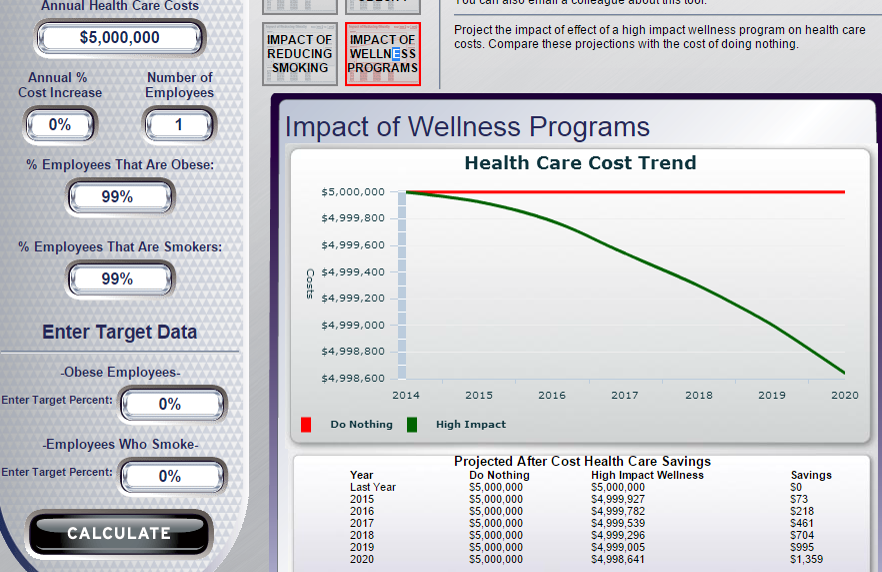
Here you save $1359 without changing smoking or obesity at all:

And here you saved $1359 even though there was nothing to save. The costs are as low as the model will allow you to enter (until they got caught, you could enter figures low enough that they model would calculate negative costs), and there was no smoking or obesity to reduce:

Naturally, Wellsteps is prominent both on the Koop Award Committee and the HERO Report Committee. Wellsteps’ “back story” is here.
Share this:

HERO vs. Huffpost: What do actual employees say about wellness?

Quizzify is very uniform. Uniformly smart and funny, that is
HERO (the wellness vendors’ trade group) says: “Employees are not uniform in their receptiveness to wellness programs.” That’s like saying: “Republicans are not uniform in their receptiveness to the Clinton campaign.”
Take a look at Huffpost — especially the comments— to see what employees really think, not what HERO wants you to believe they think. With more than 23,000 views, this Huffpost was probably the most widely read posting on wellness anywhere in all of 2015.
These comments are unexpurgated (except for Huffpost’s own obscenity filter, which we suspect got quite a workout). You can add your own.
Then urge your HR department to redesign your wellness program. Tell them to ax your “pry, poke, prod and punish” vendor. If the vendor makes a fuss, bring us in and we can find all the lies they’ve told you in their outcomes reports and threaten to sue them.
No one thinks Quizzify isn’t fun
Then your company can start doing wellness FOR its employees instead of TO them. Read Jon and Rosie’s book to get some guidance. If you get depressed by the amount of work you have ahead of you, take a breather and read Surviving Workplace Wellness to tickle your funny bone– If laughter were truly the best medicine, wellness would be a blockbuster drug.
Share this:

7 Take-Aways from the HERO-Goetzel Webinar in Defense of Wellness
This is the sixth in a series on the HERO disinformation campaign around wellness ROI. The other six installments can be found here.

They said what?
This afternoon HERO and Ron Goetzel conducted an entire Groundhog Day-type webinar as though They Said What, the entire media, and 2015 don’t exist.
They talked about the “confusion in the marketplace” (to quote their invitation) without once even mentioning the source (us) of the confusion in the marketplace. Actually all we did was point out that they contradicted themselves in their own report. They created the confusion by inadvertently telling the truth.

Time to make the pretzels
Here are some of the things they are still saying, that they know to be somewhere between misleading and lies. Apparently Mr. Goetzel lived up to his billing as Goetzel “the Pretzel” by basically twisting “wellness loses money” into wellness makes money,” though he admitted to some “controversy” around the latter point.
First, he is still quoting the Kate Baicker 3.27-to-1 ROI, that he knows to have been thoroughly discredited. We’ve blogged about that extensively–this link will take you to a series of other links. To wit:
- She’s walked it back 4 times.
- RAND’s Soeren Mattke has attacked it (and those of you who know Soeren–he is a very thoughtful and polite guy–you really have to be way off-base to get his dander up).
- Another researcher has pointed out that many of the studies in her meta-analysis were basically made up.
- Many of these studies were claiming reductions in diabetes expense and obesity at the same they were telling people to eat more carbs and less fat, exactly the opposite of what would reduce diabetes incidence and possibly obesity. And yet somehow money was saved…
Second, the Ignorati are still quoting the American Journal of Health Promotion meta-analysis and Mr. Goetzel pretzeled his way around the accidental conclusion of that paper that high-quality studies show a negative ROI.
Third, Mr. Goetzel strongly criticized the Penn State fiasco. Hmm…maybe we’re mis-remembering this, but we seem to recall he was one of the leaders of that jihad. Here is a article about a meeting in which he and several others “take the offensive” in the controversy. Or maybe that was another Ron Z. Goetzel.

Fourth, he said: “There’s some healthy debate going on.” But the irony is, there is no debate. Partly this is because they are steadfastly refusing to debate. And partly this is because there is nothing to debate–they admitted “pry, poke, prod and punish” wellness loses money and damages morale. The only places we disagree are how much money gets lost and how badly morale is damaged.
Fifth, he is still comparing participants to non-participants, as though he hadn’t been forced — by the existence of a “smoking gun” slide — to basically admit that participants significantly outperform non-participants even in the absence of a program.
Sixth, he pretzeled RAND’s Pepsico analysis in Health Affairs, overlooking the fact that the study concluded wellness loses money. Obviously we wouldn’t have congratulated Dr. Mattke on his huge success with that article (#2 article of the year in Health Affairs) if it had reached the conclusion Mr. Goetzel said it did.
Finally, the most notable feature was the dog-not-barking-in-the-nighttime. Not once was there any rebuttal to our observations. The Wellnes Ignorati have placed themselves in a difficult position. In order to rebut us, they would have to acknowledge our existence. But ignoring our existence — and the existence of facts generally — is the core component of the Ignorati strategy.
By the way, our source, expecting a spirited rebuttal, instead got supremely bored by the insight-free recycled and invalid material in the presentation, and dropped off before the slam-bang conclusion to the webinar. We doubt there were any other members of the Welligentsia on that webinar but if there were–and you have something to share about the closing minutes that you don’t see mentioned in here — please do.

No pretzels here
Share this:

Health Enhancement Research Organization (HERO) meets Raising Arizona
 We blogged recently that HERO was going to rebut our observations that essentially none of their report makes any sense.
The good news about HERO is that they never step out of character. After we urged people to sign up, a few readers pointed out this webinar is a:

But HERO’s invitation also states:

Unless they don’t know how many members they have, how can their webinar run out of space? Come to think of it, how does anything on the web actually run out of space?
Perhaps HERO took a leaf out of John Goodman’s playbook in Raising Arizona. (You gotta click through on this, even if it means taking you off our site.)
At Quizzify, we have space for everyone
Share this:

HERO challenges us to a debate — Webinar April 22
This is the fifth in a series on the HERO report on wellness outcomes measurement. The previous installments can be found here
Doesn’t really need a caption, does it?
The Health Enhancement Research Organization (HERO) has invited us to debate the merits of “pry, poke, prod, and punish” wellness programs, on April 22. The invitation is reproduced below and available in full here.
Not.
They didn’t ask us to debate. (They didn’t even invite us to attend.) By contrast, we have offered to debate many times. We’ve even offered literally a million-dollar reward for them to debate their outcomes metrics with us.
Here’s what really happened. We received emails from many people giving us the heads-up that HERO is holding a webinar during which they will spin their information published in their report where they say wellness loses money and is bad for morale into the opposite conclusion. If this seems confusing, it is.
Ironically, they said that we have “created confusion in the marketplace,” when in reality they were the ones who created the confusion, by providing information that they are now trying to walk back. The report seems perfectly clear – wellness loses money. Nonetheless the Wellness Ignorati are befuddled by their belated observation that it was they who supplied this information. No surprise here. Through the years we have noticed that the Wellness Ignorati are easily befuddled, especially by information.
By contrast, no one can say we confuse anything. We have always been consistent: “pry, poke, prod and punish” programs are losers for all concerned, except the vendors and consultants who naturally are running this webinar. For the Wellness Ignorati, it’s all about the money.

Yes, this is our new company where we do wellness the right way…and guarantee savings
One of the fundamental differences between us and the Wellness Ignorati is that we are pro-transparency and have nothing to fear from publicizing them, so we are attaching their invitation below and urging people to attend, whereas even as they disparage our observations, they refuse to mention the existence of this website.
No surprise there either: if people find out this website exists, they might visit and learn actual facts. Facts, of course, are the worst nightmare for the Wellness Ignorati. That’s how they earned the appellation–by employing a strategy of ignoring facts.
This is even true when they themselves published the facts.
Curiously, this is the second time in recent months that the Wellness Ignorati have written that wellness loses money. At some point if they keep insisting wellness loses money, we have to believe them. The last time, Michael O’Donnell’s journal concluded (we’ll use a screenshot):

We would attend this webinar ourselves except that we are not invited. In any event, our attendance track record is not encouraging. The last time we listened to a Ron Goetzel webinar, we were disconnected after asking that he not use our copyrighted material without attribution. Ultimately we had to get our publisher, John Wiley & Sons, to make him cease and desist.
Still, we’d love it if you would attend, and here are some questions you could ask. First about the HERO Report:
- Why did they say wellness damages morale and corporate reputations if they are now saying that it doesn’t?
- Why did they say a wellness program only costs $18/year when the biometric screens alone cost more than $18/year?
- How can they say that companies should allocate only $18/employee/year to a wellness program when their own invitation below says that to be successful, a program must be “comprehensive” and “well-resourced”?
- Why did they omit their own carefully compiled list of 11 elements of cost other than vendor fees from that $18 figure?
- If wellness only saves $12/employee/year before fees according to their own figures, how can it save money if it costs $18?
- Why are there so many rookie mistakes in this report, like “forgetting” to adjust the decline in cardiac events for the secular decline in cardiac events that the entire country is enjoying?
- If their methodology is so sound, how come they haven’t collected their million-dollar reward when all they have to do was apply fifth-grade math to a simple word problem without lying?
When facts interfere, just twist and turn them, like a pretzel
And while you’re in attendance anyway, there are 11 still-outstanding questions for Mr. Goetzel himself, that he has steadfastly refused to answer. Here are a few you could ask:
- Why does he keep insisting that the Nebraska wellness program – whose vendor admitting lying about saving the lives of cancer victims – is a “best practice” or “exemplar” program?
- Why does he always give Koop Awards to customers and clients of his sponsors and board members, even when they claim 100 times as much savings as they themselves said was possible?
- Who “unfortunately mislabeled” the key slide that invalidates the industry’s obviously fallacious participant-vs-non-participant methodology and why did neither he nor any other analytical luminary on the Koop Committee notice it until we pointed it out four times?
- Why has he refused to answer these questions even though Al Lewis has offered to answer any questions you could ask him?
In one respect, though, the Ignorati are finally making progress in the integrity department. This invitation is 100% Kate Baicker-free. Maybe, finally, they are accepting the reality that she has walked back her 3.27-to-1 ROI not once, not twice, not three times, but four times. (Four seems to be the magic number of times needed to point out a fact to the Wellness Ignorati before they admit its existence.)
INVITATION:
Don’t Throw Out the Baby with the Bathwater – A Measured Response to Critics of Workplace Health Promotion and Disease Prevention Programs
April 22, 2015
1:00 PM – 2:00 PM Central Time
(Members only event)
Recently, several individuals have raised doubt about the efficacy and cost-benefit of workplace health promotion and disease prevention programs (otherwise known as wellness programs). These critics cast doubt on the very core of work site wellness efforts and have generated widespread publicity. They argue against the benefits of prevention and workplace health promotion, question the validity of ROI estimates, and aim to restrict the use of outcomes-based wellness incentives. These criticisms have created confusion in the market. This session will re-state the business case for adopting evidence-based, comprehensive, and well-resourced workplace health promotion programs. It will also review the methods used to evaluate these programs in “real world” settings, but also acknowledge the limitations of “average” programs that may not produce expected outcomes. Finally, Dr. Goetzel will comment on value-on-investment (VOI) approaches to assessment of workplace programs in contrast to the more traditional return-on-investment (ROI) models.
Share this:


HERO meets Trading Places: Wellness Saves One Dollar
This is the fourth installment of the series on interpreting the Health Enhancement Research Organization’s Outlines Guidelines report. It covers page 23. The full series can be found here

One Dollar.
23 pages into their report, HERO has finally benefitted from the law of averages and gotten an analysis right…and it shows savings of: one dollar.
HERO conducted a “wellness-sensitive event rate analysis,” otherwise known as a plausibility test. It’s the only valid way of measuring outcomes. Not coincidentally, I invented it. There is no ambiguity about this. It’s in all my old presentations and my first book, Why Nobody Believes the Numbers. No one else has even pretended to claim credit. Nor is this one of those situations where the usual invention cliches apply. The Chinese did not invent it in 1000 BC. DaVinci didn’t sketch it in 1541. The Germans and the Allies weren’t racing to develop it at the end of World War II. Nope, mine and mine alone.
Of course there is no attribution of that (or of any of my contributions to this field, anywhere, in their 88 pages). I find this “oversight” quite flattering.
Here it is.
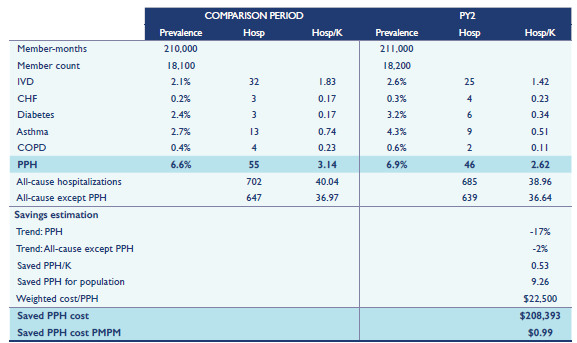
Note a few things.
First, this methodology counts all the admissions, whether or not the patients/employees participated or didn’t participate in a program, or whether the admitted patients were even known to have the condition in the first place. This is how it should be. This eliminates the participation bias, one of the two biases (not including lying) that the wellness industry utilizes to sustain the fiction that it saves money. It also eliminates regression to the mean (the other bias).
Second, this exercise generates 99 cents PMPM in gross savings. Yep, basically one dollar, like the bet in Trading Places. The “problem” with measuring validly is that your savings essentially dwindle to nothing.
One dollar. The Duke brothers turned the lives of Dan Ackroyd and Eddie Murphy upside down over a one-dollar bet, and the wellness industry wants you to turn your entire employee relations strategy upside down — in their own words, damaging morale and your corporate reputation — in order to save: one dollar. (That of course is one dollar before costs, which are $1.50.)

Quizzify…where there is no need to fake results
Third, believe it or not, even that $1 in savings is grossly overstated. Focus on ischemic vascular disease or IVD (heart attacks, strokes etc.) They show a decline of 7 admissions, or 23%, from 32 to 25 admissions — easily the largest component of the 9 avoided admissions they are attributing to wellness and disease management. This decline took place over a 3-year period, as they averaged the two pre-program years and compared that to Program Year 2.
The problem is that, according to US Government data below, this set of IVD events declined everywhere over the same 3-year period by– as luck would have it– that very same 23%. Don’t believe us? Here is the data. The comparable group on the display below is the “privately insured” cohort, underlined in red, now that we have figured out how to do underlines on screenshots. (Even Medicare, where there is no workplace wellness and where the population grew almost 10% and aged quite a bit, showed a decline in IVD of almost 10%.)

Despite the fact that all their savings from IVD got eliminated by the simple step of seeing how much savings would have accrued even without a program, I don’t think this particular oversight was purposeful on HERO’s part. I’d give them the benefit of the doubt and say the abject failure to compare their performance to the obvious benchmark was a rookie mistake. The lesson is, before they write reports on outcomes analysis, someone should teach them how to actually do outcomes analysis. I’m just sayin’…
By the way, a similar secular decline transpired in asthma nationwide. The 2009-2012 decline was 21%, meaning that 2 of the 4 admissions HERO says wellness “avoided” over that period would have gone away on their own.
So when you take out the IVD decline of 7 admissions and 2 of the avoided asthma admissions, you are left with: no decline at all. Essentially HERO just proved that – even before taking costs into account – their vaunted “pry, poke, prod and punish” wellness programs are worthless.

Share this:

HealthFair Wins Wellness Industry’s Race to the Bottom
Ever wonder why students don’t just grade themselves? For your answer, look no further than HealthFair.com’s self-assessed grade:

And yet by any standard other than their own, HealthFair completely flunks the test. Literally, their “basic package” proposes more “D”-rated tests (and “D” is a failing grade by US Preventive Services Task Force standards) than any vendor we’ve ever seen. They would lose their wellness vendor license tomorrow, except for the fact that wellness vendors don’t need licenses.

The first four all get “D”s. Here are the screenshots if you don’t believe that any vendor could possibly offer so many inappropriate tests at all, let alone in the “basic” package.

The abdominal aortic ultrasound test is such a stupid (where “stupid” is synonymous with “profitable”) idea for the non-elderly population that the USPSTF doesn’t even bother to say no:

Along with their “D” as a general screening tool, The EKG gets a whopping “I” for individuals at risk, but since HealthFair’s basic package includes no basic tests to see who is at risk, and by law they can’t ask about history, they would still have to screen everyone whether or not they are at risk:

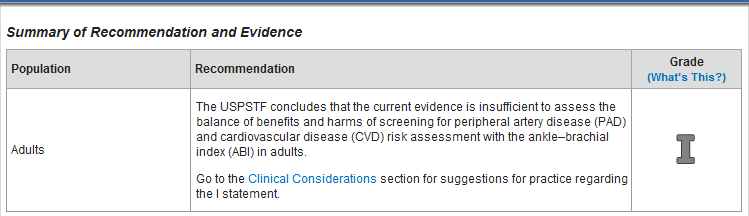
By earning another “I”, the peripheral artery disease test does well by HealthFair’s standards. The USPSTF concludes that researchers don’t know enough about it to recommend it, which doesn’t stop HealthFair.
As for “hardening of the arteries,” the USPSTF doesn’t bother to grade it due to the fact that no one uses this test as a screen…except wellness vendors. But even the American Heart Association, not exactly shy when it comes to screening people for cardiac disease whose treatment can enrich their members who treat it, disses this test:

Speaking of D-Rated tests, sorry, guys. If you want a D-rated PSA screen — a screen not even recommended by its own inventor — you have to insist that your employer buy HealthFair’s “advanced” package:

Give your employees wellness that always earns an “A”
That brings us to the H Pylori screen, Healthfair’s groundbreaking, earth-shattering, pushing-the-envelope leap forward in the wellness vendor competition to out-stupid one another.
Where to start…
First, the US Preventive Services Task Force doesn’t bother to offer a recommendation on it, largely because no self-respecting doctor would ever screen patients for this. Shame on the USPSTF for consistently failing to anticipate all the ways in which wellness vendors can misunderstand basic clinical science!
Second, most of us who harbor H Pylori have no symptoms. So why screen for something that’s not causing problems? That’s why this is a test, not a screen. If you have an ulcer or symptoms that suggest an ulcer, go to the doctor. Even then, the doctor probably won’t even bother to test you, since most people get relief simply from well-tolerated, commonly used, proton pump-inhibitor medications–some of which don’t even require a prescription. It is only if the first-line medications fail that most doctors will even test you.
Third, there is a significant school of thought that says H. Pylori is beneficial. Screening us for something we’re better off having in our bodies represents a new frontier in the wellness industry’s answer to overdiagnosis, which we call hyperdiagnosis.
Fourth ironically, given the wellness industry’s obsession with employees’ weights, it is even slightly possible that killing off H. Pylori contributes to weight gain.
Fifth, what exactly are we supposed to do, if it turns out we harbor H. Pylori? Get a course of antibiotics to clear the bacteria out of our system? That’s a great idea. We’ve always maintained that one of the problems with America’s healthcare system is that patients don’t get to take enough antibiotics.
The good news for the pharmaceutical industry is due to the nature of H Pyroli, hiding in our stomach mucus, it takes a lot of antibiotics to ferret it out, plus a bunch of other pills. Is this a great country or what?
Sixth, the H Pylori tests themselves are among the most complex, unhelpful and inaccurate commonly used tests in existence.
Finally, half the world’s population has it. Given the expense and inaccuracy of the test and the prevalence of the bacterium, why not eliminate the middle step and just put all your employees on antibiotics?
One of us is a screaming libertarian. And even he thinks the cowboys that populate the wellness industry need to be reigned in with some regulation, before they screen the American workforce to death. The regulation would be very straightforward: employers and vendors must disclose the USPSTF recommendations to employees before making them take these tests. If after this disclosure, a few employees still insist on getting these D-rated or off-the-charts-inappropriate screens, congratulations! Your screening program will have just done something useful: identified employees who are totally incapable of making an intelligent decision.
To those of you who are reading this and thinking: “Haven’t I heard this song before?”, the answer is, you have. HealthFair is the “Intel Inside” for the screening jihad offered by SSM Healthcare, the Sisters of Saint Mary health system we “profiled” a few weeks ago, thus once again proving that wellness mantra: great minds aren’t the only ones that think alike.
Share this:

Johnson & Johnson accepts our analysis that wellness loses money
Newsflash: Someone from Johnson & Johnson named Michael Schmidt responded to our posting that the HERO Report shows wellness loses money. This is the first time anyone associated with HERO has strayed from the tried-and-true Wellness Ignorati strategy of ignoring us. We were concerned that he might have found a mistake in our math, which no one has ever done.
Fortunately, our math is OK with Mr. Schmidt, and — by implication, since he is writing on their URL — J&J itself. His point is different. He argues that we write these columns to do the following: generate business. Touche!
He also says that the headline is inflammatory and that we will turn off more people than we turn on. That is probably accurate. However, the people we would turn off — traditional “pry, poke, prod and punish” wellness vendors such as Johnson & Johnson — have had and would have no interest in paying us to find out that wellness is worthless.
In any event the headline “The Wellness Wars Are Over. Wellness Lost” captures exactly what the HERO report says — and was edited by the ITL editor. Headlines, as Mitt Romney found out when his New York Times op-ed was entitled “Let Detroit Go Bankrupt,” are the purview of the editor, not the author.
The curious thing is, Johnson & Johnson is listed as one of the “endorsers” of the HERO report. So as an endorser of the report, Johnson & Johnson is tacitly nonetheless acknowledging that the report is right–wellness loses money.
In case there is some ambiguity, here is the screenshot of the first set of comments

Share this:


Star Wellness Illuminates the Health Hazards of Wellness
 Once in every great while, when we’re least expecting it, a company comes along that makes us reconsider our viewpoint–and ponder the possibility that maybe we’re wrong about wellness. Maybe, finally, we’ve discovered a company that will motivate employees to get well. Maybe a company that adheres to screening guidelines. Maybe even a company that will solve America’s healthcare crisis.
Star Wellness is not that company.
Quite the contrary: If you are an employee of an organization that has retained this outfit, your best course of action is simply to pay the fine and have nothing to do with these people. Or take the tests to secure your money, and then don’t open the envelope with the results in them, because due to false positives, you are equally or more likely to be harmed than helped by taking their full panel of tests.
Star Wellness says doctors “typically order these tests during a routine physical.” If you find a doctor that does so, please contact the licensing authorities because for many of these screenings, a doctor would be sanctioned for routinely ordering and billing for these tests on all patients. However, this being the wellness industry, there are no authorities…but there are plenty of tests. Not being doctors, wellness vendors are allowed to harm employees up to the limit of HR’s willingness to pay them to do so–and, being wellness vendors, they take full advantage of this budget. (Among other things, the higher the budget, the more vendors can pay the employers’ brokers–and hence the more likely they are to keep the account.)

Leaving aside all the tests they do that the United States Preventive Services Task Force (USPSTF) does not recommend doing annually if at all (which is to say, most of them), let’s focus on the ones the USPSTF specifically recommends not doing. In each case, we’ll use screen shots because otherwise no one would believe that any preventive services vendor could possibly be this out of touch with preventive services guidelines.
PSA screens for prostate cancer. Perhaps Star Wellness’s internet connection is down because nobody does these any more. Even the guy who invented the test recommends not doing it.

Carotid artery screening. Seriously? Even the Highmark/Goetzel Penn State program, the industry’s most coercive and ill-conceived program ever, didn’t recommend those.

Our favorite is abdominal aorta screening. These screens are so not-recommended for the <65 population that the USPSTF assumes nobody,no matter how stupid or dishonest, would ever do them. So they don’t even bother to waste valuable electrons posting non-recommendations of this screen for the <65 population. It would be like recommending not parking your car on a railroad crossing. Instead, all of their recommendations start with the assumption that people being considered for these tests (tests on individuals, not screens on everyone, by the way) are over 65 to begin with.


Even their basic tests are mostly USPSTF not-recommended as screens (and certainly not annual screens), but more interesting is some of the misinformation they’ve piled on top of these tests.
They say these tests are a “$350 value.” Since a checkup including tests costs $200 or less, the whole PCP profession would be going bankrupt if their math was right — and if doctors were actually doing these screens.
Of course they also make up their savings figures (all this overscreening somehow saves $250/employee net of the costs of the overscreening itself), but lying about outcomes is embedded in wellness vendor DNA. We can’t fault them for that. It isn’t possible to compete in this field without making up outcomes.

But they did make up at least one other statistic. As noted above, they said that 75% of Americans are deficient (or, more specifically, DEFICIENT!) in Vitamin D and need supplementation. However, the CDC and the rest of the triple-digit IQ grownup crowd say the opposite. The CDC notes that only 8% of Americans are deficient, while the Journal of the American Medical Association and the USPSTF also don’t recommend screening and supplementation.

In addition to not understanding preventive medicine guidelines, Star Wellness appears to not understand the (very few) regulations putting even the slightest of constraints on the wellness industry’s overdiagnosis-today-overdiagnosis-tomorrow-overdiagnosis-forever ethos. One of those very few constraints (ironically, a misguided one) is: wellness vendors can’t ask about family history. And yet, here they are…asking about family history. Now it’s possible they aren’t asking about family history and they mis-stated their own position, in which case by their own admission, they are doing this screen on people without a family history, people who shouldn’t get the screen at all. Their other screen on this slide, C-Reactive Protein, is also not recommended by USPSTF.

Not all the news about Star Wellness is bad. We always try to end on good news, and the good news is – if Star Wellness is to be believed – their needles are among the least contaminated in the entire industry!

A postscript
Sal, Wyoming’s not a country.

Star, Vitamin B12 is not a vaccine

While we’re on the subject of vaccines, according to the CDC, the biggest categories of people who are supposed to get Hepatitis A/B vaccines include toddlers and street drug users. If you are routinely hiring enough people fitting those criteria to be considering an on-site vaccination clinic, I’d say wellness isn’t your biggest problem.

 They Said What?