
Home » Uncategorized (Page 26)
Category Archives: Uncategorized
Corporate Care Management Rounds Up 25 Times the Number of Usual Suspects
You may recall Phantom Tollbooth, a classic of children’s literature. Among other things, the book features a dish called “subtraction stew,” where the more you eat, the hungrier you get. Likewise the more cancer cases Corporate Care Management (CCM) finds, the more money they save.
With math like that, it’s no wonder that 5% of their case study population of 600 was told they have cancer or precancer. And that was just in 2015 alone.
In Casablanca, Captain Renault told Major Strasser: “Owing to the seriousness of this crime I’ve instructed my men to round up twice the usual number of suspects.” Turns out Inspector Renault had nothing on CCM. In a typical year maybe 0.2% of the working-age population would get a valid cancer diagnosis for the cancers they screen for. That means CCM rounded up 25 times the number of usual suspects. To put this in perspective, at this rate we’d all get diagnosed with cancer twice during a 40-year career.

And the savings? Over $20,000 per alleged cancer victim. That means CCM saved more than $1000 per covered employee, which is more than most employers spend on cancer — simply by finding more cancer cases to spend money on. (Care for a second helping of Subtraction Stew?) And, yes, of course, this screening includes the USPSTF D-rated prostate screens, a staple of the wellness industry.

This cancer-finding is all accomplished on the basis of a letter-writing campaign. (For instance, men were instructed on three different occasions in 2015 to get their prostates screened.)
One other nuance: the 5% cancer incidence rate — 30 people — is based on the total 600 employees. Yet the company sent out only 146 “welcome packets,” meaning that less than a quarter of the employees actually responded to the letters. Of those 146, almost a quarter (30) allegedly had cancer or precancer. This proportion even tops the previous high for cancer hyperdiagnosis, which was the Nebraska wellness program (before Ron Goetzel and Health Fitness Corporation admitted they had made the whole thing up).

While it wasn’t clear what the other 454 people did with those letters, here is a question for your consideration: would you even open a letter with a return address of: “Corporate Care Management” ? As a patient, those are three words I hope never to see adjacent to one another over the course of my natural lifetime.
Lest I forget, here is what the actual letter looked like. I don’t know about you, but if I ever received letters with this design from an outfit with this name, I’d get a restraining order.

And apparently I’m not the only one who would prefer to be left alone. The Maytag repairmen used to be the loneliest people on earth.

But CCM’s nurses might give them a run for their money. Here are the utilization statistics they presented to this very same client with 600 employees:
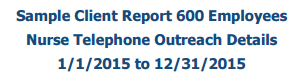

Yes, that’s correct. they completed one conversation. Although that may be because the other 599 employees are too worried that if they talk to these people, they’ll get treated for cancer so CCM can save even more money.
Share this:

American Journal of Health Promotion Announces New Fabricator-in-Chief — Paul Terry
Paul Terry, formerly of Staywell and the Health Enhancement Research Organization, has just been appointed the new editor of the wellness industry trade publication, the American Journal of Health Promotion. He replaces Michael “Let’s Charge Employees Insurance by the Pound” O’Donnell in that role.
Mr. Terry brings exactly the type of expertise to this job that AJHP readers have come to expect, in that very few people can claim to surpass Mr. Terry’s ability to fabricate outcomes.
I first became familiar with Mr. Terry’s work when Staywell claimed mathematically impossible savings for British Petroleum’s pry-poke-and-prod wellness program, which I dutifully reported on The Health Care Blog in the posting: “BP’s Wellness Program is Spewing Invalidity.” Staywell, as a preferred vendor of Mercer, was able to “convince” Mercer to fabricate savings, when their client, BP, asked for an evaluation. Staywell pretended to have saved almost $20,000 for every risk factor reduced among active participants (meaning dropouts and nonparticipants’ failures aren’t counted).
This was quite a feat considering that the average employee only spent about $5000 during the year in which this analysis was conducted. And of course only a tiny percentage of healthcare costs in the short term are attributable to risk factor reduction anyway. (Staywell was offered the opportunity to rebut, and didn’t.)
But the smoking gun here was that Mr. Terry apparently forgot that Staywell itself only claimed to be able to save $129/risk factor reduced. Magnanimous guy that I am, I was kind enough to point out that integrity chasm for him in the article.
Most people, when they are caught fabricating data, try to deny it. But Paul Terry brags about it. In case you haven’t already done so, take a looksee at his defamatory letter to the media that he sent, along with his cronies Ron Goetzel and Seth Serxner. He insists that they made up the data I reviewed — meaning his best argument against me is that I didn’t realize he was lying. If we take him to court, he could argue that the judge should apply the legal standard for negligence — that I “knew or should have known” their data was fabricated, because all their data is fabricated.
Although ironically it turns out the data they insisted was fabricated was, this time, legitimate — meaning that he was making up his claim that HERO had made up the data. That’s a topic for another blog. Suffice it to say that, in the immortal words of the great philosopher LL Cool J, he lied about the lies he lied about.
Most importantly, if you read the letter he wrote, you’ll see that another of his arguments is that when calculating ROI, you should not compare costs to savings. And a good thing because comparing costs to savings, and other feats of arithmetic, would be the wellness industry’s second-worst nightmare (next to facts).
Refusing to acknowledge the existence of basic arithmetic makes Mr. Terry a perfect choice to be editor of the wellness industry trade publication.
Share this:

10 Reasons Employees Hate Wellness Programs
In keeping with my New Years resolution to be more positive (and not like: “I’m positive that the board of HERO knows they are liars” — which, by the way, I am, and which they are, and which will be the subject of a future posting), I would like to recommend an outstanding posting by Romy Antoine on Linkedin. No, I didn’t know who he was either…but I do now, and you should too. He exemplifies the next generation of talent in this field.
He lists 10 reasons employees hate “pry, poke and prod” wellness programs. (Just in case you are keeping score at home, zero of those reasons would apply to Quizzify — and that’s not an accident.) I found myself nodding at every single one. You may be able to address some of these, but if there is one thing that Ron Goetzel and I agree on besides the sun rising in the east, it’s that wellness is, to use his words from our debate, very very hard to do right, which is why, to use his words again, thousands of programs fail while only 100 succeed.
Oh, and here is a reason employees might not hate your wellness program: according to Employee Benefit News: they don’t know it exists.
80% said their wellness program has had a positive effect on employee health and productivity and 70% said it has had a positive effect on health care costs. However, the data released by the Transamerica Center for Health Studies also showed a significant number of employees did not know their company had a wellness program.
Yes, I know it isn’t always about me (my first wife was quite clear on that point), and, yes, I know it isn’t always about Quizzify, but Quizzify can customize questions to educate your employees on your wellness offerings, so at least they’ll know your program exists. And hopefully they won’t hate it when they do.
Share this:
Cleveland Clinic Wellness Rant Breaks the Record for Stupidity
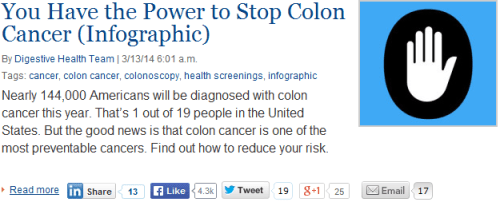
“Stupid” has never been the first adjective that comes to mind when discussing the Cleveland Clinic’s wellness program. Obviously, they’re stupid, as the display below shows. (144,000 people does not equate to “1 out of 19 people in the “United States.” 144,000 would barely be 1 out of 19 people in greater Cleveland.) But, until now, just mainstream wellness vendor stupid, not stupid-as-a-business-strategy stupid like Wellsteps.

Likewise, until now, a strategy of competing on the basis of stupidity wasn’t a major priority for them. They preferred to compete on the basis of the three other pillars of the wellness industry — weight-shaming, fabricating outcomes and alienating employees. Now, though, they have thrown their hat into the ring in the race to outstupid the rest of the wellness industry…and against stiff competition have jumped into the lead, as described below.
By way of background, the wellness industry spends most of its energy hyperdiagnosing employees by screening the stuffing out of them. Their informal motto is “overprevention today, overprevention tomorrow, overprevention forever.” Vendors can and do provide as many USPSTF D-rated screens as they can get a company to pay for.
In reality, of course, among clinical prevention tools (meaning, excluding lifestyle-based prevention), vaccination against preventable disease is the only major prevention tool with incontrovertible results dating back to 1796. Consequently there is 100% agreement about the value of vaccination.
Oops. Make that 99.99% agreement. The Cleveland Clinic Wellness Institute’s medical director, Daniel Neides, just came out against them. Sure, the Cleveland Clinic claims he didn’t mean a word of it and made him retract it. They said they would take appropriate measures in response, by which I guess they mean anointing Dr. Neides as a “Cleveland Clinic Wellness Expert.”
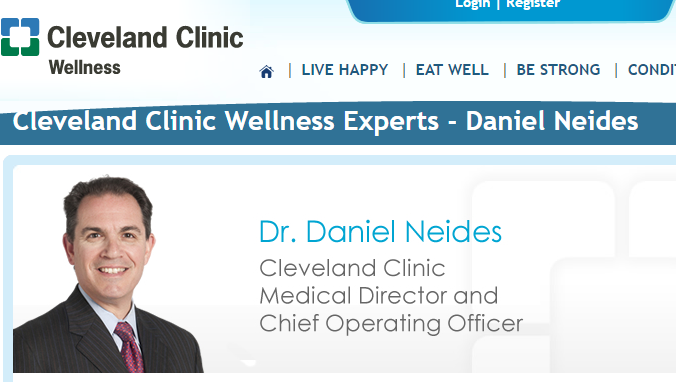
So it’s not enough that the wellness industry wants to subject us to all sorts of unnecessary medical interventions. Now this Cleveland Clinic “Wellness Expert” (synonym: see “idiot”) wants to discourage us from getting necessary medical interventions. While ranting about vaccines generally, he especially targets the flu vaccine, because it contains formaldehyde. And a good thing, because formaldehyde is the ingredient that inactivates the flu virus in the vaccine, so that we don’t get injected with the flu itself. (If you’re worried about formaldehyde, try eliminating pears from your diet. Each one contains enough formaldehyde to supply 100 flu vaccines.)
Normally I debunk each point these blithering wellness experts make one at a time. However, in this case I’m yielding the floor to Tara Haelle of Forbes, who shows, much better than I could, that this guy is an even bigger wellness expert than the rest of the wellness experts running their program.
Share this:

Top-rated WGN in Chicago takes on wellness…and wellness loses
This was a great interview. The interviewer, Amy Guth, was obviously quite interested in, and well-prepared on, the topic, which I imagine explains why she interviewed me instead of one of the Wellness Ignorati. She let the interview run way over — 12 minutes without a commercial on AM Newsradio — pinch me!
SPOILER ALERT: the answer is to — get ready — screen according to established clinical guidelines, published by the US Preventive Services Task Force.
In coming weeks and months I hope to highlight various vendors who are screening according to guidelines. Examples would be Wellsteps, Health Fitness Corporation, Total Wellness, Bravo Wellness and Staywell. Not!
Share this:
2015 Koop Award Winner McKesson Stock Plummets in 2016
They say being on the cover of Sports Illustrated jinxes you. I wouldn’t know. There is no chance of that for me, unless they run a feature story about 60-year-olds playing Ultimate Frisbee on Christmas night, when they should be playing canasta with their aunts.
That jinx may be an urban legend, but here’s a real jinx: winning a C. Everett Koop Award. The 2016 vendor got humiliated in STATNews, of course — we’ve already covered that. The 2012 awardee was embarrassed in the media as well. The vendor ended up losing their gig.
Neither of their customers (Boise or Nebraska) are public companies, though, and that’s what this article is about, because it’s the customer’s performance we are most interested in, not the vendor’s. The latter do quite well for themselves, snookering unsuspecting employers.
The most recent public company to win an award was the 2015 winner, McKesson. McKesson got clobbered in the stock market in 2016, the 14th worst performance among the S&P 500, as investors learned that only the dumbest bunch of managers would pay a cabal of vendors (that themselves are among the industry’s most clueless, like Vitality) to harass their employees. Employee Benefit News took notice of the McKesson wellness program, and pilloried them, thus triggering the sell-off.
You might say: “Wait a minute. Yes, that was a failed, hilariously mismeasured, program whose award was due to the cronyism of having 5 of their vendors and consultants connected with the Awards Committee, but how could something as trivial as a wellness program be responsible for their stock price collapse?”
The answer, of course, is that it doesn’t. Based on the amount of money these programs lose, McKesson’s wellness program was probably only responsible for 1% or so of the 27% stock price decline. And that’s precisely the point. Ron Goetzel claimed that winning a Koop Award caused a dramatic increase in stock prices. I noted that, like most of Ron’s defenses of wellness, that analysis didn’t hold water, and any observer with a calculator and access to stock price histories could see that wellness causes a dramatic decrease in stock prices.
While I won that face-off (a year later, you would have been way ahead of the game shorting Koop Award stocks and hedging with index and sector funds), neither conclusion is really valid. Both analyses have a ridiculously low signal-to-noise ratio. Many things happen in the market that overwhelm wellness. For instance, I don’t think any of the analyses of Citibank’s 2008 crash would blame their Koop Award-winning wellness program.
Instead, the negative impact on stock valuations can be shown to be pretty trivial. Let’s start out with some favorable assumptions. Assume the typical program is more successful both than the allegedly successful one most recently measured in Health Affairs and also than the award-winning so-called best-in-the-country Wellsteps program for Boise, in that it neither loses money nor harms employees. Instead, it is only worthless. So even though Ron Goetzel and Michael O’Donnell say most programs fail, let’s assume yours neither causes health spending to increase or employees to get worse.
If you pay vendors to “manage” 10,000 employees @$150, that’s $1.5 million lost. With a typical pretax P/E of 10, you reduce your market value by $15,000,000. A company with 10,000 employees might have (for example) a market value of $1.5-billion. That makes the negative impact of wellness on stock price only 1%, hardly enough to cost a CEO his job.
So the good news is that McKesson’s collapse is the exception. Screening the stuffing out of employees, lying about outcomes, winning a Koop Award, and hiring a cabal of clueless vendors will not cause your stock price to plunge. In a year in which the media gave the wellness industry little reason to cheer, costing your shareholders only 1% of their investment in your company is great news. Worthy of a celebration. Or at least a couple rounds of canasta.
Share this:
The 2016 Wellness Deplorables Award winner: Wellsteps
This completes our year-end series on the Goofuses and Gallants of the wellness industry. See:
- Announcing the 2016 Deplorables Awards
- Wellness Industry Stars of 2016
- So Many Candidates for the Deplorables Award Countdown, So Few Numbers between 1 and 10
- Wellness Stars of 2016, Part 2.


Are you smarter than an award-winning wellness vendor? Take this quiz and find out.
Q: How is the first unlike the second?

The first, Wellsteps CEO Steve Aldana, claims that it’s bananas that provide magical powers. And unlike Popeye and spinach, he doesn’t think we need to consume massive quantities. “Even one more bite of a banana” is all it takes to reduce overall costs by fully a third, despite their admission that costs for individual employees increase by about the same amount over the same period.
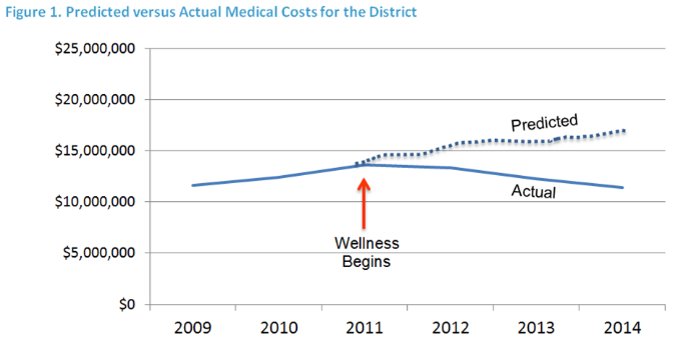

Yes, you read that right, and, yes, is it mathematically impossible for a number to go up and down at the same time. I noted in Wellsteps Stumbles Onward that Wellsteps had accidentally told the truth on the second display showing increasing costs, thus totally contradicting the first. The second display subsequently disappeared.
Perhaps Wellsteps deliberately made up the first slide to fool people (in this case, the Boise School District). The more charitable explanation, which shows Wellsteps in a better light, is that they didn’t deliberately lie when they said costs increased and decreased at the same time. Instead, they were simply confused by their own stupidity.
Lying is a Business Strategy
Wellsteps’ Linkedin group is called Wellness is a Business Strategy. I was banned from posting on it, accompanied by the following invocation of the First Amendment:
“It has come to our attention that an outspoken critic has entered false data into these calculators in order to make a point. We certainly support free speech; however, we wonder how valid the point can be when it is based on false data?” [Where “false data” is defined as “any data”]
Sounds like they support free speech…except when they don’t. Speaking of supporting free speech, they claimed in bright red letters — for no apparent reason other than they were probably suffering withdrawal symptoms from having gone a whole week without lying — that they had convinced Linkedin to ban us from posting. And yet many of you clicked through from linkedin. So here we are, posting.

Stupid is a Business Strategy
Wellsteps’ ROI model doesn’t generate an ROI. It doesn’t even generate a savings projection. What does it “generate”? One number: $1359. Yes, it always gives the same answer ($1359 savings per employee) if you zero out “annual cost increases” in their model to control for inflation. So anyone can see this model simply makes no sense, notwithstanding Wellsteps’ insistence that it is “based on every ROI study ever published.”
How stupid is Wellsteps’ model? Even Ron Goetzel refused to defend it. And when Ron Goetzel won’t defend stupid data fabricated by his friends, you know it’s bad.

Harming Employees is a Business Strategy
To win the Deplorables Award, outlying and outstupiding other vendors is a dicey strategy due to all the competition trying to do the same thing. So Wellsteps decided to boldly go where no vendor has gone before: they acknowledged, even bragged about, harming employees. Sure, plenty of vendors harm employees–by enticing them into crash-dieting contests, flouting clinical guidelines or giving them worthless nutritional supplements and billing their insurers. But no one had ever documented the before-after harms of wellness as conscientiously as Wellsteps did, which I helpfully displayed in detail.
Insults are a Business Strategy
What the judges here at TSW especially liked about Wellsteps’ candidacy for the Deplorables Award was their track record of not just harms and deceit, but also insults. Very clever ones too.
For instance, Wellsteps’ rebutted my observation that all their data is fabricated by saying I’m full of “hot air.” Touche!

One would think that that this guy (Mr. Aldana’s crony) could have come up with a better counterargument, given that he claims to have spent “11 years in college.” If you’re keeping score at home, that’s four more years than Bluto Blutarski.
Here are a few more targets of their ripostes:
- Everyone who is overweight: “It’s fun to get fat. It’s fun to be lazy.” They skewered 2/3 of the population in 10 words. Bada-bing!
- Sharon Begley, arguably the best health/science journalist of our generation. Mr. Aldana called her a “lier.” Her crime? Quoting him verbatim.
- WELCOA‘s exemplary leader, Ryan Piccarello. For not wanting to harm employees, Ryan is apparently part of a “gang of bullies.”
Such brilliant repartee, in an earlier generation, would have landed them a seat at the Algonquin Roundtable.
Bananas are a Business Strategy
So, congratulations to Wellsteps for winning their first Deplorables Award. Darwin will take it from here, and maybe get them a new gig more appropriate to their capabilities.

Share this:

Shocking News: Employees Reveal They Cheat in Weight-Loss Contests
Recently we described how to cheat one of those worthless, hazardous corporate crash-dieting contests, like the ones run by Wellness Corporate Solutions or HealthyWages or Virgin Pulse (nee ShapeUp). But we didn’t interview any employees who actually did.
Journalist and wellness expert Pat Barone, writing in LifeZette (Laura Ingraham’s popular online magazine) managed to do just that. She found some employees who “confessed” (bragged about) the ways they snooker these vendors — and of course their own employers –every year, starting again in most cases next month.
These employers, like Schlumberger, think they are creating a culture of wellness when in reality they are creating a culture of deceit, diet pills and dyspepsia. Why would any employer sponsor one of these contests? Simple: in wellness, stupid is the new black.
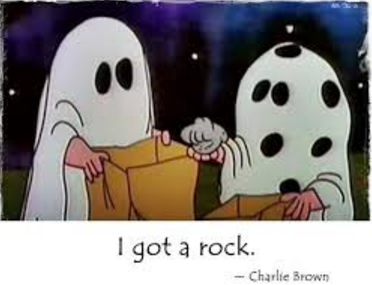
I don’t want to spoil your fun reading the article by giving away all the punchlines, but the keywords are carbs, sodium, and rocks. All the things that employees should eat, as part of a healthy diet. OK, maybe not too many vitamins but certainly lots of minerals.
Share this:

A hilarious example of a shockingly misleading statistic
A shocking statistic just appeared on Linkedin:
Does this concern you? “A small share of doctors, 11 percent, accounted for about 25 percent of the complications. Hundreds of surgeons across the country had rates double and triple the national average. Every day, surgeons with the highest complication rates in our analysis are performing operations in hospitals nationwide.
Darn right it concerns me. It concerns me that someone who claims to be an expert (and I won’t mention a name, because it’s the holiday season, and because he is quite good at other things, and because he ordered my book so I don’t want to embarrass him) thinks this paragraph makes any sense whatsoever. Sure, it sounds dramatic to a lay reader, but a true expert would have parsed it just a bit…
First, it is possible that those 11% of surgeons also accounted for about 25% of surgeries–and that’s why they accounted for about 25% of complications.
Second, “11% accounting for 25%” actually proves the opposite point than the one this guy is trying to make. If there were truly “bad apples” there would be an 80-20 rule. 11% accounting for 25% is about as far from an 80-20 rule as you can get. In sharp contrast, in healthcare spending generally, 5% of the population accounted for 50% of spending last year. And a tiny percentage of doctors account for half of all oxycontin. Truly bad apples. 11% of doctors probably account for 90% of oxy prescriptions, I would guess.
Third, he said “hundreds of surgeons…had complication rates double and triple the national average.” Newsflash: it’s called an “average” because many people will be above it and many below it.
Indeed, with maybe 135,000 surgeons in the country, it would almost be mathematically impossible for only “hundreds to be double or triple the national average,” given that many surgeons, particularly those with low volumes of patients, would be at zero complications.
This whole thread is a perfect example of why people should read Why Nobody Believes the Numbers: Separating Fact from Fiction in Population Health Management. It teaches how to read this type of statistic using a critical eye, rather than accept stuff at face value that makes no sense whatsoever.
Note: none of this is to say there aren’t bad surgeons out there. Certainly, there are. But there are better ways to make the point than using mathematical fallacies about averages and 80-20 rules. And sometimes surgeons are really competent in the OR because they perform high volumes of surgeries…but maybe many of those surgeries shouldn’t have been performed in the first place and that’s why the surgeon is performing so many. As Peter Drucker says: “Nothing is more wasteful than doing something efficiently that need not have been done at all.”
That, of course, is what Quizzify teaches…how to avoid medical interventions that should not be done at all.
Two postscripts. First, he ends with:
Every day, surgeons with the highest complication rates in our analysis are performing operations in hospitals nationwide.
Well, where the heck else would they be performing operations besides hospitals (and surgicenters)?
Second, although he is a very capable guy in other ways, biostatistics are not his long suit. For instance, he once wrote:
“For millenia [sic], employers had no way of knowing that their employees were walking around without a clue that they had a debilitating or terminal condition…percolating in their bodies.”
I must confess I learned a lot from this exposition. I had not realized that employers’ concerns about employee chronic disease had their roots in ancient history. But there it is, right in the opening words: these concerns date back “millenia,” when employers failed to get their employees tested for “percolating” conditions before throwing them to the lions.
Share this:
Wellness Stars of 2016, part 2
Last week I highlighted the first cavalcade of Wellness Stars of 2016, deftly juxtaposed with the popular Wellness Deplorables Award annual countdown. (The actual countdown has to be done in three parts, with #1 still to come. So many candidates, so few numbers between 1 and 10.)
Today we again switch back from the Deplorables to the Stars, in nonprofits, government, and the private sector. We’ll end with shout-outs to some individuals.
Nonprofit Advocacy and Government Groups
A number of organizations have distinguished themselves in 2016. AARP is right out in front, advocating for employee rights. AARP is right out in front, advocating for employee rights. They see involuntary wellness poking and prodding as highly disproportionately discriminatory against older employees (which we would observe is just one of wellness’s many charming features). Since older people are more likely to weight more, have higher blood pressure, diabetes, and more trouble losing weight, etc., they are more likely to want to withhold health information from their employers for fear of discrimination, but instead will be penalized by these programs into surrendering it, with wellness promoters advocating even more penalties.
Next is NIOSH, the National Institute of Occupational Safety and Health. Withstanding the pressure from their CDC overlords who have gotten completely drunk on wellness Kool-Aid, NIOSH wrote an amazingly thoughtful vision for the next 10 years of “Total Worker Health“…without even mentioning the word wellness. Why? For the simple reason that hiring a vendor to pry, poke and prod employees in excess of US Preventive Services Task Force (USPSTF) guidelines has virtually nothing to do with real occupational health and safety — except, as in the case of crash-dieting contests and/or Wellsteps, to damage it.
And speaking of USPSTF, hats off to them. They have withstood the pressure from various specialty societies and the National Business Group on Health (NBGH is now the leading wellness vendor shill in Washington) demanding more screenings, and threatening to oppose their funding if they don’t deliver. The actual science always favors USPSTF in these debates, but the whiners have plenty of money to support their very specific agenda: overscreening today, overscreening tomorrow, overscreening forever. (Those with long memories recall when USPSTF revised its mammogram recommendations to be consistent with the evidence…and almost lost their funding as a result.)
Also on the nonprofit scene would be the former National Business Coalition on Health, now renamed the National Alliance of Healthcare Purchaser Coalitions, in order not to be confused with NBGH, and hence not be accidentally sullied by the latter’s reputation. The regional coalitions that comprise the national group also take their roles defending employers seriously.
In particular, the Midwest, Philadelphia, Northeast, Pittsburgh and South Carolina coalitions deserve extra plaudits. I’ve participated in each of those regional events and consistently have found them to be among the best of the employee health conference genre. The speakers are well-vetted, and it’s not a vendorfest. And the food is consistently good too. One was even covered by the local media.
And if there were an advocacy organization hall of fame, Leapfrog Group would be the first inductee. For years they’ve been getting hollered at by hospitals for ranking them objectively, and lobbying for more transparency in medical error reporting. Since “pry, poke and prod” overscreening is one humongous medical error, needless to say Leapfrog has been visibly opposed to it, and highly supportive of our efforts…and also can be as funny as we are on that subject.
The Private Sector
First is Medencentive. Whereas most employee health vendors generate tons of comments demanding the program’s removal (Penn State received about 2000 employee signatures demanding the removal of their Goetzel-inspired debacle before they finally caved), Medencentive generated over 3,000 users signatures in support of their program…out of only 21,000 eligible people, over a brief 45-day period. You might say: “Oh, well, their program must be tied to some huge incentive.” Actually, it’s only $15 per office visit.
A list of other companies worth of mention would include, as always, Quantum Health. When Cooperstown builds the Employee Health Program Hall of Fame, Quantum will be the first inductee. While what they do is most important, what they don’t do is also notable: they don’t chase down healthy employees to pry, poke and prod them. They focus only on employees who can benefit from their assistance. That shouldn’t be rocket science, and yet focusing only on employees in need who want help is the opposite of the typical wellness vendor “hyperdiagnosis” model.
I would also like to give a shout-out to Welltok, which received validation from the Validation Institute, for creating some of the best analysis I’ve ever seen to show noticeable and completely valid impact of their program.
Wellable, right here in Boston, publishes a newsletter that is a must-read, due to its sensible and literate takes on the wellness scene and speaking of sensible and literate, that brings us to…
People
…the industry’s drop-everything-and-read blog, when he actually gets around to writing it, is Bob Merberg’s In tEWn. To say Bob’s smackdown of Ron Goetzel’s Graco fiction was Al-worthy is an insult to Bob. He even found obvious lies missed by even the guy Mr. Goetzel calls “sharp-eyed Al Lewis.” (That explains it. All this time I thought Ron’s analysis was wrong all the time because he was dishonest. Turns out it’s only because he didn’t get LASIK and I did.)
To be sure, Mr. Goetzel’s reports in general — and Graco in particular — are a target-rich environment but even so, Bob’s was an impressive piece of peer review. Though to call this “peer review” is also an insult to Bob.
I am also a big fan of postings by Fred Goldstein, Bill McPeck and Dean Witherspoon even if I don’t always agree with them, and am pleased to add them to the Stars list despite the occasional disagreement. I am not interested in conformity but rather just in basing a debate on facts.
The up-and-comer on the scene among individuals? That would have to be Dave Chase. Dave is putting together The Big Heist, a documentary series on ripoffs in healthcare, naturally featuring wellness. You can look at his master list to find other “Good Guys.” Big Bang Health is such a Good Guy, also an up-and-comer. Phia Group, also a charter Good Guy, enjoys a well-deserved top-flight reputation in designing benefits plans incorporating state of the art cost and risk reduction techniques — and is also certain to be featured in Dave Chase’s magnum opus.
And three cheers for the industry’s #1 podcasters, James Kelley and Michael Prager. No one has ever found a material inaccuracy in this blog and I don’t want to start now so just for the record, Michael’s is on video. Speaking of which, Michael hasn’t found “inaccuracies” but he has made observations that helped me tighten or tweak my language, on two occasions, so thank you for that. Rachel Druckenmiller and Michelle Spehr have also contributed very insightful comments and postings and I look forward to highlighting them separately.
Meanwhile, more astute commenters on TSW worthy of mention: Dell Dorn and Doug Dame (I don’t think those are the same person, but then again, has anyone ever seen them in a room together?), and a big shout-out to Robert Dawkins for finding a fallacy in McKesson’s stillborn overvendored, underperforming, program that, as with Bob’s Graco analysis, even sharp-eyed Al Lewis missed. While McKesson’s program basically accomplished nothing, I did give them credit for a 1% reduction in tobacco use. Mr. Dawkins pointed out that over that same period, US tobacco use in general fell by that very same 1%. Frank Pennachio also has our backs and pushes out much of our material to the workers comp community.
Now that you are all done puking, rest assured that for my last post of the year, next week, I will step back into character and name the Winner of the 2016 Wellness Deplorables Award.
Until then, in the spirit of the season, we graciously offer all the Wellness Ignorati, Ron “the Pretzel” Goetzel, and all the Deplorables a very


 They Said What?