Home » Uncategorized (Page 7)
Category Archives: Uncategorized

What a smoky bar teaches about COVID transmission
it’s rare that we use this blog to simply point you to something that:
- we had nothing to do with,
- is better than anything we could have come up with…
…but we’re doing exactly that today. This is the best explanation of airborne COVID transmission I’ve ever seen. Special thanks to Dr. Anthony Pearson of The Skeptical Cardiologist for bringing it to our attention.
Think of smoke as COVID viruses. Just like smoke is suspended in the air, so are virus particles. In both cases, there is no magic in being 6 feet from the source. The 6-foot distancing rule is more like an “80-20 rule” of distancing. It’s not an invisible barrier.
If one person smokes in a bar, basically everyone in the bar can smell a little smoke. Obviously, the patrons sitting closer to the smoker smell more. Likewise with one COVID superspreader in an indoor space.
Outdoor spaces are different. Someone can smoke downwind from you or X number of feet away with no wind…and you won’t even notice. But you don’t want to be surrounded by smokers or upwind from them.

Connect here to go the The Conversation and read the entire analogy. And why we think it’s the best way to describe COVID transmission.
Fortunately, Quizzify has question sets addressing this exact topic. So contact mark@quizzify.com today to see how you can get access.
Share this:


Are you wearing the wrong mask?

New research shows two popular masks are probably worse than none at all.
This research was conducted by a team of researchers at Duke University, including a professor of physics, chemistry, radiology and also biomedical engineering, the type of guy you would have wanted on your side last time you played Trivial Pursuit against a team of Nobel Prizewinners.
For a second opinion, join our webinar August 25th at 1 PM EDT, featuring COVID Uber-Expert Dr Ian Lipkin (yes, the same Dr. Ian Lipkin you’ve seen on every major network in th last few months), in a virtual open-mike Q&A session covering this and every other COVID-related topic.
First, the good news. The tried-and-true disposable surgical mask is indeed effective. Those little blue ones that you hook to your ears do the job. 100,000 surgeons can’t be wrong.
Not all the mask news is good, though. At least one popular design turns out to be worse than no mask at all.
To read more, visit the latest blog post on Quizzify.
Since you’ve probably already clicked through once, from Linkedin, I’m not gonna make you click through again to Quizzify. I’ll just give you the answer. It’s those “neck gaiters” favored by runners. The reason I’m not simply repeating the entire Quizzify blog post here is that you can’t just copy-and-paste a blog post. You have to re-upload all the images in a multistep process for each image. Life is too short.
Got more questions? Join that webinar on August 25th! Get your questions in early to Mark@quizzify.com to make sure they get answered.
Share this:


8/25 Webinar featuring #1 COVID expert not named Fauci

You’ve maybe read about him, or seen him remotely, many times, on both Fox and MSNBC (yes, both), as well as CNN, CNBC, CBS, NBC, and even the BBC. Now is your chance to ask your questions live, directly to Dr. Ian Lipkin, John Snow Professor of Epidemiology at Columbia University.
The webinar will be held 8/25 (Tuesday) at 1 PM EDT.
Dr. Lipkin, who has warned about the pandemic hazard potential of “wet markets” for many years, has first-hand knowledge of the origin, development of vaccines, and, of course, all the information and misinformation surrounding COVID.
As reported in USA Today, he also got the virus himself in March. (“If it can happen to me, it can happen to anyone.”) So in the immortal words of the great philosopher Judy Collins, he can look at COVID from both sides now.

This webinar will feature a few minutes of prepared remarks, along with 5 test-your-knowledge-of-COVID questions…and otherwise it’ll be the webinar equivalent of open-mike night. Dr. Lipkin will answer as many questions as we can squeeze in. So register early, and (while questions will be taken live too, time permitting) get your questions in early, to Mark@quizzify.com.
Share this:

PBMs: The “Tapeworm” Revealed
Warren Buffett famously said that medical spending was the “tapeworm” of the American economy. Many a tree has been killed demonstrating this point, but there has never been a single one-page image that would sear it into everyone’s mind, and rally the entire employer community behind the idea that there has to be a better way.
Until now. Here it is.
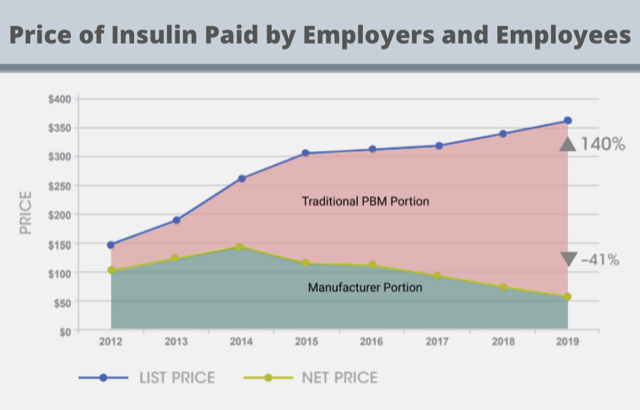
Source: Buried in something called Drug Channels.
There may be a few buyers who have generic insulin on the formulary, but there are plenty that don’t:

There you have it: the shock-the-conscience unveiling of the Tapeworm (the pink), as far as drugs are concerned. This is just one drug, but this process likely repeats many many times for many generic drugs. How is it that the process of distributing a drug and tracking who buys it sucks up much more of the value chain than actually making it?
How is it that the price paid of a container of generic Ambien can range from $3.25 (Drexi) to $136 (CVS)?


Speaking of scams…
Don’t get us started on wellness.
Balance (surprise) billing is Quizzify’s favorite scam.

Even though, according to the New York Times and others, we actually solved the problem (for non-elective surprise bills), most employers — like with PBM markups — don’t realize they have a problem in the first place. They are simply picking up most of the tab without noticing something amiss. Sort of like ET hiding in the stuffed animals.

Crooked PBMs, wellness vendors and providers…
The problem is that, for all the complaints about spending, employers how easy it is to solve these problems. Alternatives to PBMs are easy to come by. And swap out wellness for Quizzify, and put the Quizzify surprise billing language on every insurance card.

Share this:

Court-ordered 2021 EEOC wellness rules: an existential threat or huge opportunity?
The EEOC has published rules in draft form. They still need review by the Office of Managment and Budget, but that’s just a formality.
Incentives need to be cut back to “de minimis” for participation-based programs…but there is a way around the court ruling for those highly popular and effective (not!) outcomes-based programs.
Since the EEOC is basically pro-business these days, they have managed to circumvent the spirit of Judge Bates’ December 2017 decision, without violating the letter, and employers will be able to subject employees to fines of thousands of dollars starting in January.
However, it increasingly appears that outcomes-based programs, while arguably complying with the new rules regarding the Americans with Disabilities Act, violate the Affordable Care Act, because (with the well-documented, Validation Institute-validated exception of US Preventive Medicine), they fall short of the ACA’s standard of being “reasonably designed to reduce risk or prevent disease.” Just too many epic fails, all documented on this blog, including Koop award winners like Wellsteps, arguably the industry’s worst program now that Intereactive Health has gone bankrupt. (Ironically, it is also among the best-documented programs. Why they published their own self-immolation is anyone’s guess.)
Fortunately, there is a solution allowing you to maintain your existing incentive structure next year, and significantly reduce the cost while improving the performance of your program…and we will be covering it on Thursday at 1 PM ED. Register here.
PS Admit this is the first you are hearing of these new rules. And yet they are pretty close to a done deal in practice, even though the public can still comment soon. Good luck with that.
Share this:

The biggest scam in dentistry
If you or a loved one has had a small-to-medium-sized cavity filled in the last 6 years, on a molar, premolar, or baby tooth, you’ve fallen for the biggest scam in dentistry, a scam of a magnitude that would make the wellness trade association green with envy.

You are getting most cavities filled for no reason at all, other than for dentists to make money.
It turns out the large majority of cavities can be treated with Silver Diamine Fluoride, or SDF. That solution — used in Japan for 60 years — arrests the decay and to some extent can remineralize the tooth. The cavity can’t be too deep, and it has to be in place where it can be easily reached. It also turns the decay black, so it’s probably not a good idea for front teeth, at least for people who are hoping to be swiped right.
Quizzifans among TSW Nation may think they’ve heard this song before. They’d be right. Quizzify has been asking questions about SDF and writing on this topic for years.
Marty Makary and some colleagues have also highlighted the benefits of SDF, and correctly predicted that dentists would be very tardy in adopting it.
The difference now? Not unlike the wellness perps, it turns out that dentists’ own words are their own worst enemy. If you read this new Quizzify blog, peruse the quotes carefully, and link through to the sources, you’ll see what I mean: they’ve known all along this along.
Share this:

Hit me with your best shot! Fire away!
Dear TSW Nation,
I’ll be the guest on a live webinar on Thursday at noon EDT, courtesy of The Zero Card.
The difference between this webinar and others is that the questions won’t be curated. I will answer every question, no matter how obnoxious.
If you are a wellness vendor or consultant, this is your chance to challenge any of my smackdowns. Surely somewhere in my 500,000+ words published (plus podcasts), you can find a mistake.

Share this:

Wellness industry jumps the shark
So, before we get into the fun stuff, let me express my condolences to Interactive Health’s non-management employees, who probably had no idea their employer was living a lie. For them, I will make pdfs of my books on outcomes measurement free, provide a free coaching session on outcomes measurement, and basically try to be as helpful as possible in this job market. Just ping me on linkedin.

To paraphrase the immortal words of the great philosopher George Carlin, consider how stupid the average wellness vendor is. Now realize that half of them are stupider.
The winner in this race to the bottom? Interactive Health, winning Deplorables Awards in 2017 and 2018.
Yesterday, in a shocking display of efficient markets, Interactive Health (IH) went bankrupt, stiffing enough creditors to make a President blush. I do feel badly for those creditors, though no one should offer credit to a company that can’t even pass its own IQ Test.)
Or perhaps IH ran out of money because they spent so much of it developing their “smoking recession program.”
And, proving that it’s not only great minds that think alike, Interactive Health got this effusive write-up from Ron Goetzel’s outfit. Ron, please never write a glowing case study of Quizzify. I’m not sure we could survive it.
Some of their greatest hits include:
- Interactive Health gives clueless wellness vendors a bad name
- Interactive Health fails fact check by college intern
- Interactive Health breaks its own record for stupidity
- Is Interactive Health’s advice dumb enough to require a warning label?
- Interactive Health botches both its lies and its cover-up
- The very stable geniuses at Interactive Health once again put their very good brains on public display
See a pattern here? If so, then it’s safe to conclude they never would have hired you. You’re overqualified.
Wellness trade association concedes that wellness loses money
The Health Enhancement Research Organization HERO) and all its pilot fish have finally thrown in the towel on defending “pry, poke and prod.” No surprise, given that only one vendor out of 1000 (well, out of 999, I guess) has managed to consistently reduce risk. They (US Preventive Medicine) are too honest to claim savings for it.
Recall the write-up we did on the National Bureau of Economic Research’s wellness study a few weeks ago? HERO has now accepted its validity, by refusing to comment on it. What alternative did they have? The dilemma for these people was that every single one of them used the following, same, observation to diss the study when it reported initial results:
- The National Business Group on Health (financed by wellness vendors, of course) said: “The lack of first-year cost savings should not be surprising.”
- Paul Terry, Prevaricator-in-Chief of the wellness industry promotional journal, said it was only a “1-year program and that no one familiar with a socioecological approach would have deemed this intervention to qualify”
- Ron Goetzel, trying to poke holes in what he admitted was a “superb” methodology, said:
Although the Jones et al study was titled “What Do Workplace Wellness Programs Do?” a more appropriate title might have been “What Did the University of Illinois Workplace Wellness Program Do, in a Very Short Amount of Time?”
So what are you supposed to do with all these mentions of a single year (or a “very short period”) once the second year shows the same thing? Here’s what Interactive Health would do…

Share this:


Dog bites man: Large new study shows wellness loses money
So I just got word of another of Ron Goetzel’s signature moves–spreading rumors among my business contacts. (How’s that worked out, Ron?)
Typically the “tell” is that a contact will ask me: “Hey, is it true that you eat your young?”
I’ll reply: “Lemme guess. Goetzel.”
“How’d you know?” would be the response.
Just for the record, because things I say have a way of being misquoted or misinterpreted, I do not eat my young, my old, my middle-aged or anyone else. Not for breakfast, lunch, or dinner. Or even between-meal snacks.

This happened again last week. My signature response to Ron’s signature move is, invariably, when-they-go-low-we-go-high. I simply shine a light on a wellness outcome, embarrassing him and his cronies. With the exception of US Preventive Medicine, which somehow manages to noticeably reduce risk in a population, these are quite predictably unfavorable. That’s on a good day. On a bad day, they actually harm employees.
Unfortunately, there hadn’t been a good wellness outcome to analyze in months.
And then, yesterday, a deus ex machina. The Journal of the American Medical Association just published the second year of the University of Illinois study showing, as usual, that:
Wellness. Doesn’t. Work.
This Seinfeld-like result showed no change in risk factors, after two years. The only “positive” was that more employees had PCPs, an outcome which could have just as easily been acheived by saying: “Hey, everyone, go get a PCP. We’ll give you the $100 we would have wasted by paying a wellness vendor.”
Cost savings? Haha, good one.
It will be interesting to hear the wellness industry’s excuse for this one. Because after the first year, the excuse from the vendor-infested National Business Group on Health was: “The lack of first-year cost savings should not be surprising.” For the second year, I guess they’ll just cross out the word “first,” and replace it with “second,” using a sharpie.
How, one might ask, do these people even stay in business after 12 studies in a row show an epic fail? Here is how. This is a comment on a previous article that was just recently forwarded to me:
I know I’m late joining the discussion, but I nonetheless felt the need to contribute. I worked as an analyst for one of the corporate wellness providers on Al’s shit list, so I have an insider’s perspective. I ran some of our client’s ROIs. People love to quote them – including some of the commenters below [Michael O’Donnell, Ron Goetzel, etc.] and the sad thing is that we often base our arguments on what these ROIs are, as though they are fact. They are not.
Our models are based off poorly reviewed industry research, which would be laughed at in the econ graduate program I attended. That aside, I produced an ROI using their model – a model that I would have been embarassed to defend to anyone.
The result was a negative ROI, but when I emailed my supervisor the result, he called me into his office and told me verbatim: “We aren’t allowed to have a negative ROI. Go fix it.” I argued with him about how our already crappy model would be completely devoid of integrity and would render the results meaningless if I were to cherry pick variables to yield a favorable outcome, but that fell on deaf ears.
Additionally, our contracts often had a clause that penalized us if we did not “deliver” on a pre-agreed upon ROI. Talk about incentivizing us to cheat! During my tenure I never once witnessed a client question our methodology in any meaningful way.
So it’s back on you, the employer, to put the kibosh on these wellness people, since they are clearly not on the honor system.
While you do that, I am going to go have something to eat. Perhaps liver, with a nice chianti.
Share this:

Surprise bills meet COVID: What you need to know
Ooooh….yikes. We just did a webinar on this very topic, with Dave Chase and Doug Aldeen. And you missed it. We know what it feels like to miss things.

So, there is a reprise, covering surprise medical bills and COVID, being offered next Thursday, at 2 PM EDT, by our friends at a wellness company called Wellable. Yes, I know it seems out-of-character for us to use the phrase “our friends at a wellness company,” but there are plenty of upstanding wellness companies that we are thrilled to be associated with, like US Preventive Medicine, with whom we may do a joint webinar this summer.
Indeed many stranger things have happened. Case in point: Ron Goetzel himself — the very same Ron Goetzel who we have blown the whistle on multiple times — once publicly gave Quizzify a shout-out as being “lots of fun and very clever.” That was before he tried walk it back, like in this Seinfeld episode.

So what’s going on here?
No, we haven’t all just entered this.
Nor have pods taken over our bodies. (Though I suspect, if pods had taken over our bodies, they wouldn’t admit it.)

Quite the opposite, we find common ground with almost any ethical, competent company in this field, of which Wellable is one.
We invite you to join their webinar and look forward to answering your questions.
Spoiler alert: we have figured out how to solve your surprise bill problem, for most non-elective situations, by combining Marty Makary’s “battlefield consent” with reference-based pricing. You can implement this solution very easily.
No need to take our word for this. Our solution was featured in the New York Times.
Seats are limited, so register as fast as you can…


