
Home » Posts tagged 'HERO' (Page 4)
Tag Archives: HERO
HERO vs. Huffpost: What do actual employees say about wellness?

Quizzify is very uniform. Uniformly smart and funny, that is
HERO (the wellness vendors’ trade group) says: “Employees are not uniform in their receptiveness to wellness programs.” That’s like saying: “Republicans are not uniform in their receptiveness to the Clinton campaign.”
Take a look at Huffpost — especially the comments— to see what employees really think, not what HERO wants you to believe they think. With more than 23,000 views, this Huffpost was probably the most widely read posting on wellness anywhere in all of 2015.
These comments are unexpurgated (except for Huffpost’s own obscenity filter, which we suspect got quite a workout). You can add your own.
Then urge your HR department to redesign your wellness program. Tell them to ax your “pry, poke, prod and punish” vendor. If the vendor makes a fuss, bring us in and we can find all the lies they’ve told you in their outcomes reports and threaten to sue them.

No one thinks Quizzify isn’t fun
Then your company can start doing wellness FOR its employees instead of TO them. Read Jon and Rosie’s book to get some guidance. If you get depressed by the amount of work you have ahead of you, take a breather and read Surviving Workplace Wellness to tickle your funny bone– If laughter were truly the best medicine, wellness would be a blockbuster drug.
Share this:

7 Take-Aways from the HERO-Goetzel Webinar in Defense of Wellness
This is the sixth in a series on the HERO disinformation campaign around wellness ROI. The other six installments can be found here.

They said what?
This afternoon HERO and Ron Goetzel conducted an entire Groundhog Day-type webinar as though They Said What, the entire media, and 2015 don’t exist.
They talked about the “confusion in the marketplace” (to quote their invitation) without once even mentioning the source (us) of the confusion in the marketplace. Actually all we did was point out that they contradicted themselves in their own report. They created the confusion by inadvertently telling the truth.

Time to make the pretzels
Here are some of the things they are still saying, that they know to be somewhere between misleading and lies. Apparently Mr. Goetzel lived up to his billing as Goetzel “the Pretzel” by basically twisting “wellness loses money” into wellness makes money,” though he admitted to some “controversy” around the latter point.
First, he is still quoting the Kate Baicker 3.27-to-1 ROI, that he knows to have been thoroughly discredited. We’ve blogged about that extensively–this link will take you to a series of other links. To wit:
- She’s walked it back 4 times.
- RAND’s Soeren Mattke has attacked it (and those of you who know Soeren–he is a very thoughtful and polite guy–you really have to be way off-base to get his dander up).
- Another researcher has pointed out that many of the studies in her meta-analysis were basically made up.
- Many of these studies were claiming reductions in diabetes expense and obesity at the same they were telling people to eat more carbs and less fat, exactly the opposite of what would reduce diabetes incidence and possibly obesity. And yet somehow money was saved…
Second, the Ignorati are still quoting the American Journal of Health Promotion meta-analysis and Mr. Goetzel pretzeled his way around the accidental conclusion of that paper that high-quality studies show a negative ROI.
Third, Mr. Goetzel strongly criticized the Penn State fiasco. Hmm…maybe we’re mis-remembering this, but we seem to recall he was one of the leaders of that jihad. Here is a article about a meeting in which he and several others “take the offensive” in the controversy. Or maybe that was another Ron Z. Goetzel.

Fourth, he said: “There’s some healthy debate going on.” But the irony is, there is no debate. Partly this is because they are steadfastly refusing to debate. And partly this is because there is nothing to debate–they admitted “pry, poke, prod and punish” wellness loses money and damages morale. The only places we disagree are how much money gets lost and how badly morale is damaged.
Fifth, he is still comparing participants to non-participants, as though he hadn’t been forced — by the existence of a “smoking gun” slide — to basically admit that participants significantly outperform non-participants even in the absence of a program.
Sixth, he pretzeled RAND’s Pepsico analysis in Health Affairs, overlooking the fact that the study concluded wellness loses money. Obviously we wouldn’t have congratulated Dr. Mattke on his huge success with that article (#2 article of the year in Health Affairs) if it had reached the conclusion Mr. Goetzel said it did.
Finally, the most notable feature was the dog-not-barking-in-the-nighttime. Not once was there any rebuttal to our observations. The Wellnes Ignorati have placed themselves in a difficult position. In order to rebut us, they would have to acknowledge our existence. But ignoring our existence — and the existence of facts generally — is the core component of the Ignorati strategy.
By the way, our source, expecting a spirited rebuttal, instead got supremely bored by the insight-free recycled and invalid material in the presentation, and dropped off before the slam-bang conclusion to the webinar. We doubt there were any other members of the Welligentsia on that webinar but if there were–and you have something to share about the closing minutes that you don’t see mentioned in here — please do.

No pretzels here
Share this:

Health Enhancement Research Organization (HERO) meets Raising Arizona
 We blogged recently that HERO was going to rebut our observations that essentially none of their report makes any sense.
The good news about HERO is that they never step out of character. After we urged people to sign up, a few readers pointed out this webinar is a:

But HERO’s invitation also states:

Unless they don’t know how many members they have, how can their webinar run out of space? Come to think of it, how does anything on the web actually run out of space?
Perhaps HERO took a leaf out of John Goodman’s playbook in Raising Arizona. (You gotta click through on this, even if it means taking you off our site.)
At Quizzify, we have space for everyone
Share this:

HERO challenges us to a debate — Webinar April 22
This is the fifth in a series on the HERO report on wellness outcomes measurement. The previous installments can be found here

Doesn’t really need a caption, does it?
The Health Enhancement Research Organization (HERO) has invited us to debate the merits of “pry, poke, prod, and punish” wellness programs, on April 22. The invitation is reproduced below and available in full here.
Not.
They didn’t ask us to debate. (They didn’t even invite us to attend.) By contrast, we have offered to debate many times. We’ve even offered literally a million-dollar reward for them to debate their outcomes metrics with us.
Here’s what really happened. We received emails from many people giving us the heads-up that HERO is holding a webinar during which they will spin their information published in their report where they say wellness loses money and is bad for morale into the opposite conclusion. If this seems confusing, it is.
Ironically, they said that we have “created confusion in the marketplace,” when in reality they were the ones who created the confusion, by providing information that they are now trying to walk back. The report seems perfectly clear – wellness loses money. Nonetheless the Wellness Ignorati are befuddled by their belated observation that it was they who supplied this information. No surprise here. Through the years we have noticed that the Wellness Ignorati are easily befuddled, especially by information.
By contrast, no one can say we confuse anything. We have always been consistent: “pry, poke, prod and punish” programs are losers for all concerned, except the vendors and consultants who naturally are running this webinar. For the Wellness Ignorati, it’s all about the money.

Yes, this is our new company where we do wellness the right way…and guarantee savings
One of the fundamental differences between us and the Wellness Ignorati is that we are pro-transparency and have nothing to fear from publicizing them, so we are attaching their invitation below and urging people to attend, whereas even as they disparage our observations, they refuse to mention the existence of this website.
No surprise there either: if people find out this website exists, they might visit and learn actual facts. Facts, of course, are the worst nightmare for the Wellness Ignorati. That’s how they earned the appellation–by employing a strategy of ignoring facts.
This is even true when they themselves published the facts.
Curiously, this is the second time in recent months that the Wellness Ignorati have written that wellness loses money. At some point if they keep insisting wellness loses money, we have to believe them. The last time, Michael O’Donnell’s journal concluded (we’ll use a screenshot):

We would attend this webinar ourselves except that we are not invited. In any event, our attendance track record is not encouraging. The last time we listened to a Ron Goetzel webinar, we were disconnected after asking that he not use our copyrighted material without attribution. Ultimately we had to get our publisher, John Wiley & Sons, to make him cease and desist.
Still, we’d love it if you would attend, and here are some questions you could ask. First about the HERO Report:
- Why did they say wellness damages morale and corporate reputations if they are now saying that it doesn’t?
- Why did they say a wellness program only costs $18/year when the biometric screens alone cost more than $18/year?
- How can they say that companies should allocate only $18/employee/year to a wellness program when their own invitation below says that to be successful, a program must be “comprehensive” and “well-resourced”?
- Why did they omit their own carefully compiled list of 11 elements of cost other than vendor fees from that $18 figure?
- If wellness only saves $12/employee/year before fees according to their own figures, how can it save money if it costs $18?
- Why are there so many rookie mistakes in this report, like “forgetting” to adjust the decline in cardiac events for the secular decline in cardiac events that the entire country is enjoying?
- If their methodology is so sound, how come they haven’t collected their million-dollar reward when all they have to do was apply fifth-grade math to a simple word problem without lying?
When facts interfere, just twist and turn them, like a pretzel
And while you’re in attendance anyway, there are 11 still-outstanding questions for Mr. Goetzel himself, that he has steadfastly refused to answer. Here are a few you could ask:
- Why does he keep insisting that the Nebraska wellness program – whose vendor admitting lying about saving the lives of cancer victims – is a “best practice” or “exemplar” program?
- Why does he always give Koop Awards to customers and clients of his sponsors and board members, even when they claim 100 times as much savings as they themselves said was possible?
- Who “unfortunately mislabeled” the key slide that invalidates the industry’s obviously fallacious participant-vs-non-participant methodology and why did neither he nor any other analytical luminary on the Koop Committee notice it until we pointed it out four times?
- Why has he refused to answer these questions even though Al Lewis has offered to answer any questions you could ask him?
In one respect, though, the Ignorati are finally making progress in the integrity department. This invitation is 100% Kate Baicker-free. Maybe, finally, they are accepting the reality that she has walked back her 3.27-to-1 ROI not once, not twice, not three times, but four times. (Four seems to be the magic number of times needed to point out a fact to the Wellness Ignorati before they admit its existence.)
INVITATION:
Don’t Throw Out the Baby with the Bathwater – A Measured Response to Critics of Workplace Health Promotion and Disease Prevention Programs
April 22, 2015
1:00 PM – 2:00 PM Central Time
(Members only event)
Recently, several individuals have raised doubt about the efficacy and cost-benefit of workplace health promotion and disease prevention programs (otherwise known as wellness programs). These critics cast doubt on the very core of work site wellness efforts and have generated widespread publicity. They argue against the benefits of prevention and workplace health promotion, question the validity of ROI estimates, and aim to restrict the use of outcomes-based wellness incentives. These criticisms have created confusion in the market. This session will re-state the business case for adopting evidence-based, comprehensive, and well-resourced workplace health promotion programs. It will also review the methods used to evaluate these programs in “real world” settings, but also acknowledge the limitations of “average” programs that may not produce expected outcomes. Finally, Dr. Goetzel will comment on value-on-investment (VOI) approaches to assessment of workplace programs in contrast to the more traditional return-on-investment (ROI) models.
Share this:


HERO meets Trading Places: Wellness Saves One Dollar
This is the fourth installment of the series on interpreting the Health Enhancement Research Organization’s Outlines Guidelines report. It covers page 23. The full series can be found here

One Dollar.
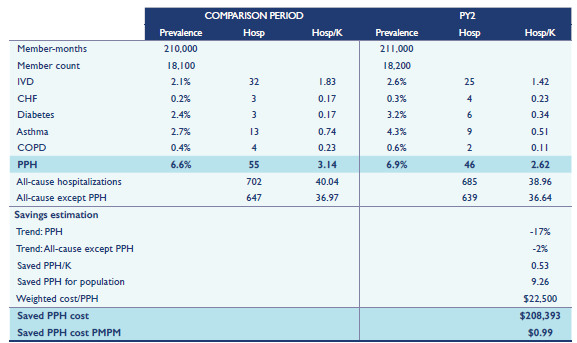
23 pages into their report, HERO has finally benefitted from the law of averages and gotten an analysis right…and it shows savings of: one dollar.
HERO conducted a “wellness-sensitive event rate analysis,” otherwise known as a plausibility test. It’s the only valid way of measuring outcomes. Not coincidentally, I invented it. There is no ambiguity about this. It’s in all my old presentations and my first book, Why Nobody Believes the Numbers. No one else has even pretended to claim credit. Nor is this one of those situations where the usual invention cliches apply. The Chinese did not invent it in 1000 BC. DaVinci didn’t sketch it in 1541. The Germans and the Allies weren’t racing to develop it at the end of World War II. Nope, mine and mine alone.
Of course there is no attribution of that (or of any of my contributions to this field, anywhere, in their 88 pages). I find this “oversight” quite flattering.
Here it is.
Note a few things.
First, this methodology counts all the admissions, whether or not the patients/employees participated or didn’t participate in a program, or whether the admitted patients were even known to have the condition in the first place. This is how it should be. This eliminates the participation bias, one of the two biases (not including lying) that the wellness industry utilizes to sustain the fiction that it saves money. It also eliminates regression to the mean (the other bias).
Second, this exercise generates 99 cents PMPM in gross savings. Yep, basically one dollar, like the bet in Trading Places. The “problem” with measuring validly is that your savings essentially dwindle to nothing.
One dollar. The Duke brothers turned the lives of Dan Ackroyd and Eddie Murphy upside down over a one-dollar bet, and the wellness industry wants you to turn your entire employee relations strategy upside down — in their own words, damaging morale and your corporate reputation — in order to save: one dollar. (That of course is one dollar before costs, which are $1.50.)

Quizzify…where there is no need to fake results
Third, believe it or not, even that $1 in savings is grossly overstated. Focus on ischemic vascular disease or IVD (heart attacks, strokes etc.) They show a decline of 7 admissions, or 23%, from 32 to 25 admissions — easily the largest component of the 9 avoided admissions they are attributing to wellness and disease management. This decline took place over a 3-year period, as they averaged the two pre-program years and compared that to Program Year 2.
The problem is that, according to US Government data below, this set of IVD events declined everywhere over the same 3-year period by– as luck would have it– that very same 23%. Don’t believe us? Here is the data. The comparable group on the display below is the “privately insured” cohort, underlined in red, now that we have figured out how to do underlines on screenshots. (Even Medicare, where there is no workplace wellness and where the population grew almost 10% and aged quite a bit, showed a decline in IVD of almost 10%.)

Despite the fact that all their savings from IVD got eliminated by the simple step of seeing how much savings would have accrued even without a program, I don’t think this particular oversight was purposeful on HERO’s part. I’d give them the benefit of the doubt and say the abject failure to compare their performance to the obvious benchmark was a rookie mistake. The lesson is, before they write reports on outcomes analysis, someone should teach them how to actually do outcomes analysis. I’m just sayin’…
By the way, a similar secular decline transpired in asthma nationwide. The 2009-2012 decline was 21%, meaning that 2 of the 4 admissions HERO says wellness “avoided” over that period would have gone away on their own.
So when you take out the IVD decline of 7 admissions and 2 of the avoided asthma admissions, you are left with: no decline at all. Essentially HERO just proved that – even before taking costs into account – their vaunted “pry, poke, prod and punish” wellness programs are worthless.

Share this:

Johnson & Johnson accepts our analysis that wellness loses money
Newsflash: Someone from Johnson & Johnson named Michael Schmidt responded to our posting that the HERO Report shows wellness loses money. This is the first time anyone associated with HERO has strayed from the tried-and-true Wellness Ignorati strategy of ignoring us. We were concerned that he might have found a mistake in our math, which no one has ever done.
Fortunately, our math is OK with Mr. Schmidt, and — by implication, since he is writing on their URL — J&J itself. His point is different. He argues that we write these columns to do the following: generate business. Touche!
He also says that the headline is inflammatory and that we will turn off more people than we turn on. That is probably accurate. However, the people we would turn off — traditional “pry, poke, prod and punish” wellness vendors such as Johnson & Johnson — have had and would have no interest in paying us to find out that wellness is worthless.
In any event the headline “The Wellness Wars Are Over. Wellness Lost” captures exactly what the HERO report says — and was edited by the ITL editor. Headlines, as Mitt Romney found out when his New York Times op-ed was entitled “Let Detroit Go Bankrupt,” are the purview of the editor, not the author.
The curious thing is, Johnson & Johnson is listed as one of the “endorsers” of the HERO report. So as an endorser of the report, Johnson & Johnson is tacitly nonetheless acknowledging that the report is right–wellness loses money.
In case there is some ambiguity, here is the screenshot of the first set of comments

Share this:

HERO (Health Enhancement Research Organization) Crowdsources Arithmetic
This is the third in a series deconstructing the Health Enhancement Research Organization’s (HERO) attempt to replace the basic outcomes measurement concepts presented to the human resources community in Why Nobody Believes the Numbers with a crowdsourced consensus version of math. The first installment covered Pages 1 to 10 of their outcomes measurement report, where HERO shockingly admitted wellness hurts morale and corporate reputations. The second installment jumped ahead to page 15, where HERO shockingly admitted wellness loses money. This report covers pages 11-13. Next week we shall be covering Page 14.

4 out of 5 wellness vendors don’t get this
Spoiler Alert: The wellness industry believes that math is a popularity contest. (We have a million-dollar reward if they can show that’s true. More on that later.)
All the luminaries in the wellness industry got together to crowdsource arithmetic, and put their consensus (a word they use 50 times) in an 88-page report. Unfortunately, math is not a consensus-based discipline, like democracy. It is not even an evidence-based discipline, like science. It is a proof-based discipline. A methodology that doesn’t work in hypothetical mathematical circumstances is proven wrong no matter how many votes it gets.
The pages in question list 7 “methodologies” for measuring outcomes. To begin with, consider the absurdity of having 7 different ways to measure. Imagine if you asked your stockbroker how much money you made last year, and were told: “Well, that all depends. You could measure that seven different ways. And by the way, six of those ways will overstate your earnings.” Math either works or it doesn’t. There is only one right answer.
Methodology #1: “Cost Trend Compared with Industry Peers”
This methodology “may require consulting expertise.”
As a sidebar, one of the many ironies of this HERO report is that most of these methodologies emphasize the need for actuarial or consulting “inputs” or “analytic expertise”…and yet no mention was made on Page 10 of the cost of this expertise when all the elements of cost were listed. While not mentioned as a cost element, consulting firms are very expensive And even if consulting were free, we generally recommend hiring only consultants to do outcomes report analysis who are certified in Critical Outcomes Report Analysis by the Validation Institute.
By contrast, Staywell and Mercer offer an example of what happens when you as a buyer use non-certified “consulting expertise” to evaluate a vendor. Here’s what happens: the vendor wins. Needless to say, Staywell showing savings 100x greater than what Staywell itself said was possible simply by reducing a few employees’ risks raises a lot of questions. But despite repeated requests and offers of honoraria to answer these questions, Mercer wouldn’t answer and the only response Staywell gave us was to accuse us of bullying them. Staywell and Mercer held firm to the Ignorati strategy of not commenting—even though Mercer was representing the buyer (British Petroleum), not the vendor. Oh, yes—both Staywell and Mercer are represented on the HERO Steering Committee.
To HERO’s credit, they do admit the obvious for Methodology #1: If all your peers are using the same vendors, who recommend the same worthless annual checkups, the same overscreening/overdiagnosis, the same lowfat(!) diets, and the same consultants to evaluate all the phony savings attributable to these checkups, diets, and biggest-loser contests, obviously you’ll get the same results. And since trend is going down everywhere (including Medicare and Medcaid, which have no wellness), everyone gets to “show savings.”
Methodology #2: “Inflection on expected cost trend.”
Mercer has been a big proponent of this methodology, as in the previous Staywell example. At one point they used “projected trend” to find mathematically impossible savings for the state of Georgia’s program even though the FBI(!) later found the program vendor, APS, hadn’t done anything. In North Carolina, they projected a trend that allowed them to show massive savings in the state’s patient-centered medical home largely generated, as luck would have it, by a cohort that wasn’t even eligible for the state’s patient-centered medical home.
Comparing to an “expected” trend is one of the most effective sleight-of-hand techniques in the wellness industry arsenal. Every single published study in a wellness promotional journal comparing results to “expected trend” has found savings. And have you ever hired a consultant or vendor to compare your results to “expected trend” who hasn’t found “savings”? We didn’t think so.
QED.
Methodology #3: “Chronic vs. non-chronic cost trend.”
The funny things about this methodology are twofold.
First, the HERO Committee already knows this methodology is invalid because it was disproven in Why Nobody Believes the Numbers (and I offered an unclaimed $10,000 reward for finding a mistake in the proof). We know that people on the Committee have read my book because at least one of them – Ron Goetzel – used to copy selected pages from it until the publisher, John Wiley & Sons, made him stop. Methodology #3 was the fallacy on which the entire disease management industry was based. I myself made a lot of money measuring outcomes this way, until I myself proved I was wrong. At that point, integrity being more important to me than money, I changed course abruptly, as memorably captured by Vince Kuraitis’ headline: Founding Father of Disease Management Astonishingly Declares: “My Kid Is Ugly“. (Naturally the benefits consulting industry filled the vacuum created by my withdrawal from this market, and plied their clients with worthless outsourced programs that more than coincidentally generated a lot of consulting fees.)
If you had perfect information and knew who had chronic disease (before the employees themselves did) and everyone stayed put in either the non-chronic or chronic categories, you could indeed use non-chronic trend as a benchmark, mathematically (though the epidemiology is still very squirrelly). The numbers would add up, at least in a hypothetical case.
But we can’t identify anywhere near 100% of the employees who have chronic disease. Absent that perfect information, any fifth grader could understand the proof that this methodology is fabricated, as follows. Assume that 10 people with a chronic disease cost $10,000 apiece both in the baseline and in the study period. Their costs are therefore flat. The program did not reduce costs between periods.
Now add in 10 people with undetected chronic disease as the “non-chronic benchmark.” Maybe they are ignoring their disease, maybe they don’t know they have it, maybe they are misdiagnosed, maybe the screen was wrong (vendor finger-pricks are very unreliable). Assume these 10 people cost $5000 in the baseline…but they have events in the study period so their costs become $10,000.
That makes the “non-chronic trend” 100%! Suddenly, the program vendor looks much better because they kept the costs of the chronically ill cohort constant even though the “benchmark” inflation was 100%.

At Quizzify, wellness results always add up.
Second, Why Nobody Believes the Numbers has already shown how to make this methodology valid mathematically (though the epidemiology applied to that math might still be squirrelly, and there could still be random error in non-hypothetical populations). You simply apply a “dummy year analysis” to the above example. So do exactly what is described above, but for a year-pairing before the program. Then you’ll know what the regression-to-the-mean bias is, and apply that bias to the study years. So If in fact the “non-chronic trend” is always 100% due to the people with unrecognized chronic disease, you would take this trend out of the benchmark non-chronic population before applying that trend to the chronic population. In this case, as in every case, the bias is eliminated. This is called the Dummy Year Adjustment. (Chapter 1 of Why Nobody Believes the Numbers offers several examples of the DYA.)
Proofs are best understood to be proofs if accompanied by rewards, since only an idiot would monetarily back a proof that wasn’t a proof. So here’s what we propose for this one: I’ll up my $10,000 reward to $1,000,000. A panel of Harvard mathematicians can decide who is mathematically right. The HERO Committee escrows a $100,000 nuisance fee for wasting my time and paying for the panel if they are wrong. (We’ll pay if we lose.) They present Methodology #3. We lose the $1,000,000 if the panel votes that this HERO methodology is valid without our “Dummy Year Adjustment.”
My challenge: Either collect your $1,000,000, or publicly apologize for proposing a methodology which you know to be made up. Or is offering you a million dollars “bullying,” a word defined very non-traditionally in this field? Our bad.
Yes, we know this sounds like a big risk but you might remember the old joke:
Science teacher: “If I drop this silver dollar into this vat of acid, will it dissolve?”
Student: “No, because if it would, you wouldn’t do it.”
Methodologies 4 and 5: The Comparison of Participants to Non-Participants
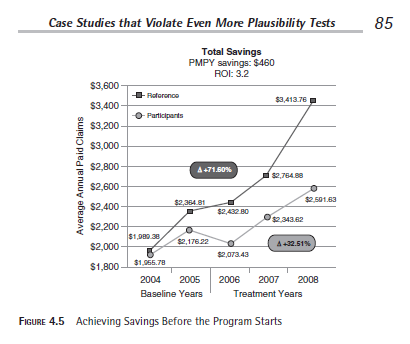
Besides not making any intuitive sense that active motivated engaged participants are somehow equivalent to inactive unmotivated non-participants, Ron Goetzel already admitted this methodology is invalid. Health Fitness Corporation, accidentally proved that on the slide below.

Note that they “matched” the participant (blue) and reference (red) groups in the 2004 “baseline year” but didn’t start the “treatment” until 2006. However, in 2005, they already achieved 9% savings vs. the “reference group” even without a program. This “mistake” was in plain view, and was pointed out to them many times, politely at first. Page 85 of Why Nobody Believes the Numbers showed it, but as the screenshot below shows, I was too polite to mention names or even to call it a lie, figuring that as soon as Health Fitness Corporation or Ron Goetzel saw it, they/he would be honest enough to withdraw it.
Not knowing the players well, I naively attributed the fact that HFC used this display to a rookie mistake, rather than dishonesty. That was plausible because rookie mistakes are the rule rather than the exception in this field. (As we say in Surviving Workplace Wellness, the good news about wellness vendors is that NASA employees don’t need to worry about their job security because these people aren’t rocket scientists.)
On the advice of colleagues more familiar with the integrity of the wellness industry true believers, I also tried a test of the rookie-mistake hypothesis: I strategically placed the page with this display next to the page that I knew Ron Goetzel would be reading (and copying), a page whereon I complimented him on his abilities. I might the the world’s only bully who publicly compliments his victims and offers to pay them money:

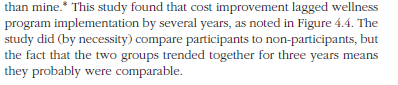
That way, I would know that if Mr. Goetzel and his Koop Committee and their sponsors HFC didn’t remove this display, it was due to a deliberate intentiion to mislead people, not an oversight or rookie mistake.
Sure enough, that display continued to be used for years. Finally, a few months ago, faced with the bright light of being “bullied” in Health Affairs, HFC withdrew the slide. Ron “the Pretzel” Goetzel earned his moniker, twisting and turning his way around how to spin the fact that this “mistake” was ignored for so long despite all the times it had been pointed out. He ending up declaring the slide “was unfortunately mislabeled.” He gave no hint as to who did the unfortunate mislabeling, despite being repeatedly asked. We suspect the North Koreans. The whole story is here.
Summary and Next Steps
The first five of these methodologies in Pages 13-14 have several things in common:
- They all contradict the 6th methodology;
- They contradict the statement on page 15 that the only significant savings is in reducing admissions. Of course, self-contradiction is embedded in Wellness Ignorati DNA. To paraphrase the immortal words of the great philosopher Ned Flanders, the Wellness Ignorati “believe all the stuff in wellness is true. Even the stuff that contradicts the other stuff.”
- They call for megadoses of consulting and analytic expertise, contradicting the list on Page 10 that omits the cost of outside expertise.
Speaking of Methodology #6, our next installment will cover it. It’s called event-rate based plausibiltiy testing. I would know a little something about that methodology, since I invented it. I am flattered that the Wellness Ignorati, seven years later, are finally embracing it. I am even more flattered that they aren’t attributing authorship to me. No surprise. That’s how the Wellness Ignorati got their name – by ignoring inconvenient facts. Ignoring facts means they cross their fingers that their customers don’t have internet access. Customers who do can simply google on “plausibiltiy test” and “disease management” and see whose name pops up.
Share this:

Apologies to HERO and the Wellness Ignorati!
(March 18) Due to vacation schedules, we are taking a brief time-out from both our “profiles” of vendors and our serial analysis of the HERO report (Part 1 was our most popular posting ever — don’t forget to “Follow” us so as not to miss a single installment.).
Knowledge + fun + respect = happiness + health
This posting is to apologize to the HERO Wellness Ignorati. A comment our posting on the HERO report said we shouldn’t call the Wellness Ignorati “ignorant.” We aren’t calling them ignorant and we apologize if we were misunderstood. Since it has sold almost 6000 copies despite Wiley’s decision to price it to finance their retirement accounts, we thought by now most people had read Cracking Health Costs. That was the book in which the term was coined. It emphatically does NOT mean “ignorant.” We would never call them “ignorant” and the Ignorati are anything but. Quite the contrary, they are smart enough to realize that facts are their worst nightmare.
Or as Tom Friedman said in today’s New York Times, “We wouldn’t be human if we didn’t outright ignore facts that make a laughingstock of our hopes.” (I actually did the opposite. See the blog post: Founding Father of Disease Management Astonishingly Declares: “My Kid Is Ugly.” Dee Edington did something very similar. Both of us were simply not willing to sacrifice our integrity for filthy lucre.)
The Wellness Ignorati are more than smart. They are brilliant. They have elevated fact-ignoring to an art form.
They realize that enough people seeing this site will derail their HR-financed gravy train, so they keep to a strict strategy of not even acknowledging that facts exist. Example: us. Not a mention of our existence in their entire report. A brilliant strategy for them, and one that flatters us immensely. Obviously, in the massive tome they just published, if they thought we were wrong, they could have said: “They Said What and its authors offer a competing view, but it’s wrong because…”
Fact suppression is of course the opposite of what we do — we want facts to be front-and-center. We welcome transparency and debate, though the latter is tough because people either repeatedly decline (Ron Goetzel) or, after the debate, wouldn’t agree to release the recording (Michael O’Donnell).
Instead they simply disappear us. This is despite the fact that the two of us (plus our colleagues like Jon Robison and Tom Emerick) have sold more books, been interviewed in more major publications, authored more articles in high-impact journals than all the Ignorati combined.

Do you employees know when to just say “no” when it comes to medical care?
I’ll close with a f’rinstance. We copied a screenshot from that report showing that the Ignorati finally admitted that “pry, poke, prod and punish” programs damage morale. This guy looked at that screenshot, and put a comment on our post that this screenshot didn’t exist, but rather it was our propaganda. Someone else said the screenshot was out of context, so we invite everyone to read the context.
The bottom line is, of course the HERO Report is correct about the cost of morale damage. Coincidentally, I am writing this from State College, Pennsylvania. I am here as an honored guest of the Penn State Faculty Benefits Committee, feted for my role in helping to free them from the Goetzel/Highmark forced wellness program (featuring those immortal testicle checks). Try telling Penn State there’s no morale impact. (For those of you thinking of sending your kids here, do it! I’ve never been to a university where the professors were more passionate about teaching their students than PSU–despite what happened to them in 2013.)
“Everyone is entitled to their own opinions, but not to their own facts.”
–Daniel Patrick Moynihan
Share this:

A Short Painless Primer on the Value of Screening
At the risk of knocking our second-most-widely viewed posting (the first of several analyses of the HERO report) off our front page, this is a brief and amusing lesson on the value of screening
If you like this, you’ll love this–it will also tickle your funny bone.
Share this:

HERO Report: Wellness Industry Leaders Shockingly Admit that Wellness Is Bad for Morale
The question is: how do you help employees spend less and get healthier at the same time?
(March 14) This is the first in a series looking at the strengths and weaknesses of the HERO Outcomes Guidelines report, recently released by the Wellness Ignorati. One explanatory note: A comment accused us of insulting the Wellness Ignorati by calling them that. It is not an insult. It describes their brilliant strategy of ignoring facts and encouraging their supporters to do the same. We are very impressed by the disclipline with which they have executed this strategy, and will be providing many examples. However, if they prefer a different moniker to describe their strategy, they should just let us know.
We encourage everyone to pick up a copy of this report, the magnum opus of the Wellness Ignorati. Unlike the Ignorati, we are huge advocates of transparency and debate (which they call “bullying”). We want employers to see both sides and decide for themselves what makes sense, rather than spoon-feed them selected misinformation and pretend facts don’t exist.
The latter is the strategy of the Wellness Ignorati. Indeed, they earned their moniker by making the decision to consistently ignore inconvenient facts. (This is actually a smart move on their part, given that basically every fact about wellness is inconvenient for them.) For example, they just wrote 87 pages on wellness outcomes measurement without admitting our existence, even though we wrote the only book — an award-winning trade best-seller — on wellness outcomes measurement. Observing the blatant suppression of facts and the loss of credibility that comes with blatantly suppressing facts is just one of the many reasons to read this report. In total, their report provides a far more compelling argument against pry, poke, prod and punish programs than we ourselves have ever made, simply by bungling the (admittedly impossible) argument in favor of them.
There is too much fodder for us to deconstruct in one posting, so over the next several weeks we will highlight aspects of this report that we think are especially revealing about the sorry state of the wellness industry.
In terms of getting off to a good start, the Ignorati are right up there with Hillary Clinton, with their first self-immolation appearing on Page 10. Remember our mantra from Surviving Workplace Wellness: In wellness, you don’t have to challenge the data to invalidate it. You merely have to read the data. It will invalidate itself.
And sure enough…
Ironically, the first self-immolation is the direct result of that rarest of qualities among the Ignorati: integrity. We were shocked by the revelation that the Ignorati actually realize that employee morale and a company’s reputation both suffer when companies institute wellness programs – but here is the screenshot. Both morale and reputation are listed, as “tangential costs.”
Try telling a CEO that the morale of his workforce and his corporate reputation are “tangential” to his business. We ourselves run a company, and we would not list low morale as a “tangential cost.” Quite the opposite — our entire business depends on our employees’ intrinsic motivation to do the best job they can. If their morale suffers, our profit suffers. That’s why we would never institute a wellness program. The last thing we want to do is impact our morale in order to measure our employees’ body fat. Obviously, it is harder to hire and retain people if you value body fat measurement over job performance, and we are pleased to see the ignorati finally admit this.

Why, having now read this revelation in the ignoratis’ own words, that wellness is bad for morale, would any company still want to “do wellness”? Or as we say in Cracking Health Costs, “If you’re a general, would you rather have troops with high morale or troops with low cholesterol?”
The fact that employees hate wellness isn’t exactly a news flash. Anytime there is an article in the lay press, the public rails against wellness — or “bullies” the wellness industry, to use the term that the Ignorati use for people who disagree with them publicly. You don’t have to look far—just back to HuffPost on Wednesday. Or All Things Considered.
Obviously, if you have to bribe employees to do something (or fine them if they don’t), it’s because they don’t like it. If employees would rather sacrifice considerable sums of money than be pried, poked and prodded, they are sending you a message: “This is a stupid idea we want nothing to do with.”
The news flash is that this whole business of “making employees happy whether they like it or not,” as we say in Surviving Workplace Wellness is now acknowledged – by the Ignorati as a group — to be a charade.
HERO seems to have exhausted their integrity quota pretty quickly, because after that welcome and long-overdue and delightfully shocking admission, they slip back into character.

To get good answers, you must ask good questions. We do.
Specifically, in their listing of costs, they conveniently forgot a bunch of direct, indirect and “tangential” costs. Like consulting fees. Generally, the less competent and/or honest the consultants, the more they charge. (For instance, we can run an RFP for $40,000 or less, and measure outcomes for $15,000 or less — and do both to the standards of the esteemed and independent GE-Intel Validation Institute. Most other consultants can’t match either the price or the outcome.) We’re not calling any consulting firm incompetent or dishonest other than pointing to a few examples that speak for themselves, but it does seem more than coincidental that the consultants involved in this report have conveniently forgotten to include their own fees as a cost.
And what about the costs of overdiagnosis caused by overscreening far in excess of US Preventive Services Task Force guidelines? The cost of going to the doctor when you aren’t sick, against the overwhelming advice of the research community?
Still, we need to give credit where credit is due, so we must thank the Ignorati for acknowledging that wellness harms morale. It took even less time for this acknowledgement than for the tobacco companies to admit that smoking causes cancer.


