
Home » Posts tagged 'Star Wellness'
Tag Archives: Star Wellness

Star Wellness Doubles Down on Ignorance
Once in every great while, when we’re least expecting it, a company comes along that makes us reconsider our viewpoint–and ponder the possibility that maybe we’re wrong about wellness. Maybe, finally, we’ve discovered a company that will motivate employees to get well. Maybe a company that adheres to screening guidelines. Maybe even a company that will solve America’s healthcare crisis.
Star Wellness is not that company.
Below, you’ll find a partial list of the clinical goodies in Star Wellness’s hyperdiagnostic candy jar. Most of these tests would never be ordered on an asymptomatic patient by a doctor, but not to worry. In 47 states, you can actually purchase these tests directly from the Star’s lab, without some pesky doctor with some silly medical degree observing that it’s a bad idea to subject healthy people to a barrage of mostly US Preventive Services Task Force C-and-D-rated tests. Instead, you can get your results reviewed by one of Star’s highly qualified, thoroughly vetted, well-trained…franchisees:

Star is seeking franchisees with backgrounds in sales, finance or (and we are using a screenshot because we don’t want to be accused of making this up):


Five whole days? Oh, wait — “up to” five whole days. So maybe a really smart municipality administrator could cover all the material in four days. That leaves one extra day to snooker employers and harm employees.
Here is a partial list of their tests. I say “partial” because you can click through on the “general health profile” and find even more tests. And many of these tests themselves include more tests. For instance, a complete blood count has 6 and the “comprehensive thyroid panel” has 7. In total, you can get more than 40 blood values measured. If these tests are 90% accurate and you are completely normal, 4 (10%) of those tests could return a value that is out of range, just randomly.

When I say they “doubled down on ignorance” of the fact that you simply aren’t supposed to go around hunting for diseases, it’s because they used to do only about half as many useless tests as they do now. So they have literally doubled down on ignorance, vs. this original list:

Where to start? First, no licensed doctor should “typically order” these tests “during a routine physical,” at least if they want to keep that license. (Star can order them because wellness vendors aren’t doctors. They only play doctor, so they don’t need a license.)
Second, these tests are not “over $350 value,” for many reasons. Besides most of them being worthless or harmful, a “routine physical” doesn’t cost $350. Capitated doctors would go bankrupt ordering these tests.
Then there is “Lyme’s Disease.” News flash: it’s called “Lyme Disease.” No apostrophe. Just as they are confused about basically everything else involving wellness, they may be getting confused about the origin of the name, so I’ll clue them in. It’s named for the town where an epidemiologist identified it, not for a Yankee who died of it.
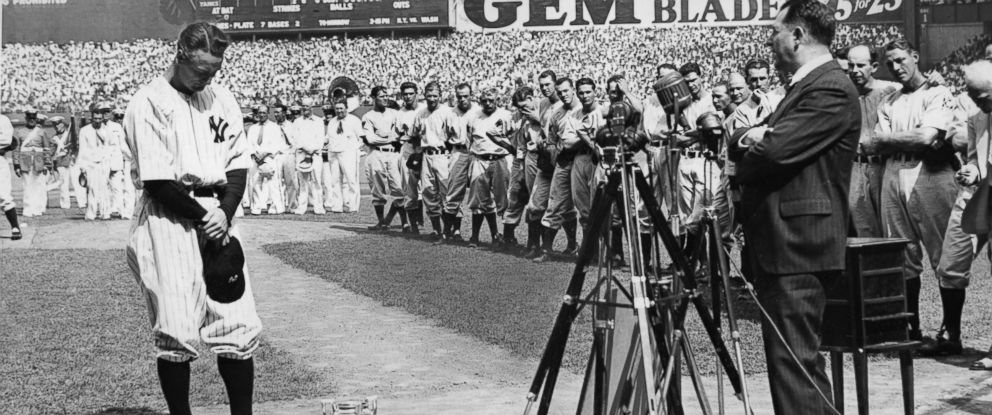
And if they have figured out how to accurately diagnose Lyme Disease, they deserve a Nobel Prize. Finally, no doctor would order a test for “Lyme’s Disease” as part of a routine physical.
The US Preventive Services Task Force doesn’t rate Lyme Disease screening because no one should be screened for Lyme Disease, and everyone other than Star Wellness knows that. (Yes, people who have been exposed to ticks or who have symptoms should be tested. But those are tests done as part of a diagnostic workup, not screens that employees are forced to undergo if they don’t want to be fined. Tests are done by doctors, not municipal administrators.)
H. pylori: The worst wellness screen ever?
First, the US Preventive Services Task Force doesn’t bother to grade it, largely because no self-respecting doctor would ever screen patients for this. Shame on the USPSTF for consistently failing to anticipate all the ways in which wellness vendors can misunderstand basic clinical science!
Second, most of us who harbor H. pylori have no symptoms. So why screen for something that’s not causing problems? That’s the very stable genius of Star Wellness. By expanding tests to include panels of no clinical value whatsoever, Star Wellness can make more money, which will please them, and hyperdiagnose more employees, which will please their clients.
The fact that a real doctor would only test someone who has an actual reason to be tested explains why H. pylori is a test, not a screen. If you have an ulcer or symptoms that suggest an ulcer, go to the doctor. Even then, the doctor probably won’t even bother to test you, since most people get relief simply from well-tolerated, commonly used pills like Zantac. It is only if the first-line medications fail that most doctors will even test you.
Third, H. pylori may be beneficial. Screening us to try to get rid of something we generally want in our bodies represents a new frontier in hyperdiagnosis.
Fourth — ironically, given the wellness industry’s obsession with employees’ weights — it is even possible that killing off H. Pylori contributes to weight gain.
Fifth, what exactly are we supposed to do, if it turns out we harbor H. pylori? Get a course of antibiotics to clear the bacteria out of our system? That makes sense. We’ve always maintained that one of the problems with America’s healthcare system is that patients aren’t prescribed enough antibiotics. (Not.)
The good news for the pharmaceutical industry is due to the nature of H. pyroli, hiding in our stomach mucus, it takes a lot of antibiotics to ferret it out, plus a bunch of other pills. Is this a great country or what?
Finally, half the world’s population has it. Given the expense and inaccuracy of the test and the prevalence of the bacterium, why not eliminate the middle step and just put all your employees on antibiotics?
And now let’s play Jeopardy

Answer: Along with everything else, this is a topic Star Wellness knows nothing about.
Question:

Their random number generator is slightly off: 222,000 people under age 45 do not suffer a stroke every year. For 18-to-44-year-olds, the actual statistic is 14,835. And yet Star is convinced that the number should be 14 times higher, judging by their choice of punctuation mark! Let’s test their hypothesis that you can make an utterly false statement true by adding an exclamation point to see how well that works: “Star Wellness Is Run by Geniuses!”
No such luck. We’ll try a few more exclamation points below to see if we get a different result, which is very likely!
Since there are more than 50,000,000 adults under 45, you would need to screen 3000 employees to find one person who would have a stroke. If their test is 90% accurate (in their dreams), for every person they find who needs to go to the doctor to prevent this stroke, 300 (10% of 3000 — the false positive rate is the inverse of the accuracy rate) would be sent to the doctor for no reason to potentially have their arteries reamed out or some such thing. And the only way that guarantees that you’ll prevent a stroke is if the treatment kills the employee first.
That is exactly why you shouldn’t be going around screening people for this stuff — especially people under age 45.
Let’s teach Star Wellness how to do their job
Take a looksee at this illustration of a Star Wellness health fair. I’m sure this picture will appeal to every employee!


Star Wellness, Vitamin B12 is not a vaccine.
And why any employer would want to go around poking employees with syringes full of vitamins would be a mystery to most doctors. But Star Wellness franchisees are way smarter than any doctor!
At least when it comes to knowing how to administer a municipality.
Share this:


Wellness News Roundup: New EEOC rulemaking delay, obesity myths, and celebrity-fueled overscreening
Folks, if you want the news, you’re going to have to subscribe to it.” From now on, TSW is only going to carry summaries, likely a few days late now that fall frisbee season is taking up my weekends. Here’s what you missed Friday:
- In a completely unanticipated* move, the EEOC is pushing out its proposed rulemaking date once again, this time to June 2019. That means new rules likely won’t be formally in place until 2020.
- Of course what’s another week of news without yet another expert observing that wellness vendors’ obsession with weight loss is harming employees?
- Speaking of yet anothers, yet another celebrity is urging mass screening for yet another USPSTF D-rated screen, this time ovarian cancer. Early-stage ovarian cancer is pretty darn undetectable — except of course by wellness vendors. Total Wellness says its test is “possibly an indicator of cancer cells,” a ringing endorsement indeed. Another vendor pushing these screens, Star Wellness, says these tests are “not readily available from your doctor,” as though that’s a selling point. (It reminds me of a kid I knew in high school who used to brag about not brushing his teeth.) Maybe doctors know something that Total Wellness and Star Wellness, which thinks Vitamin B12 is a vaccine, don’t.
Read the full summary, with links, here.
Got news? Clue us in. (How do you think we found these nuggets?)
*Except by me
Share this:

Colon cancer screening should start at 45. (Not!)
If there is one thing the US healthcare system is really really good at, it’s rooting out hidden disease via massive hyperdiagnostic screening campaigns. But there is always room for “improvement” by finding some unsuspecting cohort — in this case, 45-year-olds — that was getting just a little too complacent about the fact that virtually no one that age dies of something that could have been found — and also prevented or addressed — via a non-USPSTF-recommended screen.
Serves them right.
The American Cancer Society (ACS) recently decided that, because the rate of colon cancer has been increasing in the 45-to-49-year old cohort, that screenings should start in that age group. The “alarming” 22% increase in relative risk during this century translates into an increase in the absolute rate of colon cancer in the 45-to-49 cohort from 0.035% to 0.043%. Yes–0.008% more of the 45-to-49 population in this country will get colon cancer now than 18 years ago. I’m surprised they didn’t recommend calling out the National Guard.
Further, many of that 0.035% experienced symptoms, and hence would be getting a colonoscopy as a diagnostic test, not a screen. And others in that age grouping had a family history and should get screened regardless of what the “average” person should do. Suppose those two categories account for half of the colon cancer population. That leaves roughly 0.018% of the 45-to-49-year-old population who could possibly benefit from a screen.
As with the other “alarming” colon cancer figures that have been published in the last few years, your chances of having your life saved by a colon cancer screening at that age is about the same as your chances of being struck by lightning.
And a screen is far from a lifesaver in general. Quite the contrary, statistically speaking it is likely to find the slow-growing tumors while missing the more aggressive, faster-growing tumors that begin between screens.
The Hazards of Screening
That trivial benefit must be weighed against the nontrivial harms. The risk of a complication, such as a perforation, is estimated between 1.6% and 1.8%. (In all fairness to the ACS, they aren’t insisting that the screen be done via a colonoscopy, though the non-invasive screens have such high positive/inconclusive test rates that they often lead to colonoscopies.)
Unless I have the decimal point in the wrong place, that means the rate of complications is a whopping 320 times the likelihood of something being found. Oh, wait a sec — make that 3200 times.
OF course, the worst complication is death, and the mortality rate from colonoscopies (0.02%) appears to be, on its face, much higher than the rate of lives that would be saved. However, once again, though it kills me to say it, in all fairness the mortality rate, and for that matter the complication rate, increases with advancing age, meaning the younger you are, the less likely you are to die from this screening. So maybe the mortality rate in the 45-50-year-old cohort isn’t any higher than — and might even be slightly lower than — the rate at which early detection will save lives. I feel much better knowing this. Don’t you?
And what is it about colon cancer that brings out people’s inner very stable genius? Here is the Cleveland Clinic on the subject:

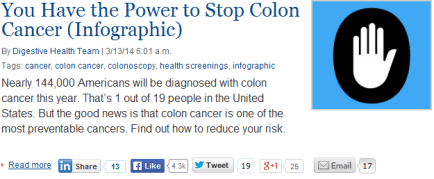
Newsflash: 144,000 is not “1 out of 19 people in the United States.” It is barely 1 out of 19 people in greater Cleveland.
The best argument against screening 45-year-olds
Nonetheless, when it comes to screening 45-year-olds for colon cancer, the best argument against it is that Star Wellness is for it. By way of background, Star Wellness is best known in wellness for not knowing anything about wellness. They take great pride in that, boasting that anyone can become a wellness vendor. All you need, they say, is a background in “sales or municipality administration,” five days of training…and of course a certified $65,000 check payable to — get ready — Star Wellness. No surprise that Star was leading the wellness industry’s race to the bottom until they got outstupided by Total Wellness, Interactive Health, and Wellsteps.
But Star Wellness is not willing to lose this race to the bottom without a fight.
Not content to offer the full range of USPSTF non-recommended screens, they are practically hyperventilating over this opportunity to add yet another one. They use the example of ovarian cancer screening to justify more colon screening. Here is the USPSTF on the subject of ovarian cancer screening:

The USPSTF found adequate evidence that screening for ovarian cancer can result in important harms, including many false-positive results, which can lead to unnecessary surgical interventions in women who do not have cancer. Depending on the type of screening test used, the magnitude of harm ranges from moderate to substantial and reflects the risk for unnecessary diagnostic surgery.
While we’re on the subject of Star Wellness…
Star, Vitamin B12 is not a vaccine.
And remind me why we are lining up employees to get Vitamin B-12 shots, vaccines or no vaccines?
While we’re on the subject of vaccines, according to the CDC, the biggest category of people who are supposed to get Hepatitis A/B vaccines include street drug users. If you are routinely hiring enough street drug users to be holding vaccination clinics focused on Hepatitis A/B, I’d say Vitamin B-12 deficiencies are not your biggest problem.
Share this:

A Festivus Special: The Year’s Funniest Vendors — Keas, Star, and Vivify
In the spirit of Festivus, we reprise four of the funniest vendors we’ve highlighted in 2015 that you might have overlooked. In more ways than one, these vendors didn’t get as many hits as they deserved:
- Vivify Brings Incompetence to Life.
- Keas Meets Lake Wobegone: All Employees Are Above Average (in Stress)
- Star Wellness Illuminates the Health Hazards of Wellness
and just to be fair and balanced…
Seasons Greetings from all (both) of us here at They Said What?

Share this:

First, Do Harm: The Ten Most Dangerous Wellness Vendors
If corporate wellness didn’t already exist, no one would invent it. In that sense, it’s a little like communism, baseball, pennies, or Outlook.
After all, why would any company want to purchase programs that damage morale, reduce productivity, drive costs up…and don’t work 90%-95% of the time? And that’s according to the proponents. What the critics say can’t be repeated in a family publication such as ours.
Still, those are the employers’ problems. However, the employers’ problems become the employees’ problems when employees are “voluntarily” forced to submit to programs that are likely to harm them. (As the New York Times recently pointed out, there is nothing voluntary about most of these programs.)
Recently, the head of United Healthcare’s (UHC) wellness operations (Optum), Seth Serxner, admitted that Optum’s programs consciously ignore US Preventive Services Task Force (USPSTF) screening guidelines. Lest anyone was expecting a wellness vendor to actually apologize for bad behavior, Mr. Serxner went on to blame employers for insisting on overscreening and overdiagnosing their own employees…and (by implication) overpaying for the privilege of doing so. “Our clients make us do it,” were his exact words.
Funny thing, we first asked our own clients who use Optum about why they turned down Optum’s generous offer to do more appropriate screenings at a lower price. None of them remember receiving this offer. Go figure. Then a UHC executive wrote and said we were making them look bad. I softened some of the language (like the paragraph below), and said I would happily retract the whole thing if indeed they could introduce me to just one customer — one out of their thousands — who recalls insisting on overscreening and overpaying. Never heard back…
United Healthcare isn’t alone in harming employees. They are just the first company to admit it, and far from the worst offender, as the harms of overscreening for the usual suspects (glucose, cholesterol etc.) don’t hold a candle to some of the more creative ideas listed below. Here, in order, are the ten vendors most likely to harm employees in the name of wellness.
#10 Healthmine
Healthmine’s CEO, Bryce Williams, isn’t blaming the victim like United did. He has publicly announced that Healthmine flouts clinical guidelines. He says he is right and everyone else — specifically including the “US Preventative [sic] Services Task Force” — is wrong. A real doctor acting on this pronouncement might be risking his or her license. Fortunately for Mr. Williams, being a wellness vendor doesn’t require a license, so regardless of the harms a wellness vendor inflicts on employees, no one can confiscate it because there is nothing to confiscate..
In addition to not misspelling the name of the group he is attacking, we might also recommend that he not misquote the sources on which his faulty argument is based. We’re just sayin’…
For starters Mr. Williams declares: “One out of every two people in America has at least one chronic condition according to the CDC…”
Here’s what the CDC really said: “One out of every two adults has at least one chronic condition.” And if you dig deeper, you’ll see that this list of chronic conditions cited by the CDC includes arthritis, mental illness, eye disorders and asthma, none of which Healthmine’s hyperscreening is going to reveal.
He also claims that “chronic diseases account for $3 out of every $4 spent on healthcare.” Here’s what the CDC really said: $3 out of every $4 “is spent on people with chronic conditions.” That is a much broader statement. It would include someone with borderline hypertension giving birth. In any event, we long ago eviscerated Mr. Williams’ cherished myth and just this week showed that essentially none of the top 25 hospital admissions has anything to do with screening, broccoli, or Fitbits.
#9 Cerner
The employee who recorded this blood pressure is essentially dead. Cerner’s diagnosis? Blood pressure “higher than what is ideal.” Cerner’s recommendation? “Talk to your healthcare provider.” A real doctor’s recommendation? “Call an ambulance. The guy barely has a pulse.”
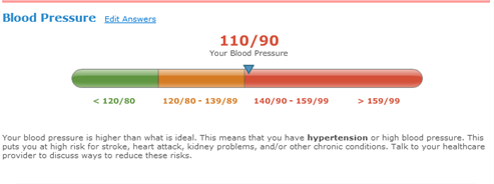
This is not a random mistake. This is the front cover of their brochure.
#8 Nebraska/Health Fitness Corporation
USPSTF Screening age recommendations aren’t minimums. They are optimums, the ages at which screening benefits might start to exceed harms, even if they still fall far short of costs. Otherwise you are taking way too much risk. This is especially true for colonoscopies, one of this program’s favorite screens — complications from the test itself can be very serious.
Your preventive coverage is not supposed to be “greater than health care reform guidelines.” That’s like “rounding up twice the number of usual suspects.” And you aren’t supposed to waive “age restrictions.” That’s like a state waiving minimum “age restrictions” to get a driver’s license.

Yet despite or perhaps because of this and other examples of total cluelessness and pure dishonesty, this program won a C. Everett Koop Award for excellence in wellness, not to mention the unwavering support and admiration of leading wellness apologist Ron Goetzel.
#7-#6 (tie) ShapeUp and Wellness Corporate Solutions
Both these outfits pitch exactly the opposite of what you are supposed to do in weight control: unhealthy crash dieting. Attaching money to this idea and setting a start date makes it even worse: along with crash-dieting during these eight weeks, you’re incentivizing employees to binge before the initial weigh-in.
Here is ShapeUp:

Here is Wellness Corporate Solutions:
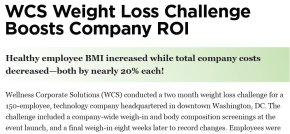
Both also made up outcomes. In ShapeUp’s case they had to rescind their “findings” after their customer, Highmark, skewered them in the press. And neither seems to care that corporate weight control programs are proven not to work.
In addition to its dystopian wellness program that collects employee DNA (partnered, ironically, with a company called Newtopia) and then makes up savings, Aetna owns the distinction of launching the only wellness program whose core drugs are specifically editorialized against in the Journal of the American Medical Association. This would literally be the most harmful wellness program ever, except that the only employees being harmed are (1) obese employees who (2) answer the phone when their employer’s health plan calls them to pitch these two drugs; (3) have a doctor who would willingly prescribe drugs that almost no other doctors will prescribe due to their side effect profile; and (4) not google them. Presumably in combination this is a very low percentage of all employees.
The good news is that these drugs, Belviq and Qsymia, should be off the market in a couple of years because almost no one wants to take them, so the harms of this Aetna program should be self-limited.
Star Wellness offers a full range of USPSTF D-rated screens. “D” is the lowest USPSTF rating, and means harms exceed benefits. Star gets extra credit for being the first wellness vendor to sell franchises. All you need is a background in sales or “municipal administration” plus $67,000 and 5 days of training and you too can poke employees with needles and lie about your outcomes. Is this a great country or what?
Also, their vaccination clinic features Vitamin B12 shots. We don’t know which is more appalling–routinely giving employees Vitamin B12 shots, or thinking Vitamin B12 is a vaccine.
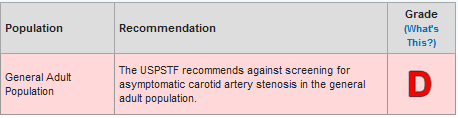
Angioscreen doesn’t have the most USPSTF D-rated screens. In fact, it offers only one screen in total, for carotid artery stenosis. That screen gets a D grade from USPSTF, giving Angioscreen the unique distinction of being the only vendor 100% guaranteed to harm your workforce.

Angioscreen’s other distinction is that they admit right on their website that this screen is a bad idea. This is probably literally the only non-tobacco company in America to admit you are better off not using their product.
Total Wellness loses the wellness industry’s race to the bottom only because the winner, HealthFair, has out-stupided them. However, in addition to the usual assortment of D-rated tests, they offer screens that the USPSTF hasn’t even rated, because it never, ever occurred to them that anyone would ever use these tests for mass screening of patients or employees. Criticizing the USPSTF for not rating these “screens” (CBCs and Chem-20s) would be like criticizing Sanofi-Aventis for not warning against taking Ambien after parking your car on a railroad crossing.
#1 HealthFair
Let’s leave aside for a fact that the majority of their other screens are harmful too, and focus on their screening for H.pylori, the strain of bacteria associated with ulcers. To say it is a stupid idea would be an understatement. As Clarice Starling replied when asked if Hannibal Lecter was a sociopath: “They don’t have a word for what he is.”
Likewise, this idea is too stupid for words, certainly for the small number of words we can allot to this overview blog. Visit our full treatment here. In a nutshell, the majority of us harbor H.pylori–without symptoms. It may even be beneficial. The screening test is expensive and notoriously unreliable, and the only way to get rid of it is with some very powerful antibiotics, a treatment rarely even used on patients with symptoms due to its inconvenience, ineffectiveness and potential long-term side-effects.
A Modest Proposal
So how should we as a country protect employees from these harms? Our policy recommendation is always the same, and very non-intrusive. We aren’t saying wellness vendors shouldn’t be allowed to harm employees. That would be too radical to ever pass Congress. If it did, the Business Roundtable would pressure the White House again, to preserve their hard-earned right to medicalize the workplace, and literally and figuratively, show employees who’s boss.
Instead, we recommend merely a disclosure requirement. The harms of screens or (in United Healthcare’s case) screening intervals that don’t earn at least a “B” from USPSTF should be disclosed to employees, and employees should get a chance to “opt out” into something that isn’t harmful (like Quizzify, perhaps?) without suffering financial consequences. Call us cockeyed optimists, but we don’t think employers should be able to force employees to choose between harming themselves and paying fines.
Share this:

Should the Wellness Vendor Oath Be: “First, Do Harm” ?

The Quizzify oath: First, do help.
When Thomas Edison said: “We don’t know a millionth of 1% about anything,” he wasn’t talking about the wellness industry, because wellness vendors aren’t that knowledgeable. And much of what they “know” is harmful.
Smoking and exercise aside, taking wellness vendors’ advice 10 years ago — during the time wellness was somehow allegedly racking up its famously fictitious 3.27-to-1 ROI by making employees healthier– would have been a very bad idea. PSA tests, annual mammograms for younger women, colonoscopies at 5-year intervals, and EKGs were perfect examples of must-to-avoid screens, even if it meant leaving incentives on the table.
And yet even though most wellness vendors (Star Wellness, Bravo Wellness Total Wellness, HealthFair Services and Aetna being notable exceptions) won’t harm employees as much as they did 10 years ago, a lot of mythology still causes a lot of harm today, albeit more subtly.
Myth: “We need to ‘do wellness’ because 75% of our healthcare cost is due to preventable chronic disease.” (Ron Goetzel, in our recent debate, boosted this figure to 80% for reasons unknown.)
Fact: Have ya looked at your high utilizers and other expenses? We-can-prevent-75%-of-cost-due-to-chronic-disease is the biggest urban legend in healthcare. We’ve done multiple articles on it — there are too many fallacies to squeeze in here. Though it’s just arithmetic, this is the most harmful fallacy of all, because by causing employers to obsess with overprevention, it spins off all the other fallacies below.
Myth: “Reducing our employees’ BMIs will save money.”
Fact: The actual science is far more nuanced. Some people have high BMIs because they are healthy. And belly fat — even at “normal” weights — is riskier than all but the highest BMIs. Further, attaching money to weight loss between weigh-ins creates a binge/crash-diet cycle that is decidedly unhealthy.
Myth: “Corporate weight loss programs save money.”
Fact: No corporate weight loss program has ever saved money. They don’t reduce BMIs, BMIs are the wrong measure (see above), and the link between reducing BMIs and saving money is nonexistent.
Myth: “Screening our employees will be good for their health.”
Fact: Annual screenings are a bad idea for the majority of employees. The head of Optum’s wellness operations, Seth Serxner, just acknowledged this inconvenient truth last week. (He somehow shifted the blame to employers, for stupidly spending too much money on Optum and other vendors. That’s a topic for another post.) The US Preventive Services Task Force has a schedule of screenings that essentially no wellness vendor follows. Because so few biometric screens are recommended for working-age adults by the card-carrying grownups who comprise the USPSTF, following USPSTF guidelines would bankrupt the industry.
Myth: “Screening guidelines balance costs and benefits so at worst we’ll break even.”
Fact: Screening guidelines balance harms and benefits, not costs and benefits. The subtlety of the distinction would be lost on most wellness vendors, but it is important. (1) Unless screens are provided free, an employer will lose money even on a screening program done according to guidelines; (2) you are not doing your employees any favors by providing screening “greater than” guidelines, like the Health Fitness Corporation/Nebraska program did. You are simply raising the likelihood of harm.

Myth: “Annual checkups will keep our employees healthy.”
Fact: For wellness vendors, the annual checkup has almost mystical power. Bravo’s CEO Jim Pshock loudly credits checkups with preventing cancer. Wellness vendor bloviating aside, the science is quite settled: employees are more likely to be harmed than benefited by annual checkups.
Myth: “Our employees need to eat healthier.”
Fact: OK, there is a, uh, grain of truth here. Many people have bad diets–fried food, sugar etc. But beyond eating less fried food and sugar, the science remains unsettled. Salt, saturated fat, complex carbohydrates…all in the realm of not completely settled. What is true and remarkably overlooked is the epidemiological rule of thumb that if an impact is major, it shows up in small samples. 86 cases were needed to link lung cancer to smoking. And a famous study of 523 veterans proved very high blood pressure causes strokes. Yet after tons of controlled and observational studies — even comparing countries to one another — we still haven’t found “the answer.” That means “the answer,” whatever it is, won’t matter much in the workplace. So you’re wasting your time trying to get employees to “eat right.”
We could keep going — antioxidants are more likely to cause cancer than prevent it. Sitting is not the new smoking. And drinking eight glasses of water a day is good for you only in that you’ll get more exercise going to and from the restroom.
The biggest myth of all? Wellness vendors actually do anything of value, other than make up savings figures to show your CFO so you look good. Or as my colleague Vik Khanna says: “Love your employees. Fire your wellness vendor.”
Share this:

Hey, How Come Wellness Needs an ROI But Real Healthcare Doesn’t?
Now that the myth that there is any ROI in wellness is thoroughly both debunked and also even acknowledged by the wellness industry, vendors often fall back on the “argument” that nothing else in healthcare needs an ROI. Why should workplace wellness be singled out? The editor of the American Journal of Health Promotion, Michael O’Donnell, even asked: “Who cares about an ROI anyway?”
The answer to Michael’s question? Everyone should care. And everyone should insist on an ROI from wellness, for three distinct reasons. Each reason is sufficient on its own. So even if there were a fallacy in two of the reasons (and there isn’t), the remaining reason would still be definitive.
First, consider an employee with appendicitis. You don’t calculate an ROI. You call an ambulance. But suppose a vendor says to you: “If an employee’s appendix bursts, the cost could be $100,000. So we propose taking out everyone’s appendix preventively.”
You’d ask: “What’s the rate of burst appendixes and how much do appendectomies cost?” While that’s an extreme example (and we didn’t mean to give these people any ideas), this is basically the calculation you should make when vendors propose screens. Here’s how to do the calculation. You’ll be shocked at how much it costs to avoid even one event by screening everyone.
Second, wellness is the only thing in healthcare that employees are forced to do, subject to a financial forfeiture of penalties or lost incentives. Other activities which people are penalized for not doing include: wearing helmets/life jackets/seat belts and getting kids vaccinated. In each case, the clinical evidence/science overwhelms considerations of personal choice. (Even then, in some states personal choice still rules.)
By contrast, the only thing that’s overwhelming about wellness evidence/science is how overwhelmingly the evidence eviscerates wellness, which of course is what this site is all about. Unfortunately, wellness vendors don’t understand evidence — or for that matter healthcare itself. Many vendors have no knowledge of basics like clinical guidelines, or even arithmetic. One wonders how they can do their jobs as wellness vendors without understanding healthcare. And that brings us to the third reason that wellness (unlike healthcare) needs an ROI, which is…
…Wellness isn’t healthcare. Quite literally every other provider of physical healthcare–from heart surgeons to acupuncturists–needs to train, pass a test, get a license, take continuing education, and be subject to review by an oversight board. Not wellness vendors. You can become a wellness vendor for $67,000. “Up to” eight days of classroom and on-the-job-training are also included in that $67,000. (To put that in perspective, Four Seasons housekeepers get ten days of training.) The vendor that offers these franchises, Star Wellness, brags about how no healthcare background is needed to be a wellness vendor. A background in “sales or municipal administration” is perfectly sufficient.
So if you’re wondering why wellness vendors know so little about wellness, there’s your answer: they aren’t required to know anything about wellness. Knowing just a little exceeds the minimum requirement.
Quizzify does have an ROI…and it’s guaranteed.
To conclude, here is our advice to workplace wellness vendors trying to justify what popular healthcare blogger Paul Levy calls the “wellness tax“: shut up and just be happy you still get to collect it, and that the authorities haven’t shut you down. (A doctor doing all this overscreening and billing for it would have been shut down.)
Don’t try to justify your hyperdiagnostic jihad on the basis of ROI or any other purpose other than enriching your bank accounts. Every time you try, you provide yet another reason why whatever college gave you a degree in anything other than advanced idiocy should lose its accreditation.
Share this:

You Too Can Become a Wellness Vendor…in Just 5 Days
Anyone care to become a wellness vendor? Good news: you can buy a wellness franchise from Star Wellness without knowing a single thing about healthcare…
…as long as you have your checkbook handy.
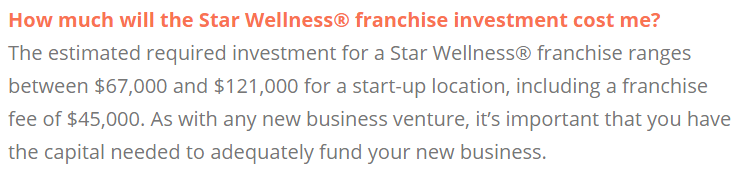
They do, however, recommend a background in sales, finance, or municipal administration.
The other good news — for you salespeople, financiers, or city managers — is that Star Wellness will teach you everything you need to know about wellness:
Yes, in five days you too can learn everything that Star Wellness knows, like how to ignore USPSTF guidelines, which is one category in which Star leads the industry. (One place they lag is reading comprehension, since we have already pointed out that most of what they propose is more likely to harm employees than benefit them…and yet they continue to advertise these hazardous screens.)
In addition to “up to” 5 days in the classroom, franchisees also get 3 days of on-the job training. So in case anyone is keeping score at home:
- Training required to get a job as a wellness vendor: 8 days
- Training required to get a job as a housekeeper at the Four Seasons: 10 days
This intensive training has captured the attention of WELCOA, which has named Star a Premier Provider:
WELCOA has very high standards, as we have noted on They Said What. One thing they excel at is spelling the name of their founder, assuming their founder invented the all-you-can-eat self-service restaurant.

A commitment to excellence, like that displayed by Star Wellness and WELCOA, might explain why employers have gone all-in on the notion that teaching employees, for example, to drink eight glasses of water a day will reduce healthcare costs, and also increase productivity, at least between trips to the water coolers and the rest rooms.
You’d learn far more than the typical wellness vendor knows about wellness simply by taking the Quizzify quiz. You’d learn more just by taking the demo quiz on the landing page.
Heck, you’d learn more just by reading the Quizzify landing page itself.

 They Said What?