
Home » screenings (Page 2)
Category Archives: screenings
Why do employee wellness industry leaders hate employees so much?
I would like to express my gratitude to the editor of the American Journal of Health Promotion, Michael O’Donnell. He recently decreed that “despite common lore, I am not an idiot.” Coming from a man brilliant enough to singlehandedly create entire alternative universes of arithmetic and statistics, “not an idiot” is mighty praise indeed.

I’m unsure exactly what “common lore” he is disputing, unless he means that the Phi Beta Kappa committee at Harvard also thinks I am an idiot, relatively speaking, because they snubbed me until I was a senior.
I will return the compliment. Michael O’Donnell is not an idiot either. Quite the contrary, he and his Koop Committee buddies knew exactly what they are doing when they gave their friends at Wellsteps awards for harming employees. Bottom line is, these people simply hate employees, and happily throw them under the bus whenever it’s profitable to do so. While Boise is a great example, Penn State still reigns supreme.
While we could write a post about almost any member of that Committee, this post focuses only on one member, Mr. O’Donnell. Still, it’s hard to dislike the man given all the kudos he throws my way. For instance, in addition to not being an idiot, I am also praised above as: “close to being accurate.” Since we disagree on everything, he is therefore acknowledging that he himself is many light-years from accurate — as Wellsteps and every other Koop award demonstrates.
Michael O’Donnell’s Anti-Employee Jihad
Michael O’Donnell also said, as you can see above, that I am not a “misanthrope.” However, in this case, I can’t return the compliment. His new editorial is a misanthropic anti-employee jihad. First, he says prospective new hires should be subjected to an intrusive physical exam, and hired only if they are in good shape. OK, not every single prospective new hire — only those applying for “blue collar jobs or jobs that require excessive walking, standing, or even sitting.” Hence he would waive the physical exam requirement for mattress-tester, prostitute, or Koop Committee member, because those jobs require only excessive lying.
Second, he would fine people for not meeting “outcomes standards.” In an accompanying document, he defines those “outcomes standards.” He specifies fining people who have high BMIs, blood pressure, glucose, or cholesterol.
Finally, he wouldn’t hire smokers at all, because they are so unworthy and untalented. Meaning Humphrey Bogart never should have been cast in Casablanca. Ernest Hemingway and George Orwell should have piled up rejection letters. Roger Maris should get his asterisk back.* Rihanna, Simon Cowell, Adele, Brad Pitt, Obama, Churchill, Einstein. Sinatra, Twain, Kidman. Sheesh! I agree with you, Michael. What a bunch of losers.
And thank goodness Watson didn’t smoke or Moriarty would likely still be at large.

A Unique Way to Charge Employees for Health Insurance: By the Pound
Almost every nonsmoker would be caught in his dragnet too, as he would “set the standard for BMI at the level where medical costs are lowest.” Since people with very low BMIs incur higher costs than people with middling BMIs, Mr. O’Donnell would fine not only people who weigh more than his ideal, but also employees with anorexia.
If employees didn’t already have an eating disorder, what better way of giving them one — and hence extracting more penalties from them — than to levy fines based on their weight? Hopefully, he would allow people with wasting diseases like cancer to appeal their fines.
Employees above his ideal weight would pay per pound, sort of like they were ordering lobster or mailing packages.
Yes, I have a hard time believing anyone would disdain employees that much too, so here is the screenshot:
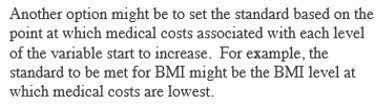
He claims that all these fines will “enhance morale” for employees, whether they like it or not.
How would Michael defend his anti-employee jihad?
The Wellness Ignorati don’t engage with me, for obvious reasons given their self-immolating comments when they do. So I’ll provide his rebuttal. It would be, as he said in the first screenshot above, that I am once again “creating controversy where it does not exist.” Clearly, his editorial and white paper are mainstream, and I’m just causing trouble again for no reason.
Michael wonders why, in his own words (echoed by Ron Goetzel), 90% to 95% of wellness programs fail. He says it’s because employers don’t spend remotely enough money on them. He recommends up to $300/employee/year…and what better way to reach that spending target than to make them go to the doctor, and set up expensive weigh-ins, inspections and fining procedures?
While Michael O’Donnell may not be an idiot, I’m not sure I could say the same about any CEO who takes his advice.
*Maris should get his asterisk back because, as a smoker, he still holds the record for “Most home runs by a player who never should have made the team.”
Share this:

Are you smarter than a wellness vendor? Take the Interactive Health IQ test and find out.
I’ve raised the bar for getting “profiled” on this site. Life is too short to simply highlight every wellness outfit that tests inappropriately and then lies about their outcomes.
Nor can you get on this list simply with bold proclamations of fatuous statements, like Interactive Health does:

Hey, Interactive Health, we get that you don’t understand statistics in general, based on the mind-boggling excuses your consultant offered about your completely invalid savings report (“Al, the [massive] savings on Page 4 have nothing to do with the [trivial] risk reduction on Page 9. It’s a completely separate analysis.”).
Even so, maybe you can find a smart person to explain this particular statistic to you:
- According to the CDC, the number of annual deaths caused by smoking: 480,000
- According to the CDC, the number of annual deaths caused by sitting: 0
Here are some other differences between the two activities: Chairs don’t carry excise taxes or warning labels. If you’re under 18, you can buy a chair without a fake ID. Workers are allowed to sit inside the building. Chairs don’t make you clothes smell, cause lung cancer or dangle from the lips of gunslingers in old John Ford westerns. Sitters aren’t assessed health insurance penalties. Your Match date will not feel misled if he or she catches you taking a seat, even if your profile didn’t disclose that you sit.
Sitting isn’t the “new smoking.” Opioids are the “new smoking.” But since you don’t help employees understand the risks of opioid addiction, it’s probably because you don’t understand these risks yourselves. Quizzify has produced a painkiller/pain reliever awareness quiz that you might benefit from. Welcome to 2016. THIS is what’s harming and even killing employees, not sitting.
The Interactive Health IQ Test
Which of these images is most unlike the others?

No, these days to get into this column, you need to soar above and beyond ordinary wellness vendor stupidity and dishonesty, because Wellsteps has totally raised the bar…and yet Interactive Health has cleared it.
I was recently screened by Interactive Health. They were supposed to send me a standard summary writeup, which I asked for repeatedly but never received. Instead, weeks later, their lab sent me a lab report, with no interpretation. There are one of three explanations for this:
- They are too incompetent to send out summary writeups in a timely way;
- They think an unadorned, highly technical, lab report sent three weeks after the fact constitutes a useful summary writeup;
- They were about to send out their standard summary writeup, before someone noticed my name and said: “Whoa! That’s Al Lewis. He is nowhere near stupid enough to find our usual nonsense acceptable. He has already exposed our savings lies in the Wall Street Journal, and if we give him our usual writeup on his screening, he will expose our stupidity on his blog. We need to cover that up. So let’s just send him a lab report.”
By process of elimination, I originally landed on #3. Quite flattering really. I’d make a few observations.
First, I specifically asked them, in accordance with USPSTF guidelines, not to measure my PSA. They interpreted that — as you can see from the top of that page reproduced at the very end — as a request specifically to measure my PSA. (It is on Page 2 of the report, which I can’t put my hands on right this very moment. However, the Wellness Ignorati, who still think it predicts cancer, will be disappointed to learn that it was quite low.)
Second, the glucose is slightly high because some very generous folks had just treated me to a large and delicious breakfast. A classic false-positive, the type of reading that makes wellness vendors’ hearts go all aflutter, because then they can do a followup reading and show that they improved the outcome, after it improves on its own. Interactive Health’s lab report was completely unhelpful on this high reading. No advice offered.
Third, Interactive Health shattered the record, previously shared by Total Wellness and Star Wellness, for most USPSTF non-recommended blood tests. I don’t know what half these things are, which means neither does Interactive Health. (Total Wellness might win a second-place tiebreaker because they would still be testing for ovarian cancer — it’s still advertised on their website — except that the only company that makes the test has pulled it from the market following FDA warnings not to use it. Hopefully, Total Wellness stockpiled some assays ahead of the recall, like Elaine did with the sponges.)
Interactive Health also tested me for calf tightness, as I mentioned in an earlier blog. It turns out my calves are tight, and right on-site they loosened them. I could feel my productivity soaring…until the left one went into spasm that night. Still, loose calves are a useful trait for some jobs, such as first baseman.

Interactive Health may have also just assumed that because they don’t like me, no one else in the industry does either. That’s actually a fairly accurate assumption, one I am quite proud of given the integrity of most of them, with their trade association, the Health Enhancement Research Organization, leading by example in the pants-on-fire department. Indeed a good rule of thumb to determine if a wellness vendor is honest is to ask them what they think of me.
Nonetheless, I was able to find someone who was screened at a different screening and said he received an actual wellness outcomes report from these people, someone who likes me well enough to send it to me. Coincidentally, this individual had been urging me to post on Interactive Health for quite some time. I figured, cool, I could see what a real report from Interactive Health looks like, the kind that changes employee behavior enough to explain their whopping savings claims of $54,000 for each employee who reduced a risk factor.
No such luck. He sent me exactly the same lab printout that they sent me. Only he hadn’t lost the second page, so I could count the total: 43 lab values. “Knowing your numbers” could be a full-time job. One would think they had covered all the risk factors with all those lab values, but, curiously, the guy said his blood pressure was quite high, and they missed that altogether.
Hmm…how come he got the same completely unhelpful report I did? Did Interactive Health view my linkedin profile — as their executives are wont to do on a regular basis bordering on the obsessive –and decide that it wasn’t safe sending any of my connections their typical employee printout, on the theory that if I’m not stupid, neither are most of my connections? If so, that would be their second fairly accurate assumption.
The only other explanation is that everyone receives the same unadorned lab report, full of letters and numbers and signifying nothing, at least to the average person without a PhD in biochemistry. My feelings were shattered. I wasn’t special. Do they send everyone else incomprehensible lab reports with 43 different numbers in them along with assortments of letters most people would associate with Scrabble…and no interpretations or advice?
Whether incompetence or botched coverup, the explanation itself remains a mystery. Nonetheless here are a few numbers and letters from his report.

Maybe Interactive Health could interpret this for us, but I would be more confident of their ability to distinguish (for example) AST-SGOT from ALT-SGPT if they could distinguish (for example) a chair from a cigarette.
Another one:

How is anyone supposed to make any sense out of this? Most employees would think a “negative risk factor” is a bad thing,” as in “telling the truth is a negative risk factor for the profitability of wellness companies, which is why most of them never do it.” And what does “VLDLCH” mean and why isn’t it reported? Still no interpretations.
And then of course there is the PSA test. If you don’t speak up — or even if you do speak up, as I learned — they’ll do one on you, even though the USPSTF rates it “D”, not to mention that the actual inventor of the test says the test is “inaccurate and a waste of money.” My friend’s PSA result is listed at the bottom of this apparently random number and letter generator…

And, yes, finally, an interpretation!
“Values obtained with different assay methods or kits cannot be used interchangeably. Results cannot be interpreted as absolute evidence of the presence or absence of malignant disease.”
In other words, the interpretation is that this test doesn’t explain anything, so we recommend ignoring the result.
It would have been even more helpful for them to recommend ignoring Interactive Health altogether– the calves, the chairs, the cigarettes, the AST and ALT, and, to be discussed in a future posting, the fabricated outcomes report.
Here is the entire first page of my own results, so that you know we are not taking this out of context…

Share this:

Should the Wellness Vendor Oath Be: “First, Do Harm” ?

The Quizzify oath: First, do help.
When Thomas Edison said: “We don’t know a millionth of 1% about anything,” he wasn’t talking about the wellness industry, because wellness vendors aren’t that knowledgeable. And much of what they “know” is harmful.
Smoking and exercise aside, taking wellness vendors’ advice 10 years ago — during the time wellness was somehow allegedly racking up its famously fictitious 3.27-to-1 ROI by making employees healthier– would have been a very bad idea. PSA tests, annual mammograms for younger women, colonoscopies at 5-year intervals, and EKGs were perfect examples of must-to-avoid screens, even if it meant leaving incentives on the table.
And yet even though most wellness vendors (Star Wellness, Bravo Wellness Total Wellness, HealthFair Services and Aetna being notable exceptions) won’t harm employees as much as they did 10 years ago, a lot of mythology still causes a lot of harm today, albeit more subtly.
Myth: “We need to ‘do wellness’ because 75% of our healthcare cost is due to preventable chronic disease.” (Ron Goetzel, in our recent debate, boosted this figure to 80% for reasons unknown.)
Fact: Have ya looked at your high utilizers and other expenses? We-can-prevent-75%-of-cost-due-to-chronic-disease is the biggest urban legend in healthcare. We’ve done multiple articles on it — there are too many fallacies to squeeze in here. Though it’s just arithmetic, this is the most harmful fallacy of all, because by causing employers to obsess with overprevention, it spins off all the other fallacies below.
Myth: “Reducing our employees’ BMIs will save money.”
Fact: The actual science is far more nuanced. Some people have high BMIs because they are healthy. And belly fat — even at “normal” weights — is riskier than all but the highest BMIs. Further, attaching money to weight loss between weigh-ins creates a binge/crash-diet cycle that is decidedly unhealthy.
Myth: “Corporate weight loss programs save money.”
Fact: No corporate weight loss program has ever saved money. They don’t reduce BMIs, BMIs are the wrong measure (see above), and the link between reducing BMIs and saving money is nonexistent.
Myth: “Screening our employees will be good for their health.”
Fact: Annual screenings are a bad idea for the majority of employees. The head of Optum’s wellness operations, Seth Serxner, just acknowledged this inconvenient truth last week. (He somehow shifted the blame to employers, for stupidly spending too much money on Optum and other vendors. That’s a topic for another post.) The US Preventive Services Task Force has a schedule of screenings that essentially no wellness vendor follows. Because so few biometric screens are recommended for working-age adults by the card-carrying grownups who comprise the USPSTF, following USPSTF guidelines would bankrupt the industry.
Myth: “Screening guidelines balance costs and benefits so at worst we’ll break even.”
Fact: Screening guidelines balance harms and benefits, not costs and benefits. The subtlety of the distinction would be lost on most wellness vendors, but it is important. (1) Unless screens are provided free, an employer will lose money even on a screening program done according to guidelines; (2) you are not doing your employees any favors by providing screening “greater than” guidelines, like the Health Fitness Corporation/Nebraska program did. You are simply raising the likelihood of harm.

Myth: “Annual checkups will keep our employees healthy.”
Fact: For wellness vendors, the annual checkup has almost mystical power. Bravo’s CEO Jim Pshock loudly credits checkups with preventing cancer. Wellness vendor bloviating aside, the science is quite settled: employees are more likely to be harmed than benefited by annual checkups.
Myth: “Our employees need to eat healthier.”
Fact: OK, there is a, uh, grain of truth here. Many people have bad diets–fried food, sugar etc. But beyond eating less fried food and sugar, the science remains unsettled. Salt, saturated fat, complex carbohydrates…all in the realm of not completely settled. What is true and remarkably overlooked is the epidemiological rule of thumb that if an impact is major, it shows up in small samples. 86 cases were needed to link lung cancer to smoking. And a famous study of 523 veterans proved very high blood pressure causes strokes. Yet after tons of controlled and observational studies — even comparing countries to one another — we still haven’t found “the answer.” That means “the answer,” whatever it is, won’t matter much in the workplace. So you’re wasting your time trying to get employees to “eat right.”
We could keep going — antioxidants are more likely to cause cancer than prevent it. Sitting is not the new smoking. And drinking eight glasses of water a day is good for you only in that you’ll get more exercise going to and from the restroom.
The biggest myth of all? Wellness vendors actually do anything of value, other than make up savings figures to show your CFO so you look good. Or as my colleague Vik Khanna says: “Love your employees. Fire your wellness vendor.”
Share this:

You Too Can Become a Wellness Vendor…in Just 5 Days
Anyone care to become a wellness vendor? Good news: you can buy a wellness franchise from Star Wellness without knowing a single thing about healthcare…

…as long as you have your checkbook handy.
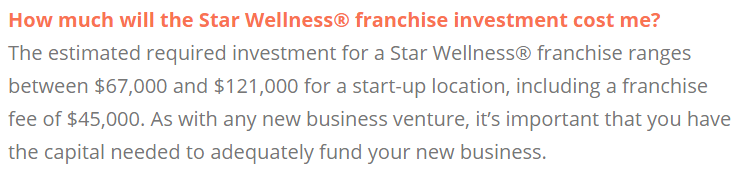
They do, however, recommend a background in sales, finance, or municipal administration.
The other good news — for you salespeople, financiers, or city managers — is that Star Wellness will teach you everything you need to know about wellness:

Yes, in five days you too can learn everything that Star Wellness knows, like how to ignore USPSTF guidelines, which is one category in which Star leads the industry. (One place they lag is reading comprehension, since we have already pointed out that most of what they propose is more likely to harm employees than benefit them…and yet they continue to advertise these hazardous screens.)
In addition to “up to” 5 days in the classroom, franchisees also get 3 days of on-the job training. So in case anyone is keeping score at home:
- Training required to get a job as a wellness vendor: 8 days
- Training required to get a job as a housekeeper at the Four Seasons: 10 days
This intensive training has captured the attention of WELCOA, which has named Star a Premier Provider:
WELCOA has very high standards, as we have noted on They Said What. One thing they excel at is spelling the name of their founder, assuming their founder invented the all-you-can-eat self-service restaurant.

A commitment to excellence, like that displayed by Star Wellness and WELCOA, might explain why employers have gone all-in on the notion that teaching employees, for example, to drink eight glasses of water a day will reduce healthcare costs, and also increase productivity, at least between trips to the water coolers and the rest rooms.
You’d learn far more than the typical wellness vendor knows about wellness simply by taking the Quizzify quiz. You’d learn more just by taking the demo quiz on the landing page.
Heck, you’d learn more just by reading the Quizzify landing page itself.
Share this:

HealthFair Wins Wellness Industry’s Race to the Bottom
Ever wonder why students don’t just grade themselves? For your answer, look no further than HealthFair.com’s self-assessed grade:

And yet by any standard other than their own, HealthFair completely flunks the test. Literally, their “basic package” proposes more “D”-rated tests (and “D” is a failing grade by US Preventive Services Task Force standards) than any vendor we’ve ever seen. They would lose their wellness vendor license tomorrow, except for the fact that wellness vendors don’t need licenses.

The first four all get “D”s. Here are the screenshots if you don’t believe that any vendor could possibly offer so many inappropriate tests at all, let alone in the “basic” package.
The abdominal aortic ultrasound test is such a stupid (where “stupid” is synonymous with “profitable”) idea for the non-elderly population that the USPSTF doesn’t even bother to say no:

Along with their “D” as a general screening tool, The EKG gets a whopping “I” for individuals at risk, but since HealthFair’s basic package includes no basic tests to see who is at risk, and by law they can’t ask about history, they would still have to screen everyone whether or not they are at risk:

By earning another “I”, the peripheral artery disease test does well by HealthFair’s standards. The USPSTF concludes that researchers don’t know enough about it to recommend it, which doesn’t stop HealthFair.
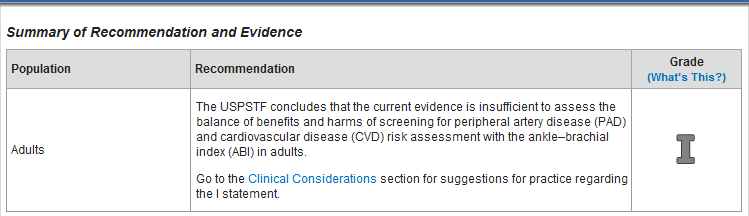
As for “hardening of the arteries,” the USPSTF doesn’t bother to grade it due to the fact that no one uses this test as a screen…except wellness vendors. But even the American Heart Association, not exactly shy when it comes to screening people for cardiac disease whose treatment can enrich their members who treat it, disses this test:

Speaking of D-Rated tests, sorry, guys. If you want a D-rated PSA screen — a screen not even recommended by its own inventor — you have to insist that your employer buy HealthFair’s “advanced” package:


Give your employees wellness that always earns an “A”
That brings us to the H Pylori screen, Healthfair’s groundbreaking, earth-shattering, pushing-the-envelope leap forward in the wellness vendor competition to out-stupid one another.
Where to start…
First, the US Preventive Services Task Force doesn’t bother to offer a recommendation on it, largely because no self-respecting doctor would ever screen patients for this. Shame on the USPSTF for consistently failing to anticipate all the ways in which wellness vendors can misunderstand basic clinical science!
Second, most of us who harbor H Pylori have no symptoms. So why screen for something that’s not causing problems? That’s why this is a test, not a screen. If you have an ulcer or symptoms that suggest an ulcer, go to the doctor. Even then, the doctor probably won’t even bother to test you, since most people get relief simply from well-tolerated, commonly used, proton pump-inhibitor medications–some of which don’t even require a prescription. It is only if the first-line medications fail that most doctors will even test you.
Third, there is a significant school of thought that says H. Pylori is beneficial. Screening us for something we’re better off having in our bodies represents a new frontier in the wellness industry’s answer to overdiagnosis, which we call hyperdiagnosis.
Fourth ironically, given the wellness industry’s obsession with employees’ weights, it is even slightly possible that killing off H. Pylori contributes to weight gain.
Fifth, what exactly are we supposed to do, if it turns out we harbor H. Pylori? Get a course of antibiotics to clear the bacteria out of our system? That’s a great idea. We’ve always maintained that one of the problems with America’s healthcare system is that patients don’t get to take enough antibiotics.
The good news for the pharmaceutical industry is due to the nature of H Pyroli, hiding in our stomach mucus, it takes a lot of antibiotics to ferret it out, plus a bunch of other pills. Is this a great country or what?
Sixth, the H Pylori tests themselves are among the most complex, unhelpful and inaccurate commonly used tests in existence.
Finally, half the world’s population has it. Given the expense and inaccuracy of the test and the prevalence of the bacterium, why not eliminate the middle step and just put all your employees on antibiotics?
One of us is a screaming libertarian. And even he thinks the cowboys that populate the wellness industry need to be reigned in with some regulation, before they screen the American workforce to death. The regulation would be very straightforward: employers and vendors must disclose the USPSTF recommendations to employees before making them take these tests. If after this disclosure, a few employees still insist on getting these D-rated or off-the-charts-inappropriate screens, congratulations! Your screening program will have just done something useful: identified employees who are totally incapable of making an intelligent decision.
To those of you who are reading this and thinking: “Haven’t I heard this song before?”, the answer is, you have. HealthFair is the “Intel Inside” for the screening jihad offered by SSM Healthcare, the Sisters of Saint Mary health system we “profiled” a few weeks ago, thus once again proving that wellness mantra: great minds aren’t the only ones that think alike.
Share this:


Star Wellness Illuminates the Health Hazards of Wellness
 Once in every great while, when we’re least expecting it, a company comes along that makes us reconsider our viewpoint–and ponder the possibility that maybe we’re wrong about wellness. Maybe, finally, we’ve discovered a company that will motivate employees to get well. Maybe a company that adheres to screening guidelines. Maybe even a company that will solve America’s healthcare crisis.
Star Wellness is not that company.
Quite the contrary: If you are an employee of an organization that has retained this outfit, your best course of action is simply to pay the fine and have nothing to do with these people. Or take the tests to secure your money, and then don’t open the envelope with the results in them, because due to false positives, you are equally or more likely to be harmed than helped by taking their full panel of tests.
Star Wellness says doctors “typically order these tests during a routine physical.” If you find a doctor that does so, please contact the licensing authorities because for many of these screenings, a doctor would be sanctioned for routinely ordering and billing for these tests on all patients. However, this being the wellness industry, there are no authorities…but there are plenty of tests. Not being doctors, wellness vendors are allowed to harm employees up to the limit of HR’s willingness to pay them to do so–and, being wellness vendors, they take full advantage of this budget. (Among other things, the higher the budget, the more vendors can pay the employers’ brokers–and hence the more likely they are to keep the account.)

Leaving aside all the tests they do that the United States Preventive Services Task Force (USPSTF) does not recommend doing annually if at all (which is to say, most of them), let’s focus on the ones the USPSTF specifically recommends not doing. In each case, we’ll use screen shots because otherwise no one would believe that any preventive services vendor could possibly be this out of touch with preventive services guidelines.
PSA screens for prostate cancer. Perhaps Star Wellness’s internet connection is down because nobody does these any more. Even the guy who invented the test recommends not doing it.

Carotid artery screening. Seriously? Even the Highmark/Goetzel Penn State program, the industry’s most coercive and ill-conceived program ever, didn’t recommend those.

Our favorite is abdominal aorta screening. These screens are so not-recommended for the <65 population that the USPSTF assumes nobody,no matter how stupid or dishonest, would ever do them. So they don’t even bother to waste valuable electrons posting non-recommendations of this screen for the <65 population. It would be like recommending not parking your car on a railroad crossing. Instead, all of their recommendations start with the assumption that people being considered for these tests (tests on individuals, not screens on everyone, by the way) are over 65 to begin with.


Even their basic tests are mostly USPSTF not-recommended as screens (and certainly not annual screens), but more interesting is some of the misinformation they’ve piled on top of these tests.
They say these tests are a “$350 value.” Since a checkup including tests costs $200 or less, the whole PCP profession would be going bankrupt if their math was right — and if doctors were actually doing these screens.
Of course they also make up their savings figures (all this overscreening somehow saves $250/employee net of the costs of the overscreening itself), but lying about outcomes is embedded in wellness vendor DNA. We can’t fault them for that. It isn’t possible to compete in this field without making up outcomes.

But they did make up at least one other statistic. As noted above, they said that 75% of Americans are deficient (or, more specifically, DEFICIENT!) in Vitamin D and need supplementation. However, the CDC and the rest of the triple-digit IQ grownup crowd say the opposite. The CDC notes that only 8% of Americans are deficient, while the Journal of the American Medical Association and the USPSTF also don’t recommend screening and supplementation.

In addition to not understanding preventive medicine guidelines, Star Wellness appears to not understand the (very few) regulations putting even the slightest of constraints on the wellness industry’s overdiagnosis-today-overdiagnosis-tomorrow-overdiagnosis-forever ethos. One of those very few constraints (ironically, a misguided one) is: wellness vendors can’t ask about family history. And yet, here they are…asking about family history. Now it’s possible they aren’t asking about family history and they mis-stated their own position, in which case by their own admission, they are doing this screen on people without a family history, people who shouldn’t get the screen at all. Their other screen on this slide, C-Reactive Protein, is also not recommended by USPSTF.

Not all the news about Star Wellness is bad. We always try to end on good news, and the good news is – if Star Wellness is to be believed – their needles are among the least contaminated in the entire industry!

A postscript
Sal, Wyoming’s not a country.

Star, Vitamin B12 is not a vaccine

While we’re on the subject of vaccines, according to the CDC, the biggest categories of people who are supposed to get Hepatitis A/B vaccines include toddlers and street drug users. If you are routinely hiring enough people fitting those criteria to be considering an on-site vaccination clinic, I’d say wellness isn’t your biggest problem.
Share this:

Total Wellness’s Total Package of Totally Inappropriate Tests
Total Wellness is very concerned about “fostering a positive culture in your office.”

And what better way to “foster a positive culture,” and “recruit talented employees to your workforce” so that they can “improve relationships with one another” than by screening the stuffing out of them?
To start with, don’t just ask your “talented employees” that you just “recruited” if they smoke. That would be too easy and obviously they would all lie, right? Isn’t lying exactly what talented employees do the day after you hire them? Of course! And isn’t deceit what a positive culture is all about? Of course! That’s why you have to test their nicotine 7 ways to Sunday.
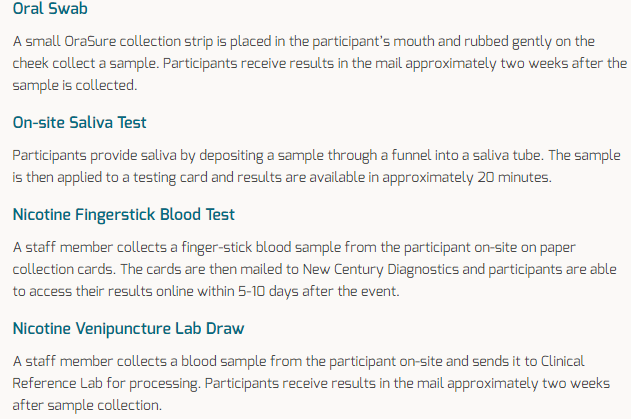
And if those tests are too easily gamed, here’s another one — just in case a few of those lying, cheating employees manage to pass the first set of tests, a la Lance Armstrong. And we wouldn’t put it past them to game the test. After all, they are “talented.”

When you’re done with nicotine, screen them for body fat. Nothing spells “talented employee” like an absence of body fat.

But wait…there’s more. Total Wellness offers a package of seven additional tests that aren’t recommended by the US Preventive Services Task Force. Now how much would you pay?
A lot, as it turns out (not even including follow-up from false positives). The more inappropriate tests you authorize, the more money they make.
Total Wellness is able to do this through their “partnership with Clinical Reference Laboratory.” Translation: they charge you, send some of the money to this other outfit, and keep the rest.
Let’s go test by test down their list.
First are two sets of tests that the USPSTF doesn’t even bother to evaluate because it would never occur to them that anyone, even a doctor, would use them as a screen.


Chem-20s aren’t even recommended as screens by the doctors who get paid to do them.
No one bothers to recommend against CBC screens…because CBC tests aren’t screens. A CBC is a test that actual doctors, not wellness vendors, order for patients who are not feeling well. Get it? As has been well-established for two decades, it’s not a screen. it’s a test. It’s useful for finding the sources of symptoms in a patient who presents in an actual doctor’s office, not for telling healthy people they’re sick. By analogy, if you think you broke your arm, the doctor might x-ray it. That’s a test. But even the dumbest wellness vendor wouldn’t propose X-raying all your employees as a screen to see if their arms are secretly broken.

Helping employees achieve health shouldn’t include lying to them. Quizzify them instead.
Assuming a CBC were used as a screen, it would be much more potentially hazardous than if a doctor were to do the test. Since apparently Total Wellness doesn’t understand the concept of false positives anyway (a prerequisite for being in the screening business is not understanding false positives), they would likely misinterpret the results.
How did Total Wellness manage to get a license as a wellness vendor without knowing the difference between a screen and a test? Simple — you don’t need a license to be a wellness vendor. That means wellness vendors are allowed to charge employers to perform screens on employees that would get doctors in a lot of trouble if they tried to bill insurers for them.
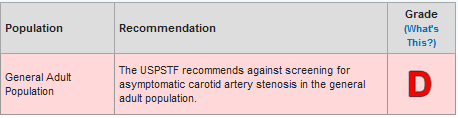
We’d encourage you to visit their site to see a few more proposed screens that the USPSTF doesn’t recommend doing, like TSH, homocysteine, CRP. But let’s end with the mother lode of the screening industry: screens that the USPSTF specifically recommends not doing, but are very profitable for vendors.

The good news is, Total Wellness isn’t overselling this test. They say it is “possibly an indicator of ovarian cancer cells,” which makes the test literally less than useless, due to the overwhelming number of false positives and false negatives from such a test. That’s why no grownup doctors use it as a screen and that’s why the USPSTF says:
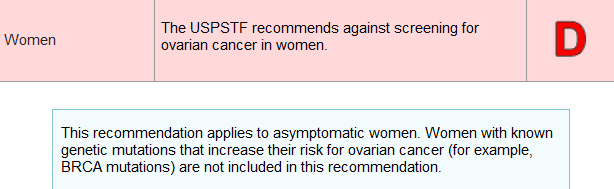
You may say: “Yes, but this ‘D’ recommendation doesn’t apply to women with the BRCA mutation.” Alas, by law, wellness vendors aren’t allowed to ask an employee whether she has a BRCA mutation or any other family history question, dramatically the reducing the already abysmal odds that a screening vendor might do something useful.
Let us close with my favorite test:
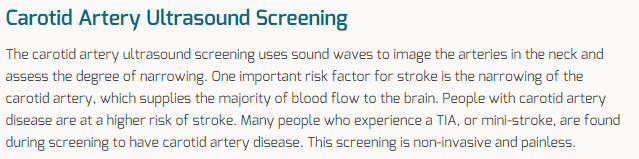
Ask vendors why they do it and they’ll say exactly what this one says: this test is “non-invasive and painless.” Sure. In that respect it’s not unlike palm-reading. The more relevant adjective that applies to both: useless.
If you want to get technical, “D” means less-than-useless.
We do like to close on a high note. Total Wellness is right in that this screening program would indeed help your employees “improve relationships with one another.” Forcing your employees to participate in this costly and misanthropic jihad might lead them to use their “talents” to all get together and revolt–just like at Penn State.
Share this:


We Concede the HERO Report is right–wellness does lose money
The HERO Report concludes that wellness loses money. We agree. We also think it loses much more money than they will admit to, but the news here is not about us. The news is that more than 3 dozen self-described experts and industry leaders representing more than 2 dozen companies have reached consensus that their industry loses money. 
Count us more shocked now than we were by the report’s admission that wellness adversely impacts morale, (This is covered in Installment 1.)
Together, the HERO findings — and our broad consensus with those findings — have serious Affordable Care Act policy implications. The entire basis for the ACA “Safeway Amendment” allowing large fines for (among other things) failure to lose weight is that the cost savings from skinnier employees merits invading their privacy, dignity and automony through medicalizing the workplace (“companies playing doctor” as some have called it). Senate committee hearings, proposed new legislation, and EEOC lawsuits around this provision have all been based on the assumption that wellness saves money. The Senate committee never even lobbed a softball question about that assumption, and even the more hostile witnesses didn’t challenge it.
Recently there was even an eyeball-to-eyeball encounter between the Business Roundtable’s (BRT) Gary Loveman and President Obama. Even though his company (Caesar’s) went bankrupt while embracing wellness as essential to their profitability, Mr. Loveman argued that corporations should be allowed to fine workers who don’t lose weight because the benefit to corporate bottom lines would trump both privacy concerns and the substantial health hazards of these programs.

Gary Loveman, Business Roundtable
Apparently, though, Mr. Loveman’s company went bankrupt slightly faster because of wellness. Yes, along with employees, employers would be better off without forced (highly penalized or incentivized) workplace medicalization. If you fire your wellness vendor, everyone benefits.
Everyone, that is, except the wellness industry denizens who make their money off this. That’s why we think HERO spoke the truth unintentionally. Very few people (I was one of them, having switched sides in 2007 when I saw that data failed to support wellness/disease management) willingly undermine their own incomes for integrity’s sake. So this posting will proceed on the basis that is was a gaffe on their part.
Curiously, this is the second time in recent months wellness industry leaders have accidentally admitted wellness loses money, and the third time they’ve accidentally told the truth and had to walk it back.
Equally curiously, wellness economics information disseminates very slowly if at all — testament in large part to the absolutely brilliant and flawlessly executed strategy by the Wellness Ignorati of ensuring that facts get ignored (hence their name). So even as the vendors are admitting that wellness loses money, benefits consultants and HR executives have once again pushed participation incentives/penalties to new highs, a whopping $693/employee/year, according to a new report.
As for the figures themselves, we are also attaching a spreadsheet so that you—as an employer—can figure this out on your own in your own population, rather than just take HERO’s word for it that wellness loses money.
The costs, according to the HERO report’s own screenshots
First, review the screenshot from the first installment, showing the costs of wellness. The list of cost elements is fairly exhaustive –down to the level of a space allocation for a health fair — though the Committee conveniently left out consulting fees. No surprise there, given that Mercer consultants sit on the committee.

Then, compare the list of costs in that screenshot to costs in this second screenshot, from Page 15 of the HERO Report. That comparison won’t take long because only one program cost is listed: “$1.50 — Cost of EHM [Employee Health Management] PMPM fees.”

The two lists of costs are totally inconsistent. Suddenly, when it comes time to measure ROI on page 15, most of the costs on Page 10 have disappeared…
The reason for that? The savings from wellness – in the HERO committee’s own words below – are so trivial that in order for wellness to produce savings, the second screenshot has to ignore most of the costs listed on the first one. Whereas the first screenshot listed three categories of costs covering 12 different line items (13 if you count the AWOL consulting expenses), the second screenshot says you should only count one item: vendor fees.
And by the way, the vendor fees themselves self-invalidate. At about $40 per employee per year, biometric screening fees alone cost more than the stated $1.50 per person per month, or $18/year. Yet $18/year is the total they list for all fees combined, including the $40 screenings.
Rather than point out the many cost elements on the first screenshot missing from the second, we’ll invite you to use our spreadsheet and enter your own data instead of theirs. Simply fill in your own direct costs of wellness.
Whatever number you get will dramatically understate your true costs because there are three elements of cost that we aren’t counting on this spreadsheet:
- What their spreadsheet call the “indirect” costs, which we have listed as “$0”,
- What their spreadsheet calls the “tangential” costs of damaged reputations and employee morale—ask Honeywell whether they brag about their wellness fines and lawsuit in their recruiting (and, ironically, I just returned from a consult for Penn State itself, where the adverse morale impact still overhangs employee relations);
- The massive costs of overscreening, overdiagnosis, and overtreatment generated by biometric screens – all of which are conducted far more often than the USPSTF recommends and most of which (as in the examples we occasionally post on this site) include screens that no one other than a wellness vendor or consultant would ever propose.
The financial benefits
Against those costs are the benefits. Page 15 lists some alleged benefits of wellness that leave us scratching our heads.
Generic substitution? How does that have anything to do with wellness? Quite the contrary, obsessing with wellness might take your eye off the generic substitution ball, and cause you to miss some tiering opportunities. (The company that is best at tiering its pharmacy benefit, Procter & Gamble, is also known for its current employee-friendly wellness program, sort of the anti-Honeywell.) And has anyone ever seen one health risk assessment (HRA) or participated in one health screen that even mentioned generic substitution?
Outpatient procedures? Try to find one person in your organization whose outpatient procedure could have been prevented by eating more broccoli.
ER visits? Maybe they decline. But maybe they increase, due to sports injuries sustained by newly activated employees. And someone who really is eating more broccoli might slice their finger chopping the crowns off the stalks. (Anybody who voluntarily eats the crowns with the stalks still attached doesn’t need a wellness program.)
And then the catch-all: savings through “overall wiser use of healthcare.” Come again? This is an industry that — as well documented by their own words captured on this website — makes its living telling employees to do exactly the opposite: go get checkups you don’t need and won’t benefit from, submit to screens far in excess of USPSTF guidelines so that vendors can brag about how many sick people they find, yo-yo diet for “biggest loser contests” and weigh-ins, like ShapeUp’s get-thin-quick 8-week crash-diet programs, and avoid eating fat and cholesterol and load up on carbs instead.
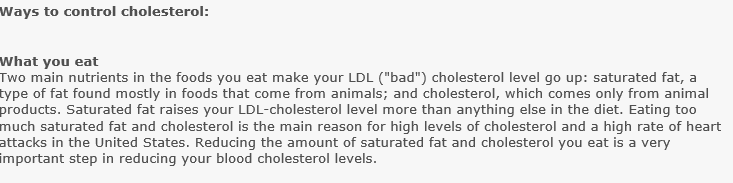
Perhaps what the HERO committee intends is that since employees largely don’t trust their employers, they will do the opposite of the recommendations.
The savings from wellness

When wellness doesn’t add up, Quizzify does
We are going to leave out respiratory savings. To capture those, charge a smoking differential and make smoking cessation available. Done. You don’t need an intrusive and expensive wellness program for that. (We are big believers in a “smoking differential” for employee-paid premiums. It makes sense for all the reasons weight loss and other wellness programs don’t.)
Instead let’s focus on people who have cardiometabolic issues. In order to lose weight and reduce their risk, they need to switch to a low-fat, low-cholesterol diet.
Oh, my bad! That is sooo 2014! While most of us not in the wellness business already knew the dangers of eating too many simple carbohydrates long before now, even the most ardent card-carrying member of the Wellness Ignorati learned in March that all their dietary advice has been wrong — to go along with their incorrect screening and checkup advice. Yet recommending exactly the wrong things hasn’t stopped most vendors from claiming massive savings. See “On the (Even) Lighter Side” and The Smoking Guns for examples.
Now let’s look at all the hospitalizations that can be avoided through wellness – heart attacks, angina, hypertension, and…um, hmm…did we mention heart attacks? You’re thinking: “What about diabetes events?” OK, we’ll add diabetes, only because the HERO report lists it and we want to be true to the report. But diabetes complications admissions (like CHF, which they also list) are a disease management issue, not a wellness issue — you can’t prevent or manage diabetic neuropathy or left-ventricular heart failure by eating more broccoli. The $1.50 PMPM price would not be high enough to also include disease management, and in any event what one does in disease management for complex cases is much different from a typical “pry, poke, prod and punish” wellness program.
And “straight” diabetes admissions are usually the result of diabetic employees pushing their blood sugar too low by over-medicating themselves—often in a good-faith effort to hit Hba1c “targets” that your wellness program set, no doubt on the advice of your consultants. Low blood sugar won’t do much for productivity either. Without the advice of a company specializing in diabetes, you’re likely to get this result. (And if this is the first you are hearing about the likely causes of “straight” diabetes ER visits and admissions, you should consider such an option.)
So we are now adding all ischemic and hypertensive heart events and diabetes as what they call “potentially preventable hospitalizations.” How many of your hospitalizations are for those items? Simply run the primary codes for those events, being careful not to double-count professional fees, to see how many you had. Here’s what happens when you do it for the United States as a whole.

Next, divide the relevant figure (Private insurance, 432,065) by the total number of privately insured discharges in the US (7,360,684)

So—using the HERO Committee’s own acknowledgment of the undeniable fact that wellness can only impact wellness-sensitive medical events (WSMEs) and using the diseases that the report says to use — less than 6% of admissions are WSMEs. If your non-birth-event admit rate is, as the report says, 45 per 1000, then you have 2.6 admissions per 1000 in non-smoking-related WSMEs. Once again, don’t take our word for this. Run this analysis on your own admissions. You won’t be surprised by how few there are. Do you even know anyone admitted to the hospital for these things, especially where the admissions could have been prevented with a few more screens, HRA and servings of broccoli?
Shameless plug: We are happy to do this WSME analysis for you. We do these all the time. It’s $4000. We can also tell you your savings, ROI, trend, comparison to others over time, and more. We also adjust for the major secular decline in cardiac events that has been taking place anyway for decades that the Committee seems to be unaware of, sort of surprising given their alleged expertise in cardiac risk reduction.
Let’s say you run this analysis with or without our help, and a rate/1000 similar to the US average pops up. The HERO report says you need to reduce this rate by “only 1 or 1.25 admissions.” But that’s almost half of your total 2.6/1000 WSMEs! And in any event, you’ve probably seen by now – if you downloaded the spreadsheet – that Page 15 seriously underestimates your wellness program expenses, meaning your breakeven reduction needs to be much higher than “only 1 or 1.25.” It’s probably higher than the number of admissions you have available to be reduced.
You can enter both your admissions per 1000 and the reduction in that figure you achieved directly into the spreadsheet.
But for now let’s very generously assume their expenses are right, and you only need to reduce admissions by 1 to succeed. How hard would it be to go from 2.6 to 1.6 WSMEs per 1000, a reduction of 39%? Here are five things to keep in mind:
- Your true engagement rate itself is probably much lower than that aforementioned 39%, not including people who simply participate for the money, and the people who are engaged generally aren’t the ones who would crash anyway;
- A big chunk of all heart attacks can’t be predicted at all, and certainly not now that law prohibits asking about family history;
- Even events that can be generally predicted can’t necessarily be prevented (we all know people who are “walking heart attacks” and have been ignoring advice for years);
- “Straight” diabetes admissions are more likely to be for over-control than under-control;
- In 7 years of measuring this, we have never seen a reduction in WSMEs remotely approaching 39% after adjusting for secular declines in cardiac events that take place even without a wellness program (which the report overlooks)
See The Million Dollar Workplace Wellness Heart Attack Screen in Health Affairs for a more in-depth view of the math. But the entire committee writing this HERO report insists wellness saves money, right? So, it’s us against them, right? A he said-she said? Wrong. Here’s the denouement. On Page 23, the report’s own example shows that wellness only saves $0.99 PMPM! That figure, by the way, is grossly overstated for reasons we will get to when we deconstruct Page 23. But for the time being, here it is.

So even their own comparison of their own overstated savings estimates to their own understated cost estimates reveal: wellness is a loser financially. They have already admitted it is a loser for employee relations. Funny — if we had made these two arguments, they would attack us. But they are making these two arguments themselves.
Once again, the Surviving Workplace Wellness mantra applies: “In wellness, you don’t have to challenge the data to invalidate it. You merely have to read the data. It will invalidate itself.”
Where does this leave us?
To summarize, pages 10, 15 and 23 combined tell us:
- Even before adding page 10’s cost categories back to page 15, costs are $1.50 PMPM;
- Savings are only $0.99 PMPM, meaning wellness loses $0.51 PMPM;
- The first two points are not our estimates — they’re their estimates and are far more optimistic than ours;
- Adding back the cost elements on page 10 to page 15, and then on Page 23 removing the respiratory savings, adjusting for secular decline in WSMEs, and adding in all the extra doctor visits would create a much larger loss from wellness;
- And they have already admitted that “pry, poke, prod and punish” programs are bad for morale.
Now you see why RAND’s PepsiCo study showed a negative ROI from wellness: It’s because there is a negative ROI from wellness, which no one disputes any more.
And you see the reason we asked the question in the last installment: Why would any company “do wellness” if the biggest proponents of wellness – people who make their living off it – admit that it’s a waste of money that adversely impacts morale?
Likewise, now you see why wellness vendors and consultants get “outed” all the time on this site, advocate savings methodologies designed to obfuscate rather than enlighten, and try to prevent you from learning that we exist. We are not saying they are sociopaths. Sociopaths lie for no reason. Conversely, wellness vendors and consultants are just trying to keep their jobs. Bleeding customers or clients dry is only a good job security plan if indeed the customers or clients never find out about it.
But now customers know how their own vendors and consultants really feel. And we can all work together to dismantle these programs and start doing wellness for employees instead of to them.
Poll: Cue the Wellness Industry Response…
We have a little dispute with RAND’s Soeren Mattke. He says the wellness industry modus operandi is, whenever one claim is disproven, to switch to another claim.
We say the reason they are known as the Wellness Ignorati is, their strategy is to ignore facts, including ones they admit, and they will simply just ignore this posting so as not to create a news cycle, rather than switch claims.
There is also the chance that they admit that their own financial model is accurate. This would demonstrate integrity, a quality historically in short supply in this field.
So vote early (but not often)…
While we aren’t deconstructing this as a sales tool for Quizzify. But as it happens, Quizzify is literally the only wellness program that does pay for itself. Don’t take our word for it. Quizzify is 100% guaranteed to save money and improve morale/engagement–exactly the opposite of what the HERO report says usually happens. No other wellness program is either, let alone both.

Quizzify: the antidote to poke-prod-pry-punish wellness
Share this:

Health Advocate Caught in the Act…
…Of getting it right!
Proof that wellness can be both useful & fun.
People think this site is all about “outing” scoundrels, but we’re just presenting facts, usually in the form of screen shots, that can’t be denied. That’s why none of the organizations or people “profiled” have ever sued us, despite our entreaties. However, sometimes the facts are actually good, and we want to recognize that too.
For this posting let’s set aside policy/economics issues and just focus on on-site execution of screenings. I attended a Health Advocate biometric screening which was being held in my neighborhood, to attract potential customers, meaning the attendees were comped but had been invited on the hopes that they would set up a screening event. The first thing they got right was the list of tests. The manager on site, Rich Prall, listed the usual tests. I then asked what other tests they had available. As you know, many vendors “profiled” on this site push completely inappropriate tests, that even if they were free would cause more harm than good. We have three more vendors in the queue too, each worse than the previous one in pushing tests that the US Preventive Services Task Force specifically says not to do.
Mr. Prall listed the same bunch of tests that the USPSTF recommends not doing, but then volunteered without being prompted that the right answer was indeed for an employer not to do them. (“If you do them at all, it should be at the doctor’s office. What’s an employer going to do about your potassium level, anyway?”) So Mr. Prall was willing to sacrifice revenues for integrity. Literally, this is the first time we’ve seen that happen. What Mr. Prall was appropriately shying away from, other vendors call their “Gold” or “Platinum” packages.
Next, I did some height/weight stuff. They had a device that measures body fat (and BMI, which of course is a bit squirrelly as a measure, but leave that aside for now). The body fat measurement was almost 20%. I am usually 2-3 points lower. It could have been the inaccuracy of the machine or perhaps because this winter’s weather has crimped my workout routine, but I expressed a little concern. The screener said: “Actually as you get older (I’m 59), you want to have a little body fat.” That is, once again, the right answer,an answer which shockingly few vendors are aware of.
Finally, I did the fingerstick. The screener explained it all very thoroughly, understood the distinction between fasting and non-fasting, and did everything quite well. Unlike Vik’s experience with Provant’s six-week delay, he ran the numbers right on the spot.
Even though a finger-stick is not particularly accurate, my values were what they usually are, except cholesterol. My cholesterol, at 127, was 30 points lower than usual. I expressed concern that a cholesterol value could be too low, and the screener said he didn’t know what too low was, but didn’t think it was an issue at 127.
So I googled it, and indeed there is a “too low,” but it is south of 127. Apparently people with too-low cholesterol tend to do impulsively self-destructive things, like attempt suicide or drive recklessly. I’ve never done anything particularly impulsive/self-destructive, unless one counts running this blog. So, once again, the Health Advocate person was right. That was 3 in a row, which might be a record for wellness vendors.
I could have talked to a counselor about the numbers but there was a bit of a line to get into these private areas, and in any event, I was so pleased with these guys that I didn’t want to risk bursting my balloon with one more conversation. (Nor have I visited their website to see if they make wacky ROI claims. Let me just live the moment, please…)
So I idenitifed myself (I hadn’t misrepresented myself earlier–remember, Vik and I are in the “integrity segment” of the market — but I just hadn’t given the full story) and congratulated them on best-in-class job of screening.
Literally every other vendor on this site could learn a lot from Health Advocate. I know I did.
Share this:

A Short Painless Primer on the Value of Screening
At the risk of knocking our second-most-widely viewed posting (the first of several analyses of the HERO report) off our front page, this is a brief and amusing lesson on the value of screening
If you like this, you’ll love this–it will also tickle your funny bone.

 They Said What?