
Home » Posts tagged 'Ron Goetzel' (Page 8)
Tag Archives: Ron Goetzel
New York Times 3, Wellness 0

Quizzify doesn’t misinterpret any employee’s right to not be coerced
Seems like the only people who hate wellness more than the reviled right-wing media are the reviled left-wing media, specifically the New York Times.
For the third time in the last 16 months, their economics blog has slammed wellness. This posting is about how “voluntary” wellness programs are anything but voluntary. If the incentive is high enough, a program is forced, even if the Business Roundtable pressures the EEOC into redefining “forced” as “voluntary.” Like if I park in a towaway zone here in Boston, I am forced to move my car or face a $200 fine. Moving the car in no way would be considered a voluntary act on my part. And yet fines for refusing to participate in wellness programs can be ten times that figure and still be considered “voluntary.” The column goes into great detail about how forced programs are not voluntary.
This column comes roughly a year after their last smackdown, the first line of which was:

We’re unsure how much clearer they can get, but even so, Ron Goetzel, who never steps out of character, misrepresented their conclusion.
- NYT: “We’ve said it before, many times and in many ways — workplace wellness programs don’t save money.”
- Goetzel interpretation: “The New York Times columnists…answered the question ‘Do Wellness Programs Work?’ with ‘usually not.’ “

If “voluntary” can mean “forced,” then I guess “no, never” can mean “usually not.” You know wellness is in trouble when even Ron Goetzel’s misrepresentation of their position says wellness doesn’t work.
Share this:

First, Do Harm: The Ten Most Dangerous Wellness Vendors
If corporate wellness didn’t already exist, no one would invent it. In that sense, it’s a little like communism, baseball, pennies, or Outlook.
After all, why would any company want to purchase programs that damage morale, reduce productivity, drive costs up…and don’t work 90%-95% of the time? And that’s according to the proponents. What the critics say can’t be repeated in a family publication such as ours.
Still, those are the employers’ problems. However, the employers’ problems become the employees’ problems when employees are “voluntarily” forced to submit to programs that are likely to harm them. (As the New York Times recently pointed out, there is nothing voluntary about most of these programs.)
Recently, the head of United Healthcare’s (UHC) wellness operations (Optum), Seth Serxner, admitted that Optum’s programs consciously ignore US Preventive Services Task Force (USPSTF) screening guidelines. Lest anyone was expecting a wellness vendor to actually apologize for bad behavior, Mr. Serxner went on to blame employers for insisting on overscreening and overdiagnosing their own employees…and (by implication) overpaying for the privilege of doing so. “Our clients make us do it,” were his exact words.
Funny thing, we first asked our own clients who use Optum about why they turned down Optum’s generous offer to do more appropriate screenings at a lower price. None of them remember receiving this offer. Go figure. Then a UHC executive wrote and said we were making them look bad. I softened some of the language (like the paragraph below), and said I would happily retract the whole thing if indeed they could introduce me to just one customer — one out of their thousands — who recalls insisting on overscreening and overpaying. Never heard back…
United Healthcare isn’t alone in harming employees. They are just the first company to admit it, and far from the worst offender, as the harms of overscreening for the usual suspects (glucose, cholesterol etc.) don’t hold a candle to some of the more creative ideas listed below. Here, in order, are the ten vendors most likely to harm employees in the name of wellness.
#10 Healthmine
Healthmine’s CEO, Bryce Williams, isn’t blaming the victim like United did. He has publicly announced that Healthmine flouts clinical guidelines. He says he is right and everyone else — specifically including the “US Preventative [sic] Services Task Force” — is wrong. A real doctor acting on this pronouncement might be risking his or her license. Fortunately for Mr. Williams, being a wellness vendor doesn’t require a license, so regardless of the harms a wellness vendor inflicts on employees, no one can confiscate it because there is nothing to confiscate..
In addition to not misspelling the name of the group he is attacking, we might also recommend that he not misquote the sources on which his faulty argument is based. We’re just sayin’…
For starters Mr. Williams declares: “One out of every two people in America has at least one chronic condition according to the CDC…”
Here’s what the CDC really said: “One out of every two adults has at least one chronic condition.” And if you dig deeper, you’ll see that this list of chronic conditions cited by the CDC includes arthritis, mental illness, eye disorders and asthma, none of which Healthmine’s hyperscreening is going to reveal.
He also claims that “chronic diseases account for $3 out of every $4 spent on healthcare.” Here’s what the CDC really said: $3 out of every $4 “is spent on people with chronic conditions.” That is a much broader statement. It would include someone with borderline hypertension giving birth. In any event, we long ago eviscerated Mr. Williams’ cherished myth and just this week showed that essentially none of the top 25 hospital admissions has anything to do with screening, broccoli, or Fitbits.
#9 Cerner
The employee who recorded this blood pressure is essentially dead. Cerner’s diagnosis? Blood pressure “higher than what is ideal.” Cerner’s recommendation? “Talk to your healthcare provider.” A real doctor’s recommendation? “Call an ambulance. The guy barely has a pulse.”
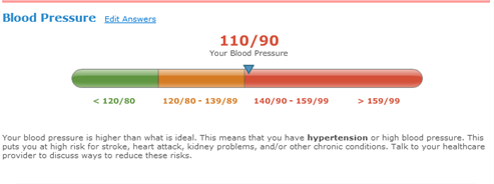
This is not a random mistake. This is the front cover of their brochure.
#8 Nebraska/Health Fitness Corporation
USPSTF Screening age recommendations aren’t minimums. They are optimums, the ages at which screening benefits might start to exceed harms, even if they still fall far short of costs. Otherwise you are taking way too much risk. This is especially true for colonoscopies, one of this program’s favorite screens — complications from the test itself can be very serious.
Your preventive coverage is not supposed to be “greater than health care reform guidelines.” That’s like “rounding up twice the number of usual suspects.” And you aren’t supposed to waive “age restrictions.” That’s like a state waiving minimum “age restrictions” to get a driver’s license.

Yet despite or perhaps because of this and other examples of total cluelessness and pure dishonesty, this program won a C. Everett Koop Award for excellence in wellness, not to mention the unwavering support and admiration of leading wellness apologist Ron Goetzel.
#7-#6 (tie) ShapeUp and Wellness Corporate Solutions
Both these outfits pitch exactly the opposite of what you are supposed to do in weight control: unhealthy crash dieting. Attaching money to this idea and setting a start date makes it even worse: along with crash-dieting during these eight weeks, you’re incentivizing employees to binge before the initial weigh-in.
Here is ShapeUp:

Here is Wellness Corporate Solutions:
Both also made up outcomes. In ShapeUp’s case they had to rescind their “findings” after their customer, Highmark, skewered them in the press. And neither seems to care that corporate weight control programs are proven not to work.
In addition to its dystopian wellness program that collects employee DNA (partnered, ironically, with a company called Newtopia) and then makes up savings, Aetna owns the distinction of launching the only wellness program whose core drugs are specifically editorialized against in the Journal of the American Medical Association. This would literally be the most harmful wellness program ever, except that the only employees being harmed are (1) obese employees who (2) answer the phone when their employer’s health plan calls them to pitch these two drugs; (3) have a doctor who would willingly prescribe drugs that almost no other doctors will prescribe due to their side effect profile; and (4) not google them. Presumably in combination this is a very low percentage of all employees.
The good news is that these drugs, Belviq and Qsymia, should be off the market in a couple of years because almost no one wants to take them, so the harms of this Aetna program should be self-limited.
Star Wellness offers a full range of USPSTF D-rated screens. “D” is the lowest USPSTF rating, and means harms exceed benefits. Star gets extra credit for being the first wellness vendor to sell franchises. All you need is a background in sales or “municipal administration” plus $67,000 and 5 days of training and you too can poke employees with needles and lie about your outcomes. Is this a great country or what?
Also, their vaccination clinic features Vitamin B12 shots. We don’t know which is more appalling–routinely giving employees Vitamin B12 shots, or thinking Vitamin B12 is a vaccine.

Angioscreen doesn’t have the most USPSTF D-rated screens. In fact, it offers only one screen in total, for carotid artery stenosis. That screen gets a D grade from USPSTF, giving Angioscreen the unique distinction of being the only vendor 100% guaranteed to harm your workforce.

Angioscreen’s other distinction is that they admit right on their website that this screen is a bad idea. This is probably literally the only non-tobacco company in America to admit you are better off not using their product.
Total Wellness loses the wellness industry’s race to the bottom only because the winner, HealthFair, has out-stupided them. However, in addition to the usual assortment of D-rated tests, they offer screens that the USPSTF hasn’t even rated, because it never, ever occurred to them that anyone would ever use these tests for mass screening of patients or employees. Criticizing the USPSTF for not rating these “screens” (CBCs and Chem-20s) would be like criticizing Sanofi-Aventis for not warning against taking Ambien after parking your car on a railroad crossing.
#1 HealthFair
Let’s leave aside for a fact that the majority of their other screens are harmful too, and focus on their screening for H.pylori, the strain of bacteria associated with ulcers. To say it is a stupid idea would be an understatement. As Clarice Starling replied when asked if Hannibal Lecter was a sociopath: “They don’t have a word for what he is.”
Likewise, this idea is too stupid for words, certainly for the small number of words we can allot to this overview blog. Visit our full treatment here. In a nutshell, the majority of us harbor H.pylori–without symptoms. It may even be beneficial. The screening test is expensive and notoriously unreliable, and the only way to get rid of it is with some very powerful antibiotics, a treatment rarely even used on patients with symptoms due to its inconvenience, ineffectiveness and potential long-term side-effects.
A Modest Proposal
So how should we as a country protect employees from these harms? Our policy recommendation is always the same, and very non-intrusive. We aren’t saying wellness vendors shouldn’t be allowed to harm employees. That would be too radical to ever pass Congress. If it did, the Business Roundtable would pressure the White House again, to preserve their hard-earned right to medicalize the workplace, and literally and figuratively, show employees who’s boss.
Instead, we recommend merely a disclosure requirement. The harms of screens or (in United Healthcare’s case) screening intervals that don’t earn at least a “B” from USPSTF should be disclosed to employees, and employees should get a chance to “opt out” into something that isn’t harmful (like Quizzify, perhaps?) without suffering financial consequences. Call us cockeyed optimists, but we don’t think employers should be able to force employees to choose between harming themselves and paying fines.
Share this:

Albert Einstein Meets the C. Everett Koop Wellness Award
Quizzify’s unified theory of healthcare: smarter employees use less
One of Albert Einstein’s great regrets was never having developed a “unified theory,” a consistent set of calculations that could explain the universe. That’s the bad news. The good news is that he did give us the word “Einstein” as in: “Ron Goetzel’s Koop Committee members are the biggest bunch of Einsteins in all of wellness, no easy feat considering the competition from WELCOA, HERO and others.”
Past postings have easily invalidated all the Koop awards since 2010. This did not require breaking a sweat. Rather, as Surviving Workplace Wellness observes: “In wellness, you don’t have to challenge the data to invalidate it. You merely have to read the data. It will invalidate itself.”
Previously, we’ve had to content ourselves with pointing out the plethora of individual rookie mistakes in each award. Now, however, we have a Unified Theory of Koop Award Ludicrous Impossibility. It reveals a remarkably consistent set of ludicrously mathematically impossible outcomes across all this decade’s award-winners. Not just any old ludicrously mathematically impossible outcomes but — and this is what excites my Inner Nerd — the same ludicrous mathematical impossibility pervades every award-winning outcome.
In each case the award winner has documented a small risk reduction among active participants. (They have also shown that willingness to participate, rather than the actual program, is what generates the savings, of course, but choose to ignore their own findings.) And in each case that small risk reduction generates what we thought were fairly random claims of savings. But it turns out that in 5 of the last 6 awards, the claims savings weren’t random at all but rather were essentially the same, using the same simple formula comparing risk reduction to claims savings. (The missing year is 2013. We can’t do Dell because we don’t want to embarrass them due to our relationships.)
The Unified Theory of Koop Award Ludicrous Impossibility Revealed
In the real world, trivial reductions in risk among participants — excluding non-participants because they increase in risk — have no impact on spending discernible in the white noise of random claims variation. And if we could discern an impact, it would be even more trivial than the risk reduction, because risk-sensitive medical events are a small percentage of total events. For instance, if risk-sensitive medical events comprise the typical 5% of total spending, and risk declines by 1%, the reduction in total spending would be 1% of 5%, or 0.05%. And that’s before subtracting fees.
However, on Ron Goetzel’s planet — also inhabited by fellow Einsteins like Optum’s Seth Serxner, Wellsteps’ Steve Aldana, and Staywell’s David Anderson, and obviously Mercer and Milliman — the opposite is true: a trivial reduction in risk generates massive cost savings. For example, McKesson saved $13 million via a 1% overall risk reduction. At that rate of savings and their rate of spending, their entire health spend could be wiped out if risk factors fell 14%. Not just their spending on wellness(risk)-sensitive medical events, but their total spending spending on healthcare. Wiped out. Gone. Obliterated.
A simple example can demonstrate how the Unified Theory works. Suppose the Koop Award goes to an outfit that claims to have achieved a 10% cost savings by reducing risks 2%. Then it follows that a 100% cost savings (10 times the claimed amount) could be achieved if risks fell 10 times the claimed 2%, or 20% in total.
To give credit where credit is due, we shall call this resulting figure — 20% in this hypothetical — the Goetzel Factor. The Goetzel Factor is specifically defined as: “The percentage decline in risk factors projected to wipe out spending according to the Koop Award Committee validations of risk and cost savings.”
The Evidence
Let’s review the last five awards (leaving out 2013) using this formula to estimate a Goetzel Factor. Note that the risk reduction is cross-sectional, meaning it is averaged across the entire population, not just participants. So if the stated or calculated risk reduction is 2%, as with McKesson, and half the employees participate (ditto), the figure in the table below for McKesson would be 1% (half of 2%).
Conclusion: the range of Goetzel Factors is remarkably tight–13% to 16%. Given the ludicrous impossibility of wiping out spending by reducing a small minority of risk factors, the consistency of the result is amazing: the Goetzel Factor reveals almost exactly the same ludicrous impossibility every time!
There are a few asterisks in this Unified Theory. In some cases, the award application itself wasn’t specific on some things, like total spending. So we made assumptions and “showed our work” as they say in fifth-grade math. Or, in the case of British Petroleum, we defaulted to their article in JOEM, which had much more detail. In any case, the spreadsheet calculations and sources are available to all legitimately qualified researchers, meaning those excluded from the Koop Award Committee because they aren’t Einsteins.

Koop Award Shmoop Award!
Share this:

Should the Wellness Vendor Oath Be: “First, Do Harm” ?
The Quizzify oath: First, do help.
When Thomas Edison said: “We don’t know a millionth of 1% about anything,” he wasn’t talking about the wellness industry, because wellness vendors aren’t that knowledgeable. And much of what they “know” is harmful.
Smoking and exercise aside, taking wellness vendors’ advice 10 years ago — during the time wellness was somehow allegedly racking up its famously fictitious 3.27-to-1 ROI by making employees healthier– would have been a very bad idea. PSA tests, annual mammograms for younger women, colonoscopies at 5-year intervals, and EKGs were perfect examples of must-to-avoid screens, even if it meant leaving incentives on the table.
And yet even though most wellness vendors (Star Wellness, Bravo Wellness Total Wellness, HealthFair Services and Aetna being notable exceptions) won’t harm employees as much as they did 10 years ago, a lot of mythology still causes a lot of harm today, albeit more subtly.
Myth: “We need to ‘do wellness’ because 75% of our healthcare cost is due to preventable chronic disease.” (Ron Goetzel, in our recent debate, boosted this figure to 80% for reasons unknown.)
Fact: Have ya looked at your high utilizers and other expenses? We-can-prevent-75%-of-cost-due-to-chronic-disease is the biggest urban legend in healthcare. We’ve done multiple articles on it — there are too many fallacies to squeeze in here. Though it’s just arithmetic, this is the most harmful fallacy of all, because by causing employers to obsess with overprevention, it spins off all the other fallacies below.
Myth: “Reducing our employees’ BMIs will save money.”
Fact: The actual science is far more nuanced. Some people have high BMIs because they are healthy. And belly fat — even at “normal” weights — is riskier than all but the highest BMIs. Further, attaching money to weight loss between weigh-ins creates a binge/crash-diet cycle that is decidedly unhealthy.
Myth: “Corporate weight loss programs save money.”
Fact: No corporate weight loss program has ever saved money. They don’t reduce BMIs, BMIs are the wrong measure (see above), and the link between reducing BMIs and saving money is nonexistent.
Myth: “Screening our employees will be good for their health.”
Fact: Annual screenings are a bad idea for the majority of employees. The head of Optum’s wellness operations, Seth Serxner, just acknowledged this inconvenient truth last week. (He somehow shifted the blame to employers, for stupidly spending too much money on Optum and other vendors. That’s a topic for another post.) The US Preventive Services Task Force has a schedule of screenings that essentially no wellness vendor follows. Because so few biometric screens are recommended for working-age adults by the card-carrying grownups who comprise the USPSTF, following USPSTF guidelines would bankrupt the industry.
Myth: “Screening guidelines balance costs and benefits so at worst we’ll break even.”
Fact: Screening guidelines balance harms and benefits, not costs and benefits. The subtlety of the distinction would be lost on most wellness vendors, but it is important. (1) Unless screens are provided free, an employer will lose money even on a screening program done according to guidelines; (2) you are not doing your employees any favors by providing screening “greater than” guidelines, like the Health Fitness Corporation/Nebraska program did. You are simply raising the likelihood of harm.

Myth: “Annual checkups will keep our employees healthy.”
Fact: For wellness vendors, the annual checkup has almost mystical power. Bravo’s CEO Jim Pshock loudly credits checkups with preventing cancer. Wellness vendor bloviating aside, the science is quite settled: employees are more likely to be harmed than benefited by annual checkups.
Myth: “Our employees need to eat healthier.”
Fact: OK, there is a, uh, grain of truth here. Many people have bad diets–fried food, sugar etc. But beyond eating less fried food and sugar, the science remains unsettled. Salt, saturated fat, complex carbohydrates…all in the realm of not completely settled. What is true and remarkably overlooked is the epidemiological rule of thumb that if an impact is major, it shows up in small samples. 86 cases were needed to link lung cancer to smoking. And a famous study of 523 veterans proved very high blood pressure causes strokes. Yet after tons of controlled and observational studies — even comparing countries to one another — we still haven’t found “the answer.” That means “the answer,” whatever it is, won’t matter much in the workplace. So you’re wasting your time trying to get employees to “eat right.”
We could keep going — antioxidants are more likely to cause cancer than prevent it. Sitting is not the new smoking. And drinking eight glasses of water a day is good for you only in that you’ll get more exercise going to and from the restroom.
The biggest myth of all? Wellness vendors actually do anything of value, other than make up savings figures to show your CFO so you look good. Or as my colleague Vik Khanna says: “Love your employees. Fire your wellness vendor.”
Share this:

Part 3 of the Proof Wellness Doesn’t Work.
This posting should be read in conjunction with Part 2 of the proof that wellness doesn’t work, which in turn links to Part 1 that shows mathematically wellness can’t work.
During the Great Debate, Ron Goetzel’s side admitted that wellness admissions haven’t fallen, but added: “Yes, wellness admissions haven’t fallen. However, without workplace wellness, wellness-sensitive medical admissions (WSMEs) would have risen. We kept WSMEs from rising.”
We explained how this wasn’t the case, and promised that we would post the analysis, so that he wouldn’t have to take our word for it. So here it is.
Since $11.3-billion was spent on these admissions in the private-pay population according to the wellness industry’s own HERO Report, these events would have had to rise by at least 60% in order to make the claim that the $7-billion wellness vendor industry broke even by avoiding them. If indeed workplace wellness prevented this huge increase in the privately insured population, one would expect that these very same events would have risen by something similar to 60% in the non-privately insured population–meaning the combined Medicare, Medicaid, and uninsured.
As researchers might say, the privately insured population was “exposed” and the remaining US population was “non-exposed.” As wellness spending snowballed, the separation between those two populations’ WSME trendlines should have increased significantly.
Instead, we find these populations WSME-as-percent-of-total-admissions also flat-lined, just like the private-pay population. Ironically, to the extent there is a difference, the population without access to workplace wellness trended slightly more favorably in WSME admission rates than the population with access to workplace wellness.
The graph below compares WSMEs — or what the HERO Guidebook refers to as Potentially Preventable Hospitalizations (PPH) — over this century, using the national Healthcare Cost and Utilization Project database.
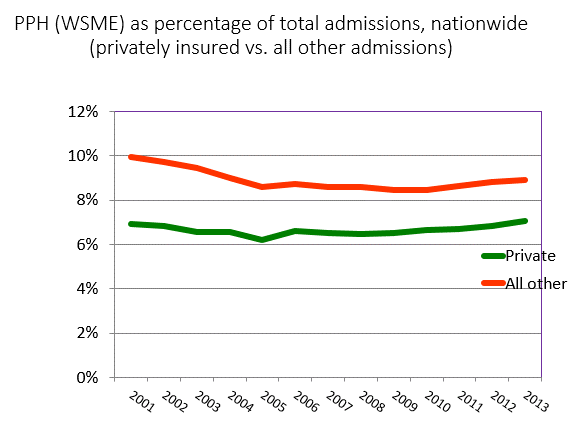
Likewise, the idea that wellness events have indeed fallen on an absolute basis in the employed population due to wellness is also a fallacy. These events have fallen even faster in the population not privately insured.
Share this:

And the Envelope Please. The Goetzel-Lewis Debate winner was:
Lewis.
It wasn’t even close. I offered a proof that wellness has not avoided a noticeable number of hospital admissions this century. Ron Goetzel accepted that the data was accurate and declined to claim the million-dollar reward for finding a mistake in it.
Here is the first post-debate coverage. Highly favorable. Quoted Ron as saying employees like wellness. Try telling that to an employee…
The exchange I will be dining out on for years will be when Ron admitted I am the best peer reviewed in the industry. After he accused me of not being qualified to do my job, the following transpired:
“Ron, will you admit I am the best peer reviewer in the industry?”
“No”
“Then who is?”
Silence, followed by laughter from the audience.
Ron’s biggest points are:
- Wellness works if you do it right
- Almost nobody does it right. Maybe Procter & Gamble did it right a quarter-century ago (yes, he cited a 25-year-old study) but unless you are Ron’s client or a few others, you’re doing it wrong
- You can only expect a 1-to-1 return, and he cited an example to that effect
Ron’s other points were (in no particular order):
(1) He had nothing whatsoever to do with the Penn State program even though he was one of four people in the conference room holding the press conference titled: Penn State Takes Offensive in Health Plan Controversy.
(2) Four people stood up to say how bad their program was. In each case, Ron’s answer was that it was their own fault or it was a lousy program. In one case when someone complained about the typically cliched advice given to them by a wellness coach, he said: “You should listen to them and then maybe you will change your behavior.” He and Michael O’Donnell agree that most programs (95% in Michael O’Donnell’s estimation) are done badly.
(3) I was castigated because Quizzify has a 100% guarantee of savings. In the wacky world of wellness, companies that don’t guarantee anything because they can’t achieve savings are better than companies that guarantee savings because they can achieve them.
(4) Companies do not screen according to guidelines, but that is their fault. Wellness vendors would be perfectly happy to cut their fees by 70% and just screen the people who the USPSTF says to screen.
(5) He said none of my stuff is peer-reviewed so I am not qualified to do peer review. That’s why I’ve been blacklisted. Never mind that my most recent peer-reviewed article is trending #1 for the year in a major journal. Never mind that all of their stuff is full of obvious rookie mistakes, and never mind that legitimate journals like Health Affairs ask me to peer-review. And never mind that Ron himself admitted I have found many mistakes in his stuff.
I also named all the household names (in healthcare, at least) who had reviewed our stuff–Stuart Altman, Tom Scully, Regina Herzlinger, Jim Prochaska, Bob Galvin, Leah Binder, Norton Hadler. Oh, yes–and Quizzify is the only company in population health whose content is reviewed and approved by doctors at Harvard Medical School. (Formal announcement forthcoming.) And then finally I observed that we weren’t standing up there today because of his peer-reviewed stuff. We were standing up there today because of my non-peer-reviewed whistleblowing.
(6) They will still be quoting Katherine Baicker’s “Harvard Study” with the 3.27-to-1 ROI for years to come. They claim the authors haven’t backed off it one iota, regardless of what Baicker has said. And since there are no other studies to cite other than their own (which accidentally found wellness loses money), they’re stuck with this one.
(7) RAND, the NY Times Incidental Economist, and the rest of the world are all wrong because they oppose wellness. His view is: “Everyone’s out of step but Ronnie.”
(8) Even though it appears that every employee in a “pry,poke, and prod” program thinks it’s a joke or worse (and that’s why the bribes and fines have to keep rising), employees really do love wellness and want more of it, according to Ron.
(9) He accused me of spreading lies and misformation but didn’t actually name any.
(10) He admitted to doctoring original applications in the Koop Award file after my exposes, but didn’t apologize either for doctoring them or for writing in Health Affairs that they weren’t doctored, but rather that the “original application is online and available for review.”
(11) He is still defending the lies told in the Nebraska program about saving the lives of cancer victims, and still thinks Health Fitness Corporation deserves their Koop award, even though only 161 state employees improved a risk factor and the state also lied about their savings.
(12) He says 80% of costs are due to preventable diseases like cancer. I have had cancer and it was not preventable. It is frustrating to see someone tell people that my disease was preventable, when it wasn’t. He is referring to the old urban legend, thoroughly debunked on this site, that 75% of cost is preventable…but, what the heck, why not add 5%? 75% or 80%, we had already shot this fallacy down anyway.
(13) Even thought the HERO Guidelines which he co-authored and which represent “countless hours of collaboration” say wellness loses money, he doesn’t believe that section. He didn’t write it or (I guess) read it during the “two years” of this guidebook’s development. And maybe the person who conducted the webinar defending it was a different Ron Z. Goetzel.
My points–none of which were rebutted except where noted–were:
(1) I proved (using the proofs on this site) that wellness loses money and that if he thought it made money he would claim his million-dollar reward. He accepted the proof (no choice — the database that the proof was based on is maintained by another part of his company) and didn’t rebut it. One of his cronies in the audience, Seth Serxner, tried to rebut the proof but we were fully prepared for that and already had the data. We apologize to Seth for making him look bad. So the proof that wellness has lost money for 14 years is established.
(2) I proved that his entire participants-vs-non-participants methodology is made up. This was not rebutted. So all the savings in all the Koop Awards are toast.
(3) There was no rebuttal to my observation that most programs don’t work according to their own data. The rebuttal was that their own data was only one case study.
(4) I showed that basically everybody who does not make their living off wellness is opposed to it, like the left wing media and the right wing media. (Wellness supporters are running out of wings.) See the In the News section.
(5) I also made the unrebutted point that his own allies on his own committee have strayed off the reservation too — Debra Lerner and Altarum and of course Michael “95% of programs don’t work and RCTs have negative ROIs” O’Donnell.
Conclusion: nothing will change. He and his cronies — even though they have now admitted my proof, and have all passed on claiming the $1-million award — will still attempt to shove programs down employees’ throats — even though most of them (in their own words) fail and (in their own words) it is “very hard” to do a successful program.
And as long as they continue to do try to protect their revenue streams on the backs of corporations and employees, we will continue to protect them from the “pry, poke, prod and punish” jihad that is increasingly part of our corporate culture.
A special shout-out to Professor Matthew Woessner of Penn State, who made the trip down to DC, and was able to ask very pointed questions about Ron’s/Highmark’s program, the worst in wellness history. Ron disavowed any part of the “awful” Penn State program (he must have gotten lost and wandered into that conference room mentioned above) A question was also raised to the point of, that’s only one university. So the others are all fine. Matthew then got up and said Ohio State, which was the only other one he was closely familiar with, also hated their program. Quite a timely put-down and along with the questions from actual wellness program participants, highlighted the disregard in which most employees hold these programs.
Share this:

Part 2 of the Proof: Even If Wellness Could Save Money, It Doesn’t
Recently we promised a Part 2 to our original proof that wellness savings are mathematically impossible. Commenters said: “How can you have a Part 2 to a proof? You just proved it.”
Read on.
The previous proof showed wellness can’t save money, even if programs were perfect. This installment proves that even if wellness could save money, it hasn’t. Meaning even if wellness were free, it couldn’t pay for itself. So this proof is independent of the previous proof. For wellness to save money, the wellness true believers would have to find fallacies in both proofs. Either is sufficient to make our case…but we have both.
Quite literally, forcing employees to “do wellness” or lose money has avoided basically zero wellness-sensitive medical events in the 13 years ending 2013 (2014 data isn’t in yet), according to the federal government. If the name “federal government” sounds familiar, it’s because it’s the very same federal government that has passed a law encouraging vendors to pitch “pry, poke and prod” programs to you despite their complete lack of evidence basis, lack of effectiveness, and potential for harm.
Here is the way our analysis was done. We used the government database called the Healthcare Cost and Utilization Project, or HCUP. That database tracks all hospitalizations due to all causes, by population. So it is possible to focus on just the commercially insured population, which they call “privately insured.”
The privately insured population is 100% sensitive, meaning everyone whose workplace “offers” wellness is in that database. The database isn’t specific, meaning plenty of people in it do not have access to wellness. Nonetheless, the dramatic increase over the 13 years in the number of people whose employers push wellness should produce an equally dramatic decrease in wellness-sensitive medical events. While wellness was rare at the start of this analysis in 2001, today most large companies, nonprofits, and governments have wellness. In total, one can project from the Kaiser Family Foundation data that about 75-million people (or roughly half of all privately insured people) are subject to what Jon Robison has termed wellness-or-else.
Keep in mind that all hospitalizations have been declining over this 13-year period, due to shifts to outpatient, better usual care, etc. So the question is not whether WSMEs have been declining, but whether they have been declining faster than the rates of all other hospitalizations in combination due to the large and increasing “dose” of wellness” being applied to them.
Instead, as you can see, these WSME admissions have trended essentially flat over the period, as a percentage of all admissions. In other words, there is no difference between the decline in admissions for WSMEs – despite $7-billion/year being spent on vendors to prevent them – and the declines in every other category of hospitalization. 13 years ago about 6.9% of events were wellness-sensitive. Now it’s about 7.0%. (This is 2013. 2014 is also in, for our customers for whom we track WSMEs, and shows no change.)
This is based on ICD9s 401-405, 410, 430-438, and 250 — strokes, hypertensive events, heart attacks, and diabetes events.

To make the point visual, the “dose” of wellness probably quintupled, in total, over this period, so the directional expectation of the chart would be:

Prima facie, the debate is over, again, just like it was over after our last proof.
Needless to say, the true believers aren’t about to give up their revenue stream just because we’ve double-proved they’re fabricating savings. They will make two arguments against this proof of their own ineffectiveness. First, they’ll argue that wellness reduces all events and other costs equally, so really we should credit wellness for the total cost reduction, not the reduction in just wellness-sensitive admissions. This might seem like a pollyannish view of wellness, but wellness true believers attribute everything that’s good to wellness. True believer Bruce Sherman has even argued that wellness actually reduces industrial waste, so to a wellness true believer, eating more spinach makes every employee a Popeye.
Unfortunately for Bruce and others, the wellness industry’s own HERO report says wellness can only reduce WSMEs. Other costs go up, it says:

Second, one could argue that there isn’t enough penetration of wellness yet to bend this trend, since the HCUP privately insured population includes tons of people without access to wellness, and even many people with wellness access refuse to participate.
Unfortunately, that argument self-immolates. Vendor fees are $7 billion. All these WSME ICD9s combined (using the HERO-estimated admission cost of $22,500) amount to about $11.3 billion. That $11.3 billion includes the half of privately insured people who don’t have access to wellness. Already, when you cut that figure in half to account for those employees with employers who’ve decided not to “do wellness” to them, the $7 billion size of the wellness industry exceeds the size of avoidable events ($5.7 billion). This is consistent with our first proof, which showed the same thing, but on an individual company level. Now—assuming participation is 50%, you need to cut the WSME hospitalization total in half once again. You’re down to $2.85 billion in potentially avoidable events — that companies are spending $7 billion on vendors to avoid.
So, no matter how you look at it, “pry, poke and prod” programs have been singularly ineffective in reducing WSMEs. And if the HERO Guide is right that these are the only admissions wellness can avoid (while other costs increase, as they admit), wellness does not and cannot save money.
Instead, wellness-or-else is basically a pile of, um, industrial waste.
Anyone still want to try to claim the million-dollar reward for showing pry, poke and prod programs aren’t a total waste of resources? I didn’t think so.
The thing most likely to save money is knowledge.
Note: This graphical analysis is copyright 2015 to Quizzify. However, any disinterested researcher or journalist may request a copy of the backup material from us.
Share this:

Wellness isn’t only junk science. It’s also junk arithmetic.
Vendors of “pry, poke and prod” programs often wax rhapsodic about “Wellness 2.0.” Translation: HRA-screening-checkup programs have historically failed. Likewise, vendors talk about how more “wellness champions” or better “communications plans” or higher incentives/penalties are needed to make wellness work–as though it’s HR’s fault vendors are misrepresenting what their programs can do.
Unfortunately for those vendors, tinkering with wellness is like tinkering with alchemy. Nothing can turn “pry, poke and prod” lead into gold. Understanding that wellness is alchemy is why we’ve offered the million-dollar reward…and also why that reward has had no takers. Wellness outcomes measurement is junk arithmetic, to go with the junk science of screening the stuffing out of employees in order to hyperdiagnose them. All told, vendored wellness is the kind of junk that gives junk a bad name.
We’ve covered the junk science at length, showing how vendor after vendor ignores clinical guidelines either because they don’t understand healthcare or because they want to maximize profits. Today we are covering junk arithmetic.
Here is Part One of the very simple mathematical proof of why “pry, poke and prod” can’t possibly save money. All this information comes from the wellness industry’s own materials, notably the HERO Outcomes Guidelines Report. They can’t “challenge the data” because it’s their data. All we’ve done is fashion it into a proof.
The Size of the Pie: “Potentially Preventable Hospitalizations” (PPHs)
The HERO Report places the current PPH rate at 2.62 per 1000. (It was once higher — 3.14, as noted below — but usual care improvements continue to reduce admissions for both asthma and cardio/IVD, reducing the need for wellness even as vendors insist that all your employees are getting sicker.)
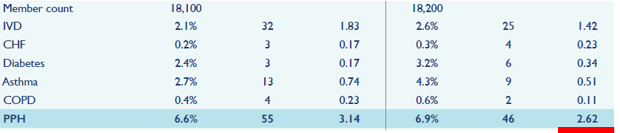
That same page (23) of that same report lists the episode costs of a PPH at $22,500.

The product of those two components? About $59,000 per 1000 people, or $59/person.
And alas you can forget about adding other healthcare cost savings from wellness to that $59. That’s wishful thinking. The Goetzel crowd not only admits they don’t decrease, but says they are likely to increase (p.22)
The Cost of Wellness
Against that $59, what is the cost of a wellness program? $150/employee, according to Ron Goetzel. (Your cost could be higher or lower, obviously. Wellness vendors collect about $7 billion by prying, poking and prodding about 70 million people, so typical vendor fees are about $100.)
Therefore even a wellness program that eliminates every potentially preventable hospitalization without increasing doctor visits or those other listed expenses would lose money–$91, if Mr. Goetzel’s advice is taken.
And this is according to the wellness industry’s own cost figures, which of course are highly suspect, largely because their costs count vendor fees only. Our figures would add in all the other costs of wellness. Though the HERO Report ignored these other costs in its own calculations, it nonetheless listed them on p 11. (This list overlooks the hefty consulting fees involved in making up positive outcomes figures to show to the C-Suite. This is no surprise given that Mercer was a co-sponsor of this report.)

Want proof that Quizzify is more fun & smarter than any wellness program? Take the quiz.
Also remember that this $91 loss is for a perfect wellness program –one that eliminates all $59 in spending with no added preventive services cost. Coming soon is the second half of the proof, showing that wellness programs are anything but perfect.
Share this:

Mr. Goetzel Covers Up his Cover-Up: The latest on the Nebraska Koop Award
To our new readers, while 2016 was the first time a Koop Award ever went to a company that harmed employees, 2016 wasn’t the first Koop Award ever to go to a company whose own data showed they fabricated results. Below is a history of one of the Koop Award’s Greatest Hits.
For those of you who haven’t been following the saga of the Nebraska state employee wellness program, here is a crash course, aka “Lies, Damn Lies, and the Nebraska State Wellness Program.” If you have been following it, you can skip to the end for the latest installment, Mr. Goetzel’s cover-up of his cover-up.
By way of background, this program is called “wellnessoptions” (imagine e.e. cummings-meets-poking employees with needles-meets-a sticky spacebar). They used to say the Holy Roman Empire was neither Holy nor Roman nor an Empire. Likewise, wellnessoptions is neither optional, if you want a decent deal on healthcare, nor wellness. Instead of wellness, it features a hyperdiagnostic anti-employee jihad in which Health Fitness Corporation (HFC) diagnoses employees but does nothing about the diagnosis except take credit for it.
TIMELINE — PART ONE: HFC’S TROUSERS COMBUSTED
September 24, 2012, 2:00 PM
I read Health Fitness Corporation announcement that its customer, the state of Nebraska, won Ron Goetzel’s C. Everett Koop Award for program excellence.
September 24, 2012, 2:01 PM
I recognize that the cancer outcomes were obviously made up. Until then, I hadn’t been following the Koop award closely enough to realize that making up outcomes was apparently one of the award criteria, as I later came to learn.
October 2012
I read the full write-up on the program and realize that not only were most of the other outcomes made up, but they had actually lied about saving the lives of cancer victims. If you screen a few thousand people for colon cancer, you don’t find 514 cases of cancer, and you certainly don’t save their lives, as HFC was claiming. And you absolutely don’t save money, as they were also claiming. All this is even more true when you waive age-related guidelines and let anyone get screened, and encourage overscreening by sending out 140,000 letters to state employees graced with the picture of a beautiful young model way too young to be getting a colonoscopy.

How this invalid nonsense ever got by all the eagle-eyed Koop Committee members would be a mystery, except that HFC is a sponsor of the Koop Committee.
December 2012
I review the entire application and all the marketing materials. It becomes obvious that the entire thing was made up, not just the cancer part. They claimed to save $4.2 million because 161 of their roughly 6000 participants reduced a risk factor.
The math is quite self-evident. Suppose you doubled the number of participants who reduced risks to 312. It stands to reason that you could save $8.4-million. Double it again to 624 and you save $16.8.
Now double it one more time. If 1,248 people out of those 6000 reduced one single risk factor, you’d save $31.6-million, which is about equal to the entire spending for all 6000 participants. And of course most medical spending has nothing to do with identifying previously unrecognized risk factors, so this would be quite a feat. (Do you even know anyone under 65 who had a heart attack that could have been avoided by one more workplace screening?)
I later learn that all the Koop Award-winning program outcomes are made up, using exactly the same math.
November 2012 to June 2013
I try to contact the authorities, like Roger Wilson, who allegedly runs this program for the state, but no one seems to care. The rule of thumb in the wellness industry is that what you say counts. What you do is pretty irrelevant.
June 20, 2013
Breakthrough: The Wall Street Journal editors decide that I am correct, and that the outcomes were made up. Vik and I are allowed to publish this on their op-ed page.
July 14, 2013
Breakthrough again: Another very well-read blogger professes shock-and-awe that any vendor could lie so blatantly and apparently get away with it.
July 15, 2013
Breakthrough yet again: Ace reporter Martha Stoddard of the Omaha World Herald gets Dennis Richling of Health Fitness Corporation to admit that the outcomes — at least the “life-saving catches” of “early stage cancer” outcomes — were indeed made up. Richling tries to spin his gaffe by calling the difference between “life-saving catches of early-stage cancer” and saying someone might possibly get cancer in the future “semantics.” So, according to Richling, having cancer and not having cancer are the same thing.
February 1, 2014
The hilarious wellness industry smackdown Surviving Workplace Wellness is published. Since the HFC Nebraska program had too many lies to fit on a page or two, it gets its own chapter. Here’s the opening paragraph, which in all modesty I must admit is one of my favorite in the book.

February 23, 2014
Nebraska political blogger ReadMoreJoe picks up the scent. He points out that this wellness program is an obvious fraud. The problem is that the same posting is also exposing several other equally obvious frauds, so this one gets overlooked.
TIMELINE–PART TWO: GOETZEL STRIKES BACK
Ron Goetzel isn’t about to sit back and let his friends/sponsors/clients be pilloried for a little white lie about saving the lives of cancer victims who didn’t have cancer.
June 2, 2014
At the Health Datapalooza conference, Ron Goetzel, while admitting the Nebraska cancer outcomes data was made up, claims they/HFC still deserve the Koop Award because he somehow didn’t realize the data was made up at the time the award was granted. And it is true that HFC didn’t actually announce they had made up the outcomes. Ron would have had to actually read the materials to figure it out, same as I did.
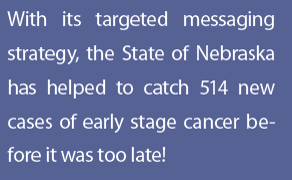
September 2014
Ron Goetzel calls the Nebraska program a “best practice” in the Journal of Occupational and Environmental Medicine but refuses to answer any questions about the obvious mistakes and inconsistencies in the article.

November 2014
After knowing for 16 months that they had lied, Ron Goetzel, writing in Employee Benefit News, finally drops Nebraska from his list of best-practice programs:

Being a fair-minded person, I take it upon myself to congratulate him on his newfound sense of ethics. I don’t specifically agree that what he did was ethical, because the ethical thing would have been to admit complicity, apologize, and revoke their Koop Award. But I do say that Nebraska being dropped from the list of best practices means ethical “progress is definitely being made,” albeit from a low base.

Only 29 minutes elapses before Ron erases all my illusions about his honesty and re-adds Nebraska to the list of “best practice organizations.”

He also adds PepsiCo to the list. I guess losing only $2 for every $1 you spend qualifies as such in wellness, where most organizations lose much more.
May 2015
In a rally-the-base invitation-only webinar, we are told that Ron has promoted the Nebraska program from “best practice” to “exemplar.” It seems like the more obvious it becomes that the whole thing was fabricated, the more Mr. Goetzel worships its outcomes.
TIMELINE–PART THREE: RON STANDS ALONE
September 2015
WELCOA finally takes the fabricated case study of Nebraska’s outcomes off their website, 26 months after the fraud was admitted. Perhaps some pressure is being put on them to come clean, given that this is Nebraska’s program and they themselves are based in Omaha.
Just for the record, I’m not saying that an organization founded by all-you-can-eat cafeteria magnate “Warren Buffet” knowingly kept a false document on their site for those 26 months. History suggests they might just be slow learners. [2016 update: WELCOA is under new management, and they appear to be doing a great job, as exemplified by their development of the Employee Health Program Code of Conduct.]
This means Ron Goetzel is literally the only person left who thinks it’s perfectly OK — indeed, a “best practice/exemplar” — to lie about saving the lives of cancer victims. Good luck with that in the upcoming debate. It’s him against the world.
Or, as he sees it, everybody’s out of step but Ronnie.
October 2015
Nebraska tentatively re-awards the wellness contract to Health Fitness Corporation. I am looking over the precipice towards utter humiliation.
TIMELINE–PART FOUR: THE ORIGINAL DATA DISAPPEARS
November 2, 2015–the original cover-up, on the morning of the Great Debate
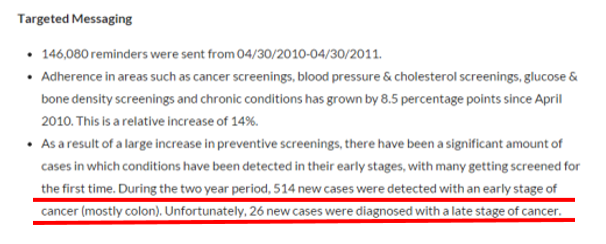
At our urging (and we must confess to delighting in creating this “Sting” operation), a third party alerted Mr. Goetzel to the fact that, his protestations to the contrary, the Koop Award Committee did know (even if they had somehow not seen the marketing materials quoted above) that Health Fitness Corporation was making fictitious claims about saving the lives of cancer victims. It was right in the award application. The original award application from Nebraska had originally stated (underlining is ours):
But then, a hour following the call from this third party the morning of the debate, the original award application suddenly read:
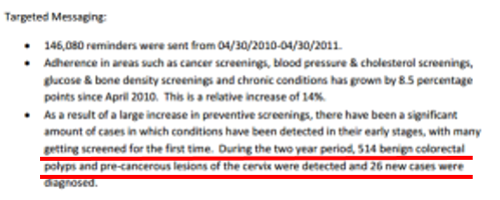
In the original application, this excerpt appears in a letter from the Governor of Nebraska. Only now the Governor’s letter says the opposite what he actually wrote. In the real world, this would be considered forgery. In wellness, a forged cover-up of a blatant and admitted lie about saving the lives of cancer victims who didn’t have cancer is considered business as usual. Johns Hopkins and Truven (Ron’s employers) don’t seem to mind either.
April 2016
The state is rescinding its award to Health Fitness and terminating its wellness program. In the immortal words of the great philosopher Stewey Griffin, victory is mine.
September 2016: The cover-up of the cover-up
Mr. Goetzel finally acknowledges that Health Fitness Corporation told a whopper, and the Koop Committee accidentally overlooked it. He now calls this an “erratum.” The technical term for it is a “lie-um.” You can’t forge official state documents and then call the whole thing an “erratum.” Is a robber allowed to give the money back after he gets caught and just uncommit the crime?

So now, having admitted that the award-winning vendor told the biggest lie in wellness history (once again, quite a feat), and knowing that all the obviously fabricated outcomes were mathematically impossible, and that waiving age restrictions for screening is akin to waiving age restrictions for buying beer, the Koop Committee finally, after 4 years, rescinded the Nebraska award.
Haha. No one falls for that line any more. Quite the opposite, they are doubling down. They say that whopping lies like this one don’t matter, if you are an award sponsor. You get to keep your award.
Ditto, if your entire claim of “separation” between participants and non-participants is shown to be false but you are sponsor, Ron merely doctors the data and you get to keep your award.
Also, if it turns out you lied about your savings because there was no change in the biometrics to attribute the savings to, but Ron was a consultant on your project, you get to keep your award.
Likewise and as was confirmed in 2016, if you are a committee member, as Wellsteps’ CEO was until recently, despite your own data showing that you actually harmed employees, you get to keep your award.
Bottom line: as a friend-of-Ron, you might get to keep your award even if you shoot someone on Fifth Avenue.
Share this:

Prediction: Wellsteps-Boise School District wins 2015 Koop Recognition
We are going to make a prediction. We might be wrong, though, because in the immortal words of the great philosopher Yogi Berra, “It’s tough to make predictions, especially about the future.” We predict that the Boise School District, a Wellsteps customer, is going to win the 2015 Koop Award. At a minimum, they will get an honorable mention.
We base this prediction on three insights. First, as our previous posting shows, the award tends to go to the program that spews the most nonsense. Specifically, to the one that ignores both biostatistics and fifth-grade math most creatively. Obviously, Wellsteps misunderstands the statistical concept of regression to the mean. Misunderstanding biostatistics is a requirement for being a wellness vendor. What’s more surprising is that they were absent that day in third grade when the teacher explained the law of math that numbers can’t increase and decrease at the same time. Laws of math tend to be strictly enforced.
In all fairness, it is possible that both Wellsteps’ claims are true: total costs may very well have declined even as cost/person increased. The Boise School District might simply employ or insure fewer people in 2014 than in 2011. Or maybe the Wellsteps program was so unpopular and worthless that employees opted to get insurance through their spouses. But even the most dishonest wellness vendor with the most clueless customer wouldn’t claim credit for a reduction in costs due to fewer people being insured. And even the ethically challenged Koop Committee isn’t dishonest enough to endorse a claim that blatantly specious.
Second, the award almost always goes to a client or customer of a Koop Award Committee member, or to a client or customer of a sponsor of the Committee. Wellsteps’ Steve Aldana sits on the Committee. All the other vendors and sponsors on this Committee have already been graced with an award for one of their customers. So now it’s Wellsteps’ turn, as they have yet to win one for a customer of any size. (This partly reflects their lack of customers of any size.)
After all, why even bother being on this C.Everett Koop Award committee if you can’t give a C. Everett Koop Award to yourself? Isn’t that what Dr. C. Everett Koop was all about — self-dealing, cronyism and corruption? (not)
Third, the timing of the “White Paper” Wellsteps just published is quite fortuitous. Sort of like in World War I, when one side knew an infantry attack was coming because it was preceded by an artillery bombardment by the other side, Wellsteps is preparing us for more “over the top” claims of success in a program that — by their own admission — was a total failure at controlling costs through 2013, and only did OK in 2014 because the cost of non-participants declined precipitously.
Fourth, if the Committee was at all on the fence, our posting last month would have helped them decide in favor of Wellsteps. One thing this Committee enjoys doing is showing us that facts and math doesn’t matter because their customers don’t read our material. The more outrageous their claims, the more they like to rub our faces in the reality that very few people in human resources care what we have to say.
This isn’t because they have, to use Mr. Aldana’s hilariously misinformed term, I-don’t-care-itis. Instead it’s because most HR executives don’t hear what we have to say, as we are blocked from most linked-in groups run by members of the wellness ignorati.
We are actually quite proud of the enemies we’ve made…but even so would appreciate if you could re-post this.
Update: it is also possible that Wellsteps didn’t get their act together in time to apply for this award–applications were due in May and their White Paper just came out last month. In that case, we’ll look forward to revisiting this post next year.
 They Said What?