
Home » Uncategorized (Page 29)
Category Archives: Uncategorized
AARP files suit against EEOC for wellness program overreach
Along with the overwhelming preponderance of the decidedly un-rigged media establishment, the AARP has emerged as the unlikely vox populi in the battle against “pry, poke and prod” programs and their ethos of “overscreening today, overscreening tomorrow, overscreening forever.”
The reason for the AARP’s interest is that often it is the older employees who have trouble losing the weight or keeping their blood pressure down — and hence get disproportionately penalized. Indeed, those two metrics do rise with age, a factoid that the wellness industry penalty/incentive schedule rarely takes into account. (Along with smoking and family history, age is the #1 risk factor for heart disease and other related medical events. What do these risk factors have in common? Wellness programs don’t change the first, can’t inquire about the second, and ignore the third. And people wonder why these programs don’t work.)
For instance, you don’t see age mentioned at all in the shocking anti-fat-employee jihad recently proposed by the American Journal of Health Promotion. Thank goodness that trade magazine has a low “impact factor,” and no one will notice or care about this rant. Otherwise, older employees would be in a lot of trouble. Further, the Johnson & Johnson Fat Tax proposal, which fortunately appears to have been stillborn, would have made employers less likely to keep older employees in the workforce as well, for similar reasons.
The AARP just yesterday filed suit against the Equal Employment Opportunity Commission (EEOC). The suit addresses both:
- Whether workers’ medical information is at risk; and
- Whether these programs are truly voluntary.
The former is less important, in our opinion. While Staywell managed to get itself hacked, most information that employees submit is fabricated (as we learned from Wellsteps’ Boise program, where almost no one admitted to smoking or drinking) and fairly useless to hackers. Or, for that matter, to employees or anyone else. So ironically, the best defense for wellness proponents against the first charge is that this isn’t medical information. It’s garbage, so who cares whether it’s at risk? (I’m being a bit facetious here.)
However, the second is clearly an issue. The Business Roundtable (BRT) has strongly pressured both the legislative and executive branches of government regarding wellness in general, and the definition of “voluntary” participation in particular.
And if you don’t think the BRT owns the former branch, consider the title of the Senate Committee “hearing” on wellness. It was not: “Do Wellness Programs Work?” Instead it was titled: “Employer Wellness Programs: Better Health Outcomes and Lower Costs.”
Title optics aside, obviously the BRT and their cronies at the US Chamber of Commerce have no interest in whether these programs actually work. (If they did, they’d have abandoned them by now, or else claimed their $1-million reward for showing they’ve worked, a reward which we have specifically offered to them.) What they are most decidedly interested in, though, is giving their member corporations the right to collectively withhold billions from employees who refuse to let their employers “play doctor.”
In classic doublespeak in order to avoid EEOC sanctions, the BRT had the feds redefine the word “forced” to mean “voluntary,” for the purposes of wellness. Non-participants (or in the jihad described above, people who don’t lose the weight) can be fined quite literally thousands of dollars. How is this voluntary?
The some degree, the EEOC’s hands are tied by Congress and the White House, because they can only write the regulations and interpret the laws. They don’t make laws. And there is no law that protects employees from harmful programs like Wellsteps. So the AARP can only work around the edges of wellness, with challenges to privacy and voluntariness, rather than address the elephant in the room, which is that many wellness programs flout guidelines and harm employees…and there’s not a thing anyone can do about it.
Until then, we wish AARP the best. Perhaps for the definition of “voluntary,” their attorney should cite the Urban Dictionary:

Share this:

Don’t Swallow Your Gum
Rarely does a “wellness” book come along that actually teaches us stuff about personal health we don’t already know, the last one being Tom Emerick’s An Illustrated Guide to Personal Health. Typically, books that we review undo the misinformation perpetrated by wellness vendors, on the subject of prostate screening, crash-dieting etc.
Another such book that has “come along” (copyright © 2009, but I am just finding out about it now, as my internet connection has been slow lately) is Don’t Swallow Your Gum: Myths, Half-Truths, and Outright Lies about Your Body and Health. The authors are Drs. Aaron E. Carroll and Rachel C. Vreeman. If the former name rings a bell, it’s because this particular polymath is also part of The Incidental Economist. If that name rings a bell, it’s because TIE has the same impression of wellness as we do, so we often refer TSW readers to them. The only difference being, as far as I can tell, is they have Day Jobs and possibly even Lives, and hence unlike us can’t spend all their time dissing these Goetzel-infused Einsteins.
In any event, these 164 pages will teach you a ton about everyday health and well-being. Like, if your kid swallows his gum, you don’t need to pump his stomach or even turn him upside down and shake him. He’ll survive. Or whether acupuncture, Airborne, or zinc work. (Sometimes, no, and unlikely.) Or whether walkers help your baby walk sooner. (Not even close. Incredibly, it’s the opposite.)
Several workplace wellness myths are debunked, like the eight-glasses-of-water thing, a staple of Provant’s program.
More serious topics are covered as well, like fluoridated water, drinking while nursing, and giving cough medicines to children. These are sprinkled in and provide a nice balance.
Quizzify, of course, is full of similar tidbits (to lighten up some much more serious health and healthcare education issues), though in a Q&A format. Indeed, although roughly 30 topics overlap, there is only one disagreement…

…Yep, you guessed it. Quizzify is totally chill on the chances of getting sick by dipping a chip in a dip that’s been double-dipped. Incredibly and probably uniquely in my lifetime, that puts me on the same side of an argument as George Costanza. Drs. Carroll and Vreeman, by contrast, are firmly in Timmy’s corner. (“Don’t you see? That’s like putting your whole mouth in the dip.”)
We all agree that it is rude and spreads germs. Beyond that, we observe (and we are in good company here) that:
- If someone is sick enough to spread harmful germs (most germs are harmless), they probably aren’t at the party;
- If they are at the party, they probably aren’t eating;
- If they are eating, they probably aren’t double-dipping;
- If they are double-dipping, the odds of getting those particular germs when you dip are pretty remote anyway;
- And if they really are that sick, you got way more germs when you greeted the perp via a handshake or kiss.
Further, there is a logical fallacy. You can’t assume you’ve seen the double-dipper. Someone could have double-dipped while you weren’t looking. Who stares at the refreshment table for the entire party? That’s ruder than double-dipping.
On the flip side, if you go to a party, you want to have fun. If you spend your time fretting over a 20-year-old Seinfeld episode, you might as well stay home. And loneliness — this is a major observation in Tom Emerick’s book — really is a major health risk.
Mind you, the folks at Quizzify aren’t exactly Pollyannas on the subject of party dip. We recommend steering clear of it towards the end of the evening. Not because of the double-dipping risk, but rather because who the hell knows what’s going on in guacamole that’s been sitting out all night in an overheated roomful of half-soused nightclub rabble? (Yes, another Seinfeld line.)
That, though, is the exception that proves the rule. For the large but fortunately diminishing pool of employees unlucky enough not to have access to Quizzify via their employer, this book is a worthy and entertaining substitute, for topics of everyday personal health.
Share this:

Rebecca Johnson’s article in Corporate Wellness Magazine may disappoint our loyal readers
Yes, we know you read this blog for the chuckles. Our most popular and funniest posts are usually the ones showcasing the wellness industry’s race to the bottom. And despite heavy competition, very few industry scams can beat corporate get-thin-quick schemes to that inexplicably coveted nadir:
- Here is Healthywage discussing its newest schemes, like “dieting for dollars” and “paying for pounds.” They also describe how to prevent “fraudulent participants,” a category presumably comprised of zombies and dead voters in Chicago.
- “In Wellness, Stupid is the New Black” shows how Healthywage can’t even read a scale.
- “Shape Up falls down trying to do math for Highmark,” about a weight-loss program so clueless that it got covered by the Pittsburgh Post-Gazette.
- Perhaps our favorite is Wellness Corporate Solutions. We won’t ruin the punchline for you.
In sum, we say: “To call corporate crash-dieting contests a joke is an insult to jokes.”
Unfortunately for those of you seeking a few chuckles, this is not that situation.
Quite the contrary, Rebecca Johnson has penned one of the best articles on corporate weight loss programs we’ve ever seen, so we can’t dismiss it with our usual clever if by now overexposed putdowns like: “She should have had this reviewed by a smart person before publishing it,” or “Perhaps her subscription to the internet expired.”
Instead, rarely have we seen more intelligent observations packed into a tighter space, more thoroughly sourced and clearly explained. To summarize:
- Corporate crash-dieting contests are much more likely to harm employees than benefit them;
- They don’t produce an ROI;
- Our mothers were right. Eat a balanced diet. There are more benefits than one would think to not obsessing with what are the “best” and “worst” foods. (Having said that, some people seem to do very well on a low-carb diet. We leave that debate to others and recommend The Big Fat Surprise to readers with an interest in that topic.)
- It is better to be fit and fat (“health at every size”) than to yo-yo diet, for sure.
She goes on to explain her particular approach to mindful eating. I myself have no expertise in that area so I can’t critique the specifics, except to say that Healthywages, ShapeUp (now Virgin Pulse), and Wellness Corporate Solutions should definitely find a smart person to explain this approach to them, even if it means having to pay for an internet connection.
Share this:

Eureka! An actual response to these debate update postings
A rebuttal from Goetzel? Of course not. The Wellness Ignorati deal in secret missives to the media, not open discussion. Or, in the case of the proposed Code of Conduct urging vendors not to harm employees or lie about outcomes, stonewalling it. What they never do is, engage with this blog. We’re good enough for Slate, STATNews, and the Chicago Tribune (and that’s in the last 3 months alone), but not the Wellness Ignorati.
However, we did manage to get a thoughtful response from a third party, Michael Prager. He raises some excellent points.
First, Ron says (and has said variations of this on many occasions) “most diseases are preventable” by wellness. That statement is flat-out wrong. Had Ron said — and this is Michael’s take on what he meant to say — “most people eventually die of chronic diseases that, had they made better choices in their life, might not have developed until later in life,” then he would have been right. Fact is, heart disease and diabetes are leading killers. Just as Michael says.
Ron got it totally wrong, though, with his most-diseases-are-preventable mantra. Only a few diseases are preventable through corporate “pry, poke and prod” programs. Just look at Ron’s own HERO guidebook. It lists diabetes and heart attacks and a few other ICD 9 codes as “potentially preventable hospitalizations.” Meanwhile, there are about 14,000 other ICD 9 codes (or 60,000+ ICD 10 codes) which are not preventable through workplace screenings, though one study tried to credit a wellness program with a decline in cat scratch fever.
Think of all the diseases or other expenses or health programs you yourself (assuming you are a non-smoker) have endured in your lifetimes. How many would have been prevented by one of Ron’s pry, poke and prod programs? Or, as Wellsteps’ Steve Aldana says, by eating one more bite of a banana? (He really did say that, but the STATNews website seems to be down this very minute.)
Now, if employees were covered for their entire lives by employers (they aren’t), and if employers could get them to reduce their risks (they can’t), then corporate wellness could work, and might possibly save money.
Second, Michael also points out that I distinguish disease-related “events” from the diseases themselves. These events are — and Ron’s HERO guidebook agrees with me on this — the only place an employer actually realizes savings from wellness, offset by many other costs. However, very few events caused by these conditions take place during our actual <65 working years. Like the annual odds of a heart attack for commercially insured people <65 are about 1-in-800. Using a few generous assumptions about program effectiveness, that already-low rate means it costs companies about a million dollars to prevent one through pry, poke and prod.
Finally, you should know a little about Michael’s back story. He did in fact turn his own health around through rigorous attention to diet and exercise, and I applaud and respect him for that. He encourages others to do the same, as do I. However, “encouragement” and intrinsic motivation are a lot different from, for instance, Michael O’Donnell’s recent diatribe that employee health insurance premiums should (at least in part) be assessed on a per-pound basis, sort of like when ordering lobster or mailing a package. That system, Mr. O’Donnell says, will get employees to lose weight.
Alas, if there is one thing wellness vendors can’t do, it’s get people to lose weight. The best example would be Ron’s buddies at the Vitality Group. They couldn’t even get their own employees to lose weight.
I am shortcutting Michael’s comments, so do go take a looksee on your own. It was a thoughtful response (two words you won’t see in succession in any other TSW posting) and is worthy of a careful read.
Share this:
The Great Debate, Part 4: Ron Goetzel Admits Doctoring Original Documents
In my rebuttal, I was finally able to introduce ethics into the debate. Along with arithmetic and facts, ethics would be one of the three categories that I have the greatest advantage over Ron. Quizzify and I are in the “integrity segment” of the market.
39.20
As is always the case in this debate and in general, I don’t need to cite my own data. His data is so obviously wrong (the New York Times had a few choice words, like “crap”) that I merely point out that his own data sets reveal wellness’s failures when read by an actual smart person, as opposed to, for example, a member of the Koop Award committee.
Citing his own data means we don’t get into he said-she said arguments over the validity of the data sets. We can both agree to use his data.
39:55
I eviscerate Ron’s old saw about 50% of people having chronic disease. As I always do when someone repeats that myth, I ask attendees to raise their hands if they have a chronic disease and maybe 3% of hands go up. This 50%-of-people-have-chronic disease is the biggest urban legend in healthcare, as we have noted. It’s somewhat true in the Medicare population, but we are talking about the employed population today. In the employed population, it is only true if the definition of “chronic disease” is expanded to cover, for example, back pain, tooth decay, dandruff, and Ring Around the Collar.
I got some good laughs in this hand-raising exercise (“To be compliant with HIPAA, close your eyes”).
40:30
I had anticipated that he would cite his Procter & Gamble study from a quarter-century ago (!) in defense of wellness. So I had checked with P&G, who are my clients, and no one there has any idea what he was talking about.
40:50
I get Ron to admit doctoring the evidence on the Koop Award site and then lying about it. He not only doctored the original, but said he didn’t doctor the original. The back story: showing their typical level of competence at reading graphs, Ron’s committee accidentally gave out an award to a program in which participants had outperformed non-participants for two years (2004 and 2005 below) before the program even started, so he changed the x-axis so it looks like the program had been in place during that period. Here is the “before” graph:

Here is the x-axis after he doctored it to remove the evidence that the whole thing was invalid:
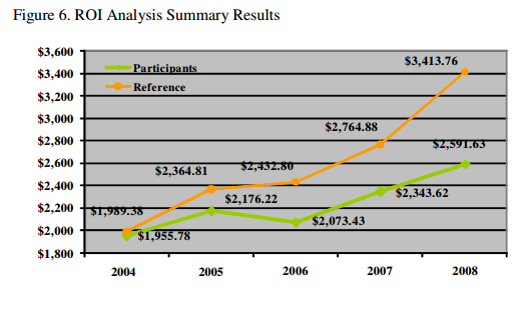
As he was doctoring the original application, he created the fiction that the original “application was online and subject to review.”

Even if the study had started in 2004 instead of 2006, the risk profile only improved by 0.17 on a scale of 5 (3%) by 2008, making the massive savings in 2008 completely impossible. (Until 2016, when they shed all pretense of integrity in order to give an award to their Wellsteps colleagues, the Koop Committee trademark was attributing massive savings to trivial reductions in risk.)
41:40
I point out that Aetna had just accidentally confirmed what should be obvious: participants-vs-non-participants is a totally invalid study design. They were trying to show the opposite, of course. This is classic wellness and confirms our mantra: “In wellness, you don’t need to challenge the data to invalidate it. You merely have to read the data. It will invalidate itself.” The most respected member of the journal’s editorial board, Dr. Nortin Hadler, apologized and said Aetna’s article never should have passed peer review. So much for the peer review process at Ron’s favorite journal.
I also observed that Ron had himself admitted the participants-vs-non-participants study design was invalid:

42:30
Ron responds to my observation that he had “doctored the information.” He admits that the chart in question was originally “mislabeled” on the x-axis. The label was unmistakably clear. To allow Health Fitness Corporation (HFC) to win an award for this non-attributable, invalid result either reflects the total inability of the vendors (Wellsteps, Staywell etc.) and actuarial consultants (Mercer, Milliman etc.) on this committee to recognize a screamingly obvious invalidity when it’s staring at them, or was a conscious decision to give the award to a Koop Committee sponsor. Or maybe both. Each year has seen the award go to someone connected with the Committee.
Ron at least gives me credit for being “sharp-eyed,” but, honestly, anyone who’s taken my course in Critical Outcomes Report Analysis would have seen that the X-axis clearly shows the program didn’t start until 2 years after the two groups were separated.
44:20
I sprung the trap I had set earlier, when Ron said I praised him in my book. I had reproduced that HFC graph in Why Nobody Believes the Numbers on the page following the page where I praised his own work, so that I knew he would see the graph in all its hilariously invalid glory. That juxtaposition was a test to see if he would retract that graph once the obvious invalidity was brought to his attention. He not only didn’t retract it then, but he called that program (listed below under “Eastman Chemical,” HFC’s customer) a “best practice” for two years after that–knowing full well the key graph showed no program impact.

45:40
I ask Ron if he’s doctored any other Koop Award application after my expose. He is completely silent. He did doctor another original application that very morning in preparation for the debate, not realizing I had saved a screenshot of the original original. The original and the doctored version are reproduced below, for the Nebraska application. But he was “saved by the bell.” The moderator jumped in and started asking the audience for questions, and I frankly forgot to bring this one up later. Compare the last line of each passage below. The first was before my expose of Nebraska. Ron had claimed the Koop Committee had no knowledge of Health Fitness Corporation’s lie about finding all those cancer victims in the Nebraska state employee population. However, it was right in the application…until Ron doctored the application before the debate.
Before doctoring:
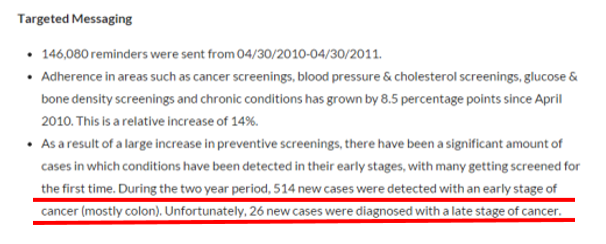
After doctoring:

While he has conceded many points so far in this debate, I have yet to concede that Ron and his cronies do anything well, so here’s the first: he excels at tampering with evidence.
Share this:

The Great Debate, Part 3: Ron Goetzel Reveals the Secret to Eternal Life
This is Part 3 of the November 2015 “Great Debate.” If you are just tuning in now, here are Parts 1 and 2.
Each of us delivers a rebuttal-cum-second statement. Ron uses his time to shore up his base — the “low information voters,” as they say in political science–with claims he knows to be inaccurate because he himself has said the reverse and/or the statements are invalid on their faces.
As a reminder, the time stamps for each section below roughly synch to this master recording.
36:30
Ron says “A large proportion of the diseases we suffer from are preventable.” Actually, excluding smoking-related illness (where there has never been disagreement), “preventable” events consume far fewer employer dollars than birth events, musculoskeletal issues, and general “worried well” medical concerns.
Employers also spend money on rare diseases, infections, catastrophic issues, sports injuries, trauma, drugs, and doctor visits for various things. Are you seeing a pattern here? None of these are preventable by wellness. Where does he get his ideas?
Tallying all spending according to Ron’s own co-authored report — and the HCUP database compiled by Ron’s own employer, Truven — the rate of “potentially preventable hospitalizations” is 2.62 per 1000. Their report uses $22,500 as the average cost/hospitalization. Doing the math with the $22,500, that’s $59/per person per year, out of $6000/person or so spent on healthcare. Meaning about 1% of claims would be preventable through “pry, poke and prod” programs. And that assumes these programs worked perfectly. As years of Koop Awards of demonstrated, they don’t work at all. The most carefully studied program is Connecticut’s. Connecticut‘s pry, poke and prod program actually increased state spending on health care.
So Ron’s premise is utterly false. Let me put it another way: have you ever had a medical event that could have been prevented by completing a health risk assessment or eating more broccoli?
At this point his strategy emerges: argument-by-cliche. “Most diseases are preventable,” is his favorite. That would mean health-conscious folks would be blessed with eternal life.
Also, “80% of money is spent treating chronic diseases.” He is off by a factor of 80 from the relevant figure of 1%. He would arrive at that 1% figure if he asked the right question: “What percentage of cost can an employer save with a perfect wellness program?” He knows that because his co-authored guidebook says it. We also long since debunked this 80% myth.
As a public service, at the end of this posting we list the top hospitalizations. Remind us, Ron, which of these your wellness programs are going to prevent?
36:00
Someone needs to tell Ron that “stroke” is not a chronic diseases, nor are most cancers. A stroke is about as acute as you can get — each minute without treatment raises the odds of ending up like the Kardashians. And if cancer were a chronic disease, we wouldn’t run in “Races for the Cure.” We’d run in “Races for the Control and Management.”
I am personally infuriated that he thinks my recurring bladder tumors were/are preventable. I was involuntarily exposed to a carcinogen in 1984. He’s right about one thing, though: bladder cancer is usually chronic. However, most cancers aren’t, contrary to his claim. When was the last time someone said to you: “My doctor says I have lung cancer, but we’re staying on top of it” ?
He also, ironically, lists “depression” as something that can be addressed by wellness without explaining how employers forcing employees to do something they hate — “playing doctor” by taking their blood — is going to cure their depression.
37:00
“You can improve population health in the workplace if you apply evidence-based programs,” he says. And yet, his own Koop Awards, presumably given to the best programs, go to organizations that made essentially no impact on population health — 1%, 2% or 3% reductions in risk factors –-but then made up clinically and mathematically impossible savings figures. [Postscript: I wrote that in 2015. Little did I know that in 2016, the Koop Award committee would give an award to a company that increased risk factors and admitted flouting evidence-based guidelines.]
Following the debate, Health Affairs put the total kibosh on Ron’s idea. They published a study showing that you can’t get employees to lose clinically or statistically significant amounts of weight. Not that it would matter because weight has only the most trivial impact on health spending in the <65 population.
Another irony (there’s that word again): all the evidence — the US Preventive Services Task Force etc — says you shouldn’t screen all adults every year for anything other than blood pressure. And yet these Ron and his buddies advocate exactly that.
37:50
Ron’s business model is to write up studies showing his friends and clients save money on wellness, so he rattles some off. He notably leaves out Nebraska, because their program and his award for it were shown to be complete lies. However, leaving that program off this list (though it appears on most of his other “best practice” lists) is an excellent debate technique. Listing it as a best practice would have allowed me to point out the results were admitted to have been made up.
He also claims: “some organizations can actually achieve a positive ROI,” As an endorsement, that’s right up there with Benjamin telling Mrs. Robinson that he found her to be among the most attractive of all of his parents’ friends.
It’s also a total walkback of his previous certitude, like:

38:00
Just like Gary Hart invited reporters to follow him to show he wasn’t sleeping around, Ron invited “everybody to go in and look at [the Koop Awards] to determine whether they are telling the truth or not.” And, just like Miami Herald reporter Tom Fiedler did with Gary Hart, I took him up on his offer…and found that almost every award over the last five years showed provably fabricated savings figures. [Postscript: once again, I wrote this in 2015, before the Wellsteps award this year, which raises fabrication of Koop Awards to a plateau that even presidential candidates can’t reach.]
So Ron managed to lose his own rebuttal round–even when, as with his opening statement, I didn’t say anything. The debate has pivoted badly for him…and it’s only going to get worse.
Postscript: At 37:28, he says people with “high biometric measures…are more expensive” than people without. This means he knows full well that Wellsteps is lying in their 2016 award when they show increased biometrics but massively reduced costs.
As a public service to Ron and his cronies, I am listing the top 25 hospitalizations in order of spending. See if you can find one or two that are “preventable” by eating more broccoli or being poked with needles.

Share this:

The Great Goetzel-Lewis Debate, Part 2: The Debate Ends Almost Before It Begins
This is Part 2, my opening remarks. These and all future annotations will be synched to the main debate tape, which is downloadable from the Population Health Alliance website. “Synched” meaning that the exchanges being annotated below can be found at the points in the tape noted in bold.
Click here if you haven’t already listened to/read Part 1.
20:40
I got a chuckle for my opening line but Ron clearly won the style points on opening lines.
You’ll note my opening statement contains no unsupported claims, whereas his entire opening statement was nothing but unsupported claims. I am all about proof and examples — all of which are in the public domain, easily sourceable, and on this site. Many come right from him and his cronies, in their multitudinous gaffes. Ron isn’t debating me as much as he is “debating” against his own industry. The walk-backs, disavowals, concessions etc. make my presence almost superfluous.
22:00
I review Penn State’s ill-fated wellness program. This is a layup. Worst program ever, and Ron’s fingerprints are all over it. I get some laughs for my riff on testicles, which were a major focus of the Penn State program, along with a disproportionate number of questions about ladyparts.
23:00
Ron interrupts (with my permission) to say: “I had absolutely nothing to do with Penn State.” I observed that he was in the room defending it, and gave chapter and verse , referring to the screenshot below and quoting the title. He must have assumed I didn’t see that article. But at the time many journalists contacted me, dumbfounded that Ron, Highmark’s Don Fischer and Penn State’s Susan Basso were still defending it.

The exact quote from that article, in which he was in the room, on the call:
23:40
I review Nebraska. Because I did not anticipate the pants-on-fire Wellsteps-Boise Koop Award in 2016 — the type of lying that gives lying a bad name — I call Nebraska “the most dishonest program ever” …and yet Ron gave them a Koop Award and steadfastly refused to rescind it (since the vendor was a sponsor of the award) even after they admitted lying following my expose of their lies. [Postscript: Ron has now completed the rewrite of the history of this program. Fortunately we took screenshots along the way, documenting each time he tampered with the original application.]
24:10
I quote Ron’s co-authored HERO guidebook — which of course, in a major gaffe (gaffe is defined as “accidentally telling the truth”) — admitted wellness loses money. If this debate were in a court of law, the case wouldn’t even get to the jury. It’s called estoppel. If you have said something on the record, you can’t turn around and say the opposite. So the debate is technically over, legally speaking.
His response (actually the moderator jumped in to defend him) was, that was just one data set. No, that data set was quite representative of the decline in events that takes place regardless of a program, and in any case, who deliberately plants an invalidating data set in their own propaganda? No, these people just didn’t notice that the costs on Page 15 exceeded the savings on Page 23. And they are the self-professed experts in measuring outcomes.
Costs ($1.50 PMPM):

Savings ($0.99 PMPM):

25:00
I reference two proofs. First, the one that says wellness can’t work. Next, my proof that the official government database shows quite literally no impact of workplace wellness on cardiometabolic inpatient admissions this century. Ron accepts this proof. He is caught. His own employer, Truven, holds the contract for managing this database. If he claims the data is flawed (it isn’t), he disses his own employer. So the debate is technically over, mathematically speaking. He just admitted wellness has been completely ineffective. Game, set and match to me. However, wellness apologists don’t understand fifth-grade math (hence this site), so few people in the room understood that the debate had ended.
25:45
I reference the million-dollar reward that we’ve offered to anyone who can show that wellness has broken even. Of course, Ron hasn’t claimed it. I offered the reward because even people who don’t understand mathematical proofs understand that someone who backs his claims with $1-million must believe them. By declining to collect the $1-million (the reward has rules and is a legally binding contract), Ron is admitting he and his cronies are lying about the effectiveness of wellness.
26:14
I point out that RAND and the New York Times are both on my side. The Times, I noted, “was laughing at you folks for how bad your analysis was.” I continue with many more examples of both the left wing and right wing media skewering wellness. “You guys are running out of wings.” Ron attempts no rebuttal even though I had offered to let him interrupt me if I said something inaccurate. But there’s nothing inaccurate about my portrayal of the mainstream media’s position on workplace “pry, poke and prod” wellness. It’s all here. They hate it.
[Postscript: You can now add Slate, STATNews, and many others to list of publications which have skewered wellness, all linked from here.]
27:25
I point out the many instances in which Ron’s own cronies have gone rogue. Altarum, Debra Lerner, and Michael O’Donnell (three times) are all examples of Koop Committee members who deliberately or accidentally dissed wellness. And I reiterate that the HERO Report, that Ron co-authored, admits wellness loses money. This report was signed by 60 wellness apologists. Basically the entire industry admitted failure, in the industry’s biggest-ever gaffe. See our 8-part critique of that ill-fated venture.
Thus ended the two prepared opening statements. By the way, a shout-out for Fred Goldstein, the moderator. In reviewing this tape I had clocked Ron’s “5-minute” opening speech at 9 minutes, but I was allotted the same length. The next installments will cover the rebuttals.
Share this:

Rocky, Bullwinkle, Wellness, and the American Journal of Managed Care
Some of you might remember the closing credits of Rocky and Bullwinkle. Due to copyright restrictions, we can display only a “fair use” snippet. (“Fair use” means you could use one question from Quizzify as an example without special permission as long as you cite the source, but if you tried to copy the whole thing, we’d get elected president, hire a special prosecutor, and throw you in jail.)
Rocky asks: “You got the credits, Bullwinkle?”
Bullwinkle replies: “All on this itty-bitty card…oops” and then it folds out:

(Source: Jay Ward Productions.)
So what does this have to do with wellness, besides nothing?
Simple –I just consolidated all the lies and harms of the Wellsteps/Koop Award into one itty-bitty posting for the American Journal of Managed Care blog. And it also folds out — with links to all the other “smoking guns” in this scandal. If you just want to forward one article around, that’s the one.
Kudos to American Journal of Managed Care for going where Health Affairs fears to tread, by posting the entire, unbowdlerized expose in all its sordid glory. Indeed one would think the latter publication would show some contrition for having started this “pry, poke and prod” mess, by publishing the original Baicker propaganda — with no disclosure of the authors’ conflicts of interest or funding sources…and apparently also no peer review. This thing has been cited 250 times. And that was after it was shown to have been made up. It has 549 citations in total.
Sadly, in addition to not being subject to any other regulations, wellness is not subject to Pottery Barn Rules. Health Affairs created this mess, but they don’t need to pay for it. Quite the contrary, the Health Affairs “impact factor” has probably been boosted more by this article’s 549 citations than almost any other article they’ve ever published. And guess who has to clean up after them?

(Source–you guessed it–Jay Ward productions. These are the closing credits to Mr. Peabody.)
Kudos also, by the way, to the perpetrators of the Wellsteps fraud — Steve Aldana, Ron Goetzel, Seth Serxner. They have the good sense not to take my bait by actually attempting to rebut. The one time they did, in Sharon Begley’s article, their “rebuttal” took the form of basically admitting they had made the whole thing up.
Abe Lincoln seems to be in the news a lot this week, and he put it best: “Better to be thought a fool and say nothing than to speak out and remove all doubt.” Words the Wellness Ignorati should live by. You’d think they would have learned that by now.
Share this:

Now is your chance to fight back against intrusive, coercive wellness programs!
I hate to knock the HealthFairs USA posting off the front page, since it is still bringing in lots of hits and providing lots of laughs. (If you missed the addendum, their reference site is Wells Fargo.)
However, there is some time-sensitivity on this more serious one. My AARP friends (and, yes, I am old — that picture on linkedin is from 2006, and I wasn’t young even then) are the only ones brave enough to fight the good fight against the Business Roundtable and US Chamber of Commerce, whose goal is to make wellness programs so onerous that most employees will fail them…and the penalties will flow right to the bottom line of their member companies. (It is ironic that while both candidates talk about the forgotten working class, neither is actually willing to stand up to their overlords on the subject of forced wellness programs, one of the few places where there really is a simple solution that would help working people.)
Here’s what they have to say and have asked me to disseminate in real time:
Does your employer charge you more for health insurance if you don’t give your health information to the “wellness” program? AARP thinks participation in workplace wellness programs should be genuinely voluntary. If you must surrender your or your family’s health information to a wellness program in order to avoid paying higher insurance premiums, AARP needs to hear from you now! We are especially interested in hearing from AARP members who are being affected by wellness “incentives.” Please share your story, privately and confidentially, by contacting Brian Dittmeier at bdittmeier@aarp.org by no later than October 17, 2016.
Share this:
HealthFairs USA: A wellness program that defies description
The English language contains 450,000 words, the most of any language, but apparently it needs a 450,001st. Why? Because whoever invented the first 450,000 words had obviously not reviewed HealthFairs USA’s wellness program, which no existing word comes close to describing.
First, they test for cancer — with 99% accuracy! This precision may seem impossible but their claim is correct in that 99% of the words in the clipping below are indeed spelled accurately. (This is actually a better track record than the rest of their website, in which they describe their “unparallelled” customer service and how they “minimize your companies risk” and “build company moral.” They also advertise “less call-outs for sickness,” by which I suspect they mean “fewer absences.”)

Besides the slight problem that this statement is beyond absurd about a zillion different ways, Preventest lacks FDA approval (and — equally surprisingly given their accuracy — a Nobel Prize). That doesn’t stop HealthFairs USA from submitting claims to insurance companies and promising “no out of pocket cost” in most cases:

By the way, there is no FDA-approved genetic “check swab,” or test of any kind, let alone one with 99% accuracy, for any cancer. And few cancers on this list even have a genetic component. (Bladder cancer, for example, is 100% environmental.)
But wait…there’s more. Now how much would your insurance company pay? HealthFairs USA is selling worthless nutritional supplements and submitting insurance claims for those as well:

Let’s review what they’ve told us so far: they perform useless, non-FDA-approved tests and sell useless, non-FDA-approved supplements to employees who don’t need them, and then submit bills to third party payors. Can anyone spell insurance fraud? I doubt they can, since they can’t even spell “alleviates.” (So much for their 99% accuracy target.)
How does this benefit employees?
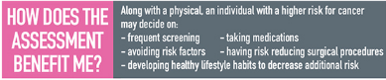
Lots of ways. Employees can submit to more frequent screenings. And I’ve always said the problem with the US healthcare system is that employees don’t get screened enough. (not!)
Or, they can take medications. It’s not clear which ones, and there aren’t any “medications” that are FDA-approved for preventing most cancers in any case. But whichever ones you take, I’m sure they’ll figure out how to bill the insurance company for them. Most importantly, you can “have risk reducing surgical procedures.” Let’s see…what word can describe a wellness vendor recommending surgery for employees tagged by non-FDA-approved cancer screens for a possibly elevated risk of cancer?
Hmm…maybe we need a 450,002nd.
Indeed, a true wellness program might consist of warning employees not to get anywhere near HealthFairs USA, so clearly these people don’t have any accounts of any sophistication, right? Right?
Wrong. Here are their accounts:

That means they are submitting insurance claims to their insurers on behalf of their employees, as directed and incentivized by their human resources department. I’m not a practicing attorney, but I am a practicing non-idiot, and as such my opinion would be that Coca-Cola and others look into this posthaste.
Plus, it’s not like they’re completely fraudulent. They have references from stellar companies with outstanding reputations:

Full disclosure: I’m not 100% sure that it is actually illegal to submit insurance claims for useless, unapproved, possibly harmful, USPSTF D-rated screens and useless, unapproved, probably harmful, supplements for employees who have no diagnosis, no recognized medical necessity and aren’t seen by a real doctor.
Quite the contrary, my opinion may only be 99% accurate.

 They Said What?