They Said What?

Blog

Welcome Slate Readers!

Please enjoy your visit to our site, “follow” it, and share it.  The best example of a wellness story is how the city of Boise got completely snookered by Wellsteps. Wellsteps harmed their employees but obfuscated the data so the Boise administrators wouldn’t notice. Then they got some friends of theirs to give them an award for it.  We can’t make this stuff up.

If you have a story to tell, please contact us directly at al@quizzify.com .  There are journalists-in-waiting, who want a story, even a not-for-attribution story, in order to write one of their own.

Also, see if your own vendor is listed (via the “search” function) and forward it to HR, with the suggestion that we can help them if they were snookered. Your HR department should demand that your wellness vendor endorse the Employee Health Program Code of Conduct, which commits them to not harming you, respecting your dignity, and not lying to your HR department.  A very modest threshold and yet United Health Care’s program, among others, refuses to commit to it.

Finally and most importantly, visit www.quizzify.com .  That is the way real wellness works. You play a game and learn things about the healthcare system and your own health that you didn’t know. Imagine Jeopardy-meets-health education-meets-Comedy Central.

Don’t just take our word for it. Play the game, and send it to your HR department. It’s guaranteed to improve health and save money, and as you  can see, the content is reviewed by Harvard Medical School.


Wellsteps Apologizes, Returns Koop Award, and Endorses Code of Conduct

Wellsteps has profusely apologized for harming Boise’s employees, according to objective and subjective health indicators, for overscreening the employees, for demonizing even the slightest consumption of alcohol, for suppressing their earlier acknowledgement that costs increased, and for mis-attributing the allegedly massive savings figures.

Not!

They’ve recognized that these smoking guns exist, of course — that much we’ve learned from other sources.  But obviously they haven’t apologized.  In case you haven’t noticed, these days refusing to apologizing is a thing. Indeed it’s more than a thing. It’s a Major Lifestyle Trend, potentially even bigger than quinoa, bidet toilets, and the Kardashians combined.

They (Wellsteps, not the Kardashians) aren’t going to give up their Koop Award voluntarily.  To paraphrase the immortal words of the great philosopher S.I. Hayakawa, they stole it fair and square. (Helps that Wellsteps’ CEO is on the award committee, of course, though you wouldn’t guess it from their announcement.)

And they (Wellsteps again, but probably also the Kardashians) certainly aren’t going to endorse the Code of Conduct.  They can’t, because they and their whole Koop Award cabal would be in immediate violation of its call for no harms to employees and no lying about outcomes.


However, the Code of Conduct is getting great reviews everywhere else, which is actually what this column is all about.

First, honest, well-intentioned, and competent vendors, brokers and consultants — none of which are connected with the Koop Committee or the Health Enhancement Research Organization — have shown their support in large numbers. The Code has garnered tons of “likes” and very supportive comments.  If you see your consultant or vendor on this list of “likers” and commenters, give them the kudos they deserve. And add your own too.

Quizzify

Second, Quizzify on Friday became the first vendor to endorse the Code, and will be incorporating it in every contract going forward.  Read the Quizzify statement, and urge other vendors to follow suit. Embracing the code should be easy for others like it was for Quizzify. Any honest, competent vendor should find the principles self-evident.

ConscienHealth

Third is a pleasant surprise twist, the one referred to in the Linkedin “tease” for this column.  On Sunday, I was delighted to see http://www.ConscienHealth.org pick it up.  By way of background, ConscienHealth is an advocacy group for the evidence-based treatment and prevention of obesity. In their own words:

We develop strategies that are based on sound science [and] public policy, and a deep understanding of consumer needs.”

Here is a summary of what they said, but we’d urge you to read the whole shebang, because they stated it better than we did. Alone among websites with an interest in wellness, ConscienHealth speaks specifically for the overweight employees who are victimized by crash-dieting schemes and other corporate fat-shaming activities:

We now have enough regulations on the subject of employer wellness programs to make your head spin…but the most encouraging development is a code of conduct based on a simple premise: act purely to improve health and do no harm.

The folks who developed this code – Ryan Picarella, Al Lewis, Rosie Ward, and Jon Robison – applied deep knowledge of the good and the harm that employer wellness programs can do. While others fight over the fine points, this code brings us back to the big picture with a few key principles:

  1. Wellness programs should work for the benefit of employees.
  2. Programs should not single out, fine, or embarrass employees for their health status.
  3. Employers should respect and protect employee privacy.
  4. Employers should measure and report program outcomes honestly.

If those considerations seem obvious, it’s because they are. And yet we have examples of “wellness” that have disrespected, humiliated, and financially exploited employees. Sometimes it’s been done out of ignorance. Sometimes it’s a subterfuge for cost shifting to people with chronic diseases – health problems that nobody wants to have.

We here at They Said What would urge Wellsteps and other “pry, poke and prod” vendors to develop programs that satisfy those same four criteria. Unfortunately, they aren’t quite there yet. Indeed a beam of light leaving criteria #1, and #4 wouldn’t reach them for several seconds.


Disclosure: Al Lewis, who co-maintains this site, is also a principal in Quizzify, which endorsed the Code.  Attention to Wellsteps: See how conflict-of-interest disclosures work?  It’s not that hard. Next time you win a Koop Award — and based on the number of consultants and vendors on the award committee (plus sponsors) who need to be win one too, it should be your turn again in about 6 years — try disclosing your presence on the award committee in your breathless announcement of how brilliant you are.

Or, as Mark Twain said: “Always tell the truth. This will delight some people and astonish others.” We will be both, if it ever happens.

The Employee Health Program Code of Conduct: A Game-Changer for Wellness

Even war has a code of conduct.  Why shouldn’t wellness?

Why should vendors like Wellsteps be allowed to harm employees…and win awards for it?  The answer, of course, is that they shouldn’t.  Conversely, vendors that benefit employees, respect their dignity, and measure outcomes validly should be recognized and applauded.

We invite everyone to read the Employee Health Program Code of Conduct, just posted by Rosie Ward, and a joint offering of WELCOA, They Said What, and Salveo Partners.   This is Version 1.0, of the “First, do no harm” variety.

While They Said What and Quizzify are separate entities and normally this blog doesn’t speak for Quizzify, I can assure everyone that Quizzify will be incorporating the Code of Conduct directly into our contracts, as a key contractual term, meaning that if we don’t adhere to it, we are in breach.  We urge other vendors to follow suit, and purchasers to insist on its inclusion in contracts.

While everyone should read Rosie’s full posting for the “back story,” the actual verbiage is as follows:

The Employee Health Program Code of Conduct:  Programs Should Do No Harm

Our organization resolves that its program should do no harm to employee health, corporate integrity or employee/employer finances. Instead we will endeavor to support employee well-being for our customers, their employees and all program constituents.

Employee Benefits and Harm Avoidance

Our organization will recommend doing programs with/for employees rather than to them, and will focus on promoting well-being and avoiding bad health outcomes. Our choices and frequencies of screenings are consistent with United States Preventive Services Task Force (USPSTF), CDC guidelines, and Choosing Wisely.

Our relevant staff will understand USPSTF guidelines, employee harm avoidance, wellness-sensitive medical event measurement, and outcomes analysis.

Employees will not be singled out, fined, or embarrassed for their health status.

Respect for Corporate Integrity and Employee Privacy

We will not share employee-identifiable data with employers and will ensure that all protected health information (PHI) adheres to HIPPA regulations and any other applicable laws.

Commitment to Valid Outcomes Measurement

Our contractual language and outcomes reporting will be transparent and plausible. All research limitations (e.g., “participants vs. non-participants” or the “natural flow of risk” or ignoring dropouts) and methodology will be fully disclosed, sourced, and readily available.

How to read an outcomes report: the Wellsteps example

We’ve summarized the four analyses of Wellsteps’ Koop Award-winning program for the Boise School District, and put it all in one Linkedin Pulse.  The bad news is that they harmed employees, fabricated savings figures, and apparently snookered the Koop Award Committee.

However, there is offsetting good news.  Reading this Pulse — and comparing it to the original Wellsteps submission — should help you become a more discerning reader of outcomes reports generally.  That’s the good news for you. (The good news for me is that, after reading this, members of the Koop Award committee might finally buy Why Nobody Believes the Numbers.)

The other good news for all of us is that this should be a wake-up call for the industry that a code of ethics is needed.  To put it mildly, harming employees and falsifying outcomes should not be allowed, and should certainly not win awards. Yes, I realize that is an understatement, like when Lyndon Johnson said: “Killing, rioting and looking are contrary to the best traditions of this country.”

Still, we have to start somewhere, and a good place to start would be: “First, do no harm.”

A brief intermission from the ongoing Wellsteps-Koop Award debacle

Here are a few items that might be of interest, while I give people a chance to digest last week’s three Wellsteps smackdowns.  And it’s even worse than I thought. In the immortal words of the great philosophers Bachmann Turner Overdrive, you ain’t seen nothing yet.

If you are just tuning in now, here are the links:


At this point, you may be wondering: “Hey, is there any way to get actual helpful information on wellness, since I’m obviously not going to get it from Wellsteps?”   As luck would have it, there are several. First, Jon Robison and Rosie Ward run a CEU-creditable program leading to the Thriving Workplace Culture certificate.  Culture-of-wellness is gradually replacing “pry, poke and prod” as the preferred way to “do wellness.”  I’ve done a guest-lecture to the community of folks that Jon and Rosie have assembled and can tell you this: we are not alone in the universe. If you are reading this blog and feeling deluged by pry-poke-and-prod vendors, you will feel right at home here…and you’ll learn a lot too.

Oh, yes, and claim your Friend-of-Al discount of $100 for the course. Enter FALL16FRIEND in the promo code line.


If that is not within your price range even with the discount, there is a webinar on incentives this Thursday, in which I’m participating along with a few colleagues. It’s a production of Sarah Hunt of the Corporate Health and Wellness Association, and James Kelley, so you know it will be good.


And if you would to save wear-and-tear on your eyeballs, you can listen to a recent podcast I did on wellness. It can be found three different ways:

The website: http://bit.ly/Al_Lewis

iTunes link: http://bit.ly/iTunesRWpodcast

Stitcher link: http://bit.ly/StitcherRWpodcast

Wellsteps Raises the Koop Award Standard for Outcomes Invalidity to a New Low

Wellsteps claims to have dramatically reduced the total cost of the Boise School District’s health spending. Their Koop Committee colleagues gave them an award for it, as they typically do for their fellow board members and sponsors.  (Yes, Wellsteps’ CEO, Steve Aldana is on the committee that grants the award, but, in accordance with Koop Committee tradition and Wellsteps ethical standards, there is no mention of this possible conflict of interest in the announcement from Wellsteps. This is not a violation of the Wellness Industry Code of Ethics, because there is none.)

Unfortunately for Wellsteps, three completely distinct observations from Wellsteps’ own data invalidate their analysis separately. In combination, these observations create a level of impossibility demonstrating that whoever invented the English language was unfamiliar with the wellness industry, or they would have come up with a word meaning: “Impossible doesn’t begin to describe it.”


First, as we saw in the last posting, employee health deteriorated over the course of the program, measured both subjectively and objectively.

There is a concept, covered in Health Services Research 101, called “causation.” Wellness vendors love taking credit for everything that happens during their program. Hence we can conclude that Wellsteps’ program caused employee health to decline.

Therefore, no reduction in costs due to a healthier employee population can be attributed to Wellsteps’ program.


Second, also covered in Health Services Research 101, is the concept of “fifth-grade arithmetic.” Potentially Preventable Hospitalizations (PPH), as described in the official Health Enhancement Research Organization (HERO) outcomes measurement guidelines (a report on which Wellsteps’ CEO claims to have collaborated), account for a very small percentage of all spending. Specifically, as described in the HERO report  and reproduced below, these events account for 2.62 hospitalizations per 1000.  Boise’s 3284 employees would therefore suffer about 9 PPH’s. If each PPH cost Boise the HERO-assumed cost/admission of $22,500, that’s about $202,000. Not enough to cover even the out-of-pocket fees for the Wellsteps program, assuming the Wellsteps did a perfect job. And as we’ve learned in the past, a beam of light leaving “perfect” wouldn’t reach Wellsteps for several seconds.

Still, we’ll never know because despite their endorsement of the HERO report, Wellsteps decided not to disclose the rates of Boise’s PPH’s, likely to obscure the fact that they didn’t reduce it.

hero total page 23 with red bar

And as the HERO guidebook says, any reduction in PPH’s is offset by more spending elsewhere. In Wellsteps’ case, “more spending elsewhere” is annual biometric screenings.  Curiously, Wellsteps admitted annual screenings are a stupid idea four whole days before they announced their Koop Award for doing exactly the opposite.

July 11 blog

wellsteps july 11 blog

July 15 announcement:

wellsteps july 20 blog biometrics

Yet Wellsteps reported annual savings ultimately exceeding $5-million, or about a third of Boise’s total spending.  This would be equivalent to wiping out every hospitalization unconnected with childbirth plus every ER visit.  Adding yet another layer of impossibility to this narrative, at the end of this, we show the rank order of the top 25 reasons people visited the ER or went to the hospital, which basically have nothing to do with corporate wellness programs. Hence the cost of these visits and admissions couldn’t be dented, let along wiped out, by massive overscreening or even by appropriate screening.

Compounding this impossible outcome (and wellness is one of the few industries in which there are degrees of impossibility, since a typical wellness vendor makes at least a dozen impossible claims before breakfast) is the surprising health of the Boise population to begin with. People rated their health as 7.98 out of 10, and only 2.5% reporting smoking (vs. 20% for Idaho as a whole) and only 20% reported drinking (vs. 70% for the US as a whole). These ridiculously low levels did not strike Wellsteps as suspicious, so we will assume they are accurate.

Further, most Boise employees had fairly normal blood pressure, glucose and cholesterol — at least before they got sucked into the program.

So, with impossibly smoking and drinking, excellent reported health status, and largely normal biometrics, how is there room to improve health enough to save money, especially when health status is declining and the population is being overdiagnosed?


Speaking of misunderstanding the concept of arithmetic, third and most important is the data Wellsteps suppressed between their initial report and their Koop Award application. Normally Koop Award Committee Chairman Ron Goetzel suppresses the invalidating data after the award is announced, as with Health Fitness Corp/Eastman Chemical, and then the state of Nebraska (technically actually incriminating, not just invalidating). That’s because in the past I haven’t predicted who would win the award. Rather I just pointed out all the obviously incorrect data after the fact. By predicting Wellsteps would win a Koop Award and pointing out exactly why their data was sufficiently fictitious to merit it, I gave Wellsteps itself the opportunity to suppress their own data, so Ron wouldn’t have to do it for them.

Contrast below the trend they reported for total spending for Boise against the claims cost per person for Boise. The former goes up. The latter goes down even though the number of employees stays the same.  Obviously, this is an impossible coexistence, as mentioned both in the first installment of this series and in every elementary school in the world. This time, we are going to transpose the bar graph, which separated participants from non-participants, onto the line graph, which included both cohorts, for the baseline and the first two years of the program. The assumption, as Wellsteps states, is that their participation rate is 80%, largely because of the massive $870/year incentive, which in classic wellness fashion is not included in the savings calculation. The number of employees seems to bounce around a bit between reports, but we’ll go with 3284 for this valuation.

By way of review from the first installment, here is total spending:
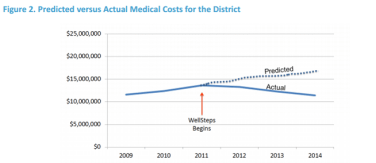
wellsteps overall trend

Also by way of review, here it total spending, participants vs. non-participants, going exactly the other way:

wellsteps cost per person

Now let’s overlay the second set of figures onto the first. In addition to trending in opposite directions during the wellness program years, the total spending on these dueling slides doesn’t even coincide in the baseline year.  Since the whole point of the exercise is to look at the trend subsequent to the baseline, we will add about $3-million to each year for the bar graph figures, so that the 2011 starting points coincide. That let’s us focus on the difference-of-differences in the program years. Starting at the baseline, costs increased about $1.7-million by 2013, putting the 2013 red endpoint almost exactly in line with their prediction.

wellsteps overlaid slides

In all fairness, let’s continue the analysis, by looking at the Wellsteps performance in 2014:
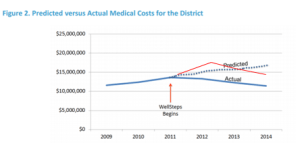
wellsteps overlaid through 2014

As you can see, costs did fall below the “prediction” in 2014, though still way above “Wellsteps Begins” and “Actual.”  The only problem?  More than 100% of the entire decline from the previous year was due to non-participants’ costs plummeting, while participant costs increased.

wellsteps 4 year view

So where do we stand? Wellsteps, by their own admission, overscreened and overdiagnosed this population. And their own admission, the population was quite healthy to begin with. By their own admission, the health of the Boise employees deteriorated. And, by their own admission, the only successful annual performance is attributable to a large improvement in non-participants.

To paraphrase the immortal words of the great philosopher Samuel Goldwyn, the title of this post, Wellsteps has raised the Koop Award standard for outcomes invalidity to a new low.


Top hospital discharge codes:


hcup rank order top 25 costs

Top ER visit codes:

er visits using ccs


How the health of Boise’s teachers deteriorated while Wellsteps was winning a Koop Award

We’ve always made the observation that in wellness, you don’t have to challenge the data to invalidate it. You merely have to read the data. It will invalidate itself.  Wellsteps attempts to prevent people from doing this by making the data almost impossible to read in the first place.

And a good thing, because watch what happens if you do figure out how to read it. (For newbies to this thread, this is the Boise School District results. We have already covered Wellsteps’ inability to understand math and their inability to understand alcohol and smoking in two previous postings. This one is about Wellsteps’ inability to understand health. You’d think that would cover all the bases…and yet we have two more posts coming next week.)

wellsteps biometrics

Start with the BMI, which of course is a dubious measure to begin with. No variances are given, so we will use the average figures. 683 people reduced their BMI, while 1641 employees got larger. The changes are trivial in any event, but do move in the wrong direction.  And according to the p-values, the changes are significant.

Systolic blood pressure is similar. 1992 people got worse, while only 360 improved.  (Diastolic did better, as did glucose.)

Likewise, cholesterol, where only 216 people improved while 1434 got worse and 691 stayed almost the same.

in all these cases, you might say, “yes, but the highest-risk people improved.” Of course, they did. The highest-risk cohort almost always shows improvement and the lowest risk cohort almost always deteriorates.  This is called the “natural flow of risk.” Taking credit for improvements while ignoring people who deteriorate is indeed the wellness industry business model. Compare Wellsteps “improvements” on the employees with the most health risks to Dee Edington’s “natural flow of risk” (also a bit inscrutable on its own). The “natural flow”  shows about half  the high-risk people improving on their own (1640 to “medium” and 678 all the way to “low”), with no program at all.

edington flow of risk

The impact on the population as a whole

In another attempt to demystify the Wellsteps results and assuming a variance of zero (since none was provided), I simply summed all the improved biometrics and compared that total with the total that deteriorated.  It turns out that 6397 deteriorated while only 5293 improved.

In other words, the physical health of the Boise School District suffered during the Wellsteps wellness program.  

And no wonder–Wellsteps was screening the stuffing out of these people, far in excess of guidelines, and encouraging unneeded annual checkups. This conclusion is reached without even taking into account the likelihood of employees lying on HRAs, cheating during the weigh-ins, or Wellsteps putting their fingers on the scale in the measurements above (“adjusted for age and sex”), as they are wont to do.

Saying that health actually deteriorated during a program would be controversial, but there is no need to take our word for this conclusion. You can ask the employees themselves.  Come to think of it, you don’t even have to ask them.  Wellsteps asked them…and they agreed: their health got worse. Keeping with the inscrutability theme, you have to squint real hard to see it on the last line, but it’s there: a statistically significant decline in self-reported health status over the two-year period:

wellsteps selfrated health

Wellsteps termed this deterioration “an improvement” but then again, Boise employees could forfeit a total of $830 by not playing along with their wellness scheme…and Wellsteps calls that figure a “small incentive.”  So in addition to having their own version of math, they have their own vocabulary.


However, there is one instance in which I would agree with Wellsteps, and that is they certainly have the following figured out:

wellsteps winning


Wellsteps: 20% of Boise’s teachers drink too much

Yikes! Wellsteps just announced–and the Koop Award Committee just agreed–that 20% of Boise’s teachers have a drinking problem.  Boise parents, before you start worrying, the good news is that it may not specifically be the teachers with the drinking problems. It’s technically 20% of all school employees, so you can relax. Maybe the problem is more prevalent in non-teaching employees, such as, oh, I don’t know, school bus drivers.

Is Wellsteps right or wrong about the drinking problem in Boise? Read on and then you can decide for yourself. Having read their alcohol analysis ourselves, we’re doubling down on our original conclusion that Wellsteps deserves a Koop Award like Vladimir Putin deserves a Nobel Peace Prize. Wellsteps is way off base, meaning Boise’s schoolchildren are safe.

Our original conclusion was reached simply by looking at the “smoking gun” slide in our previous posting, which they had tried to suppress (but we took a screenshot).  We’ll expand on that slide another day. For now, just ignore that particular smoking gun and instead consider the rest of the smoking arsenal they just wrote up in their self-congratulatory press release.

Speaking of smoking, today in addition to reviewing the Wellsteps analysis of Boise’s drinking, we’ll also include their smoking write-up.


Alcohol Consumption in the Boise School District

There was a saying in the old Soviet Union: “We pretend to work. They pretend to pay us.” For employees completing the Wellsteps’ Health Risk Assessment (HRA), the corollary would be: “We pretend to tell the truth. They pretend to believe us.”  Of 3284 employees, 671 admitted to drinking.  That means 80% of the Boise School District employees are teetotalers, as compared to 30% of the country as a whole. Or else — a shocker — 50% of the HRA respondents are lying.

The Koop Committee did not question this result.

But wait. There’s more.

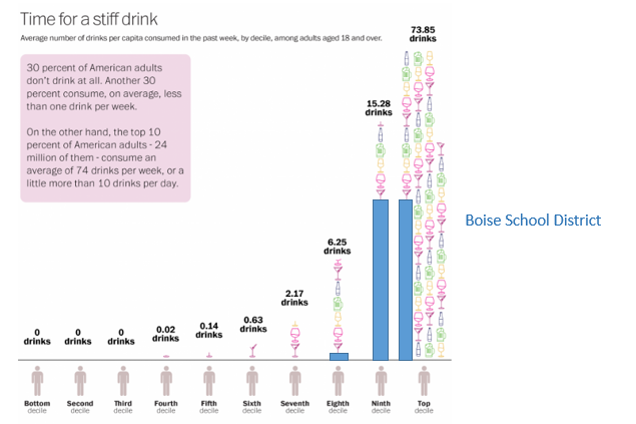
Now let’s consider the 20% of respondents who admitted to drinking at all. How much do they claim to drink? A paltry 1.31 drinks a day, or about 10 ounces of alcohol a week.  By contrast, the top 20% of drinkers in the US not employed by the Boise School District (“Boise”) consume roughly 43 ounces of alcohol a week.  Let’s overlay the Boise School District consumption (in blue) against US consumption, on the following chart. It shows 10 ounces for Boise vs. 15 ounces for the second-to-top decile for the US as a whole, and vs. a whopping 73 ounces for the top decile.

boise alcohol consumption

The Koop Committee did not question this result.

But wait.  There’s even more.

How much do you have to drink in order for Wellsteps to accuse you of having a drinking problem? Answer: any amount. According to Wellsteps, drinking alcohol at all counts as a “worst health behavior.”  Shame on us for not realizing the evils of a glass of wine!

This screenshot from their writeup captures both the average respondent’s self-reported consumption of alcohol, at the very top, with the “worst health behaviors” in alcohol consumption at the very bottom. Note that the two rows of figures are identical. In other words, everyone who drinks has a “high level of…alcohol use” no matter how much they drink. The average consumption (meaning at least half are even lower) to count as a “worst behavior” and “high level of alcohol use” is the aforementioned 10 ounces a week.

wellsteps problem drinking

The Koop Committee did not question this result.


Smoking

Squirrelly HRA findings aren’t confined to drinkers. Of the 3284 school district employees, apparently only 77 smoke (see chart above), placing the Boise School District’s alleged smoking rate at roughly 2.5%, or about 80% lower than the national or Idaho average. And those 2.5% are very light smokers. Whereas the average Idaho smoker burns through 16 cigarettes a day, Boise School District smokers abstain from smoking 10 days a month. So just like alcohol, hardly anyone smokes…and even the smoking employees hardly smoke.

With this amazingly healthy population, it’s a wonder Wellsteps could make any improvements at all. But as we will see later this week, they made enough improvements to save massive sums of money, defying all odds and all rules of arithmetic, which are strictly enforced.

The Koop Committee did not question this result.

We called it! We predicted the combination of invalidity and cronyism would win Wellsteps a Koop Award!

We cannot, cannot make this stuff up.

Wellsteps, which could take lessons in integrity from the presidential candidates, was obviously fabricating the outcomes for its Boise School District. How do we know this? Simple. Costs can’t rise and fall at the same time, even using wellness industry math. And yet Wellsteps claimed they did.

As soon as we saw how obviously, hilariously invalid their result was, we predicted that Wellsteps would win a Koop Award for the Boise School District.  We based this prediction on the combination of data fabrication, cronyism, nonsense, and cluelessness which are the DNA of both that award and of Wellsteps’ phony outcomes. Our only mistake was thinking they would win in 2015, but you’ll see at the end, we said that if they didn’t win in 2015, it was because they were late, and would win in 2016, which is what they just did.

Note when you compare Wellsteps Stumbles Onward: Costs Rise and Fall at the Same Time to their current press release, you’ll see there is something missing from the latter.  They removed the “smoking gun,” which invalidates the entire program.  In both documents, they said costs absolutely declined across the whole population, including non-participants…

wellsteps overall trend

…but on a per capita basis the costs of both participants and non-participants increased, at least in their initial writeup. This slide below has now been conveniently disappeared from their press release. I suspect this is not an accident. Here it is:

wellsteps cost per person

Participants’ cost rose just a little while non-participants’ cost rose a lot.  This separation is due to the proven fallacy of the participants-vs-non-participants methodology.  Even so, the line graph says the whole enchilada at Boise declined, not just the participants.

The only way per capita costs could increase AND total costs decline is if the program is so bad that employees prefer to join their spouse’s health plan, or if the number of employees declines.  But even the most dishonest wellness vendor wouldn’t credit either of those changes to their wellness program, and no member of the Koop Award Committee could “overlook” that impossibility.

Or would they?


Be sure to read the second installment, where we dive even deeper into the Wellsteps doodoo.


Wake the neighbors. Phone the kids. Goetzel admits wellness loses money (again).

If Ron Goetzel keeps telling the truth, at some point we need to believe him.

The July 20 Chicago Tribune quotes Mr. Goetzel as saying that wellness can reduce risk factors by 1% to 2%.  Yikes! He’s right. Mr. Goetzel is finally telling the truth. Or, in the immortal words of the great philosopher Rick Perry, even a stopped clock is right once a day.

More importantly, the debate on savings is over (again).  We have learned, also in the immortal words of the great philosopher Rick Perry, whether or not who is right.

Let’s see what happens if Mr. Goetzel is right…

That 1% to 2% reduction, by the way, are outcomes from the allegedly best wellness programs, the ones that have won his Koop Awards. Here is a list of winners, along with the risk factor reduction. The risk factor reduction doesn’t count failures, meaning dropouts and non-participants .  Not counting people who fail is a wellness industry tradition.  Imagine if they counted that way in education. Every school would have a 100% graduation rate.  But let’s cut Mr. Goetzel some slack and agree to assume that his 1% to 2% reduction in risk factors is correct.

Let’s apply this assumption to the HERO guidebook chapter that says wellness-sensitive medical events constitute about 5% of total events. (This proportion is higher if you include disease management-sensitive events.  This 5% estimate includes only events from conditions people don’t know they might possibly have until they get screened and find out how sick they are, a revelation which will certainly increase their productivity and focus on the job.)

Since hospitalizations comprise roughly 40% of cost, that means 2% of all costs can be addressed with pry, poke and prod programs. Reducing that 2% by the upper bound of Ron’s risk-reduction estimate of 2% yields a grand total of 0.04% reduction in costs.

What is that in dollars? If an average covered person costs an employer $6000, Mr. Goetzel says wellness could save $2.40.  This figure excludes the extra doctor visits, drugs and follow-on tests that might be ordered after the initial screen.

So what is the ROI for wellness, assuming Mr. Goetzel’s savings figures are correct?  Mr. Goetzel says that a typical wellness program costs $150/employee/year. (That, by the way, is a large multiple of what Quizzify costs, so Quizzify can get immediate savings simply by not being a wellness program.)

And the envelope please…

Using Ron Goetzel’s very own assumptions for both the benefits and the costs, the ROI is: $2.40/$150, or 0.016-to-1. This is not a misprint: for every dollar spent, a company loses almost 99 cents. No wonder, as he says, most programs fail.  Yikes!  He’s right again. Looks like Mr. Perry better check his clock.