However, if you control your heartburn through regular use of Nexium, Prevacid, Prilosec or Protonix, be aware that these are very effective drugs specifically because they control stomach acid so well, with no obvious short-term side effects in most cases.
And yet they are probably the riskiest, most misunderstood and most overused drugs currently available without a prescription.
So this installment will take over where the previous one left off. The previous installment (covering the first three of the “Six Things”) covered heartburn prevention. This installment, starting with the fourth “thing,” covers the remedies – specifically the most popular remedy, the PPI. Of us who have experienced it (which is to say, virtually all of us), heartburn — otherwise known as indigestion or acid reflux — seems to be a part of the human condition. We would cite the massive numbers of people — probably a third of the American adult population — who experience this condition at least once a month, but we don’t have to because you, or at least most of the employees in your organization, are likely among them.
4. PPIs should be a last choice, not a first choice — and even then, only for the short term
Your doctor may not mention lifestyle changes or even the generic over-the-counter versions of safer but perhaps less effective remedies like Pepcid and Tums. The fact that PPIs are largely brand names and doctors get “detailed” on them by charismatic drug company salespeople may also influence their choice. Just a little…
As a result – and particularly if you yourself as a patient suggest the “purple pill” or something like it — your doctor might jump right to a prescription or recommendation for an over-the-counter PPI. Some doctors are confident the drug is going to relieve your symptoms posthaste.
With this in mind, you should:
Ask about effective non-drug or OTC drug options to control your heartburn.
Ask about the potential long-term harms of PPIs.
Ask about an end date: if you have simple heartburn and you are started on a PPI, it should never be for more than 8 weeks, after which you should be reassessed, or reduce the use of your PPI to an “as needed” intermittent basis.
This is another in Quizzify’s Six Things Employees Should Know series, that They Said What? is offering this month. Heartburn is a two-part series.
To all of us who have experienced it (which is to say, virtually all of us), heartburn — otherwise known as indigestion or acid reflux — seems to be a part of the human condition. We would cite the massive numbers of people — probably a third of the American adult population — who experience this condition at least once a month, but we don’t have to because you, or at least many of the employees in your organization, are likely among them.
Rather than suffer through an episode or repeat episodes, many of us reach for a remedy. That remedy ranges from an occasional chewable Tums or Rolaids to daily dosages of Proton Pump Inhibitor (PPI) drugs, like Nexium, Prevacid or Prilosec. Most of these options reliably relieve most people’s symptoms without immediate side effects, so few people question either the need or the remedy.
And yet it turns out both the need and the remedy should be questioned. Simple lifestyle changes can reduce the need, and nobody should be taking any drug designed as a remedy every day. Most drugs intended to be taken intermittently or for short periods of time are not labeled, tested or, as we shall see in the next installment, safe for long-term use. (Our most recent Six Things post exposed another example: harmless-sounding OTC sleep aids.)
1. Some of the causes of heartburn can easily be addressed
Next, probiotics found naturally in some yogurts (or kombucha) can solve many people’s indigestion if eaten regularly for two weeks or so.
There are hundreds of yogurts on the market, so how can you tell if a yogurt has probiotics? Rule of thumb: if you recognize the brand from your childhood, it doesn’t. There are also many types of probiotics. None fit everyone’s needs exactly, so varying your yogurt choices might be a good idea.
Caution: like every other nutritional supplement, probiotics should not become an obsession. Get them from natural sources rather than pills or other concentrated sources.
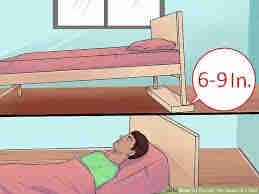
Finally, if you have nighttime indigestion, try elevating the head of your bed to create a slight downward plane. Not just adding pillows (see comment above about not scrunching your stomach), but rather inclining your entire bed — using books, or wedges available online or in any medical supply store. https://www.health.harvard.edu/diseases-and-conditions/gastroesophageal-reflux-disease While you’re sleeping, this small angle helps keep digestive juices out of your esophagus — which is specifically the body part that “acid reflux” irritates, as the next section describes.
Better sleeping through chemistry? Your employees need to know the risks…
In case you missed the last edition of Six Things, it was all about sleep hygiene. We were originally going to lump sleep medications in with sleep hygiene, but, based on what Quizzify has learned from responses to its sleep quizzes, there is enough misunderstanding on the subject of sleep meds that we decided to create a dedicated “Six Things” post, rather than append it to the previous one.
Wellness programs need to recognize that employees live in the real world, and that real-world issues need to be addressed. (For that reason, we were the first vendor to address opioids https://www.quizzify.com/opioids-employer-quiz.)
For sleep, we need to go beyond “sleep hygiene” and directly address the 10% to 15% of employees who use drugs to get to sleep. As a special bonus, at the end, I will tell you how I use drugs to get to sleep. Stay tuned.
1. Benadryl is probably not safe for long-term nightly use
While Benadryl is one of the safest drugs around for occasional and short-term use, few employees are aware of the risk of nightly use of Benadryl. https://drugabuse.com/hooked-on-benadryl-its-much-more-than-a-harmless-dependency/ The feeling generally is, if it’s over-the-counter and it’s been around forever, it must be pretty harmless. However, as you will learn in our upcoming Six Things Employees Don’t Know About Heartburn Pills, there are very few drugs designed and labeled for short-term use that are safe for long-term regular use.
By way of background, Benadryl is an antihistamine originally developed, using technology older than virtually everyone reading this posting, to relieve allergies. Its sleep-inducing property was originally a bug but is now a feature.
2. Employees may be taking Benadryl without knowing it
Benadryl goes by the generic name of diphenhydramine. It’s contained in – get ready — 115 over-the-counter drugs. https://www.ncbi.nlm.nih.gov/pmc/articles/PMC5541127/ Included in that list of drugs are popular products like Advil PM, Aleve PM, and Anacin PM. And that’s just the A’s. The list literally goes from A to Z, with the last entry being ZZZ-Quil.
3. Since they don’t think of Benadryl or these “PM” drugs as sleeping pills, employees may not realize the risk of dependence
Most employees can recognize a sleeping pill when it’s labeled as such. But when they see a familiar name, sold over the counter, they may not realize that it’s the “PM” (or “ZZZ”) part of the name to be concerned about, not the brand name. PM drugs can create a dependence. A dependence is not an addiction but many people don’t know the difference. Frankly, we didn’t know the difference until we started researching the subject.
4. Ambien may have a less concerning safety profile than OTC drugs containing Benadryl
Some people experience immediate side effects from Ambien, like short-term amnesia. Some side effects – like sleepwalking – are bizarre enough to get in the media every now and then. But the thing about short-term side effects is that you know whether you are experiencing them or not, and can discontinue a drug if you are.
Wellness vendors tell employees that getting a good night’s sleep is important to overall health. Their sound observations include:
Avoiding caffeine later in the day
Keeping a consistent bedtime
Sleeping in a dark, quiet room, and
Turning off the computer 1-2 hours before bed.
Of course, Quizzify’s popular sleep quizzes include these Q&As because a few employees may not know them. But we also include 12 more things that many employees who have difficulty sleeping don’t know…and would benefit from learning because in every case, the required behavior change is as easy as screwing in a light bulb.
Speaking of which, that is the first of the Six Things we will cover in this two-part installment.
Everyone knows colas contain caffeine. Some folks know that most root beers and even cream sodas do too. But orange soda? Turns out that Sunkist Orange Soda contains more caffeine than Coke. Along with more sugar too. The good news is that, being orange-based, it provides some Vitamin C. (Not.) Here is a list of all popular beverages containing caffeine, including some you wouldn’t expect.
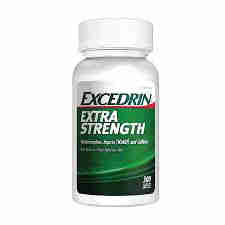
Yes, Excedrin. The irony is that caffeine is suspected as a migraine trigger. So the last thing you’d expect a headache remedy to contain would be caffeine. And yet it does. Some (but not all) medications labeled “non-drowsy” also contain caffeine. And while we’re on the subject of surprising sources of caffeine, let’s add breath mints, decaffeinated coffee, and any product that contains the word “energy.”
This month (meaning next month, but it already feels like December around here), we are donating this space to Quizzify, where we are reposting Quizzify’s Greatest Hits of their Six Things Employees Need to Know series. One a weekday for the next month, interrupted only by our annual awards.
Antibiotics are America’s most overused prescription non-opioid. Here’s what your employees should know about them. [SPOILER ALERT: They don’t.]
(1) Do not demand an antibiotic if one is not offered
Americans get enough antibiotics without asking for more. Official statistics show that half of all antibiotics are the wrong dose, wrong duration, or wrong drug – including a quarter that should not have been prescribed at all.
My personal tally is probably 75% wrong, in one way or another, as in this harrowing example, one of the highlights of which is a dentist asking me; “So, what’s your favorite antibiotic?
There is nothing, nothing in Quizzify, that suggests the correct way to prescribe an antibiotic is to ask your patient what their “favorite” is. Quite the opposite, taking the same antibiotic multiple times is a good way to create antibiotic resistance.
Dentists, with Exhibit A being my former one as noted above, are major overprescribers. With a few exceptions, of course.
And if a telemedicine doctor prescribes one, consider this: how can they possibly be sure you have a bacterial infection? There’s no in-person exam and no culture. You guessed it – they are also major overprescribers.
(3) If an antibiotic is proposed, ask some questions
“Are you sure this is a bacterial infection?” is the best. If you get an answer like: “This is just to be safe,” or something similar, your best bet may be to get the prescription, but maybe only fill it once the culture is completed and is positive for bacteria. Or maybe whatever you have will go away on its own. Or ask (and call back if needed) what new symptoms might lead the doctor to think this is bacterial, and start taking the antibiotic then.
There is also a decent chance that whatever antibiotic the doctor guesses at before the culture is completed is the wrong one. Or is an overly powerful “broad spectrum” antibiotic when the culture reveals a specific organism that should be targeted.
(4) “Finish your entire course even if you are feeling better” is an urban legend
The one thing drilled into us when we are prescribed an antibiotic is that stopping early gives the hardier bacteria a chance to rebound.
At the risk of insulting the 76 million canines in this country, Wellsteps fabricating its outcomes is the “Dog Bites Man” headline of the wellness world. it really shouldn’t make the front page, especially in an industry as idiot-intensive as wellness. Yet transparently fabricating outcomes is their signature move, so I do like to make sure they get credit for it.
Even so, it’s impossible to do the “There’s nothing to see here. Move on” routine where Wellsteps is concerned. Wellsteps’ problem is that they aren’t remotely smart enough to lie without being caught. They may or may not be the most dishonest vendor, and they may or may not be the stupidest vendor, but they are certainly the stupidest dishonest vendor.
This time, in a last-minute quest to win their third Deplorables Award in 5 years, their very stable genius CEO, Steve Aldana, attempted to doctor the evidence of their cluelessness that won them their second Deplorables Award. His plot was foiled because he hadn’t realized that technology had advanced to the point that a skilled hacker, equipped with state-of-the-art hardware, could take screenshots.
Here is a screenshot of the original evidence of the harms done to teachers in the Boise School District:
You might ask: “What harms done?”
You can’t tell at first glance, because their original display scrambles the people whose risk scores increased with those whose risk scores decreased. Wellsteps does deserve credit for obfuscating outcomes in this manner, a brilliant application of their limited intellect that completely fooled the Koop Award Committee.
Unscrambling those datapoints to discern the actual net change in risk scores requires use of another application of another advanced technology – a spreadsheet.
Unscrambling those increases and decreases revealed that, in fact, risk scores had dramatically deteriorated on Wellsteps’ watch. This spreadsheet copies the the three columns from Wellsteps’ version and then unscrambles the improvements and deteriorations, to create totals of both:
6397 risks (red) increased, while only 5293 (green) improved. Of the 5293 that “improved,” 2134 were people with normal glucose reducing it further, potentially making some of them hypoglycemic. Nothing screams “productivity improvement” like hypoglycemic teachers trying to control a roomful of kids who’ve just finished their juice-and-cookies.
In all other cases – BMI, blood pressure, cholesterol – the average low-risk person (or even middle-risk person, in two instances) showed an increase in risk factors (in red), as would be expected due to regression to the mean. Our suspicion in glucose is that Wellsteps simply miscalibrated their equipment or misadded their figures. Or they made some other rookie mistake, rookie mistakes being another of their signature moves. The reason you can be fairly certain of this is that it is statistically virtually impossible that an entire cohort of 2134 people whose glucose was already low would go even lower, especially when all the other “normal” starting values spiked higher.
So instead of teachers suffering from hypoglycemia, the likelihood is that Wellsteps was suffering from hyperstupidemia.
Removing those 2134 glucose decreases from the calculation means, almost literally, that twice as many risk factors inreased as decreased.
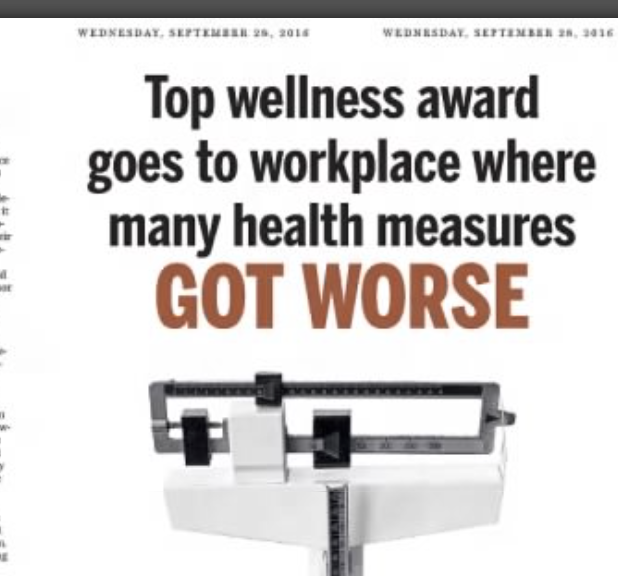
This was major news, a full-page article in the Boston Globe, as the headline below shows. But the Boise School District wellness coordinators, either embarrassed because they hadn’t realized their teachers were being harmed at considerable cost, or because they were suffering from Stockholm Syndrome, never reported this to the Boise media.
Now here is Wellsteps’ new spin on their outcomes. Wellsteps decided the only way they could show results that weren’t a complete embarrassment was to omit the large majority of participants, because their risk on the whole increased. Instead they would just show the small minority whose risk decreased, riding the regression to the mean (“RTM”) train to hoodwink gullible prospects into thinking they actually accomplished anything other than killing a few billion electrons.
Ironically given their level of overall ignorance, they can’t claim ignorance of RTM. Mr. Aldana himself, – whom epidemiologists have determined is Patient Zero in the wellness industry’s epidemic of cluelessness – actually admitted that he understands the concept of RTM and how it applies here:
“In just one year, many employees will move from one [risk] group to the other,” he explained, “even though they did not participate in any wellness programs or any intervention whatsoever.” That movement, he continued, “reflects changes in health risks that occur naturally,” making it possible that some high-risk people become low risk “even though your program didn’t do anything.”
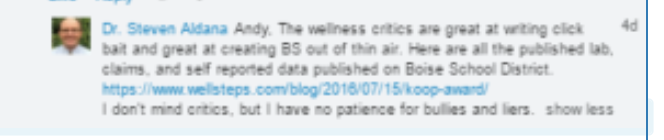
He called the author of the article citing this quote, the late, esteemed, highly respected health/science writer Sharon Begley, a “lier.” Though he never said exactly what she was lying about, of course.
He also accused Sharon and me of violating the Law of Conservation of Mass, “creating BS out of thin air.”
To close on a conciliatory note, in that very same article, Mr. Aldana made an observation which with I and readers of this column would concur: “I agree there is some real crap out there being sold under the guise of wellness.”
Hear, hear! So I think we can also all agree that it’s time to rid the industry of “liers” that sell “real crap.” And we can also agree to apologize to all who have been victims of Wellsteps’ schemes or invectives: teachers, Boise taxpayers, Sharon Begley, honest vendors, relatives of the deceased electrons, and, of course, our collective 76 million dogs.
Quizzify2Go supports fifty common doctor/dentist conversations covering everything from abdominal pain to wisdom teeth with a “Cheat Sheet,” with a heading for context. Beyond that heading are 4 to 10 questions to ask.
Here is an example, for kids’ earaches:
The headings and questions often come with links to authoritative sources. And you can share particular questions with friends-and-relations using the “share-by-email”feature.
Before the formal January introduction date, Quizzify2Go will be linked to and from Quizzify quizzes, and will include almost twice as many Q&A Cheat Sheets, now in the works. Quizzify2Go will be the left shoe to Quizzify’s current right shoe, quite literally bringing the Quizzify knowledge right into the doctor visit, where it would be most helpful.
Even though we know the “right answers,” most of the material is in the form of questions, in order to enhance the doctor-patient relationship rather than threaten it. As you know, doctors get annoyed when patients think they are experts on a topic because they’ve searched it.
All this will be covered in our Tuesday webinar, so sign up now. Attendees will receive Quizzify2Go gratis through year-end.
*You may wonder, how does Quizzify2Go solve the problem of “feeling too embarrassed to ask”?
“Health indicators in 2013 and 2014 were adjusted in the analysis, while several sensitivity analyses of the ‘inter-individual’ impact that used a matching approach confirmed the results.”
Lately, though, McKesson’s award-winning program has come under fire, with horrible things being said about it:
“Low participation rates”
“Inconvenient blood tests”
“Unsustainable results”
“Minimal health improvement”
“Silo’ed, inefficient programming”
“Unmet employee needs”
“Confusion of available services”
Who is responsible for such horrible, libelous insults, insults that would make us blush?
Why, McKesson, that’s who. Apparently, one of McKesson’s divisions, Canada, didn’t get the memo that their program is good:
So McKesson Canada switched to an outfit called “Sprout,” featured here:
Thanks to this picture, I’m sold on them already! That’s because they’ve apparently achieved the vaunted and elusive triple aim of wellness: reducing employee costs, increasing employee productivity, and poking employee cheeks.
Sprout also features REAL TIME DATA:
This is one of those “What is wrong with this picture?” pictures. Review the caption, curiously juxtaposed with the laptop. Perhaps McKesson puts their employees on camera so the wellness coach can get REAL TIME DATA of employees doing situps because, without REAL TIME DATA, their “program won’t survive.”
This particular employee might not survive, either. Unless the coach is miked too — in which case this employee can be “coached” to move his water bottle before he impales himself on it.
Let’s dig a little bit deeper into these Sprout people, the wellness industry’s newest entrant in the competition to win the 2021 Deplorables Award, bestowed annually on the company that best reveals the IQs of their own customers.
Sprout At Work is built using cognitive behavioural science, game theory, and behavioural economics to empower lasting behaviour change.
Two things come to mind. First, to raise money, Sprout could go on Wheel of Fortune to sell their surplus vowels.
Second, speaking of coaches, perhaps they can use the proceeds from those sales to buy a coach. That coach could coach their coach to coach employees to [SPOILER ALERT–contains stupidity] stop doing situps.The 1980s called. They want their exercise back. Sit-ups are out, and have been out for years.
Planks, of course, are the new situps.
Second, before they brag about using “game theory,” they need to google on what game theory is:
The branch of mathematics concerned with the analysis of strategies for dealing with competitive situations where the outcome of a participant’s choice of action depends critically on the actions of other participants. Game theory has been applied to contexts in war…and biology.
Biology??? Mathematics??? The only thing biology and mathematics have in common with wellness is that Sprout knows nothing about them. We suspect they meant “gamification,” which has about as much to do with game theory as Sprout has to do with competence.
Luckily for Sprout, unlike real industries, wellness has very little to do with competence. And wellness vendor outcome data, REAL TIME or otherwise, is invariably wrong, so unlike this poor employee about to complete perhaps his last-ever rep of his last-ever exercise, Sprout will survive.
Most behavior-change vendors take months to show any impact at all anywhere in your population, so how can a vendor be so impactful, so innovative, that it can change your own health behaviors in an hour? Join our 9/28 webinar (1:00 PM EDT) and see for yourself.
We often achieve behavior change even before people sign up for Quizzify, starting with webinars like this one. One of our favorite closing lines is: “See, you haven’t even signed up yet and we’re already saving you money.”
We’ll show plenty of examples, starting with our newest and most dramatic immediate savings opportunity. [SPOILER ALERT: Reducing ER expenses by 50% or more, cash on cash.] We’ll cover categories as diverse as screenings, fusions, pregnancy, scans, and of course: Cavities.
Cavities? If you haven’t seen our cavities material, it alone is worth the price of admission. Why submit to a century-old procedure when you can get one that is $30, painless, fast and more effective?
We even have a partner vendor whose own guaranteed savings increases if implemented alongside Quizzify!
In each case when we show what Quizzify teaches, we’ll do some “before and after” polling…and you can watch as the plurality of the webinar audience shifts attitudes and likely behaviors on the spot.
We’ll close by noting that you don’t even have to believe your own eyes: everything we say is 100% guaranteed.
Quizzify’s “Jeopardy-meets-health education-meets-Comedy Central” approach takes both employee engagement and cost savings to a new plateau. It’s so powerful that it simply isn’t believable unless you participate in it. Now is your chance.
This is Tom’s last week on Linkedin and other work-related social media. He wrote me this note and asked me to post it.
Adding something of my own to the note below, it was great to work with him. We wrote an entire trade-bestselling book together, Cracking Health Costs, without ever meeting until it was published. He was disruptive before disruptive was a thing, and was the first champion of Centers of Excellence, back when everyone else thought they could save money by just “doing wellness.”
Dear Al,
As I am retiring from the industry today, I would like to ask you, as my best friend in healthcare, to post this note and send thanks to the many people who have also been great friends and supporters through the years.
First, at Walmart, I’d like to thank Sally Welborn for rolling out our Centers of Excellence model before it was a “thing” – during a time when everyone wanted employees to “do wellness” instead. I would also thank Adam Stavisky for taking it to the next level at Walmart.
And while we are on Centers of Excellence, thank Dr. Fred MacQueary and Dr. Alan Sparrow and especially Dr. Mary Bourland at Mercy Hospital in Springfield for avoiding so many unneeded and harmful spinal fusions. They are the classic Center of Excellence.
Next, special thanks to Leah Binder for the great work that Leapfrog Group does, and for introducing us. Without Leah there is no Cracking Health Costs, and that book launched my post-Walmart career. And thank you for graciously allowing my name to go first even though you did most of the writing.
So many other people to thank and support that I am only going to mention a few and hope they tell the others. Sandra Morris, Scott Haas, Mark Kendall, Rick Chelko, Paul Levy.
If you would like to write Tom a nice sendoff, please don’t do it in the comments here. Instead, go to linkedin https://bit.ly/3xRvxIB so all the comments can be in one place.


















 They Said What?